First record of abnormal tail regeneration in the Moroccan endemic gecko, Quedenfeldtia trachyblepharus (Boettger, 1874), and for the family ...
←
→
Page content transcription
If your browser does not render page correctly, please read the page content below
Herpetology Notes, volume 14: 959-963 (2021) (published online on 30 June 2021)

      First record of abnormal tail regeneration in the Moroccan
    endemic gecko, Quedenfeldtia trachyblepharus (Boettger, 1874),
                 and for the family Sphaerodactylidae

                  Jalal Mouadi1, Abderrafea Elbahi3, Omar Er-rguibi2, El-Mustapha Laghzaoui2,
              Abdessamad Aglagane1, Ahmed Aamiri1, El Hassan El Mouden2,*, and Mohamed Aourir1

  The Atlas Day Gecko, Quedenfeldtia trachyblepharus              (ca. 31.20°N, 7.87°W, elevation 2700 m). The site is
(Boettger, 1874), is a small high-elevation gecko                 covered in fractured sandstone rocks and characterized
(maximum snout–vent length, SVL 4.4 cm; weight 3                  by mountainous vegetation with plants of alpine and
g) endemic to the High Atlas Mountains of Morocco                 boreal origin (Haroni et al., 2009). The climate is cold
(Loveridge, 1947). These geckos generally live                    temperate, with precipitation around 500–600 mm per
in open rocky habitats and are regularly observed                 year and mean temperatures ranges from 4–22°C.
basking close to rock crevices, often communally.                   Mean snout-to-vent length and the mean weight of
The species is oviparous, and females typically lay               the four abnormal individuals were 46.2 ± 1.7 mm
their eggs in rock crevices (Schleich et al., 1996;               and 2.02 ± 0.28 g respectively. Two males and one
Bouazza et al., 2016). Quedenfeldtia trachyblepharus              female presented with a bifurcation of regenerated
is the dominant species in the alpine lizard assemblage           tail material, whereas the second female possessed
above an elevation of 2500 m (Bons and Geniez, 1996;              a trifurcation (Fig. 1). In all cases, the anomalies are
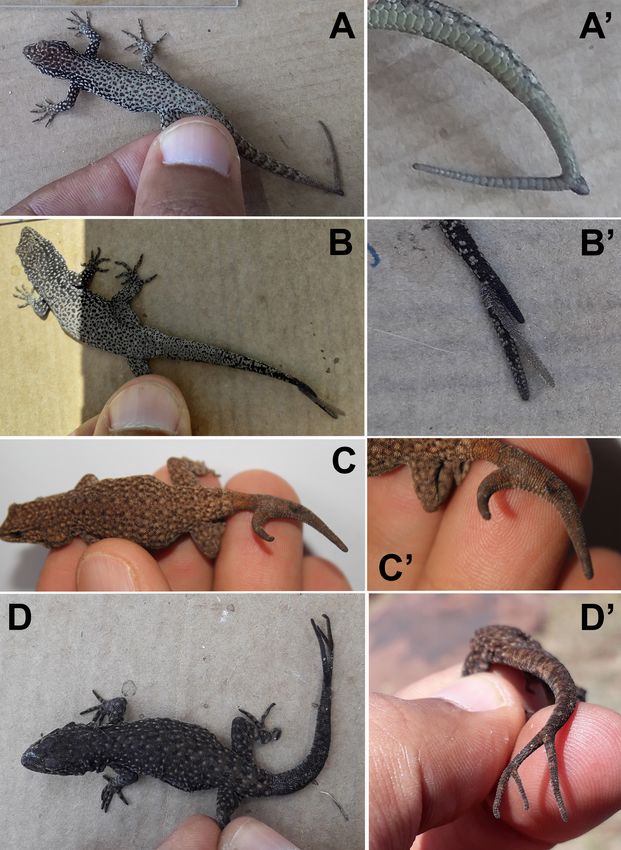
Comas et al., 2014). A clear sexual dimorphism in                 well defined with distinctive branches.
dorsal colouration exists (Blouin-Demers et al., 2013)              In one male individual (Fig. 1A), the tail appears to
allowing identification of sex by sight. Like many                have been injured at a distance 44.1 mm from the vent,
lizards, Q. trachyblepharus can shed its tail (caudal             with the distal portion preserved past the breakage
autotomy) to escape predation and sometimes during                point. There, beginning regeneration of a second
intra-specific territorial conflicts (Arnold, 1984). After        branch is visible (Fig. 1A’). The development of this
a tail is shed, a process of regeneration is initiated to         abnormal branch appears to have caused healing of the
replace the autotomized one. Here, we report on four              original tail in a deviating position, at an angle > 130°
individuals of Q. trachyblepharus (two females, two               towards the body of the gecko. The row of subcaudal
males) with abnormal tail regeneration.                           scales continues in a single, unbroken line onto the
  The geckos were among a sample of 199 individuals               original tail in its angled position (Fig. 1A’).
captured and examined during 2019–20 in the                         In the second male individual (Fig. 1B, B’),
Oukaimeden Region, High Atlas Mountains, Morocco                  branching begins at approximately the same point as
                                                                  seen in the first male, 42.3 mm from the vent. Based on
                                                                  its length and colour pattern it appears that the longer
                                                                  branch is the original tail (branch length = 14.9 mm),
1
  Laboratory of Biodiversity and Ecosystem Functioning, Faculty   and the shorter (length 6.2 mm), plain black portion is
   of Sciences, Ibn Zohr University, Agadir, Morocco.             regenerated. Both parts of the bifurcation are oriented
2
   Laboratory of Water, Biodiversity, and Climatic Change,
                                                                  in the same direction. The abnormality may impede the
   Faculty of Sciences Semlalia, Cadi Ayyad University,
                                                                  gecko’s ability to shed its skin cleanly, as evidenced by
   Marrakech, Morocco.
3
  Venom Systems and Proteomics Lab, Ryan Institute, National      the skin remnant still attached to the original portion of
   University of Ireland Galway, Ireland; and Laboratory of       the tail (Fig. 1B’).
   Oceanography and Fisheries, Faculty of Sciences, Ibn Zohr        One of the females presents with a very unusual
   University, Agadir, Morocco.                                   bifurcation, in which a short branch of the tail appears
*
  Corresponding author. E-mail: elmouden@uca.ac.ma                to grow in an anterior direction, with a larger branch
© 2021 by Herpetology Notes. Open Access by CC BY-NC-ND 4.0.      continuing in the normal direction along the body axis.
960 Jalal Mouadi et al. Figure 1. Male and female Atlas Day geckos, Quedenfeldtia trachyblepharus, from the Oukaimeden Region, Morocco, presenting with abnormal, regenerated tails. In each image pair, the right image shows a close-up of the abnormal section. (A, A’) Male gecko with a healed, incomplete tail break and a short, abnormal growth at the site of the break. The ventral view in (A’) shows the continuing subcaudal scale row at the site of the break. (B, B’) Male gecko with a narrow bifurcation, which did not allow the complete shedding of the skin. (C, C’) Female gecko displaying extra growth, presumably after an incomplete tail break, in the proximal half of the tail. (D, D’) Female with a branched, trifurcated tail, displaying two consecutive, Y-shaped branches. Photos by O. Er-rguibi (A, B, D) and J. Mouadi (C).
Abnormal Tail Regeneration in Quedenfeldtia trachyblepharus 961
The entire tail of this female had been autotomized in of the Family Sphaerodactylidae, which is widely
the past, based on the change in colour pattern and the distributed across South America, the Caribbean,
narrowing of the tail proximally (Fig. 1C). This break northern Africa, and the Middle East (Gamble et al.,
likely occurred in one of the most proximal autotomic 2008; Uetz et al., 2021). In Morocco, this family is
caudal vertebrae. The regenerated bifurcation is represented by two species of Quedenfeldtia and six
therefore the result of a second tail breakage about species of Saurodactylus (Bons and Geniez, 1996;
7.5 mm from the base of the tail, and the unusual Javanmardi et al., 2019). Our finding therefore
morphology probably derived from an injury to the represents the not only the first record of abnormal tail
region of active regrowth. In dorsal view (Fig. 1C’), growth and regrowth in Q. trachyblepharus but for the
the right, better developed branch has a length of 19.2 entire Family Sphaerodactylidae.
mm; it is probably the primary regenerated branch and Abnormal tail regeneration in Q. trachyblepharus
grew unimpeded by the injury to the regrowth region. seems to occur as a result of incomplete caudal
The left, shorter branch is 8.2 mm long and diverges autotomy when a new tail grows out of the side rather
from the right branch at an angle of approximately than at the tip of the injured, original tail (Bateman
90°, with its tip beginning to align itself to the gecko’s and Fleming, 2009; Pheasey et al., 2014). The injured
body axis. It likely constitutes a secondary centre of point allows the generation of an additional tip (Chan
regeneration, with growth slowed by both injury and et al., 1984; Gogliath et al., 2012), which may induce
abnormal direction. one or more structures to regenerate In general, tail
The other female displays a “trifurcation” anomaly, abnormalities in lizards range from bifurcations to
comprising two successive bifurcations (Fig. 1D, D’). hexafurcations, with bifurcation much more frequent
The first bifurcation begins 24.9 mm posterior to the (86%) than trifurcations (12%) or multifurcations
vent, the second 7.7 mm beyond the first. In this case, (2%) (Barr et al., 2020). In fact, tail bifurcation has
the cause for the successive bifurcations is not obvious been widely documented for several groups of lizards
and, given that the shorter portions are consistent with (Chan et al., 1984; Anajeva and Danov, 1991; Gogliath
the morphology and scalation of the main tail (at left et al., 2012; Martins et al., 2013; Koleska et al., 2017;
in Fig. 1D’), they may do not appear to be related to Vergilov and Natchev, 2017; Koleska, 2018). In
tail autotomy. Perhaps slight injury of distal elements geckos, the percentage of species with abnormal tail
in the tail can prompt non-regenerative growth as regeneration in each family ranges from 2–4%, but
observed here. This situation therefore appears to be in the Sphaerodactylidae and Carphodactylidae these
different than in the three other individuals, which values are lower (0.4% and 0%, respectively; Table 1).
presented with definite tail regeneration. The low documentation of abnormal tail regeneration
Abnormal tail regeneration has been documented in in these two families is probably due to reduced
over 175 different species of lepidosaurs across 22 of sampling effort. It is possible, but speculative, that
45 recognized families (Barr et al., 2020), but until low incidence could be linked to low survival rates of
now it has not been reported in any of the 228 species individuals with abnormal regeneration, perhaps by
Table 1. Gecko families with abnormal, regenerated tails (Barr et al., 2020) and the total number of species in
each family (Uetz et al., 2021). The asterisk (*) denotes the current record.
Species with Tail
Family Species Total
Abnormalities
Carphodactylidae 0 32
Pygopodidae 2 46
Diplodactylidae 6 157
Eublepharidae 1 43
Phyllodactylidae 5 151
Gekkonidae 26 1400
Sphaerodactylidae 1* 228962 Jalal Mouadi et al.
affecting their ability to escape (Gamble et al., 2015). C. (1984): Morphological anomalies of two geckos,
Future studies are needed to test the ecological impact Hemidactylus frenatus and Lepidodactylus lugubris, and the
toad, Bufo marinus, on the island of Hawaii. In: Proceedings
of these abnormalities on gecko families with small
of the Fifth Conference in Natural Sciences, Hawaii Volcanoes
and cryptic individuals.
National Park, p. 41–50. Smith, C.W., Ed., Manoa, Hawaii,
In terms of our surveys, geckos with abnormal tails USA, University of Hawaii.
represented four of 199 individuals (2%), a figure Comas, M., Escoriza, D., Moreno-Rueda, G. (2014): Stable
close to the mean of 2.75 ± 3.41% estimated within isotope analysis reveals variation in trophic niche depending
lizard populations in general (Barr et al., 2020). on altitude in an endemic alpine gecko. Basic and Applied
According to previous studies, species that readily use Ecology 15: 362–369.
Gamble, T., Bauer, A.M., Greenbaum, E., Jackman, T.R. (2008):
caudal autotomy may be predicted to be less likely to
Evidence for Gondwanan vicariance in an ancient clade of
generate abnormal regenerations (Barr et al., 2020).
gecko lizards. Journal of Biogeography 35: 88–104.
Our observations do not allow us to elucidate the Gamble, T., Greenbaum, E., Jackman, T.R., Bauer, A.M. (2015):
effects of abnormal tail regeneration on gecko survival. Into the light: diurnality has evolved multiple times in geckos.
However, a lizard with an abnormality could be Biological Journal of the Linnean Society 115: 896–910.
competitively inferior and sexually unattractive, which Gogliath, M., Pereira, L.C.M., Nicola, P., Ribeiro, L.B. (2012):
may result in a decline in social status and reproductive Natural history notes. Ameiva ameiva (Giant Ameiva).
Bifurcation. Herpetological Review 43(1): 129.
fitness (Martin and Salvador, 1993; Maginnis, 2016).
Haroni, A., Alifriqui, M., Simonneaux, V. (2009): Recent
Furthermore, morphological anomalies may affect
dynamics of the wet pastures at Oukaimeden plateau
lizards by negatively influencing locomotion, escape (High Atlas mountains, Morroco) [sic]. Biodiversity and
mechanisms, and anti-predator tactics (Barr et al., Conservation 18: 167–189.
2020). In fact, intact tails are important for territorial Higham, T.E., Russell, A.P., Zani, P.A. (2013): Integrative biology
defence and play crucial roles in locomotion and intra- of tail autotomy in lizards. Physiological and Biochemical
specific social interactions (Bateman and Fleming, Zoology 86: 603–610.
Jagnandan, K., Russell, A.P., Higham, T.E. (2014): Tail autotomy
2009; Higham et al., 2013; McElroy and Bergmann,
and subsequent regeneration alter the mechanics of locomotion
2013; Jagnandan et al., 2014).
in lizards. Journal of Experimental Biology 217: 3891–3897.
Javanmardi, S., Vogler, S., Joger, U. (2019): Phylogenetic
References differentiation and taxonomic consequences in the
Ananjeva, N.B., Danov, R.A. (1991): A rare case of bifurcated Saurodactylus brosseti species complex (Squamata:
caudal regeneration in the Caucasian agama, Stellio caucasius. Sphaerodactylidae), with description of four new species.
Amphibia-Reptilia 12: 343–356. Zootaxa 4674(4): 401–425.
Arnold, E.N. (1984): Evolutionary aspects of tail shedding Koleska, D. (2018): First record of tail bifurcation in Asaccus
in lizards and their relatives. Journal of Natural History 18: gallagheri from the United Arabian Emirates. Herpetology
127–169. Notes 11: 115–116.
Barr, J.I., Somaweera, R., Godfrey, S.S., Gardner, M.G., Koleska, D., Svobodová, V., Husák, T., Kulma, M., Jablonski,
Bateman, P.W. (2020): When one tail isn’t enough: abnormal D. (2017): Tail bifurcation recorded in Sauromalus ater.
caudal regeneration in lepidosaurs and its potential ecological Herpetology Notes 10: 363–364.
impacts. Biological Reviews 3: 1–18. Loveridge, A. (1947): Revision of the African lizards of the
Bateman, P.W., Fleming, P.A. (2009): There will be blood: family Gekkondiae. Bulletin of the Museum of Comparative
autohaemorrhage behaviour as part of the defence repertoire Zoology 98(1): 1–469.
of an insect. Journal of Zoology 278: 342–348. Maginnis, T.L. (2016): The costs of autotomy and regeneration
Blouin-Demers, G., Lourdais, O., Bouazza, A., Verreault, C., in animals: a review and framework for future research.
El Mouden, H., Slimani, T. (2013): Patterns of throat colour Behavioral Ecology 17: 185–189.
variation in Quedenfeldtia trachyblepharus, a high-altitude Martin, J., Salvador, A. (1993): Tail loss reduces mating success
gecko endemic to the High Atlas Mountains of Morocco. in the Iberian rock-lizard, Lacerta monticola. Behavioral
Amphibia Reptilia 34: 567–572. Ecology and Sociobiology 32: 185–189.
Bons, J., Geniez, P. (1996): Amphibiens et Reptiles du Maroc Martins, R.L., Peixoto, P.G., Fonseca, P.H.M., Martinelli, A.G.,
(Sahara Occidental Compris). Atlas Biogéographique. Silva, W.R., Pelli, A. (2013): Abnormality in the tail of the
Barcelona, Spain, Asociación Herpetológica. collated lizard Tropidurus gr. torquatus (Iguania, Tropiduridae)
Bouazza, A., Slimani, T., El Mouden, H., Lourdais, O. (2016): from Uberaba City, Minas Gerais State, Brazil. Herpetology
Thermal constraints and the influence of reproduction on Notes 6: 369–371.
thermoregulation in a high-altitude gecko (Quedenfeldtia McElroy, E.J., Bergmann, P.J. (2013): Tail autotomy, tail size,
trachyblepharus). Journal of Zoology 300: 36–44. and locomotor performance in lizards. Physiological and
Chan, J.G., Young, L.L., Chang, P.R.K., Shero C.M., Watts, Biochemical Zoology 86: 669–679.Abnormal Tail Regeneration in Quedenfeldtia trachyblepharus 963
Pheasey, H., Smith, P., Atkinson, K. (2014): Natural history notes.
Vanzosaura rubricauda (Red-tailed Vanzosaur). Bifurcation
and Trifurcation. Herpetological Review 45: 138–139.
Schleich, H.H., Kästle, W., Kabisch, K. (1996): Amphibians and
Reptiles of North Africa: Biology, Systematics, Field Guide.
Königstein, Germany, Koeltz Scientific Books.
Uetz, P., Freed, P., Hošek, J. (2021): The Reptile Database.
Available at: http://www.reptile-database.org. Accessed on 12
February 2021.
Vergilov, V., Natchev, N. (2017): First record of tail bifurcations
in the snake-eyed skink (Ablepharus kitaibelii Bibron & Bory
de Saint-Vincent, 1833) from Pastrina Hill (northwestern
Bulgaria). Arxius de Miscellania Zoologica 15: 224–228.
Accepted by Timothy ColstonYou can also read


