Freight Terminal at the Lahr Logistics Service Centre (Logistik-Leistungszentrum/LLZ Lahr) - EGTC ...
←
→
Page content transcription
If your browser does not render page correctly, please read the page content below
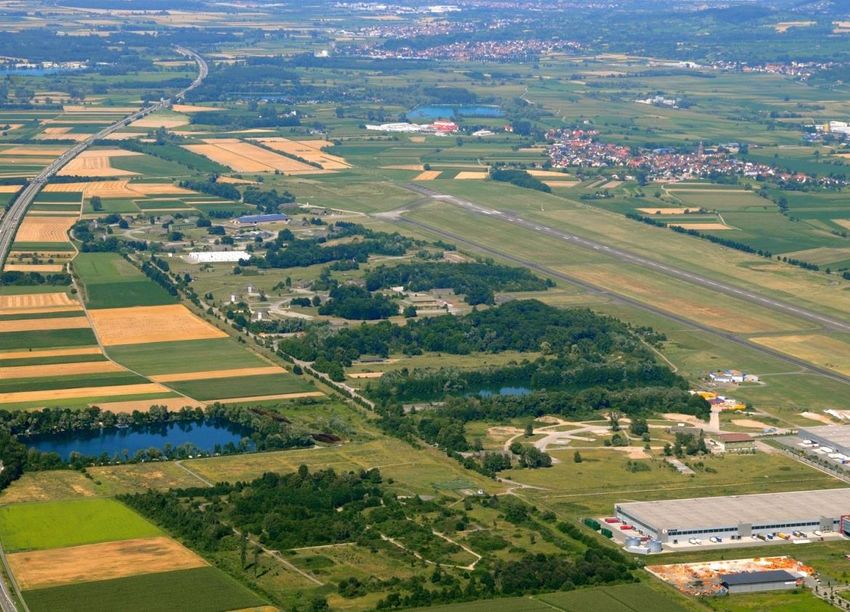
Freight Terminal at the Lahr Logistics Service
Centre (Logistik-Leistungszentrum/LLZ Lahr)
Concluding Summary Report of 27 October 2014
Project team
Dr.-Ing. Ralf Chaumet
Dipl.-Ing. Matthias Hofer
Dr. Benjamin Buser
Dr.-Ing. Alexander Dahl

Ernst Basler + Partner AG
Mühlebachstrasse 11
CH-8032 Zurich
Switzerland
Phone +41 44 395 16 16
info@ebp.ch
www.ebp.ch

Printed: 27 October 2014
Report No.: 212213
Document: 20141027_ZusammenfassenderSchlussbericht_Lahr_final.docx
Management Summary

CODE 24: Rotterdam – Genoa       CODE 24 was approved as part of the strategic initiatives of the
Corridor along the Rhine axis
                                 INTERREG IV-B NWE programme. Corridor 24 covers regions with very
     via Gotthard/Lötschberg
                                 strong economic clout in the Netherlands, Germany, Switzerland and
                                 Italy with a catchment area of some 70 million people. This freight
                                 corridor connects the North Sea port of Rotterdam with the
                                 Mediterranean port of Genoa and corresponds to the EU TEN-T Core
                                 Network’s Rhine-Alpine Corridor.
Importance of this corridor in   The future completion of the Gotthard Base Tunnel in 2017 and the
                rail transport
                                 completion of the Lötschberg Base Tunnel in 2007 present new transport
                                 challenges: together with the rail infrastructure measures along the
                                 entire corridor already adopted and under construction, possibilities
                                 have to be created to eliminate bottlenecks for loading goods from road
                                 to rail. The region around the Ortenau District plays a key role in this, as
                                 there are no efficient transhipment facilities for rail-road transport
                                 between Karlsruhe and Basel.
  Routing alternatives in the    The current expansion plans provide for the addition of two tracks along
 Offenburg – Freiburg region
                                 the existing rail line between Offenburg and Kenzingen. As an alternative
                                 to this, many stakeholders are calling for a rail line along the A5
                                 motorway reserved for freight traffic, with the existing line being used
                                 solely for passenger transport in the future. This routing would enable
                                 the construction of a transhipment terminal for combined transport in
                                 the area of the erstwhile military airport in addition to the ongoing
                                 development there of a business park. For various reasons a terminal like
                                 this can only be efficiently developed in conjunction with such a routing.
  Freight terminal in the Lahr   Given the local circumstances, such a terminal can be designed for 750-
      Logistics Service Centre
                                 metre long trains of unaccompanied combined transport and a “rolling
                                 highway” (loading of lorries in the Alpine transit through Switzerland).
                                 Another advantage is that these 750-metre trains can be parked in a
                                 marshalling yard, without intermediate processing, and afterwards filter
                                 smoothly onto freight tracks directly alongside. This directly enables
                                 cost-efficient, timely access to a continuous main line. As the motorway
                                 accesses are in the immediate vicinity of such a freight terminal, this
                                 allows rapid accessibility for lorries without them having to cross
                                 residential areas. With additional traffic management measures, further
                                 improvements can be easily achieved beyond the situation existing
                                 today by the conveniently located development of such a freight
                                 terminal.
              Freight volume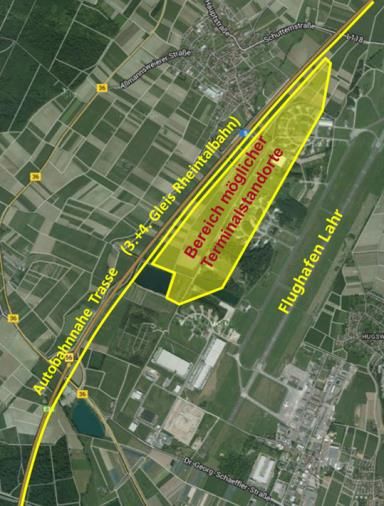
Freight terminals are often developed in stages: as a target of total
potential, about 1.1 million tons a year can be expected in
unaccompanied transport from 2025 in north and south traffic direction.
It is also possible to design the facility in such a way that it effectively
supports the Swiss modal shift policy, and 160,000 lorries in a trend
scenario or up to 450,000 lorries in a maximum scenario can be shifted
on to rail. This forecast of potential should be realised expediently in
stages.
Regional economic effects A positive impact on gross value creation can be expected from the
active components of a freight terminal at the Lahr Logistics Service
Centre. This consists of:
The direct operation of a freight terminal
Transport cost savings resulting from an economically advantageous
involvement in combined transport
Location effects in the area of the Startk(L)ahr Airport Business Park
Location effects in the Ortenau District
The effects will be felt beyond the Ortenau District, with a calculable
positive overall effect of approx. 45 million euros a year for the entire
region.
Combined transport: Reducing road haulage leads to lower CO2 emissions: depending on the
elimination of road haulage
assumptions behind the forecast, these cuts amount to between 90,000
and 185,000 tons of CO2 a year. These figures show that there is
potential for a modal shift to environmentally friendly means of
transport (rail) in a region with a large volume of freight like the Ortenau
District and surrounding areas.
Assessment of the requirements The convenient location in terms of transport is coupled with the
under planning legislation
smallest possible adverse impact on and lowest possible noise emissions
to be expected in the neighbouring municipalities; that makes the facility
fundamentally feasible under planning law as things stand.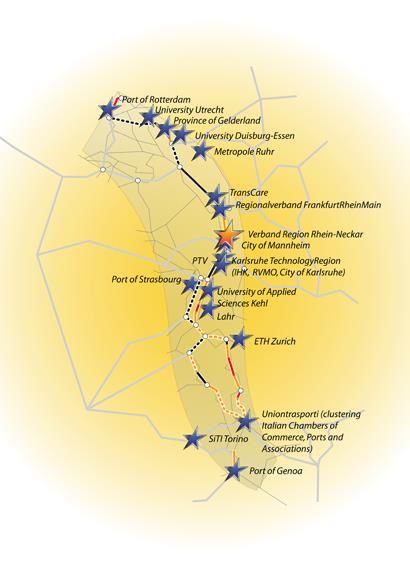
Table of contents

Management Summary................................................................................................. 1
1      Starting situation ......................................................................................................I
2      Analysis of potential............................................................................................. IV
3      Technical feasibility ........................................................................................... VIII
4      Regional economic effects ................................................................................ XI
5      Operator model: possible procedure ......................................................... XIV
6      Aspects of traffic management for road haulage .................................. XVI
I

                                1        Starting situation

           Starting situation   CODE 24 was approved as part of the strategic initiatives of the
                    Code 24
                                INTERREG IV-B NWE programme. Corridor 24 covers several European
                                regions with very strong economic clout and crosses the Netherlands,
                                Germany, Switzerland and Italy, connecting the North Sea port of
                                Rotterdam with the Mediterranean port of Genoa. Some 70 million
                                people live in this catchment area and 50% (700 million tons a year) of
                                the north-south freight is transported by rail.
  Figure 1: CODE 24 corridor

                                                                                 Source: www.code-24.eu

   Importance of Corridor 24    The forthcoming opening of the second railway Alpine Base Tunnel in
                                2017 at Gotthard and the ongoing expansion of the feeder lines will
                                further increase the corridor’s importance. The Upper Rhine region,
                                which includes the Ortenau District, is a key hub in this trans-European
                                transport axis, with all three elements of the trans-European networks
                                crossing it.
Access to combined transport    As there is no direct access to the north-south rail freight line in the area
                                between Karlsruhe and Basel for combined transport, the question is
                                whether a terminal for combined transport could be built in the Lahr
                                area in addition to the development of a business park on the land of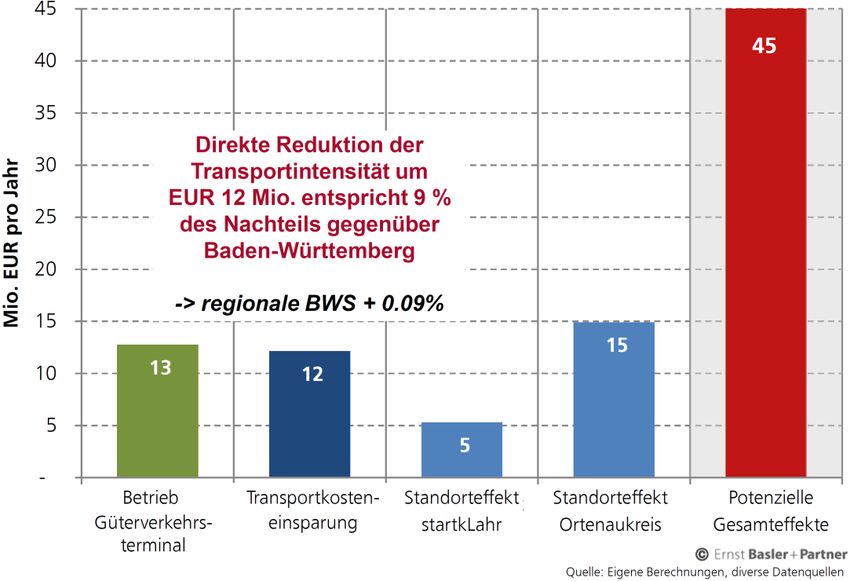
II
the former military airport at Lahr, and whether its catchment area has
sufficient freight potential for such a terminal.
Current situation in relation to There are only restricted loading facilities for the current rolling highway
the rolling highway
in the urban area of Freiburg im Breisgau. We studied whether loading
facilities with greater capacity than the transhipment facilities in Freiburg
(south) could be created. This would effectively support Switzerland’s
modal shift aims for trans-Alpine transport by moving the transhipment
of the rolling highway away from Freiburg.
Freight terminal = combined Such a terminal with loading facilities for the rolling highway and
transport & rolling highway
transhipment facilities for combined transport is referred to below as the
freight terminal.
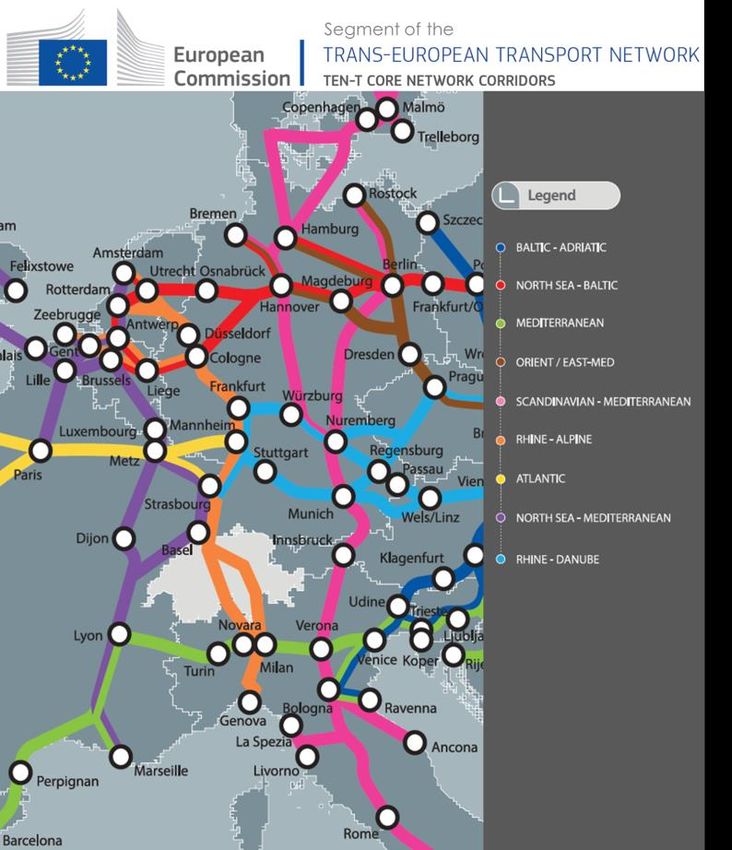
EU corridors Two of the EU “TEN-T Core Network” corridors cross the Upper Rhine rift
valley running north-south (cf. Figure 2):
The Rotterdam – Genoa (RHINE-ALPINE) axis under discussion here
and
An axis branching off the corridor Glasgow – London – Brussels –
Lyon – Marseille via Metz – Strasbourg (NORTH SEA –
MEDITERRANEAN)
Figure 2:
Segment of the TRANS-
EUROPEAN TRANSPORT
NETWORK TEN-T CORE
NETWORK CORRIDORS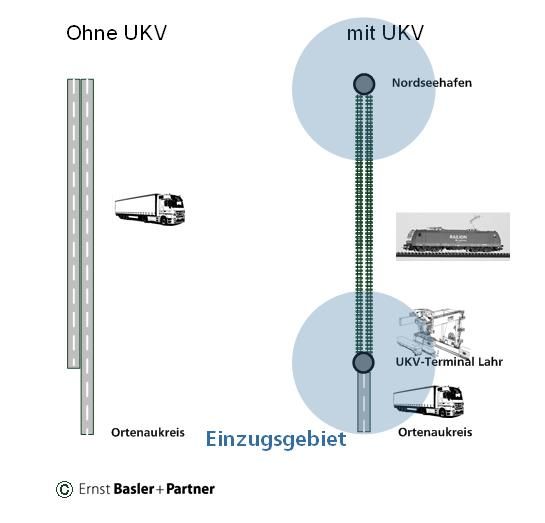
III

                                The TEN-T corridors “Atlantic“ and “Rhine – Danube“ with their west-east
                                transport flows also cross near a possible freight terminal in Lahr,
                                meaning additional potential for development. This was not looked at in
                                more detail under CODE 24 because of the focusing on the north-south
                                routes of the CODE 24 corridor (c.f. Figure 1).
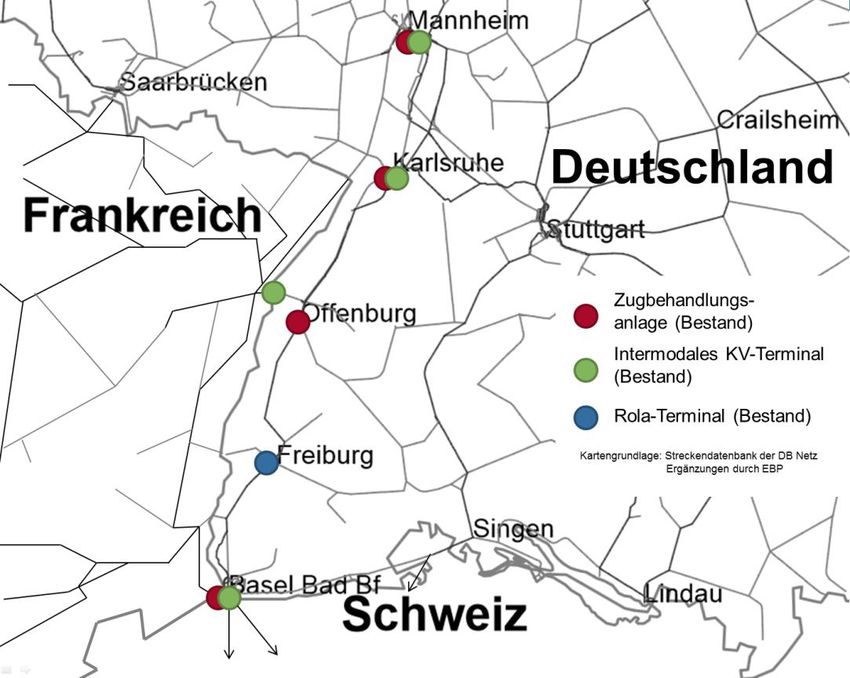
                                As the technical requirements in rail transport of the corridor crossing
                                Belgium and France are totally different from those of the rail network
                                on the German side, the terminal situation shown in the following
                                overview (cf. Figure 3) is limited to the German side of the Upper Rhine
                                rift valley (including Basel).

                    Figure 3:
    Overview of the terminal
situation in the Upper Rhine
                      region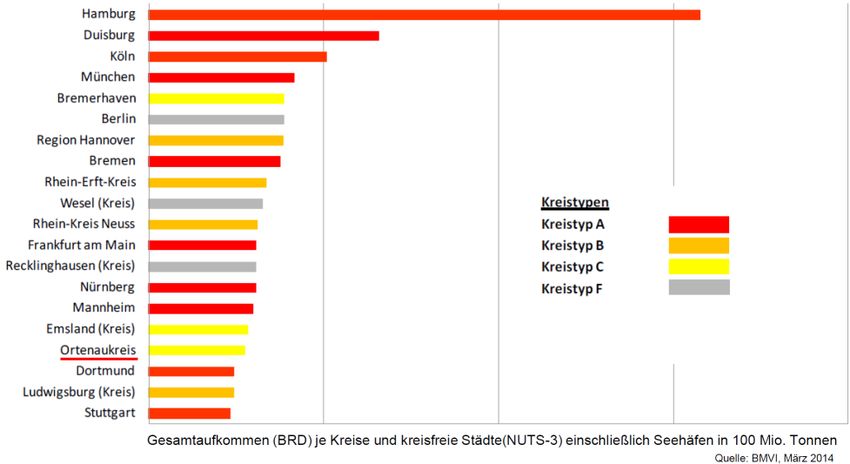
IV
2 Analysis of potential
Analysis of potential: sufficient The aim of combined transport as unaccompanied combined transport is
volume to be expected
to shift road haulage over long distances in an environmentally friendly
way to rail. Here one differentiates between:
Unaccompanied combined transport (UCT) and
Accompanied combined transport, also known as “rolling highway”.
Both forms of combined transport require a rail transport ↔ road
haulage transhipment terminal for the transport containers and so create
a transport chain. Figure 4 compares these transport chains – road only,
without UCT, road-rail with UCT – taking the example of road haulage
with the Ortenau District.
Figure 4:
Transport chain with/without
unaccompanied combined
transport (UCT)
The Ortenau District with its high volume of freight on the road (about
34 million tons in 2007) is in second place of all rural districts outside of
an agglomeration nationwide, measured by its volume.
Since the Ortenau District as a rural district outside of a metropolitan
region has different structural conditions from agglomerations, under
present conditions the future development of volume without a freight
terminal would be almost completely on the road.
Figure 5:
Total volume per district and
independent town (NUTS 3)
including seaports in 100
million tonsV
Taking into consideration usual transport distances in UCT of more than
350 km and types of goods particularly suitable for this (no bulk
transport, no building materials), with a 40% potential growth in
combined transport from 2007 to 2025 almost 1 million tons of freight
(dispatch and reception) can be expected for northbound traffic. The
potential forecast for southbound traffic for 2025 is 0.2 million tons of
freight in each direction; this includes current observations of the impact
of general transport conditions in Switzerland on today’s modal split of
comparable trans-Alpine freight transport through Switzerland. This
potential is regarded as original volume in the catchment area (cf. Figure
6) of a freight terminal in the Lahr Logistics Service Centre.
Figure 6:
Catchment areas (based on
districts) from the viewpoint of
lorry transport for a UCT
terminal
©VI
Rolling highway: accompanied Transit traffic through Switzerland – in addition to unaccompanied
combined transport
combined transport (UCT) – is now also transported on the rolling
highway from Freiburg South as accompanied combined transport.
According to an evaluation of statistical data on the sources and
destinations of the lorries transported on the rolling highway, this is
long-distance road haulage traffic. The rolling highway provides drivers
with rest time in the couchette car on board, whilst the lorries are
transported by rail through Switzerland. This type of transport on the
rolling highway seems to be of less interest for the catchment area, as
shown by the current, relatively low use (at present about 2% of the
current rolling highway volumes). In our consideration of the potential
we assume that this situation will not change substantially, and the
percentage of rolling highway volume will remain at its current level.
Rolling highway scenarios In order to consider a range of possible transport developments on the
rolling highway, we have worked with scenarios; depending on the
modal shift scenario one can reckon on a volume
of approx. 160,000 lorries to be shifted to rail in 2025 with an
average expected growth of the rolling highway up to
a maximum scenario of up to 450,000 lorries to be shifted to rail.
This forecast of the development in volume is heavily contingent on
Switzerland’s transport policy; yet the trend scenario alone signifies a
60% growth in piggybacked lorries compared to today’s level.
Figure 7: Transport chain
with/without rolling highway
Environmental impact of If long-distance road haulage traffic is shifted to rail using a freight
shifting transport to rail
terminal in Lahr, there will be reductions in lorry mileage with the
following reductions in environmental impact due to CO2 emissions:
In UCT: a reduction of up to 56 million lorry km a year, cutting
environmental impact by up to 40,000 t CO2 emissionsVII
For a rolling highway: depending on the shift scenario, 70 to 200
million lorry km a year, equating to a cut in CO2 emissions of
50,000 to 145,000 t a year.
This is based on average lorry capacity utilisation.VIII
3 Technical feasibility
Technical feasibility: The precondition for the implementation of a freight terminal is that the
given with freight line alongside
new third and fourth tracks planned are routed alongside the motorway.
the motorway
With the aid of a short siding it is possible to link up a freight terminal in
such a way that trains from north and south can drive into this terminal.
The surface required for this was calculated as roughly 20 hectares.
Figure 8 illustrates the basic options and requirements.
Figure 8: Area of possible sites
Area of possible terminal sites - Facility about 2 km long
recommended and feasible
Functions/terminal areas by
modules
- Combined freight transport
- Rolling highway
- Marshalling yard: entrance and
exit tracks
Traffic connection
- Line alongside motorway (Lahr
terminal = added benefit)
- Lorries do not drive through
any residential areas
- Motorway connections: full
expansion / construction
Map source: www.google.de Land required for transhipment
area
- Up to 20 hectares for UCT and
rolling highway
Layout options A large number of possible layouts and configurations were studied in
the area of possible terminal locations. A layout to the west directly
alongside the site of the former military airport emerged as feasible, also
from noise abatement aspects. As the Regional Association’s land is
zoned for industrial development, layouts of a freight terminal east of
the feeder road (“Panzerstraße”) were excluded from further
considerations.IX
The following aspects make this facility special:
Two modules functionally separated from each other are possible for
the rail-road transhipment:
- UCT transhipment facility with the aid of gantry cranes
- Rolling highway loading facility for lorries, which drive
automatically on to railway wagons
These facilities can be combined with a marshalling yard (which can
also be used for freight train passing manoeuvres) in such a way that,
although functionally separated, they produce a multimodal freight
terminal.
Because of the spatial extension the UCT facility can be planned for
750-metre long combined transport trains.
UCT liner trains are possible, i.e. the UCT trains can roll in a northerly
and southerly direction into the facility directly with the mainline
locomotive and, after a relatively short period of stay, drive out again
with the mainline locomotive. This enables high-quality, rapid
transhipment.
The facility can be built in stages, depending on the intended degree
of expansion, without having to lose basic functionalities.
The lowest possible impact is expected for the environment, and
noise emissions in the neighbouring municipalities will be below the
admissible limits; that makes the facility fundamentally feasible under
planning law as things stand.
Figure 9 shows a possible terminal layout suitable for handling
unaccompanied combined transport (transhipment using gantry cranes)
and accompanied combined transport (rolling highway; lorries drive
under their own steam onto railway wagons) in line with the forecasts of
potential. It can likewise be seen from the figure that the functional
separation enables implementation in stages or a partial realisation of
the facility by modules.X
Figure 9:
Schematic track plans for Lahr
Freight Terminal
Above: stage 1 – launch option
Below: addition of a stage 2XI
4 Regional economic effects
Regional economic effects: The following aspects were studied:
region is the main beneficiary
What regional economic effects are expected for the Ortenau District
from a Lahr freight terminal?
How large are the regional economic effects in relation to the gross
value creation of the Ortenau District?
These regional economic effects of a freight terminal in Lahr – which
necessitates a freight rail line (3rd and 4th track) alongside the motorway
– are created when new infrastructure is built and put into operation.
This Lahr freight terminal enables the transport industry of the Ortenau
District to participate in the pan-European context in combined transport
and to develop transport rationalisation potential.
Ortenau District: relatively low Figure 10 shows the lower productivity of Ortenau District trade and
productivity
industry compared to Germany and Baden-Württemberg; this results in
the regional gross value creation also being lower.
Figure 10: Productivity by
worker and year for
industry/trade and services for
2011 for Germany, Baden-
Württemberg and the Ortenau
District
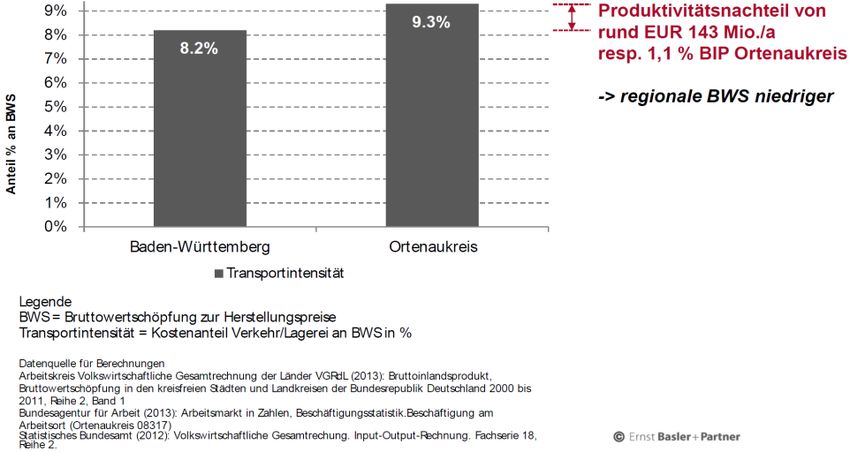
The explanation for this is that, as illustrated in Figure 11, the proportion
of gross value added expended on transport is relatively higher in the
Ortenau District than in Baden-Württemberg. Access by means of a
freight terminal and an efficient link-up with the main lines of combined
transport can help here to a certain extent.XII
Figure 11: Aggregate transport
intensity of Baden-
Württemberg and Ortenau
District according to percentage
share of transport costs in GDP
Considered effects of a freight Should a Lahr freight terminal go ahead (planned state), its active
terminal
components encompass both supply effects and demand effects for
freight services. This is shown in Figure 12 below. When one works out
the impact on gross value creation by active components in a regional
economy analysis, one sees that they can be subdivided in the following
factors:
Direct operation of a freight terminal at LLZ Lahr
Transport cost savings resulting from an economically favourable
participation in combined transport
Location effects in the area of the startk(L)ahr Airport Business Park
Location effects in the Ortenau District
The figure below illustrates these effects, with a total effect of about
45 million euros a year being expected.
Figure 12: Methodology of the
Potenziale multimodales Umschlagsterminal (Planfall)
study of the regional economic
potential
Angebotseffekte Nachfrageeffekte infolge
befriedigter
direkter Effekt Güterverkehrsleistungen
Aktivitäten IGZ Lahr
Struktureffekte
Standorteffekte
indirekte Effekte induzierte Effekte
This figure equates to roughly 0.35% of the current gross domestic
product of the Ortenau District, meaning that a freight terminal can
reduce the disadvantage in productivity ascertained in the comparisonXIII
with Baden-Württemberg by approx. 10 % (cf. Figure 13). This creates
new jobs.
Figure 13: Calculated overall
effects on regional gross value
creation with the various active
components on the supply and
demand side
Other positive effects are:
Trade and industry space throughout the Ortenau District becomes
more attractive
An increase in regional competitiveness
Retention of the function as top region in freight transport by
relieving the strain caused by growth in road haulage
A key requirement for such effects to be achieved is for the freight
terminal to have high-quality facilities and a good capacity.
Additional potential for traffic The location on the crossing point of the east-west-oriented axes can
of the TEN-T corridors “Atlantic”
create not only synergy potential but also additional effects, especially
and “Rhine – Danube”
for eastbound transport. We recommend adding this aspect to the
CODE 24 programme in a future project development.XIV
5 Operator model: possible procedure
Starting situation in relation to In principle the methodology for further procedure – after a decision to
the requisite acquisition of land
build the third and fourth track of the Rhine Valley Railway alongside the
motorway – can be outlined as follows in accordance with the current
starting point:
Define the line layout and planned completion and start-up times
Satisfy the conditions of planning law
Secure the requisite land by integrating the provision of land relating
to the Regional Association’s business park to be developed; acquire
land
Define an owner strategy (public or private or public/private mixed)
by making the land available for a freight terminal, integrally linked
with the development of the startk(L)ahr business park
Search for interested parties among potential operators of freight
terminals (combined transport companies, port operators, state
companies etc.) in an open, transparent process
As with the layout of the facility, its operating concept can be broken
down into modules:
The unaccompanied combined transport terminal can be operated as
an independent facility from a functional and operator point of view
The rolling highway facility can be operated as another independent
module separately from that of unaccompanied combined transport.
Parties interested in operating the respective modules can include, for
instance, the established operators of combined transport facilities or
regionally based companies already operating in the segment.
Consideration can also be given to consortia of logistical service
providers or individual logistical service providers expecting from such a
terminal a possible concentration of freight flows of high-volume
proportions. This solution would represent a strong regional anchoring.
On the other hand, the operation of the rolling highway facility will be
regarded as a special market for which priority will be given to
companies operating in this segment according to current information.
Aspects of operator models In accordance with the new starting situation arising after the acquisition
of the pieces of land, the next steps are as follows:
Clarify the landowners’ strategy and the modalities for operating the
terminal on their properties
Develop financing models, perhaps private-public partnership
models, tooXV
Adjust or improve the layout in line with the operator requirements
to be specified, schedule in stages etc. on the basis of the search for
operators conducted beforehand and of the expected location of the
rail line alongside the motorway
To be done by the operator of the terminal: organise the financing in
line with the provisions applicable at the time of implementation
The actual implementation phases can only be initiated once there is a
decision on the routing variant alongside the motorway, and its location
is well enough known that the exact connection points of such a freight
terminal can be co-ordinated with the planning of the line alongside the
motorway.
Question of the transhipment The transhipment technology to be used cannot be decided on until the
technology to be used
beginning of the project planning phase with the co-operation of or as
specified by a terminal operator. What should be taken into account,
however, is that terminal facilities can be highly viable for the future if
standard rolling stock with a high distribution rate can be operated
efficiently (with low operating costs) among different rail companies.
Incorporating the logistical Freight terminals benefit from land reserves in the immediate vicinity for
potential of LLZ Lahr
additional logistical services; these can be, for instance:
Facilities for empty container management (e.g. storage)
Track capacities for parking wagons
Integrating maintenance facilities (e.g. sheds) in logistical processes
This is possible if a freight terminal is integrated in the LLZ Lahr because
of the land reserves. Additional uses (e.g. timber loading) can be
established in the area of the marshalling yard.XVI
6 Aspects of traffic management for
road haulage
Methodology of transport Given the transport distances, the methodology of transport
development: proximity to development is as follows:
motorway important
Rolling highway: this is long-distance road haulage shifted to rail in
Switzerland as trans-Alpine traffic; the vast majority of this traffic is
transit traffic through the Ortenau District, too. This transport is
already handled on the A5 motorway and can be routed directly into
the freight terminal via the Lahr motorway slip road.
Unaccompanied combined transport: this has different sources in the
catchment area and is already operating as long-distance road
haulage via the motorway. The freight terminal enables transport
containers from lorries now driving past on the motorway to be
transhipped to rail next to the slip road. Because of the location of
the freight terminal, access to the motorway slip road/freight
terminal remains the same in principle.
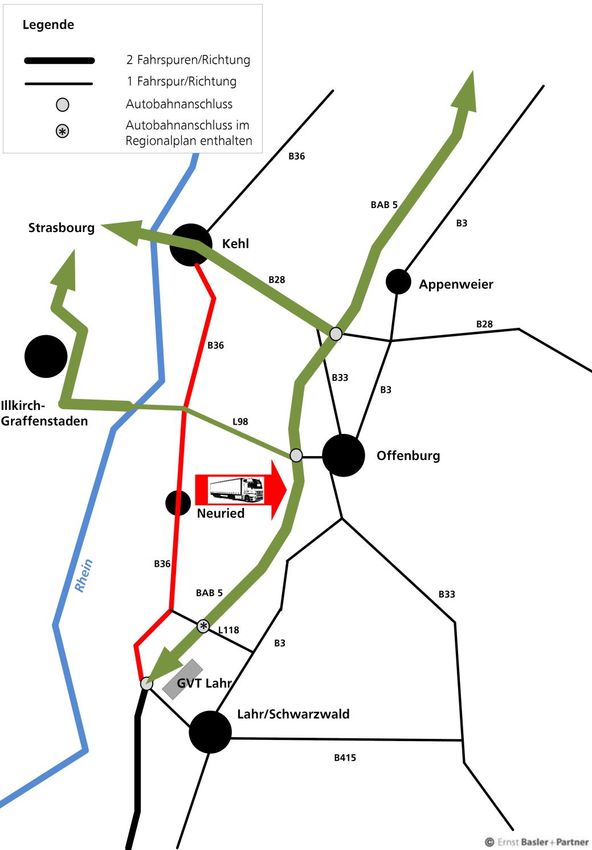
Aspects of traffic management A possible future freight terminal will have ideal conditions for direct
for road haulage
motorway access in road transport:
There is direct access to the A5 motorway running north-south. In
addition the Lahr junction is also to be extended (full expansion).
Even if there are currently no concrete plans for a Lahr-Nord/
Friesenheim junction, another direct entrance option from the A5 on
to the slip road to the freight terminal could be an interesting option
and a reason to reassess the transport situation for road haulage in
Lahr itself in general.
In this context reference should also be made to a possible link-up of the
B33 and A5 motorways south of Offenburg, as this likewise improves
accessibility to the motorway.
Current road haulage volume To shift road haulage from federal highways to the motorway we
recommend incorporating the following aspects in future considerations:
Where road haulage already represents a problem today, traffic-
limiting measures/traffic regulations should be studied for the
current status quo; this is independent of a freight terminal at Lahr.
In future, tolls are also to be levied on federal highways, reducing the
cost benefit over the (faster) connections via the motorway.
With a Lahr North/Friesenheim junction, in addition to the B33 south
junction road haulage coming from Offenburg can be intercepted
and directly – bypassing the town of Lahr – channelled into the area
of the possible freight terminal and the current business park.XVII
For that reason, regardless of whether a freight terminal goes ahead at
Lahr, we recommend recording the current road haulage volume and if
necessary stipulating traffic regulations. Figure 14 illustrates the
proposed regional transport development concept in conjunction with a
freight terminal.
Figure 14:
Regional transport
development conceptXVIII
Examining possibilities of traffic Under certain conditions, traffic regulations for limiting traffic flow can
management
be passed.1) These conditions are met, for instance, if a major impact is
expected in the form of substantial increases in noise due to toll-
avoiding through-traffic in towns and municipalities. Under recent
rulings, a further increase in noise pollution above the existing level of
70 dB (A) in the daytime or 60 dB (A) at night is regarded as a substantial
increase in noise.2) Furthermore, a decision has to be taken in this
consideration process as to whether a restriction of or a ban on traffic is
appropriate and proportionate, taking into account the function of the
road and other concerns such as the environment, the economy and
road safety. We recommend conducting exploratory talks with the
institutions concerned at an early stage. To minimise any divergences,
measures ought to be designed in such a way that they result in
practically no negative consequences for local businesses.
Proposals for effective As shown in Figure 15, examples of traffic regulation measures that have
measures
proven effective with regard to road haulage are as follows:
Restrictions on through traffic speeds, e.g. to 30 km/h
Transit restrictions for lorries over a stipulated permissible total
weight (e.g. 12 t), perhaps varying with the time of day or at night-
time
As these measures are contingent on the total lorry volume on the
surrounding road network, this should be considered now already if
needs be to reduce the road haulage impact. There also has to be a
guarantee that these restrictions are enforced by checks.
Road planning additionally In addition, expedient road planning likewise counters general lorry
required
through-traffic.
1) cf. Highway Code (StVO), section 45, para. 9 and decree issued by the Baden-Württemberg
Ministry of the Interior on 17 January 2006
2) cf. Judgment of the Federal Administrative Court of 15.12.2011 and Sixteenth Ordinance on the
th
Implementation of the Federal Emission Control Act (Traffic Noise Ordinance – 16 BImSchV) of
19 September 2006XIX
Figure 15:
Examples of traffic regulation
Traffic regulation procedures and options
procedures and options
Possible Maximum permissible speed Transit restriction
measures
Explanation Restriction of maximum Transit restriction on lorry
permissible speed to 30 km/h through-traffic from 12 t
permissible maximum weight
Signs Signs 274-53 Sign 253 with additional
signs 1053-38 and “12t”
Sanction 3) Depending on the severity of Flat sum of € 75
the offence, a fine of up to
€ 680, 4 demerit points and a 3-
month driving ban
3) cf. Ordinance on the Issuance of a Warning, Scales of Financial Penalties, and the Issuance of a
Driving Ban for Traffic Offences (Catalogue of Fines Ordinance - BKatV), no information on
transit restrictions and repeat offenders available from the Federal Office for Goods Transport
or police stationsYou can also read


