FRENCH NATIONAL ACTION PLAN ON ANTIMICROBIAL RESISTANCE: INNOVATIVE MEASURES
←
→
Page content transcription
If your browser does not render page correctly, please read the page content below

FRENCH NATIONAL
ACTION PLAN ON
ANTIMICROBIAL RESISTANCE:
INNOVATIVE MEASURES
MAY 2021 - Actions in Human Health

FRENCH NATIONAL ACTION PLAN ON ANTIMICROBIAL RESISTANCE: INNOVATIVE MEASURES

Summary

The interministerial national action plan to tackle antimicrobial resistance........................... 3

1st strategic objective:
Improve awareness and understanding of antimicrobial resistance	����������������������������������������� 4

2nd strategic objective:
Strengthen knowledge through surveillance and research	��������������������������������������������������������� 5

3rd strategic objective:
Reduce the incidence of infections................................................................................................. 6

4th strategic objective:
Optimize the use of antimicrobial agents....................................................................................... 7

5th strategic objective:
Improve innovation (new antibiotics, diagnostics, vaccines and other interventions)
and maintain access to existing antibiotics.................................................................................... 8

                                                                  2
The interministerial national action plan to tackle antimicrobial resistance

      comité
  interministériel
   pour la santé

      maîtriser
 l’an�biorésistance

The first Interministerial Committee for Health was                          The 2020 annual report summarizes the main ac-
specifically devoted to antimicrobial resistance                             tions conducted in human health within the frame-
(AMR). In November 2016, the French government                               work of the inter-ministerial roadmap to tackle an-
adopted the interministerial national action plan,                           timicrobial resistance. Some innovative actions are
using a One Health approach. This action plan is                             presented each year in French and English in a short
organized along five objectives:                                             leaflet.

  1. R
      aising awareness among the general public
     and healthcare professionals;                                           France coordinates the European
                                                                             Union Joint Action on Antimicrobial
  2. Education;                                                             Resistance and Healthcare-
                                                                             Associated Infections (EU-JAMRAI)
  3. Research and innovation;

  4. Monitoring and surveillance;

  5. Interministerial and international actions gov-
      ernance;

                                                                             France coordinated the 3-year EU Joint Action on
Three sectoral action plans in                                               Antimicrobial Resistance and Healthcare-Associated
Human Health, Animal Health                                                  Infections (EU-JAMRAI), co-funded by the European
and the Environment                                                          Commission, launched in September 2017 in Paris,
                                                                             which ended in February 2021. The main project
                                                                             coordinator was the French National Institute for
                                                                             Health Research (Inserm), supported by the French
                                                        Projet pour le
                                                 4e PLAN NATIONAL
                                            SANTÉ ENVIRONNEMENT__

                                                                             Ministry of Solidarity and Health. The Ministry was in
                                                           2020 -2024

                                                                             charge of the Work Package “Integration in national
                                                                             policies & sustainability”. Inserm co-coordinated,
                                                                             with Norway, the research and innovation Work
                      Juin 2015
                                                                             Package.

The interministerial roadmap to tackle antimicrobial                         The first global symbol to raise awareness on the
resistance is implemented in each sector through                             threat of antibiotic resistance was revealed on
three action plans:                                                          10th November 2020 by the Joint Action EU-JAMRAI.
                                                                             This symbol was selected among 600 proposals,
  In human health, through the “Prevention of                               following a competition open to all. It was designed
   Healthcare-Associated Infections National Pro-                            as a visual tool to raise awareness on this global
   gramme” (PROPIAS);                                                        challenge. It can be easily crafted and used by all.

  In animal health, the 2017-2021 Plan “Ecoanti-                            The Joint Action produced eight policy briefs that
   bio 2”;                                                                   have been widely disseminated among policy
                                                                             makers and stakeholders. They are available online
   nd concerning the environment, there is the
  A                                                                          in four languages (English, German, Spanish and
  2020-2024 “National Health and Environment                                 French).
  Plan” (PNSE4).
                                                                               The layman report

                                                                         3
FRENCH NATIONAL ACTION PLAN ON ANTIMICROBIAL RESISTANCE: INNOVATIVE MEASURES

    1ST STRATEGIC OBJECTIVE:

 Improve awarenessDossier
                   andde presse
                          understanding of antimicrobial resistance

Strengthening the training of                                                  A social marketing campaign for healthcare
healthcare students and raising                                                professionals and the general public
awareness of the public

      Le service sanitaire
            Les formations en santé
           au service de la prévention                                         Santé publique France is developing a nationwide
                                                                               social marketing campaign that will be rolled out
                                                                               in November 2021 for healthcare professionals
In France, a health service-training programme for                             and early 2022 for the general public. The actions
healthcare students has been implemented since                                 will be continued during the up-coming years. The
2018. In 2020, the topic “Prevention of Infections                             aim of this campaign is to raise awareness among
and of Antimicrobial                       Resistance”
                            Lundi 26 Février     2018  with a One Health       citizens and healthcare professionals about causes
perspective, was                    identified as a national priority
                               #servicesanitaire                               and consequences of AMR and to empower them
of this programme. The objective is for healthcare  MINISTÈRE
                                                 DES SOLIDARITÉS
                                                  ET DE LA SANTÉ
                                                                               to take action. Several preliminary studies have
students (medicine, pharmacy, dentistry, midwifery,  MINISTÈRE
                                                DE L’ENSEIGNEMENT
                                                    SUPÉRIEUR,
                                                                               been carried out to better define targets and key
  enseignementsup-recherche.gouv.fr
nursing            and physiotherapy) to organize actions                      messages to change general public and healthcare
                                                 DE LA RECHERCHE
                                                ET DE L’INNOVATION
  solidarites-sante.gouv.fr

to raise awareness of the public (e.g. children,                               professionals’ behaviour regarding antimicrobial
students, elderly people) on this topic. In order to                           stewardship.
help students implement actions on the prevention
of infections and of antimicrobial resistance,
educational resources have been produced and are                               “Antibio’Malin”: a digital resource
available on the following websites : e-Bug, RéPias                            to raise awareness on antimicrobial
and Santé publique France.                                                     resistance among the general public

Strengthening the training
of healthcare professionals
                                                                               In November 2019, the Public Health Information
                                                                               Service (SPIS) launched the “Antibio’Malin” resource
                                                                               on the Santé.fr website. This digital resource offers
                                                                               the general public simple and short information on
                                                                               antibiotics available in the outpatient setting as well
                                                                               as the most common infections. Antibio’Malin is
                                                                               regularly updated: in 2020, Covid-19 was included.
The French national agency for professional train-                             The site has also become more user-friendly and
ing programmes develops professional and inter-                                easier to navigate. Since its launch, Antibio’Malin
professional trainings through calls for proposals, in                         has been consulted nearly 65,000 times.
order to select and fund actions corresponding to
the identified quality and care safety needs. Within
this framework, a 3-year budget is dedicated to the
Antimicrobial Resistance (AMR) topic for 2021-2023
(7 million euros for 2021). These calls for proposals
are essential to involve professionals on key public
health issues such as AMR.

                                                                           4
2ND STRATEGIC OBJECTIVE

Strengthen knowledge through surveillance and research

The RePias and Santé publique                                 projects were launched in 2021 to develop platforms
France: key surveillance actors                               and observatories dedicated to AMR. The National
                                                              Research Agency also funded 11 research projects
                                                              for a total amount of 25 million euros following a
                                                              call for expressions of interest. The originality of the
                                                              French research approach is detailed in an article
                                                              published in a prestigious international scientific
                                                              journal.
The French network for the Prevention of Healthcare-
Associated Infections (HCAI) gathers five national
missions for the surveillance and prevention of               National Antibiotic Resistance
HCAI and AMR, led by Santé publique France.                   Research website
The objectives of these missions are to produce
surveillance data on HCAI, AMR and antibiotic                 Inserm has developed the National Antibiotic Re-
consumption. The five missions are:                           sistance Research interactive website, mapping the
                                                              French research forces with a One Health perspec-
  The PRIMO mission, for the surveillance                    tive. It identifies academic and industrial key play-
   and prevention of antimicrobial resistance                 ers, networks and observatories as well as research
   and healthcare-associated infections in the                projects on AMR. The national antibiotic resistance
   community and in nursing homes;                            interface brings together all the information in
                                                              terms of research on AMR (national database, news,
  The SPARES mission, for the surveillance and               priority research programme, etc.).
   prevention of antimicrobial resistance in hospitals;

  The SPICMI mission, for the surveillance and
   prevention of HCAI in surgery and interventional
   medicine;

  The SPIADI mission, for the surveillance and
   prevention of invasive devices’ infections;

  The MATIS mission, providing support to the
   other four missions.

All data produced by the five missions are accessible
to all on the Geodes website.

Antimicrobial resistance research
programme and funding

Funding for research on AMR, based on a One
Health approach, is reinforced by a strategic plan
developed at European level through the JPI-AMR
(Joint Programming Initiative on Antimicrobial
Resistance) and in France within the priority research
programme coordinated by the French National
Institute for Health and Medical Research (Inserm).
Within this framework, three calls for structuring

                                                          5
FRENCH NATIONAL ACTION PLAN ON ANTIMICROBIAL RESISTANCE: INNOVATIVE MEASURES

   3RD STRATEGIC OBJECTIVE:

Reduce the incidence of infections

The RePias and Santé publique France:                        or less for a lower respiratory infection” or the
key actors for the prevention of                             indicator “Good practices in complementary
                                                             contact precautions”.
healthcare-associated infections

                                                             Financial Incentives for Quality
                                                             Improvement Indicators (IFAQ)

As mentioned above, the RePias, which is a network
constituted of five national missions of the regional
centers for the prevention of healthcare-associated
infections (CPias), coordinates national actions to
prevent healthcare-associated infections, offering
in particular training and communication tools for
professionals and the general public.                        The quality and safety of care is one of the priorities
                                                             of the French national health strategy 2017-2022.
                                                             Since 2016, the Financial Incentive for Quality
The certification of hospitals                               Improvement indicators (IFAQ) have introduced
for the quality of care                                      a quality-related component into the hospitals’
                                                             funding (pay-for-performance system).

                                                             In the upcoming years, additional indicators
                                                             concerning the prevention of AMR might be added
                                                             to the system.

This is an independent and mandatory evaluation
procedure of the level of quality and safety of care
in public and private hospitals. It takes place every
four years. The new certification of hospitals for the
quality of care was issued in 2020. Certain criteria
target the prevention of healthcare-associated
infections and of antimicrobial resistance.

Health care quality and safety indicators

The HAS provides health care quality and safety
indicators (QSI). These indicators have been
developed with healthcare professionals, patients
and service users as tools for improving the quality
of care and patient safety in health care facilities.
They are also used for the certification procedure,
for public dissemination on Scope Santé and for
the pay-for-performance system (e.g. IFAQ). Some
indicators used in hospitals cover the AMR and
HCAI topics, for example, the indicator “Prevalence
of patients with an antibiotic treatment of 7 days

                                                         6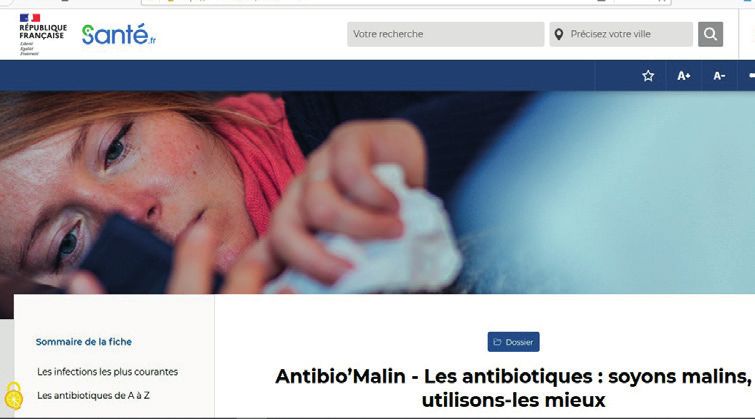
4TH STRATEGIC OBJECTIVE:

Optimize the use of antimicrobial agents

Regional Organisation                                        Professional recommendations
for antimicrobial stewardship                                on antibiotic prescriptions during
                                                             telemedicine consultations

An instruction (legal text) to Regional Health
Agencies (ARS) and a technical guide were published          Due to the large increase in telemedicine
in May 2020. They recommend the implementation               consultations, the Ministry of Solidarity and Health
and/or reinforcement of regional antimicrobial               asked the General Medicine College and the
stewardship centers in all French regions, with a            Paediatrics professional organisation to produce
dedicated budget. These centers provide expertise            recommendations      to    promote      antimicrobial
and support in all the settings (community, nursing          stewardship principles during telemedicine activities
homes, hospitals), including a strategic mission on          for common acute infections in primary care. These
antimicrobial stewardship, and the coordination and          professional recommendations were published in
animation of networks of healthcare professionals            February 2021 on both organisations’ websites and
in charge of coordinating antimicrobial stewardship          may help guide practices.
programmes. These centers must work in synergy
with the regional centers for the prevention of
healthcare-associated infections (CPias) and will be
made up of at least one infectious diseases physician
and one general practitioner. The instruction also
recommends       implementing       multidisciplinary
antimicrobial stewardship teams, who should
coordinate actions in all settings (community,
nursing homes, hospitals).

Recommendations on short
durations of antibiotic treatment

The Haute Autorité de Santé, in partnership with
the Société de Pathologie Infectieuse de Langue
Française (SPILF) and other relevant professional
societies, contributes to promoting the shortest
possible duration of antibiotic treatments to tackle
AMR. Guidelines will be finalized in 2021 focussing
on upper respiratory tract infections, urinary
tract infections, skin and soft tissue infections,
urethritis and cervicitis, as well as non-severe acute
diverticulitis.

                                                         7
QUELQUES MESURES INNOVANTES DU PLAN D’ACTION NATIONAL FRANCAIS DE LUTTE CONTRE L’ANTIBIORÉSISTANCE

   5TH STRATEGIC OBJECTIVE:

Improve innovation (new antibiotics, diagnostics, vaccines
and other interventions) and maintain access to existing antibiotics

Securing antibiotics supply                               The French government is committed
                                                          to ensuring the availability of antibiotics

In the event of a shortage or risk of shortage of
an antibiotic, the National Agency for the Safety
of Medicines and Health Products (ANSM) defines
and coordinates the actions that must be taken by
pharmaceutical companies to secure access to these        A three-year project, part of the Structural Reform

                                                                                                                  Édition : Ministère des Solidarités et de la Santé • Mise en page : Dicom des ministères sociaux • Crédit photo : Adobe Stock/Shutterstock • Avril 2021
drugs for patients. In practice, the ANSM seeks to        Support Programme, co-financed by the European
secure the supply of medicines of major therapeutic       Union and with a “One Health” approach started
interest, which include many antibiotics. In this         in November 2020. The aim of the project is to
context, the ANSM is also responsible for informing       identify and implement pilot measures in France
healthcare professionals and patients about               to tackle the root causes of lack of availability and
shortages as well as available alternatives.              shortages of off-patent antibiotics used in human
                                                          and veterinary medicine. The programme also aims
In addition, the ANSM is fully committed to               to protect the environment and takes into account
the implementation of the ministerial roadmap             the European and national regulatory contexts. The
presented in 2019 to tackle drugs’ shortages and          European Commission’s Directorate General for
improve the availability of medicines in France, with     Structural Reform Support (DG REFORM) and the
a particular focus on antibiotics due to the number       WHO provide technical assistance to the French
of supply tensions and shortages observed each            Government with the participation of five ministries
year, particularly for injectable products.               and two national agencies.

Discussions with the private sector                       European meeting
to encourage innovation and maintain                      on the availability of antibiotics
existing antibiotics on the market

                                                          The French Ministry of Solidarity and Health
                                                          organized a technical meeting on the availability
These discussions with industry aim to:                   of existing antibiotics in human health on
                                                          24th November 2020. The aim of the meeting was to

  Stimulate innovation and investment, and                raise awareness among European Member States on
  maintain new products and existing antibiotics          antibiotics shortages, and to promote collaboration
  on the market;                                          and best practice sharing.

  Improve the use of in vitro diagnostics. There
   are many diagnostic tests available for human
   health. These technologies could contribute to
   tackling AMR by optimizing treatments, but also
   by reducing transmission.

Discussions are underway with the public and
private sectors’ stakeholders to come up with
concrete measures, within the framework of the
Strategic Industry Contract, launched in February
2019 and extended until 2022.

                                                                         More information available on:
                                                                                        antibiotiques.gouv.fr

You can also read


