Fukushima Power Plant Accident and Food Safety in Japan - Mar. 2014 Fisheries Agency of Japan
←
→
Page content transcription
If your browser does not render page correctly, please read the page content below
Fukushima Power Plant Accident and
Food Safety in Japan

                  Mar. 2014
          Fisheries Agency of Japan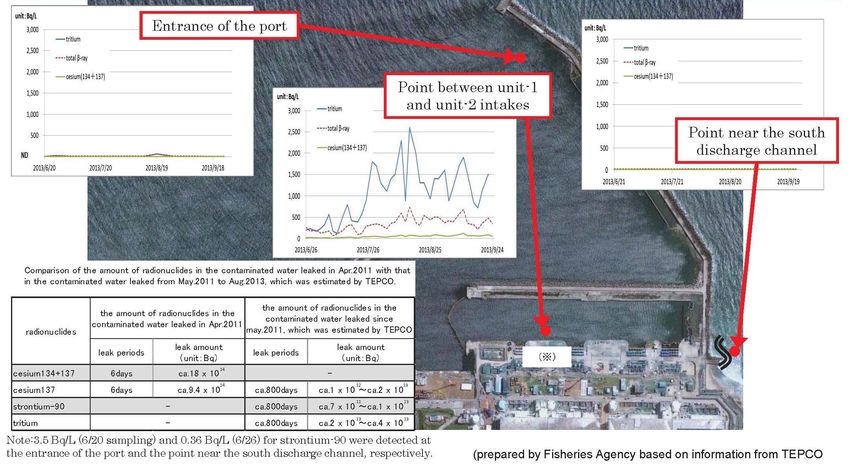
1. Food safety standard of Japan
Based on the requirement by the Food Sanitation Act, the Ministry of
Health, Labor and Welfare of Japan has set the Standard Limits of
radioactive Cesium as following for distribution of foods in Japan;
Foods in general: 100 Bq/kg
Milk :50 Bq/kg
Drinking Water :10 Bq/kg
Infants Foods :50 Bq/kg
(The limits for radioactive Cesium are established for effective dose of
radionuclides (including Strontium and Plutonium) not to exceed
1mSv/year , which is consistent with the level adopted by CODEX.)
In advance of the establishment of the standard, the MHLW consulted the Food
Safety Commission for Risk Assessment. The effective dose above is based on the
risk assessment by the Food Safety Commission, which sets the intervention
exemption level in the whole life to be 100msv.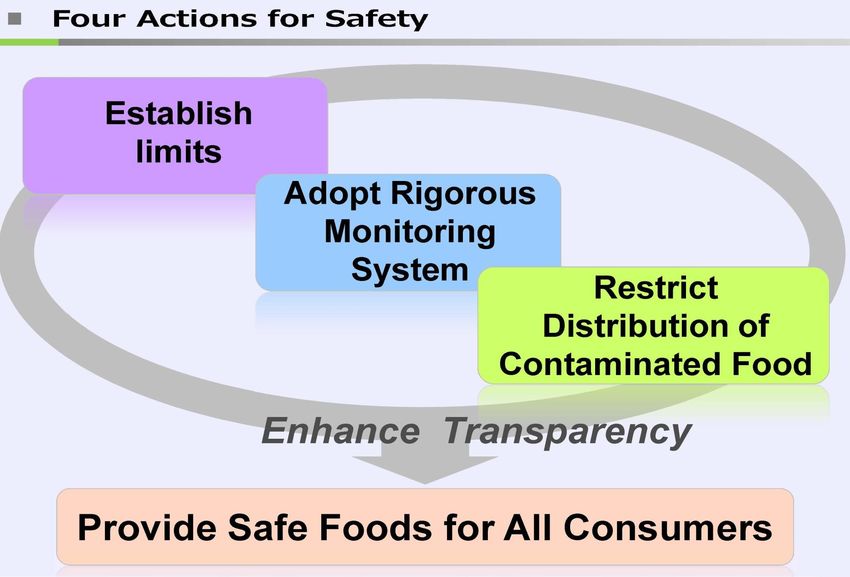
2. Image of Food Safety in Japan
3. Framework of food monitoring in Japan
The Nuclear Emergency Response Headquarters(*1) set the guideline
for food monitoring(*2) in March 2013.
*1: Established by the “Act on Special Measures Concerning Nuclear Emergency
Preparedness” after Fukushima Accident.
*2 Official name for the guideline is ““Concepts of Inspection Planning and the
Establishment and Cancellation of Items and Areas to which Restriction of Distribution
and/or Consumption of Foods concerned Applies”.
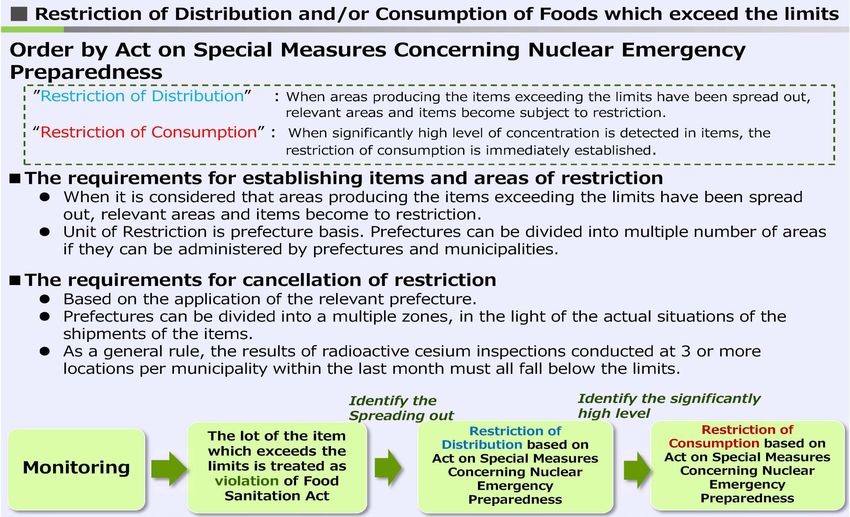
This guideline determines the fundamental framework with regard to the local
governments’ monitoring scheme.
The objective of the guidelines is to ensure that the level of the radioactive
materials in food distributed to the market shall be below the legal standard
set by Food Sanitation Act.
The inspection is carried out in accordance with the guideline, and
with the support of the MAFF and MHLW.
IAEA understood that “the measures taken to monitor and rapidly
respond to any issues in the food system regarding radionuclide
contamination are appropriate and that the public food supply is safe.”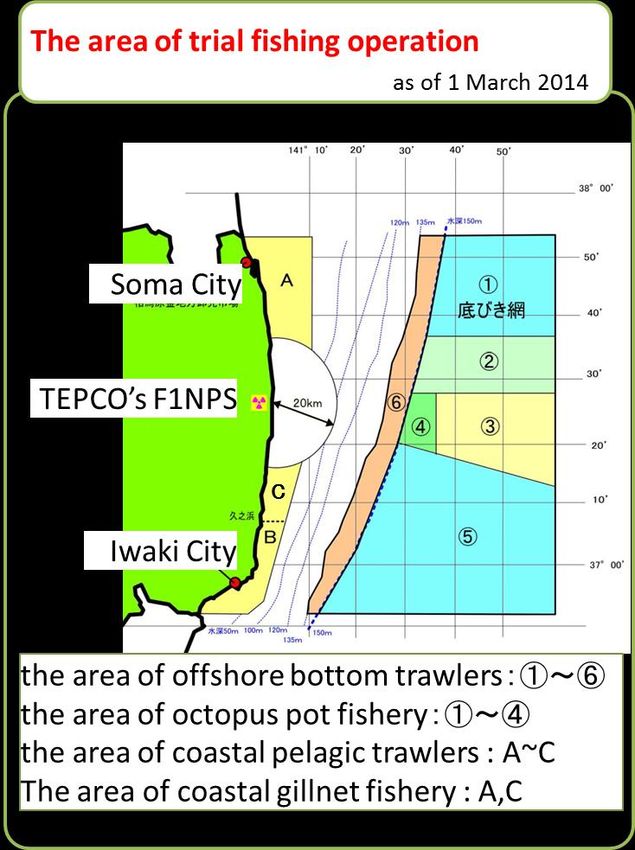
4. Control of radioactive materials in foods.
Establish the limits on radioactive materials in foods.
Monitor radioactive materials in foods.
Recall and dispose of the food from which radioactive
materials are detected above the limits.
Restrict distribution of foods.
Lift the restriction of distribution if monitoring results
meet certain criteria.
5. Thorough measures to reduce radioactive
6. Monitoring results for agriculture and livestock products (1)
Measures taken to reduce radioactive Cs in
production site:
・ Decontamination of farmland(e.g. Removal of topsoil,
inversion tillage).
・ Application of potassium fertilizer to reduce the uptake
of radioactive Cs by rice.
・ Cleaning the surface of fruit trees(e.g. shaving outer-
cortex and high-pressure washing).
・ Establishing the provisional tolerance of radioactive Cs
level for feed in order to meet the limits for foods of
animal origin.7. Monitoring results for agriculture and livestock products (2)
Apr 2013 – Dec 2013 Apr2012- Up to Mar
Mar2013 2012
Excess Sample No. No. Excess Excess
ratio(%) >Limit ratio (%) ratio
(%)
Rice 0.0003 10.8 million 28 0.0008 2.2
Wheat & Barley 0 591 0 0 4.8
Pulse 0.2 3,018 5 1.1 2.3
Vegetables 0 16,047 0 0.03 3.0
Fruits 0 3,985 0 0.3 7.7
Tea 0 427 0 1.5 8.6
Other cultivated plants 0 1,572 0 0.5 3.2
Milk 0 1,561 0 0 0.4
Meat and Eggs 0 150,656 0 0.003 1.3
Mushrooms and Wild Edible Plants 2.9 6,709 194 9.2 20
Total 0.002 10.9million 227 0.008 2.58. Monitoring framework for fishery products
○ Target species : Major commercial species and species that have record of detection with more than
50 Bq/kg in the past. Due consideration is given to, inter alia: (a) living layers of species (surface,
mid water and bottom), (b) fishing season and (c) results of neighboring prefectures’ monitoring.
Monitoring plan developed
- Distribution restriction
mainly by local governments in case the excess of the
>100 Bq/kg
Monitoring Target species Frequency limit is found only in
Area • Major species • Once a week
one area
• Local government
• Species that has record of • Before fishing season - Distribution
Monitoring
divides its area into
several areas detection with more than (skipjack, saury .etc. ) suspension order in
• Inspection at the main 50 Bq/kg
case more than one
landing ports in each
area area show the excess.
Distribution for
≦100 Bq/kg consumption (when
the monitoring result
Strengthen monitoring is close to the limit, a
prefecture may
Results of require distribution
neighboring
Approximate to standard limit restriction.)
monitoring
8
9
For the effective implementation, landing of the species subject to the restriction and /or suspension is
prohibited (except samples for monitoring). In addition, market people confirm that the species are not
sold at ports.9. Monitoring results for fishery products (1) – according to species-
○ Nowadays, shallow‐sea fishes (e.g. whitebait and Japanese sand lance), migratory fishes (e.g.
skipjack, tunas, chum salmon, and Pacific saury), molluscs (squids and octopuses, and shellfish),
crustacean (shrimps and crabs), and seaweeds have radiation levels below the standard limit
throughout the country. However, some bottom fishes including flounders still have radiation level
higher than the standard limit in several areas.
○ The environment and food habits may contribute to the such high levels.10. Monitoring results for fishery products (2) – according to species -
11. Trial Fishing Operation in Fukushima
1. Monitoring results of radiation level for each species during
the last 12 months (since January 2013).
○Bottom fish
 Marbled sole, Stone flounder, flounder etc.:
                 Rarely exceeded the standard limit (100bq/kg)
○Mollusk
 Octopuses, Squids : Not exceeded the standard limit
○Surface/ Pelagic fish
 Anchovy, Japanese sandlance, sardine: Not exceeded the standard limit
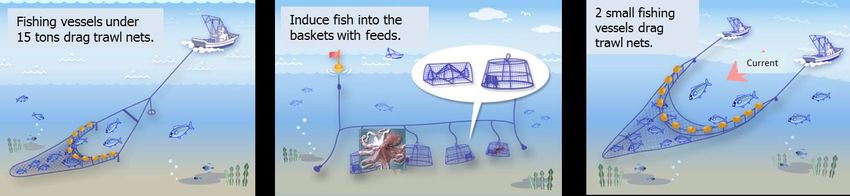
2. Trial fishing operations off the coast of Fukushima
Bottom trawlers           Octopus pot fishery       Coastal pelagic/surface
→Octopuses, Squids,       → Octopuses                trawl fishery
  Willowy flounder etc.                              → Anchovy etc.
12. Monitoring results for marine fishery products (3)
- Fukushima prefecture-
The excess ratio shows constant decrease, and it was 1.6% in the period of January
to February, 2014.
Coastal fishing and trawl fishing off Fukushima have been suspended except for trial
fishing.
Excess Ratio
more than 100Bq/kg
2,500 100%
less than100Bq/kg
Excess Ratio 30 34
2,000 84
57.7% 135
1,500 154
202
41.0% 300 20 50%
37.3% 2,001
1,000 1,921
278 1,751
1,452 1,625
380 25.1% 21.6% 1,302 1,193
299
500 13.4%
9.6%
7.7%
1,092 4.6%
1.5% 1.7% 1.6%
120 638 828
88 430
0 0%
2011 2011 2011 2012 2012 2012 2012 2013 2013 2013 2013 2014
4-6 7-9 10-12 1-3 4-6 7-9 10-12 1-3 4-6 7-9 10-12 1-213. Monitoring results for marine fishery products(4)
-the other prefectures-
In prefectures other than Fukushima, excess ratio has been gradually
decreasing to under 1% in 3rd quarter of 2012.
No sample was exceeded the limit from January to February, 2014.
Excess Ratio
4,000 more than 100Bq/kg 100%
less than 100Bq/kg
3,000 Excess Ratio 9
27 6
12 2 3
3
2,000 45 50%
34
0
2,885 2,345
2,539 2,671
1,509 1,727 2,260 2,280
1,000 2,189
11 1,395
22
1.9% 2.2% 2.5% 1.1%
4.7% 0.5% 0.3% 0.1% 0.2% 0.1% 0.1% 0.0%
0 0%
451 575
2011 2011 2011 2012 2012 2012 2012 2013 2013 2013 2013 2014
3-6 7-9 10-12 1-3 4-6 7-9 10-12 1-3 4-6 7-9 10-11 1-214. Countermeasures against contaminated water issue
Three principles of countermeasures against contaminated water
issue in Fukushima power plant incident:
1) Removing the source of the contamination
2) Isolating ground water from the contamination source
3) Preventing leakage of the contaminated water
Examples of actions:
1)Pumping out the ground water from sub-drain before reaching the
reactor building.
2)Installation of sea-side impermeable wall.
3)Installation of high performance contaminated water treatment
equipment.15. Measures taken for monitoring and prevention of water leakage in response to contaminated water leakage issue Impact of the leakage of contaminated water is investigated by various organizations, including TEPCO, “Ministry of Education, Culture, Sports, Science and Technology” of Japan and prefectural government of Fukushima.
16. Safety measures taken for fishery products in response
to contaminated water leakage issue
Fishing operation in general has not
been conducted since March 2011.
In addition, even trial operations
has not been conducted within a
20km radius of Fukushima Dai-ichi
Power Plant.
The species of fish caught in trial
operations are limited to those that
are confirmed to be safe based on
the results of monitoring.
In order to prevent contaminated
fish from being distributed in the
market, cumulative measures are
taken, namely, mutual surveillance
among fishermen, monitoring of
radioactive materials and filtering of
products sold.17. IAEA international peer review mission
IAEA dispatched international peer review mission on decommissioning
of Fukushima Daiichi Nuclear Power Station from Nov. 25 to Dec. 4,
2013, and reported that systematic approach of Japan ensures the
safety of marine fisheries products in the markets.
IAEA mission report (excerpt)
“ Japan adopted a limit of 100 Bq/kg in combined Cs-134 and Cs-137 for food products in
2012, which also applies for marine fishery products, to keep public dose below the
international standard level (1mSv/year, the Codex Alimentarius,
http://www.codexalimentarius.org/codex-home/en/). Accordingly, the comprehensive
monitoring system has been developed by Japan, both for seawater and for the products in
the food chain. Additionally, Japan has introduced limits for food controls that are based on
the international standard level. This systematic approach, together with the distribution
restrictions by relevant local governments, ensures the safety of the marine fishery products
in the market. “
Source: IAEA. “Mission Report, IAEA International Peer Review Mission on Mid-and-Long Term Roadmap towards the Decommissioning of TEPCO’s Fuku
Daiichi Nuclear Power Station Units 1-4 (Second Mission)” 25 November – 4 December 2013You can also read


