H5N1 ( Avian Flu ) Hemagglutinin ELISA Pair Set
←
→
Page content transcription
If your browser does not render page correctly, please read the page content below
H5N1 ( Avian Flu ) Hemagglutinin
         ELISA Pair Set

                  Catalog Number :                               SEK002

To achieve the best assay results, this manual must be read carefully before using this product and the
                     assay is run as summarized in the General ELISA protocol.

                                                  1

              Sino Biological Inc. Your Affordable Premium Quality ELISA Kits Provider
         Fax :+86-10-51029969        Tel:+86-400-890-9989    http://www.sinobiological.com
BACKGROUND
Influenza (flu) is a viral respiratory infection in mammals and birds. This virus is divided into three main types (A, B and
C). Influenza A is found in a wide variety of mammalian and avian species and is associated with the major human
pandemics. Influenza B is largely confined to humans and became unexpectedly prevalent in humans during 2000-2002.
Influenza C infects humans, dogs and pigs and generally causes only mild upper respiratory tract infection. However,
influenza A and B viruses cause a wide spectrum of severe disease including lower respiratory, tract infection,
pneumonia and encephalitis. Influenza A is further divided into subtypes based on antigenic differences in the
membrane proteins hemagglutinin (HA) and neuraminidase (NA). 16 HAs (H1-H16) and 9 NA (N1-N9) had been
identified. While different combinations of the two antigens appear more frequently in some groups of birds than others,
only few subtypes have established themselves in humans (HA:H1, H2, and H3; NA: N1 and N2).

Sustained, widespread highly pathogenic avian influenza (HPAI) H5N1 epidemics represent a significant public health
hazard because they not only cause mortality in poultry but also increase the risk of a human influenza pandemic. In
1997, the first case of human infected H5N1 was reported in Hongkong, China. Avian influenza have broken the
species barrier and made heavy threaten to human health. In the process of epidemic, more than 100 countries had
found more than 400 human avian influenza infected cases, within 262 patients dead. Since two human-to-human
transmission cases were reported in China, controlling the interspecies transmission of avian influenza is of critical
importance.

At least 4 major antigenic groups of H5N1 viruses currently in circulation have caused infection in humans. The recent
emergence and development of the unique antigenic FJ-like virus (clade 2.3.4) in Asia, the continuous circulation and
expansion of Qinghai-like virus (clade 2.2) in Europe, the Middle East, and Africa, and the persistent prevalence of
clade 2.1 viruses in Indonesia, and classic Clade 1 in Vietnam and Hong Kong.

Hemagglutinin (HA), which binds to sialic acid (SA)-containing receptors on host cells, is the protein that produces
neutralizing antibodies. Hemagglutinin plays a major role in the determination of host range restriction and virulence
because human influenza HA preferentially binds to SA-α-2,6 while avian influenza HA preferentially binds to SA-α-2,3.
The cleavage of HA into two disulfide-linked subunits, HA1 and HA2, is a prerequisite for initiating infection. Usually HA
is restricted to be cleaved at respiratory tracts by limited proteases. Highly pathogenic avian influenza contains a stretch
of basic residues adjacent to the HA cleavage site, enabling its HA to be cleaved by a wide range of proteases with
ubiquitous tissue distributions. This process permits productive virus replication in organs outside of the respiratory and
gastrointestinal tracts, including the brain, resulting in widespread disease and high mortality rates.

                                                             2

                   Sino Biological Inc. Your Affordable Premium Quality ELISA Kits Provider
              Fax :+86-10-51029969        Tel:+86-400-890-9989    http://www.sinobiological.com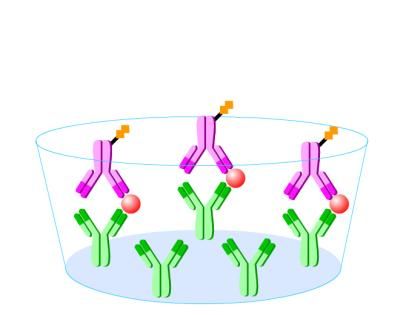
PRINCIPLE OF THE TEST
The Sino Biological ELISA Pair Set is a solid phase sandwich ELISA (Enzyme-Linked Immunosorbent Assay). It utilizes
a monoclonal antibody specific for hemagglutinin coated on a 96-well plate. Standards and samples are added to the
wells, and any hemagglutinin present binds to the immobilized antibody. The wells are washed and a biotinylated rabbit
anti-hemagglutinin polyclonal antibody is then added, producing an antibody-antigen-antibody “sandwich”. To produces
color in proportion to the amount of hemagglutinin present in the sample strepavidin-HRP and TMB substrate solution
are loaded. The absorbances of the microwell are read at 450 nm.
INTENDED USE
The H5N1 (avian flu) hemagglutinin ELISA Pair Set is for the quantitative determination of hemagglutinin.
This ELISA Pair Set contains the basic components required for the development of sandwich ELISAs.
ASSAY PROCEDURE SUMMARY
Capture Antibody Analyte Biotinylated Detection Antibody HRP-conjugated Streptavidin
This Pair Set has been configured for research use only and is not to be used in diagnostic procedures.
3
Sino Biological Inc. Your Affordable Premium Quality ELISA Kits Provider
Fax :+86-10-51029969 Tel:+86-400-890-9989 http://www.sinobiological.com
SPECIFICITY
This H5N1 HA / Hemagglutinin ELISA Pair Set (SEK002) can quantificationally detect Anhui-HA
(A/Anhui/1/2005), Indonesia-HA (A/Indonesia/5/2005), and Vietnam-HA (A/Vietnam/1194/2004).

And it can also react with Turkey-HA (A/turkey/Turkey/1/2005) and Qinghai-HA (A/bar-headed
goose/Qinghai/14/2008).

MATERIALS PROVIDED
Bring all reagents to room temperature before use.

Capture Antibody – 0.5 mg/mL of mouse anti-H5N1 hemagglutinin monoclonal antibody. Dilute to
a working concentration of 0.5 μg/mL in PBS before coating.

Detection Antibody - 0.5 mg/mL biotinylated rabbit anti-H5N1 hemagglutinin polyclonal antibody.
Dilute to a working concentration of 1.5 μg/mL in detection antibody dilution buffer before use.

Standard - Each vial contains 150 ng of recombinant H5N1 hemagglutinin. Reconstitute with 1 mL
detection antibody dilution buffer. A seven-point standard curve usi ng 2-fold serial dilutions in
sample dilution buffer, and a high standard of 5000 pg/mL is recommended.

Streptavidin-HRP - 100 μL of streptavidin conjugated to horseradish-peroxidase. 1:2000 Dilution in
detection antibody dilution buffer before use.

SOLUTIONS REQUIRED
PBS - 136.9 mM NaCl, 10.1 mM Na2HPO4, 2.7 mM KCl, 1.8 mM KH2PO4, pH 7.4, 0.2 μm filtered
TBS - 20mM Tris , 150 mM NaCl , pH 7.4
Wash Buffer - 0.05% Tween20 in TBS, pH 7.2 - 7.4
Blocking Buffer - 2% BSA in Wash Buffer
Sample dilution buffer - 0.1% BSA in wash buffer, pH 7.2 - 7.4, 0.2 μm filtered
Detection antibody dilution buffer - 0.5% BSA in wash buffer, pH 7.2 - 7.4, 0.2 μm filtered

Substrate Solution : To achieve best assay results, fresh substrate solution is recommended
Substrate stock solution - 10 mg/ml TMB ( Tetramethylbenzidine ) in DMSO
Substrate dilution buffer - 0.05M Na2HPO4 and 0.025M citric acid ; adjust pH to 5.5
Substrate working solution - For each plate dilute 250 μl substrate stock solution in 25ml substrate dilution
buffer and then add 80μl 0.75% H2O2 , mix it well

Stop Solution - 2 N H2SO4

                                                     4

                 Sino Biological Inc. Your Affordable Premium Quality ELISA Kits Provider
            Fax :+86-10-51029969        Tel:+86-400-890-9989    http://www.sinobiological.com
PRECAUTION
The Stop Solution suggested for use with this Pair Set is an acid solution. Wear eye, hand, face, and
clothing protection when using this material.
STORAGE
Capture Antibody: Aliquot and store at -20℃ to -80℃ for up to 6 months from date of receipt. Avoid
repeated freeze-thaw cycles.

Detection Antibody: Aliquot and store at -20℃ to -80℃ for up to 6 months from date of receipt. Avoid
repeated freeze-thaw cycles.

Standard: Store lyophilized standard at -20℃ to -80℃ for up to 6 months from date of receipt. Aliquot and
store the reconstituted standard at -20℃ to -80℃ for up to 1 month. Avoid repeated freeze-thaw cycles.

Streptavidin-HRP: Store at 4℃ and protect it from prolonged exposure to light. DO NOT FREEZE! It is
stable for up to 6 months from date of receipt.

                                                    5

                 Sino Biological Inc. Your Affordable Premium Quality ELISA Kits Provider
            Fax :+86-10-51029969        Tel:+86-400-890-9989    http://www.sinobiological.com
GENERAL ELISA PROTOCOL
Plate Preparation
1. Dilute the capture antibody to the working concentration in CBS. Immediately coat a 96-well microplate with 100μL
per well of the diluted capture antibody. Seal the plate and incubate overnight at 4℃.
2. Aspirate each well and wash with at least 300μl wash buffer, repeating the process two times for a total of three
washes. Complete removal of liquid at each step is essential for good performance. After the last wash, remove any
remaining wash buffer by inverting the plate and blotting it against clean paper towels.
3. Block plates by adding 300 μL of blocking buffer to each well. Incubate at room temperature for a minimum of 1
hour.
4. Repeat the aspiration/wash as in step 2. The plates are now ready for sample addition.
Assay Procedure
1. Add 100 μL of sample or standards in sample dilution buffer per well. Seal the plate and incubate 2 hours at room
temperature.
2. Repeat the aspiration/wash as in step 2 of plate preparation.
3. Add 100 μL of the detection antibody, diluted in antibody dilution buffer, to each well. Seal the plate and incubate 1
hour at room temperature.
4. Repeat the aspiration/wash as in step 2 of plate preparation.
5. Add 100 μL of Streptavidin-HRP to each well. Incubate for 1 hour at room temperature.
6. Repeat the aspiration/wash as in step 2 of plate preparation.
7. Add 200 μL of substrate solution to each well. Incubate for 20 minutes at room temperature ( if substrate solution
is not as requested, the incubation time should be optimized ). Avoid placing the plate in direct light.
8. Add 50 μL of stop solution to each well. Gently tap the plate to ensure thorough mixing.
9. Determine the optical density of each well immediately, using a microplate reader set to 450 nm.
CALCULATION OF RESULTS
Calculate the mean absorbance for each set of duplicate standards, controls and samples. Subtract the mean zero
standard absorbance from each.
Construct a standard curve by plotting the mean absorbance for each standard on the y-axis against the
concentration on the x-axis and draw a best fit curve through the points on the graph.
To determine the concentration of the unknowns, find the unknowns’ mean absorbance value on the y-axis and
draw a horizontal line to the standard curve. At the point of intersection, draw a vertical line to the x-axis and read
the concentration. If samples have been diluted, the concentration read from the standard curve must be multiplied
by the dilution factor.
Alternatively, computer-based curve-fitting statistical software may also be employed to calculate the concentration
of the sample.
6
Sino Biological Inc. Your Affordable Premium Quality ELISA Kits Provider
Fax :+86-10-51029969 Tel:+86-400-890-9989 http://www.sinobiological.comTYPICAL DATA
This standard curve is only for demonstration purposes. A standard curve should be generated for each assay.
Concentration (pg/ml) Zero standard subtracted OD
0 0.000
78.125 0.063
156.25 0.090
312.5 0.150
625 0.300
1250 0.592
2500 1.177
5000 2.191
PERFORMANCE CHARACTERISTIC
SENSITIVITY
The minimum detectable dose of H5N1 hemagglutinin ( HA ) was determined to be approximately 78.125 pg/ml. This is
defined as at least three times standard deviations above the mean optical density of 10 replicates of the zero standard.
7
Sino Biological Inc. Your Affordable Premium Quality ELISA Kits Provider
Fax :+86-10-51029969 Tel:+86-400-890-9989 http://www.sinobiological.comTROUBLE SHOOTING
Problems Possible Sources Solutions
Add appropriate Detection Antibody and
Incorrect or no Detection Antibody was added
continue
Substrate solution was not added Add substrate solution and continue
No signal
Check if the kit is stored at recommended
Incorrect storage condition
condition and used before expiration date
Standard was incompletely reconstituted or was Aliquot reconstituted standard and store at
inappropriately stored -70 ℃
Imprecise / inaccurate pipetting Check / calibrate pipettes
Poor Standard Curve
Incubations done at inappropriate temperature,
Follow the general ELISA protocol
timing or agitation
Avoid cross contamination by using the
Background wells were contaminated
sealer appropriately
The concentration of antigen in samples was too Enriching samples to increase the
low concentration of antigen
Poor detection value
Check if the samples are stored at cold
Samples were ineffective environment. Detect samples in timely
manner
Use multichannel pipettes without touching
the reagents on the plate
Insufficient washes
Increase cycles of washes and soaking
time between washes
High Background
TMB Substrate Solution should be clear
TMB Substrate Solution was contaminated
and colorless prior to addition to wells
Materials were contaminated. Use clean plates, tubes and pipettes tips
Samples were contaminated Avoid cross contamination of samples
Non-specificity
The concentration of samples was too high Try higher dilution rate of samples
8
Sino Biological Inc. Your Affordable Premium Quality ELISA Kits Provider
Fax :+86-10-51029969 Tel:+86-400-890-9989 http://www.sinobiological.comH5N1 (avian flu) Hemagglutinin ELISA Pair Set
Fax :+86-10-51029969 Tel:+86-400-890-9989 http://www.sinobiological.comH5N1 (avian flu) Hemagglutinin ELISA Pair Set
NotesYou can also read


