Infection Prevention and Control and Hand Hygiene - WHO 2019 Global Survey on Infection Prevention and Control Global Unit - World Health ...
←
→
Page content transcription
If your browser does not render page correctly, please read the page content below
WHO 2019 Global Survey on
      Infection Prevention and
     Control and Hand Hygiene

Infection Prevention and Control Global Unit
WHO HQ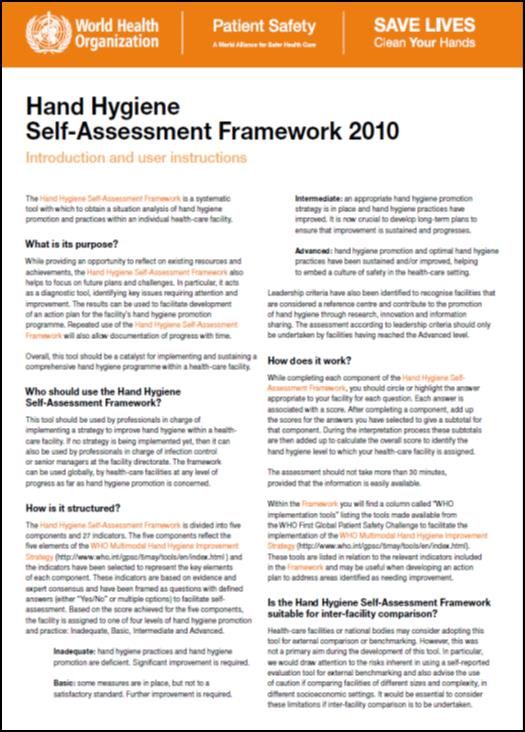
WHO IPC Global Survey 2019
           Use the two tools*, calculate your score,
                     show your progress!
                                 16 Jan – 16 July 2019!
                                 https://www.who.int/infection-prevention/
                                 campaigns/ipc-global-survey-2019/en/
  Prepare:                        Take part in WHO                            Jan-Feb - complete                     Mar-Apr –
   read the                       webinars, hear                              IPCAF3, act on                         complete HHSAF4,
  tools and                       more about using                            your results and                       act on your results
documents1-4                      the tools and how                           submit your results                    and submit your
                                  to take part in the                         to WHO online                          results to WHO
                                  global survey5                                                                     online

                   Part of SAVE LIVES: Clean Your Hands
                                5 May 2019
*Facility level tools to be used: IPC Assessment Framework (IPCAF), Hand Hygiene Self Assessment Framework (HHSAF)
1. http://www.who.int/infection-prevention/tools/core-components/en/
2. http://www.who.int/infection-prevention/tools/hand-hygiene/en/
3. http://www.who.int/infection-prevention/tools/core-components/IPCAF-facility.PDF?ua=1
4. http://www.who.int/gpsc/country_work/hhsa_framework_October_2010.pdf?ua=1
5. Find more here soon http://www.who.int/infection-prevention/news-events/current-news/en/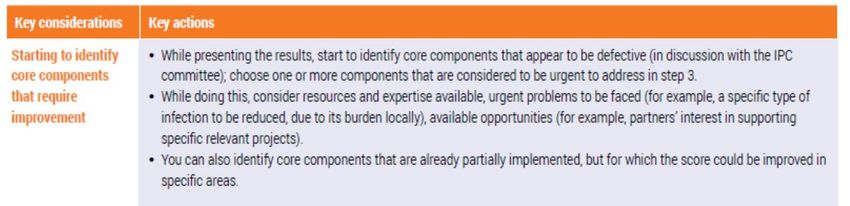
WHO IPC Global Survey 2019
Objectives
1)   To encourage and support local assessments of IPC
     and hand hygiene activities using standardized and
     validated tools, in the context of the regular work of the
     IPC teams/committees and the development of local
     improvement plans
2)   To gather a situational analysis on the level of progress
     of current IPC and hand hygiene activities around the
     world and inform future efforts and resource use
     for supporting patient safety, health care quality
 improvement, outbreak preparedness and response, and
     antimicrobial resistance prevention and control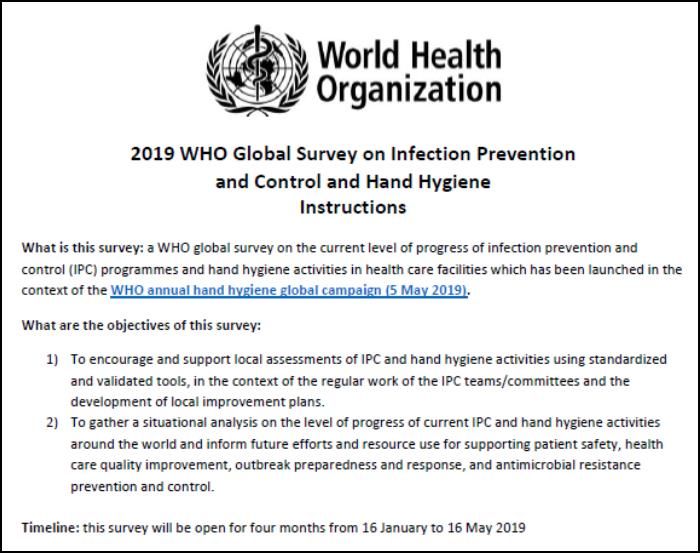
SAVE LIVES: Clean Your Hands - 5 May 2019
Monitoring IPC & Hand Hygiene –
WHO Global Survey 2019 (1)
Tools: IPC Assessment Framework (IPCAF)* & Hand Hygiene Self-
assessment Framework (HHSAF)**
Timeline:
– Survey conduct: 16 January - 16 July 2019
– Survey analysis: May-August 2019
Sample:
– Open voluntary participation by health care facilities around the
world + countries
– Stratified sub-sample
Data submission: online protected system
*http://www.who.int/infection-prevention/tools/core-components/IPCAF-facility.PDF?ua=1
*http://www.who.int/infection-prevention/tools/core-components/IPCAF-facility.PDF?ua=1
**http://www.who.int/gpsc/country_work/hhsa_framework_October_2010.pdf?ua=1
**http://www.who.int/gpsc/country_work/hhsa_framework_October_2010.pdf?ua=1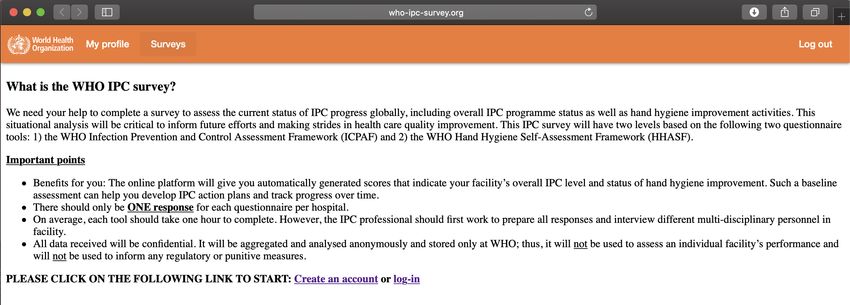
SAVE LIVES: Clean Your Hands - 5 May 2019
Monitoring IPC & Hand Hygiene – WHO
Global Survey 2019 (2)
Data confidentiality and property: WHO’s and MS (upon specific
agreement) – data completely anonimized
Planning:
➢ Month 1: preparations for IPCAF
➢ Month 2: IPCAF completion
➢ Month 3: preparations for HHSAF
➢ Month 4: HHSAF completion
I.
Tools completion on paper at HCF level II. Submission
online or by email
Report: to be issued by WHO by 2019
*http://www.who.int/infection-prevention/tools/core-components/IPCAF-facility.PDF?ua=1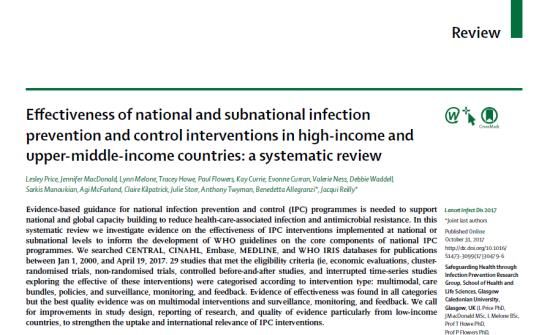
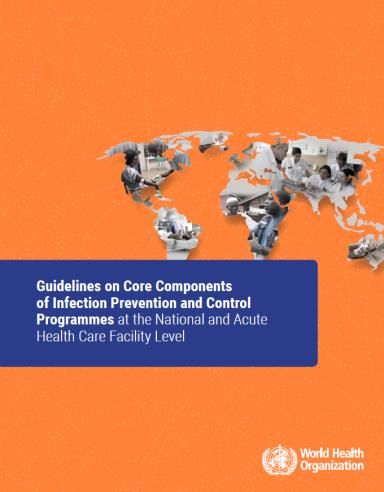
WHO Guidelines on Core
Components of IPC Programmes
at the National and Acute Health Care
Facility Level

Focus on
preventing
HAIs and
combating
AMR
Sources:
• http://www.who.int/infection-prevention/publications/ipc-components-guidelines/en/
• Zingg W et al. TLID 2015
• Storr J et al. ARIC 2017
• Presley L et al. TLID 2017
New IPC facility-level assessment tool

• Structured, closed-formatted questionnaire with an associated scoring
  system based on the HHSAF approach; 81 indicators
• Self- or joint-assessments
• Tested for usability, reliability and construct validity in a sample of 181 acute
  health care facilities in 46 countries across the world
http://www.who.int/infection-prevention/tools/core-components/en/
https://youtu.be/yMJPVtma9I0

Structure of the IPC
Assessment Framework
8 sections:
      1. IPC programme
      2. IPC guidelines
                                                       IPC
      3. IPC education & training
      4. HAI surveillance                              Core
      5. Multimodal strategies
      6. IPC Monitoring/audits & feedback              Components
      7. Workload, staffing, bed occupancy
      8. Built environment
•   Who completes it: Health care professionals responsible for organising
    and implementing IPC measures and who have in-depth knowledge of
    IPC at the facility level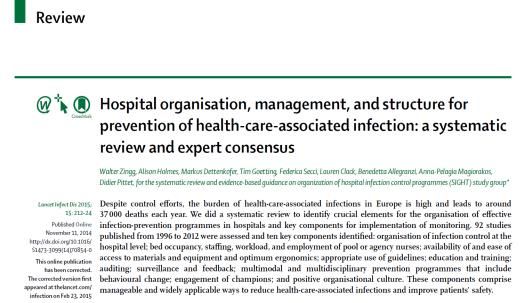
IPC assessment framework
(IPCAF) – purpose of the tool
• It provides a quantitative evaluation IPC programmes in a
  systematic way, allowing changes to be tracked over time
• Its purpose is to help assess, plan, organize and implement
  a facility IPC programme
• To determine the core components already in place and
  identify gaps or weaknesses to guide action planning
• The resulting scores can be used to measure and monitor
  progress in implementing IPC programmes at the facility
  level
• Its usefulness depends on being completed as objectively
  and accurately as possible
  See explanatory video at: https://youtu.be/yMJPVtma9I0
IPCAF – how to complete the tool
•   In general, you should choose only one answer per question (questions
    marked either “yes/no” or “choose one answer”)
•   Some questions are designed to allow multiple answers. These
    questions are marked with the note “please tick all that apply”, which
    enables you to choose all answers that are appropriate to your facility
    (choose at least one)
•   Any partially implemented or intermediate progress in achievement can
    be recorded in the comments’ fields, as well as any additional
    information/clarification
•   When you are unfamiliar with terminology in the stated questions, it is
    strongly recommended to consult the WHO Guidelines on core
    components of IPC programmes1 or other resources provided in the
    footnotes
    1
        https://www.who.int/infection-prevention/publications/ipc-components-guidelines/en/

    See explanatory video at: https://youtu.be/yMJPVtma9I0
Section 1: IPC programme IPC programme subtotal score /100
IPCAF – scoring
•   Points are allocated to the individual answers of each
    question, depending on the importance of the
    question/answer in the context of the respective core
    component
•   In each section (core component), a maximum score of 100
    points can be achieved
•   After you have answered all questions of a component, the
    score can be calculated by adding the points of every
    chosen answer. By adding the total scores of all eight
    components, the overall score is calculated
•   A final field presents potential verifiers to guide the user in
    completing the tool
See explanatory video at: https://youtu.be/yMJPVtma9I0
IPCAF – interpretation of the
results: a 3-step process
45
60
75
20
45
50
65
30
390Interpreting results Source: Facility Interim Pratical Manual http://www.who.int/infection-prevention/tools/core-components/en/
IPCAF step 3 – Review the results
 and develop an action plan
 Detailed facility assessment
  IPCAF Section                                Strengths                                        Gaps
1. IPC programme
2. IPC guidelines
3. IPC education &
training
4. HAI surveillance
5. Multimodal
strategies
6. Monitoring/audits
& feedback
7. Workload, staffing
and bed occupancy
8. Built environment
  Source: Facility Interim Pratical Manual http://www.who.int/infection-prevention/tools/core-components/en/
Detailed assessment: CC1
  IPCAF Section           Strengths               Gaps

1. IPC programme • XX                      • YY

Repeat this table up to Core Component 8
IPCAF step 3 – Review the results
and develop an action plan
•   Review the areas identified by this evaluation as requiring
    improvement in your facility and develop an action plan to
    address them
•   Keep a copy of this assessment to compare with repeated
    uses in the future
What help you can find CASE STUDY EXAMPLES Source: Facility Interim Pratical Manual http://www.who.int/infection-prevention/tools/core-components/en/
WHO Hand Hygiene improvement
     Multimodal Strategy
https://www.who.int/infection-prevention/tools/hand-hygiene/en/ https://youtu.be/PDz8kxrPaMk
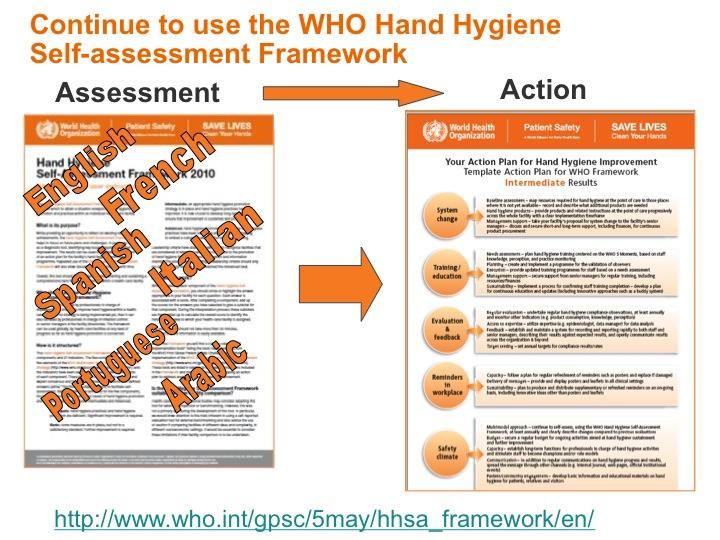
Introduction to the Hand Hygiene
     Self-Assessment Framework (HHSAF)
 Purpose and background
     - The HHSAF assigns hospitals a score and
       position on a continuum of improvement from
       “inadequate” to “advanced”
     - It is a diagnostic tool to assess existing hand
       hygiene activities and identify strengths and
       gaps
     - It comprises the 5 components of the WHO
       Multimodal Hand Hygiene improvement
       strategy and addresses a total of 27 indicators
       framed as questions
https://www.who.int/infection-prevention/tools/hand-hygiene/hhsa_framework/en/
Introduction to the Hand Hygiene
Self-Assessment Framework (HHSAF)
• Hand hygiene is a key healthcare quality indicator
• The HHSAF facilitates regular monitoring and
reporting of the WHO multimodal improvement
strategy at local and national level
• WHO recommends to use the HHSAF on an annual
basis
• HHSAF survey may act as a proxy indicator of the
global quality of healthcare deliveryWho should complete and
use the HHSAF?
This tool should be used by professionals in charge of
implementing a strategy to improve hand hygiene within a
healthcare facility
Infection
Senior
control
managers
team
The HHSAF can be used globally at any level of
hand hygiene progressHow is the HHSAF
structured?
Training Evaluation
System
and and
Change
Education Feedback
Reminders Institutional
in the Safety
workplace ClimateHow to complete the survey?
1. Complete each of the 5 components of the HHSAF
2. Circle or highlight the answer appropriate to your facility
for each question
3. Each answer is associated with a score
4. Each component has a maximum score of 100
5. After completing a component, add up the scores for the
answers you have selected to give a subtotal for that
component
6. Add the subtotals for each component to calculate the
overall score
7. Identify the hand hygiene level to which your health-care
facility is assigned1. System Change
System Change subtotal 100/1001. Add up your points
Score
1. System change 100/100
2. Education and Training 60/100
3. Evaluation and Feedback 75/100
4. Reminders in the 90/100
Workplace
5. Institutional Safety Climate 60/100
Total Score 385
2. Determine the assigned Hand Hygiene Level
Total Score Hand Hygiene Level
0-125 Inadequate
126-250 Basic
251-375 Intermediate or (consolidation)
376-500 Advanced or (embedding)HHSAF scoring and interpretation
Score Hand Hygiene Level Interpretation
HH practices and promotion are
deficient. Significant
0-125 Inadequate
improvement is required.
Some HH measures are in
place, but not to a satisfactory
126-250 Basic standard. Further improvement
is required.
An appropriate HH promotion
strategy is in place and HH
practices have improved. It is
251-375 Intermediate now crucial to develop long-term
plans to ensure that
improvement is sustained and
progresses.
HH promotion and optimal HH
practices have been sustained
and/or improved, helping to
376-500 Advanced
embed a culture of safety in the
health-care setting.3. If your facility has reached the ADVANCED Level complete the Leadership section
Leadership Criteria (2)

                          Total   6/20
Interpretation:
A four step process
1. Add up your points 2. Determine your
• System change
Hand Hygiene Level
• Education and Training
• Evaluation and Feedback
• Reminders in the Workplace
• Institutional Safety Climate
3. Complete the Leadership 4. Develop and execute
Section an action plan
• For Advanced Hand Hygiene Level • Analysis of results
• If not go to Step 4 • Identify strengths and gaps
• Answer “yes” to at least one • Next steps for improvement
leadership criteria per category • Sustain the HH programme over the
• For HH Leadership level score long term
should be 12 or more
HAND HYGIENE SELF-ASSESSMENT FRAMEWORK 20194. Develop an ACTION PLAN…
• Identify strengths and gaps from the
HHSAF results for your facility
Component Strengths Gaps
1. System change
2. Education and
Training
3. Evaluation and
Feedback
4. Reminders in the
workplace
5. Institutional Safety
Climate
Find template action plans here:
https://www.who.int/infection-prevention/campaigns/clean-hands/EN_PSP_GPSC1_5May_2015/en/Find template action plans here: https://www.who.int/infection-prevention/campaigns/clean-hands/EN_PSP_GPSC1_5May_2015/en/ 74
Tracking progress
       over time
Score   Hand          Month/Yea Month/Yea Month/Yea
        hygiene level r         r         r

0-125   Inadequate
                        ✘
126-250 Basic
                                  ✘
251-375 Intermediate
                                             ✘
376-500 Advanced
Training videos on the use of the tools https://youtu.be/yMJPVtma9I0 https://youtu.be/PDz8kxrPaMk
Timeline: WHO IPC Global Survey 2019

       Year 2019

         Jan             Feb           March          April         May

       Launch of       Complete      Learn how      Complete       5 May
       the Survey      IPCAF         to complete    HHSAF          Hand
                       Act on your   HHSAF          Act on your    Hygiene
       Learn how       results                      results        Day
       to complete     Submit                       Submit
       IPCAF           results to                   results to
                       WHO                          WHO
                       online                       online

 https://www.who.int/infection-prevention/campaigns/ipc-global-survey-2019/en/
• Health-care facilities registered for
SAVE LIVES: Clean Your Hands and
participating in other WHO
networks will receive a personal
email invitation to participate,
including specific link to the WHO
IPC Global Survey online system
• Other health-care facilities wishing
to participate can:
➢ Register for SAVE LIVES: Clean
Your Hands
➢ send a request to participate to
who_ipc_globalsurvey@who.intSUGGESTED STEPS TO BE TAKEN
1. Register your facility in the WHO IPC Global Survey online system
(see instructions to get an invitation if you don’t have it yet)
2. Familiarize with the IPCAF, HHSAF and the WHO Core
Components of IPC programmes and hand hygiene documents
3. Watch the training and promotional videos about the use of the
Frameworks and the 2019 WHO IPC Global Survey and use the
available slides
4. Complete the IPCAF and the HHSAF, provide feedback locally and
develop your improvement action plans
5. Submit your results through the WHO IPC Global Survey online
system
https://www.who.int/infection-prevention/campaigns/ipc-global-survey-2019/en/Online system for data submission Step 1: Creating an account
IPCAF online system
Step 2: Completing the IPCAF
IPCAF continued

                  Download IPCAF as a PDF
HHSAF online system Step 3: Completing the HHSAF
Thank you for participating in the
    WHO 2019 Global Survey on Infection
  Prevention and Control and Hand Hygiene

Learn more at:
https://www.who.int/infection-prevention/campaigns/ipc-global-survey-2019/en/
Send a request to participate and enquiries to:
who_ipc_globalsurvey@who.int
You can also read


