INFRASTRUCTURE FOR SOCIAL CONNECTION - PREPARED FOR THE INNER SOUTH-EAST METROPOLITAN PARTNERSHIP WORKING GROUP - APO
←
→
Page content transcription
If your browser does not render page correctly, please read the page content below
INFRASTRUCTURE FOR
SOCIAL CONNECTION
PREPARED FOR THE INNER SOUTH-EAST
METROPOLITAN PARTNERSHIP WORKING GROUP
Researching the existing assets for creating social
connectedness and identifying interventions

              Social Innovation
              Research Institute
      Infrastructure for Social Connection 2020       1
INFRASTRUCTURE FOR SOCIAL CONNECTION

Authors: Adam Karg, Tracy De Cotta, Jane Farmer, Amir Aryani,
Jasmine Knox, Viktoria Adler & Peter Kamstra.
DOI: https://doi.org/10.25916/pzh1-rm04
Funded by the Inner South-East Metropolitan Partnership and the
Metropolitan Partnership Development Fund
Department Precincts, Jobs and Regions Grant: Regional Alliance for
Social Inclusion: building collaborations within the region, researching
the existing assets for creating social connectedness and identifying
interventions

Recommended Citation: Karg, A., De Cotta, T., Farmer, J., Aryani, A.,
Knox, J., Adler, V., & Kamstra, P. (2021). Infrastructure for Social
Connection, Swinburne Social Innovation Research Institute.

Publisher: Social Innovation Research Institute
Swinburne University of Technology
John Street, Hawthorn Victoria 3122 Australia

Email: sii@swinburne.edu.au

Web: https://www.swinburne.edu.au/
research-institutes/social-innovation/

Date of publication: July 2021 Copyright ©
Social Innovation Research Institute Publication
Design by Swinburne Design Bureau.

Infrastructure for Social Connection 2020                                  2

TABLE OF CONTENTS
1 Executive summary                                           4
1.1 Background and Project Aims                                5
1.2 Summary of Findings                                        6
1.3 Overview of recommendations                                7

2 Introduction                                                8

3 Background                                                  11
3.1 Social Connection                                         12
3.2 A Spaces and Places Approach to Social Connection         14
3.3 Types of Spaces: Physical | Hybrid | Online               15
3.4 Framework of Practice for Social Connection               18
3.5 COVID-19 Impact on Social Connection                      20
3.6 The SE Metropolitan Partnership Region (Summary)          21

4 Methology                                                   22
4.1 Typology of Social Connection Infrastructure              23
4.2 Social Data Mapping                                       24
4.3 Places and Spaces Asset Mapping                           25
4.4 User Experiences - Focus Groups                           25

5. Outcomes                                                   26
5.1 Typology for Social Connection                            27
5.1.1 Physical Places and Spaces                              27
5.1.2 Online Places and Spaces                                32
5.2 Case Studies for Spaces and Places of Social Connection   34
5.3 Social Data & Assets Mapping                              38
5.4 User Experiences Focus Groups                             47

6. Summary of Findings                                        61

7. Recommendations                                            64

8. References                                                 74

9. Appendices                                                 77

Infrastructure for Social Connection 2020                          3

1 | Executive Summary

Infrastructure for Social Connection 2020               4
1. Executive Summary                                                                     1. Executive Summary

1.1 Background and Project Aims                                                          1.2 Summary of Findings
Social connection is a critical outcome     • Mapped both social data and                We identified close to 2700 examples        and places to ensure social connection
of community-based planning and               places and spaces to understand            of pro-connection and pro-integration       is embedded as a strategic aim.
activity given its ability to positively      the alignment of places and spaces         spaces in the four LGAs - focused           Optimal components for social
affect health and wellbeing at the            with population characteristics, and       on community (or non commercial             connection include the maximisation of
individual and community level. Within                                                   spaces). These were classified into         bumping/incidental spaces, facilitation
                                            • Undertook focus groups with                32 sub-groups and five operational
communities, people, places, activities       managers and facilitators of                                                           of collaboration across diverse groups
and connections are key components                                                       groups (arts, sports and recreation,        or places, developing a sense of
                                              activities, places and spaces to           community, infrastructure, online).
in building an infrastructure to              understand perceptions of user                                                         ownership and ensuring a balance and
maximise the benefits of connection.          experience, and opportunities to           The findings report and provide             choice of formal and informal activities.
This report informs a deeper                  enhance the current infrastructure.        cases for a range of types of spaces        Barriers were identified relative to
understanding of key foundations,                                                        including learning, problem solving         design or capacity, via a lack of inclusive
                                            •                                            and helping spaces, bumping or              practices or personal barriers related
assets and optimal conditions for
social connection within communities        The aims of the project were to:             incidental spaces, as well as those         to language, technology or confidence.
from a strengths-based perspective.                                                      inclusive to specific age groups.           While organisations had been
                                            • Understand what a place-based
Specifically, it focuses on social and        approach looks like when it                Maps provide identification of spaces       responsive, COVID-19 restrictions
structural resources of the community,        comes to reducing social isolation         across the LGAs as well as hotspots         have had significant impacts for
and how they develop a platform to            and loneliness and encourage               for pro-social connection, where high       groups and spaces. A by-product of
enhance connection outcomes.                  pro social connection                      density of places existed within each       COVID was growth in how digital and
We examined public infrastructure                                                        LGA. Hotspots are different in their        hybrid spaces contribute to social
                                            • Leverage an understanding of                                                           connection, with facilitators citing
places and spaces within four local                                                      distribution, density and place makeup
                                              current pro-connection places and                                                      benefits related to growth. While
government areas (LGAs), as well as                                                      across the LGAs. Analysis of mapping
                                              spaces (assets) in the region as                                                       this usage is likely to continue, there
user experiences, to inform how social                                                   for each LGA then extends to highlight
                                              well as ‘hotspots’ for connection                                                      were concerns over the resourcing
infrastructure can best encourage                                                        cases of alignment between the
and support pro social connection           • Provide empirical evidence of              distribution of places and social data.     of online spaces and risks associated
activities within the community.              community experiences within                                                           with negative online behaviours.
                                                                                         Perspectives of user experiences
                                              places and spaces                                                                      The largest concerns were around
                                                                                         were then collected via focus groups.
                                            • Provide a foundation for                                                               inclusive spaces and access for older
                                                                                         They identified places, activities and
To explore social connection we:              understanding the breadth                                                              populations and CALD communities.
                                                                                         people as critical components of social
• Undertook a review of literature            and role of places and                     connection infrastructure. Facilitators
  and practice with regards to                spaces in the community                    noted that social connection was viewed
  community connection initiatives,         • Deliver recommendations for the            as important, and linked to positive
                                              Inner South East Metropolitan              community outcomes. Social connection
• Developed and classified groups
                                              Partnership to advance to                  was often seen as the by-product of
  or types of pro connection
                                              government for future initiatives.         pro-connection activities, as opposed to
  places and spaces,
                                                                                         the primary outcome, or roles of those
                                                                                         managing places and spaces. There
                                                                                         is scope to provide support to groups

Infrastructure for Social Connection 2020                                            5   Infrastructure for Social Connection 2020                                                 6
1. Executive Summary

1.3 Overview of Recommendations:
Six recommendations from the
report are grounded in DJPR strategic       Recommendation 1: Enhance
outcomes related to building                Collaboration and Connection
prosperous and liveable regions             Across and Between Diverse
and precincts, growing vibrant,             Places
active and creative communities and
fostering a fair and inclusive society.     Recommendation 2: Prioritise
                                            Creation and Maintenance of
•   Recommendations 1 and 2 present         Incidental and Bumping Spaces
    opportunities to expand on key
    components and outcomes                 Recommendation 3: Support
    delivered by infrastructure.            Accelerating Progress towards
                                            Digital Capacity and Online /
•   Recommendations 3 and 4                 Hybrid Spaces
    consider initiatives related to
    online or digital spaces.               Recommendation 4: Embed
                                            Digital Inclusion Strategies for
•   Recommendations 5 and 6                 Older Age Groups and CALD
    provide guidance for capacity           Communities
    building for social connection
    infrastructure including processes      Recommendation 5: Develop
    to inform and capitalise on             Resources and Training for
    benefits, best practices and            Best Practice Social Connection
    barriers identified in the project.     Programming and Place Design

Recommendations are explained               Recommendation 6: Enhance
in detail in Part 7, including some         Understanding of User and
examples of operational action steps        Community Experience
to build on the recommendations.

Infrastructure for Social Connection 2020                                      7
2 | Introduction

Infrastructure for Social Connection 2020        8
2. Introduction                                                                          2. Introduction

Social connection is fundamentally                                                       As the setting for the project, local
concerned with interactions                                                              councils and regions are critical
between individuals. Connection                                                          components, given their links to
is represented in the layers of                                                          programs, facilities, venues and
individual social networks, from                                                         services that both indirectly and
the small, intimate layers, to wide                                                      directly provide settings for social
networks of acquaintances. The recent                                                    connection. To this end, the aim of
COVID-19 pandemic has brought to                                                         the project is to identify the spaces,
the foreground the importance for                                                        places and experiences that encourage
establishing and maintaining healthy                                                     and facilitate social connection within
social connections, at the individual,                                                   the Inner South-East Metropolitan
community and societal level.                                                            Region, and explore and report on
Past work undertaken by the Inner                                                        the experiences of those who play a
South-East Metropolitan Partnership                                                      critical role in the delivery of services.
spanning four LGAs has focused on                                                        Specifically, this report takes a ‘pro
                                            The scope of this project
social isolation and loneliness. This                                                    connection’ lens or strengths-
                                            is determined by:
has included journey mapping and                                                         based approach (as opposed to a
asset maps for specific populations         •   a) ‘Pro-Social Connection’ places        lens of isolation/loneliness which
of individuals. Outcomes of this                (as governed by definitions and          has been the focus of much work
and related work to date have                   typology developed in Part 3):           to date). In its transition to inform
suggested that social connection            •   b) physical, hybrid and                  practice, it has been noted that “social
“is a regional and state issue that             digital spaces, and:                     connection and participation are
is non-discriminatory” and that                                                          identified within a range of policy
“experiences can begin or stop as           •   c) four Local Government Areas           documents, however there is no
people go through life transitions”             governed by four Councils (Bayside       state-wide or regional strategy with
(Metropolitan Partnership, 2020).               City Council, Boroondara City            a dedicated focus on connected
Further detailed was the limited                Council, Glen Eira City Council,         communities and participation”
community knowledge and awareness               Stonnington City Council), and           (Metropolitan Partnership, 2020).
of available support, and reluctance        •   d) limited to the community or           By considering pro-connection places
to access services that encompass a             public infrastructure, as opposed        and spaces and their role in the
“program” framework, pathologising              to commercial places and spaces.         development of social infrastructure
loneliness and social isolation”.           Expanding on this base, this report          for connected communities, the
                                            progresses towards a deeper                  report combines current knowledge
                                            understanding of the current state           on social connection with empirical
                                            and opportunities within social              data including social data, mapping
                                            infrastructure for generating social         of physical and digital spaces and
                                            connection and positive outcomes.            insights from key stakeholders
                                                                                         to provide recommendations.

Infrastructure for Social Connection 2020                                            9   Infrastructure for Social Connection 2020    10
3 | Background

Infrastructure for Social Connection 2020      11
3. Background                                            3. Background

3.1 Social Connection                                    Previous work commissioned by the Australian
                                                         Red Cross revealed that an individual’s sense
Social connection can be described as a person’s         of belonging to a social group enables people
positive range of relationships with others,             to feel socially connected. Tajfel (1982) explains
from light acquaintances through to friendship           that a person’s social identity is to a great
and love. The quality of these relationships             extent grounded in their “knowledge that he [or
can have benefits for both individuals and               she] belongs to certain social groups, together
society (Hutcherson, Seppala & Gross, 2008).             with some emotional and value significance to
  “Good social relationships and connections             him [or her] of the group membership” (p. 31).
  with people around us are vitally important            Similarly, Baumeister and Leary (1995)
  to individual well-being. This is important            argue that humans are fundamentally
  to national well-being because the strength            motivated by the need to belong which the
  of these relationships helps generate social           authors understand as “a strong desire to
  values such as trust in others and social              form and maintain enduring interpersonal
  cooperation between people and institutions            attachments’ (p. 522). This need to belong is
  within our communities” (Evans 2015, p. 10-11).        key in understanding human interpersonal
Social connection and social infrastructure              behaviour with people commonly seeking
are integral aspects of community wellbeing.             at least a small number of regular, positive,
Research has shown that “those with fewer                long-term, caring relationships.
social connections are more likely to report a           Social connection is an important feature
range of adverse physical and psychological              of community based interventions, having
health outcomes, such as cardiovascular disease          the potential to positively affect health and
and depression” (Farmer et al., 2019, p. 4).             wellbeing and build resilience. Previous
Focusing on the importance of encouraging                research has shown that “community members
social connection in people’s lives is a strength        with more social connections are better able
based approach to addressing loneliness,                 to communicate in natural disasters, and
social isolation and their negative health               that communities with higher internal social
consequences. In doing so, this “encourages              connectedness have quicker disaster response
individuals to be mindful of the existing                and recovery rates” (Farmer et al., 2019, p. 5).
resources that people have, and foregrounds the          In light of the COVID-19 pandemic, addressing
practical mechanisms necessary to maintain or            the negative health consequences of social
build on existing connections, such as time and          isolation and building community resilience
emotional resources” (Farmer et al., 2019, p. 2).        has never been a more pertinent task.
                                                         See Appendix 2 for more detail and
                                                         background on Social Connection.

Infrastructure for Social Connection 2020           12   Infrastructure for Social Connection 2020            13
3. Background 3.2 Social Inf rastructure and a Place Based Approach to Social Connection Social infrastructure emerges as an important component of connection and wellbeing outcomes (Davern et al., 2017). Defined as social service needs across the lifespan, they are “essential services that create the material and cultural living conditions for an area” (Davern et al., 2017, p.195). Social infrastructure can be related to: health; education; childcare; community support agencies; sport and recreation; parks and playgrounds, community development services; housing; employment and training, legal and public safety emergency services; public and community transport; arts and cultural institutions, senior citizen centres or “anywhere that brings people together” (Davern et al., 2017; Temple and Reynolds 2007; Whitzman 2001). Within this, a place based approach is defined as “a collaborative, long-term approach to build thriving communities delivered in a defined geographic location. This approach is ideally characterised by partnering and shared design, shared stewardship, and shared accountability for outcomes and impacts” (Dart, 2018). See Appendix 3 for more detail on Place Based Approaches as applied to this research. Infrastructure for Social Connection 2020 14
3. Background

3.3 Types of Spaces: Physical | Hybrid | Digital
A scoping literature review on spaces and places of social
connection identified types of pro-connection places including;
physical places such as third places, incidental ‘bumping places’,
ephemeral places and community groups. In addition to these,
hybrid or online places can be located as digital spaces .

Name                               Description                      Evidence of Social Connection

Third Places                       Third places are where           “Public, informal gathering places away
                                   people can meet up               from home (the first place) and work
Places that aren’t                 informally or locations used     (the second place) that have facilitated
home or work that                  as meeting places in addition    social attachments through spontaneous
allow us to be social,             to their primary role            opportunities for conversation and the
like cafes or libraries                                             sharing of problems as well as elations”
                                   Third places include;            (Vaux and Asay., 2019, p.22).
                                   community gardens
                                   and urban farms, ocean           Third places are “places that host the
                                   swimming location (natural       regular, voluntary, informal, and happily
                                   resources in the area), public   anticipated gatherings of individuals
                                   places such as libraries,        beyond the realms of home and work”
                                   churches, shared areas in        (Oldenburg 1999, p. 16).
                                   housing developments, and
                                   commercial spaces such as
                                   cafes, book stores, cinemas.

Bumping Places                     Infrastructure such as           Locations “designed for people to meet
                                   sidewalks, areas designed        e.g. streets, squares, parks, play areas,
Places that offer                  for people to bump into          village halls, community centres” (Bagnall
the possibility                    each other, parks and            et al., 2018, p.21).
for incidental                     playgrounds.
interactions, though                                                Research has found that repetition
not specifically                   Public art e.g. outdoor          encourages social connection, bumping
designed for                       galleries, installation art,     places (as well as third places) allow for
connection like local              murals.                          repetitive interaction that can either be
art installations,                                                  planned or spontaneous and incidental
sculptures or even                                                  (Andrews et al., 2015; Wood et al., 2013).
park benches
                                                                     Andrews et al. (2015), identified that a
                                                                    higher level of social connectedness was
                                                                    perceived to be related to higher density
                                                                    locations that allowed for ‘incidental
                                                                    interactions’ with neighbors, or in
                                                                    playgrounds, parks and cafes.

Infrastructure for Social Connection 2020                                                                        15
3. Background
Name Description Evidence of Social Connection
Ephemeral Places Festivals, events, pop-ups Research has found that festivals helped
and alternative use of to “promote social norms by showcasing
Places that are not spaces. a common social identity and facilitating
permanent but when a public expression of shared values
they occur they allow Temporal in nature, can be and by being part of the shared life of
us to socially connect a main event plus smaller a community, including its rituals and
like events, festivals regular opportunities for traditions” (Mair & Duffy 2018, p. 884).
and street parties connection for participants
organising event.
Community Groups Groups found to encourage Research has found that a sense of
social connection included; working together towards a common goal
Community groups sporting groups, community helped to overcome perceived class or
create places to choirs, education programs, racial boundaries (Wilkonson, 2017).
connect around intergenerational art
activities with like- programs and intervention “Choir singing is a regular group activity
minded people, or programs for at risk groups. that tends to draw members together as
people that can a single entity that must work together
support or teach us to produce a good sound” (Dingle et al.,
2012, p. 407)
Online & Hybrid Online platforms, such Research has found that “social
Spaces as social media, websites connectedness can be increased by
and blogs that allow users sharing situational information between
Online spaces or to chat or post content. smart home devices and users. It can also
spaces that are both Online spaces can include increase perceived social support as the
physical and online or integrate emergent user would see the smart home devices
allow for alternative technology such as as family members or housemates living
ways to connect augmented reality games in the same space” (Lee et al., 2017, p.
and smart home technology, 925).
social media application
features such as Facebook “The potential for geo-mapped
groups. technologies to directly improve users’
social connectedness through the
Hybrid spaces connect fostering of a sense of belonging and
the online and the offline. underlines the importance of physical
During COVID-19, we have public spaces—not just online ones—in
seen with new online spaces facilitating positive social outcomes” (Vella
emerging. Examples might et al., 2019, p. 600).
include places such as
libraries and community
houses, who integrate online
activities or places, alongside
traditionally physical settings
or experiences.
Infrastructure for Social Connection 2020 163. Background Literature suggests the above types of spaces are all pro-connection places, that provide the setting for connection. However, certain activities and people are needed to activate and amplyify scope for connection between individuals. Therefore, best practice suggests there needs to be a purpose for people to interact other than to form connections. As such, social connection tends to occur as a by-product in pro- connection places including, but not limited to: • Play spaces- for adults and children • Community groups- choirs, sport and leisure activities, community radio stations • Community gardening and urban farming • Creating events or festivals • Art and education programs • Intervention programs for at risk groups • Online technology such as Augmented Reality gaming devices and smart home technology Infrastructure for Social Connection 2020 17
3. Background

3.4 Framework of Practice for Social Connection                                            A Framework for Social Connection
A summary of literature and existing work in pro social connection suggests
key principles for building infrastructure for social connection to occur.
These recognise the role of infrastructure and a place based
approach as critical, but include aspects of activities and people
as connectors to ensure social connection as a by-product
of meaningful place based engagement can occur.
                                                                                                                                              Community connectors
Building on this, foundational aspects of pro-social                                                                          CONNECTORS
connection aligned to this project are described as:
                                                                                                                                                  Involving problem-solving and negoitating
                                                                                                                                 ACTIVITIES       Helping integrate new people
1. Focussing on critical components         4. Facilitating activities that include
   (see below) including: spaces,              problem-solving, negotiating and                                                                         Formal, Informal, ‘bumping’ spaces,
   places, activities and community            working on purposeful tasks that                                          SPACES AND PLACES
                                                                                                                                                        indoors, outdoors and online
   connectors, all of which                    give best chances for people to
   are required for optimising                 meet, build relationships and trust
                                                                                                                                                                     Safe and accessible
   opportunities for social connection      5. Identifying opportunities to build                                            FOUNDATIONS                             choice of spaces
2. Developing a foundation of                  (new) collective social identities;
   safe, accessible places that                a shared identity of living in the
   provide a mix and choice for                same place is a great place to
   community engagement                        start to build a shared identity
3. Ensuring the presence of                 6. Understanding the outcome
   ‘incidental’ or ‘bumping’ spaces            of connection is best nurtured
   that allow for meeting new people           as a by product of other
                                               purposeful activities

Infrastructure for Social Connection 2020                                             18   Infrastructure for Social Connection 2020                                                          19
3. Background
3.5 The COVID-19 Impact
on Social Connection
It has been well documented that to meeting others in physical places
loneliness and social isolation in order to connect with one another.
can cause significant emotional Hybrid spaces can connect the
distress and have a negative online world with the physical world
impact on our health and wellbeing and include emergent technology
(Holt-Lundstad et al, 2015). such as augmented reality games
The onset of COVID-19 since March and smart home technology.
2020 and resultant enforced social Similarly, the use of social media
distancing practices, has meant that application features such as Facebook
more people are potentially at risk groups, can help to bridge the gap
of the negative effects associated between the online and offline and
with loneliness and social isolation. create new hybrid spaces for us
to strengthen our existing social
Social isolation refers to the lack of connections and create new ones.
connection between a person and
society, whereas loneliness is the Given the onset from March
gap between social connections and 2020 onwards of lockdowns and
a person’s perception of the quality restrictions for Victoria (inclusive of
of those relationships (Caccioppo the four LGAs from this study), the
& Caccioppo, 2014). Loneliness project specifically seeks to provide
and social isolation are often used evidence of the impact of COVID on
interchangeably, but social isolation place based infrastructure, including
does not have to mean loneliness. the development and presence of
new online and hybrid spaces and
It is important that during the time the impact on existing physical
of COVID-19 restrictions, there infrastructure and communities.
is a focus on maintaining social
connections even while physically A key task post COVID- 19 will
distancing. This is critical, both at an be to explore ways to create and
individual and a community level. leverage hybrid spaces using the
resources and technology that
During and post COVID-19 it has already exist to keep communities
been evident that people have and connected, healthy and resilient.
will rely more heavily on online
platforms and technology in addition
Infrastructure for Social Connection 2020 203. Background
3.6 The Inner South East Metropolitan Partnership Region
The South East Metropolitan Partnership Region comprises 4 LGAs.
An overview of the four regions is provided below as background.
LGA (Sq Km) Bayside (37 Sq Km) Boroondara (60 Sq Km) Glen Eira (39 Sq Km) Stonnington (26 Sq Km)
Suburbs (Postcodes) Brighton (3186), Brighton Ashburton (3147), Balwyn St Kilda East (3183), Elsternwick South Yarra (3141), Toorak (3142),
East (3187), Hampton (3188), (3103), Balwyn North (3104), (3185), Gardenvale (3185), Caulfield Prahran (3181), Windsor (3181),
Hampton East (3188), Camberwell (3124), Canterbury South (3162), Caulfield (3162), Armadale (3143), Malvern (3144),
Sandringham (3191), Highett (3126), Deepdene (3103), Glen Caulfield North (3161), Caulfield Kooyong (3144), Glen Iris (3146),
(3190), Black Rock (3193), Iris (3146), Hawthorn (3122), East (3145), Glen Huntly (3163), Malvern East (3145)
Cheltenham (3192), Beaumaris Hawthorn East (3123), Kew Carnegie (3163), Murrumbeena
(3193) (3101), Kew East (3102), Surrey (3163), Ormond(3204), McKinnon
Hills (3127) (3204), Bentleigh (3204)
June 2016 Population 102912 177276 148583 111606
June 2019 Population 106862 183199 156511 118549
Gender (%) Male 47.6% / Female 52.4% Male 47.9% / Female 52.1% Male 48.4% / Female 51.6% Male 47.5% / Female 52.5%
Median Age 44 38 37 35
Ave. Children per Family with Children 1.9 1.9 1.8 1.8
Ave. Children per Family 0.8 0.8 0.7 0.5
Ave. People per Household 2.6 2.6 2.5 2.2
Married (%) 54.6% 50.5% 49.4% 38.9%
Currently Attending Educational Institution (%) 29.4% 29.3% 27.8% 28.6%
Graduated High School (%) 73.5% 77.8% 75.3% 77.9%
Born in Australia (%) 69.0% 64.2% 58.3% 60.8%
Religious (%) 64.2% 63.3% 68.8% 63.1%
Unemployed (%) 4.6% 5.6% 5.8% 5.2%
Personal Median Weekly Income ($) 897 869 780 1042
Household Median Weekly Income ($) 2145 2083 1741 1944
Volunteered within the past 12 months (%) 23.9% 26.0% 21.3% 21.4%
Sources: Profile ID (2020); Forecast ID (2020); ABS (2020)
Infrastructure for Social Connection 2020 214 | Methodology Infrastructure for Social Connection 2020 22
4. Methodology

Noting a focus on foundational elements per the Framework in Part 3, the
research design incorporated multiple elements aligned to key objectives.
The four stages of the project are outlined below. Through these steps
we aimed to explore the needs, assets and gaps in pro social connection
infrastructure for each of the LGAs, as well as report and translate insights
of the users, managers and facilitators of places and spaces in the region.

                                                                                     User
   Typology of
                                                         Places and              Experiences
    Pro-Social                          Social Data
                                                        Spaces Asset               via Focus
   Connection                            Mapping
                                                          Mapping                Groups and
 Infrastructure
                                                                                  interviews

Typology of Social                                    • Assets, Infrastructure
                                                        and Natural Spaces
Connection Inf rastructure
                                                      • Community Organisations
Initially, we operationalised a
                                                        and Groups
foundation typology using existing
collaborative work and literature.                    • Public Leisure, Sport, Recreation
The original typology was developed                     and Physical Activity
by drawing on work on social                          • Arts and Events
connectedness conducted by
                                                      These categories helped identify
the Social Innovation Research
                                                      places and spaces in each of the
Institute and the Australian Red
                                                      four LGAs that could support social
Cross (Farmer, 2019) and VicHealth
                                                      connection. A process of engaging
(2010) and existing categorisations
                                                      with the project working group then
of Social Infrastructure in literature
                                                      refined the collection and inclusion of
(Davern et al., 2017). We identified
                                                      data. Data to populate the typology of
four base categories of operational
                                                      physical places and spaces was then
physical places and spaces that
                                                      sourced using the following inputs:
encourage social connection in the
context of Australian LGAs. These                     • Publicly available data
were identified as the following:                     • Desk research undertaken
                                                        by the research group
                                                      • Data provided by each local council

Infrastructure for Social Connection 2020                                                       23
4. Methodology
In a second step, searches for online Social Data Mapping
places and spaces were used to
To better interpret the mapping
uncover the location of informal
of places and spaces, we used
connection or incidental sites within
Geographic Information System (GIS)
the community. By informal we refer
Mapping to develop an understanding
to places and spaces where people
of where high volumes of potentially
meet or interact which are outside of
at risk individuals may reside
known physical infrastructures sites.
withing and across the LGAs.
Incidental sites are physical sites that
Leveraging risk areas of social
may have another primary purpose
connection identified in past Inner
than fostering social connection.
SE Metropolitan Partnerships
For this reason, our search included
research (Clear Horizons, 2019),
connection spaces outside council and
we focused on the mapping of the
community organisation infrastructure.
following variables: Age (Young
Overall inputs into the typology people, 25 and under / Older persons,
generated 2892 assets (2692 physical 65+) and Lone Households.
and 200 digital places and spaces)
We used ABS census data retrieved
across 32 sub-groups. These were then
from each LGAs community
classed into both discrete and non-
demographic resource (https://atlas.
discrete groups for further analysis.
id.com.au/boroondara; https://atlas.
The Outcomes section of the report id.com.au/glen-eira; https://atlas.
provides a categorisation of the id.com.au/bayside; https://atlas.
places and spaces, and analysis of the id.com.au/stonnington) to generate
distribution over the LGAs. We also mapping inputs and variables.
identify here the different forms of
We applied them at the SA1 level
physical places and functions for online
across the LGA. Maps were generated
places identified in the analysis, aligned
to provide a visual assessment
with past work on social infrastructure.
identifying where high volumes
of individuals were located within
each LGA, with identification of the
higher risk groups (i.e. those over
the age of 65, those under the age
of 25, and those living alone/lone
households). Visualisations and
maps are provided in the Outcomes
section for each of the four LGAs.
Infrastructure for Social Connection 2020 244. Methodology
Places and Spaces Asset User Experiences - Focus
Mapping Groups
As the second GIS stage, we mapped As a final stage, focus groups were
all identified places and spaces for pro held with managers and facilitators
social connection assets identified in of different types of spaces and
the typology for each of the LGAs. places across the four LGAs.
Mapping was undertaken based on Ethics was acquired via the Swinburne
addresses and text-based location University Human Ethics Committee
information, and were mapped to govern data collection and use
to provide a visual representation within the research process.
of assets for each LGA. The aim of the focus groups was to
Mapping focused on: enhance understanding of the role
a) identifying the location of identified and function of places and spaces
places and spaces in each LGA: within the community. Focus Groups
were structured in six question areas:
b) identifying the ‘hotspots’ for pro- background, places and community
social connection within each LGA:, and needs; creating connection; barriers
c) identifying where specific forms and needs; online or digital spaces;
of places were aligned with higher COVID-19 impact and recovery; and
areas of risk or need (relative amplifying impact and connection.
to social data mapping). Focus groups and online interviews
Outcomes in the following section included 52 people in total.
provide analysis across four maps Respondents were inclusive of all
for each of the LGAs and descriptive LGAs and the majority of sub groups
analysis. We focused the analysis represented in the data. Thematic
on both the volume of places and coding and analysis was undertaken on
spaces relevant to the social data for the data, and themes and narratives
each LGA and the identified type or are provided in the outcomes to
function of social connection assets. support results and recommendations.
Infrastructure for Social Connection 2020 255 | Outcomes Infrastructure for Social Connection 2020 26
5. Outcomes

5.1 Typology for Social Connection
The inputs of the research stage and council input delivered a
representation of the physical and online spaces that play a role in social
connection infrastructure for each of the four LGAs and communities.
Outcomes are presented in the following sections for
physical spaces, followed by digital spaces.

5.1.1 Physical Spaces and Places
The asset mapping identified 32 different sub groups or types
of assets classified as pro-connection places and spaces
These were initially represented in four groups, in line with
the developed operational typology with 2692 physical
spaces and places identified over the four LGAs.

                                    Bayside     Boroondara   Glen Eira   Stonnington   TOTAL
                                    (n=682)     (n=976)      (n=672)     (n=410)       (n=2692)

Arts and Events                     42 (6%)     35 (4%)      24 (4%)     40 (10%)      141 (5%)

Assets and                          44 (6%)     99 (10%)     84 (13%)    45 (11%)      271 (10%)
Infrastructure
                                    354 (52%)   468 (48%)    253 (41%)   175 (43%)     1250 (46%)
Community
Organisations/Groups
                                    242 (35%)   374 (38%)    263 (42%)   150 (37%)     1029 (38%)
Recreation, Sport and
Leisure

                                                                          Table: Operational Space
                                                                          Types Located per LGA

Infrastructure for Social Connection 2020                                                            27
5. Outcomes
Identification of pro-connection and pro-integration spaces
in the community were defined in 32 subgroups.
Physical and online spaces were identified to operational level across the
LGAs (equivalent to one space for approximately every 240 people of the
population). 46% of these were community groups and organisations,
with 38% recreation, sport and leisure places and 5% made up by arts and
events places. The remaining 10% was represented by infrastructure.
Space Type Subgroups
Arts and Events (5%) Art Centres / Galleries
Community Radio Stations
Events – Festivals / Street Parties
Markets
Museums
Music / Theatre Organisations
Public Art and Sculptures
Assets and Infrastructure (10%) BBQ/Benches/Seating
Libraries
Town Hall
Table: Operational Space Types and Sub Groups
Infrastructure for Social Connection 2020 285. Outcomes
Space Type Subgroups
Community Organisations and Community Centre / Neighborhood House
Groups (46%) Community workshops / Classes / Training / Programs
Friends of/Environmental Groups
Hobbies and Arts Clubs
Men’s Shed
Multicultural Groups
Rotary Clubs/RSL/Service Groups/Probus
Support Groups
Older Adults/Senior Citizens
Youth Focused Groups
Advocacy Groups (Inc Commerce, Historical, Community)
Disability Support
Op Shops/Charities/Volunteering
Religious Facilities and Programs
Recreation, Sport and Leisure BMX/Skate Parks/Off-road bicycle paths
(38%)
Community Gardens
Exercise Classes/Groups
Leisure Centres /Swimming Pools
Playgrounds/Recreation Spaces
Public Games/Exercise Spaces
Sport Clubs
Table: Operational Space Types and Sub Groups
Infrastructure for Social Connection 2020 295. Outcomes 5. Outcomes
Recognising there are a number of ways to classify these spaces,
sub groups were then coded based on their type of connection to
allow a more specific application in the analysis and mapping.
Note these groups were non-discrete, meaning a
place could belong to multiple groups.
The following groups were developed:
Space Type (% of total coded to type) Subgroups Space Type Bayside Boroondara Glen Eira Stonnington
Cost (27%) Where a cost was applied to use the activity or space. Cost 198 (29%) 381 (39%) 104 (17%) 96 (23%)
Examples include leisure centres, swimming centres,
museums and theaters., Incidental/Bumping 117 (17%) 166 (17%) 216 (35%) 132 (32%)
Incidental/Bumping (25%) Activities or spaces which provided possibility for incidental Older Age Groups 360 (53%) 378 (39%) 294 (47%) 136 (33%)
interactions, though not specifically designed for
connection. Examples include BBQ areas, public parks, Younger Age Groups 238 (35%) 355 (36%) 303 (49%) 188 (46%)
playgrounds, public games and exercise spaces and art
galleries. Active Space 232 (34% 370 (38%) 255 (41%) 152 (37%)
Inclusive for Over 65 (42%) Activities or spaces specifically targeting or inclusive of Learning, Problem Solving 388 (57%) 477 (49%) 267 (43%) 182 (44%)
those over the age of 65. Examples include senior citizens and Helping
associations or groups and training or hobby groups
Outdoor and Natural 111 (16%) 153 (16%) 206 (33%) 110 (27%)
Inclusive for Young (under 25) Activities specifically targeting or inclusive of those Spaces
and Family (41%) under the age of 25 or young families. Examples include
libraries, playgrounds and recreation spaces and child play
Table: Space Types per LGA
centres.
Note: Multiple codes possible for each place, so total does not equal 100%
Active Space (37%) Activities or spaces which are were defined by physical
activity or spaces to encourage physical activity.
Examples include leisure centres, sport or active recreation
clubs, playgrounds and sporting facilities or courts and
exercise classes.
Learning, Problem Solving and Activities or spaces specifically looking at task-related
Helping (48%) learning, shared activities or trust building. Examples
include advocacy groups, hobbies, arts and language
classes and community gardens.
Outdoor and Natural Spaces Activities or spaces which are based outside or in natural
(20%) spaces. Examples include BBQ areas, benches and seating,
playgrounds, parks and community gardens ,
Table: Space Types
Note: Multiple codes possible for each place, so total does not equal 100%
Infrastructure for Social Connection 2020 30 Infrastructure for Social Connection 2020 315. Outcomes 5. Outcomes
5.1.2 Online Spaces and Places Purpose Definition Operational Aims and Examples
In addition to Physical Spaces, over 200 online or digital spaces were
also identified representative of the various sub groups, and the four Information Sharing A space that enables • Information shared by an organisation/
LGAs. Online spaces for social connection were identified as and Delivery (website efficient and effective individual relating to that entity’s purpose
extension) communication of
• Hybrid or extension spaces: Physical places or spaces than have concurrent relevant information • Provide additional information that isn’t
to a targeted and available on other platforms (i.e. website)
physical spaces as well or those providing both online and physical interactions
interested audience. • Provide an interested and targeted
• Online spaces: Digital spaces delivering online
community with relevant information
services or scope for connection only
• Improve efficiency and effectiveness of
• COVID-19 emergent spaces: New or transitional online communicating relevant information, such
spaces providing services in the COVID-19 setting as speed and reach of communication.
Online spaces were found to fulfill a number of • Enhance audience knowledge in relation to
often complementary aims and functions. the online space’s subject focus
Assessment of online spaces categorised the Network / Common A space that enables • Connect individuals who share a common
following purposes of online spaces: Interest people with mutual interest
interests to connect,
share information or • Facilitate interaction and the exchange of
services, and generate information or services
Purpose Definition Operational Aims and Examples or act upon mutually • Provide a space for passionate discussion
beneficial opportunities.
• Develop professional or social contacts
Facilitate Meetings, A space that assists • Building awareness of physical and online
Events and Activities in the organisation of events/activities • Identify, generate or act upon common
online and physical interest opportunities
events/activities • Providing an avenue for event queries and
through the generation discussion Buy/Sell/Swap A space that provides • Help community members trade and
of awareness and + Commerce / the community with borrow items that they desire
• Aid in the organisation of meet ups, events
conversation. Borrowing a simple, easy to use
and activities • Connect like minded community members
platform that enables
• Encourage social interaction within the members to trade and • Simplify and facilitate the community’s ability
community borrow items with the to Buy/Sell/Swap/Borrow
objective of generating
Advice/ A space that • Encourage community to ask questions and mutually positive • Improve the livelihoods of community
Recommendations encourages community queries outcomes. members
members to share
knowledge, insights • Encourage community to share knowledge/
and opinions with the insights/opinions Table: Assessment of online spaces categories 7-8 purposes of online spaces
objective of helping • Encourage community to discuss relevant
others to learn and topics
solve problems
• Help communities to learn and solve
(individual and collective) problems
Table: Assessment of online spaces categories 7-8 purposes of online spaces
Infrastructure for Social Connection 2020 32 Infrastructure for Social Connection 2020 335. Outcomes
5.2. Case Studies for Spaces and
Places of Social Connection
To provide examples of the various places of connection, we present a
range of eight case studies below, chosen to represent an array of the
groups and practices within the wide social connection infrastructure. Pro-connection places for young people:
FReeZa
The FReeZa program is targeted at young Victorians
Bumping Space: Carnegie Community aged between 12-25. The program provides
Laneway Garden & Gallery affordable and accessible music and cultural
events for young people in an alcohol, drug and
The Carnegie Community Laneway Garden smoke-free environment. FReeZa committees
& Gallery is a community organised initiative organise live band gigs, dance parties and other
that started in 2017 by a group of locals who activities such as BMX/Skate competitions, Hip
decided to turn a run-down commuter laneway Hop showcases, art and short film competitions,
into a community garden and laneway gallery. DJ dance events, theatre productions and local
Planted with propagations from local gardens, community, music and youth festivals. In addition
community members removed the rubbish and to their committees and events FReeZa also runs
worked with a local artist to install a series of an online platform through which they engage their
murals and art pieces. Anyone is able to take part community with their activities and local musicians. Link: https://www.youthcentral.
in the initiative via the groups Facebook page. vic.gov.au/get-involved/freeza
FReeZa is a good example of how to connect young
This community initiative is an example of how bumping people in safe and supervised environments. Important
spaces can be created to encourage social connection Link: https://www.facebook. hereby is that they work together, decide and organise
to occur through incidental interactions and by working com/CarnegieLaneway/ activities that they are passionate about.
collaboratively to redesign existing spaces.
COVID-19 specific spaces - Stonnington
Hybrid Space: Glen Eira Rocks
Book chats
Glen Eira Rocks is a Facebook group originally started
by Moongala Community House in Bentleigh East. Stonnington Book Chats is an initiative started due
The group invites community members to paint rocks to the COVID-19 pandemic and its consequential
and include the hash tag #GlenEiraRocks with the restrictions in Victoria. The group aims to connect
Facebook sign on the back and hide them in locations library members to library staff as they share their
such as parks and playgrounds for others to find. recommendations from the eLibary along with
Once hidden, the location details are then posted on news and ideas around books and reading. This
the Facebook group page. Members who discover service is complemented by real time chats about
the painted rocks, take a photo of it and post the books. Once a fortnight the library organises a
location where they found it and either keep it or re- book chat following a theme such as ‘romance’
hide it for someone else to find. The Facebook group or ‘narrative non-fiction’ where participants can
has gone viral and spread across Victoria, with the Vic share their experiences and recommendations via
Rocks Facebook group having over 30,000 members. zoom with like-minded book lovers. Stonnington Link: https://www.facebook.com/
Book Chats focuses their book recommendations groups/stonningtonbookchat
This initiative is an example of how online application on ebooks and audiobooks available through
features such as Facebook groups can help to create their services to enable accessibility.
hybrid spaces of social connection where group
members can interact both online and offline in physical This is a good example of a responsive organisation that
spaces by providing a reason for members to interact, was able to quickly adopt to the pandemic. They were
so that connection can occur as a by-product. able to connect to their members and continue to offer
their services in a safe and accessible way
Infrastructure for Social Connection 2020 34 Infrastructure for Social Connection 2020 355. Outcomes 5. Outcomes
Online Spaces - Stay Connected, Pro- connection places for older people:
Swinburne University Bayside U3A
Stay Connected is an initiative to support staff Bayside U3A is a learning exchange for retired or
and students during the COVID-19 restrictions. semi-retired adults, a place where older adults can
The initiative is based on a series of informal attend to learn or teach through formal and informal
conversations that encourage people to connect classes, talks and demonstrations. Bayside U3A was
and share experiences. The aim is to provide the 100th Victorian U3A to be established. Each U3A
support via practical forms such as how to best reflects the needs and interests of its community
structure your workday when working from home, and offers a wide range of classes and activities, all
talk about challenges during lockdown, exchange provided by volunteer tutors. Courses range from
of support opportunities, friendly chatter or simply ‘Introduction to Astrology’ to ‘Wine Appreciation’.
connecting with others from the Swinburne cohort.
The online space offers information on how to This initiative is an example of a pro- connection place LINK: https://www.facebook.
connect to others along with other resources LINK: https://www.swinburne. targeted to older people who are at risk of social com/BaysideU3A/
intended to provide support through the COVID-19 edu.au/intranet/coronavirus- isolation. U3A’s offer the opportunity for older people to
restrictions such as mental health resources covid-19/stay-connected/ socially connect with others through learning something
or information on flexible working options. new or teaching a course for an affordable annual fee.
This is a good example of an initiative targeted
at connecting University members via a variety of
activities for its diverse cohort. The online catch ups are
voluntarily and informal.
Activated places: ABC Community Garden Integrated places: Brighton Recreational
The Armadale Baptist Church have used land Centre
to create a community garden. The garden is The Brighton Recreational Centre is a not- for- profit
a space for all residents to come together and community based organisation which provides a
participate in sustainable gardening and local range of educational, cultural and sporting activities
food growing in Stonnington. The garden provides to all ages and abilities in their local community.
opportunities for residents to connect, learn and The centre offers over 25 sporting and artistic
work together through local food production. programs for children and adults, plus a gymnastics
The Committee designed a Mission Statement program, school holiday programs, squash courts
to help guide the development of the garden at and room hire facilities. Classes at the centre are
Armadale Baptist Church. “Our garden promotes inclusive and diverse ranging from pottery all
wellbeing and resilience for individuals, community abilities classes to fitness for over 50s classes.
and the environment in a shared space where
we learn, teach, model, research and discover This initiative is an example of an integrated place,
sustainable, productive and creative living”. as the centre is a multipurpose place for a variety
of activities, there are opportunities for people from LINK: https://www.facebook.
This initiative is an example of how community gardens diverse backgrounds to interact and socially connect. com/BrightonRecCentre
are activated places, where social connection occurs
often as by- product through problem solving activities,
such as gardening and learning about sustainable LINK: https://www.facebook.
practices. com/ABCCommunityGarden
Infrastructure for Social Connection 2020 36 Infrastructure for Social Connection 2020 375. Outcomes 5.3 Social Data & Assets Mapping Outputs for social data and asset mapping are presented concurrently in this section. Maps are provided to demonstrate the assets and infrastructure which exists for each of the LGAs alongside identification of where potentially high volumes of a particular group of the population reside. This mapping includes visual identification of hotspots to identify where high density of places or spaces exist for the LGA. Specific mapping of social data focused on variables known to present as high risk within the Australian population, as well as those who have been a focus of past research undertaken by the Inner South East Metropolitan Partnership. Maps are presented for each LGA with the following focus: • High volume of population over 65 years combined with targeted or inclusive spaces for over 65 age groups • High volume of population members aged 18-25 combined with targeted or inclusive spaces for under 25 age groups and families • High volume of lone households or people living alone combined with incidental or bumping spaces Infrastructure for Social Connection 2020 38
5. Outcomes                                                                                                               5. Outcomes

Boroondara

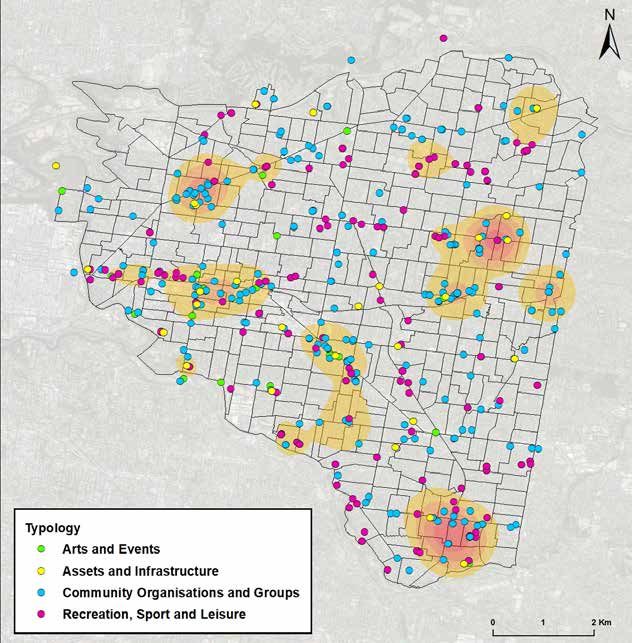
                                                                                                                   Figure: High Volume (Over 65) and Inclusive         Figure: High Volume (Under 25) and Inclusive
                                                                                                                   Spaces (Over 65s)                                   Spaces (Young/Families)

                                                                                                                                                                        Notes:
                                                                                                                                                                        Servicing the main cluster of people over 65
                                                                                                                                                                        around Balwyn and Camberwell, are a number
                                                                                                                                                                        of activities that are inclusive for older people
                                                                                                                                                                        Clustering of activities are around main
                                                                                                                                                                        shopping strips in most cases.
                                                                                                                                                                        For young people and young families
                                                                                                                                                                        there is a cluster of activities along the
                                                                                                                                                                        Alamein train line which is great for
                                                                                                                                                                        accessibility through public transport
                                                                                                                                                                        In Balwyn North there is a cluster of both
                                                                                                                                                                        65+ and 25 and under residents – there is
                                                                                                                                                                        an opportunity here for intergenerational
                                                      Figure: All Places and Spaces by Operational Group                                                                activities for social connection
Population: 177,276 (60 sq Km)              Located
Arts and Events                             35                                                                                                                          Where there are clusters of lone households
                                                      Hotspots:                                                                                                         there are also clusters of bumping spaces –
Assets and Infrastructure                   99                                                                                                                          can these be better leveraged to encourage
Community Organisations/Groups              468       • Glenferrie Road/ Burwood Road Hawthorn – dense mix                                                              more incidental connections particularly
Recreation, Sport and Leisure                           of recreation, sport and leisure / community groups                                                             for lone households to participate
                                            374                                                                    Figure: High Volume of Lone Households
Bumping Spaces                                        • Ashburton – high volume of community groups and            and Incidental/Bumping Spaces                        Interactive versions of the maps and detailed
                                            166         recreations sport and leisure – few arts and events                                                             analysis has been provided to each LGA/
Inclusive (65+)                                                                                                                                                         Council as part of the project.
                                            378
Inclusive (Young/Family)                              • High Street Kew – high volume of community groups
                                            355
Learning, Problem Solving
                                            477

Infrastructure for Social Connection 2020                                                                     39           Infrastructure for Social Connection 2020                                                        40
5. Outcomes 5. Outcomes
Bayside
Figure: High Volume (Over 65) and Inclusive Figure: High Volume (Under 25) and Inclusive
Spaces (Over 65s) Spaces (Young/Families)
Notes:
The clusters of young people under
25 and those over 65 in Beaumaris
suggest there is potential here for
engagement between intergenerational
spaces to support social connection
Beaumaris also has a good proportion
of bumping spaces. It is possible
these can be leveraged to support
engagement spanning lone households,
older residents and under 25s
Figure: All Places and Spaces by Operational Group Areas that have large numbers of
Population: 102,912 (37 sq Km) Located people under 25 are serviced with
Arts and Events 42 Hotspots: activities catering to young people and
families within walking distance
Assets and Infrastructure 44 • Sandringham Beach – community organisations
Community Organisations/Groups 354 and recreation sport and leisure most dense Interactive versions of the maps and
Figure: High Volume of Lone Households detailed analysis has been provided to
Recreation, Sport and Leisure 242 • Brighton – predominantly community organisations and Incidental/Bumping Spaces
with a few recreational and arts spaces each LGA/Council as part of the project.
Bumping Spaces 117
• Beaumaris – community organisations
Inclusive (65+) 360
and recreational spaces – arts spaces
Inclusive (Young/Family) 238 located away from the main cluster
Learning, Problem Solving 388
Infrastructure for Social Connection 2020 41 Infrastructure for Social Connection 2020 425. Outcomes 5. Outcomes
Glen Eira
Figure: High Volume (Over 65) and Inclusive Figure: High Volume (Under 25) and Inclusive
Spaces (Over 65s) Spaces (Young/Families)
Notes:
There is a density of 65+ households in the North
Caulfield / Elsternwick area that is serviced by a
large number of activities within walking distance.
The older residents around Bentleigh /
Bentleigh East have less access to activities
within walking distance, they do have a few
bumping spaces and there is a density of
sport and recreation within this area.
The North Road/Grange Road and Carnegie
areas have a high density of lone households,
though seem to have limited access to bumping
Figure: All Places and Spaces by Operational Group spaces. However, as these are both within
Population: 148,583 (39 sq Km) Located
commercial areas and community hubs with
Arts and Events 24 lots of cafes, restaurants and stores it is not
Hotspots: unreasonable to assume that these third spaces
Assets and Infrastructure 84
• Carnegie cluster is mainly sport and recreation will provide opportunities for social connection.
Community Organisations/Groups 254
• Bentleigh cluster has a mix of community Figure: High Volume of Lone Households Interactive versions of the maps and detailed
Recreation, Sport and Leisure 263 analysis has been provided to each LGA/
organisations and groups and recreation and Incidental/Bumping Spaces
Bumping Spaces 216 sports and leisure, as well as arts Council as part of the project.
Inclusive (65+) 294 • The Elsternwick cluster is predominantly
Inclusive (Young/Family) 303 community organisations and groups
Learning, Problem Solving 267
Infrastructure for Social Connection 2020 43 Infrastructure for Social Connection 2020 44You can also read


