ISG Provider Lens - Germany 2018 Internet of Things (I4.0) Platforms, Services & Solutions - T-Systems
←
→
Page content transcription
If your browser does not render page correctly, please read the page content below

ISG Provider Lens – Germany 2018
Internet of Things (I4.0) Platforms,
Services & Solutions
Germany

                                                                        An Analysis by
                                            Information Services Group Germany GmbH
                                                                   Frankfurt a.M., Germany
                                                                         September, 2017
                                                           Author: Dr. Henning Dransfeld

© 2017 Experton Group AG, an ISG business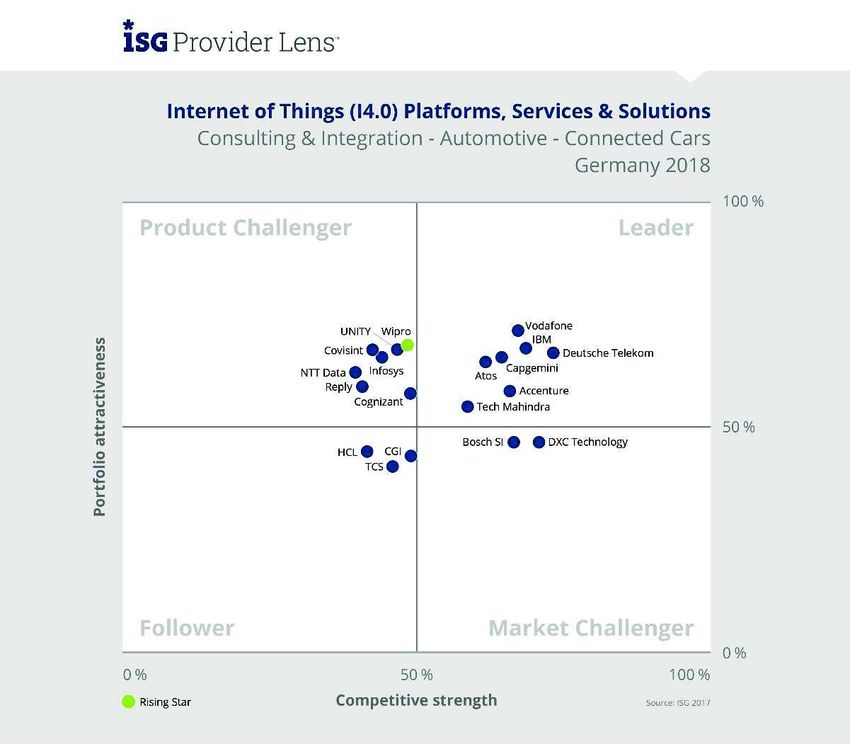
Internet of Things (I4.0) Platforms, Services & Solutions

COPYRIGHT

This analysis has been prepared by Information Services Group Germany GmbH (ISG). The
information and data contained herein were gathered conscientiously and with the utmost care.
Nevertheless, we cannot guarantee their exhaustiveness and accuracy. Nobody should take action,
based on this information, without expert advice and an in-depth analysis of the individual situation.

All rights to the content of this analysis are reserved by ISG. The data and information remain the
property of ISG. Reproduction – even of parts thereof – may only be made with the written
permission of ISG.

© 2017 Information Services Group Germany GmbH. All rights reserved.                                     2

Internet of Things (I4.0) Platforms, Services & Solutions

1. EXECUTIVE SUMMARY
Most of us do not have a robot that takes over daily household chores fully automatically. While we
get supported when driving our car, we are still the ones who have to make decisions or get things
done. Also, shopping is mostly not based on integrated steps of selection, purchasing and delivery,
both in our daily life and within corporate production environments. However, there are interesting
case studies of how we can use IoT technologies in various industries.

As of today, we expect Industrie 4.0 investments in Germany to amount to about 1.5 billion Euro in
2017 and 2.5 billion Euro by 2020. Alone in the machine & plant engineering segment, this will
increase the gross value added to reach about 100 billion Euro 1.

While the degree of connectedness and automation of devices, machines and products is advancing,
especially in the manufacturing industry, new business models that are adopted by the market are
still rare. IoT projects are highly complex and a lot of open questions remain when it comes to the
related security architecture. As a study by Bitkom Research 2 has revealed, 75% of respondents
perceive the high investments as the major obstacle to Industrie 4.0 implementations, followed by
privacy and data protections issues, which 55% of respondents regard as a problem. As a result,
corporate decision-makers are still hesitant with respective planning and implementation initiatives.

IoT – More flexible production is a key driver
The current market does not feature a killer application or highly innova tive or disruptive business
models.

The manufacturing industry has already collected experiences, based on the early usage of
predictive analytics to secure robotic applications within production facilities. Many production
managers have a focus on building up basic structures and provide safe connectivity between
existing isolated IoT solutions, based on open standards, to drive automation. Based on this
foundation, two major concepts are available as potential new business models:

    1. More flexible production ensures a more extensive offering for end customers.
    2. The possibility to build up micro production close to the market ensures the manufacturer’s
       closer interaction and integration with customers and reduces transportation costs.

1
 Source: Bitkom; Fraunhofer IAO: Industrie 4.0 – Volkswirtschaftliches Potenzial für Deutschland, April 2014
2
 Source: Bitkom Research: Industrie 4.0 – Wie Sensoren, Big Data und 3D-Druck die Produktion und die Arbeit in der
Fabrik verändern; April 2016
© 2017 Information Services Group Germany GmbH. All rights reserved.                                                 7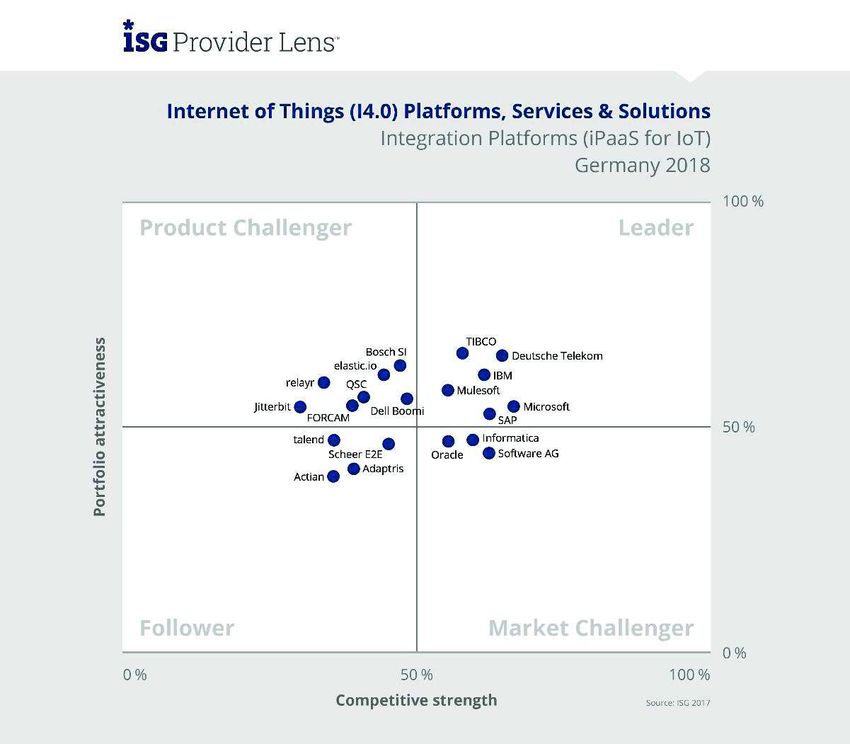
Internet of Things (I4.0) Platforms, Services & Solutions

IoT platforms and ecosystems
During the last 12 months, several larger IoT ecosystems have evolved , where software vendors, IT
system houses and hardware manufacturers are engaged in close cooperation. Practically all
vendors and service providers work with open interfaces to be able to connect to multiple IoT
platforms and cloud solutions. Considering the fact that less players than expected have entered this
market with their own platforms, certain segments, such as MES platforms, have undergone
consolidation already.

iPaaS for IoT are evolving into an open platform for applications
The focus of development efforts is on IoT platforms, serving as data “hubs” (for data integration,
storage, analysis and visualization). Available offerings include full-service IoT platforms with a fully
integrated data, device and process management portfolio as well as new IoT integration platforms
that provide connectors with open interfaces to allow for the fast and easy connection between
multiple data, device and process management solutions. Every platform provider knows that the
strength of the platform is dependent on the combined strength of his application partners. In the
wake of price declines in the sensor market, the degree of connectedness and dynamics of IoT
platforms will increase. Providers demonstrate a higher involvement with respective bodies and
committees to drive standardization. Based on this trend, it will be easier to add new functionality to
IoT platforms and to allow for the coexistence of multiple platforms.

Industrie 4.0 platforms as basis for a higher degree of automation
Industrie 4.0 platforms are used for predictive maintenance purposes or for analyzing the real
utilization of machines. They increase the degree of automation through combining analytics with
MES systems and ERP applications. This market, too, is characterized by more partnerships
between MES specialists, IT system houses and software vendors to allow for integrated use cases
accordingly. Increasingly, attempts are made to combine IoT with Industrie 4.0 use cases, for
instance, to include building data into production processes. The required platforms are increasingly
based on cloud solutions and provide connectivity to business data to allow for more complex use
cases. For instance, it would be possible to slow down machines if transporters carrying required
parts supplies are caught up in a traffic jam. The key discipline are flexible rule engines which help
make context-related decisions, for instance for tool accounting purposes; as of to date, only few
providers provide such functionality.

© 2017 Information Services Group Germany GmbH. All rights reserved.                                        8
Internet of Things (I4.0) Platforms, Services & Solutions

Industrial analytics & visualization / data analytics as driver of automation
First use cases for industrial analytics & visualization solutions included the delivery and
visualization of structured data for production control centers to support decisions during production
processes. However, this is not sufficient to achieve the goals of a flexible, highly automated factory.
Industrial data analytics requirements are becoming enormously complex, and the next step will be
to consolidate data from highly diverse sources and automate responses. Business intelligence, big
data and automation technology providers are challenged to master complex pro duction systems as
well as meet traditional enterprise IT requirements. In this segment, too, cooperation and joint
market offerings are becoming more relevant.

IoT security requirements are often underestimated
IoT-related security is more than protection against data theft. The focus is on avoiding production
errors and sabotage as well as detecting industrial espionage attempts, which are meanwhile
conducted without physical access to production facilities. In the wake of creased connectedness of
endpoints, for instance, based on production machines that are equipped with sensors, with IT
systems such as ERP or the cloud, new IT requirements are arising along the whole process chain.
Although integrated IoT security is highly critical for user organizat ions, only few solution providers
are as strongly committed to this topic as Siemens with their Cyber Secure Operations Cen ter for
industrial facilities. Within this context, endpoint security is a too limited approach. Provider s will
enhance their portfolio, engage in alliances or have to exit this market accordingly.

IoT starter kits – the fast track to first IoT use cases
Starter kits have already reached a high degree of maturity, based on concrete use cases. Provider s
actively market these starter kits as entry-level products, since they constitute a complete
component which can be used by customers immediately. Starter kits can be divided into two main
variants: One variant has a focus on machine data, including visua lization, the other on complete
use cases with automated actions or integrated business applications. While the degree of
connectivity varies, most of these solutions are highly mature and are advanced rapidly. Some of
these products are sold through traditional online shops. ISG expects the number of related projects
to increase significantly. Customers’ unanimous feedback is that this practical approach provides a
direct entry into the world of IoT.

© 2017 Information Services Group Germany GmbH. All rights reserved.                                       9
Internet of Things (I4.0) Platforms, Services & Solutions

IoT consulting & integration – the market lacks viable innovation strategies
From the automotive sector to the manufacturing industry, facility management, retail and logistics
sectors – in practically all industries a gap exists between IoT vision and implementation. While on
the one hand, there are visions of self-driving ships and vehicles and the fully automated company,
IoT projects in Germany, on the other hand, are mostly conducted to optimize processes, reduce
energy costs or improve maintenance cycles for production robots.

Consultants are challenged to demonstrate ways of using IoT to provide a new, sound and
sustainable basis for their customers’ business models. While it is certainly a good thing to
continuously improve the traditional business, this market needs more innovative approache s. As of
today, only few viable concepts are available to help customers transform their company into a
digital factory or allow for the 3D display of products in retail shops. Many companies have not
realized yet how they can advance from optimization projects to new business models.

    © 2017 Information Services Group Germany GmbH. All rights reserved.
                                                                                                       10
Internet of Things (I4.0) Platforms, Services & Solutions

2. INTRODUCTION
2.1. Methodology and Definitions

Within the project “Internet of Things (I4.0) Platforms, Services & Solutions ” we have analyzed the
relevant providers in the German market, based on a multi-phased research and analysis process
and positioned them accordingly, based on the ISG Provider Lens research process. The project
was divided into the following steps:

1.   Definition of the “Internet of Things (4.0) Platforms, Services & Solutions” target market
2.   Provider surveys, based on a questionnaire
3.   Expert interviews with providers and users
4.   Analysis and evaluation of services, service documentation and references

2.2. „Internet of Things (I4.0) Platforms, Services & Solutions” Definition

Internet of Things is a term that refers to one of the major drivers of change in today’s world – the
increasing connectedness and automation of devices, machines and products. The Internet of
Things has a focus on digitized and connected devices and products and their use along the whole
value chain of businesses and consumers.

Industrie 4.0 is part of these dynamics of change, with a focus on the production process within a
“smart factory”, based on highly connected and automated machines. Both topics examine the
possibilities arising through increasing connectedness on various levels – from the device and
machine level, to the machine park level or product and device groups to vertical and horizontal
business processes.

The platforms analyzed within this study range from highly specialized Industrie 4.0 platforms for
optimizing production control and management to iPaaS for the integration of multiple application
systems, based on a PaaS cloud infrastructure.

In the wake of these developments, the offering of respective industry-specific solutions and services
is enhanced accordingly, and so, the following market categories have been included into this study
accordingly:

     © 2017 Information Services Group Germany GmbH. All rights reserved.
                                                                                                        11
Internet of Things (I4.0) Platforms, Services & Solutions

                Figure 1 Market categories of the “Internet of Things (I4.0) – Platforms, Services & Solutions” study

   © 2017 Information Services Group Germany GmbH. All rights reserved.
                                                                                                                        12
Internet of Things (I4.0) Platforms, Services & Solutions

2.3. ISG Provider Lens Research Process

                                    Figure 2 Sample of the ISG Provider Lens research quadrant

The “ISG Provider Lens” research quadrant results from the evaluation matrix and contains four
segments where the providers are positioned accordingly:

Leaders

The “leaders” among the vendors have a highly attractive product and service offering and a very
strong market and competitive position; they fulfill all requirements for successful market cultivation.
They can be regarded as opinion leaders, providing strategic impulses to the market. They also
ensure innovative strength and stability.

Product challengers

The “product challengers” offer a product and service portfolio that provides an above -average
coverage of corporate requirements, but are not able to provide the same resources and strengths
as the leaders regarding the individual market cultivation categories. Often, this is due to the
respective vendor’s size or his weak footprint within the respective target segment.
    © 2017 Information Services Group Germany GmbH. All rights reserved.
                                                                                                       13
Internet of Things (I4.0) Platforms, Services & Solutions

Market challengers

"Market challengers" are also very competitive, but there is still significant portfolio potential and
they clearly lag behind the "leaders". Often, the market challengers are established vendors that are
somewhat slow to address new trends, due to their size and company structure, and have therefore
still some potential to optimize their portfolio and increase their attractiveness.

Followers

“Followers” are still lacking mature products and services or sufficient depth and breadth of their
offering, while also showing weaknesses and improvement potentials in their market cultivation
efforts. These vendors are often generalists or niche players.

Rising Star

Rising Stars are mostly product challengers with high future potential. When receiving the “Rising
Star” award, such companies have a promising portfolio, including the required roadmap and an
adequate focus on key market trends and customer requirements. Also, the "Rising Star" has an
excellent management and understanding of the local market. This award is only given to vendors or
service providers that have made extreme progress towards their goals within the last 12 months
and are on a good way to reach the leader quadrant within the next 12-24 months, due to their
above-average impact and innovative strength.

2.4. Project Schedule

The project started in April 2017 with the research phase, which lasted until May 2017 and was
followed by the analysis, evaluation and report creation phases. Selected results were presented to
the media in September 2017.

Milestones                           Start                         End

Project kick-off                     March 8, 2017
Provider survey                      April 3, 2017                         May 8, 2017
Sneak previews                       July 7, 2017                          August 29, 2017
Delivery of the study                September 13, 2017
Press release                        September 20, 2017

    © 2017 Information Services Group Germany GmbH. All rights reserved.
                                                                                                      14
Internet of Things (I4.0) Platforms, Services & Solutions
3. Internet of Things (I4.0) Platforms, Services &
Solutions
3.1. RATING BY CATEGORIES
ISG Provider Lens Germany 2018 - Internet of Things (I4.0) Platforms, Services & Solutions
market segments
Platforms (iPaaS
Integration - Smart
IoT Platforms &
IoT Starterkits
Connected Cars
Integration - IoT
Integration - IoT
Integration - IoT
Visualization
Categories
Ecosystems
IoT Security
Industrie 4.0
Consulting &
Consulting &
Consulting &
Consulting &
Analytics &
Consulting &
Automotive -
Integration
Number of
Platforms
Integration -
Production
Industrial
Buildings
Energy for
Logistics
Logistics
for IoT)
Retail
Players
Accenture L MC PC 3
Actian F 1
Adaptris F 1
Atos MC L L L L L L 7
AWS MC F 2
Axians L 1
Axiros F 1
AXOOM PC 1
Barracuda PC 1
Beckhoff L 1
BEDM PC L 2
Bosch SI L PC L PC L MC PC L L 9
CANCOM L PC 2
Capgemini F L PC L 4
Caverion L 1
CGI F MC 2
Cisco MC MC 2
Cognizant PC MC 2
Covisint PC 1
CyberArk PC 1
Dell Boomi PC 1
Detego MC 1
Deutsche
L L L L L L 6
Telekom
Device Insight PC L MC MC L L 6
© 2017 Information Services Group Germany GmbH. All rights reserved.
15Internet of Things (I4.0) Platforms, Services & Solutions
market segments
Platforms (iPaaS
Integration - Smart
IoT Platforms &
IoT Starterkits
Integration - IoT
Integration - IoT
Integration - IoT
Connected Cars
Visualization
Categories
Ecosystems
Industrie 4.0
IoT Security
Consulting &
Consulting &
Consulting &
Consulting &
Analytics &
Consulting &
Automotive -
Integration
Number of
Integration -
Platforms
Production
Industrial
Energy for
Buildings
Logistics
Logistics
for IoT)
Retail
Players
DXC Technology MC MC 2
elastic.io PC 1
Empolis L 1
Eurotech F 1
FIT F L MC 3
fluidOps PC 1
FORCAM PC L L 3
Fortinet F 1
Gefasoft MC 1
GE F MC 2
GreenCom MC PC 2
Greenpocket MC 1
HCL F F F 3
IBM L L L L PC L L PC L L 10
inconso MC 1
Informatica MC 1
Infosys PC PC PC 3
Inway MC 1
iTAC PC L 2
iTiZZiMO F 1
Ivanti L 1
Jitterbit PC 1
Kiwigrid L 1
Luftmeister F 1
Microsoft L L MC F 4
MPDV F 1
Mulesoft L 1
nemetris PC PC 2
NTT DATA PC PC 2
Oracle MC 1
L – Leader / PC – Product Challenger / F – Follower / MC – Market Challenger / RS – Rising Star
© 2017 Information Services Group Germany GmbH. All rights reserved.
16Internet of Things (I4.0) Platforms, Services & Solutions
market segments
Platforms (iPaaS
Integration - Smart
IoT Platforms &
IoT Starterkits
Integration - IoT
Integration - IoT
Integration - IoT
Connected Cars
Visualization
Categories
Ecosystems
Industrie 4.0
IoT Security
Consulting &
Consulting &
Consulting &
Consulting &
Analytics &
Consulting &
Automotive -
Integration
Number of
Integration -
Platforms
Production
Industrial
Energy for
Buildings
Logistics
Logistics
for IoT)
Retail
Players
Plex PC 1
PTC L L L 3
QSC PC PC 2
relayr F PC PC L MC L PC 7
Reply PC PC 2
SALT Solutions MC 1
SAP MC L L F 4
SAS PC 1
Scheer E2E F 1
Siemens L MC L L 4
Software AG L MC PC 3
Sopra Steria MC 1
Symantec MC 1
talend F 1
TCS F PC F 3
Tech Mahindra L PC MC RS MC 5
TIBCO L 1
UNITY PC PC 2
Vodafone L 1
Wipro F RS PC PC 4
L – Leader / PC – Product Challenger / F – Follower / MC – Market Challenger / RS – Rising Star
Figure 3 Vendor landscape
© 2017 Information Services Group Germany GmbH. All rights reserved.
17Internet of Things (I4.0) Platforms, Services & Solutions
3.2. IoT Platforms & Ecosystems
3.2.1. Introduction
IoT platforms are evolving into corporate data hubs. They connect four key elements: things, user
devices, business applications and web services. Information on things (machines, devices,
products, components and materials) is collected and prepared accordingly to visualize this
information on user devices. Remote access to “things” via user devices is also possible. IoT
platforms are industry-independent and pursue a horizontal approach to connect data and things
across industry and company boundaries. Full-service platforms’ core functionality includes data &
device management to connect and centrally manage distributed/decentralized things (devices,
products, machines) and process (store, integrate, analyze and visualize) related data. Common
additional functionality includes data analytics, application development for data vis ualization and
connectivity management. Other relevant aspects include integration with business applications
(ERP, CRM or PLM) and external web services such as social media data or weather information.
Specific integration platforms provide connectors to ensure fast and easy connectivity of multiple
data, device and process management solutions.
Key evaluation criteria and requirements for providers of IoT Platforms & Ecosystems can be
summarized as follows:
· Breadth & depth of functionality · Cooperation with other relevant IoT
players and platforms (ecosystem)
· USP
· Scalability
· Partnerships with system integrators,
developers and sales partners · Successful local customer projects
As we have observed, not much change has occurred in the market, with the exception of
Cumulocity, who were acquired by Software AG.
Some market participants have significantly increased the attractiveness of their portfolio by
engaging in partnerships and integrating them into their portfolio. Many players provide respective
cloud solutions, either based on their own cloud, a third-party cloud or a cloud-agnostic solution.
Interestingly, some of the available platforms have a focus on standard interfaces for sensor
connectivity, while others focus on connectivity with legacy machines with highly divers e interface
requirements. Many platform-related use cases only address cost optimization topics.
Providers demonstrate a higher involvement with respective bodies and committees to drive
standardization. Based on this trend, it will become easier to add functionality to IoT platforms and
allow for the coexistence of multiple platforms, which means that both customers and provider s
without their own cloud infrastructure need not decide on one single suite. ISG expects market
participants to increasingly cooperate to ensure a faster time to market of use cases, as opposed to
© 2017 Information Services Group Germany GmbH. All rights reserved.
18Internet of Things (I4.0) Platforms, Services & Solutions
individual solutions. In the future, communities will evolve that develop solutions which could not be
developed by a single company or could only be developed with delay.
Established players make high investments to enhance and advance their platforms, based on very
different strategies. Bosch SI, for instance, develops their solutions for their internal market before
offering these tested & proven solutions to other companies; Deutsche Telekom, on the other hand,
invests strongly into cooperation with partners such as Cisco, Microsoft or Huawei to provide
customers a highly comprehensive portfolio, redefining the full-service provider concept.
Many providers have realized that increasingly, use cases do not originate from a specific industry,
but are based on use cases from other industries and areas of application a nd are adapted
accordingly. Therefore, the history and origins of the platform are losing their relevance.
© 2017 Information Services Group Germany GmbH. All rights reserved.
19Internet of Things (I4.0) Platforms, Services & Solutions
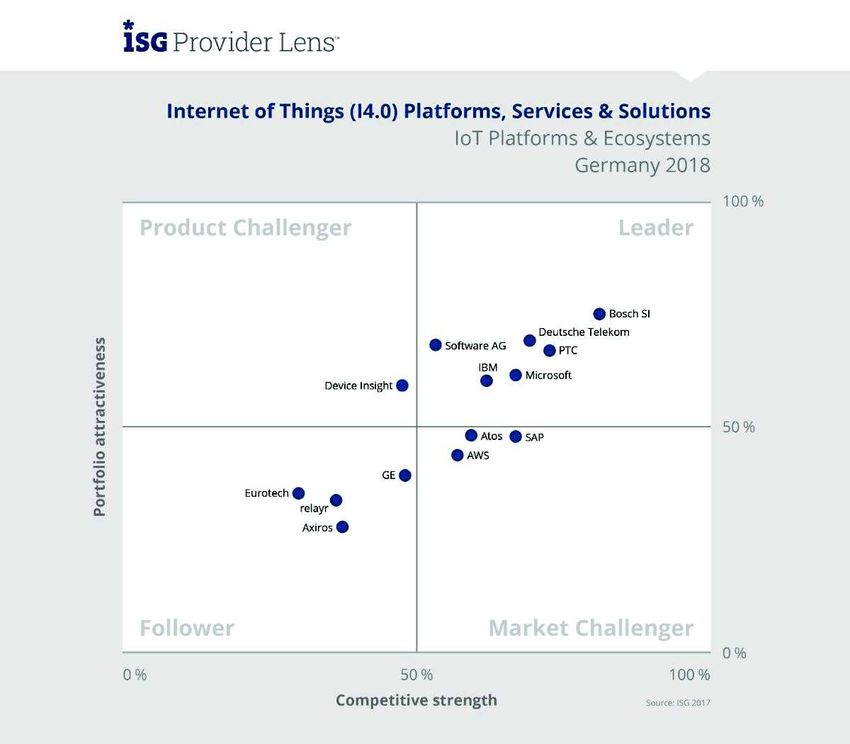
3.2.2. Evaluation of Providers
ISG has identified 14 relevant providers of IoT Platforms & Ecosystems for the German market.
The following six of these providers have been positioned as leaders:
· Bosch SI · Microsoft
· Deutsche Telekom · PTC
· IBM · Software AG
Figure 4 Quadrant for IoT Platforms & Ecosystems
© 2017 Information Services Group Germany GmbH. All rights reserved.
20Internet of Things (I4.0) Platforms, Services & Solutions
Category: IoT Platforms & Ecosystems
Deutsche Telekom
Strengths/Opportunities: Weaknesses/Challenges:
· Based on the Multi IoT Platform, Customers · The MISP platform could be enhanced
are granted access to a huge portfolio, further by taking over use cases from
including access to partners’ platforms. customer projects into the platform.
· Solutions consist of tested and proven · The provider should work to provide a
individual components, based on end-to- clearer presentation of the IoT platform on
end integration. their web pages. While a lot of individual
information is available, for instance, on
· Customers benefit from the clear IoT focus, use cases, the presentation of the
including tested and proven use cases that platform’s potentials is insufficient.
can be used to build up their own complex
use cases. · It is rather difficult to find information on the
MISP platform.
· Deutsche Telekom combines their offering
with the option to use their German data
center to ensure compliance with the strict
German privacy regulations. Advisor Statement
· The Multi IoT Service Platform (MISP)
ensures connectivity of sensors and “Deutsche Telekom’s Multi IoT
devices and provides data management Platform grants customers access
capabilities. to a huge portfolio, including
access to partners’ platforms.”
· Deutsche Telekom has already many
customer references for their IoT platform
in the German market as well as real-world
use cases.
© 2017 Information Services Group Germany GmbH. All rights reserved.
22Internet of Things (I4.0) Platforms, Services & Solutions
3.2.3. Overview of Providers in the Market for IoT Platforms & Ecosystems
with Trend Assessment
IoT Platforms & Ecosystems
Trend
Portfolio attractiveness (Y-Axis on Grid) Competitive strength (X-Axis on Grid)
assessment
Features / Innovation Strategy &
Strategy & Architecture & Client Sales & Awareness
Player / Categories Vision
Portfolio
Service Design Experience Marketing
Capacity & Local
& Image
depth Viability Reach
Atos 0 - 0 0 0 0 0 0 ÅÆ
AWS 0 - 0 0 0 0 0 0 ÅÆ
Axiros - - - - - - - - È
Bosch SI + + 0 0 + + + + Ç
Deutsche Telekom + 0 0 0 + + + - Ç
Device Insight 0 0 0 0 0 - 0 - ÅÆ
Eurotech - - - - - - - - È
GE 0 - - - 0 0 - - ÅÆ
IBM + 0 0 0 0 0 0 0 ÅÆ
Microsoft + 0 0 0 0 + + 0 Ç
PTC 0 0 0 0 0 + + 0 Ç
relayr 0 0 - - - - - - ÅÆ
SAP 0 - 0 0 0 0 0 0 ÅÆ
Software AG + 0 0 0 - 0 0 0 Ç
Legend: "+" above average; "0"average; "-" below average (compared to the competition); trend assessment: Arrow up = positive; arrow left_right =
neutral; arrow down = negative (forecast)
Figure 5 IoT Platforms & Ecosystems – overview of providers with performance dashboard
© 2017 Information Services Group Germany GmbH. All rights reserved.
27Internet of Things (I4.0) Platforms, Services & Solutions
3.3. Integration Platforms (iPaaS for IoT)
3.3.1. Introduction
iPaaS solutions enable customers to integrate multiple application systems, based on a PaaS cloud
infrastructure. iPaaS for IoT have been added functionality and ensure easy integration of IoT
systems with IT. They play a special role in the market. iPaaS for IoT solutions must be added to IoT
platforms to ensure easy and fast integration of these platforms with other data sources and
applications, based on a cloud environment.
iPaaS for IoT solutions support IoT platforms with connectors and adapters in t hree concrete use
cases: the fast and easy integration of IoT platforms with business applications such as CRM or
ERP; the fast and easy integration of data from web applications (e.g., weather data, social media
data) with IoT platforms; and the fast and easy functional extension of IoT platforms, for instance,
through specific tools for advanced data analysis or data visualization.
iPaaS for IoT application development efforts tend to take over certain IoT platform functionality and
provide a centralized offering. They must also address the specific scalability and event handling
requirements of IoT solutions.
Key evaluation criteria and requirements for providers of Integration Platforms (iPaaS for IoT) can be
summarized as follows:
· Connectors to IoT platforms and other · Ease of use and self-service
relevant IoT applications functionality
· Connectors to key ERP/CRM and · Functionality for easier scalability and
analytics applications event handling
· Connectors to web applications · Network and specifically secured
(weather data, social media, cloud connectivity
storage)
The market has evolved strongly, since platform providers have recognized the relevance of the
iPaaS for IoT topic and offer their own solutions, often with a very strong focus on IoT. Major players
include Bosch SI, FORCAM, relayr and QSC. Considering the high degree of complexity, these
providers often offer highly industry-specific solutions, with a focus on the engineering/manufacturing
industries and the energy segment. Some providers who only offer iPaaS with in their own IoT
platform have not been included in this analysis, since these offerings do not constitute stand -alone
systems.
iPaaS providers have also started to enhance their generic solutions with connectors to IoT systems.
The same is true for software vendors who add IoT capability to their aPaaS offering, based on third -
party iPaaS solutions. This connector-based approach enables them to address very specify
© 2017 Information Services Group Germany GmbH. All rights reserved.
28Internet of Things (I4.0) Platforms, Services & Solutions
security, data volume and process requirements. Providers who are enhancing their iPaaS offerings,
based on this approach, include TIBCO, elastic.io, IBM, Microsoft, Deutsche Telekom, Mulesoft,
Software AG and Dell Boomi.
A third group of suppliers consists of business software vendors, who offer proprietary iPaaS
solutions to integrate IoT processes into their software. Examples include SAP and Oracle.
The three groups pursue very different approaches; clear differentiation is dif ficult. Customers’
decision in favor of a specialized IoT iPaaS solution or an integrated iPaaS solution that has been
added IoT capability must be based on very concrete project requirements. The future will show
whether the specialists from the manufacturing and sensor technology segments who are entering
the IoT market will put pressure on or even replace the established IT providers. As of to date, both
approaches are selected in equal shares. Mid-term, ISG expects the trend to go towards integrative
cooperation.
The leader segment in this market is rather stable; top players include Deutsche Telekom, TIBCO
and IBM. More and more third-party providers integrate Azure into their own IoT platform, and as a
result, Microsoft’s relevance in this segment is increasing continuously. While SAP enjoys a strong
position, the provider’s solution is mainly interesting for the SAP customer base. SAP must be
careful to keep up with the competition accordingly. Mulesoft is a newcomer to the leader quadrant;
the provider offers an end-to-end solution, including the device. Considering the strong
specialization of this market, no clear Rising Star could be identified.
© 2017 Information Services Group Germany GmbH. All rights reserved.
29Internet of Things (I4.0) Platforms, Services & Solutions
3.3.2. Evaluation of Providers
ISG has identified 20 relevant providers of Integration Platforms (iPaaS for IoT) for the German
market. The following six of these providers have been positioned as leaders:
· Deutsche Telekom · Mulesoft
· IBM · SAP
· Microsoft · TIBCO
Figure 6 Quadrant for Integration Platforms (iPaaS for IoT)
© 2017 Information Services Group Germany GmbH. All rights reserved.
30Internet of Things (I4.0) Platforms, Services & Solutions
Category: Integration Platforms (iPaaS for IoT)
Deutsche Telekom
Strengths/Opportunities:
· Deutsche Telekom’s “Data Orchestration · Deutsche Telekom’s “House of Clouds” is a
as-a-Service” offering is an iPaaS solution multi-IoT platform that combines the
that is based on the Informatica iPaaS platforms of multiple IoT providers, such as
platform and has been enhanced with Microsoft Azure and Cisco Fog. The future
Deutsche Telekom’s proprietary IoT will show how this offering will affect the
connectors, software and additional cloud iPaaS for IoT solution.
services to address IoT use cases.
· Deutsche Telekom has a clear focus on
Weaknesses/Challenges:
IoT. The provider offers easy use cases
that can be used by customers and have · Still, it is not easy for customers to get an
been designed to gradually increase overview of the offering and find suitable
application complexity to provide an entry information. The various web sites lack
level into complex IoT applications. transparency and coordination. Marketing
should provide more clarity for users and
· The data center is located in Germany.
should not be limited to purely technical
· The Informatica solution provides more aspects.
than 149 connectors to all common IoT and
· There is still a lack of local customers
non-IoT systems and is enhanced
references.
continuously; Deutsche Telekom supplies
additional IoT connectors.
· The customer can use additional secure
agents for scaling purposes. Data Advisor Statement
orchestration is also based on the
Informatica Cloud. “Deutsche Telekom provides a
strong offering and is an extremely
interesting player in the iPaaS for
IoT segment.”
© 2017 Information Services Group Germany GmbH. All rights reserved.
31Internet of Things (I4.0) Platforms, Services & Solutions
3.3.3. Overview of Providers in the Market for Integration Platforms (iPaaS for
IoT) with Trend Assessment
Integration Platforms (iPaaS for IoT)
Trend
Portfolio attractiveness (Y-Axis on Grid) Competitive strength (X-Axis on Grid)
assessment
Features / Innovation Strategy &
Strategy & Architecture & Client Sales & Awareness
Player / Categories Vision
Portfolio
Service Design Experience Marketing
Capacity & Local
& Image
depth Viability Reach
Actian - - 0 - - - - - È
Adaptris - - 0 - - - 0 - ÅÆ
Bosch SI 0 0 0 0 - 0 0 0 Ç
Dell Boomi 0 0 0 0 - 0 0 0 Ç
Deutsche Telekom 0 + + 0 0 0 0 0 Ç
elastic.io + 0 0 0 - - 0 0 Ç
FORCAM 0 0 0 0 - - - - Ç
IBM 0 0 0 0 0 0 0 0 Ç
Informatica - - 0 0 0 + 0 0 ÅÆ
Jitterbit 0 0 0 0 - - - - Ç
Microsoft 0 0 0 0 0 + 0 0 ÅÆ
Mulesoft 0 0 0 0 0 0 0 0 Ç
Oracle 0 0 0 - 0 0 0 0 È
QSC 0 0 0 0 - 0 - - Ç
relayr 0 0 0 0 - - - - Ç
SAP - 0 0 0 + 0 0 0 ÅÆ
Scheer E2E - - - - - 0 0 - È
Software AG - - 0 0 0 0 0 0 È
talend 0 0 0 - - - - - ÅÆ
TIBCO + 0 0 0 0 0 0 0 Ç
Legend: "+" above average; "0"average; "-" below average (compared to the competition); trend assessment: Arrow up = positive; arrow left_right =
neutral; arrow down = negative (forecast)
Figure 7 Integration Platforms (iPaaS for IoT) – overview of providers with performance dashboard
© 2017 Information Services Group Germany GmbH. All rights reserved.
37Internet of Things (I4.0) Platforms, Services & Solutions
3.4. Industrial Analytics & Visualization
3.4.1. Introduction
Analytics for predictive maintenance, combined with dashboards for remote monitoring and
maintenance, remains the key IoT use case. Increasingly, the focus is also on influencing the data
source, i.e., the devices that have delivered the analyzed values. Slowly, first solutions are emerging
that can be used to influence production lines directly out of analyses.
This segment includes providers whose products, solutions and services have a focus on processing
(analyzing) and visualizing (sensor) data from industrial machines and facilities and from multiple
sources to derive new insights accordingly.
Other analyzed solutions include smart energy, smart building and smart city solutions.
All solutions are based on the analysis and visualization of large amounts of complex and
unstructured data.
Key evaluation criteria and requirements for providers of Industrial Analytics & Visualization
solutions can be summarized as follows:
· Strategy, vision and technology · Market position and market presence
leadership · Revenues and growth rates
· Product features, depth of portfolio and · References and customer projects
roadmap
· Innovation
· USP, skills, architecture and solution
· Stability, financial and organizational
design
dependencies of the German
· Service, support and additional organization
solutions
· Advertising, PR, marketing
· Client experience (portfolio quality from communications, sales marketing and
the customers’ perspective) with sales
customer satisfaction ratings and
· Channel and partnerships
feedback
Considering the fact that forecasts expect 20 or even 50 billion “things” to be connected to the
Internet by 2020, it is not sufficient anymore to simply display information on these things in a traffic
light color scheme. Information must be presented in a meaningful way to ensure users’ fast and
comprehensive understanding of these data. Additional required functionality are drill -down options
to gain in-depth information.
© 2017 Information Services Group Germany GmbH. All rights reserved.
38Internet of Things (I4.0) Platforms, Services & Solutions
Production-related information is collected in manufacturing execution systems and integrated into
business systems; plenty of data exist on various company levels, which must be visualized and
analyzed accordingly.
Meanwhile it is clear that visualization and analytics have converged within the Internet of Things
context. Customers want solutions that are able to analyze and visualize the states of individual
machines as well as of whole production lines, under consideration of the planned production
sequence.
As has been the case in previous years, predictive maintenance remains the key topic for industrial
analytics & visualization use cases. Automated actions, derived from the respective analysis results,
remain the key discipline, but only very few use cases are available.
© 2017 Information Services Group Germany GmbH. All rights reserved.
39Internet of Things (I4.0) Platforms, Services & Solutions
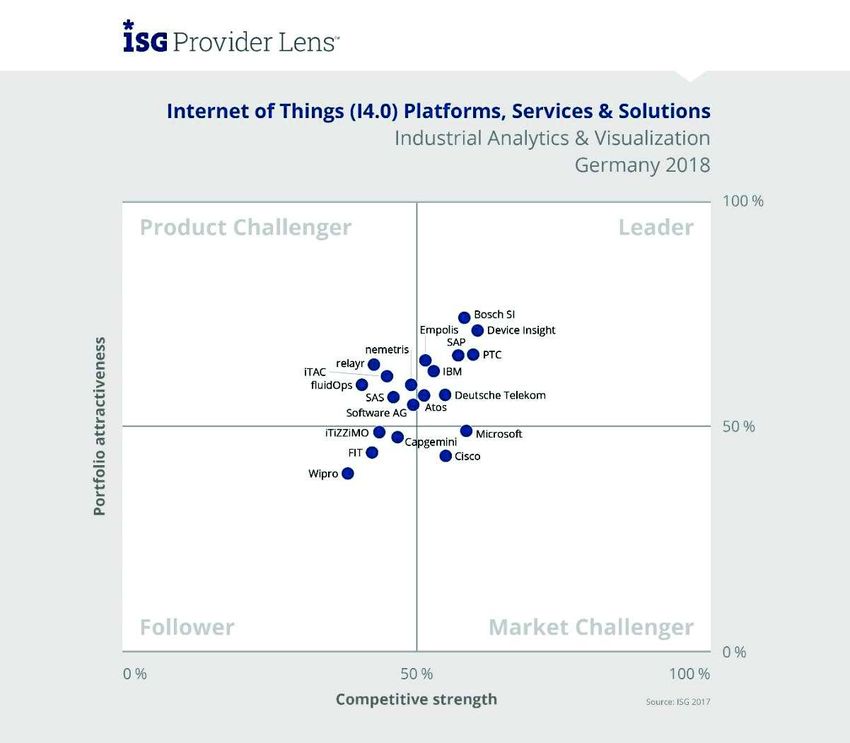
3.4.2. Evaluation of Providers
ISG has identified 20 relevant providers of Industrial Analytics & Visualization solutions in the
German market. The following eight of these providers have been positioned as leaders:
· Atos · Empolis
· Bosch SI · IBM
· Deutsche Telekom · PTC
· Device Insight · SAP
Figure 8 Quadrant for Industrial Analytics & Visualization
© 2017 Information Services Group Germany GmbH. All rights reserved.
40Internet of Things (I4.0) Platforms, Services & Solutions
Category: Industrial Analytics & Visualization
Deutsche Telekom
Strengths/Opportunities: Weaknesses/Challenges:
· Deutsche Telekom is one of the large IT · The portfolio and its presentation lack
service providers in the German market transparency and it might be useful to
with a large competence center, consisting establish its own, specific branding to drive
of comprehensive IoT and M2M resources. sales accordingly.
· A two-level storage concept is available for · While integration of analytics & visualization
analyzing IoT data: cost-efficient storage into the provider’s one-stop shopping
options for long-term data archiving are approach for IoT is certainly positive, it
available to perform long-term analyses and might be a challenge to market this
achieve process optimizations, while approach among midmarket businesses.
current data are stored in a real-time
database to allow for the monitoring and
real-time analysis of current data.
Advisor Statement
· Industrial analytics & visualization is part of
the provider’s IoT portfolio and has a
“Deutsche Telekom has set up
modular structure; customers have the
additional references and flagship
option to integrate Microsoft’s German
projects and has further
Cloud, for which Deutsche Telekom acts as
strengthened their IoT competence
data trustee.
and position in this segment.”
© 2017 Information Services Group Germany GmbH. All rights reserved.
43Internet of Things (I4.0) Platforms, Services & Solutions
3.4.3. Overview of Providers in the Market for Industrial Analytics &
Visualization with Trend Assessment
Industrial Analytics & Visualization
Trend
Portfolio attractiveness (Y-Axis on Grid) Competitive strength (X-Axis on Grid)
assessment
Features / Innovation Strategy &
Strategy & Architecture & Client Sales & Awareness
Player / Categories Vision
Portfolio
Service Design Experience Marketing
Capacity & Local
& Image
depth Viability Reach
Atos 0 0 0 0 0 0 0 0 Ç
Bosch SI + + 0 0 0 0 0 0 Ç
Capgemini 0 0 0 0 - 0 0 - ÅÆ
Cisco 0 - - 0 0 - 0 0 ÅÆ
Deutsche Telekom + 0 0 + 0 0 0 0 ÅÆ
Device Insight + + 0 + 0 0 0 0 Ç
Empolis 0 + 0 0 - 0 0 0 Ç
FIT - 0 0 0 - 0 0 - ÅÆ
fluidOps + + - - - 0 - 0 Ç
IBM + 0 0 0 + 0 0 0 ÅÆ
iTAC + 0 - 0 - 0 0 0 Ç
iTiZZiMO 0 0 0 0 0 0 0 - Ç
Microsoft + - 0 0 0 + 0 0 Ç
nemetris 0 0 0 0 0 0 0 - Ç
PTC + + 0 + + 0 0 + Ç
relayr + 0 0 0 0 0 0 - Ç
SAP + 0 0 0 0 + 0 0 Ç
SAS 0 0 0 0 0 - 0 - ÅÆ
Software AG 0 0 0 0 0 0 0 - ÅÆ
Wipro 0 - - - - - - - ÅÆ
Legend: "+" above average; "0"average; "-" below average (compared to the competition); trend assessment: Arrow up = positive; arrow left_right =
neutral; arrow down = negative (forecast)
Figure 9 Industrial Analytics & Visualization – overview of providers with performance dashboard
© 2017 Information Services Group Germany GmbH. All rights reserved.
49Internet of Things (I4.0) Platforms, Services & Solutions
3.6. IoT Starter Kits
3.6.1. Introduction
IoT starter kits provide a fast, easy and practical entry-level approach to IoT. They allow independent
developers as well as technically savvy midmarket businesses to quickly build their own IoT
solutions (often for initial test purposes). On the hardware side, IoT starter packs consist of several
sensors and actors that are connected to a small microcontroller. WLAN or mobile communications
are used to connect them with an IoT platform to collect, prepare and visualize device data. Ideally,
it is not only possible to collect and visualize data, but to also activate actors to (remotely) co ntrol
devices.
Key evaluation criteria and requirements for providers of IoT Starter Kits can be summarized as
follows:
· Number and kind of sensors and actors · Connectivity options
· Capabilities of the connected IoT · Local market access
platform 8as back-end for data
· Level of awareness of the solution
visualization, analysis and application
development) · Sales channels & marketing
· Pricing structure for the three core
components
While starter kits are still relatively new in the market, they have already reached quite a high degree
of maturity. Starter kits deliver concrete use cases, which can be directly implemented by customers
to generate immediate added value.
Starter kits can be divided into two main variants: One variant has a focus on supplying machine
data, including their visualization, the other on complete use cases with automated actions or
integrated business applications such as ERP. Some providers’ offerings also include the mobile
infrastructure to ensure connectivity between remote sensors and the Internet of Things. Respective
providers include Deutsche Telekom and Device Insight in cooperation with Vodafone.
An exception is SAP as a new player in this market, with a starter kit that is ultimately made up of
concepts and pieces of code, for instance, to develop use cases in an ERP system.
Bosch SI leverages available starter kits, including sensors, within their own company group.
External customers benefit from highly mature starter kits.
All providers are enhancing their starter kit portfolio rapidly, either through additional gateways,
sensors and interfaces or via complete use cases.
© 2017 Information Services Group Germany GmbH. All rights reserved.
57Internet of Things (I4.0) Platforms, Services & Solutions
ISG expects these products to evolve into an independent market, lowering IoT entry barriers
drastically. Some of these products are sold through traditional online shops already. For instance,
Amazon sells their IoT starter kit through their shop.
While case studies for such starter kits are still limited to rather simple use cases, this will change
short-term.
ISG expects the number of customer projects, based on starter kits, to increase rapidly short -term.
Based on customers’ positive experiences, more and more user organizations will be encouraged to
experiment with such starter kits. Another advantage should not be underestimated either: Starter
kits also allow non-IT staff to gather first IoT experiences.
© 2017 Information Services Group Germany GmbH. All rights reserved.
58Internet of Things (I4.0) Platforms, Services & Solutions
3.6.2. Evaluation of Providers
ISG has identified eight relevant providers of IoT Starter Kits for the German market. The following
three of these providers have been positioned as leaders:
· Deutsche Telekom · relayr
· FORCAM
Figure 12 Quadrant for IoT Starter Kits
© 2017 Information Services Group Germany GmbH. All rights reserved.
59Internet of Things (I4.0) Platforms, Services & Solutions
Category: IoT Starter Kits
Deutsche Telekom
Strengths/Opportunities: Weaknesses/Challenges:
· In addition to their “Cloud der Dinge” starter · Customers who have developed solutions,
kit, Deutsche Telekom has launched the based on the starter kits, and want to
“Predictive Maintenance” starter kit. It migrate them into Deutsche Telekom’s
contains everything required, from condition MISP, often require support by the provider,
monitoring of machines and components to especially in cases where the customer has
automatically triggered service just started his digitization journey.
assignments, including scheduling and
planning.
· Based on Deutsche Telekom’s mobile Advisor Statement
network, it is possible to also connect
remotely installed sensors.
“Based on Deutsche Telekom’s
mobile network, it is possible to
also connect remotely installed
sensors.”
© 2017 Information Services Group Germany GmbH. All rights reserved.
60Internet of Things (I4.0) Platforms, Services & Solutions
3.6.3. Overview of Providers in the Market for IoT Starter Kits with Trend
Assessment
IoT Starterkits
Trend
Portfolio attractiveness (Y-Axis on Grid) Competitive strength (X-Axis on Grid)
assessment
Features / Innovation Strategy &
Strategy & Architecture & Client Sales & Awareness
Player / Categories Vision
Portfolio
Service Design Experience Marketing
Capacity & Local
& Image
depth Viability Reach
AWS 0 - - - - 0 - - ÅÆ
Bosch SI - + 0 0 - 0 0 - Ç
Deutsche Telekom 0 + + 0 0 0 0 0 Ç
FORCAM + 0 - 0 0 - 0 0 Ç
IBM 0 + - + - 0 0 - Ç
Microsoft 0 - - 0 - 0 0 - ÅÆ
relayr + - - 0 0 - 0 0 Ç
SAP - - - 0 - 0 0 - ÅÆ
Legend: "+" above average; "0"average; "-" below average (compared to the competition); trend assessment: Arrow up = positive; arrow left_right =
neutral; arrow down = negative (forecast)
Figure 13 IoT Starter Kits – overview of providers with performance dashboard
© 2017 Information Services Group Germany GmbH. All rights reserved.
63Internet of Things (I4.0) Platforms, Services & Solutions
3.8. Consulting & Integration – Automotive – Connected Cars
3.8.1. Introduction
Dieselgate and the Tesla hype suggest an abandonment of traditional drive and motor technology,
which has been evolved and advanced over decades; supply chains and many jobs depend on this
industry. Internet companies such as Google and Uber demonstrate German OEMs the reality of
autonomous driving today. These topics are driven by politics and media, but not by paying
customers.
IoT provides solutions to improve the automotive product as well as automobility and increase
security and comfort – increasing its attractiveness for the users of the respective product. Smart
manufacturing is only one aspect that helps improve the customers’ choice of solutions, while
reducing waiting times. Key components of the OEM’s portfolio include services that improve the
driving experience, such as smart parking in unfamiliar cities and communications with restaurants
to inform them of the time of arrival, if a reservation has been made via the navigation system. Car -
to-car communications increase the security of road users through anticipatory vehicles. Real added
value is generated only through respective connectedness and a wide range of practical applications
that make life easier.
Key evaluation criteria and requirements for providers in the market for Consulting & Integration –
Automotive – Connected Cars can be summarized as follows:
· Industry-specific, automotive · Customer satisfaction with the delivery
knowledge and know-how quality, based on local references
· Consulting and portfolio on the · Strategic focus on important industry-
strategic and technical level specific future topics (e.g., self-driving
vehicles)
· Integration competence for connected-
car solutions (connectedness between · Go-to-market: access to customers
cars for additional services) within the automotive sector via direct
sales, channel, marketing
· Project experience with IoT use cases
for connected cars, specifically in the · Core competences: innovation,
German market security, analytics, customer focus,
partnerships
· Delivery performance, based on team
strength (size, skills, experience, USP)
During the last 12 months, IoT and Industrie 4.0 have affected massive changes in the automotive
sector. In the wake of advanced sensor technology and increasing integration, the focus of research
& development initiatives is increasingly on self-driving vehicles. An ethics commission is working on
rules for machines that have to make unpleasant decisions within accident scenarios.
© 2017 Information Services Group Germany GmbH. All rights reserved.
73Internet of Things (I4.0) Platforms, Services & Solutions
The development is making progress; vehicles by BMW and Mercedes are already available with
self-steering functionality. We have also observed progress regarding the automation of in -car
support systems and connectedness between vehicles. In the German market, these challenges are
mostly addressed by traditional IT system houses who are actively engaged in respective consulting
projects.
However, in times where the number of young people who take their driving tests is lower than ever
before, other topics need to be addressed: IoT provides the opportunity to enrich the actual driving
experience through connectivity to service stations, parking facilities and smart homes. Considering
the fact that many of these concepts still have to be developed and still lack the required technical
refinement, the focus within this industry remains on strategic consulting.
© 2017 Information Services Group Germany GmbH. All rights reserved.
74Internet of Things (I4.0) Platforms, Services & Solutions
3.8.2. Evaluation of Providers
ISG has identified 19 relevant providers in the German market for Consulting & Integration –
Automotive – Connected Cars. The following seven of these providers have been positioned as
leaders:
· Accenture · Deutsche Telekom
· Atos · Tech Mahindra
· Capgemini · Vodafone
· IBM
Wipro has been identified as the Rising Star.
Figure 16 Quadrant for Consulting & Integration – Automotive – Connected Cars
© 2017 Information Services Group Germany GmbH. All rights reserved.
75Internet of Things (I4.0) Platforms, Services & Solutions
Category: Consulting & Integration – Automotive – Connected Cars
Deutsche Telekom
Strengths/Opportunities: Weaknesses/Challenges:
· Deutsche Telekom has many competences · While Deutsche Telekom is taking
and many years of experience with appropriate steps to integrate the portfolios
integration projects in the automotive of several corporate units, there is still a
segment. long way to go until customers perceive
these solutions as an integrated offering.
· The consulting and integration portfolio for
the automotive segment has a very modular · Deutsche Telekom has many concrete
structure; modules can be combined very projects and could market this competence
flexibly. much more strongly, based on a respective
vision.
· Based on the new management structure,
the provider is able to better bundle the
capabilities of the various business units
such as Detecon, T-Systems and Advisor Statement
Multimedia Dresden.
· Deutsche Telekom provides a very broad “In the connected car segment,
portfolio and real-world show cases, from Deutsche Telekom provides a
after-sales optimization to back-end broad integration portfolio and very
solutions for in-car ICT to connected car interesting show cases with
and home use cases, which have been leading OEMs.”
implemented in cooperation with renowned
OEMs.
© 2017 Information Services Group Germany GmbH. All rights reserved.
79Internet of Things (I4.0) Platforms, Services & Solutions
3.8.3. Overview of Providers in the Market for Consulting & Integration –
Automotive – Connected Cars with Trend Assessment
Consulting & Integration - Automotive - Connected Cars
Trend
Portfolio attractiveness (Y-Axis on Grid) Competitive strength (X-Axis on Grid)
assessment
Features / Innovation Strategy &
Strategy & Architecture & Client Sales & Awareness
Player / Categories Vision
Portfolio
Service Design Experience Marketing
Capacity & Local
& Image
depth Viability Reach
Accenture 0 0 0 0 0 0 0 + È
Atos 0 0 0 + 0 0 0 0 È
Bosch SI 0 0 - - 0 0 0 0 Ç
Capgemini 0 + 0 0 0 0 0 0 ÅÆ
CGI 0 0 - - 0 0 0 0 ÅÆ
Cognizant 0 0 0 - 0 0 0 0 ÅÆ
Covisint + 0 0 0 - - 0 - Ç
Deutsche Telekom + 0 0 + + + 0 + ÅÆ
DXC Technology 0 0 - 0 0 + 0 + È
HCL 0 - - - - 0 - - ÅÆ
IBM + 0 0 + 0 + 0 0 ÅÆ
Infosys 0 0 0 0 - - 0 0 Ç
NTT Data + 0 0 0 - - - - ÅÆ
Reply 0 0 0 0 - - 0 - Ç
TCS - - - - 0 0 - 0 ÅÆ
Tech Mahindra 0 0 0 0 0 0 0 0 Ç
UNITY 0 0 0 + - 0 0 0 È
Vodafone + + 0 + 0 + + 0 ÅÆ
Wipro 0 0 0 + - 0 0 0 ÅÆ
Legend: "+" above average; "0"average; "-" below average (compared to the competition); trend assessment: Arrow up = positive; arrow left_right =
neutral; arrow down = negative (forecast)
Figure 17 Consulting & Integration – Automotive – Connected Cars – overview of providers with performance dashboard
© 2017 Information Services Group Germany GmbH. All rights reserved.
83You can also read


