Issues Paper - DER Roadmap: Distributed Energy Resources Orchestration Roles and Responsibilities - 14 August 2020 - DER Roadmap: Distributed ...
←
→
Page content transcription
If your browser does not render page correctly, please read the page content below
Issues Paper - DER Roadmap:
Distributed Energy Resources
      Orchestration Roles and
              Responsibilities
                    14 August 2020
An appropriate citation for this paper is: Issues Paper - DER Roadmap: Distributed Energy Resources
Orchestration Roles and Responsibilities

Energy Transformation Taskforce
Level 1, 66 St Georges Terrace
Perth WA 6000
Locked Bag 11 Cloisters Square WA 6850
Main Switchboard: 08 6551 4600
www.energy.wa.gov.au

Enquiries about this report should be directed to:

Brad Smart
Telephone: 08 6551 4695
Email: brad.smart@energy.wa.gov.au
Contents
Disclaimer...................................................................................................................................... 4
1.    Introduction............................................................................................................................ 5
      1.1 Electricity Transformation Strategy ................................................................................ 5
      1.2 Guiding principles .......................................................................................................... 6
      1.3 Purpose of this paper..................................................................................................... 7
      1.4 Background ................................................................................................................... 7
      1.5 Making a submission ..................................................................................................... 9
2.    The Electricity System Today ............................................................................................. 11
      2.1 The clear and present challenge .................................................................................. 11
      2.2 Existing roles ............................................................................................................... 11
3.    The Future ............................................................................................................................ 14
      3.1 The need for change.................................................................................................... 14
      3.2 DER Orchestration Pilot and development of the DSO, DMO and aggregator
           roles ............................................................................................................................ 15
      3.3 New roles in the high-DER future................................................................................. 18
      3.4 Whole-of-system optimisation ...................................................................................... 21
4.    New Roles ............................................................................................................................ 22
      4.1 Distribution System Operator (DSO) ............................................................................ 22
           4.1.1      DSO issues and policy questions .................................................................. 23
      4.2 Distribution Market Operator (DMO) ............................................................................ 25
           4.2.1      DMO issues and policy questions ................................................................. 27
      4.3 Aggregators ................................................................................................................. 29
           4.3.1      Aggregator issues and policy questions ........................................................ 31
5.    Customers ............................................................................................................................ 33
6.    Other Issues ......................................................................................................................... 35
      6.1 Multiple trading relationships ....................................................................................... 35
      6.2 Equity of DER dispatch ................................................................................................ 35
      6.3 Emergency conditions ................................................................................................. 36
      6.4 Dispatch of Western Power assets and contracts ........................................................ 36
7.    Next steps ............................................................................................................................ 38
Glossary ...................................................................................................................................... 39
Appendix A: Summary of proposed Roles and Responsibilities .............................................. 1
Appendix B: Summary list of questions...................................................................................... 4
Appendix C: Examples of Technical Responsibilities................................................................ 6
Appendix D: Legislative framework in the SWIS ........................................................................ 7

Issues Paper - DER Roadmap: Distributed Energy Resources Orchestration Roles and Responsibilities                                               3
Disclaimer
© State of Western Australia
The information, representations and statements contained in this issues paper have been prepared
by the Energy Transformation Implementation Unit.
It is provided to assist in understanding the approach being taken to implement greater orchestration
of distributed energy resources on the South West Interconnected System (SWIS).
Any views expressed in this consultation paper are not necessarily the views of the State of Western
Australia, the Western Australian Government (including the Minister for Energy), or the Energy
Transformation Taskforce, nor do they reflect any interim, firm or final position adopted by the
Government in connection with the orchestration of distributed energy resources.
Whilst due care has been taken in the preparation of this issues paper, the State of Western
Australia, the Minister for Energy, the Energy Transformation Taskforce, Energy Policy WA, and their
respective officers, employees and agents:
• make no representation or warranty as to the accuracy, reliability, completeness or currency
of the information, representations or statements in this publication (including, but not limited
to, information which has been provided by third parties); and
• shall not be liable, in negligence or otherwise, to any person for any loss, liability or damage
arising out of any act or failure to act by any person in using or relying on any information,
representation or statement contained in this publication.
Issues Paper - DER Roadmap: Distributed Energy Resources Orchestration Roles and Responsibilities 41. Introduction
1.1 Electricity Transformation Strategy
This paper forms part of the work to implement the actions outlined within the Distributed Energy
Resources (DER) Roadmap, delivered as part of the Energy Transformation Strategy. The Strategy
is the Western Australian Government’s response to the energy transformation that is underway and
the need for a plan for the future of our power system in the SWIS.
The delivery of the DER Roadmap, which was released on 4 April 2020, is being overseen by the
Energy Transformation Taskforce (Taskforce). The Taskforce is being supported by the Energy
Transformation Implementation Unit (ETIU), a dedicated unit within Energy Policy WA, a
sub-department of the Department of Mines, Industry Regulation and Safety.
More information on the DER Roadmap, the Energy Transformation Strategy, the Taskforce, and
ETIU can be found on the Energy Transformation website.1
This paper is prepared as part of the Distributed Energy Resources work stream of the Energy
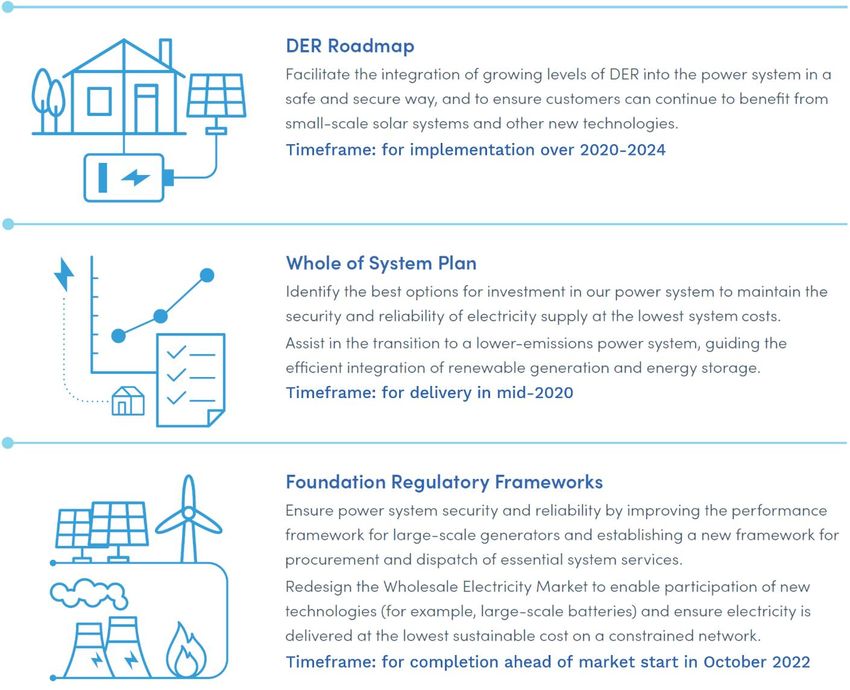
Transformation Strategy, as shown in Figure1, below.
Figure 1: Energy Transformation Strategy Workstreams
1
https://www.wa.gov.au/organisation/energy-policy-wa/energy-transformation-strategy
Issues Paper - DER Roadmap: Distributed Energy Resources Orchestration Roles and Responsibilities 5The DER Roadmap outlines a vision for a future where DER is integral to a safe, reliable and efficient
electricity system, and where the full capabilities of DER can provide benefits across the power
system and value to all customers.
There are three parts to this vision:
• A safe and reliable electricity system where customers can continue to connect DER and where
DER supports the system in an efficient way.
• DER capability offers value throughout the electricity supply chain.
• DER benefits flow to all customers, both with and without DER.
The DER Roadmap vision includes far greater DER participation in Western Australia’s Wholesale
Electricity Market (WEM) than exists today. To achieve this level of participation and enable greater
orchestration of DER, change will need to be made to the roles and responsibilities of the Network
Operator, the Market and System Operator, and Retailers or other entities who coordinate individual
DER components.
1.2 Guiding principles
This issues paper follows the same guiding principles outlined in the DER Roadmap.2 It also takes
into consideration the WEM objectives.3
WEM objectives
Pursuant to the WEM Rules the objectives of the WEM are to:
• Promote the economically efficient, safe and reliable production and supply of electricity and
electricity-related services in the South West Interconnected System (SWIS).
• Encourage competition among generators and retailers in the SWIS, including by facilitating
efficient entry of new competitors.
• Avoid discrimination in that market against particular energy options and technologies, including
sustainable energy options and technologies such as those that make use of renewable resources
or that reduce overall greenhouse gas emissions.
• Minimise the long-term cost of electricity supplied to customers from the SWIS.
• Encourage the taking of measures to manage the amount of electricity used and when it is used.
2
DER Roadmap, p.37, available at https://www.wa.gov.au/government/distributed-energy-resources-roadmap
3
Wholesale Electricity Market Rule 1.2 - Objectives, available at https://www.erawa.com.au/rule-change-panel/wholesale-electricity-
market-rules
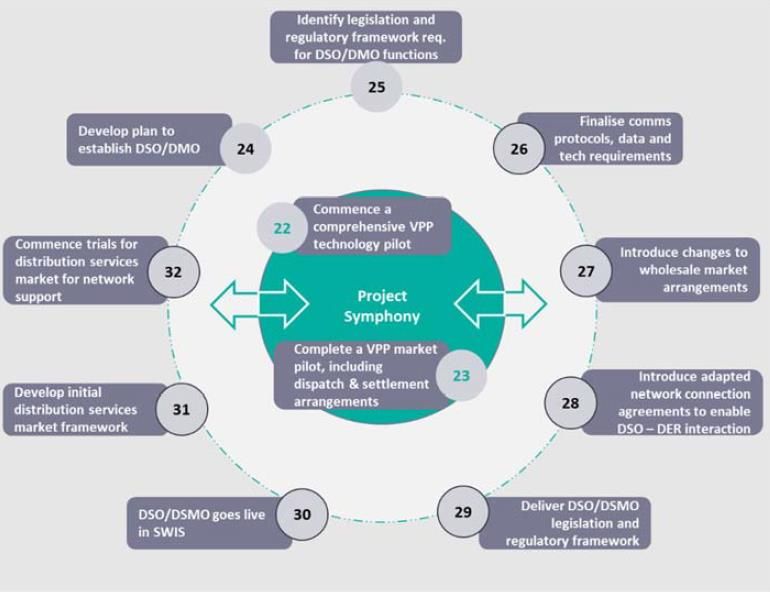
Issues Paper - DER Roadmap: Distributed Energy Resources Orchestration Roles and Responsibilities 61.3 Purpose of this paper This paper is the first step in addressing DER Roadmap Action 24: DSO/DMO Plan – Roles and Responsibilities. The capability of customers to interact with the power system will be increased by actions implemented as part of the DER Roadmap. This paper seeks to define issues for discussion on changes that will enable customer DER to provide services to the network and participate in the Wholesale Electricity Market. This paper discusses issues related to: • A Distribution System Operator (DSO). • A Market Operator that includes participation from DER, the DMO. • Aggregators of DER. • Customer protections and considerations. • Supplementary issues. The paper requests responses to 22 consultation questions, but stakeholder feedback should not be limited by these. 1.4 Background The DER Roadmap set out the high-level requirements and outlines many actions required to integrate DER into the electricity system and market. In a future with high DER penetration, it is expected that DER will eventually provide services that support the power system and are rewarded for doing so. For the SWIS, this will require an evolution of the roles of Western Power and the Australian Energy Market Operator (AEMO), and the entry of ‘DER aggregators’ to the market. The coordination of many individual customer DER by aggregators will allow small, distribution-connected electricity consumers to participate in the provision of services that benefit the power system. The development of mechanisms that allow DER to provide, and be compensated for, these services will open new value streams for customers and lower system costs. This issues paper provides further detail on how a DSO and a DMO model may look like in the WEM, as well as how these new functions will be established and their interaction with traditional roles in the system (such as retailers). Public comment is sought on these proposed roles to help in the development of policy and regulatory changes as there will be significant energy sector impacts associated with the transition. This paper does not address detailed issues of a technical, contractual or regulatory nature, but identifies these issues for future resolution and propose high-level positions that will allow further detailed design work. To deliver on the vision of enabling DER participation, the Roadmap outlines a series of Actions to conduct a DER Orchestration Pilot (Actions 22 & 23), and to define the DSO and DMO function set (Actions 24 to 32). These are listed in Table 1. Issues Paper - DER Roadmap: Distributed Energy Resources Orchestration Roles and Responsibilities 7
Table 1: DER Roadmap actions to facilitate DER participation. 4

    Roadmap           Roadmap               Description
    Action            Element

    24                DSO/DMO               By Dec 2020, develop a plan for the establishment of a DSO and DMO
                                            in the SWIS, including the identification of roles, functions, costs and
                                            practical operations. This plan should include an assessment of the
                                            costs and benefits to the system for the establishment of these
                                            functions.

    25                DSO/DMO               By December 2020, identify legislation and regulatory framework
                                            requirements including timeframes for development and implementation
                                            to establish DSO and DMO functions.

    26                DSO/DMO               By September 2021, finalise communications protocols, data and
                                            technology requirements to accurately predict and publish operating
                                            constraints on the distribution network under a DSO, and requirements
                                            for coordination with the system operator.

    27                DSO/DMO               By December 2021, introduce changes to wholesale market
                                            arrangements necessary to enable the participation of DER in the
                                            wholesale market via a DER aggregator.

    28                DSO/DMO               By June 2022, introduce adapted network connection agreements that
                                            enable the DSO, once established, to interact with devices on the
                                            distribution network.

    29                DSO/DMO               By December 2022, deliver a DSO/DMO legislative and regulatory
                                            framework, for transition to commencement by 1 July 2023.

    30                DSO/DMO               At 1 July 2023, DSO and DMO goes live in the SWIS, with active DER
                                            able to respond to meet network needs as well as be dispatched into
                                            the WEM and be compensated appropriately.

    31                DSO/DMO               By July 2023, develop the initial design of the framework for a
                                            distribution services market5 with fit for purpose arrangements for
                                            dispatch and settlement. Include an assessment of the cost and
                                            benefits of market creation.

    32                DSO/DMO               By July 2024, commence the development of trials for a distribution
                                            services market for network support.

These Roadmap actions align with other work under the Energy Transformation Strategy through
the Foundation Regulatory Frameworks workstream, in particular developing a new wholesale
market design, including a framework for the provision of Essential (Power) System Services (ESS).6

This paper makes the following assumptions:

•        Policy regarding the retail contestability threshold for small-use customers remains unchanged.
•        The uptake and cost of DER will continue in line with recent trends.
•        Associated DER Roadmap actions, such as work on inverter standards, communication
         requirements and the DER Orchestration trial progress in line with identified timeframes.

4
         DER Roadmap, p. 68, available at https://www.wa.gov.au/government/distributed-energy-resources-roadmap. Note that some
         dates have been amended to reflect updates following the publication of the DER Roadmap.
5
         A distribution services market is one for the provision of network support services to the DSO. This market is not envisaged to be
         needed in the short to medium term in the SWIS but may emerge in the future as DER capabilities evolve and saturation increases.
6
         Essential System Services were previously referred to as Ancillary Services.

Issues Paper - DER Roadmap: Distributed Energy Resources Orchestration Roles and Responsibilities                                        8
• The Western Power Advanced Meter Infrastructure (AMI) deployment schedule is achieved.
This issues paper builds on information provided in the following publications:
• DER Roadmap and supplements (Regulatory Settings Summary and DER Project Stocktake).
• Energy Transformation Taskforce Information Paper – Market Settlement: Implementation of
five-minute settlement, uplift payments and Essential System Services Settlement.
• Energy Transformation Taskforce Information Paper - Registration and Participation
Framework in the Wholesale Electricity Market.
• Energy Transformation Taskforce Information Paper - Essential System Services – Scheduling
and Dispatch.
• Energy Policy WA – Directions Report, Creating a dynamic customer protections framework for
behind-the-meter electricity services.
This paper does not seek to resolve or set out a final position on many of the practical implementation
issues that need to be addressed before the targeted ‘Go Live’ of a DSO and DMO on 1 July 20237,
such as consumer protections or the regulatory framework pertaining to new aggregation related
business models.8 While many of these are discussed or mentioned in the paper, the primary focus
is on defining functions, roles and responsibilities and where the boundaries of these lie. A series of
issues associated with these definitions are identified for industry consultation.
In assessing the options and pathway for implementation of DER orchestration in the SWIS the
Energy Transformation Taskforce will take into consideration the range of costs and benefits.
This paper will act as direct input for work on DER Roadmap Action 25: DMO/DSO Legislation and
Regulation Requirements and Action 27: DER Wholesale Market Arrangements.
Feedback provided to this issues paper will be taken into consideration in the development of a final
position paper which the Taskforce expects to release by the end of 2020.
1.5 Making a submission
The Taskforce invites feedback on the proposed roles and responsibilities outlined in this paper.
Comment can be submitted in any of the following ways:
1. Email your written submission to energytransformation@energy.wa.gov.au
2. Contact energytransformation@energy.wa.gov.au to arrange a one-on-one discussion.
3. Post your written submission to Energy Policy WA at Locked Bag 11, Cloisters Square, WA 6850.
Consultation on the issues paper closes at 5.00pm (AWST), 25 September 2020. Late submissions
may not be considered.
In the interests of transparency and to promote informed discussion, submissions will be made
publicly available on www.energy.wa.gov.au unless requested otherwise. Accordingly, stakeholders
should clearly specify if the information they provide is confidential and, where possible, should
separate confidential information from non-confidential information.
7
DER Roadmap, p. 68, available at https://www.wa.gov.au/government/distributed-energy-resources-roadmap
8
Many of these issues are captured under the Electricity Retail Licencing and Exemption Review being undertaken by Energy Policy
WA, more information is available https://www.wa.gov.au/organisation/energy-policy-wa/review-of-licensing-and-exemption-
regulatory-framework
Issues Paper - DER Roadmap: Distributed Energy Resources Orchestration Roles and Responsibilities 9Persons making any claim for confidentiality should familiarise themselves with the provisions of the Freedom of Information Act 1992 (Western Australia), which imposes obligations on Energy Policy WA in respect to the release of documents. Issues Paper - DER Roadmap: Distributed Energy Resources Orchestration Roles and Responsibilities 10
2.          The Electricity System Today
2.1         The clear and present challenge
The challenges facing the current electricity system are well documented in the DER Roadmap.

The SWIS was designed for one-way flows of energy from large generators, though transmission
networks down into distribution networks and finally to customers.

The rapid growth of rooftop solar photovoltaic (PV) has presented a new generation source that is
displacing large volumes of energy from utility-scale generation (including wind and solar farms) at
certain times. Energy from DER (self-consumed and exported) is currently largely not controllable
and has impacts on power system operations, energy markets and network investment. It is only
visible in the impact that it has on other elements of the power system and managing it relies on
forecasts and estimates of its output and behaviour.

Rooftop solar PV is particularly vulnerable to significant seasonal and daily variability and, if
unmanaged, will seriously threaten the security of the power system. The DER Roadmap concluded
that to avoid this risk and harness the benefits of rooftop solar and other forms of DER, these
resources need to be fully integrated into the operation of the power system. The aggregation of
DER through development of a two-way market in the SWIS, with enhanced roles for a Distribution
System Operator and a Distribution Market Operator, will be key to achieving this integration and
accommodation of emergent retailer business models.

2.2         Existing roles
The following roles are important in the managing the power system on a day-to-day basis:
Generators, the Network Operator, the System Operator, the Market Operator and Retailers.

The legislative frameworks that give power to these roles are listed in Appendix D: Legislative
framework in the SWIS.

Generators

Large generators respond to contractual arrangements with customers and dispatch signals from
AEMO. With few exceptions, large generators are connected to the transmission network and are
generally located some distance from the Perth metropolitan area.

More recently, the number of intermittent large generators, such as wind and solar farms, has grown
as a proportion of total generation capacity and this has implications for network, system and market
operations.

However, the profound dynamic is that customer premises, located deep within the distribution
network, have become generators as well as loads. The volume of electricity generated by
distributed solar PV has grown rapidly over the last 5 years and now represents a significant
proportion of total day time generation.

Currently energy exported from rooftop solar PV is not explicitly included in existing dispatch
processes, and its effects are only visible through reductions in the overall demand. Other generators
are effectively required to change their behaviour in response to the output from DER.

Issues Paper - DER Roadmap: Distributed Energy Resources Orchestration Roles and Responsibilities   11
Network Operator

Western Power, as network operator, operates the transmission and distribution network within
defined technical limits, and is responsible for managing new and existing network connections.
Constraints have traditionally been managed through the augmentation of network with new
investment in poles and wires. There are increasing opportunities to enable deferment of network
augmentation through deployment of efficient non-network alternatives for network support,
including battery storage.9

The recent rapid growth in rooftop solar PV has led to increasing two-way power flows and other
challenges for the network operator. Unlike the transmission network, visibility of power flows is
limited on the distribution network, although the deployment of AMI is improving capability.

System Operator

AEMO, as system operator, has responsibility under the WEM Rules to maintain system security
and reliability. This includes dispatching generation and demand management facilities, assessing
generation and network outages and determining ESS requirements.10 In this context, 'secure'
means that the power system operates within defined technical limits, and 'reliable' means that the
supply of electricity is adequate to meet demand.

Market Operator

AEMO, as market operator, is responsible for operating the WEM in accordance with the WEM Rules
and the related WEM Market Procedures. The current WEM design does not adequately
contemplate energy or services sourced from DER. For example, the energy purchased from rooftop
PVs and sold to customers on the distribution network is not captured in the same way as the energy
sold under contracts between large generators and retailers. Instead, it is largely presented as a
reduction to the notional wholesale meter.

The Energy Transformation Strategy is implementing market reforms that will help facilitate greater
participation for aggregated DER from large numbers of very small customers.

Retailers

Retailers buy energy and sell to end use customers, primarily via the Western Power network.

State Government policy limits retail contestability in the SWIS to customers who consume more
than 50MWh of electricity per year.11 Below this level customers can only purchase energy from
Synergy on regulated tariffs.12 Regulated tariffs are determined by the State Government as part of
the annual State Budget process.

Under various feed in-tariff and energy buyback schemes, Synergy has been required to offer
payment for the energy exported from eligible small-use customer rooftop solar PV systems.

Customers above 50MWh consumption per year have choice of retailer and there are several
operating in the SWIS. Retailers may enter into a power purchase agreement or other financial

9
      See the trial of PowerBank community batteries, Western Power’s Perenjori battery, and Energy Policy WA’s proposed changes to
      the Electricity Networks Access Code 2004, available at https://www.wa.gov.au/government/announcements/request-public-
      submissions-proposed-access-code-amendments
10
      More information is available at: https://aemo.com.au/energy-systems/electricity/wholesale-electricity-market-wem/system-operations
11
      More information is available at: https://www.erawa.com.au/gas/switched-on-energy-consumers-guide/can-i-choose-my-retailer
12
      This does not include customers within embedded networks such as caravan parks, apartments or shopping centres which are
      usually billed by the embedded network operator or owner, which may in turn be a contestable customer.

Issues Paper - DER Roadmap: Distributed Energy Resources Orchestration Roles and Responsibilities                                      12
arrangement with customers related to energy supplied from rooftop solar PV systems, but there is no regulated requirement to do so. As a result, energy from these systems ‘spills’ into the grid when it is excess to customer needs. This can have settlement implications for Synergy’s net energy position in the market even where it has no direct relationship with the customer. The increasing ability of many small-use customers to self-supply a large proportion of their energy needs is challenging the traditional retail models. Issues Paper - DER Roadmap: Distributed Energy Resources Orchestration Roles and Responsibilities 13
3.          The Future
3.1         The need for change
The AEMO’s 2020 Wholesale Energy Market Electricity Statement of Opportunities included, for the
first time, forecasts of minimum demand, noting that:

        ‘Strong uptake of behind-the-meter PV has continuously reduced the daytime minimum
        demand in the SWIS over the last three years. As early as 2023-24, minimum demand is
        forecast to fall below the 700 MW security threshold under the expected demand growth
        scenario.’13

and

        ‘In all scenarios, decreasing demand minimums are primarily driven by projected growth in
        behind-the-meter PV installations. In the expected growth scenario, installed behind-the-meter
        PV capacity is forecast to increase from 1,372 MW to 2,051 MW between 2020-21 and
        2024-25.’14

The DER Roadmap identifies that:

        ‘Increasing DER penetration, in combination with the anticipated increases in large-scale
        renewable generation, will displace the dispatchable synchronous generators that provide ESS
        such as inertia, frequency control, system strength and voltage control. At times of low load,
        such generators will bid into the energy market at low prices to ensure they get dispatched (in
        order to avoid high costs of shutting down and re-starting). Increasingly, the wholesale market
        is experiencing negative prices during some trade intervals – generators are now paying to
        stay on. Over time, it will no longer be economic for these generators to remain online,
        decreasing the availability of ESS.’15

As an alternative to costly interventions by AEMO, the DER Roadmap sees aggregation and
management of DER as a way of providing many of the services in the WEM as well as managing
day-to-day issues faced in the managing the Western Power network.

The potential for DER to provide these types of services has been recognised widely, and many
trials are underway locally, nationally and internationally that look at various aspects of DER
integration. These include:

• Western Power and Synergy PowerBank trials.
• Western Power Mandurah Demand Management Services.
• Western Power on-load tap changer functionality in distribution transformers.
• Horizon Power Onslow Power Project.16
• South Australia Virtual Power Plant (VPP) for distributed battery storage.17

13
      AEMO 2020 Wholesale Energy Market Electricity Statement of Opportunities, p. 8, available at https://aemo.com.au/energy-
      systems/electricity/wholesale-electricity-market-wem/wem-forecasting-and-planning/wem-electricity-statement-of-opportunities-
      wem-esoo
14
      Ibid, p. 62
15
      DER Roadmap, p. 30, available at https://www.wa.gov.au/government/distributed-energy-resources-roadmap
16
      DER Project Stocktake, p. 43, available at https://www.wa.gov.au/government/distributed-energy-resources-roadmap
17
      More information available at: https://virtualpowerplant.sa.gov.au/

Issues Paper - DER Roadmap: Distributed Energy Resources Orchestration Roles and Responsibilities                                     14
• AEMO VPP Demonstrations enabling DER to provide contingency frequency services in the
NEM.18
• ARENA/ANU Realising Electric Vehicle-to-Grid services trial.19
• Octopus (UK) for household load demand response at times of low system load.20
• OVO (UK) for EV fleet battery demand response for load/supply.21
• OFGEM (UK) work on the role of a DSO.22
Despite these trials, end-to-end integration of aggregated DER into the network, system
management and energy markets is a new and evolving process and there is limited precedent,
nationally or internationally, to follow.
The SWIS has different characteristics to most other large networks. The SWIS is an isolated power
system not interconnected with other grids and has a single integrated network operator that looks
after both transmission and distribution.23 Many of the models and solutions proposed in other
jurisdictions may not be directly applicable to the SWIS.
Western Australia does not have the luxury of waiting for the outcomes of national and international
trials or to follow the lead of approaches in other markets. The speed at which rooftop solar has been
installed in Western Australia, in part a result of the extremely favourable climate and solar resource,
and the increasing effects that it has on the power system, means that rooftop solar can no longer
continue to operate outside of the energy market, acting as an external distortion. It must be
integrated into power system operation and valued alongside other energy types to address the risks
outlined in the DER Roadmap.
3.2 DER Orchestration Pilot and development of the DSO,
DMO and aggregator roles
The DER Roadmap outlines an ambitious program of work to address the risks to system security
and stability. The relevant timeframes mean that it is necessary to undertake the DER Orchestration
Pilot (now known as Project Symphony) outlined in the DER Roadmap concurrently with the design
and implementation of the new roles outlined in this paper. There are substantial interactions and
dependencies between the work being undertaken as part of Project Symphony, and the
establishment of the DSO, DMO and aggregator roles.
It is critical to develop technical, customer and market requirements that ensure DER can support,
and not challenge, the efficiency, reliability and security of the SWIS into the future. Project
Symphony will consider the technologies, services, standards and processes, supporting regulatory
18
More information available at:https://aemo.com.au/en/initiatives/major-programs/nem-distributed-energy-resources-der-
program/pilots-and-trials/virtual-power-plant-vpp-demonstrations
19
More information available at: https://arena.gov.au/projects/realising-electric-vehicle-to-grid-services/
20
More information available at: https://octopus.energy/introducing-big-switch/
21
More information available at: https://www.ovoenergy.com/electric-cars/vehicle-to-grid-charger
22
More information available at: https://www.ofgem.gov.uk/publications-and-updates/ofgem-position-paper-distribution-system-
operation-our-approach-and-regulatory-priorities
23
The ERA has granted other distribution licences, but these have usually been in relation to mining activity. More recently, in March
2020, the ERA granted Enwave WA electricity distribution and electricity retail licences related to the operation of a microgrid
attached to the Western Power network. It is conceivable that in the future there may be multiple microgrids or embedded networks
with their own network operators. http://www.erawa.com.au/cproot/21089/2/Decision---Grant-of-EDL007-and-ERL028-and-
approval-of-standard-form-contract---Enwave-WA-Pty-Ltd.pdf
Issues Paper - DER Roadmap: Distributed Energy Resources Orchestration Roles and Responsibilities 15frameworks, market rules and proactive customer engagement to support successful and efficient
integration of DER.
The pilot will help to identify gaps in policy, processes and technology that are specific to the SWIS
through practical testing. Ideally, the orchestration pilot would be undertaken in advance of
implementation work. However, the pressing need to commence design work, and implement
changes in time to address the risks that have been identified mean an alternative approach is
required.
The Taskforce recognises that there are potential risks in conducting the pilot in parallel with
implementing regulatory and other changes. For example, the pilot may identify improvements or
practical difficulties after important design decisions have already been made. However, these risks
can be mitigated by proactive sequencing of policy determinations with outcomes from the
orchestration pilot. Learnings from the pilot will also provide an important evidentiary base to inform
the solutions put in place for the long term.
Project Symphony is currently being designed by Western Power, Synergy, AEMO and Energy
Policy WA. Over the next two and a half years the project will seek to resolve the practical challenges
of integrating DER as an active participant24in the market, and provide input to refine the functions
of relevant parties to enable DER to be orchestrated and managed in a coordinated manner as an
essential pre-requisite for the operation of a DSO and DMO.
Figure 2: Interaction between Project Symphony and the DER Roadmap
Note: Numbers refer to actions within the DER Roadmap.25
24
Active DER can respond to external instructions to that modify its behaviour, for example to charge or discharge a battery. When
‘aggregated’ in large volumes this can allow DER to replicate some services normally provided by large generators. Passive DER
acts independently of any instruction. This is distinct from autonomous capabilities of DER that automatically respond to
environmental changes, for example the use of volt-var settings in inverters to automatically lower output in response voltage rise.
Autonomous functions may exist in active or passive DER.
25
DER Roadmap, pp. 65-68, available at https://www.wa.gov.au/government/distributed-energy-resources-roadmap
Issues Paper - DER Roadmap: Distributed Energy Resources Orchestration Roles and Responsibilities 16Project Symphony will also build industry capability by progressively developing and testing the core
elements needed to optimally integrate DER for the benefit of all customers.
Specifically, the objectives of Project Symphony are to:
• Identify and test DER use cases.
▪ Network use cases - The ability of aggregated DER to deliver a range of network services
(as an alternative to transmission and/or distribution network upgrades) and the methodology
for valuing these services. Example network use cases include:
o voltage support; and
o network capacity support.
▪ Market use cases - The ability of aggregated DER to deliver WEM services, including specific
Essential System Services (such as frequency regulation). Example market use cases
include:
o frequency regulation;
o rate of change of frequency (RoCoF) control;
o contingency reserve;
o reserve capacity; and
o managing system low - any future service to maintain system strength.
▪ Retailer/Aggregator use cases - The ability of aggregated DER to navigate the multiple
market, network, retailer and customer specific value propositions that can be presented to
customers in a simple and understandable way. These may include:
o wholesale energy costs reduction (price arbitrage);
o Essential System Services payments;
o Reserve Capacity Payments (e.g. Capacity Credits);
o reserve capacity costs reduction (i.e. reduced Individual Reserve Capacity
Requirements);
o network costs reduction (e.g. reducing costs with respect to distribution tariffs);
o customer bill reduction; and
o customer specific value.
• Develop pilot prototypes of the platforms (such as Distributed Energy Resource Management
Systems (DERMS))26 and systems needed to operationalise DER integration and deliver on DER
orchestration elements of WA’s DER Roadmap.
26
DERMS can have varying interpretations may perform different functions for different entities. For clarity, this document will instead
refer to a DMO platform, DSO platform and aggregator platform as appropriate.
Issues Paper - DER Roadmap: Distributed Energy Resources Orchestration Roles and Responsibilities 17• Prepare a cost benefit analysis, supported by learnings from the project, which articulates the
overall costs and benefits of various options to integrate DER into the wholesale market.
• Prepare a social science / behavioural analysis, supported by learnings from the project, to
identify customer and stakeholder preferences regarding DER integration.
• Enable the customer journey of DER participation with exposure of a significant number of
Synergy customers directly and with third-party aggregators via a parent aggregator platform.
• Inform the development of policy, market design and regulatory reform required to integrate DER
in a fully functioning way in the market.
Practical elements of DER orchestration explored by Project Symphony will include:
• a map of responsibilities;
• control and communications protocols / processes between various parties, including the
development and testing of Application Programming Interfaces (APIs)27 for issuing deployment
instructions to individual DER;
• capability of distributed consumer-grade hardware to meet performance standards necessary for
real-time system security services;
• contractual relationships between customer and aggregator as well as between aggregator and
market and between child to parent aggregators;
• identifying commercial and regulatory requirements;
• template contractual arrangements; and
• understanding financial and data flows.
Further information on Project Symphony will be announced as the project progresses, and comment
on the project is not sought as part of this consultation.
3.3 New roles in the high-DER future
The DER Roadmap builds on work by the Open Energy Networks project (OpEN) exploring how
DER can be integrated into energy markets, and the entities and relationships that are needed to
achieve this.
OpEN modelled four different market frameworks for the integration of high levels of DER, and the
OpEN Hybrid Model28 has been used as the basis for developing a framework for the WEM.
27
A set of functions and procedures allowing the creation of applications that access he features for data of an operating system,
application, or other service.
28
More information available at:
https://www.energynetworks.com.au/assets/uploads/open_energy_networks_-required_capabilities_and_recommended_actions_r
eport_22_july_2019.pdf
Issues Paper - DER Roadmap: Distributed Energy Resources Orchestration Roles and Responsibilities 18This position was taken based on analysis undertaken by OpEN on the costs of implementing the
various models proposed, and on the characteristics of the power system and market in Western
Australia:
• There is only one network operator in the SWIS which operates at both the transmission and
distribution levels. The creation of a separate, independent DSO to coordinate the distribution
network would be inefficient as it would add costs and complexity.
• The small size of the SWIS (in terms of customer numbers) could limit the potential for a
sophisticated network support services market.
• The small size of the WEM means that duplication of functions in a second market operator to
issue dispatch requests to aggregators of distributed resources would add additional costs to
electricity supply that are likely to exceed benefits.
The proposed implementation of the Hybrid Model in the SWIS will see the existing network operator
(Western Power), and power system and market operator (AEMO) evolve to deliver expanded
functions associated with a DSO and DMO respectively29.
It is considered that changes would extend existing capability and not result in separate or distinct
business units within these organisations.
Consideration needs to be given to how the role of retailers will change when the existing retail
business model of providing energy based on high volume with low margin is eroded by the ability
of customers to self-supply most energy needs.
Figure 3: A possible DSO/DMO model for WA
Under this model, the individual customers have a relationship with an aggregator (for instance a
VPP provider), who may be an existing retailer, or a separate non-retailer energy services provider.
In order to offer DER services into energy, capacity and / or ESS markets, aggregators will need to
29
This approach was outlined at a high level in the DER Roadmap, pp. 44-45, available at:
https://www.wa.gov.au/government/distributed-energy-resources-roadmap
Issues Paper - DER Roadmap: Distributed Energy Resources Orchestration Roles and Responsibilities 19become market participants, or partner with a market participant. Some aggregators may choose
not to participate in the market but to only offer network support services.
Information about customer DER is passed from various aggregators to the DSO. The DSO takes
this information and combines it with the information it receives from its enhanced network monitoring
capability to map constraints and power quality across the distribution network. The DSO can use
this information to procure network support services30 from aggregated DER31 where it is cost
efficient.
This information, including information about DER which is providing ESS, is also passed to AEMO
to help it understand the overall status of the power system, undertake forecasting and coordinate
generation (and load) resources for dispatch in the wholesale market, and to manage system
security.
The potential for a market for network support services provided to the network operator is being
considered. However, the requirement to transition to a real-time market for these services (i.e. a
real-time market for services to Western Power) will be assessed in the future, and the DER
Roadmap does not envisage trials for this before 2024.
The full implementation of DSO, DMO and aggregator roles have several prerequisite actions,
including:
• defining and allocating functions, roles, responsibilities and operational data sets;
• developing market, technical, customer and regulatory requirements;
• developing a market interaction hierarchy and dispatch philosophy for DER;
• developing an implementation plan for DSO, DMO and aggregator functions;
• developing improved inverter standards (specifically the communications capability component);
• greater visibility of the distribution network and DER capabilities / status;
• the deployment of AMI;
• demonstrating performance of DER under real operating conditions; and
• establishing commercial arrangements.
Many of these prerequisites are being addressed through other DER Roadmap actions or Energy
Transformation Strategy work packages.
Where, through the experience of Project Symphony or other assessment, it is identified that there
is a need to depart from or vary the implementation of the hybrid model to improve efficiency or
reduce complexity for the SWIS, then that option will be taken.
30
Network support services are services that aggregated DER can offer to the network operator. DER Roadmap Action 23 will
implement changes to the Electricity Networks Access Code 2004 (including the introduction of a new chapter 6A) that will improve
the ability of Western Power to procure these alternative options. Further information can be found at
https://www.wa.gov.au/government/announcements/energy-transformation-strategy-proposed-changes-the-access-code-
open-public-comment
31
In some instances, it may be appropriate for the DSO (Western Power) to contract for network support services directly, for example
with large commercial or industrial customer.
Issues Paper - DER Roadmap: Distributed Energy Resources Orchestration Roles and Responsibilities 203.4 Whole-of-system optimisation
Whole-of-system optimisation in the presence of large volumes of active DER to deliver lowest-cost
energy is achievable where power system operations can be co-optimised with the market.
This raises the question of how energy from DER should be captured in the existing market
processes. Currently households and small businesses have the right to connect DER generation
systems up to technical limits set out in connection agreements. Energy that is surplus to local need
is usually automatically exported into the grid without regard for the wholesale market and can act
as a market distortion. This is one of the driving factors behind negative pricing events at certain
times of the year.32
As the volume of energy generated by DER grows, the level of demand served through the WEM
will reduce, and should it reach a certain minimum level will start presenting very challenging system
stability issues.
Constraining the output of DER is, of itself, not the long-term solution. The more efficient approach
is to establish mechanisms for DER to compete with other forms of generation, including large scale
renewables, to provide energy services to maintain the stability of the system. Incorporating and
managing DER in the market pricing and dispatch processes should result in better whole-of-system
optimisation and pricing outcomes.
Achieving whole-of-system optimisation requires coordination between:
• the DSO (Western Power) which uses the DSO platform to coordinate distribution-connected
resources and resolve localised issues, for example distribution constraints, where they exist;
• the System Operator which holds the single Market Platform and uses its centralised dispatch
system to balance total supply and demand; and
• the DMO as an extension of the current Market Operator function and which leverages the single
Market Platform for the coordination of market processes. This includes the dispatch of registered
facilities comprising aggregated DER, based on price offers and availability within the confines
of network limits (distribution and transmission), and the settlement of these resources.
This level of co-ordination will also enable market participants, such as aggregators, to manage the
complexity of delivering value to the market, network and their customers.
32
AEMO, Quarterly Energy Dynamics Q4 2019, p. 37, and Quarterly Energy Dynamics Q3 2019, p. 34 https://aemo.com.au/energy-
systems/major-publications/quarterly-energy-dynamics-qed
Issues Paper - DER Roadmap: Distributed Energy Resources Orchestration Roles and Responsibilities 214. New Roles
This section contains information on the expected functions and roles of the DSO, DMO and
aggregators as well as issues that need to be addressed.
4.1 Distribution System Operator (DSO)
A Distribution System Operator (DSO) enables access to the network, operates and
develops an active distribution system comprising networks, generation, demand,
and other flexible distributed energy resources (DER).
A DSO, with visibility of power flows, constraints and DER on the network, will be required to manage
the network within technical limits, identify when network issues emerge and act to manage these
issues in an efficient manner. To do this, the DSO will need to see the flow of power across the
distribution network in real time.
Where an issue on the network emerges, the DSO can enter into contracts with aggregators which
can provide network support services if such services have a lower cost than augmenting the
network. Aggregated DER that provides a service to the DSO33, and the consumers who own the
individual DER components within the aggregation, would expect to be compensated for the network
support services provided.
There is also a requirement to ensure DER interacts with the broader system (i.e. at a transmission
system level) to avoid any action on the distribution network causing disruption. The DSO should
create and publish ‘Operating Envelopes’34 that describe any constraints on the distribution network.
Where a transmission or distribution network issue has emerged, and a DER aggregator has been
instructed to alleviate the issue, these instructions must be incorporated into communications
between DSO and DMO to provide visibility for system operation and market purposes. This ensures
that the power system at all levels remains secure at least cost.
As identified in the DER Roadmap, in the high-DER future, the DSO role is a natural extension to
Western Power’s role as the regulated monopoly distribution and transmission network service
provider.35
It is efficient to augment and extend Western Power’s functions in regard to network operations,
planning and asset management into a DSO role to support the optimal use of active DER on the
distribution network and delivery of secure, sustainable and affordable electricity as part of
whole-of-system optimisation. Some of these responsibilities are extensions to the distribution
network of activities already undertaken by Western Power at the transmission level.
33
In some cases, larger DER may contract directly rather than via aggregation, for example very large commercial or industrial
customers.
34
Operating envelopes indicate to customers the export and / or import limits that they must operate within for the safe and secure
operation of the network. To update the envelopes, data needs to be collected in near real time. Algorithms are then executed to
define the network state, based on the data. Constraints determined by these algorithms would then be communicated, based on
standard protocols.
35
DER Roadmap, pp. 44-45, available at https://www.wa.gov.au/government/distributed-energy-resources-roadmap
Issues Paper - DER Roadmap: Distributed Energy Resources Orchestration Roles and Responsibilities 22Table 2: Proposed responsibilities of the DSO
Responsibility
D1 Determine technical arrangements for the connection of DER.
D2 Review and approve connection applications for DER assets. This includes assessment of network
capacity and requirements within a given area.
D3 Manage the commercial and technical control of DER connections, as allowed by the signed
connection agreement and regulatory frameworks.
Note - currently the commercial contract for connection to the network is via retailer as per linear
contracting relationship.
D4 Collate information on DER and provide it to AEMO for the purposes of establishing, maintaining
and updating a DER register.
Note - the DER register will only gather static information when initially implemented.
D5 Develop static and/or dynamic constraint equations at the distribution level that describe the transfer
limits of the network.
Note - the depth of visibility required is still to be determined.
D6 Provide a static and/or dynamic operating envelope to aggregators/retailers/AEMO for all active
DER (at the connection point).
Note - the specifications of the dynamic operating envelope are yet to be developed.
D7 Plan, install and manage links to aggregators/retailers/AEMO to disseminate information about the
static and/or dynamic operating envelopes at a specific location or interface.
D8 Create and/or administer systems, such as a DSO Platform, to enable the visibility of power flow
across the distribution network, and to provide visibility of, and means of managing, issues on its
network in real time when they emerge.
This will also support the DSO where distribution network issues have emerged, and an aggregator
has been engaged by the DSO to alleviate the issue.
The consequential actions must be addressed by the System Operator (AEMO) as part of
whole-of-system operation. This will ensure the power system at all levels is securely and reliably
operated and maintained.
D9 Develop processes within the DSO platform that allow the network operator (DSO) to request
network support services where needed and available to meet network support requirements.
D10 Provide information on the deployment of network support services to allow the Market Operator
(DMO) to consider the impact of these services on the broader power system.
D11 Planning network investments that deliver economic benefit.
4.1.1 DSO issues and policy questions
The following issues have been identified as related to DSO functions.
• Network Monitoring - Consideration of the need for network monitoring devices at critical
points of the network over and above any network visibility provided by advanced meters.
Issues Paper - DER Roadmap: Distributed Energy Resources Orchestration Roles and Responsibilities 23The cost and benefit of deep visibility versus representative sampling should form part of this
consideration.
• Platform Development - Evaluate what type of platform(s) and interfaces would be required
between the network operator, market operator and aggregators.
• Operating Envelopes - Regarding the communication of operating envelopes, consideration
needs to be given to its implementation and content, for example:
▪ What is the most appropriate instrument to define it (e.g. Technical Rules)?
▪ For which parties is the information intended (e.g. aggregators, AEMO)?
▪ What level of detail is required (e.g. NMI, zone substation)?
▪ What frequency is required (e.g. every 5 minutes)?
• Procurement - Transparency around the processes and appropriate market interactions
when a DSO obtains network support services needs to be considered.
• Network vs private assets - Transparency around the interaction of network-owned assets
and third-party aggregator schemes providing constraint relief needs to be considered.
• DER access and connection agreements - Agreement needs to be reached on the level
of access able to be provided, the contracting arrangements for such access (noting the
current linear contracting relationship36) and the need for dynamic connection agreements37
(including how DER, subject to dynamic connection arrangements, will be operationally
discharged via aggregators).
• Dynamic connection agreements - Agreement needs to be reached on the scenarios and
contingencies that a dynamic connection agreement will cover, the interaction between the
DSO and DMO when such contingencies occur, and the role of the aggregator.
• Capacity market - The interaction of aggregated dynamic connection agreements and the
capacity market needs to be considered.
• Network charging - Requirement for specific use-of-system charges for bi-directional
customers needs to be examined. Some jurisdictions have raised concerns about the
disparity between grid scale generators and DER in terms of how access is provided and
charged for.38 However, by far the majority of DER is co-located with small-use customer
load and these customers already contribute to network costs as part of existing distribution
tariffs, noting that network tariffs associated with small-use customers are currently structured
differently to large connections and are averaged across the customer base.
• Equity in curtailment - Consideration needs to be given to ensure that DER which is
managed directly is not unfairly disadvantaged. Currently there are no guidelines or
processes to assist aggregators in treating all DER providers equitably. There is also a need
to ensure that non-contestable customers are treated fairly.
• Reliability and market services - It should be considered how the hierarchy of DER
response can be governed (e.g. network needs first, market second).
36
In the WEM, for most electricity consumers, the retailer holds the access contract with the network (Western Power) on behalf of
customers. This is known as a linear contracting relationship, as distinct from the NEM where customers have a direct contractual
relationship with the distribution network operator.
37
Dynamic Connection Agreements (DCAs) are the mechanism through which dynamic limits can be implemented, unlocking
benefits for customers, networks and other parties. deX, Application and deployment of Dynamic Connection Agreements for
distributed energy resources (DER), p. 6, available at:
http://www.coagenergycouncil.gov.au/sites/prod.energycouncil/files/publications/documents/GreenSync%20attachment%20deX%
20Discussion%20Paper%20-%20Dynamic%20Connect%20Agreements%20%28DCAs%29.pdf
38
Further exploration of this issue can be found at: https://arena.gov.au/knowledge-bank/deip-access-and-pricing-reform-package-
outcomes/
Issues Paper - DER Roadmap: Distributed Energy Resources Orchestration Roles and Responsibilities 24You can also read


