Launch Webinar April 28, 2020 Maria Vargas, Jenny Heeter, Kyle Fricker, Krystal Laymon - energy.goveere/solar/national-community-solar-p...
←
→
Page content transcription
If your browser does not render page correctly, please read the page content below
Launch Webinar               Maria Vargas, Jenny Heeter,
                          April 28, 2020               Kyle Fricker, Krystal Laymon
energy.gov/solar-office    energy.gov/eere/solar/national-community-solar-partnership
Today’s Agenda
    1. Welcome
    2. State of community solar
    3. Opportunity space
    4. National Community Solar Partnership overview
    5. How to get involved
    6. National Community Solar Partnership program elements
       a. Network
       b. Technical Assistance
       c. Collaboration
    7. Q&A
                                                               2
energy.gov/solar-office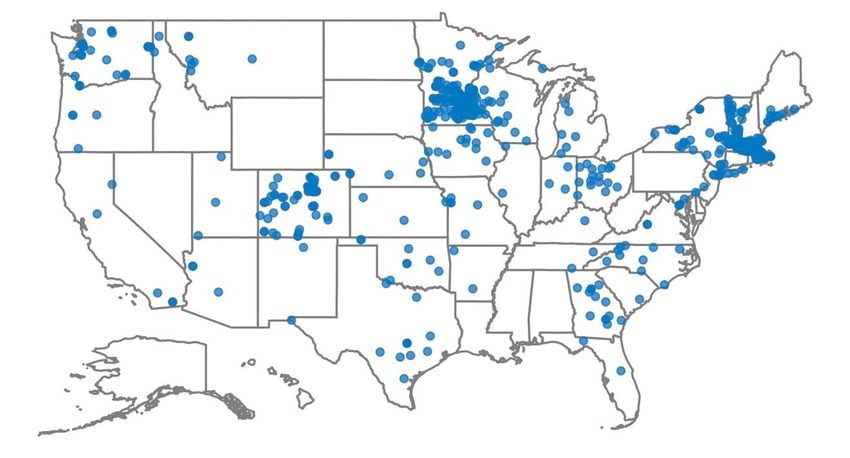
Today’s Webinar
    • All participants are muted so all can hear
    • Engage with us via Polls function in WebEx
    • We will do Q&A at end of presentation. Please use WebEx Q&A
      function to add your questions, not Chat.
    • Slides will be posted on DOE’s National Community Solar Partnership
      website after the meeting

                                                                            3
energy.gov/solar-office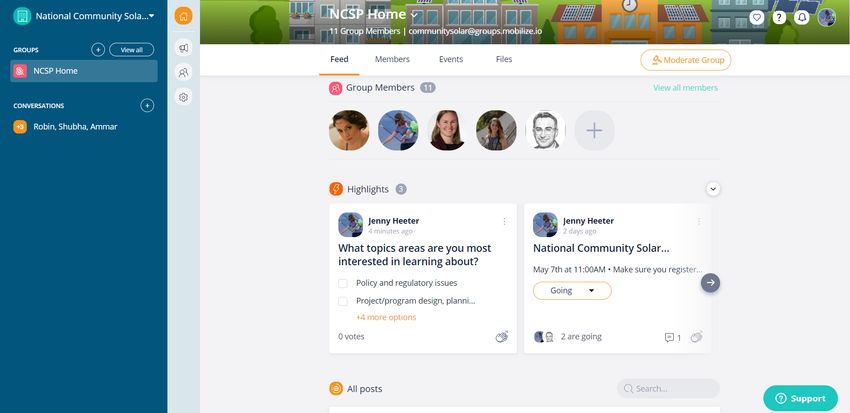
Poll #1 - Breaking the Ice
    1. Who is on the call today?
            •    Federal government                       •   Financial institution
            •    State, local, or tribal government       •   Educational institution
            •    NGO / community org                      •   Trade / member association
            •    Solar developer                          •   Software vendor
            •    Utility company                          •   Other
    2. What do you work on in community solar?
            • Implementing projects/programs
                        Design, development, financing, customer acquisition/subscription/management
            • Facilitating projects/programs
                          Policy, member associations, technology provider, analysis

                                                                                                       4
energy.gov/solar-office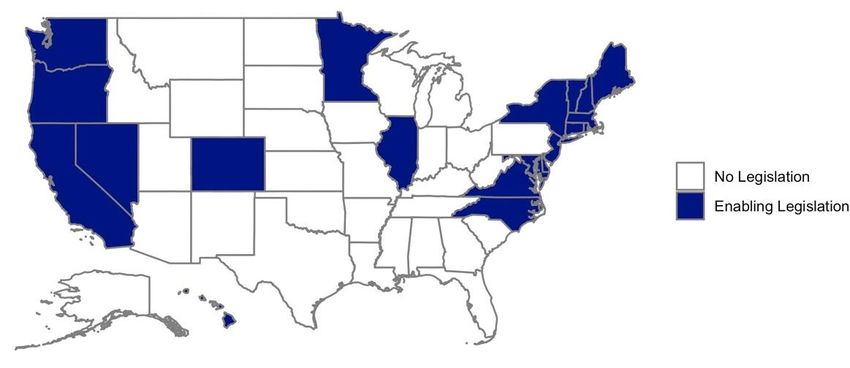
The State of Community Solar
Jenny Heeter, Senior Energy Analyst

April 28, 2020
What is Community Solar?
                                                    The Key Criteria
Community solar, for the         Financial benefits: All community solar products convey
purposes of this research,       some part of the financial gains of electricity generation
                                 to subscribers. Community solar products may also but
refers to a product where the    do not necessarily include non-financial benefits such as
                                 environmental benefits (e.g., renewable energy
financial benefits of a single   certificates).
solar photovoltaic array are     Exclusive: All community solar programs are exclusive,
                                 meaning that they serve some exclusive set of
distributed among an exclusive   subscribers within a utility or community choice
group of customers that have     aggregation service territory.

chosen to subscribe to the       Chosen: Participation in community solar is always
                                 discretionary. Subscribers opt into the program, either
program.                         through contractual payments or some non-financial
                                 transaction.

                                                                                      NREL | 6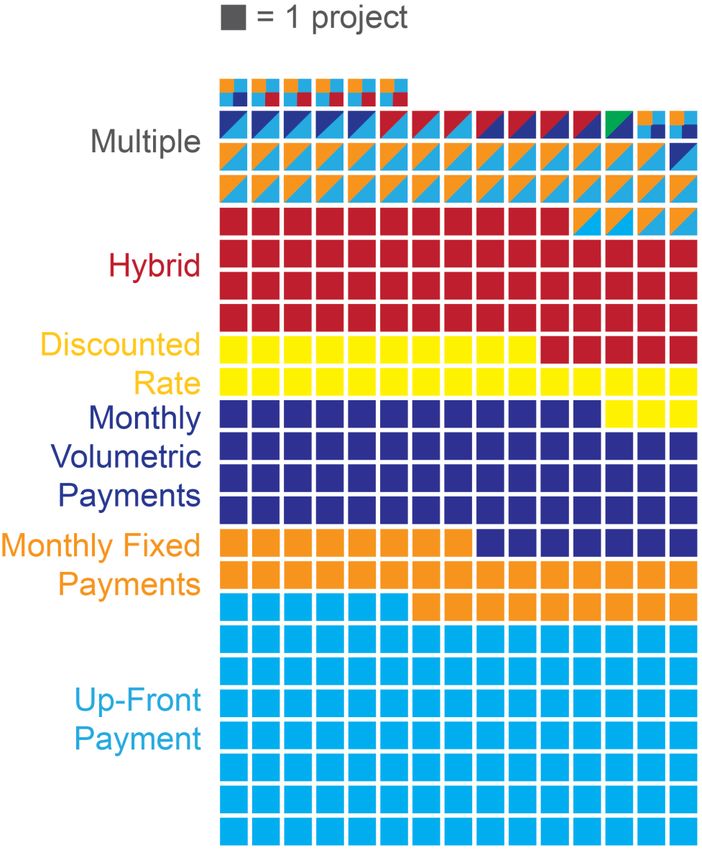
Quiz

•   >90% of the community solar market (MW basis) is located in how many states?
     – 10
     – 20
     – 40
•   What percent of community solar projects have a positive net present value (NPV) for
    residential subscribers?
     – >10%
     – >50%
     – >80%
•   How many states have community solar projects with a low- and moderate-income focus?
     – 2
     – 10
     – 25

                                                                                       NREL | 7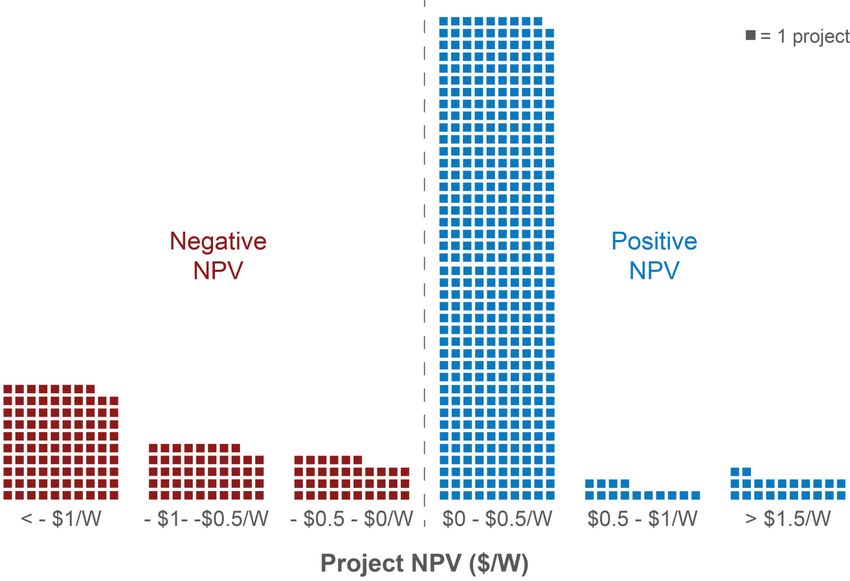
The Community Solar Market in 2018

By the end of 2018, we estimate that there were at least 1,184 MW-AC of
community solar capacity distributed across 811 projects in 39 states and
Washington, D.C.

                                                         Community solar projects
                                                         active as of end of 2018

                                                                                NREL | 8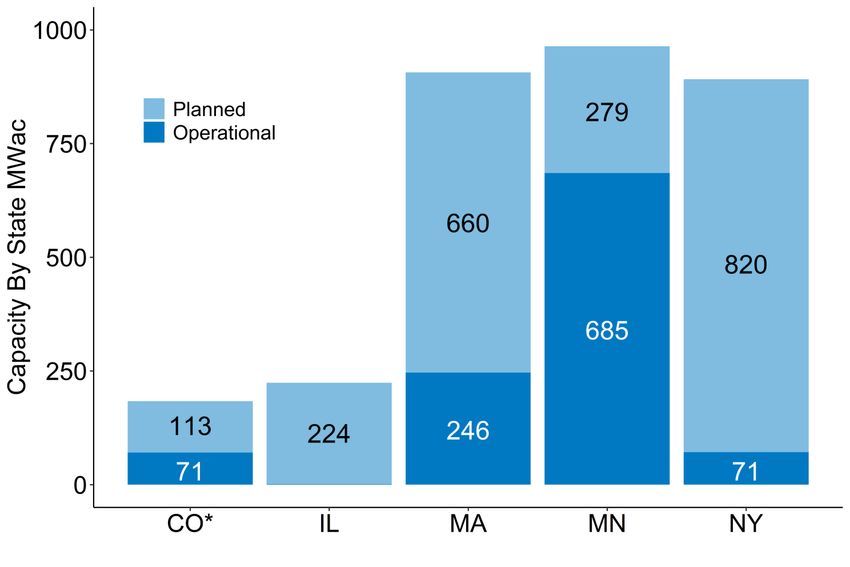
Community Solar State Policies

•   20 states and Washington, D.C.
    have passed some form of
    legislation enabling community
    solar, either through statewide
    programs or the authorization of a
    limited number of pilot projects.
•   These programs vary in scope, but
    they generally all allow for some
    form of virtual net metering so that   State-level community solar enabling
    subscribers can benefit from their     legislation
    community solar subscriptions.

                                                                                  NREL | 9
Enacted Community Solar Policies:
2019-2020 Community Solar • New York- 19-M-0463 Passed Consolidated Billing for Distributed
Energy Resources
•
Policy Snapshot Maine- Implemented LD 711- An Act to Promote Solar Energy Projects
and Distributed Generation Resources in Maine
• New Jersey- Approved TRECs, the transition program away from Solar
Renewable Energy Credit SREC program, and approved 45 new
Community Solar Projects to increase capacity for the community solar
pilot program
• Colorado- Passed HB19-1003 amending the Colorado Solar Gardens
Modernization Act to raise the cap on community solar gardens
maximum size
• California- California Energy Commission approved a project for
community solar to substitute for the solar panels to be installed on all
newly constructed homes, setting precedent for 2019 Energy Code
• New Hampshire- Implemented SB 165- Relative to net energy
metering by low-moderate income community solar projects
• Virginia- Recently passed 5 community solar specific bills (SB 710,
HB1184, HB 572, HB 573, SB 629 )-Effective July 1, 2020
Introduced Community Solar Policies:
• Minnesota- Introduced two bills (SF 3213 & HB 3368) to modify their
Community Solar Gardens Program in 2020
• Missouri- Introduced HB 2490 an Act Establishes provisions for
community solar gardens in 2020
• Illinois- Introduced in 2019, HB 3624- the Clean Energy Jobs Act was
put on the 2020 legislative calendar and expands the Solar for All
2019-2020 Policy Updates program
• Massachusetts- Introduced Bill S. 2500: An Act setting next-generation
climate policy and updating Solar Massachusetts Renewable Target
(SMART) Program
• New York- NY State Energy Research and Development Authority
(NYSERDA) request additional funds for NY Sun Program
NREL | 10Community Solar Capacity in Queue
Community Solar Capacity in Key States (Q3 2019)
• As of Q3 2019, five States (CO, IL, MA,
MN and NY) have the most
community solar capacity in queue.
Over 2,000 MWac in queue
Solar DC output capacity
has been converted to AC
rated output based on 1.24
DC/AC ratio
• In addition, Florida Power & Light
received approval of 1.4 GW
community solar.
Operational data come from the NREL/UMN Sharing the Sun Data List. CO*: Colorado installed solar capacity only includes
projects under Xcel program; IL: Planned capacities include the adjustable block program and solar for all sub-program; MA:
Planned capacities include SREC II (converted to AC) and SMART program; MN: Planned capacities only includes projects
under Xcel program; NY: Planned capacities are converted to AC output.
The solid blue represents the cumulative rated AC power output (MW) for community solar in operation by corresponding NREL | 11
year in corresponding state. The semi-transparent blue represent capacity in queueDeployment by State
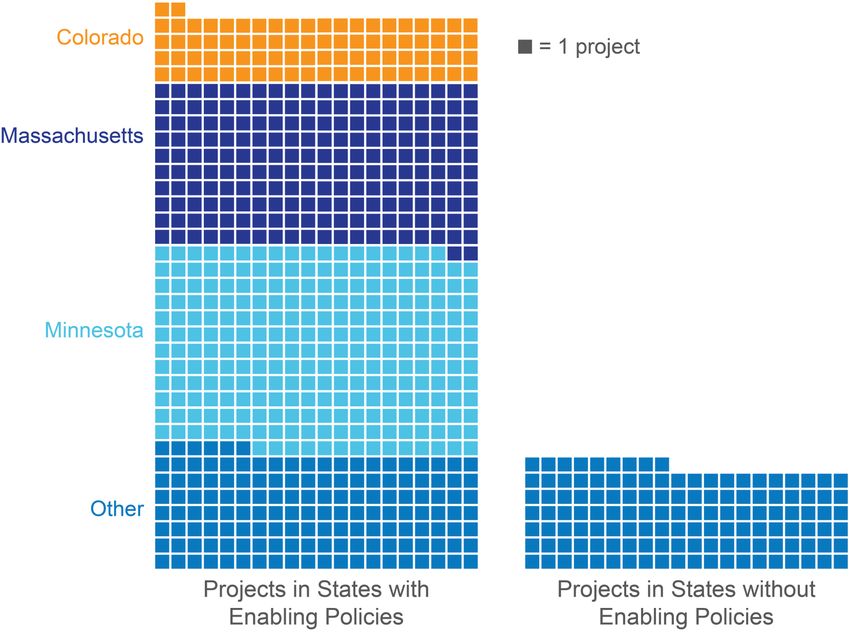
• About 76% of capacity and 84%
of projects are located in states
with enabling legislation,
dominated by capacity and
projects in Colorado,
Massachusetts, and
Minnesota.
• Legislation is not a prerequisite
for a community solar market.
There are about 279 MW in
129 projects located in 23
states without enabling
legislation.
NREL | 12More than 80% of Projects have a Positive Net
Present Value (NPV) for Residential Subscribers
• To evaluate the community solar value
proposition from the perspective of
residential subscribers, we estimated the
NPV under the various contracts offered
by each project, where data were
available. (See the Appendix for details
on the NPV modeling assumptions.)
• The median project-level NPV is about
+$0.37/W (sensitivity range: +$0.20/W
to +$0.46/W) and about 83% (sensitivity
range: 74 - 86%) of projects yield a
positive NPV, meaning that most projects
result in positive net benefits to the
customers over the course of the
subscription.
Distribution of Project-Level NPVs
NREL | 13Residential Payment Terms are Diverse
• Up-front payments are the most common
payment structure, offered in about 46% of
projects, followed by monthly volumetric
payments (22%).
• About 21% of projects offer a hybrid model
(combining different up-front and monthly
payments).
• About 15% of projects offer multiple payment
structures, most commonly a combination of
upfront and fixed monthly payments.
• About 8% of projects offered a fixed
discount over the customer's electricity rate
instead of a payment.
Distribution of Program Payment
Methods NREL | 14States are Expanding Low- and
Moderate-Income (LMI) Access
14 states and Washington, D.C.
have a policy or program
supporting LMI community
solar capacity.
DC
California, Michigan, and
Florida have new voluntary
programs.
Carve-out
Incentives/Grants
Multifamily housing
To be determined
Note: See appendix for state policy references. In addition, MN Solar*Rewards Programs 2019 will provide incentives to
both low-income nonprofit and multifamily qualifiers Voluntary Program
NREL | 15>20 MW of LMI Community Solar
Installed and >150 MW Pending
State Community Solar Capacity for LMI Customers • Based on the most recent data, 21.6
45 MW of community solar serving LMI
customers are in operation, and 155.6
40
MW are planned. This LMI capacity will
35 benefits over 40,000 LMI households,
once in operation.
30
MW-ac
25 • LMI projects are developed through:
20 – State community solar
programs with an LMI carve-out
15
(CO, CT, MD, NJ, OR)
10 – State community solar program
5
with an LMI adder (MA)
– State LMI community solar
0 program (DC, IL, NY)
CA CO CT DC IL MA MD NJ NY OR
– LMI community solar project
Installed Pending investments (CA)
Community Solar 101, NREL Presentation (2020)
Sharing the Sun: Understanding Community Solar Deployment and Subscriptions, NREL Presentation (2020)
NREL | 16Summary
• Community solar is growing rapidly but is heavily
concentrated in a small number of states.
• The net present value of community solar subscriptions is
positive in states with high levels of deployment.
• A few states and utilities have developed LMI community
solar programs and projects.
NREL | 17Persistent Barriers Limiting Solar Access
Technological Barriers
• Lack suitable roof space
• Rent home
50%
• Live in multifamily buildings
Financial Barriers
• High up-front expense
of Americans
• Lack of competitive interest rates
cannot access
• Few options for those with a low credit score and/or
rooftop solar* income below traditionally acceptable underwriting criteria
• Inability of tax-exempt businesses and certain LMI
populations to use the Investment Tax Credit
* Shared Solar: Current Landscape, Market Potential, and the Impact of Federal Securities Regulation, NREL Technical Report (2015)
https://www.nrel.gov/docs/fy15osti/63892.pdf
18
energy.gov/solar-officeValue of Increasing Access to Solar Energy
• Enable financial benefits from solar to flow to everyone
and every community
• Increase the demand for solar energy
• Drive innovation
• MORE actors + MORE familiarity = MORE ideas
19
energy.gov/solar-officeNational Community Solar Partnership (“NCSP”)
The National Community Solar Partnership is a coalition of community solar stakeholders working
to expand access to affordable community solar to every American household by 2025.
20
energy.gov/solar-officeGoals of the Program
Make community solar accessible to every U.S.
household
Ensure community solar is affordable for every
U.S. household
Enable communities to realize supplementary
benefits and other value streams from community
solar installations, such as increased resiliency and
workforce development
21
energy.gov/solar-officeApproach
Network Infrastructure: Partners have access to an online
community platform, virtual and in-person meetings, webinars
and other tools to engage with U.S. Department of Energy
(DOE) staff and each other.
Technical Assistance: Partners have the opportunity to receive
technical assistance resources from DOE, its National
Laboratories, and independent third-party subject-matter
experts for support on unique local challenges.
Collaboration: Multi-stakeholder teams of partners form groups
around specific goals to address common barriers to solar
adoption by learning from each other and sharing resources.
22
energy.gov/solar-officePartner Experience
Self
Register Goal setting
assessment
Action
Apply for TA Find partners
planning
Help others
Work to
Share data achieve their
achieve goal(s)
goal(s)
23
energy.gov/solar-officeWho are NCSP partners?
Local State
Utilities Non-profits For-profits
Governments Governments
Investor National
Cities Regulators Developers
owned scale
Community
Counties Agencies Cooperatives Financiers
groups
Regional
Legislatures Public Power Academia Consultants
planning
24
energy.gov/solar-officeWho are NCSP partners?
2C Mississippi High Peaks Solar, LLC PowerSetter
Alder Energy Systems HOPE Village CDC Puget Sound Energy
Appalachian Voices Illinois Power Agency Saginaw Chippewa Indian Tribe of Michigan
Arcadia Intelli-Products Inc. Seattle Housing Authority
BlueHub Energy Katsujinken Foundation Solar One
Boulder County Litty Solar Solar United Neighbors
Cadmus Group LLC Marketingforgreen LLC Solstice
City of Cambridge, Massachusetts Mid-Ohio Regional Planning Commission Spark Northwest
City of Jackson, Mississippi MIrasol Solar Stewards of Affordable Housing for the Future
Clean Energy States Alliance Montana Renewable Energy Association TeraVolt Energy
Cleveland Owns muGrid Analytics Texas Energy Poverty Research Institute
CVE North America Nautilus Solar Energy, LLC The Energy Coalition
Decent Energy, Inc. New Mexico Energy Minerals and Natural To the Point
Energy Solutions Resources, Energy Conservation and Transduction Technologies
Energy Trust of Oregon Management Division University Of Alabama at Birmingham
Fosterra, LLC North Carolina Clean Energy Technology Center US Department of Agriculture
Fresh Energy Office of the People's Counsel of DC Vote Solar
Great Lakes Renewable Energy Assoc Ohio University World Resources Institute
GRID Alternatives PACE Fund NM, Inc. XUTILITY
Hawaii Green Infrastructure Authority Paseki Strategies Corporation YSG Solar
Hawaiian Electric Company PowerMarket
25
energy.gov/solar-office As of April 27thJoin Us!
• Commit to:
NCSP Partner Goals include:
• Active engagement Create first low income CS project
• Data and information sharing in Mississippi
Provide benefits of local solar to
• Goal setting/ impact evaluation 100,000 LMI households reducing
their energy bills 50% by 2032
• In return, DOE will: Site CS within Opportunity Zones,
provide subscription options to
• Facilitate network low-income customers
• Offer technical assistance Implement the Oregon CS
Program and achieve the
• Develop and disseminate practical resources program's equity goals
• To join, visit
https://www.energy.gov/eere/solar/national-community-solar-partnership
Note on Partner Eligibility: The NCSP welcomes participation from all entities that meet the following requirements: (a) citizens or permanent residents of the United
States; (b) private or public entities, such as townships, tribes, corporations, governmental agencies, or other organizations that are legally formed in and maintain a
primary place of business in the United States.
26
energy.gov/solar-officePoll # 2 - Checking In
1. Which part of NCSP are you most excited about?
• Network (online platform, events, meetings)
• Technical assistance
• Collaboration with peers
2. Are you already a registered partner?
• Yes
• No
27
energy.gov/solar-officeRegister here:
Community Platform https://ncsp.mobilize.io/registrations/groups/39758
Capabilities
Social networking
Ideation / Crowdsourcing
Partner directory
28
energy.gov/solar-officeApproach to ImpactTraining
Evaluation
coming soon!
• Support every partner in goal setting and action planning
• Guide partners in using a highly effective evaluation framework
• Help partners monitor progress and evaluate impact over time
Training
coming
soon!
29
energy.gov/solar-officeNCSP Technical Assistance Coming Soon
Registered NCSP Partners can apply for direct technical
assistance to help accelerate their community solar goal(s)
Webinar on TA Selected
TA TA Applications
Application and Applications
Announcement Due
Review Process Notified
Wednesday, 4/29 Thursday 5/7 Friday 5/29 June 2020
30
energy.gov/solar-officeNCSP Technical Assistance Offerings and Selection
Co-location benefits community Project finance (e.g., cost-benefit
Important Notes:
solar can provide analysis, subscription structures,
finance considerations and modeling TA is only available
Co-location technical challenges or
valuing the benefits incentives structures for low-and- for registered
Customer acquisition, subscriber moderate income NCSP Partners
management, and billing communities/households) TA application is
Integration with existing Project planning and development not for duplicative
state/NGO/utility energy programs Regulatory issues work (for example
Integration with other technologies Resiliency of energy systems, grid
work happening in
(e.g., storage) impacts, and interconnection
another DOE
Outreach and engagement with Solar modeling, analysis, and tool
development project)
governments/public officials, low-
income communities/households, or Workforce development
utilities
Program and project evaluation
Technical Assistance Providers include National Lab
Program design
staff and third-party subject matter experts
31
energy.gov/solar-officeCollaboratives Enrollment Open
A collection of organizations engaged in peer learning and that receive direct
assistance to accelerate a partner’s community solar goal(s) and identify
sector challenges and replicable solutions for a two-year duration.
First Collaboratives Future Collaboratives Commitment Value Proposition
• Municipal Utilities • DOE will launch new • Collaborative • Peer network
(“Muni”) Collaboratives in the agreement between • Targeted webinar
• Multifamily future based on DOE and partner to series
Affordable Housing partner interest work together, share • 1-on-1 access to
(“MFAH”) data/information, DOE/SMEs
and amplify
• Technical assistance
solutions
32
energy.gov/solar-officeGeneralized Collaborative Timeline
Milestones
Sign Collaborative
Partner
Develop an Annual
Partnership Kick-Off Complete
Action Plan Meeting
Agreement Meeting
Present 2 months 6 months 2 Years
targeted webinars, peer learning, technical assistance
Outcomes: replicable models and solutions to industry barriers that
accelerate community solar and underserved solar access via outputs
including case studies, road maps, guides and other actionable resources.
33
energy.gov/solar-officeMFAH Collaborative Muni Collaborative
Goal: Create and/or scale affordable community Goal: Create and/or scale muni programs
solar access in multi-family affordable housing that provide affordable community solar
units to low-income and other underserved access to low-income and other underserved
communities. communities.
Low-and moderate-income households Currently very few municipal utilities have
reside in 60% of multi-family housing unit community solar offerings
Common Barriers: Financing, Split Incentives, Common Barriers: Siting, Procurement /
Tenant Benefits, Capacity of MFAH Building Contracting, Unique organizational structures,
Owners Project finance
Overall Goals: Overall Goals:
Achieve individual partner goals Achieve individual partner goals
Demonstrate replicable models in Demonstrate replicable models in munis
MFAH for solar energy deployment that for solar energy deployment and offer low or
reduce resident’s monthly electric utility no-fee subscriptions that result in energy bill
bills by at least 10% savings for low-income residents
34
energy.gov/solar-officeCollaborative Agreement
Collaborative Partners Agree to: DOE Agrees to:
• Appoint a collaborative lead and assemble a • Engage: Appoint a point of contact for each
team of key stakeholders needed to achieve collaborative member and schedule check-ins
goals, within the first month with each member during the collaborative’s
• Work with DOE to complete a self-assessment, active period
set specific goals/metrics, identify critical • Facilitate interactions between members, other
barriers, and create an action plan NCSP partners, and subject matter experts
• Work to complete action plan over 2 years through virtual and in-person engagements.
• Provide technical assistance to develop solutions
• Work with DOE to collect data to track progress that help to overcome identified barriers.
on individual action plan goals and support • Develop resources that facilitate
benchmarking and evaluation of community implementation of solutions by other NCSP
solar models for the NCSP partners and stakeholders across the country.
• Document lessons learned and share DOE and • Provide public recognition of members for
other NCSP partners to contribute to NCSP’s achieving milestones and commitments.
evaluation and best practices of the program
35
energy.gov/solar-officeUpcoming Meetings
Date Meeting Detail
LBNL provides overview of the TA support available to NCSP
NCSP Technical Assistance partners, describes the application process, and provides
May 7
Webinar examples of prior TA engagements and outcomes. Webinar
Registration
NREL provides deeper dive into recent trends and analysis on
May 21 Sharing the Sun Webinar
the community solar market. Webinar Registration
Co-located with the Community Solar Power Summit (CCSA,
SEIA, and SEPA’s community solar conference), the annual
meeting is an opportunity to showcase NCSP activities and
July 8 NCSP Annual Meeting
results, obtain feedback on existing and future efforts, and
provide opportunities for attendees to network with each
other.
• Regular webinars on relevant topics
• Ad-hoc meetings on topics resulting from virtual networking on platform
36
energy.gov/solar-officePoll #3 - Before We Wrap Up
1. What is your biggest barrier to expanding solar access ?
• Program design • Policy/Regulation
• Siting • Customer outreach/engagement
• Financing • Institutional capacity/bandwidth
2. How would you rate this webinar?
1. Informative and useful
2. Somewhat useful
3. Not helpful enough
3. Please provide any feedback on the NCSP program or this webinar
• Free form
37
energy.gov/solar-officeNext Steps
Register (if you haven’t already)
Engage in the community platform
Join us at upcoming meetings
Help us spread the word!
We Have Important Goals to Achieve Together
• Expand affordable community solar access
Thank You!
38
energy.gov/solar-officeQuestions?
QUESTIONS?
39
energy.gov/solar-officeYou can also read


