MBBS Undergraduate Rural Clinical Program 2018 - Year 4 & 5 Guidelines - University of Tasmania
←
→
Page content transcription
If your browser does not render page correctly, please read the page content below
MBBS Undergraduate
Rural Clinical Program
        2018

Year 4 & 5 Guidelines
C O N T E N T S
1.   PURPOSE ...................................................................................................................................................... 4
2.   ABOUT THE RURAL CLINICAL SCHOOL ............................................................................................................ 4
         2.1 Introduction .................................................................................................................................................. 4

         2.2 Rural Medicine Learning Outcomes ............................................................................................................. 4

3.   STAFF CONTACTS FOR UNDERGRADUATE PROGRAM ..................................................................................... 5
4.   THE PROGRAM ............................................................................................................................................. 8
         4.1 Overview of the Program ............................................................................................................................. 8

         4.2 Support ......................................................................................................................................................... 8

         4.3 Group Learning Programs and clinical attachments..................................................................................... 8

         4.3.1       Group Learning Program ......................................................................................................................... 8

         4.3.2       Clinical Attachments ................................................................................................................................ 9

         4.4 Clinical Attachments ..................................................................................................................................... 9

         4.4.1       Year 4 Clinical Attachment Overview ...................................................................................................... 9

         4.4.2       Year 4 & 5 Clinical Attachments ............................................................................................................ 10

         4.4.3       Year 4 Specific Attachments .................................................................................................................. 11

         4.4.4       Year 5 Specific Attachments & Requirements....................................................................................... 13

5.   STUDENT LEAVE ARRANGEMENTS ............................................................................................................... 14
         5.1 Attendance ................................................................................................................................................. 14

         5.2 Student Leave ............................................................................................................................................. 14

6.   ASSESSMENT .............................................................................................................................................. 14
         6.1 Year 4 – Assessment Due Dates.................................................................................................................. 15

         6.2 Year 5 – Assessment Due Dates.................................................................................................................. 17

         6.3 Year 4 – RCS Written Assessment Due Dates ............................................................................................. 19

         6.4 Year 5 – RCS Written Assessment Due Dates ............................................................................................. 21

7.   LEARNING RESOURCES ................................................................................................................................ 23
         7.1 Library and Information Technology Support ............................................................................................ 23

8.   SIMULATED LEARNING ENVIRONMENT (SLE) ............................................................................................... 23
9.   STUDENT SUPPORT ..................................................................................................................................... 23
         9.1 Academic Supervisors ................................................................................................................................. 23

         9.2 General Mentoring ..................................................................................................................................... 23

         9.3 Vertical/Horizontal Integration in the Year 4 & 5 RCS Medical Undergraduate Program ......................... 24

                                                                                                                                                                2|P a g e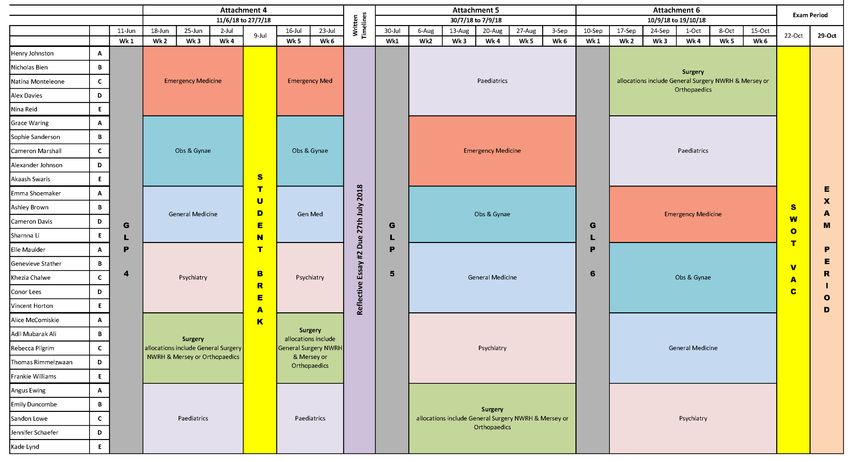
9.3.1      Year 4 Peer Support Program ................................................................................................................ 24

          9.3.2      Final Year Peer Support Program .......................................................................................................... 24

          9.3.3      Horizontal Integration ........................................................................................................................... 24

          9.4 Additional Educational Support .................................................................................................................. 24

          9.4.1      RCS Staff ................................................................................................................................................ 25

          9.4.2      Personal GP Services ............................................................................................................................. 25

          9.4.3      Counselling Services .............................................................................................................................. 26

10. 2017 RCS Calendar ...................................................................................................................................... 27

                                                                                                                                                                  3|P a g e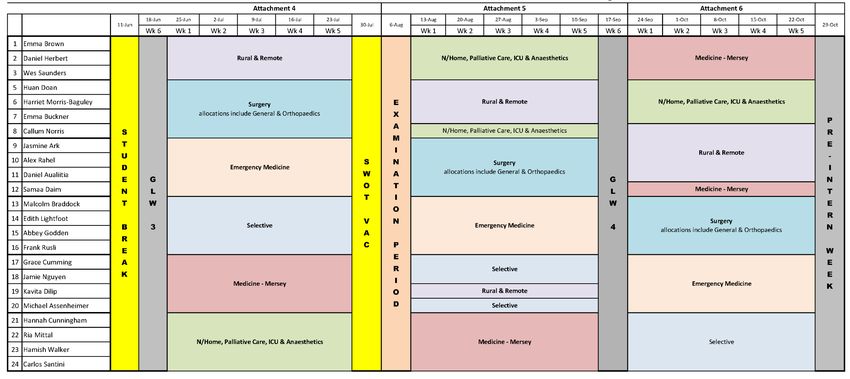
1.      PURPOSE

The Rural Clinical School guidelines are designed to be a practical resource that:

•       Outlines the learning and assessment requirements for students undertaking the final two years of the five
        year MBBS course through the Rural Clinical School (RCS).

•       Provides informative on the resources available to medical students at the RCS.

Students should use this document in conjunction with the Year 4 or 5 School of Medicine (SoM) Handbook.

2.      ABOUT THE RURAL CLINICAL SCHOOL

        2.1     Introduction

        The Rural Clinical School has a charter to provide a rural and remote health context for learning to ensure that
        students have competencies and attributes that will equip them to practice in rural and remote settings.

        The University of Tasmania’s Rural Clinical School:

        •       Is part of a national rural education and training network funded through the Australian Government’s
                Department of Health – Rural Clinical School program, a Regional Health Strategy.
        •       Provides students with clinical education and training, and supports health practitioners in rural and
                remote areas.
        •       Delivers clinical education, training and experience through the Tasmanian Health Service North West
                (THS) via the North West Regional Hospital (NWRH) Burnie, the Mersey Community Hospital Latrobe
                (MCH), the North West Private Hospital (NWPH) Burnie, and a network of general practices, district
                hospitals and community health facilities.

        2.2     Rural Medicine Learning Outcomes

        Students will be able to describe or give examples of participation in the following rural medicine learning
        outcomes to reduce health inequality for patients in rural areas.

        1.      Socio-demographic and cultural differences between rural and city life, and their effect on
                professional/patient/community relationships.
        2.      Participation in Community Engagement
        3.      Aboriginal health care issues in a regional context.
        4.      Conduct of referrals, and the relationships between the referring rural GP and their city and/or
                provincial specialist.
        5.      Impact of isolation on patient and family behaviour in addressing health problems.
        6.      Impact of geographic isolation of patients on medical management.
        7.      Impact of professional isolation on medical practice and on the personal lives of medical and other
                health professionals.
        8.      Inter-relationship between rural and urban health care providers and facilities.
        9.      Development and operation of a health care team.
        10.     Medical evacuation of the injured or ill patient.
        11.     Potential of Telehealth developments for rural health care delivery.
        12.     Techniques for maintaining professional competence and standards for professionals outside of
                tertiary clinical environments.
        13.     Knowledge of the social services in the community in which they are working.

                                                                                                             4|P a g e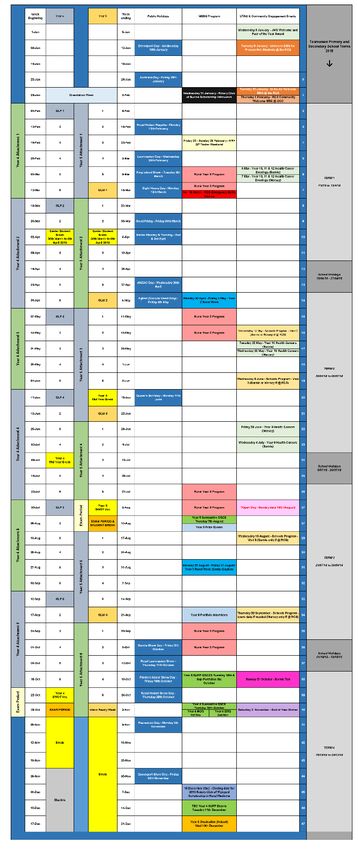
3.      STAFF CONTACTS FOR UNDERGRADUATE PROGRAM

          RCS Reception ph: 03 6430 4550. Most staff can be contacted on this number.
                                  Year 4 & 5 Rural Medical Undergraduate Program
                            (Personnel/roles may change through the year to allow for leave)

  RCS ACADEMIC STAFF - please email rcsstudent.enquiries@utas.edu.au should you need email contacts for academic
  staff.

Associate Professor Lizzi Shires (Director)          Director, Rural Clinical School
                                                     Co-ordinator for community based medical education and
Associate Professor Lizzi Shires
                                                     community engagement
(Assoc Prof. Community Based Medical Education)
                                                     Attachment Co-Ordinator - General Practice and Rural & Remote
Luanne Steven
                                                     Educational support
(Medical Education Advisor)
Dr Alison Tasker (Clinical Associate Lecturer –
                                                     Therapeutics programme, tutorial program
Pharmacy)
Dr Heinrich Weber
                                                     Paediatrics teaching and clinical attachments, CBL, tutorial program
(Clinical Senior Lecturer - Paediatrics)
Mr Russell Furzer
                                                     Surgical clinical attachments NWRH, tutorial program
(Clinical Senior Lecturer – Orthopaedic Surgery)
Mr Trevor Leese
                                                     Surgical clinical attachments NWRH, CBL, tutorial program
(Clinical Senior Lecturer – General Surgery)
Dr James Roberts-Thomson
                                                     Surgical clinical attachments Mersey Hospital, CBL, tutorial program
(Clinical Senior Lecturer – General Surgery)
Dr Albert Nwaba
                                                     Medicine clinical attachments, CBL, tutorial program, mentoring
(Clinical Senior Lecturer – Gastroenterology)
Dr Alex Clifford
                                                     Anaesthetic clinical attachments
(Anaesthetics)
Dr Nick Towle                                        Co-ordinator Aboriginal and Global Health, CBL, tutorial program,
Head of Clinical Simulation                          assessment, mentoring, educational support in clinical skills and
(Clinical Lecturer)                                  simulation
Dr Rosemary Ramsay
                                                     Nursing Home programme, tutorial program
(Clinical Senior Lecturer – Nursing Home)
Dr Satish Kumar
                                                     GP liaison, tutorial program, CBL, assessment, mentoring
(Clinical Senior Lecturer - GP)
Dr George Mabeza
                                                     General Medicine clinical attachments, CBL, tutorial program,
Clinical Co-ordinator Medicine
                                                     mentoring
(Clinical Senior Lecturer - Medicine)
Dr Raimaish Thangamaini
                                                     Obstetrics & Gynaecology - Clinical attachments, CBL, tutorial
(Clinical Senior Lecturer – Obstetrics &
                                                     program
Gynaecology)
Miranda Stephens
                                                     Psychiatry attachment and tutorials
(Clinical Senior Lecturer - Psychiatry)
Dr Balaji Bakshandi                                  ICU ward teaching and tutorials

                                                                                                            5|P a g e
COMMUNITY SUPPORT
Aryelle Sargent
Administration Officer (Community Engagement)
rcs.ce@utas.edu.au
Anne-Maree Temple
Administration Officer (Community Engagement)
RCS CLINICAL SKILLS AND SIMULATION CENTRE
Lynn Greives
Clinical Simulation Educator
Heather Bryer
Clinical Simulation Educator
rcs.simulation@utas.edu.au
Luanne Steven
Clinical Medical Educator
Hannah Eley
Administration Officer (SLE)
RCS ADMINISTRATIVE STAFF
Burnie Campus
Elvie Jean
elvie.jean@utas.edu.au
School & Community Manager
Renee Harvey
Statewide Academic Administration Coordinator
Kylie Bennett
Academic Administration Supervisor
Lucy Titmus rcsstudent.enquiries@utas.edu.au
Administration Officer (Academic)
(Maternity Leave from February 2018)
Ruth Gray
Administration Officer (Student Services)
Teena Cooper
teena.cooper@utas.edu.au
Administration Officer (Accommodation)
Christine Reynolds
Christine.reynolds@utas.edu.au
Administration Officer (Finance)
Louise Lee
Louise.lee@utas.edu.au
Administration Assistant (Reception)
Emily Nasiukiewicz
Emily.Nasiukiewicz@utas.edu.au
Junior Administration Officer
Richard Rozendaal
Richard.rozendaal@utas.edu.au
Administration Officer (Operations & Projects)
Clinton Weber
Clinton.weber@utas.edu.au
ICT Officer
6|P a g eMersey Campus
Karen Lowe rcs.gp@utas.edu.au
Administration Officer (Primary Care)
Anne-Maree Temple annemaree.temple@utas.edu.au
Administration Officer (Mersey & Comm. Eng.)
RESEARCH STAFF
Colleen Cheek
colleen.cheek@utas.edu.au
(Research Fellow - Burnie)
Dr Penny Allen
penny.allen@utas.edu.au
(Research Fellow - Mersey)
Dr Sarah Prior (Wynwood)
sarah.wynwood@utas.edu.au
(Post Doctoral Research Fellow)
Linda Jaffray
linda.jaffray@utas.edu
(PhD Student)
Nicole Reeves
nicole.reeves@utas.edu.au
(Research Support Officer)
7|P a g e4. THE PROGRAM
4.1 Overview of the Program
The RCS delivers the SoM curriculum in a rural setting. Students are able to achieve their learning outcomes
through specialty placements and in General Practice and Emergency care.
The RCS does not offer sub-speciality attachments, however students are likely to see these core presentations
in Emergency and General Practice and their General rotations. Most common presentations in Dermatology,
ENT, ophthalmology are seen during attachments and additional self-directed study or selective experience
may be required.
Students work as part of the clinical teams to acquire their clinical skills.
Please refer to the 2018 RCS Calendar (10).
4.2 Support
The programme includes:
• Structured tutorials, practical procedural skills instruction, CBL sessions and opportunities to reflect on
professional practice.
• Opportunities for self directed learning around patients.
• Support from the team based in the Clinical Attachment site.
• Full support and direction from the RCS academic team including regular meetings with your Academic
Supervisor.
4.3 Group Learning Programs and clinical attachments
4.3.1 Group Learning Program
The tutorial program occurs during the group learning program (GLP/GLW). The complete program is
available on MyLO (My Learning Online learning management system), although it is subject to
change throughout the year. Students are expected to prepare and participate in Case Based
Learning, CBL’s. Resources for CBL’s will be available through MyLO and will be updated throughout
the year.
The CBL topics form the core curriculum for the SoM .
The RCS has an active skills and communication programme which supports the clinical placements.
8|P a g e4.3.2 Clinical Attachments
Clinical attachment handbooks are available on InPlace. Students should access these at least one
week before hand to ensure that they know where to attend and any special requirements for that
rotation.
During the attachments students should maintain a clinical log book and their log of skills.
At the end of rotation, students are expected to get Clinical Attachment Report signed off by the
clinical supervisor, if the placement is of a duration of 2 weeks or less a Short Duration Report will be
required.
At all times, students are expected to wear their medical student identification, dress and conduct
themselves in a professional manner (please refer to the SoM Handbook).
4.4 Clinical Attachments
4.4.1 Year 4 Clinical Attachment Overview
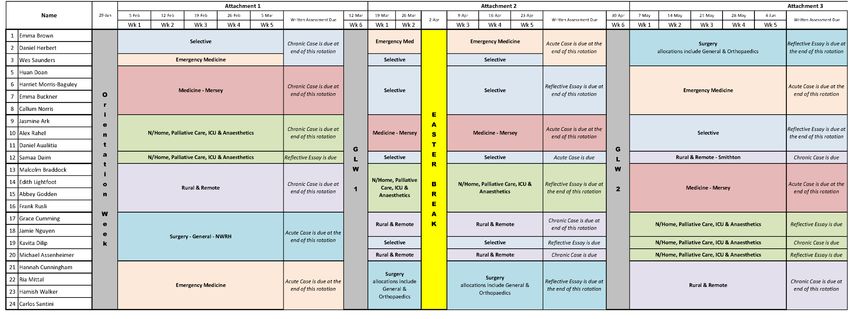
Students will experience 6 x 5 week attachments in different areas of acute services to assist in fulfilling
learning objectives and are expected to take part in ward activities during the day, as well as after
hours as scheduled, or where learning opportunities arise. Each attachment has an Attachment
Timetable that details a series of clinical experiences that students are expected to participate in
during their attachment.
The attachments for 2018 at the RCS are:
• Medicine
• Surgery (General & Orthopaedic)
• Psychiatry
• Emergency Medicine
• Paediatrics and
• Obstetrics & Gynaecology
Clinical attachments in Surgery; Medicine; Paediatrics, Emergency Medicine and Obstetrics &
Gynaecology will involve rotations at the North West Regional Hospital or the Mersey Community
Hospital campus to maximise clinical learning opportunities.
Throughout year 4, students will attend General Practice every Tuesday.
Example overview of a year 4 six week attachment:
Week 1 Week 2 Week 3 Week 4 Week 5 Week 6
Group Learning
DEM DEM DEM DEM DEM
Program
Please refer to InPlace for details of your 2018 Year 4 Attachment Allocations.
Students will be grouped into teams of four or five for attachments and will maintain that group for
the year. Students are expected to participate in all activities of the clinical unit to which they are
attached. This will include presenting cases on ward rounds or at departmental meetings.
Students may be rostered on after hours/weekend shifts or required to be on-call during a clinical
attachment to gain experience outside normal working hours.
9|P a g e4.4.2 Year 4 & 5 Clinical Attachments
Clinical Attachments are provided at North West Regional Hospital, North West Private Hospital and
the Mersey Community Hospital, and community placements across the North West Coast.
Accommodation is automatically provided in Latrobe for students undertaking attachments at Mersey
Community Hospital. Preference for accommodation is given to students with on-call requirements.
Students are encouraged to car pool for travel to and from Mersey Hospital.
Communications
It will be the student’s responsibility to inform wards of their contact number (eg mobile phone) so
they can be contacted out of hours for deliveries, emergencies etc.
Academic and administrative staff regularly update students by use of the UTAS email system.
Students should check their emails at least twice per day and should ensure that all communication in
relation to their program of study is via their UTAS email account.
It is important that you also check the Newsfeed section in MyLO on a regular basis and this will be
used as a form of communication during 2018. Please refer to MyLO instructions on how to receive
instant notifications via email for MyLO updates:
http://www.utas.edu.au/mylo/student-support/student-resources/section-01/setting-notifications
Surgery
Mr Trevor Leese and Mr James Roberts-Thomson will co-ordinate the medical student program in
Surgery for 2018.
Students are requested to download a copy of the Surgical Guidelines document from InPlace prior to
commencement of the attachment.
Students will be rotated through different Surgical teams to maximise learning opportunities. There
will be a mixture of theatre, ward work and clinics. Individual student programs will be developed with
participating students in the week prior to the commencement of the attachment.
Orthopaedic Surgery
Mr Russell Furzer co-ordinates the student attachments.
Students are requested to download a copy of the Surgical Guidelines document from InPlace prior to
commencement of the attachment.
The Orthopaedic attachment is based at the North West Regional Hospital.
General Medicine
Dr George Mabeza will coordinate the student attachment program for medicine. A detailed
attachment timetable is available on InPlace.
In 2018 the medicine rotation will incorporate a week of medical specialties (final year students
only), including Gastroenterology, Renal and Radiology. Please refer to timetable on InPlace.
Students are requested to download a copy of the General Medicine Guidelines document from
InPlace prior to commencement of the attachment.
The General Medicine attachment year 4 students will be primarily based at the NWRH campus. Year
5 students will be based at the MCH.
10 | P a g eStudents will be assigned to a Registrar and Consultant during the medical attachment and undertake
a range of tasks including ward work, clinics, Unit education program and focused student bed-side
teaching and case discussions.
DEM
Dr Marielle Ruigrok coordinates the student attachments.
Students are requested to download a copy of the DEM Guidelines and the Super Suturing documents
from InPlace prior to commencement of the attachment.
Students participate in all activities of the unit including the Thursday morning DEM teaching program.
This includes the 0830 student case presentations.
A roster for each attachment is also available on InPlace. Students are expected to be available for
morning, evening, night and weekend shifts.
A clinical log book should be completed and is available via the electronic log book.
4.4.3 Year 4 Specific Attachments
Psychiatry
Miranda Stephens, clinical psychologist coordinates the student attachments.
The psychiatry attachment will use the Spencer Clinic at the NWRH, the North West Private Hospital
and various community settings on the North West coast.
Obstetrics & Gynaecology
Dr Raimesh Thangamaini co-ordinates the student attachments.
Students are requested to download a copy of the Obstetrics & Gynaecology Guidelines document
from InPlace prior to commencement of the attachment.
The Obstetrics & Gynaecology attachment will be based at both the North West Regional Hospital and
the Mersey Community Hospital.
Paediatrics
Dr Heinrich Weber co-ordinates the student attachments.
Students are requested to download a copy of the Paediatrics Guidelines document from InPlace prior
to commencement of the attachment.
The Paediatrics attachment will be based across North West Regional Hospital and the Mersey
Community Hospital. Students should note that most clinical experience occurs in the outpatient
setting and students should be actively involved in the relevant clinics of these disciplines.
11 | P a g ePrimary Care (1 day per week)
Assoc. Prof Lizzi Shires and Karen Lowe co-ordinate student attachments.
For the first five weeks of the academic year each Year 4 medical student will participate in the Primary
Care Program (PCP1-5), which is designed to prepare you for the Primary Care attachment which will
run for the remainder of the program on a Tuesday. Students will attend two different practices during
the year. During general practice sessions students may be allocated patients for consultation, review
their findings with the doctor and use this to trigger self-directed learning. The program is designed to
provide a longitudinal in-depth and interactive teaching experience.
Each week, the Primary Care experience will focus on general practice consultation and clinical skills,
patient follow up and Primary Care for one session and the other session can be used for assorted
tasks. These tasks can include other primary care visits, audits, in depth consultations with patients
with chronic diseases. This will allow time for students to accompany patients on other visits and
observe health care across the whole team of providers. Observation and involvement with Practice
Nurses and other health professionals is an essential part of this attachment. A detailed workbook for
Primary Care is provided.
Students may work with one, or across a team of GPs, but the practice GP supervisor will be the
facilitator responsible for all activities to do with Primary Care teaching and learning, including marking
the Complex Rural Longitudinal GP Oral Case Presentation and completing the Clinical Attachment
reports. All students will give the oral presentation to the staff and students at their allocated General
Practice and their GP academic supervisor.
Advice on the oral and written presentations is available in the GP handbook and on MyLO.
The GP Attachment Roster is available on InPlace for students.
Students should consult the Practice Manager the week before they start for advice about local
arrangements. It is expected that students would be physically present in their general practices no
later than 0845 on the Tuesday. If students are going to be late on a Tuesday, they must inform the
Practice Manager and Karen Lowe at the RCS. Practices schedule patients and activities for students
and lateness and non attendance is not acceptable.
Elective Planning in Year 4
The SoM handbook outlines the requirements for summer elective attachments at the end of Year 4.
Students are reminded that electives Must be organised in advance, students should confirm
important university key dates before making firm travel plans. Information about the requirements
for electives can be found at: http://www.utas.edu.au/medicine/programs/smile.
Please ensure you start planning your elective early in the year. You must inform the Electives Co-
ordinator and the RCS of your placement details in writing. The Director of Electives, Dr Nick Cooling
will be visiting the RCS during 2018 Orientation Week to speak with Year 4 students.
Year 4 Elective reports presented in Year 5
All students are expected to present a report of the elective undertaken during the preceding summer
break. For 2018, these presentations will be in the form of a poster presentation during orientation
week and a brief oral presentation to the year group and RCS staff. The posters will remain on display
to a wider audience of students, RCS academic staff and hospital staff. A suitable template for a poster
can be found at www.posterpresentations.com
12 | P a g eSelective Planning for Year 5
Please refer to the Year 5 SoM Unit Handbook.
Students will be asked to nominate their preferred attachment dates for 2018 selective, once the
attachment dates have been finalised. This usually occurs in October.
4.4.4 Year 5 Specific Attachments & Requirements
Students should refer to InPlace for the 2018 Year 5 Attachment Allocations.
Selective
Please refer to the Year 5 SoM Unit Handbook for information regarding your selective.
Rural & Remote Medical Practice
Remote attachments are located in the communities such as Smithton, King Island, Huonville and West
Coast (Queenstown/Strahan). Students will have an attachment of five weeks at one location. Students
are required to liaise with the Remote GP Administration Officer (Karen Lowe – 6430 5903) prior to
commencing this attachment.
Students who wish to undertake remote attachments at other locations must discuss this with
Associate Professor Lizzi Shires.
An accommodation kit is available for collection and students are expected to make personal contact
with the Practice to confirm their attendance at least a week prior to taking up their attachment.
To appreciate the particular challenges and limitations of medical care in remote communities, it is
strongly recommended that students remain in their community for the full duration of the
attachment.
Students are required to complete and present a Complex Rural Longitudinal Oral Case Presentation
on return from their attachment as part of the summative assessments. It is expected that students
will do their summative Chronic Disease Case including Complex Therapeutics written case based on
the oral case and this should be submitted on the Friday at the end of your remote attachment.
Further advice on the oral and written presentations is available on MyLO.
Anaesthetics/ICU
Dr Alex Clifford coordinates this rotation .
During this rotation you will be attending a wide range of Departmental activities ranging from ward
rounds to attending elective and emergency lists in theatre.
Please download etc..
A Medical Student Anaesthetic Logbook & Orientation Manual should be completed. The log book is
also available within your electronic log book.
13 | P a g eNursing Home and Palliative Care
Dr Rosemary Ramsay coordinates this rotation
A two week placement in a residential care home and palliative care will give students experience in
managing ageing patients and patients requiring palliative care.
This rotation has a detailed rotation book with resources and learning activities that should be
accessed before the placement starts.
5. STUDENT LEAVE ARRANGEMENTS
5.1 Attendance
As outlined in the SoM Handbook, students are expected to attend 100% of clinical placements and scheduled
teaching. A minimum of 80% of attendance at clinical placements and 80% attendance of the scheduled
teaching sessions must be completed to pass the unit. To ensure that minimum requirements are met,
students will be monitored and are required to sign the attendance register (when provided) for tutorials and
other group sessions.
5.2 Student Leave
Students are required to complete the Student Leave Application which can be found in a Dropbox on MyLO
for any sick leave, leave for conference attendance or research/study related purpose, and any other personal
leave that may be required. Please submit in the relevant attachment Dropbox. These applications will be
approved by the Associate Head and you will receive notification of approval or otherwise via MyLO.
Students should notify their Supervisor of sick leave prior to shift commencement and email
rcsstudent.enquiries@utas.edu.au or should notify their Practice Manager if absent during Primary Care time
and email karen.lowe@utas.edu.au.
Students who are still sick after a days should reconfirm their absence with
rcsstudent.enquiries@utas.edu.au
Sick leave of 5 days, or more, will need to be supported by a Medical Certificate. Please see 9.5.2 for Personal
GP contact details,
If students are away they are required to include in their leave submission, plans to make up for loss of time
and discuss this with attachment Supervisor/s and/or GP contact prior to submission.
6. ASSESSMENT
Please refer to the relevant SoM Handbook for details of assessment and portfolio requirements.
14 | P a g e6.1 Year 4 – Assessment Due Dates
15 | P a g e16 | P a g e
6.2   Year 5 – Assessment Due Dates

                                      17 | P a g e
18 | P a g e
6.3   Year 4 – RCS Written Assessment Due Dates

                                                  19 | P a g e
20 | P a g e
6.4   Year 5 – RCS Written Assessment Due Dates

                                                  21 | P a g e
22 | P a g e
7.   LEARNING RESOURCES

     Clinical teaching is based on the Case Based learning and discipline topics listed in the SoM
     Handbook. The RCS will supply useful reading and references to support many of these topics via
     MyLO and the CBL handbook however students will be expected to supplement their learning
     through extensive reading and electronic resources.

     7.1     Library and Information Technology Support
     An excellent clinical library is located at the North West Regional Hospital with a satellite branch at
     the Mersey.

     Students have access to additional library support through the hospital library and to the statewide
     University library network, through the RCS computers.

     The Cradle Coast Campus offers an additional access point into web based services.

8.   SIMULATED LEARNING ENVIRONMENT (SLE)
     The RCS has a well equipped Simulated Learning Environment (SLE) at Burnie RCS and the Mersey
     hospital, with trained and dedicated staff, where students learn and practice procedural and other
     practical and professional skills, including videotaping to improve consultation skills. This may be in
     a multi-disciplinary learning environment with nurses, paramedics or other health professionals. The
     SLE’s provide an excellent opportunity to learn the essentials and practice these skills before
     performing them on a patient. Students wishing to obtain additional practice in clinical skills outside
     scheduled sessions must contact the Skills Centre staff on rcs.simulation@utas.edu.au

     The simulated environment complements, but does not substitute for the clinical environment.
     Students are strongly encouraged to take full advantage of the vast amount of clinical opportunities
     available in the hospital and general practice settings.

9.   STUDENT SUPPORT

     9.1     Academic Supervisors

     All students will be allocated a clinical Academic Supervisor. Meetings with your academic supervisor
     will be arranged within the GLP/GLW weeks. While the meetings will be relatively informal, they
     should follow an agenda which reflects the student’s interests and concerns. Students will be
     expected to bring a hard copy of end of attachment assessments and log books to these meetings.

     Academic Supervisors are available by email and phone at other times and students may arrange
     additional meetings.

     9.2     General Mentoring
             Other staff and junior doctors are also available for mentoring if required.
             Dr Lizzi Shires and the GP team will be available to assist students having difficulties with
             professional issues such as the doctor-patient relationship, breaking bad news, dealing with
             grief etc. Luanne Steven is available to students for academic issues and other issues that
             they feel they are unable to take to their usual Academic Supervisors / clinical supervisors or
             have been unable to resolve through the usual channels.

                                                                                                23 | P a g e
9.3 Vertical/Horizontal Integration in the Year 4 & 5 RCS Medical Undergraduate Program
9.3.1 Year 4 Peer Support Program
The RCS is committed to a program where vertical integration is an important aspect of the
learning environment. Year 4 and Year 5 students learn on the wards. Year 5 students provide
peer support to Year 4 students. In turn, when Year 1, 2 and 3 students visit the campus on
short attachments, Year 4 and 5 students provide them with peer support.
Part of the Year 4 Peer Support Program includes Year 5 students, along with an Intern/Junior
Medical Officer/Registrar (JMO) (in particular RCS graduates), offering clinical support and
clinical discussions and practice for OSCEs during the year.
9.3.2 Final Year Peer Support Program
Year 5 students are supported by NWRH interns (especially RCS graduates) and there are a
number of common tutorials and discussion groups. On the wards, interns provide valuable
support to Year 5 students. In particular, final year students “shadow” the interns of the
clinical unit to which they are attached.
Interns, SLE educators and RCS academics/other clinicians can provide opportunities for
further skills practice.
9.3.3 Horizontal Integration
One of the strengths of the RCS program is the availability of other health professionals to
assist with learning opportunities. Students may find themselves learning from, or alongside,
people in other disciplines, a situation which mirrors, and best prepares them for real life
situations on the wards and in the community. The concept of teamwork to share the load
and deliver the best outcomes for patients is integral to the Teaching and Learning at RCS.
9.4 Additional Educational Support
Additional Educational support is co-ordinated by Luanne Steven and provided by onsite
academic staff.
Conferences
Students may be eligible for support from the RCS to attend relevant conferences and other
educational events.
Application to the Director should be made well in advance of the event (appropriate forms
available on MyLO). Students attending conferences and educational events with support
from the RCS or in RCS time, are expected to provide a brief report on what they have gained
from these experiences and will generally be required to make a brief presentation to their
peers. Consideration for support will only be given to activities that do not conflict with the
RCS teaching program.
Research
Students wishing to undertake research projects should discuss this with Colleen Cheek,
Assoc Prof. Lizzi Shires or Dr Penny Allen.
24 | P a g e9.4.1 RCS Staff
Professional and personal support for students is a priority for the Rural Clinical School. We
have a small staff committed to the successful implementation of the Rural Clinical Program.
Please refer to ‘Administrative Staff’ list on page 7 for RCS staff available to assist with
operational matters ranging from accommodation, transport and educational requirements
including IT support within the broader rural health workplace.
9.4.2 Personal GP Services
Should a student require medical assistance, the following practices have agreed to see
students and bulk bill a consultation, provided that when seeking an appointment at
any of the practices below, the student identifies themselves as a medical student from
the Rural Clinical School Burnie. International students will be given an account which
they can claim through Medibank and the rebate will be accepted as full payment of
account.
25 | P a g e9.4.3 Counselling Services
Students can contact Student Support Services at the Cradle Coast Campus for psychological
health issues http://www.cradle-coast.utas.edu.au/campus-information/student-support
26 | P a g e10. 2017 RCS Calendar
27 | P a g eYou can also read


