Member States' ambition to phase out fossil-fuel heating - an analysis - Coolproducts
←
→
Page content transcription
If your browser does not render page correctly, please read the page content below
Member States’ ambition to
phase out fossil-fuel
heating – an analysis
Background briefing | July 2021

28% of the total energy consumed in the EU is used in space and water heating. For the
residential sector, more than 75% of the energy produced for heating currently comes
from fossil fuels (gas, oil, and coal). As a result, CO2 emissions from space and water
heating represent 12% of the total EU emissions: as much as all cars in Europe combined 1.
Decarbonising heating is key if we are to meet our climate and emission reduction
objectives.

This briefing showcases how certain national measures are, at this stage, more ambitious
than the EU regulations when it comes to phasing out fossil fuels in the building sector
from 2020 to 2050. If the Commission’s ambition for the revision of the ecodesign and
energy labelling regulations for space heaters remains low, it will not only compel
countries wanting to achieve more and faster to align, but it will also endanger everyone’s
climate goals.

Source: ‘FIVE YEARS LEFT - How ecodesign and energy labelling can decarbonise heating’, ECOS, 2020.

ECOS - Environmental Coalition on Standards
Rue d’Edimbourg 26 · 1050 Brussels · Belgium
T +32 2 894 46 68 · info@ecostandard.org · www.ecostandard.org
Introduction

In the impact assessment on the 2030 Climate Target Plan1, the European Commission proposed
different scenarios for the building sector. It is very clear that the use of oil and coal must end, and
the natural gas consumption needs to be reduced by a staggering 40%.

In 2019, EU Member States were asked to deliver their National Energy and Climate Plans
(NECPs), outlining their actions foreseen between 2021 and 2030, meant to lead them towards
meeting the EU climate targets. While the ambition of these plans differs from one country to the
next, the Council of the European Union, in their conclusions on the Renovation Wave2, pointed to
a clear rule-of -thumb: ecodesign and energy labelling measures should facilitate the phase out of
fossil-fuel operated appliances (Conclusion 24). Consequently, the Council called on the
Commission to prepare the phasing out of the […] gas and other fossil-fuel-operated heating
appliances (Conclusion 34).

Meanwhile, the European Commission is revising the ecodesign and energy labelling rules for
space heaters. The rules currently in force were adopted in 2013 and, outdated as they are, prove
to be counter-productive and actively undermining the realisation of the EU climate objectives. For
instance, the current energy labelling rules for space heaters still hugely favour gas boilers, which
are labelled A or A+ on an A+++ to D scale.

The European Commission is expected to put forward a proposal for revising these regulations
later this month (July 2021), and we hope to see a level of ambition aligned with the climate
objectives and the measures already taken by several EU Member States who have already started
to take action to phase out certain types of fuel (oil or gas) in certain types of buildings (existing or
new).

This briefing showcases how certain national measures are, at this stage, more ambitious than the
EU regulations when it comes to phasing out fossil fuels in the building sector from 2020 to 2050.
We have found that in 2026, more than half of the EU population (~222 500 000 inhabitants) will
live in a country that has either entirely or partially phased out fossil fuel heating.

If the Commission’s ambition for the revision of the ecodesign and energy labelling regulations for
space heaters remains low, it will not only compel countries wanting to achieve more and faster to
align, but it will also endanger everyone’s climate goals. The European Commission must set a
minimum ambition that is coherent with its own climate objectives, while giving a strong signal to
manufacturers that some technologies need to disappear. Otherwise, the average result for the
EU will be mediocre at best, with the least ambitious countries dragging the frontrunners down.
The planet will foot the bill.

1
    https://ec.europa.eu/clima/policies/eu-climate-action/2030_ctp_en
2
    https://data.consilium.europa.eu/doc/document/ST-8923-2021-INIT/en/pdf

Member States’ ambition to phase out fossil-fuel heating – an analysis
                                                                                                            2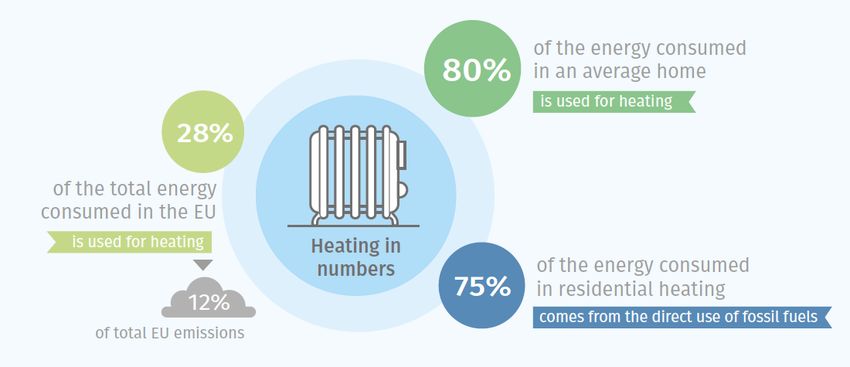
Heating (r)evolution: methodology, maps and conclusions
Our research was carried out in two parts: first, we looked into the National Energy and Climate
Plan (NECPs) - and other sources when available – of each country to see whether they had a
clear plan to phase out certain types of fossil fuel (oil or gas) in certain types of buildings (new or
existing). The results of this research are detailed in the final section of this document.

We then built a series of maps providing an overview and allowing to compare the ambition of
each country and its evolution between 2020 and 2050 when it comes to phasing out fossil fuels.
Based on the NECPs from each country and a report by the Oeko-Institut (2020)3, we have
established a set of criteria allowing us to develop an overview of the evolution of phase-out
measures between 2020 and 2050.

The two selected criteria are:
• the type of fuel that is banned (oil, gas,), and
• the type of infrastructure in which it is banned (new buildings, existing buildings, all buildings).

3
    https://www.oeko.de/fileadmin/oekodoc/AGORA-EU-Ambition.pdf

Member States’ ambition to phase out fossil-fuel heating – an analysis
                                                                                                          3
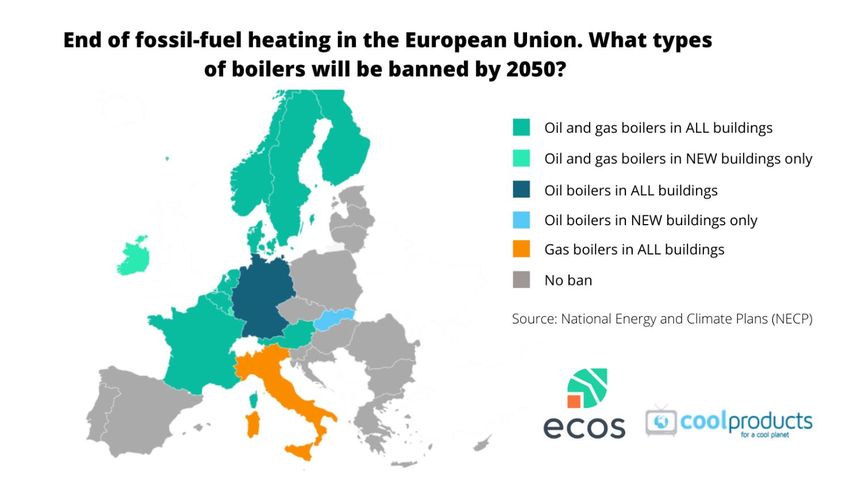
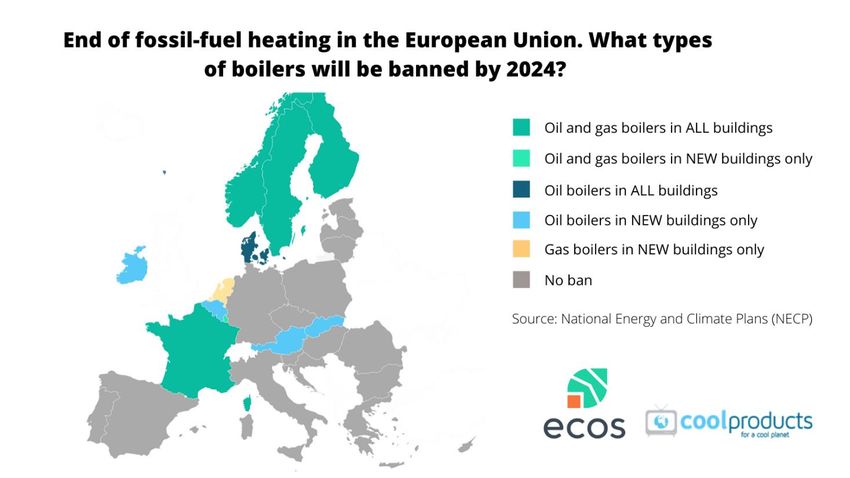
We produced evolutive maps to better showcase the progress of national measures to ban fossil-
fuel heating systems in the EU. The colour code in the maps ranges from:
• grey, for unambitious Member States having no plan to ban any type of fossil-fuel boilers,
• two shades of blue where countries phase out oil boilers,
• yellow and orange indicating the ban of gas boilers,
• two shades of green highlighting the most ambitious national measures targeting both oil and
gas boilers.
A telling example is the case of Austria. As part of the renovation initiative in 2019, the Federal
Government planned to prioritise the phase-out of fossil-fuel powered heating systems, with a
first ban in 2021 on the installation of oil heaters in new buildings. This way, Austria goes from
grey (no ban) to light blue (ban of oil boilers in new buildings only) in the 2024 map. Based on the
Austrian NECP, more measures are to come: a ban on the installation of gas heaters in new
buildings is planned for 2025 and it will be updated for both oil and gas-fired heating systems in
all buildings in 2035. The 2050 map shows this transformation with a shift from light blue to dark
green.
The Austrian example is representative of a number of ambitious EU Member States, which are
planning to remove oil and gas boilers from their markets by 2050. The European Commission
should consider this ambition shown by Member States when revising the ecodesign and energy
labelling regulations for heaters in 2021.
The boldness shown by the Commission in its climate ambition risks clashing with the direction
the EU is taking when regulating space heaters, putting at risk the capacity of Member States to
Member States’ ambition to phase out fossil-fuel heating – an analysis
4reach their own climate objectives. If the proposals are unambitious, it will penalise all EU Member
States – both the frontrunners and the laggards.
Summary of the measures per country
Because the European countries (all EU States and Norway) who have planned to phase out fossil
fuel fired heating technologies have done so at different times, we summarized the main national
initiatives in the following table4. For every country, the date of a fossil fuel phase out is mentioned,
depending on the fuel and infrastructure considered. The table on page 6 summarizes the source
of the official document as well needed and some additional information.
4
'ECOS 2021. Own analysis of EU national initiatives on the phase-out of fossil fuel heating.
Member States’ ambition to phase out fossil-fuel heating – an analysis
5Type of
Date of a fossil fuel phase Type of fossil fuels
Country infrastructure Type of legislation Specificities
out considered
considered
2021 (oil, new installations)
2025 (gas, new buildings) Funding priority to phase out fossil-fuel
National Energy & Climate
AT - Austria 2035 (oil, all buildings) Oil-fired heating systems Residential heating
Plan
powered heating systems in residential
housing (‘Oil Phase-Out Premium’)
2050 at the latest (milestone by 2030)
Flanders :
- 2021 for new constructions (oil, new
Under the energy
buildings and major energy efficient
performance EPB scheme
retrofitting – under discussion) Oil-fired heating systems (only the
(for the Flemish -
BE- Belgium - 2035 for existing buildings selling is banned, not the use of it Residential sector
Government) + Pacte
yet)
Energétique Interfédéral
Bruxelles (2025)
(Accord de Gouvernement)
Wallonie (2035)
Under the EnEV34 law, standard oil-boilers
older than 30 years are replaced.
Climate Action Programme
2026 (oil, all installations) – when a Under Ecodesign, a new (condensing) oil-
DE - Germany low-carbon alternative is feasible
Oil-fired heating systems All buildings 2030 of the federal
boiler can be installed only in combination
government
('hybrid') with solar thermal panels and/or a
heat pump.
Oil-fired boilers and natural gas Oil for heating purposes and coal are to be
2013 (oil, new buildings) New buildings
heating phased out by 2030, and electricity and
DK - Denmark Danish Climate Policy Plan
heating supply is to be 100% covered by
2016 Existing buildings
New oil-fired boilers renewable energy by 2035
FI - Finland Already - - - -
1 July 2021
(new buildings) > 2022? Oil-boilers
1 January 2022 (existing buildings)
Residential and tertiary A GHG threshold not to be exceeded
Draft Decree after the Public
FR - France (buildings for professional
Consultation
+ a gradual entry into force (2021, 2024,
1 January 2022 (mono-gas boilers in use - 1000 m²) 2027 & 2030)
new single-family homes)
2024 (mono-gas boilers new collective
housing) Gas boilers
Member States’ ambition to phase out fossil-fuel heating – an analysis
62020 (oil, new buildings)
Oil boilers
Part L (Energy) of the ROI
IE - Ireland 2022 New buildings
Building Regulations (2019)
-
Gas boilers
2025 (gas, new buildings)
Legambiente’s campaign to build a coalition
All National Energy Strategy of relevant stakeholders in Italy from the
All PNIEC to be updated on the business community, local authorities,
2050 (global date)
2025 (coal phase out) basis of new emission unions, and others to advocate for de-
IT - Italy (gas plants, coal-fired reduction targets carbonization of residential heating
2025 (coal exit)
2050 (exit from gas and other oil plants) PNRR introducing 51%
products) emissions reduction At the moment no policy or target decided
in Italy is particularly ambitious.
LU - Luxembourg 2023 (oil and gas, new buildings) - - - -
Unsuccessful for 2021 but over 90% of
For the time being there will be no ban on
newly built dwellings, is not connected
gas-fired central heating boilers (the
NL – The to the gas grid
Gas-boiler (fossil only) New buildings New Climate Package Netherlands has no oil-boilers).
Netherlands After 2025 the necessity of banning gas-
2021 (gas, new buildings)
boilers will be revisited.
2050 (gas, all buildings)
Fossil-fuel boilers not allowed for
Both new and old
2015 new buildings and major
buildings and both private
renovations
NO- Norway homes and the public Directive -
space of businesses and
2020 (oil, all buildings) Fossil-oil boilers not allowed for
state-owned facilities
existing buildings
Relying on district heating combined with
heat and power production.
SE - Sweden Already - - -
The policy pressure on the building and
heating sector has been quite strong.
To reduce the use of fossil energy sources,
National Energy and Climate
SK – Slovakia 2023 (oil, new buildings) New oil-boilers New buildings
Plan
Slovakia plans a ban on the sale and
installation of new fuel-oil boilers by 2023.
Member States’ ambition to phase out fossil-fuel heating – an analysis
7Detail of the policies per country
Austria
The Austrian Climate Plan 2021-2030, foresees abandoning fossil fuels, especially oil (with the
slogan ‘Weg vom Öl’), and increase the use of indigenous renewable energies, particularly biomass
(wood). Austria plans to phase out oil-fired heating systems in the long-term (by 2050 at the latest)
– with a milestone by 2030, when oil and gas will be banned in new buildings.
As part of the renovation initiative in 2019, the Federal Government, in cooperation with the
provinces, introduced a funding priority to phase out fossil-fuel powered heating systems in
residential housing (‘Oil Phase-Out Premium’). In 2019, 62.7 million euro was made available for
the ‘Oil Phase-Out Premium’, including the renovation check and thermal renovation measures in
buildings used for commercial purposes.
References:
• https://www.derstandard.at/story/2000125962466/bund-und-laender-einig-heizen-kuenftig-ohne-
oel-gas-unde
• Austria NECP
Belgium
The new (2019) Flemish government has announced that as from 2021, no oil-fired boilers will be
allowed in new dwellings/buildings and energy renovations (under the energy performance EPB
scheme). In addition, if there is a gas pipeline in the street, it will not be allowed to replace an
existing oil boiler with a new oil boiler. For collective space heating (apartment buildings or clusters
of houses), from 2021 it will no longer be allowed to use the gas-grid except for CHP (Combined
Heat & Power) or if combined with a significant renewable energy share. At the federal (Belgium)
level, and in order to comply with the Paris Agreement, the federal government has decided to ban
the sales of oil-fired boilers by 2035. Despite a federal ban as from 2035, the regions are free to
decide on the date:
• Flanders: In 2021 for new buildings and heavy renovations (with building permit), in 2035 for
existing houses
• Brussels Capital Region: 2025
• Wallonia: not before 2035
References:
• Législation chauffage belgique Archieven - Le blog des experts en chauffage (heatingexpertise.be)
• https://www.vrt.be/vrtnws/nl/2021/03/23/8-pioniersgemeenten-pleiten-voor-ambitieus-vlaams-
warmtebeleid-o/
• VERS LA FIN DU CHAUFFAGE AU MAZOUT EN BELGIQUE ? (lecobel-vaneau.be)
• https://ec.europa.eu/energy/sites/default/files/documents/be_final_necp_parta_en.pdf
• https://ec.europa.eu/energy/sites/default/files/documents/be_final_necp_partb_en.pdf
Bulgaria
There is no plan to ban fossil-fuel heating systems in Bulgaria, only to transition from coal to natural
gas and introduce an increasing share of renewable sources in heating and cooling.
Member States’ ambition to phase out fossil-fuel heating – an analysis
8References: • https://ec.europa.eu/energy/sites/default/files/documents/bg_final_necp_main_en.pdf Croatia There is no plan to ban fossil-fuel heating systems in Croatia. References: • https://ec.europa.eu/energy/sites/default/files/documents/hr_final_necp_main_en.pdf Cyprus There is no plan to ban fossil-fuel heating systems in Cyprus. References: • https://ec.europa.eu/energy/sites/default/files/documents/cy_final_necp_main_en.pdf Czech Republic There is no plan to ban on fossil-fuel heating systems. However, Czech Republic has a plan starting in 2022 to ban solid fuel boilers of the 1st emission class (with an efficiency of
Estonia

There is no plan to ban fossil-fuel heating systems in Estonia.

References:
•    https://ec.europa.eu/energy/sites/default/files/documents/ee_final_necp_main_en.pdf

Finland
Fossil fuels (coal, natural gas, oil) used in heat production are taxed in Finland based on their energy
content and CO2 emissions. Finland heavily relies on district heating. The remaining heat demand
(around 10%) is covered either by oil or electricity. Most users who have stopped using oil heating
have moved to district heating or geothermal heating, and this trend will likely continue. The
Energy and Climate Strategy (Ministry of Economic Affairs and Employment 2016) assumes that
the proportion of oil heating in individual heating will drop to 40% in existing commercial and
service buildings, and the use of oil in residential buildings will end by 2050. The objective of the
Finnish Government is to reduce the use of imported oil for domestic needs by 50% in the 2020s.
This objective also supports the phasing out of oil heating by 2035.

References:
 •   https://www.euractiv.com/section/energy/news/finland-confirms-coal-exit-ahead-of-schedule-in-
     2029/
 •   https://ec.europa.eu/energy/sites/ener/files/documents/fi_final_necp_main_en.pdf
 •   https://www.hel.fi/static/liitteet/kaupunkiymparisto/julkaisut/julkaisut/HNH-
     2035/Carbon_neutral_Helsinki_Action_Plan_1503019_EN.pdf
 •   https://www.hel.fi/static/kanslia/energy-challenge/heating-system-in-helsinki.pdf

France
The environmental regulation (RE2020) will enter into force on 1 January 2022 for gas fired
heating systems and two situations must be distinguished:
 • For single-family homes, where non-fossil fuel solutions are common and perfectly mastered
     (notably for heat pump or biomass heating), the threshold will be set at 4 kgCO2/m2/year
     from the entry into force of the RE2020 and will de facto exclude systems using only gas
     (measured during performance audits).
 • For collective housing, the transition will occur between 2022 and 2025. The threshold will
     initially be set at 14 kgCO2/year/m², still leaving the possibility of installing gas heating if the
     dwellings are very energy efficient. Then, from 2025, the threshold will be reduced to 6.5
     kgCO2/m2/year.

Gradual entry into force: the years 2021 to 2024 will be a learning period: a carbon threshold will
be set for the construction phase from 2021. The threshold will become increasingly demanding
over time, in 2024 corresponding to a 15% reduction in emissions compared to the current level,
and -25% in 2027. Finally, in 2030, "the maximum threshold in kgCO2/m2 will be lowered to
between 30% and 40% of the current reference level".

Member States’ ambition to phase out fossil-fuel heating – an analysis
                                                                                                            10
Furthermore, the RE2020 plans to discourage the use of electric (resistance) radiators, because
their operating costs are high, and they capture a significant share of the considerable grid
capacity. Possibly installing solar panels could be a condition for their continued use.
References:
• https://www.la-croix.com/Economie/Quel-avenir-chaudieres-fioul-2020-08-04-1201107730
• http://www.carbone4.com/analyse-chaudieres-gaz-climat/
• https://www.franceculture.fr/emissions/la-question-du-jour/fin-du-chauffage-au-gaz-un-pas-vers-la-
transition-energetique
• https://www.lesechos.fr/politique-societe/societe/la-facture-de-chauffage-a-frole-1700-euros-par-
foyer-lan-dernier-1281024
• Le décret qui interdit l’installation de chaudières au fioul (fioulmarket.fr)
• Décret tertiaire : obligations, sanctions et calendrier 2021 | Opéra Énergie (opera-energie.com)
• RE2020 : l'Etat programme la fin du chauffage gaz en logement et offre un tremplin au bois
(batiactu.com)
• Fin du chauffage au gaz et au fioul : ce qui va changer pour vous (cacheclimatisation.com) PM210218-
DP_RE2020_EcoConstruire_0.pdf (politico.eu)
• https://ec.europa.eu/energy/sites/default/files/documents/fr_final_necp_main_en.pdf
Germany
The German government in its German Buildings Energy Act has decided to ban the installation of
oil-fired heating systems from the year 2026 in new and existing buildings where more climate
friendly alternatives are available – opting out of an outright ban (after 2026 mono-fuel boilers
cannot be used in renovation). To make this economically easier on consumers, a "swap-premium"
for replacing old oil-fired heating systems has been introduced, reimbursing up to 40% of the costs
for a new and more efficient system (the funding strategy “Energy Efficiency and Heat from
Renewable Energies”). As of 2026 it will no longer be allowed to fit mono-fuel oil boilers in
buildings in which it is possible to install a more climate-friendly heating system.
References:
• https://www.iea.org/reports/germany-
2020?utm_campaign=IEA%20newsletters&utm_source=SendGrid&utm_medium=Email
• https://energypost.eu/no-energiewende-without-warmewende-making-germanys-heating-
emissions-climate-neutral-nearly/
• Heating 40 million homes – the hurdles to phasing out fossil fuels in German basements | Clean Energy
Wire
• https://www.erneuerbareenergien.de/archiv/germany-bans-oil-heaters-requires-renewable-heat-
150-437-92667.html
• Klimaschutzprogramm 2030 (bundesregierung.de)
• https://www.bmi.bund.de/EN/topics/building-housing/building/energy-efficient-construction-
renovation/buildings-energy-act/buildings-energy-act-node.html
• https://ec.europa.eu/energy/sites/default/files/documents/de_final_necp_main_en.pdf
Greece
For heating and cooling, the share of renewables should increase from 30% in 2020 to 43% in
2030, but there is no concrete plan to phase out fossil fuel heating systems.
References:
• https://ec.europa.eu/energy/sites/default/files/el_final_necp_main_en.pdf
Member States’ ambition to phase out fossil-fuel heating – an analysis
11Hungary
There is no plan to ban fossil-fuel heating systems in Hungary and the NECP reveals that the
country would need approximately HUF 50 000 billion (approximately €142 billion) to implement
carbon neutral power generation, fully phase out the use of natural gas and to fully electrify
transport.
References:
• https://ec.europa.eu/energy/sites/default/files/documents/hu_final_necp_main_en.pdf
Ireland
From June 2019, oil and gas boilers have gradually started to be banned from new builds,
according to the Republic of Ireland government’s Climate Action Plan. Oil boilers will be banned
from new builds by 2022, gas by 2025. However, the existing buildings, it seems, will continue to
be able to install gas or oil boilers.
References:
• http://ireland2050.ie/past/heat/
• New regs must ban oil and gas boilers to meet carbon targets, says expert - Selfbuild
• Draft regs focus on quality control - Selfbuild
• The installation of oil boilers in new homes will be banned from 2022 and gas boilers from 2025 –
What’s next? - Master Therm Heat Pumps
• https://www.oeko.de/fileadmin/oekodoc/AGORA-EU-Ambition.pdf
• https://ec.europa.eu/energy/sites/default/files/documents/ie_final_necp_main_en.pdf
Italy
Italy has fixed its phase-out date for all fossil fuels in all types of infrastructures (new and existing
buildings) in heating in 2050 (National Energy Strategy). The Legambiente’s campaign gained
popularity in Italy, building a coalition of relevant Italian stakeholders from the business community,
local authorities, unions, and others to advocate for decarbonisation of residential heating.
References:
• https://www.kyotoclub.org/it/progetti-e-iniziative/per-la-decarbonizzazione-efficienza-energetica-e-
riscaldamento-negli-edifici-in-italia/#contents_default_anchor
• https://www.ohga.it/se-vogliamo-ridurre-le-emissioni-di-gas-serra-partiamo-dalle-caldaie-la-
proposta-del-kyoto-club/
• https://ec.europa.eu/energy/sites/default/files/documents/it_final_necp_main_en.pdf
Latvia
Latvia states that its NECP contains an objective to use non-fossil gas, whilst simultaneously failing
to include a goal for phasing phase out fossil gas.
References:
• https://ec.europa.eu/energy/sites/default/files/documents/lv_final_necp_main_en.pdf
Member States’ ambition to phase out fossil-fuel heating – an analysis
12Lithuania
There is no plan to ban fossil-fuel heating systems in Lithuania.
References:
• lt_final_necp_main_en.pdf (europa.eu)
Luxembourg
Luxembourg stopped the flood of public money going into fossil-fuel heating and according to a
report from the Oeko-Institut, both oil and gas will be banned from heating systems in new
buildings in 2023. The combination between building insulation (roof, walls, windows, basement)
and the phasing-out of fossil fuel heating systems should help make the building renovation
strategy a success. This will be complemented by a fuel oil substitution programme and the
establishment of low-temperature heating networks fed by waste heat from industry and
renewable energy sources (deep geothermal energy, heat pumps, sustainable wood). The country,
however, does not have a specific plan to ban fossil-fuel operated appliances.
References:
• https://www.fedil.lu/fr/positions/luxembourgs-national-climate-and-energy-plan/?pdf
• https://www.oeko.de/fileadmin/oekodoc/AGORA-EU-Ambition.pdf
• https://ec.europa.eu/energy/sites/default/files/documents/lu_final_necp_main_en.pdf
Malta
There is no plan to ban fossil-fuel heating systems in Malta.
References:
• mt_final_necp_main_en.pdf (europa.eu)
Netherlands
A measure in the new climate package (Klimaatakkoord 2030) specifies that 75% of all new
dwellings built by the end of 2021 shall not have a connection to the natural gas grid (this objective
is already achieved, now over 90%). If that is not possible, the builders must take extra measures
to facilitate the transition to a ‘gas-free’ dwelling in the future, e.g. through extra insulation, or solar
panels in combination with a heat pump. In 2017, this percentage was around 35-40%. This is a
success story, where the transition has gone smoothly after the legislation was put into place (not
a lot of resistance).
Legislative change led from prioritising a gas connection (old legislative situation) to only
connecting a new dwelling to the gas grid if alternatives were proven to be impossible (new
legislative situation). Buyers of new builds can take out government loans (Nationaal
Energiebespaarfonds) to make their dwelling ‘gas-free’. The previous plan to phase out gas boilers
Member States’ ambition to phase out fossil-fuel heating – an analysis
13in 2021 was unfortunately not successful and the plans of the new government coalition should
be published this year. After 2025, the need to ban gas boilers will be revisited.
References:
• https://nltimes.nl/2018/03/28/call-ban-gas-heating-boilers-netherlands-2021
• https://www.solarthermalworld.org/news/dutch-approach-transforming-heating-sector
• Call to ban gas heating boilers in Netherlands by 2021 | NL Times
• https://energeia.nl/energeia-artikel/40091302/in-2020-kreeg-86-van-de-nieuwbouw-geen-
gasaansluiting-meer
• https://www.natuurenmilieu.nl/wp-content/uploads/2020/08/Rapport-Gasmonitor-2020-.pdf
• https://ec.europa.eu/energy/sites/default/files/documents/nl_final_necp_main_en.pdf
Norway (as part of the European Economic Area – EEA)
Norway is famous for being the ‘oil country’ but has now become the first country in the world to
ban the use of oil to heat buildings (into effect in 2020). The Ministry of Climate and Environment
specified that the ban was applied to both new and old buildings and cover both private homes
and the public space of businesses and state-owned facilities. Norwegian homeowners had to
replace their oil boilers before 2020.
References:
• Norway – First Country in the World to Ban Use of Gas to Heat Buildings - Daily Scandinavian
• Norway to ban the use of oil for heating buildings by 2020 | The Independent | The Independent
• https://www.ecoboiler-review.eu/downloads/20200214_WG1_Heating-in-Norway_presentation-
2019.pdf
• Norway bans use of heating oil in buildings - Digital Journal
• Norway stops oil boilers - News (Ekot) | Sveriges Radio
Poland
Decarbonisation and especially ban on fossil-fuel heating is a complicated topic in Poland. Due to
the country’s dependence on coal for heating as well as for electricity generation, decarbonisation
is a real challenge. Most of district heating systems, which are popular in Poland, are supplied with
heat from coal (cogeneration or heat only boilers) and rapidly growing prices of CO2 put Polish
citizens in a difficult position. While it is theoretically feasible to phase out coal from individual
heating systems before 2030, district heating systems end electricity will still depend on coal, even
if the Government announced agreement with the coal industry to close the coal mines (steam
coal only) before 2049. Nevertheless, it should be noted that coal was not considered in our
analysis, as solid fuel boilers are covered by a different regulation than gas and oil boilers.
References:
• https://foresightdk.com/polish-coal-boiler-phase-out-an-inspiration-for-clean-heat/
• https://ec.europa.eu/energy/sites/default/files/documents/pl_final_necp_part_1_3_en.pdf
• https://ec.europa.eu/energy/sites/default/files/documents/pl_final_necp_part_4_en.pdf
• https://ec.europa.eu/energy/sites/default/files/documents/pl_final_necp_part_5_en.pdf
Portugal
There is no plan to ban fossil-fuel heating systems in Portugal. Nonetheless, the country plans to
reduce the carbon intensity of buildings, consume energy more efficiently, promote greater
Member States’ ambition to phase out fossil-fuel heating – an analysis
14electrification in the sector and substitute fossil fuels with renewable energy sources. These
measures, addressing the decarbonisation of the building sector, do not indicate the phase-out of
fossil fuel appliances but assume the need to reduce the use of these appliances and focus on
incentives towards electrification and renewable energy sources.
References:
• https://ec.europa.eu/energy/sites/default/files/documents/pt_final_necp_main_en.pdf
Romania
There is no plan to ban fossil-fuel heating systems in Romania.
References:
• https://ec.europa.eu/energy/sites/default/files/documents/ro_final_necp_main_en.pdf
Slovakia
Slovakia is planning on phasing out the consumption of coal: by at least 30% by 2030, and the
decision to phase out coal consumption in Slovakia is in line with the principles of just transition
by 2021. To reduce the use of fossil energy sources, Slovakia plans a ban on the sale and
installation of new oil boilers by 2023.
References:
• sk_final_necp_main_en.pdf (europa.eu)
Slovenia
There is no plan to ban fossil-fuel heating systems in Slovenia.
References:
• si_final_necp_main_en.pdf (europa.eu)
Spain
Spain has no plan to phase out fossil fuel heating systems at national level, but it must be noted
that some of the 17 regions and 8,000 municipalities have taken measures in that direction. We
have not analysed the situation in such depth.
References:
• https://www.larazon.es/madrid/20200224/l76oi6ubljfd3nv2txgb4o5huy.html
• https://elpais.com/clima-y-medio-ambiente/2021-01-07/la-pandemia-dispara-el-uso-de-estufas-en-
las-terrazas-como-reducir-su-impacto-ambiental.html
• https://ec.europa.eu/energy/sites/default/files/documents/es_final_necp_main_en.pdf
Sweden
By relying on district heating (based on wood, peat and other biofuels, household waste, deep
thermal heat, recycled heat from industries) combining heat and power production, municipalities
in Sweden fuel their cities from renewable energy sources. In the case of Sweden, the policy
Member States’ ambition to phase out fossil-fuel heating – an analysis
15pressure on the building and heating sector has been quite strong. Overall, district heating
represents about 60% of heating in Sweden. In fact, 85% of all multi-dwelling houses and all public
buildings are connected to district heating. Today all towns in Sweden have district heating
networks, which have enabled the Swedish heating sector to become almost completely fossil-
free.
They use mainly biofuels like wood and peat, but also burn household waste. The main reason to
invest in district heating in Sweden was to create a healthy environment in Sweden’s cities.
Sweden has the lowest average CO2 intensity of residential heating of the EU-27, at 29 gCO2/kWh
due to a high concentration of biomass, nuclear and renewables in their heating sector. In 1990
from the CO2 intensity was 112 gCO2/kWh due to a decrease in oil and coal consumption. The ban
on individual appliances is not that relevant for Sweden though, because of the country’s reliance
on district heating.
References:
• https://www.mdpi.com/1996-1073/13/8/1894
• By relying on district heating combined with heat and power production, municipalities in Sweden
power their cities from renewable energy sources. (youris.com)
• https://www.mdpi.com/1996-1073/13/8/1894
• https://www.climatexchange.org.uk/media/4625/cxc-a-review-of-heat-decarbonisation-policies-in-
europe-feb-2021.pdf
• https://www.euroheat.org/news/swedish-district-heating-reducing-nations-co2-emissions/
• https://ec.europa.eu/energy/sites/default/files/documents/sweden_draftnecp.pdf
United Kingdom (not included on the map)
The ‘Future Homes Standard’ is designed to ensure that an average home built using the
guidelines will produce 75-80% less carbon emissions than one built to current energy efficiency
requirements. Amongst the proposals is a ban on fossil fuel heating systems (2019), such as gas
boilers (and all other forms of fossil fuel heating), from new homes by 2025. Gas is not the only
fuel being banned – in fact, all fossil fuel boilers will be banned going forward. The government
has indicated it will phase out installations of conventional gas boilers for home heating by the
mid-2030s as part of efforts to decarbonise the UK’s economy.
References:
• https://greenallianceblog.org.uk/2020/05/13/net-zero-is-nowhere-in-sight-for-uk-clean-heat-
policy/?utm_campaign=Carbon%20Brief%20Daily%20Briefing&utm_medium=email&utm_source=Re
vue%20newsletter
• https://energypost.eu/uk-heating-plan-still-means-120-gas-boilers-installed-for-every-low-carbon-
system/
• Government set to Ban Fossil Fuel Heating in New Homes from 2025 | Tansun
• The UK Gas Boiler Ban: Everything You Need to Know | The Eco Experts
• Conventional gas boilers to be phased out by mid-2030s | E&T Magazine (theiet.org)
Member States’ ambition to phase out fossil-fuel heating – an analysis
16About this briefing
Authors
• Jonathan Vavre, ECOS – Environmental Coalition on Standards
• Mélissa Zill, ECOS – Environmental Coalition on Standards
About ECOS
ECOS - Environmental Coalition on Standards is an international NGO with
a network of members and experts advocating for environmentally friendly
technical standards, policies and laws. We ensure the environmental voice
is heard when they are developed and drive change by providing expertise
to policymakers and industry players, leading to the implementation of
strong environmental principles.
www.econstandard.org
.
www.econstandard.org
About Coolproducts
Co-led by ECOS and the European Environmental Bureau
(EEB), Coolproducts is a coalition of NGOs working to
ensure better products for consumers and the planet.
www.coolproducts.eu
Member States’ ambition to phase out fossil-fuel heating – an analysis
17You can also read


