MULTILAYER CERAMIC CAPACITORS - MICROWAVE MLCC WITH NARROW-TOLERANCE (UF) 0402 SIZE (25V & 50V) NP0 DIELECTRIC HALOGEN FREE & ROHS COMPLIANCE
←
→
Page content transcription
If your browser does not render page correctly, please read the page content below
Multilayer Ceramic Capacitors                                                            Approval Sheet

     MULTILAYER CERAMIC CAPACITORS
     Microwave MLCC with Narrow-Tolerance (UF)
     0402 Size (25V & 50V)
     NP0 Dielectric
     Halogen Free & RoHS Compliance

                                       *Contents in this sheet are subject to change without prior notice.

Page 1 of 8                     ASC_Microwave_Narrow_Tol_UF_032B                              May. 2020
Multilayer Ceramic Capacitors Approval Sheet
1. INTRODUCTION
MLCC consists of a conducting material and electrodes. To manufacture a chip-type SMT and achieve
miniaturization, high density and high efficiency, ceramic condensers are used.
WTC UF series MLCC is used at high frequencies generally have a small temperature coefficient of capacitance,
typical within the ±30ppm/°C required for NP0 (C0G) classification, Ultra-narrow tolerance of capacitance and have
excellent conductivity internal electrode. Thus, WTC UF series MLCC will be with the feature of low ESR and high Q
characteristics.
2. FEATURES 3. APPLICATIONS
a. High Q and low ESR performance at high frequency. a. Telecommunication products & equipments: Mobile
b. Ultra low capacitance to 0.05pF. phone, WLAN, Base station.
c. Can offer ultra-narrow tolerance to ±0.02pF. b. RF module: Power amplifier, VCO.
d. Quality improvement of telephone calls for low c. Tuners.
power loss and better performance.
4. HOW TO ORDER
UF 15 N R05 P 250 C T
Series Size Dielectric Capacitance Tolerance Rated voltage Termination Packaging
UF= Microwave 15=0402 (1005) N=NP0 Two significant P=±0.02pF Two significant C=Cu/Ni/Sn T=7” reeled
MLCC with digits followed by Q=±0.03pF digits followed by G= 13” reeled
narrow-tolerance no. of zeros. And A=±0.05pF no. of zeros. And
R is in place of B=±0.1pF R is in place of
decimal point. decimal point.
eg.: 250=25 VDC
R05=0.05pF 500=50 VDC
0R5=0.5pF
1R0=1.0pF
Page 2 of 8 ASC_Microwave_Narrow_Tol_UF_032B May. 2020Multilayer Ceramic Capacitors Approval Sheet
5. EXTERNAL DIMENSIONS
Size L
L (mm) W (mm) T (mm)/Symbol Remark MB (mm)
Inch (mm)
0402 (1005) 1.00±0.05 0.50±0.05 0.50±0.05 N # 0.25+0.05/-0.10 T
# Reflow soldering only is recommended.
W
MB MB
Fig. 1 The outline of MLCC
6. GENERAL ELECTRICAL DATA
Dielectric NP0
Size 0402
Capacitance* 0.05pF to 3pF
Capacitance tolerance P (±0.02pF ), Q (±0.03pF), A (±0.05pF ), B (±0.1pF)
Rated voltage (WVDC) 25V, 50V
Q** Q≥400+20C
Insulation resistance at Ur ≥10GΩ or RxC≥100Ω-F whichever is smaller.
Operating temperature -55 to +125°C
Capacitance change ±30ppm/°C
Termination Ni/Sn (lead-free termination)
** Measured at the conditions of 25°C ambient tempe rature and 30~70% related humidity.
Apply 1.0±0.2Vrms, 1.0MHz±10%
7. PACKAGING DIMENSION AND QUANTITY
Paper tape
Size Thickness (mm)/Symbol
7” reel 13” reel
0402 (1005) 0.50±0.05 N 10,000 50,000
Unit: pieces
Page 3 of 8 ASC_Microwave_Narrow_Tol_UF_032B May. 2020Multilayer Ceramic Capacitors Approval Sheet
8. CAPACITANCE RANGE
DIELECTRIC NP0
SIZE 0402
Tolerance
RATED VOLTAGE (VDC) 25 50
0.05pF (R05) N N P, Q, A
0.1pF (0R1) N N P, Q, A
0.2pF (0R2) N N P, Q, A
0.3pF (0R3) N N P, Q, A
0.4pF (0R4) N N P, Q, A
0.5pF (0R5) N N P, Q, A
0.6pF (0R6) N N P, Q, A
0.7pF (0R7) N N P, Q, A
0.8pF (0R8) N N P, Q, A
Capacitance
0.9pF (0R9) N N P, Q, A
1.0pF (1R0) N N P, Q, A
1.1pF (1R1) N N A, B
1.2pF (1R2) N N A, B
1.3pF (1R3) N N A, B
1.5pF (1R5) N N A, B
1.6pF (1R6) N N A, B
1.8pF (1R8) N N A, B
2.0pF (2R0) N N A, B
2.2pF (2R2) N N A, B
2.4pF (2R4) N N A, B
2.7pF (2R7) N N A, B
3.0pF (3R0) N N A, B
1. The letter in cell is expressed the symbol of product thickness.
2. For more information about products with special capacitance or other data, please contact WTC local representative.
Page 4 of 8 ASC_Microwave_Narrow_Tol_UF_032B May. 2020Multilayer Ceramic Capacitors Approval Sheet
9. RELIABILITY TEST CONDITIONS AND REQUIREMENTS
No. Item Test Conditions Requirements
1. Visual and --- * No remarkable defect.
Mechanical * Dimensions to conform to individual specification sheet.
2. Capacitance 1.0±0.2Vrms, 1MHz±10% * Shall not exceed the limits given in the detailed spec.
3. Q/ D.F. At 25°C ambient temperature. * 0402/25V~50V: Q≥400+20C
(Dissipation
Factor)
4. Dielectric *To apply voltage: 250% of rated voltage. * No evidence of damage or flash over during test.
*Duration: 1 to 5 sec.
Strength
*Charge & discharge current less than 50mA.
5. Insulation To apply rated voltage for max. 120 sec. ≥10GΩ or RxC≥100Ω-F whichever is smaller
Resistance
6. Temperature With no electrical load. * Capacitance change: within ±30ppm/°C;
Coefficient Operating temperature: -55~125°C at 25°C
7. Adhesive * Pressurizing force: * No remarkable damage or removal of the terminations.
Strength of 0402 to 0603: 5N
Termination * Test time: 10±1 sec.
8. Vibration * Vibration frequency: 10~55 Hz/min. * No remarkable damage.
Resistance * Total amplitude: 1.5mm * Cap change and Q/D.F.: To meet initial spec.
* Test time: 6 hrs. (Two hrs each in three mutually
perpendicular directions.)
*Cap./DF(Q) Measurement to be made after de-aging at 150°C
for 1hr then set for 24±2 hrs at room temp.
9. Solderability * Solder temperature: 235±5°C 95% min. coverage of all metalized area.
* Dipping time: 2±0.5 sec.
10. Bending Test * The middle part of substrate shall be pressurized by means * No remarkable damage.
of the pressurizing rod at a rate of about 1 mm per second until * Cap change: within ±5.0% or ±0.5pF whichever is larger.
the deflection becomes 1 mm and then the pressure shall be (This capacitance change means the change of capacitance under
maintained for 5±1 sec. specified flexure of substrate from the capacitance measured before
* Measurement to be made after keeping at room temp. for the test.)
24±2 hrs.
11. Resistance to * Solder temperature: 260±5°C * No remarkable damage.
Soldering Heat * Dipping time: 10±1 sec * Cap change: within ±2.5% or ±0.25pF whichever is larger.
* Preheating: 120 to 150°C for 1 minute before imme rse the * Q/D.F., I.R. and dielectric strength: To meet initial requirements.
capacitor in a eutectic solder. * 25% max. leaching on each edge.
*Cap. / DF(Q) / I.R. Measurement to be made after de-aging at
150°C for 1hr then set for 24±2 hrs at room temp.
Page 5 of 8 ASC_Microwave_Narrow_Tol_UF_032B May. 2020Multilayer Ceramic Capacitors Approval Sheet
No. Item Test Condition Requirements
12. Temperature * Conduct the five cycles according to the temperatures and * No remarkable damage.
Cycle time. * Cap change:within ±2.5% or ±0.25pF whichever is larger.
Step Temp. (°C) Time (min.) * Q/D.F., I.R. and dielectric strength: To meet initial requirements.
1 Min. operating temp. +0/-3 30±3
2 Room temp. 2~3
3 Max. operating temp. +3/-0 30±3
4 Room temp. 2~3
* Cap. / DF(Q) / I.R. Measurement to be made after de-aging at
150°C for 1hr then set for 24±2 hrs at room temp.
13. Humidity * Test temp.: 40±2°C
* No remarkable damage.
(Damp Heat) * Humidity: 90~95% RH
* Cap change: within ±5.0% or ±0.5pF whichever is larger.
Steady State * Test time: 500+24/-0hrs.
* Q/D.F. value: Q≥200+10C
* Cap. / DF(Q) / I.R. Measurement to be made after de-aging at
* I.R.: ≥1GΩ.
150°C for 1hr then set for 24±2 hrs at room temp.
14. Humidity * Test temp.: 40±2°C * No remarkable damage.
(Damp Heat) * Humidity: 90~95%RH * Cap change: within ±7.5% or ±0.75pF whichever is larger.
Load * Test time: 500+24/-0 hrs. * Q/D.F. value: Q≥100+10/3C
* To apply voltage:rated voltage * I.R.: ≥500MΩ.
* Cap. / DF(Q) / I.R. Measurement to be made after de-aging at
150°C for 1hr then set for 24±2 hrs at room temp.
15. High * Test temp.: 125±3°C * No remarkable damage.
Temperature * To apply voltage: 200% of rated voltage. * Cap change: within ±3.0% or ±0.3pF whichever is larger.
Load * Test time: 2000+24/-0 hrs. * Q/D.F. value: Q≥200+10C
(Endurance) * Cap. / DF(Q) / I.R. Measurement to be made after de-aging at * I.R.: ≥1GΩ.
150°C for 1hr then set for 24±2 hrs at room temp
16. ESR The ESR should be measured at room temperature and tested
0402
at frequency 1±0.1 GHz. 0.05pF≤Cap≤1pF:< 350mΩ/pF
1pFMultilayer Ceramic Capacitors Approval Sheet
APPENDIXES
◙ Tape & reel dimensions
Size 0402
Thickness N
0.70
A0 +/-0.20
1.20
B0 +/-0.20
T ≦0.80
K0 -
8.00
W +/-0.30
4.00
P0 +/-0.10
Fig. 2 The dimension of paper tape
40.00
10xP0 +/-0.10
2.00
P1 +/-0.05
2.00
P2 +/-0.05
D0 1.50
+0.1/-0
D1 -
1.75
E +/-0.10
3.50
F +/-0.05
Size 0402
Reel size 7” 13”
C 13.0+0.5/-0.2 13.0+0.5/-0.2
W1 8.4+1.5/-0 8.4+1.5/-0
Fig. 3 The dimension of reel A 178.0±1.0 330.0±1.0
N 60.0+1.0/-0 100±1.0
◙ Example of customer label
a. Customer name
b. WTC order series and item number
c. Customer P/O
d. Customer P/N
e. Description of product
f. Quantity
g. Bar code including quantity & WTC P/N or customer
h. WTC P/N
i. Shipping date
j. Order bar code including series and item numbers
*Customized label is available upon request k. Serial number of label
Page 7 of 8 ASC_Microwave_Narrow_Tol_UF_032B May. 2020Multilayer Ceramic Capacitors Approval Sheet
◙ Constructions
No. Name NP0
1 Ceramic material Hi-Q dielectric ceramic
2 Inner electrode Cu
3 Inner layer Cu
4 Termination Middle layer Ni
5 Outer layer Sn (Matt) Fig. 4 The construction of MLCC
◙ Storage and handling conditions
(1) To store products at 5 to 40°C ambient temperature and 20 to 70%. related humidity conditions.
(2) The product is recommended to be used within one year after shipment. Check solderability in case of shelf life
extension is needed.
Cautions:
a. The corrosive gas reacts on the terminal electrodes of capacitors, and results in the poor solderability.
Do not store the capacitors in the ambience of corrosive gas (e.g., hydrogen sulfide, sulfur dioxide,
chlorine, ammonia gas etc.)
b. In corrosive atmosphere, solderability might be degraded, and silver migration might occur to cause low
reliability.
c. Due to the dewing by rapid humidity change, or the photochemical change of the terminal electrode by
direct sunlight,the solderability and electrical performance may deteriorate. Do not store capacitors under
direct sunlight or dewing condition. To store products on the shelf and avoid exposure to moisture.
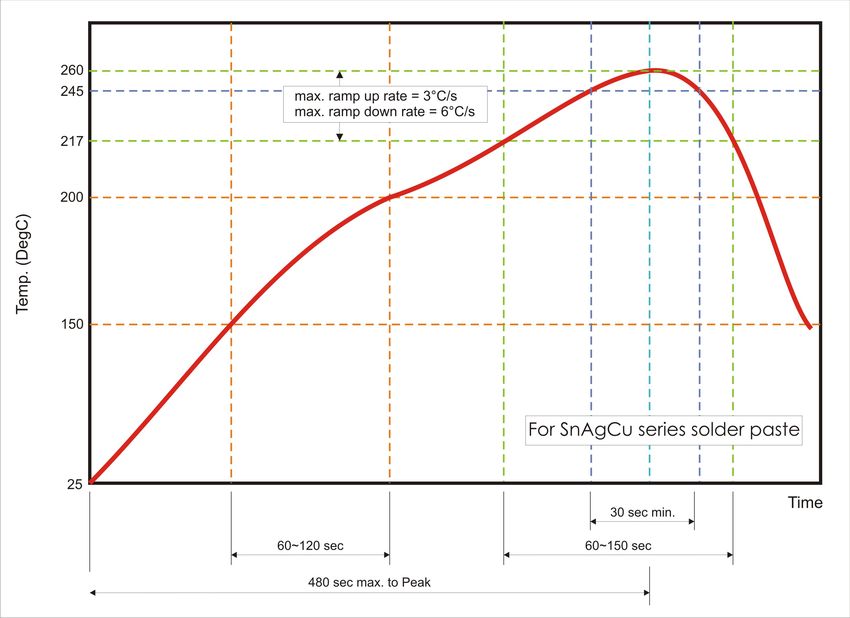
◙ Recommended soldering conditions
The lead-free termination MLCCs are not only to be used on SMT against lead-free solder paste, but also suitable
against lead-containing solder paste. If the optimized solder joint is requested, increasing soldering time, temperature and
concentration of N2 within oven are recommended.
Fig. 5 Recommended reflow soldering profile for SMT process
with SnAgCu series solder paste.
Page 8 of 8 ASC_Microwave_Narrow_Tol_UF_032B May. 2020You can also read


