Municipal Services Offices Provincial Update - Fall 2019 - AMCTO
←
→
Page content transcription
If your browser does not render page correctly, please read the page content below
Ministry of Municipal Affairs and Housing

         Municipal Services Offices
            Provincial Update

Fall 2019
                                            AMCTO ZONE 3
                                            Thursday November 14,
                                            2019
                                            Sav Johal, Municipal Advisor
                                            Diane Ploss, Municipal Advisor
Important Notice
• Municipalities are responsible for making local decisions, including
  complying with any applicable statutes or regulations.

• This presentation is for information purposes only and is not a
  substitute for legal or other professional advice in connection with
  any particular matter. This presentation deals with complicated issues
  and concepts in a highly summarized fashion, and key details may not
  be included. The inclusion of municipal or other local examples in this
  presentation does not imply an endorsement by the Ministry.

• Users should verify the information that has been included from
  other sources prior to making decisions or acting upon it.

2
Municipal Services Division
               Municipal Services Office (MSO)

Who we are and what we do
•   Work alongside ministry and municipal staff to provide advice on policy and program
    implementation
•   Organize and deliver educational activities to municipal stakeholders
•   Provide recommendations on issues, policies, and related legislation affecting local
    governments
Services and products that we provide
•   Advise on existing resources for municipalities
•   Promote municipal leading practices
•   Focus on implementing provincial priorities and plans
•   Support our stakeholders by building their capacity to assess and implement the full
    range of options available to them

3
Outline

• Local Government Updates
• Finance Updates
• Housing Updates

4
Local Government
Updates
Recent Announcements

•   On October 25th, the government made some significant announcements of interest
    to municipalities.
•   The government will consult with municipalities on whether to align the municipal
    fiscal year with the province’s.
•   The government is also proposing to combine the provincial and municipal voters
    lists, giving Elections Ontario the responsibility of managing one list.
•   Through the regional review, the government heard that local communities should
    decide what is best for them in terms of governance, decision-making and service
    delivery. After careful consideration of the feedback the government stands firm in
    its commitment to partnering with municipalities without pursuing a top-down
    approach.

6
Renewal of Funding Programs
• The October 25th announcement also included $143 million in funding for
municipalities across the province to help lower costs and deliver important services
to residents over the long term.
Municipal Modernization Program
• Building on Ontario’s previous investment to modernize municipal service delivery,
405 small and rural municipalities will have access to an application-based program,
which will provide up to $125 million until 2022-23.
• On November 1, Minister Steve Clark sent a letter to the Heads of Council which
included a summary of recent announcements, including the renewal of funding
programs to identify efficiencies.
• Following this letter, on November 12 the Assistant Deputy Minister of the Municipal
Services Division sent a letter to municipal CAOs and clerks, copying treasurers. The
letter provided details about the first round of intake under this program.
• The letter included program guidelines and an Expression of Interest form for
Intake 1 of the program.
7Municipal Modernization Program
Eligibility Criteria
• To be eligible under Intake 1, a project must:
• Be a review of municipal service delivery expenditures by an independent third-
party reviewer for the purpose of finding savings and efficiencies.
• Result in a report by the independent third-party reviewer that provides specific
and actionable recommendations for cost savings and improved efficiencies.
• Begin field work no earlier than November 1, 2019, with a draft report completed
by June 15, 2020 and the final report posted publicly by June 30, 2020.
The program will not cover review projects where:
• The goal is to identify opportunities for revenue generation or reductions in front
line services; or
• The review does not result in a formal report prepared by a third party; or
• The object of the review extends beyond municipal accountability.
8Municipal Modernization Program
Next Steps
November 22, 2019 Advise your Municipal Services Office of your municipality’s intention to
apply.
December 6, 2019 Submit your Expression of Interest and any supporting documentation to
Municipal.Programs@ontario.ca.
January-February, Learn whether your application is approved. If it is approved, enter into a
2020 transfer payment agreement for project funding, and receive an initial
payment once the agreement is executed.
June 15, 2020 Submit your third-party reviewer’s draft report to the ministry.
June 30, 2020 Post the third-party reviewer’s final report online and submit your final
report to the ministry. The final report will include: a hyperlink to the
publicly posted third-party reviewer’s report; the amount paid to the
third-party reviewer and a copy of the invoice; a statement of the total
amount of expenditures reviewed and the total amount identified as
potential savings; and a 250-word abstract of the project and its findings.
9Audit and Accountability Fund
Audit and Accountability Fund (AAF)
• The government is also extending funding for 39 large urban municipalities, by
providing up to $6 million annually for three years beginning in fiscal year 2020-
21. More information on the application process will follow in the coming
months.
Examples of past approved AAF projects:
• The City of Barrie is conducting a Service Delivery Review.
• The City of Ottawa is reviewing Ottawa Police Service back-office function.
• The City of London is conducting a Service Delivery Review of Housing.
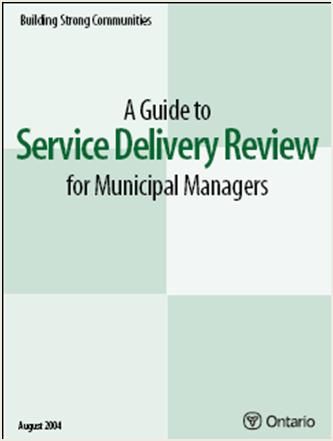
10Service Delivery Review Guides https://www.ontario.ca/page/ministry-municipal-affairs-housing 11
Shared Service Resources

     https://www.mfoa.on.ca/mfoa/MAIN/MFOA_Policy_Projects/Shared_Services_in_Ontarios_Local_
     Public_Sector_with_Case_Studies

12
Legalization of Recreational Cannabis
• On April 1, 2019, privately run cannabis retail stores authorized by the Alcohol and Gaming
Commission of Ontario began to open and sell cannabis in Ontario.
• In the initial phase, up to 25 licences were issued starting April 1, 2019.
• In a second phase, the Alcohol and Gaming Commission of Ontario will authorize a total of 50
new private cannabis retail stores to begin opening on a rolling basis in October 2019.
• In the second allocation, stores have the option to locate in municipalities with populations of less
than 50,000 and in First Nation reserves.
• When supply from federally licensed producers further improves, the government will provide
additional information.
• The province has helped municipalities with implementation costs of recreational cannabis
legalization through the Ontario Cannabis Legalization Implementation Fund (OCLIF).
– Further details on permitted uses of OCLIF funds are available at
https://www.fin.gov.on.ca/en/budget/oclif/
• MMAH will continue to work with the Ministry of the Attorney General and the Ministry of Finance to
facilitate dialogue with municipalities to support implementation.
• Questions on the Ontario Cannabis Legalization Implementation Fund: OCLIF@ontario.ca
• Questions on cannabis retail stores: municipal@agco.ca
13Bill 107, Getting Ontario Moving Act (Transportation
Statute Law Amendment), 2019
• SCHEDULE 1
Highway Traffic Act
• Numerous amendments are made to the Highway Traffic Act respecting
road safety and other matters. Some highlights are as follows:
• Section 21.1 of the Act provides for a system of administrative penalties.
Amendments are made in respect of the involvement in that system of
municipalities or persons employed by municipalities.
• Currently the Act allows regulations and municipal by-laws to be made
permitting the operation of off-road vehicles. The Act is amended to specify
that such regulations and by-laws may also prohibit the operation of off-road
vehicles.
14Proposed Changes to Aggregate Management
• Province has released a proposal that aims to reduce administrative duplication
and delays, and promote economic growth within the aggregate industry.
• Twin goals of creating opportunities and supporting growth, while maintaining a
steadfast commitment to protecting the environment and addressing impacts to
our communities.
• Proposal now posted on the Environmental Registry of Ontario for public
feedback. Key proposed changes include improving access to aggregates within
road allowances; clarifying jurisdiction on Crown land and depth of extraction;
and clarifying how haul routes are considered under aggregates legislation.
• Ontario is also proposing to strengthen review of requests to extract aggregates
below the water table.
15Other Updates
Municipal Reporting Burden

                             Overall Reporting Reduction                        MMAH has been leading the project
                       25%                                                      through:
                                                                                1. Leading inter-ministerial meetings
                              21.56%
                       20%

                                                                                2. Collaborating with municipal associations,
                                                                                   including MFOA, since December 2018
Percentage Reduction

                       15%

                                                                                3. Establishing a provincial inventory of
                       10%                                                         municipal reporting

                       5%
                                                                                4. Leading municipal reporting reduction
                                                                                   results
                                                                  3.90%
                                                2.29%
                       0%
                             Elimination     Consolidation     Simplification
                                                                                5. Immediate and longer-term reductions
                                           Reporting Changes

   17
MFIPPA Self-Assessment Tool
• The MFIPPA Program Self-Assessment consists of statements pertaining to the administration of the
information and privacy program within an institution as defined under MFIPPA.
• IPA has issued this program self-assessment to enable institutions to identify gaps or areas where their FOI
practices and procedures can be strengthened. The program self-assessments will assist individuals
responsible for the administration of MFIPPA and senior decision makers as they evaluate their FOI programs,
policies and procedures.
• IPA suggests that the program self-assessment be completed by employees with knowledge of the
administration of the information and privacy program within the institution and approved and signed by a
senior level executive with delegated authority to oversee the administration of the act within the institution.
Resources to assist in administering the Municipal Freedom of Information and Protection of Privacy Act
• Legislation
• Municipal Freedom of Information and Protection of Privacy Act (MFIPPA)
• Available Guidance
• Freedom of Information and Protection of Privacy Manual
• Further guidance and resources can be found on the Office of the Information and Privacy Commissioner of
Ontario (IPC) website.
• Contact Information
• For inquiries related to MFIPPA requirements or supporting resources, please contact the Ministry of
Government and Consumer Services’ Information Privacy and Archives Division at web.foi.mgcs@ontario.ca.
18Current Grant Opportunities
Regional Development Fund
•    On November 4, 2019 the Ministry of Economic Development, Job Creation and Trade
     announced the Regional Development Program to support investments and jobs in
     eastern and southwestern Ontario.
•    The Regional Development Program will invest more than $100 million over four years to
     support business growth in eastern and southwestern Ontario communities.
•    The program supports eligible small- and medium-sized businesses investing in new
     equipment and training to expand operations in these regions, and also provides support
     to municipalities and not-for-profit organizations investing in economic development
     projects.
•    The program maintains the Eastern Ontario and Southwestern Ontario Development
     Funds with enhanced complementary services and supports available through other
     ministries.
•    Applicants can submit an Eligibility Checklist at any time and full applications will be
     considered 4 times per year. The first intake period opens on December 2, 2019 and closes
     on January 20, 2020.
•    For more information about the Regional Development Program including application and
     contact information, please visit https://www.ontario.ca/page/regional-development-
     program.

20
Ontario Community Infrastructure Fund • Launched in 2014, OCIF provides funding to more than 420 small, rural, and northern communities to help develop and renew core infrastructure and support asset management planning. • In March 2019, MOI confirmed formula-based allocations totalling about $200 million for the 2019 calendar year, and informed municipalities that due to provincial fiscal constraints, no application-based funding is being provided for 2018 or 2019. • The Ministry also advised municipalities of plans to redesign the program. In light of program redesign, 2020 formula allocations are subject to review. • The province heard from municipalities at the AMO conference that communities need stable, reliable infrastructure funding. The government is committed to working with municipalities on the redesign of the program. 21
Finance Updates
Financial Indicator Review

• On an annual basis the Ministry calculates and reviews select
  financial indicators for each municipality.
• 7 indicators are produced from data points in the FIR.
• Indicators are shared with the municipality to facilitate dialogue
  on financial management practices
• Financial Indicator Template (FITs) Review results are provided
  to municipalities for information purposes.
• Indicators should not be looked at in isolation, and are not a
  substitute for financial or other professional advice in
  connection with any particular matter.

23
New for 2019

 Municipalities are responsible for making local decisions, including complying with any
 applicable statutes or regulations.

24
Ontario Municipal Partnership Fund

• As announced at the AMO Conference there will be no changes
  to the structure of the Ontario Municipal Partnership Fund
  (OMPF) for 2020 to provide municipalities with greater certainty
  in fiscal planning.
• In 2020, the OMPF will provide $500 million to 389
  municipalities across the province.
• 2020 Allocations were announced on October 24th – the
  earliest they have ever been announced.
• Questions on allocations should be directed to
  info.ompf@ontario.ca
• The government will continue to work with municipal partners
  on the OMPF.

25
Municipal Asset Management Planning

• Asset management planning is the process of making coordinated
  decisions regarding the building, operating, maintaining, renewing,
  replacing, and disposing of infrastructure assets.
• Ontario Regulation 588/17 came into effect on January 1, 2018.
• The full text of the regulation is available on e-Laws at
  https://www.ontario.ca/laws/regulation/170588
• Asset management plans continue to be a requirement for provincial
  infrastructure funding.
• More information on the regulation, including tools and supports
  available to help municipalities, can be found at
  www.Ontario.ca/assetmanagement

26
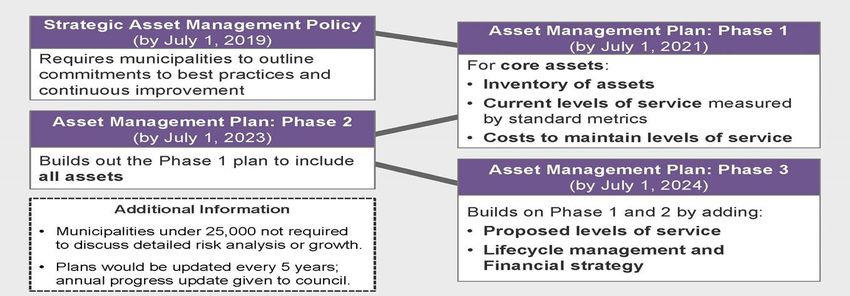
Asset Management Regulation Overview

*Core assets are municipal road, bridges, water,
wastewater, stormwater assets

  27
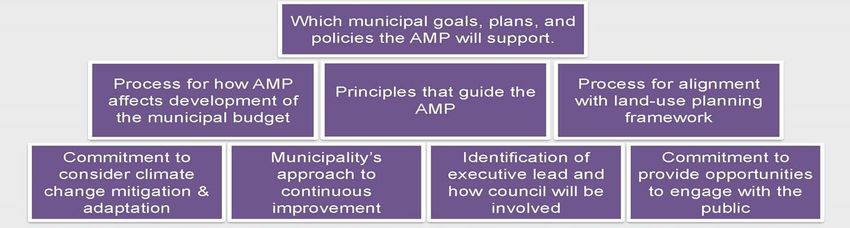
Strategic Asset Management Policy

•    All municipalities are required to develop and adopt a strategic asset management
     policy by July 1, 2019. The policy must include:

28
Provincial Update: More Housing, More Choice: Ontario’s Housing Supply Action Plan Community Housing renewal Strategy
Affordability in the
                   Housing      broader housing
     V ISION :      Supply      market – unlocking
                                the development of
 All Ontarians    Action Plan   all kinds of housing
  can find a
  home that
  meets their
needs and their
     budget       Community     Affordable housing for low-
                   Housing      income households and the
                   Renewal      non-profit, cooperative and
                                municipal housing sector
                   Strategy

30
Ministry of Municipal Affairs and Housing More Housing, More Choice: Ontario’s Housing Supply Action Plan
Housing Supply Action Plan
On May 2, 2019, the Minister of Municipal Affairs and Housing released More Homes, More Choice:
Ontario’s Housing Supply Action Plan
The Action Plan is intended to tackle Ontario’s housing crisis and help to build more homes across
the province
The Action Plan was informed by broad public and stakeholder consultations that were conducted
over Winter 2018-19. Over 2,000 submissions were received through the online portal
The consultations identified a number of themes as barriers to housing supply

Barriers to Housing Supply
1      SPEED               Red tape and paperwork can add years to a construction project.

                           Layers of permits, government approvals and charges by municipalities add to the
 2     COST                cost of building new homes.
                           We need a variety of different types of housing – from detached houses and
 3     MIX                 townhomes to mid-rise apartments, second units and family-sized condos.

 4     RENT                There are more people looking for homes than there are places to rent.

                           Ontario needs to explore new housing designs and materials, creative approaches to
 5     INNOVATION          home-ownership and leasing, and more.

32
What We Are Doing: The More Homes, More Choice Act, 2019
More Homes, More Choices Act
•    In support of the Housing Supply Action Plan, the Minister of Municipal Affairs and
     Housing introduced the More Homes, More Choice Act, 2019. The legislation received
     Royal Assent on June 6
•    The More Homes, More Choice Act, 2019 reflects feedback from public, municipal and
     development industry consultations over the past six months, including at the
     committee stage of the legislative process. The legislative changes were posted on the
     Environmental Registry
•    Changes are being proposed to regulations under the Development Charges Act to
     implement the changes introduced under Schedule 3 of the More Homes More Choice
     Act, 2019
•    Changes are being proposed to regulations under the Planning Act to implement the
     changes introduced under Schedule 12 of the More Homes, More Choice Act, 2019

34
Overview of Changes (MMAH Purview)
Legislative Changes:
Proclaimed:
• Schedule 12 of the Act made changes to the Planning Act
• Schedule 9 of the Act made changes to the Local Planning Tribunal Act
Upon proclamation:
• Schedule 3 of the More Homes, More Choice Act, 2019 would make changes to the
Development Charges Act
Proposed Regulations:
• New regulations and changes to existing regulations will be necessary to implement
the legislative changes
• The government intends to post proposal notices for the regulations on the
Environmental Registry of Ontario
The following slides provide a high-level overview of the legislative and proposed
regulatory changes.
35Legislative Changes 36
Changes to the Development Charges Act

Upon proclamation, Schedule 3 of the More Homes, More Choice Act, 2019 (Bill
108) would make changes to the Development Charges Act that are intended
to:
• Support a range and mix of housing options by expanding the ability of
    municipalities to recover costs for waste diversion and ambulance services
• Increase certainty of costs by deferring development charge payments for
    certain types of developments
• Increase the certainty and predictability of development charges by freezing
    rates earlier in the development process
• Support a range and mix of housing options by exempting second residential
    units in newly built homes, second residential units in ancillary structures to
    all homes and conversions of communal facilities in existing rental buildings
    to residential units from development charges (subject to regulation)

37
Changes to the Planning Act Proclaimed September 3rd 2019, Schedule 12 of the More Homes, More Choice Act, 2019 (Bill 108) made changes to the Planning Act to: • Make municipal charges for community benefits infrastructure, like libraries and daycare facilities, more predictable • Make it easier to create additional residential units, such as above garages and in basements • Facilitate faster decisions by reducing planning decision timelines • Increase the certainty and predictability of the planning system and help build housing, including affordable housing, near transit • Allow the Local Planning Appeal Tribunal to make decisions based on the best planning outcome 38
Community Benefits Charges - Overview

•    The new charge will enable municipalities to fund a range of capital infrastructure for
     community benefit services needed for new development
•    Community Benefits Charges (CBCs) would apply to new developments or
     redevelopments only
•    CBCs payable would not be able to exceed the amount determined by a formula
•    The formula would involve applying a specific percentage of the value of land for a
     proposed development
•    The percentages will be prescribed in regulation
•    The aim is that municipalities would not be disadvantaged in funding community
     benefits required because of the development of lower-valued land
•    A key objective in developing the formula is to enable municipalities to maintain the
     historical revenues from density bonusing, parkland dedication, and development
     charges for discounted services under this new charge
•    The Ministry is in the process of hiring a consultant to develop a potential formula,
     which will take into consideration the objective of maintaining municipal revenues
39
Other Legislative Changes
Proclaimed:
• Schedule 9 of the More Homes, More Choice Act, 2019 made changes to the
Local Planning Appeal Tribunal Act (Ministry of Attorney General) to:
o Ensure the tribunal has the resources (more adjudicators) and
adjudicative powers needed to make fair and timely decisions
Upon proclamation:
• Schedule 6 of the Act would make changes to the Environmental Assessment
Act (Ministry of the Environment, Conservation and Parks)
o Address duplication and reduce delays in the environmental
assessment process
• Schedule 11 of the Act would make changes to the Ontario Heritage Act
(Ministry of Tourism, Culture and Sports)
o Improve transparency and efficiency in municipal decision making
40 regarding properties of cultural heritage value or interestOther Legislative Changes
Upon proclamation:
• Schedule 2 of the Act would make changes to the Conservation Authorities
Act (Ministry of Natural Resources and Forestry)
o Focus Conservation Authorities on their core mandate, reduce
approval times, improve predictability of the approval process
• Schedule 5 of the Act would make changes to the Endangered Species Act
(Ministry of the Environment, Conservation and Parks)
o Support a modern, ecosystem-wide approach to protecting species
that is efficient and effective
• Schedule 7 of the Act would make changes to the Environmental Protection
Act (Ministry of the Environment, Conservation and Parks)
o Remove barriers to developing previously used land and make it easier
and safer to reuse soil in construction
41Next Steps
• Notices were posted on the Environmental Registry of Ontario for a
number of these proposed changes in June-August time frame
• The Ministry of Municipal Affairs and Housing sought input from the
municipal and development sector on the proposed regulatory
approach to establish implementation details related to the new
community benefits charge authority including, consultations on the
development of an approach to a methodology for establishing a
community benefits charge formula
• The Ministry will consult again on the prescribed percentages
associated with community benefits charges with the goal of
maintaining municipal revenues in establishing the new community
benefits tool through the Environmental Registry of Ontario (ERO)
42Other Anticipated Improvements
Development Approvals - Continue working with municipalities and developers to
remove red tape and make sure the approval process fits the project.
Housing Data - Work with our municipal and federal partners to gather the information
needed to drive informed decisions.
Rent – Second Units - Make it easier to build second suites (like basement apartments)
and help small landlords navigate the complicated Building Code approvals process.
Rent – Other - Help tenants and landlords know their rights and how to resolve disputes.
Innovation - Clarify rules and issue guides to help people understand how to take
advantage of creative solutions such as life leases, tiny homes and co-ownership, while
continuing to review legislation and regulations to make sure they spur flexibility,
creativity and new solutions.
o The ministry recently released a guide to help homeowners understand Building Code
requirements for adding a second unit in their house.
Economic Development - Work with municipalities and businesses to find housing
solutions that help communities across Ontario attract investment and good jobs.
43Upcoming Events
Events
     • AMCTO Zone 4 Fall Meeting   • 2020 AMCTO Conference
        – November 29                 – June 7-10
        – Vaughan                     – Blue Mountains

     • 2020 ROMA Conference        • 2020 AMO Conference
        – January 18-21               – August 16-19
        – Toronto                     – Ottawa

     • 2020 OGRA Conference        • 2020 MFOA Conference
        – February 23-Feb 26          – September 23-25
        – Toronto                     – Blue Mountains

45
MSO Central Contacts
Diane Ploss Vicky Rajput
Municipal Advisor Senior Financial Municipal Advisor
(Muskoka, Niagara, Durham and Hamilton) 416-585-6361
416-585-6381 vicky.rajput@Ontario.ca
diane.ploss@ontario.ca
Priyanka Debnath
Sav Johal Manager, Local Government & Housing
Municipal Advisor 416-585-6379
(Simcoe, Halton, York, Peel and Toronto) priyanka.debnath@ontario.ca
416-585-6073
savroop.johal2@ontario.ca Aly N. Alibhai
Regional Director
Terry Fenton 416-585-7264
Senior Municipal Advisor aly.alibhai@ontario.ca
416-585-6687
terry.fenton@ontario.ca
46Questions? 47
You can also read


