National Renewable Energy Laboratory Advanced Research on Integrated Energy Systems (ARIES) User Call for Advanced Distribution Management System ...
←
→
Page content transcription
If your browser does not render page correctly, please read the page content below

National Renewable Energy Laboratory
Advanced Research on Integrated Energy
Systems (ARIES) User Call for Advanced
Distribution Management System (ADMS) Test
Bed Use Cases

Table of Contents
1     Introduction ........................................................................................................................................... 2
      1.1     Collaboration with NREL ............................................................................................................. 2
      1.2     Objective ....................................................................................................................................... 3
      1.3     Funding Summary ......................................................................................................................... 3
2     ADMS Test Bed Overview .................................................................................................................... 4
      2.1     ADMS Test Bed Description ........................................................................................................ 4
      2.2     ADMS Test Bed Use Cases .......................................................................................................... 5
3     Research Areas for ADMS Test Bed Use Cases ............................................................................... 7
      3.1     Research Area 1: Control Architectures ........................................................................................ 7
      3.2     Research Area 2: Role of DERMS and Aggregators .................................................................... 8
      3.3     Research Area 3: Integration with Buildings and Vehicles........................................................... 8
      3.4     Research Area 4: Communications Architectures and Cyber-Secure Data .................................. 8
4     User Definition and Eligibility............................................................................................................ 10
      4.1     Eligible Applicants ...................................................................................................................... 10
      4.2     Other Eligibility Requirements ................................................................................................... 10
5     Submission Information .................................................................................................................... 11
      5.1     Applicants.................................................................................................................................... 11
6     Proposal Package ............................................................................................................................... 12
      6.1     Proposal Format .......................................................................................................................... 12
      6.2     Summary Slides........................................................................................................................... 13
      6.3     Formatting ................................................................................................................................... 13
7     Review and Allocation Process ........................................................................................................ 14
8     Review Process .................................................................................................................................. 15
      8.1     Criteria......................................................................................................................................... 15
      8.2     Ratings and Weighted Scores ...................................................................................................... 15
      8.3     Conflicts of Interest and Confidentiality ..................................................................................... 17
9 Notification .......................................................................................................................................... 18
10 Principal Investigator Responsibilities ............................................................................................ 19
11 Laboratory Operations Information .................................................................................................. 20
      11.1 Resource Availability .................................................................................................................. 20
      11.2 Business Hours ............................................................................................................................ 20
      11.3 After Hours.................................................................................................................................. 20
12 Points of Contact ................................................................................................................................ 21
References ................................................................................................................................................. 22
Appendix. ESIF Overview and Capabilities ............................................................................................ 23
      1.1     ESIF Capabilities......................................................................................................................... 23
      1.2     ADMS Test Bed .......................................................................................................................... 23
      1.3     Open-Source Platform and Applications for ADMS................................................................... 25
      1.4     High-Performance Computing .................................................................................................... 26
      1.5     Communications Network Emulation ......................................................................................... 26
      1.6     Cyberattack Simulation ............................................................................................................... 27

                                                                              iii
This report is available at no cost from the National Renewable Energy Laboratory at www.nrel.gov/publications.
List of Figures
Figure 1. Overview diagram of the ADMS Test Bed ................................................................................... 4
Figure 2. Use case definition and execution process .................................................................................... 6
Figure A-1. ADMS Test Bed capability ..................................................................................................... 24
Figure A-2. Photograph of ADMS Test Bed setup ..................................................................................... 25
Figure A-3. ADMS Test Bed interfaced with NREL’s communications network emulation .................... 27

List of Tables
Table 1. Review and Allocation Timeline .................................................................................................. 14
Table 2. Review Criteria ............................................................................................................................. 16

                                                                          iv
This report is available at no cost from the National Renewable Energy Laboratory at www.nrel.gov/publications.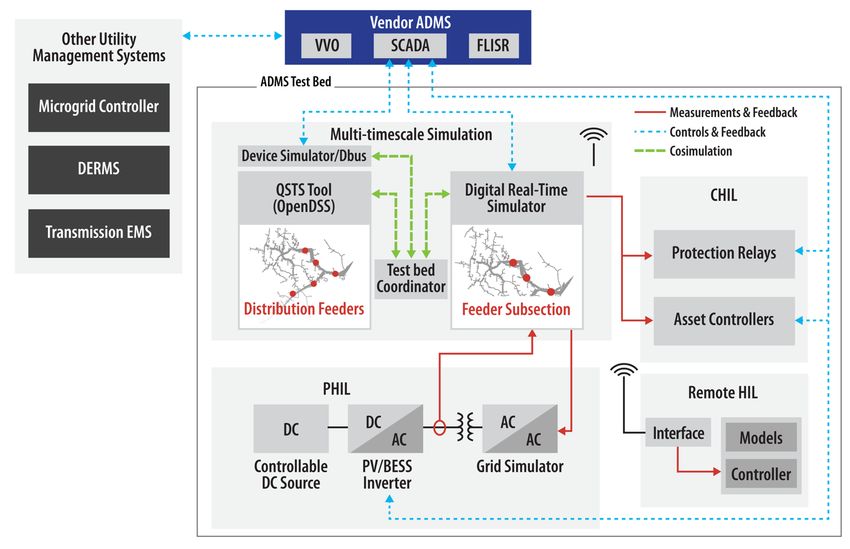
Timeline:

           •   November 19, 2021: Advanced Distribution Management System (ADMS) Test Bed
               User Call release date
           •   December 8, 2021: Questions are due to userprogram.esif@nrel.gov.
           •   December 16, 2021: Q&A session to address submitted questions.
           •   January 14, 2022: Deadline for proposal submission by 5 p.m. Mountain Daylight Time
               (MDT)
           •   February 2022: Selection and announcement of awards (anticipated)
           •   Cooperative research-and-development agreements (CRADAs) must be fully negotiated
               (including the joint statement of work) and ready for submission to the U.S. Department
               of Energy (DOE) for approval within 120 days of selection or the selected project may be
               cancelled.
       Contact/questions: Email communications and questions to userpgroam.esif@nrel.gov. Please
       note that all questions that are submitted and the respective answers will be posted to
       https://www.nrel.gov/aries/user-call-for-advanced-distribution-management-system-test-
       bed.html (except for questions deemed unresponsive to the call).

       Proposal submissions: Qualified partners are eligible to submit a proposal to this targeted ESIF
       user call. (see Section 4: User Definition and Eligibility) To apply, submit proposals to
       userprogram.esif@nrel.gov by 5 p.m. MDT on January 14, 2022. When a proposal is received, a
       confirmation email will be sent within 2–3 days stating the date and time of receipt. Note: Email
       submissions are restricted to 20 MB total, including all attachments. (See Section 6: Proposal
       Package.)

       Notification of selection: Once selections are finalized, applicants will receive an email from the
       National Renewable Energy Laboratory (NREL), and NREL will assign a principal investigator
       to each selected proposal to collaborate with the applicant on a joint statement of work.

                                                          1
This report is available at no cost from the National Renewable Energy Laboratory (NREL) at www.nrel.gov/publications.
1 Introduction
       The National Renewable Energy Laboratory (NREL), sponsored by the U.S. Department of
       Energy (DOE) Office of Energy Efficiency and Renewable Energy (EERE), is dedicated to
       transforming energy through the research, development, commercialization, and deployment of
       renewable energy and energy-efficiency technologies. NREL’s mission is to advance the science
       and engineering of energy-efficiency, sustainable transportation, and renewable power
       technologies. NREL does this by providing the knowledge to integrate and optimize energy
       systems.

       The Energy Systems Integration Facility (ESIF) is a national user facility located on NREL’s
       campus in Golden, Colorado. As a DOE user facility, state-of-the-art capabilities in the ESIF are
       available to the research community at large to conduct research that advances the missions of
       EERE and NREL. The mission of the ESIF is to accelerate the efficient transition to future
       energy systems that are secure, resilient, reliable, affordable, and clean. As a national user
       facility, the ESIF is equipped with an operations team that facilitates safe access to laboratory
       capabilities used for mission-aligned research experiments.

       NREL is issuing this user call to external research partners to identify projects that require using
       NREL’s Advanced Distribution Management System (ADMS) Test Bed. The ADMS Test Bed is
       a key capability of NREL’s Advanced Research on Integrated Energy Systems (ARIES), 1 a new
       national research capability at NREL that addresses the challenges associated with integrating
       distributed energy resources (DERs) into the broader power system. ARIES encompasses
       capabilities at both the ESIF and the Integrated Energy Systems at Scale at NREL’s Flatirons
       Campus. 2 Research at the ESIF supports up to 2 MW, which covers distribution-level testing.
       NREL is developing the Flatirons Campus to allow for research at the 20-MW scale and beyond,
       representing the interface between the distribution and bulk power levels.

       The ADMS Test Bed was developed by NREL and the DOE Office of Electricity Advanced Grid
       Research and Development program through DOE’s Grid Modernization Laboratory Consortium
       as a vendor-neutral evaluation platform for advanced grid controls implemented on ADMS
       platforms. NREL’s ADMS Test Bed works to advance the Biden-Harris Administration’s goals
       of transforming utility electric distribution management systems to enable the integration and
       management of all assets and functions across the utility enterprise regardless of vendor or
       technology. Located in the ESIF, the ADMS Test Bed is an evaluation platform consisting of
       software and hardware elements that realistically represent a power distribution system to a
       commercial or precommercial ADMS and/or other utility managements systems.

       1.1 Collaboration with NREL
       NREL seeks qualified partners to participate in collaborative projects. Each selected
       collaborative project will be conducted under a cooperative research-and-development
       agreement (CRADA) between NREL and qualified partners working on the project. To be

       1   See https://www.nrel.gov/aries/.
       2
         NREL’s recently renamed Flatirons Campus is located near Boulder, Colorado. The campus is also home to
       NREL’s National Wind Technology Center, which provides unique capabilities that support experiments,
       innovation, and technology validation that advance U.S. leadership in wind energy technology.

                                                             2
This report is available at no cost from the National Renewable Energy Laboratory (NREL) at www.nrel.gov/publications.
eligible for selection, a proposed project must include at least one qualified partner. (See Section
4: User Definition and Eligibility.)
1.2 Objective
Through this user call, NREL seeks proposals to support DOE’s goals and ARIES goals through
projects that use the ADMS Test Bed. To aid in this effort, NREL released a request for
information (RFI) in June 2021 to identify research areas that are most impactful to industry.
This user call incorporates the feedback received from that RFI. Joint partnerships between
NREL and qualified partners will enable the integration of high levels of DERs in future energy
systems by addressing one or more of the research areas identified in Section 0: Research Areas
for ADMS Test Bed Use Cases.
1.3 Funding Summary
The funding for the selected use cases are summarized as follows:
• Estimated number of projects: 1–2 projects
• Period of performance: Up to 12 months
• Estimated DOE funding available (for use at national laboratories): Up to
$1,500,000 ($500,000 to $1,000,000 per project)
• Cost share: Federal funding must be cost-shared at 40%, including at least 20% funds in,
based on the total project value. All federal funds must be costed at national laboratories.
3
This report is available at no cost from the National Renewable Energy Laboratory (NREL) at www.nrel.gov/publications.2 ADMS Test Bed Overview
This section provides an overview of the ADMS Test Bed and use case definition and execution.
2.1 ADMS Test Bed Description
The ADMS Test Bed is an evaluation platform consisting of software and hardware elements
that realistically represent a power distribution system to a commercial or precommercial
ADMS. Its main elements are simulation; controller and power hardware that can be interfaced
with the software simulation through the use of hardware-in-the-loop (HIL) techniques; and
industry-standard communications interfaces, as shown in Figure 1.
Figure 1. Overview diagram of the ADMS Test Bed
The software simulation environment acts as the real distribution system on which the ADMS
operates. The simulation environment can combine quasi-steady-state simulations, phasor-
domain simulations, and electromagnetic transient simulation studies. The Hierarchical Engine
for Large-scale Infrastructure Co-Simulation (HELICS) 3 platform, developed by a consortium of
DOE national laboratories, interconnects these simulation tools and integrates physical hardware.
Controller hardware and power hardware—such as photovoltaics (PV) and battery energy
storage system inverters, grid-edge devices, and legacy utility control and automation
equipment—can be linked to the simulated utility environment. Through integrating power
hardware, researchers can evaluate how equipment interacts with the ADMS at scale and validate
software models.
Another essential element of the test bed is the ability for all simulated devices that interface
with the ADMS to communicate using an industry-standard communications protocol. Other
utility management systems—such as energy management systems (EMS), distributed energy
3
See https://helics.org/.
4
This report is available at no cost from the National Renewable Energy Laboratory (NREL) at www.nrel.gov/publications.resource management systems (DERMS), microgrid controllers, or building automation
systems—can also be incorporated into the test bed, as needed, for specific use cases.
For each use case, a set of scenarios is generated that includes loading and solar insolation
conditions, DER levels, and/or faults. These scenarios are then simulated and can be observed
using real-time visualization tools developed for the test bed, and the data are also stored to
enable analysis.
2.2 ADMS Test Bed Use Cases
NREL has previously partnered with different utilities, vendors, and other organizations to
perform several use case studies. In one example, Holy Cross Energy partnered with NREL to
use the ADMS Test Bed to test control algorithms that manage DERs to regulate distribution
voltages, reduce peak demand, and provide more cost-efficient energy use for DER owners.
Following these experiments, the ADMS Test Bed was used to demonstrate the operation of
NREL’s real-time optimal power flow algorithms controlling DERs along with Holy Cross
Energy’s ADMS, provided by Survalent, controlling legacy equipment to reduce peak demand
and, as a result, peak demand charges (Padullaparti et al. 2021). Other uses cases studied the
impact of ADMS network model quality on volt/volt ampere reactive optimization (Pratt et al.
2020) and using advanced metering infrastructure (AMI) data for grid operations. NREL also has
an ongoing study on the effect of DERs on fault location, isolation, and service restoration (Pratt
et al. 2021) and newly launched studies on a federated DERMS approach and transmission-and-
distribution co-optimization. Through this user call, NREL seeks to identify future use cases of
the ADMS Test Bed that will enable the integration of high levels of DERs in future energy
systems.
We use a collaborative approach to define and execute the use cases, in which we involve utility
and vendor partners as stakeholders, as illustrated in Figure 2 (Veda et al. 2017). The definition
of a use case could start with a utility that defines an operational challenge that they want to
address through an ADMS deployment. It could also start with a vendor that wishes to
demonstrate the value of one of their applications under certain conditions. It could also be a
combination of the two, i.e., a utility might be interested in evaluating whether a proposed
vendor solution will address their operational challenge.
5
This report is available at no cost from the National Renewable Energy Laboratory (NREL) at www.nrel.gov/publications.Figure 2. Use case definition and execution process
Once the use case is defined, we define a test plan and configure the test bed for the specific use
case with inputs from the utility and vendor. These inputs typically include the ADMS platform,
training on the use of the platform, and information on the equipment capabilities from the
vendor; and distribution network models and historical field data from the utility. For a vendor-
driven use case with the intent of showing the value of a new application, for example, we might
choose to use synthetic feeders, i.e., anonymized, realistic feeders, such as those made available
through the Advanced Research Projects Agency-Energy Generating Realistic Information for
the Development of Distribution and Transmission Algorithms (GRID DATA) program, 4 or
representative feeders provided by the Electric Power Research Institute. Upon execution of the
test plan, we analyze the results and disseminate them to our partners and, to the extent possible,
with proper anonymization in place, to the broader utility industry and academic power research
community.
4
See https://www.bettergrids.org/portfolio_category/griddata.
6
This report is available at no cost from the National Renewable Energy Laboratory (NREL) at www.nrel.gov/publications.3 Research Areas for ADMS Test Bed Use Cases
Applicants are encouraged to propose mission-aligned research that requires the use of the
ADMS Test Bed at the ESIF that addresses at least one of four research areas. Applicants may
submit more than one proposal, and proposals may address more than one research area. The
four research areas are:
• Research Area 1: Control architectures addresses control architectures and/or
algorithms for systems with high levels of DERs. The intent of this research area is to
develop projects that evaluate emerging control architectures and/or algorithms on
realistic power systems.
• Research Area 2: Role of DERMS and aggregators addresses ways to coordinate the
operation of an ADMS with a DERMS and/or aggregators and the level of visibility that
the ADMS requires into DERMS and/or aggregator operations.
• Research Area 3: Integration with buildings and vehicles addresses the evaluation of
control and management solutions that specifically include integration with buildings
(residential or commercial) and vehicles.
• Research Area 4: Communications architectures and cyber-secure data addresses
the evaluation of control and management solutions that specifically include different
communications architectures, protocols, and/or cyber-secure solutions.
Of specific interest are projects that align with the DOE Grid Modernization Initiative (GMI). 5
The GMI coordinates research and development (R&D) across DOE to help set the nation on an
affordable path to a resilient, secure, and reliable grid with a reduced environmental impact.
Proposals that address the following technical activities in the areas of system operations, power
flow, and control are of specific interest:
• Architecture and control theory
• Coordinated system controls
• Enabling flexible generation
• Crosscutting initiatives.
3.1 Research Area 1: Control Architectures
Distribution operators need to prepare for a future electric grid with increased levels of
renewables and DERs, prosumers and microgrids, as well as new business models and services,
some of which could be provided by third-party aggregators. This complex operating
environment will require enhanced operating systems, platforms, and applications for the
management of electricity. As the levels of DERs increase—especially intermittent sources, such
as PV—distribution management system capabilities, including ADMS applications, need to be
updated to attain effective management of the electric power distribution system. This requires,
at a minimum, visibility of the DERs and ideally some level (direct or indirect) of controllability.
There is increasing consensus that a more distributed framework with a hierarchical control and
communications structure would provide more benefits toward the scalability of monitoring,
control, and communications and the underlying computations for grid operation.
5
See https://www.energy.gov/oe/downloads/gmi-updated-strategy-2020.
7
This report is available at no cost from the National Renewable Energy Laboratory (NREL) at www.nrel.gov/publications.This research area addresses control architectures and/or algorithms for systems with high levels
of DERs. The intent of this research area is to develop projects that evaluate emerging control
architectures and/or algorithms on realistic (real or synthetic) power systems.
3.2 Research Area 2: Role of DERMS and Aggregators
DERs on distribution feeders are typically not controlled or they have only local controls (such
as power factor control). As the levels of DERs increase, a coordinated control strategy might be
more appropriate, leading to the development of DERMS and the emergence of third-party
aggregators, some of which provide virtual power plant services. Both controller types need to be
integrated with distribution management systems when used by utilities. It is also possible to
interface DERs directly with a distribution management system, but this is more common for a
small number of utility-scale DERs.
This research area is intended to identify research that uses the ADMS Test Bed to address
questions such as: What is the best way to coordinate the operation of an ADMS with a DERMS
and/or aggregators? And what level of visibility does the ADMS require into DERMS and/or
aggregator operations? Systems with high levels of DERs also provide opportunities to use
DERs to provide grid services, and projects in this research area could evaluate the management
of DERs for the provision of bulk grid services.
3.3 Research Area 3: Integration with Buildings and Vehicles
Households and businesses are constantly installing new devices—e.g., electric vehicle (EV)
chargers, rooftop solar, energy storage, smart appliances—onto the grid. As the number increases
to the millions, new solutions and capabilities are needed to optimize distribution power
management. There are also some disadvantaged communities that lag in their deployment of
smart devices; thus, use cases that address the benefits of ADMS technology for future power
systems in such communities are of high interest. As more of the transportation fleet is
electrified, the impact on distribution systems will become significant. In addition to increased
load and potentially generation, EVs are mobile and will move between different nodes within
the distribution power system. Some commercial or industrial customers might also deploy fleets
of EVs at the distribution level.
The intent of this research area is to develop projects that evaluate control and management
solutions that specifically address integration with buildings and vehicles.
3.4 Research Area 4: Communications Architectures and Cyber-
Secure Data
There is a complex industry-standard landscape for communications. Various standards have
been used in this space, and communications standards can support different information models.
The communications landscape gets even more complex when considering the various types of
current and evolving communications network technologies and topologies and the associated
protocols that could be used in a specific or new deployment, such as supervisory control and
data acquisition, AMI, and third-party networks. Interoperability is needed at all levels, and
communications architecture advancements are needed to manage the complexity and to
encourage interoperability while preserving data privacy.
8
This report is available at no cost from the National Renewable Energy Laboratory (NREL) at www.nrel.gov/publications.The ability to handle the sheer number of communications and the massive amount of data also
becomes a challenge; and as home, commercial building, and industrial energy management
systems control energy consumption by managing DERs (e.g., rooftop PV and local storage) and
by shaving, shifting, and modulating loads, customer participation will increase through reliance
on networked sensors and controls. These management systems also need to interface with
power system service providers to optimize asset utilization for lower cost while maintaining
reliability and resilience; therefore, with this increased access, cyber-secure solutions to new
control strategies are critical to maintaining overall grid infrastructure reliability and resilience.
The intent of this research area is to develop projects that use the ADMS Test Bed to evaluate
control and management solutions that specifically include different communications
architectures and/or protocols and address questions such as: How do the proposed
communications perform for different types of control and under different adverse system
conditions? What is the impact of communications latency?
9
This report is available at no cost from the National Renewable Energy Laboratory (NREL) at www.nrel.gov/publications.4 User Definition and Eligibility
Users are researchers who conduct experiments at or provide collaboration for an approved
experiment in a DOE user facility. The primary type of user is an on-site, badged user (i.e., a
researcher who conducts experiments that use laboratory capabilities in the facilities). Users are
either NREL staff (including interns and postdoctoral researchers) or external users, such as
industry partners, university researchers, and other DOE national laboratory or independent
research facility staff.
External users can work in NREL facilities either independently or in collaboration with NREL
researchers.
4.1 Eligible Applicants
• Domestic entities: For-profit entities, educational institutions, and nonprofits that are
incorporated (or otherwise formed) under the laws of a particular state or territory of the
United States and have a physical location for business operations in the United States are
eligible to apply. Federally funded R&D centers (DOE/National Nuclear Security
Administration and non-DOE/National Nuclear Security Administration entities) and
federal agencies and instrumentalities are eligible to apply.
• Foreign entities: Foreign entities, whether for-profit or otherwise, are eligible to apply.
All non-U.S. applicants, users, and funding sources must be approved by DOE before
NREL will grant access to foreign entities or users.
• Individuals: Individuals are not eligible to apply.
4.2 Other Eligibility Requirements
• Funding requirement: Federal funding must be cost-shared at 40% of the total value of
the project, including at least 20% funds in. All federal funds will be provided to national
laboratories, i.e., no federal funds will be provided to project partners. Required cost-
share percentages are calculated based on the total value of the project, which is the sum
of the DOE funds and the partner contribution provided to national laboratories. Cost
shares may include cash or in-kind contributions, but for this user call, at least 20% of the
total value of the project must be in the form of funds-in to national laboratories. For
example, if the total project value is $1,000,000, 40% (or $400,000) must come from
nonfederal sources, and at least $200,000 of that must be funds-in (i.e., cash
contributions). In this example, DOE would provide $600,000 to the project. Cost shares
from other DOE offices are not permitted.
• Site security and safety: All users must be qualified to conduct work in the ESIF and
adhere to all onboarding and training requirements before access to the laboratory will be
granted. Learn more about NREL’s site security procedures, and review the ESIF User
Guide.
• Partnership agreement for applicants: Please see NREL’s Technology Partnership
Program page for additional information regarding the CRADA and agreement process.
• Requirement to share results: Nonproprietary projects are eligible under this user call.
Nonproprietary results and information must be shared for each project accepted through
the user call.
10
This report is available at no cost from the National Renewable Energy Laboratory (NREL) at www.nrel.gov/publications.5 Submission Information
Proposal packages for the user call will be accepted through January 14, 2022.
5.1 Applicants
Applicants must submit a proposal package that contains two (2) files:
1. An application that includes all sections described in Section 6: Proposal Package and
adheres to all formatting requirements.
2. PowerPoint slide deck.
Email completed proposal packages to userprogram.esif@nrel.gov by 5 p.m. Mountain
Daylight Time (MDT) on January 14, 2022. The subject line of the email should read: ADMS
Test Bed User Call - Organization, Contact Last Name (e.g., ADMS Test Bed User Call - NREL,
Taylor). There is no limit to the number of proposals that an applicant may submit.
11
This report is available at no cost from the National Renewable Energy Laboratory (NREL) at www.nrel.gov/publications.6 Proposal Package
The proposal package consists of two (2) files:
1. Application
2. Summary slide deck.
Templates are provided for the summary slide deck.
6.1 Proposal Format
Proposals should be no more than five (5) single-spaced pages (not including resumes and
references) using 11-point font (Times New Roman preferred), should be in single PDF file
format, and must include the following components under headings corresponding to:
• Title page: Include proposal title, co-principal investigator (co-PI), brief company
description, and nonproprietary summary. Include name, nationality, address, phone
number, and email address of the primary contact(s) for both contracting discussions and
technical discussions (limited to 1 page, not counted in the 5-page limit).
• 1.0 Abstract: Describe the specific product, component, algorithm, or process being
developed, refined, or evaluated. Include how NREL’s ADMS Test Bed is essential to
execute the work.
• 2.0 Project description: Describe the project in enough detail that it can be evaluated for
feasibility; research impact; relevance to DOE, NREL, and ADMS Test Bed objectives;
and appropriate use of national laboratory capabilities. Indicate the desired laboratory
start date and duration of the experiments to be conducted.
• 3.0 Research & development approach: Describe the approach, design of activities,
and methods that will be used. Identify the R&D challenges that, if successfully
addressed, will result in significant advances. Be clear about how the project will advance
the state of the art.
• 4.0 Expected benefits & deliverables: Describe the expected benefits to the research
community, EERE, NREL, and the electric utility industry that would result from
successful implementation of the project. List the deliverables and indicate whether there
is an expectation to generate intellectual property or publication.
• 5.0 Equipment & resources: Briefly state what critical equipment, resources, and
ADMS Test Bed capabilities are required for the project. Include a description and
specifications of any non-NREL equipment that would need to be brought to the ESIF.
• 6.0 Funding: Provide a detailed table describing all funding sources, amounts, and
whether the funding has been confirmed/awarded or is pending an award decision.
Clearly indicate what funding will be provided to national laboratories staff to support the
project.
• 7.0 References & technical specifications: In addition to references, proposals may
include technical data sheets for devices, products, or software platforms planned to be
brought to/deployed at the ESIF (not counted in the 5-page limit).
• 8.0 Team: Single-page resumes of key project participants should be included (not
counted in the 5-page limit).
12
This report is available at no cost from the National Renewable Energy Laboratory (NREL) at www.nrel.gov/publications.6.2 Summary Slides
All proposal packages must include a summary slide deck that adheres to the template provided.
The summary slide template files are provided as part of the document package attached to the
solicitation on https://sam.gov.
6.3 Formatting
The page format for the application document comprises margins of 1 inch around the text (top,
bottom, left, right), with the text at 11-point, single-spaced font in Times, Times New Roman, or
appropriate symbol font (for math script). The provided PowerPoint template should be used for
the summary slide deck.
• Headers and footers: To ensure that your proposal is clearly identified, please include
header and footer information (within the top and bottom 1-inch margins) as follows:
o Left header: proposal title
o Left footer: Co-PI’s name and organization
o Right footer: page number.
• Other notes: Applications may contain embedded figures, but the entire document
should be legible when printed. The inclusion of figures must not result in exceeding the
page limit. The file name on each document should match and follow this format:
o Organization name_co-PI last name.Project title
o (i.e., NREL_Taylor.NextGenDERMS.pdf and
NREL_Taylor.NextGenDERMS.ppt)
13
This report is available at no cost from the National Renewable Energy Laboratory (NREL) at www.nrel.gov/publications.7 Review and Allocation Process
All eligible proposals will be evaluated by NREL technical research staff and management. To
be considered, an applicant must meet all eligibility criteria and have an application package
comprising all required materials.
Allocations of laboratory space, equipment, and other necessary resources will be made for up to
12 consecutive months from the laboratory start date. Extensions may be granted based on
individual cases.
Table 1. Review and Allocation Timeline
Annual user call solicitation announced, posted to SAM.gov November 19, 2021
Questions are due to userprogram.esif@nrel.gov December 8, 2021
Q&A session to address submitted questions December 16, 2021
Submission deadline January 14, 2022, 5:00 p.m. MDT
Review period January 2022 – February 2022
Expected time frame for decisions February 2022
Expected time frame for agreement negotiations 90–120 days
Allocation period of performance Up to 12 months
14
This report is available at no cost from the National Renewable Energy Laboratory (NREL) at www.nrel.gov/publications.8 Review Process
Requests that pass the initial compliance screening are subject to review by NREL’s review
committee. Reviewers rate the projects on a scale from 1 (lowest score) to 5 (highest score)
according to the following criteria.
8.1 Criteria
Reviewers assess proposal packages and assign scores based on research impact, mission
alignment, and whether the project contributes to the stewardship and overall strategy of the
ADMS Test Bed.
8.2 Ratings and Weighted Scores
Table 2 provides a detailed description of the review criteria. Scores are weighted based on
criteria and summed to generate an overall score for each proposal package.
15
This report is available at no cost from the National Renewable Energy Laboratory (NREL) at www.nrel.gov/publications.Table 2. Review Criteria
ADMS Test Bed Stewardship &
Mission Alignment Research Impact
Score Strategy
20% 40% 40%
Effective crosscutting usage and
Likely of interest to most of the
addresses research areas as outlined.
Aligns with multiple research community. Will
Uses multiple ADMS Test Bed
specific GMI technical change a paradigm with
5 capabilities. Very likely to enhance or
activities and clearly effects on multiple disciplines
expand ADMS Test Bed capabilities.
Excellent articulates how the and/or market sectors. Very
Clearly builds on prior research
project will advance likely to produce intellectual
outcomes, data, models, or lab
the objective(s) property or lead to peer-
configurations. Likely to engage a
reviewed publication
strategic partner for many years.
Effective laboratory usage: Uses multiple
Likely of interest to most of the ADMS Test Bed and crosscutting
Aligns with a single research community. Will capabilities and addresses research
4 GMI technical activity change a paradigm with areas as outlined. Very likely to enhance
and clearly articulates effects on a single discipline or expand ADMS Test Bed capabilities.
Very how the project will and/or market sector. Likely to Likely to build on prior research
Good advance the produce intellectual property outcomes, data, models, or
objective(s) or lead to peer-reviewed configurations. Likely to engage a
publication strategic partner for the duration of the
project
Likely of interest to a single Uses a single ADMS Test Bed capability
Aligns broadly with
discipline in the research and addresses research areas as
NREL/DOE mission
community. Will change a outlined. Might enhance or expand
3 areas but does not
paradigm with effects on a ADMS Test Bed capabilities. Might build
articulate how the
Good single discipline and/or market on research outcomes, data, models, or
project will advance
sector. Might produce configurations developed through prior
specific GMI technical
intellectual property or lead to projects. Might bring in a strategic
activities
peer-reviewed publication partner
Likely of interest to a single
Uses a single ADMS Test Bed capability
discipline in the research
Relates to the and addresses research areas to some
community. Will not change a
2 NREL/DOE mission extent. Not likely to enhance or expand
paradigm with effects on any
area but not to a ADMS Test Bed capabilities, build on
Fair discipline and/or market
specific GMI technical prior research outcomes, data, models,
sector. Not likely to produce
activity or configurations. Not likely to engage a
intellectual property or lead to
strategic partner
peer-reviewed publication
Not likely of interest to the
Does not effectively use ADMS Test Bed
research community. Not likely
capabilities and/or does not address
to change a paradigm with
1 research areas. Will not enhance or
Does not relate to the effects on a discipline and/or
expand ADMS Test Bed capabilities,
Poor NREL/DOE mission market sector. Not likely to
build on prior research outcomes, data,
produce intellectual property
models, or configurations. Will not
or lead to peer-reviewed
engage a strategic partner
publication
16
This report is available at no cost from the National Renewable Energy Laboratory (NREL) at www.nrel.gov/publications.8.3 Conflicts of Interest and Confidentiality
Every effort is made to avoid conflicts of interest. Reviewers are required to identify potential
conflicts of interest on any projects they are requested to review. If a co-PI is concerned about a
potential conflict of interest, the applicant should provide a summary of the potential conflict in
the body of the submission email.
No proprietary information should be included in the proposal package.
17
This report is available at no cost from the National Renewable Energy Laboratory (NREL) at www.nrel.gov/publications.9 Notification
Staff from NREL’s ESIF User Program will communicate resource allocation decisions to all
applicants. The identities of reviewers are kept confidential, but reviewer comments and
composite scores might be available upon request.
18
This report is available at no cost from the National Renewable Energy Laboratory (NREL) at www.nrel.gov/publications.10 Principal Investigator Responsibilities
The primary point of contact for the research project will be the PI, who will be an NREL staff
member identified upon selection. Applicants should identify a co-PI who will be the primary
non-NREL contact for the project. No limit is placed on the number of team members or
potential laboratory users associated with a particular project.
Responsibilities of the co-PI during the proposal and review period are to:
• Submit a completed proposal package by the submission deadline.
• Ensure the accuracy of the proposal content.
• Respond in a timely manner to any requests or questions from NREL regarding the
proposal.
Upon selection, the NREL PI will work with the co-PI to develop, negotiate, and agree on a
detailed baseline execution plan.
Responsibilities of the co-PI after selection are to:
• Provide the necessary documentation to NREL’s Technology Transfer Office to enable
them to establish the appropriate agreement associated with the project.
• Support the PI in the development of an execution plan.
After receiving approval to use NREL’s resources, the co-PI’s responsibilities are to:
• Ensure that all users complete the necessary training to use the resources safely and
securely.
During the project execution, the co-PI’s responsibilities are to:
• Communicate changes in schedule, resource needs, or user access to the PI in a timely
manner. The PI will then communicate with the ESIF User Program.
• Support the PI in providing a summary of results.
• Complete a user survey.
• Support the PI in sharing nonproprietary results publicly after the conclusion of the
project.
19
This report is available at no cost from the National Renewable Energy Laboratory (NREL) at www.nrel.gov/publications.11 Laboratory Operations Information
11.1 Resource Availability
NREL’s resources are closely monitored, and every effort is made to minimize disruptions and
maximize availability to users; however, regular maintenance, unanticipated issues, and failure
of equipment might cause downtime. NREL’s Laboratory Operations staff takes all precautions
to minimize the impact of such events and communicates with users regarding these situations.
11.2 Business Hours
Laboratory Operations staff are available to monitor and manage systems and assist users during
standard business hours, from 8:00 a.m.–5:00 p.m., Monday–Friday, except on holidays or
special campus closures.
11.3 After Hours
Laboratory Operations staff also monitors systems outside of standard business hours; however,
the center does not maintain an on-call rotation. If hardware or software breaks outside of
standard business hours, resolution is not expected to start until the next business day.
Unattended operation is granted on the basis of individual cases and only after thorough safety
and operational discussions.
20
This report is available at no cost from the National Renewable Energy Laboratory (NREL) at www.nrel.gov/publications.12 Points of Contact
• ESIF user program: userprogram.esif@nrel.gov
21
This report is available at no cost from the National Renewable Energy Laboratory (NREL) at www.nrel.gov/publications.References
Blonsky, Michael, Jeff Maguire, Killian McKenna, Dylan Cutler, Sivasathya Pradha
Balamurugan, and Xin Jin. 2021. “OCHRE: The Object-oriented, Controllable, High-resolution
Residential Energy Model for Dynamic Integration Studies.” Applied Energy 290: 116732.
https://doi.org/10.1016/j.apenergy.2021.116732.
Padullaparti, H., A. Pratt, I. Mendoza, S. Tiwari, C. Bilby, and Y. Ngo. 2021. “Peak Load
Management in Distribution Systems Using Legacy Utility Equipment and Distributed Energy
Resources.” Presented at the IEEE Green Technologies Conference (GreenTech), April 7–9,
2021.
Pratt, A., I. Mendoza, H. Padullaparti, M. Baggu, Y. Ngo, and H. Arant. 2021. “Defining a Use
Case for the ADMS Test Bed: Fault Location, Isolation, and Service Restoration with
Distributed Energy Resources.” Presented at the IEEE PES Innovative Smart Grid Technologies
(ISGT), February 16–18, 2021.
Pratt, A., I. Mendoza, M. U. Usman, S. Tiwari, H. Padullaparti, M. Baggu, and E. Lightner.
2020. “Using an Advanced Distribution Management System Test Bed to Evaluate the Impact of
Model Quality on Volt/VAR Optimization.” Accepted to the IEEE PES Transmission and
Distribution Conference & Exposition (T&D) Conference and Exhibition, October 2020.
Veda, S., H. Wu, M. Martin, and M. Baggu. 2017. “Developing Use Cases for the Evaluation of
ADMS Applications to Accelerate Technology Adoption.” Presented at the IEEE Green
Technologies Conference (GreenTech), Denver, Colorado, March 29–31, 2017.
22
This report is available at no cost from the National Renewable Energy Laboratory (NREL) at www.nrel.gov/publications.Appendix. ESIF Overview and Capabilities
The U.S. Department of Energy (DOE) has established the Energy Systems Integration Facility
(ESIF) on the campus of the National Renewable Energy Laboratory (NREL) in Golden,
Colorado. The ESIF is a unique national asset that has the capability to catalyze the public and
private-sector research and development necessary to accelerate the commercialization and
adoption of renewable energy and energy-efficiency technologies into today’s energy systems
where they can operate synergistically with other energy resources and technologies. A focus of
this research is to demonstrate how advanced energy systems technologies can improve the
overall reliability, resilience, and security of energy systems at an affordable cost.
1.1 ESIF Capabilities
The ESIF 6 provides integrated energy research capabilities across six indoor high-bay
laboratories, three outdoor test areas, and associated control and visualization rooms. ESIF
research is propelled by a novel electrical bus for controlled experimentation with both AC and
DC lab assets and real devices. Covering power systems, grid controls, thermal systems,
residential and commercial buildings application, advanced vehicles interfaces, hydrogen storage
and use, and power electronics and grid technologies, the ESIF offers one of the world’s most
diverse concerted energy technology integration portfolios. Electrical power systems and devices
up to 2 MW (AC and DC) are supported, including 13.2-kV distribution research connections, 1-
MW electrolysis, +600-kg hydrogen storage, hydrogen vehicle fueling, and combined heat and
power turbines. Communications and cyber technologies at the ESIF leverage expertise and
advanced emulation tools for true system operation scenarios, helping to move technology
toward the secure, efficient, and affordable energy system of the future. Further discussion of the
ESIF’s capabilities can be found in the ESIF Annual Reports. 7
1.2 ADMS Test Bed
The Advanced Distribution Management System (ADMS) Test Bed is a national, vendor-neutral
evaluation platform funded by the DOE Office of Electricity Advanced Grid Research and
Development Program to accelerate industry development and the adoption of ADMS
capabilities. The test bed enables utility partners, vendors, and researchers to evaluate existing
and future ADMS, distributed energy resource management systems (DERMS), and other utility
management system applications in a realistic laboratory environment.
The ADMS Test Bed consists of software simulations of distribution systems and field
equipment integrated through hardware-in-the-loop (HIL) techniques that realistically represent a
power distribution system to a commercial or precommercial ADMS, as shown in Figure A-1.
6
See https://www.nrel.gov/esif/integrated-energy.html.
7
See 2017: https://www.nrel.gov/docs/fy18osti/70906.pdf; 2018: https://www.nrel.gov/docs/fy19osti/73025.pdf;
2019: https://www.nrel.gov/docs/fy20osti/75862.pdf; and 2020: https://www.nrel.gov/docs/fy21osti/79354.pdf.
23
This report is available at no cost from the National Renewable Energy Laboratory (NREL) at www.nrel.gov/publications.Figure A-1. ADMS Test Bed capability
An ADMS is interfaced to the test bed using industry-standard communications protocols—such
as Distributed Network Protocol 3 (DNP3), International Electrotechnical Commission (IEC)
61850, and the Institute of Electrical and Electronics Engineers (IEEE) 2030.5—so it can be
deployed as it would be in a utility environment. Other utility management systems—such as a
microgrid controller, DERMS, or transmission energy management system—can also be
integrated through protocols such as MultiSpeak and Inter-Control Center Communications
Protocol (ICCP).
The multi-timescale simulation environment will act as the real distribution system on which the
ADMS operates. The simulation environment is capable of performing quasi-steady-state time-
series (QSTS) simulations, phasor-domain simulations, and/or electromagnetic transient (EMT)
simulation studies. We use OpenDSS for QSTS simulations of systems with tens of thousands of
nodes and several substations, and we can use either RTDS or OPAL-RT digital real-time
simulators for phasor or EMT simulations of hundreds to several thousand nodes. Different
simulation tools are coordinated through a test bed coordinator using the Hierarchical Engine for
Large-scale Infrastructure Co-Simulation (HELICS), an open-source, cyber-physical-energy
cosimulation framework for electric power systems. The test bed can also integrate simulations
of end-use loads in buildings using NREL’s Object-oriented Controllable High-resolution
Residential Energy (OCHRE™) (Blonsky et al. 2021) tool as well as home energy management
system (HEMS) controllers with the distribution system simulation.
Controller-hardware-in-the-loop makes it possible to evaluate controller hardware—including
legacy equipment (such as capacitor bank, LTC, and line voltage regulator controllers) and
24
This report is available at no cost from the National Renewable Energy Laboratory (NREL) at www.nrel.gov/publications.newer devices (such as smart meters)—when testing at actual scale or power levels is not
required or possible. Power-hardware-in-the-loop (PHIL) links actual power system
equipment—such as photovoltaics (PV) and battery energy storage system inverters, grid-edge
devices, and legacy utility control and automation equipment—to a lab-simulated utility
environment. With PHIL, researchers can test how equipment interacts with the ADMS at scale
and validate software models. The megawatt-scale PHIL capability at the ESIF allows NREL
researchers and partners to integrate multiple hardware devices, each with a separate simulated
point of common coupling using multiple bidirectional AC grid emulators. Each point of
common coupling has independent phase control that enables the recreation of a variety of grid
scenarios, such as voltage sags/surges and the complete loss of a single phase or multiple phases.
The AC grid emulators are interfaced with either OPAL-RT/RT-Lab or RTDS/RSCAD real-time
simulation platforms. NREL has also developed approaches to conduct HIL experiments in real
time with commercially available power systems simulation software, such as OpenDSS. The
picture of the ADMS Test Bed in Figure A-2 shows a couple of different ADMS user interfaces,
a digital real-time simulator, and controller and power hardware.
Figure A-2. Photograph of ADMS Test Bed setup
Researchers and partners can make use of NREL’s advanced visualization capabilities, including
3D visualization, to analyze and present results from the test bed.
1.3 Open-Source Platform and Applications for ADMS
NREL is partnering with Pacific Northwest National Laboratory to build an open-source ADMS
platform, GridAPPS-D, that will accelerate the deployment of ADMS technologies to address
the operational challenges faced by distribution utilities. GridAPPS-D has been designed to
provide a services-based platform that supports the development of applications. GridAPPS-D
provides a reference architecture and implementation that can be used by others to implement
similar application development tools or to adapt existing systems or create new ones for the
operational deployment of applications that comply with standards. Researchers, utilities, and
vendors can use this open-source platform to develop, test, and adopt functionalities tailored to
their needs without the burden of implementing full-scale ADMS systems.
25
This report is available at no cost from the National Renewable Energy Laboratory (NREL) at www.nrel.gov/publications.GridAPPS-D has been integrated with the ADMS Test Bed to evaluate the performance of a
novel ADMS voltage regulation application, as described earlier. The GridAPPS-D platform and
some of its open-source, advanced distribution applications are available for future use cases.
Existing applications include real-time distributed energy resource dispatch, short-term grid
forecasting, and intra-hour solar forecasting.
1.4 High-Performance Computing
The ADMS Test Bed can also take advantage of the high-performance computing capability at
the ESIF 8 to emulate larger systems. One example is the federated DERMS for high-PV systems
use case, where high-performance computing will be used to enable real-time cosimulation of the
power system with many homes that have HEMS. Eagle is the newest high-performance
computing system at NREL, and it is configured to run compute-intensive and parallel
computing jobs. It is a cluster comprising 2,186 nodes (servers) that run the Linux operating
system (Red Hat Enterprise Linux or the derivative CentOS distribution), with a peak
performance of 8 PetaFLOPS. The nodes are connected to each other and to storage by a high-
speed 100-Gb/s EDR InfiniBand network. All nodes and storage are connected using an
enhanced 8-dimensional hypercube topology that provides a bisection bandwidth of 26.4
terabytes/s.
1.5 Communications Network Emulation
The ADMS Test Bed can be interfaced with a communications network emulation, originally
developed for NREL’s Cyber-Energy Emulation Platform (CEEP), to allow researchers to model
the telecommunications network and to visualize and evaluate the interdependencies of power
systems and network communications flows. A conceptual diagram of such a setup is shown in
Figure A-3.
NREL is also developing a research-focused network communications capability, Grid Research
End-to-End Network Communications (GREEN-C), within the ESIF that aims to facilitate the
interconnectivity and accessibility of virtual and physical assets at the communications layer.
GREEN-C will serve as a management plane (fabric/underlay) for asset administration as well as
a user plane (experiment/overlay) for user-defined networks. GREEN-C leverages cyber network
emulation capabilities that include virtual machine environments, protocol translation, cloud
interfaces, and remote connectivity. The physical network connections are in place, and
connectivity to hardware could be established and the virtual environments set up as needed for
integration with the ADMS Test Bed for selected use cases.
8
See https://www.nrel.gov/hpc/.
26
This report is available at no cost from the National Renewable Energy Laboratory (NREL) at www.nrel.gov/publications.You can also read


