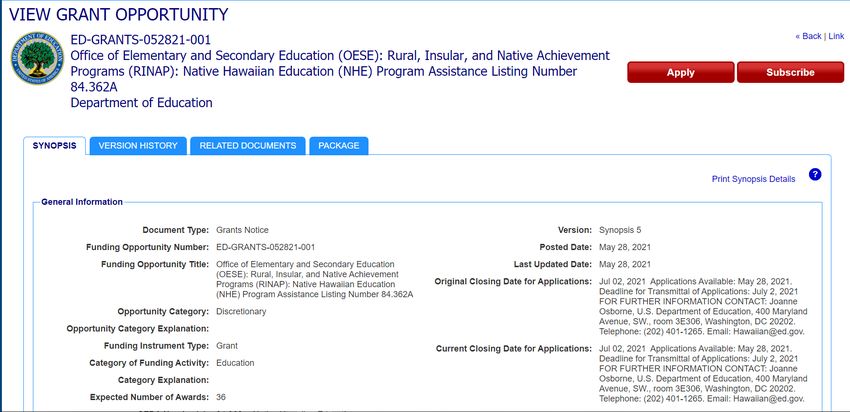
Native Hawaiian Education Program - Technical Assistance Webinar Application Closing Date
←
→
Page content transcription
If your browser does not render page correctly, please read the page content below
Native Hawaiian Education
         Program
 Technical Assistance Webinar

        Application Closing Date:
 07/02/2021 at 11:59:59 P.M. Eastern Time
        (5:59:59 P.M. Hawaii Time)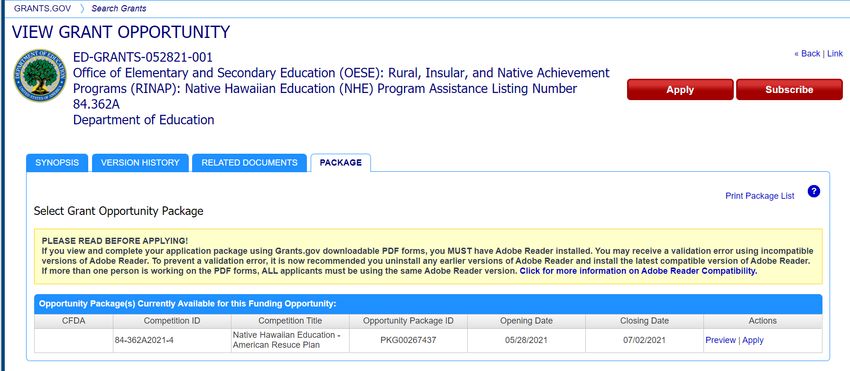
•   Introductions
          •   Overview
          •   Funding
          •   Competition Timeline
          •   Legislative Authority
          •   Program Purpose

Today’s   •

          •
              Absolute Priorities
              Budget
Agenda    •   Minor Remodeling
          •   Application Requirements
          •   Definitions
          •   Selection Criteria
          •   Application Process in
              Grants.gov
          •   Q&A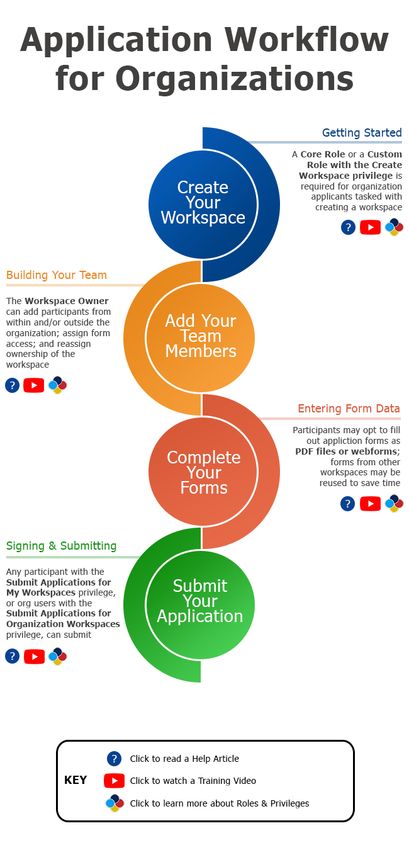
Introductions

Patrick Carr         Director, Rural, Insular, and Native Achievement Programs
Pat Johnson          Group Leader, Native Achievement Programs
Joanne Osborne       Program Manager
Almita Reed          Program Manager

Alexis Kedo          Program Officer
Elisabeth Lembo      Public Policy Fellow
Berenice Rodriguez   Summer Intern

Olivia Zalesin       Summer Intern
Overview

           4
Estimated Range of Awards: $250,000-$950,000
          annually for Absolute Priority 1; $1,000,000 -
          $3,000,000 annually for Absolute Priority 2

          Estimated Average Size of Awards: $750,000
          for Absolute Priority 1; $2,000,000 for Absolute
          Priority 2

Funding   Estimated Number of Awards: 36

          Project Period: Up to 36 months

          Cost Sharing or Matching: This program does
          not require cost sharing or matching.

                                                      5
Competition Timeline
May 28, 2021 July-August 2021
Competition opens Reviewer panels created,
applications screened and
reviewed
Department approval and
Congressional notification;
Competition closes Awards announced
July 2, 2021 September 2021
6 Applicants seeking funding
for new grant projects in
Legislative fiscal year (FY) 2021 under:
Title VI, Part B of the
Authority Elementary and Secondary
Act of 1965, as amended
(ESEA)
Section 11006(2) of the
American Rescue Plan (ARP)
78
The purpose of the NHE
program is to support
innovative projects that
recognize and address the
unique educational needs of
Program Native Hawaiians.
Purpose ARP provides an additional
$85 million to support Native
Hawaiians and Native
Hawaiian communities that
have been significantly
impacted by the COVID-19
pandemic. Absolute Priority 1 (Multiple
grants available)
Propose to fund activities
authorized under section
6205(a)(3) of the ESEA.
-- OR --
Absolute Absolute Priority 2 (One grant
available)
Priorities Solicits applications that
adopt a statewide
(p. 5, NHE Application
Package) approach to addressing the
unique educational needs of
Native Hawaiians through a
focus on the collection of
data to inform research on
the educational status and
needs of Native Hawaiian
children and adults
9 If you are not proposing a
research/data collection
statewide project, apply
under Absolute Priority 1.
An Absolute Priority 1
proposal can build on
Absolute and leverage an
existing grant or launch
Priorities a new project not
previously funded.
Statewide research/data
collection projects should
apply under Absolute
Priority 2.
10 Questions?
Budget Period: We are awarding
         all 3 years of funding from the $85
         million available. Successful
         grantees will need to report
         annually to demonstrate that the
         grant is making ‘substantial
         progress' each year.
Budget
         Project Period: Project period,
         sometimes referred to as the
         performance period, is the entire
         project from beginning to end.
         For this NHE competition, the
         project period is up to 36 months.

                                               12
Requirements for the 524-B Form
SECTION A - BUDGET SUMMARY U.S. DEPARTMENT OF EDUCATION
FUNDS
Project Year 1 Project Year 2 Project Year 3 Total
Budget Categories (a) (b) (c) (f)
Budget Table
1. Personnel
2. Fringe Benefits
3. Travel
Budget Narrative
4. Equipment
5. Supplies
6. Contractual
7. Construction
8. Other
9. Total Direct Costs
(lines 1-8)
10. Indirect Costs*
11. Training Stipends
12. Total Costs
(lines 9-11)Minor Remodeling
NHE ARP program funding may not be used for the
acquisition of real property or construction under
34 CFR 75.533.
However, this general prohibition
on construction and acquisition of real property
does not extend to activities that meet the
definition of “minor remodeling” under 34 CFR
77.1.
For more information, see pg. 26 of the Application
Package.Minor Remodeling
If minor remodeling projects are included in the
application, provide the following information:
Describe the minor remodeling project,
including details related to the previously completed
building where the project will take place.
Describe the association between the minor
remodeling project and the COVID-19
pandemic (e.g., installation or renovation of an HVAC
system to help with air filtration to prevent the spread
of COVID-19, the purchase or lease of temporary
trailer classroom units to increase social distancing,
and the purchase or costs of the installation of “room
dividers” within a previously completed building to
increase social distancing).(A) Native Hawaiian
Educational Organizations
(B) Native Hawaiian
Community-Based
Organizations
(C) Public and Private Nonprofit
Organizations, Agencies, and
Institutions with experience in
Eligibility developing Native Hawaiian
programs or programs of
instruction in the Native
Hawaiian language
(D) Charter Schools
(E) Consortia of Organizations,
Agencies, and Institutions
described in (A)
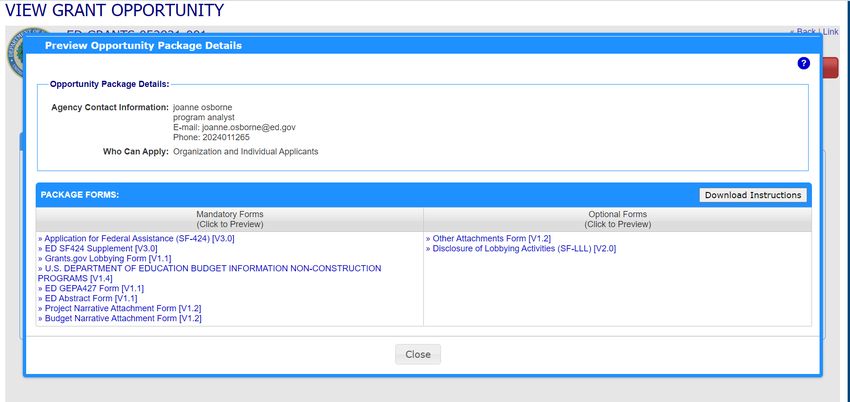
16Required Forms
Mandatory Forms
• Preliminary Documents
Application for Federal Assistance Standard Form (SF-424)
ED Supplemental Information for SF-424
• Budget Information
ED Budget Information for Non-Construction Programs (Form 524)
Budget Narrative Attachment Form (submitted as a PDF)
• Abstract
ED Abstract Form
• Narrative
Project Narrative Attachment Form (submitted as a PDF)Required Forms
Mandatory Forms (Continued)
• Other Attachments Form (all below submitted as a single, flattened
PDF)
Individual Resumes for Project Directors and Key Personnel
(required)
Copy of Indirect Cost Rate Agreement (if applicable)
• Lobbying Disclosure
Grants.gov Lobbying Form
• GEPA Statement
General Education Provision Act (GEPA) 427 FormOptional Form
Optional Forms
SF-LLL Form (Disclosure of Lobbying Activities)
Job Descriptions or Narrative Information for Key Personnel
Letters of Support (if Applicable)LEA Submission Requirement
All applicants are required to submit their
application to the Hawai’i Department of
Education (HIDOE) for comment.
We recommend applicants e-mail HIDOE at
doeinfo@k12.hi.us with their application as an
attachment in PDF form.
Use the subject line: “U.S. DOE NHE ARP Grant
Proposal: Request for Comments”
If HIDOE is able to provide a response to the applicant
before the application deadline, please include the
response in your application as an attachment.LEA Submission Requirement
HIDOE comments in response to a request for
comment from HIDOE are not required to submit an
application for NHE ARP funding.
If HIDOE is unable to respond to your request for
comment by the application deadline, please
attach proof (e.g. a screenshot or a written
statement) showing that the project was submitted
to HIDOE for comment before the NHE due date.HIDOE Contact Information Office of the Superintendent Hawai’i Department of Education P.O. Box 2360 Honolulu, Hawai’i 96804 Phone: 808-784-6200 E-mail: doeinfo@k12.hi.us
Charter school (Section 4310(2) of the
ESEA) (NIA)
Demonstrates a rationale (34 CFR 77.1(c))(p.
14 in NHE Application Package)
Logic model (34 CFR 77.1(c)) (NIA)
Native Hawaiian (Section 6207(2) of the
ESEA)(p. 14 in NHE Application Package)
Native Hawaiian community-based
organization (Section 6207(3) of the ESEA)(p.
15 in NHE Application Package)
Definitions Native Hawaiian educational
organization (Section 6207(4) of the ESEA)(p.
15 in NHE Application Package)
Native Hawaiian language (Section 6207(5) of
the ESEA)(p. 16 in NHE Application Package)
Project component (34 CFR 77.1(c))(NIA)
Regular high school diploma (Section 8101(43)
of the ESEA) (p. 16 in NHE Application Package)
Relevant outcome means (34 CFR 77.1(c))(p.
20 in NHE Application Package)Selection
Criteria
24Need for Project (up to 10 points)
(1) The Secretary considers the need for the proposed
project.
(2) In determining the need for the proposed project, the
Secretary considers the following factors the extent to which
specific gaps or weaknesses in services, infrastructure, or
opportunities have been identified and will be addressed by
the proposed project, including the nature and magnitude of
those gaps or weaknesses.
(p. 24 in NHE Application Package)Quality of the Project Design
(up to 30 points)
(1) The Secretary considers the quality of the design of the
proposed project.
(2) In determining the quality of the design of the proposed
project, the Secretary considers the extent to which the
proposed project demonstrates a rationale (as defined in this
notice).
(p. 25 in NHE Application Package)Quality of Project Personnel (up to 10 Points) (1) The Secretary considers the quality of the personnel who will carry out the proposed project. (2) In determining the quality of project personnel, the Secretary considers the extent to which the applicant encourages applications for employment from persons who are members of groups that have been traditionally underrepresented based on race, color, national origin, gender, age, or disability (up to 5 points). (3) In addition, the Secretary considers the qualifications, including relevant training and experience, of key project personnel (up to 5 points). (p. 25 in NHE Application Package)
Quality of Management Plan
(up to 30 Points)

(1) The Secretary considers the quality of the management
plan for the proposed project.
(2) In determining the quality of the management plan for
the proposed project, the Secretary considers the adequacy
of the management plan to achieve the objectives of the
proposed project on time and within budget, including
clearly defined responsibilities, timelines, and milestones for
accomplishing project tasks (p. 26 in NHE Application
Package).
Quality of Project Evaluation
(up to 20 Points)

(1) The Secretary considers the quality of the evaluation to be
conducted of the proposed project.
(2) In determining the quality of the evaluation, the Secretary
considers the following factors:
(i) The extent to which the methods of evaluation will provide valid
and reliable performance data on relevant outcomes (up to 10
points).
(ii) The extent to which the methods of evaluation include the use of
objective performance measures that are clearly related to the
intended outcomes of the project and will produce quantitative
and qualitative data to the extent possible (up to 10 points).
Note: The project evaluation selection criterion relates to
performance measure (1) under the Performance Measures section
of this notice.
The application narrative is
where the applicant
describes its proposed
program and addresses the
selection criteria.
The recommended page
limit is 30, using the
Application following standards:
Narrative A “page” is 8.5" x 11", on
one side only;
Double space all text in
the application narrative;
Use a font that is either
12 point or larger or no
smaller than 10 pitch
(characters per inch); Questions?
Grants.gov
Grants.gov

Applications for this
competition must be
submitted
electronically using
the Grants.gov
federal government
application site.

The direct link to the
NHE FY2021
Competition on
Grants.gov can be
found here.
Accessing Application Package
Accessing Application Package
Accessing Application Package
To be able to submit applications in
               grants.gov, your organization must:
               1.   Verify DUNS: Obtain or confirm your
                    DUNS number using the Dun &
                    Bradstreet website.
               2.   Register with SAM: As soon as possible,
                    ensure that your organization has an
                    active UEI (Unique Entity Identifier)
                    number in the System for Awards
                    Management (SAM). This may take
 Registering        anywhere from one week to several
                    weeks to process. The Department also
          an        has a SAM Tip Sheet available here.
                    Register with Grants.gov: If you have
Organization
               3.
                    not done so already, create an
                    applicant user account in grants.gov.
               4.   Add Profiles: Once your organization’s
                    SAM registration is active, the UEI data
                    will transfer to grants.gov. This usually
                    takes 24-48 hours. Then, you need to
                    add your organization profile to your
                    applicant user account, using your UEI
                    number. Detailed steps on adding a
                    profile can be found here.
Completing an Application Workspace is the standard way for organizations or individuals to apply for federal grants in Grants.gov. Grants.gov Workspace also allows applicants and organizations to tailor their application workflow.
Completing an Application

More information on using Workspace, as well as an instructional video, can
be found here.
What Happens After I Submit?

                                                                                     Grants.gov Status:
                                                       Grants.gov Status:
                               Grants. Gov Status:       Received by                 Agency Tracking
                                   Validated               Agency                    Number Assigned
                                The system has          Your application
                Grants.gov      accepted your          has been received             You may now track
                  Status:        application.                by ED.                   the status of your
 Applicant      Received
                                                                                        application.
Uploads and
  Submits       Grants.gov
Application       begins
                processing                                  Your application has
                application.                                 not been received
                                 Grants.gov Status:         successfully and you
                                Rejected with Errors        will need to re-submit
                                                            and ensure validation
                                                            before the deadline.
For additional information on the
registration process please view the
overview tutorial located on the
Grants.gov website.
Grants.gov
Grants.gov Contact Center:
1-800-518-4726 or support@grants.govQuestions?
Joanne Osborne
joanne.osborne@ed.gov
Alexis Kedo
alexis.kedo@ed.gov
NHEP Team Hawaiian@ed.gov
Contacts
The NHE Program
webpage can be
accessed here.You can also read


