Natura Impact Statement in support of the Appropriate Assessment for the Draft Water Services Strategic Plan - Safeguarding your water for your future
←
→
Page content transcription
If your browser does not render page correctly, please read the page content below
Natura Impact
Statement
in support of the
Appropriate
Assessment for the
Draft Water Services
Strategic Plan
Customer                  Water           Wastewater

Environment               Growth          Investment

Safeguarding your water for your future
Copyright and Non-Disclosure Notice
The contents and layout of this report are subject to copyright owned by Amec Foster
Wheeler (© Amec Foster Wheeler Environment & Infrastructure UK Limited 2015).
save to the extent that copyright has been legally assigned by us to another party or is
used by Amec Foster Wheeler under licence. To the extent that we own the
copyright in this report, it may not be copied or used without our prior written
agreement for any purpose other than the purpose indicated in this report. The
methodology (if any) contained in this report is provided to you in confidence and
must not be disclosed or copied to third parties without the prior written agreement of
Amec Foster Wheeler. Disclosure of that information may constitute an actionable
breach of confidence or may otherwise prejudice our commercial interests. Any third
party who obtains access to this report by any means will, in any event, be subject to
the Third Party Disclaimer set out below.

Third-Party Disclaimer
Any disclosure of this report to a third party is subject to this disclaimer. The report
was prepared by Amec Foster Wheeler at the instruction of, and for use by, our client
named on the front of the report. It does not in any way constitute advice to any third
party who is able to access it by any means. Amec Foster Wheeler excludes to the
fullest extent lawfully permitted all liability whatsoever for any loss or damage
howsoever arising from reliance on the contents of this report. We do not however
exclude our liability (if any) for personal injury or death resulting from our
negligence, for fraud or any other matter in relation to which we cannot legally
exclude liability.

Document Revisions

 No.           Details                                           Date

 1             Draft Report                                      19.11.14

 2             Second Draft Report                               21.11.14

 3             Final Report                                      23.01.15

 4             Final Report v2                                   29.01.15

 © Amec Foster Wheeler Environment & Infrastructure UK Limited
 January 2015
 Doc Reg No. rbri07iir

iv
Executive Summary
Section 33 of the Water Services (No.2) Act (2013) requires that Irish Water (IW) prepares a Water Services
Strategic Plan (WSSP) that sets out IW’s objectives over a 25 year period. The WSSP is a high-level overarching
strategy that will sit at the highest tier (known as Tier 1) of water services planning in Ireland. The strategies
contained within the WSSP will be realised through a number of Implementation Plans (IPs) (Tier 2), with the
specific projects and activities that are necessary to fulfil the provisions of the WSSP and IPs detailed at Tier 3 of
the hierarchy. Consequently, the WSSP is not spatially specific and does not identify specific projects or schemes.
Article 6(3) of the Habitats Directive 92/43/EEC requires that competent authorities assess the potential impacts of
plans and programmes on the Natura 2000 network of European protected sites to determine whether there will be
any ‘likely significant effects’ (LSE) as a result of a plan’s implementation (either on its own or ‘in combination’
with other plans or projects); and, if so, whether these effects will result in any adverse effects on the site’s
integrity. The provisions of the Habitats Directive 92/43/EEC are transposed into Irish law by the European
Communities (Birds and Natural Habitats) Regulations 2011 (as amended). The WSSP is a strategic plan and as
such is subject to the provisions of Article 6(3) and the European Communities (Birds and Natural Habitats)
Regulations 2011 (as amended). Part 5 of the 2011 Regulations essentially describes a two-stage process for the
assessment of plans and projects under Article 6(3), comprising ‘screening’ (sometimes referred to as ‘AA
screening’) and ‘Appropriate Assessment’ (AA).
Irish Water, supported by AOS Planning, has previously undertaken a screening of the emerging WSSP. This
screening concluded that the WSSP requires AA since it is not directly connected with or necessary to the
management of a European site; and it may have significant impacts on the Natura 2000 network. Therefore,
applying the Precautionary Principle and in accordance with Article 6(3) of the Habitats Directive, a Stage 2
Appropriate Assessment was deemed required as the possibility of significant effects on the Natura 2000 network
could not be excluded.
Amec Foster Wheeler Environment and Infrastructure UK Limited (Amec Foster Wheeler), under the management
of Nicholas O’Dwyer Ltd., was commissioned by IW to undertake the preparation of a Natura Impact Statement in
support of the Appropriate Assessment of the draft WSSP. The WSSP aims and strategies have been reviewed and
potential impact pathways by which European sites could be adversely affected have been identified and
appropriate measures that should be employed in the final Plan to ensure that significant adverse effects do not
occur as a result of the Plan’s implementation have been proposed.
The assessment of the WSSP strategies has demonstrated the following points.
49 of 68 strategies will have ‘no effect’ on any European sites (and therefore no ‘in combination’
effects either). The majority of these are directions to prepare lower-tier plans or undertake activities
that are themselves likely to be neutral in their effects (e.g. engage with stakeholders; operate an
equitable New Connections Charging Policy; etc.).
© Amec Foster Wheeler Environment & Infrastructure UK Limited
January 2015
Doc Reg No. rbri07iir
v
12 strategies cannot be meaningfully assessed at this level (e.g. the strategies contain elements that
could ultimately result in significant effects on a European site, depending on future implementation,
but is too unspecific to allow assessment at this point in the planning hierarchy).
7 strategies will have ‘no significant adverse effect’. These are generally strategies that commit to
environmental protection or other compliance (e.g. with the WFD) that are likely to have a positive
effect on European sites (i.e. there will be an effect but it will not undermine any site’s conservation
objectives).
Where there is uncertainty over the ultimate outcomes, inclusion of an overarching environmental protection
strategies and supporting text (e.g. Strategy EN1e) will provide an appropriate safeguard to ensure that the delivery
of the WSSP will not adversely affect any European sites, particularly where assessment is not possible at this level
in the hierarchy. These protective strategies will require that all lower-tier plans, strategies and projects derived
from the WSSP avoid or appropriately mitigate any potential significant adverse effects that may be identified
during their development.
It is therefore concluded that the WSSP will have no significant adverse effect on any European site, although, it
will remain necessary to undertake Appropriate Assessment on the lower-tier Implementation Plans and projects
(Tier 2 and Tier 3, respectively) as these are developed.
Potential positive effects on European sites are not factored into the Appropriate Assessment (the legislative test
does not consider the balance of positive and negative effects). However, it is worth noting that the development of
the WSSP, and the strategic management of water resources and wastewater provision by a national body, will help
improve the condition of many European sites and support the achievement and maintenance of favourable
conservation status across the Natura 2000 network.
© Amec Foster Wheeler Environment & Infrastructure UK Limited
January 2015
Doc Reg No. rbri07iir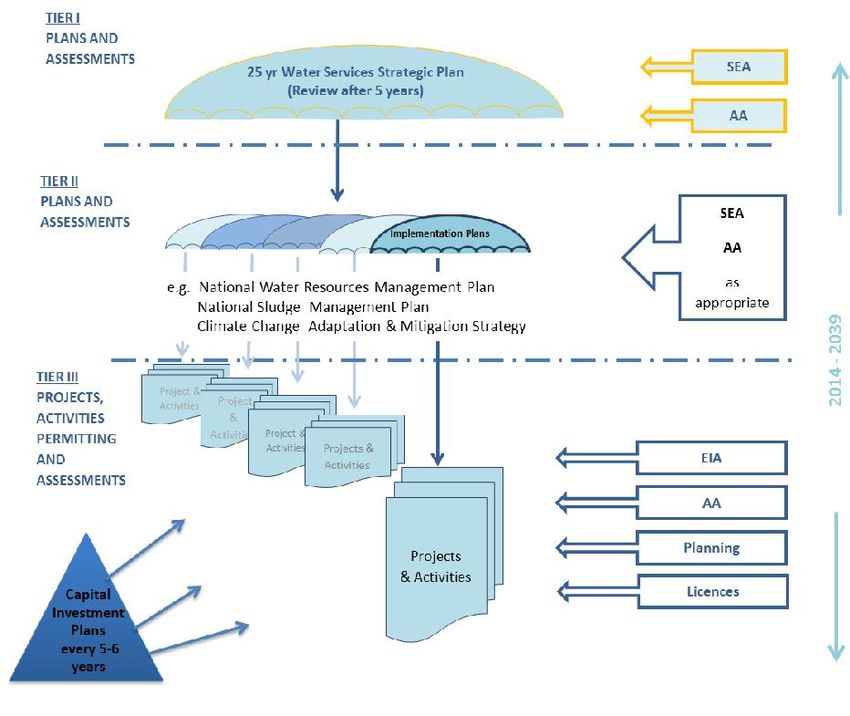
vi

Contents

1.          Introduction                                                                                          1
1.1         The Water Services Strategic Plan                                                                     1
1.2         Article 6 Assessments                                                                                 2
1.3         This Report                                                                                           3

2.          Approach                                                                                              5
2.1         Guidance                                                                                              5
2.2         Overview                                                                                              5
2.3         Key Issues for AA of the WSSP                                                                         6
2.3.1       Understanding the Likely Outcomes of the WSSP                                                         6
2.3.2       Uncertainty and ‘Down the Line’ Assessment                                                            7
2.4         Summary of Approach                                                                                   8
2.4.1       Screening                                                                                             8
2.4.2       Scope of Assessment                                                                                   8
2.4.3       Appropriate Assessment                                                                                8
2.4.4       ‘In combination’ Assessment                                                                          11
2.4.5       Mitigation and Avoidance                                                                             11

3.          Appropriate Assessment of WSSP Strategies                                                            12
3.1         Strategy Review                                                                                      12
3.2         Between-plan ‘In Combination’ Effects                                                                29
3.3         Conclusions                                                                                          29

Table 3.2           Assessment of draft strategies under each WSSP aim                                           13

Appendix A           WSSP Strategic Objectives, Aims and Strategies

Appendix B           Appropriate Assessment Outline Screening Report in support of the Appropriate Assessment of the
                     Water Services Strategic Plan

 © Amec Foster Wheeler Environment & Infrastructure UK Limited
 January 2015
 Doc Reg No. rbri07iir
1
1. Introduction
1.1 The Water Services Strategic Plan
Irish Water (IW) is responsible for the development and provision of water and wastewater services throughout
Ireland, having assumed responsibility for this from the 34 local authorities in January 2014. IW therefore supplies
drinking water to over 80% of the population and has adopted a large portfolio of assets including pumping
stations; approximately 60,000 km of water pipelines and 25,000 km of wastewater pipelines; and some 856 water
treatment plants (WTPs) and over 1,000 wastewater treatment plants (WwTPs).
Section 33 of the Water Services (No.2) Act (2013) requires that IW prepares a Water Services Strategic Plan
(WSSP) that sets out IW’s objectives in relation to the provision of water services over a 25 year period. The
WSSP must address the following aspects.
Drinking water quality.
The prevention or abatement of risk to human health or environment relating to the provision of water
services.
Existing and projected demand for water services.
Existing and planned arrangements for provisions of water services.
Existing and reasonably foreseeable deficiencies in the provision of water services.
Existing and planned water conservation measures.
The management of the property of Irish Water.
The WSSP is a high-level overarching strategy that will sit at the highest tier (known as Tier 1) of water services
planning in Ireland. The WSSP strategies will be realised through a number of Implementation Plans (Tier 2) which
will be prepared by IW following the approval of the WSSP; these Implementation Plans will include, for example,
a National Water Resources Plan and National Sludge Management Plan1. The specific projects and activities that
are necessary to fulfil the provisions of the WSSP and Implementation Plans will then be detailed at Tier 3 of the
hierarchy (i.e. project level). Consequently, the aims and strategies of the WSSP are not spatially specific and do
not identify specific projects or schemes.
A full list of the WSSP strategic objectives and associated aims and strategies are contained in Appendix A.
1
Note, this list of plans is not exhaustive and the titles of lower-tier plans may change.
© Amec Foster Wheeler Environment & Infrastructure UK Limited
January 2015
Doc Reg No. rbri07iir
2

1.2            Article 6 Assessments
Article 6(3) of the Habitats Directive 92/43/EEC requires that competent authorities assess the potential impacts of
plans and projects on the Natura 2000 network of European protected sites2 to determine whether there will be any
‘likely significant effects’ (LSE) as a result of a plan’s or projects implementation (either on its own or ‘in
combination’ with other plans or projects); and, if so, whether these effects will result in any adverse effects on the
site’s integrity.

Article 6(4) of the Habitats Directive sets out the decision-making tests which must be applied to plans or projects
that may impact a Natura 2000 site. Article 6(4) also requires compensatory measures to ensure that the coherence
of the Natura 2000 network is protected if adverse effects on a European site cannot be avoided or mitigated. The
provisions of the Habitats Directive 92/43/EEC are transposed into Irish law by the European Communities (Birds
and Natural Habitats) Regulations 2011 (as amended).

The process by which the impacts of a plan or project is assessed against the conservation objectives of a European
site is commonly known as ‘Appropriate Assessment’ or ‘Habitats Directive Assessment’ (HDA)3. European
Commission guidance4 suggests a four-stage process for this assessment, although not all stages will necessarily be
required (see Box 1).

2
  Natura 2000 is the European network of Special Areas of Conservation (SACs) and Special Protection Areas (SPAs)
designated under Directive 92/43/EEC (the ‘Habitats Directive’) and Directive 2009/147/EC (the ‘new wild birds directive’)
respectively. These sites are protected by Article 6(3) of the Habitats Directive (this applies to SACs from the point at which
the European Commission and the Government agree the site as a ‘Site of Community Importance’ (SCI)). Article 6(3) of the
Habitats Directive and Article 4(4) of the Birds Directive also apply (respectively) to any other site or area that the
Commission believes should be considered as an SAC or SPA, until their status is determined. Under the European
Communities (Birds and Natural Habitats) Regulations 2011 (as amended) the term ‘European site’ applies to any designated
SAC or SPA; any SCI; any candidate SCI (cSCI); any candidate SAC (cSAC); and any candidate SPA (cSPA).
3
  ‘Appropriate Assessment’ has been historically used as an umbrella term to describe the process of assessment as a whole.
This process is now more commonly divided into distinct stages, one of which is the Appropriate Assessment stage. The
process as a whole is generally referred to as an ‘Article 6 Assessment’ (or sometimes as a ‘Habitats Directive Assessment’)
for convenience, although these terms are not included within the legislation.
4
 EC (2001). Assessment of plans and projects significantly affecting Natura 2000 sites: Methodological guidance on the
provisions of Article 6(3) and (4) of the Habitats Directive 92/43/EEC. European Commission guidance produced by the
Impacts Assessment Unit, Oxford Brookes University.

    © Amec Foster Wheeler Environment & Infrastructure UK Limited
    January 2015
    Doc Reg No. rbri07iir
3

Box 1          Stages of Article 6 Assessment

Stage 1 – Screening:
This stage identifies the likely impacts upon a European Site of a project or plan, either alone or ‘in combination’ with other projects or plans,
and considers whether these impacts are likely to be significant.

Stage 2 – Appropriate Assessment:
Where there are likely significant effects, this stage considers the effects of the plan or project on the integrity of the relevant European Sites,
either alone or ‘in combination’ with other projects or plans, with respect to the sites’ structure and function and their conservation objectives.
Where it cannot be concluded that there will be no adverse effects on sites’ integrity, it is necessary to consider potential mitigation for these
effects.

Stage 3 – Assessment of Alternative Solutions:
Where adverse effects remain after the inclusion of mitigation, this stage examines alternative ways of achieving the objectives of the project or
plan that avoid adverse impacts on the integrity of European Sites.

Stage 4 – Assessment Where No Alternative Solutions Exist and Where Adverse Impacts Remain:
This stage assesses compensatory measures where it is deemed that the project or plan should proceed for imperative reasons of overriding
public interest (IROPI). The EC guidance does not deal with the assessment of IROPI.

The WSSP is a strategic plan and as such is subject to the provisions of Article 6(3) and the European Communities
(Birds and Natural Habitats) Regulations 2011 (as amended). However, Article 6(3) essentially provides a test that
the adopted version of a plan must pass; there is no requirement for the assessment to be undertaken on draft
versions or earlier iterations of the Plan. As with Strategic Environmental Assessment (SEA) however, it is
accepted best-practice for the assessment of strategic planning documents to be run as an iterative process
alongside the Plan development, with the emerging proposals or options continually assessed for their possible
effects on European sites and modified or abandoned (as necessary) to ensure that the subsequently adopted Plan is
not likely to result in significant adverse effects on any European sites, either alone or ‘in combination’ with other
plans. It is therefore important to recognise that the assessment of strategic plans is ideally as much about guiding
the development of the Plan (and demonstrating that this has been done) as it is about (ultimately) assessing its
effects.

1.3            This Report
The provisions of Articles 6(3) and 6(4) of the Habitats Directive 92/43/EEC are transposed into Irish law by Part 5
of the European Communities (Birds and Natural Habitats) Regulations 2011 (as amended). Part 5 essentially
describes a two-stage process for the assessment of plans and projects under Article 6(3), comprising ‘screening’
(sometimes referred to as ‘AA screening’) and ‘Appropriate Assessment’ (AA).

IW, supported by AOS Planning, has previously undertaken a screening of the emerging WSSP5. This screening
concluded that the WSSP requires AA since it is not directly connected with or necessary to the management of a
European site; and may have significant impacts on the Natura 2000 network. Therefore, applying the

5
  AOS Planning (2014). Appropriate Assessment Outline Screening Report in support of the Appropriate Assessment of the
Water Services Strategic Plan in accordance with the requirements of Article 6(3) of the EU Habitats Directive. Report for
Irish Water. AOS Planning, Dublin. (See Appendix B)

    © Amec Foster Wheeler Environment & Infrastructure UK Limited
    January 2015
    Doc Reg No. rbri07iir
4
Precautionary Principle and in accordance with Article 6(3) of the Habitats Directive, a Stage 2 Appropriate
Assessment was deemed required as the possibility of significant effects on the Natura 2000 network could not be
excluded.
Amec Foster Wheeler Environment and Infrastructure UK Limited (Amec Foster Wheeler), under the management
of Nicholas O’Dwyer Ltd., was subsequently commissioned by IW to undertake the preparation of a Natura Impact
Statement (NIS) in support of the Appropriate Assessment of the draft WSSP and to determine whether any aspects
of the WSSP (alone or in-combination) could have significant adverse effects on the integrity of any European
sites.
This report summarises Amec Foster Wheeler’s assessment of the emerging WSSP, and sets out the iterative
process that has been undertaken to support the delivery of the WSSP and ensure that it meets the requirements of
the European Communities (Birds and Natural Habitats) Regulations 2011 (as amended). This NIS report should
be read in conjunction with the AOS (2014) AA Screening Report (see Appendix B). This NIS provides a review
of the draft WSSP strategies under each Plan aim and identifies potential impact pathways by which European sites
could be affected; it then identifies appropriate measures that should be employed in the final Plan to ensure that
significant adverse effects do not occur as a result of the Plan’s implementation.
© Amec Foster Wheeler Environment & Infrastructure UK Limited
January 2015
Doc Reg No. rbri07iir5
2. Approach
2.1 Guidance
The following guidance has been used during the preparation of this Natura Impact Statement in support of the
Appropriate Assessment of the draft WSSP:
DEHLG (2010) Appropriate Assessment of Plans and Projects in Ireland: Guidance for Planning
Authorities. Department of Environment, Heritage and Local Government, Dublin.
European Commission (2001) Assessment of plans and projects significantly affecting Natura 2000
sites: Methodological guidance on the provisions of Article 6(3) and (4) of the Habitats Directive
92/43/EEC. European Commission, Brussels.
UK Water Industry Research Ltd (2012) Strategic Environmental Assessment and Habitats
Regulations Assessment - Guidance for Water Resources Management Plans and Drought Plans.
UKWIR, Queen Anne’s Gate, London.
RSPB (2008) Appropriate Assessment of Spatial Plans in Northern Ireland. A guide to why, when and
how to do it. RSPB, Sandy, Beds.
DTA Publications (2013) The Habitats Regulation Handbook [online]. Available at:
http://www.dtapublications.co.uk/handbook/. Accessed 11.11.14.
SNH (2012) Habitats Regulations Appraisal of Plans: Guidance for plan-making bodies in Scotland.
Scottish Natural Heritage / David Tyldesley Associates.
2.2 Overview
The current European Commission guidance6 suggests a four stage process for the assessment against Article 6,
which is summarised in Box 1. The assessment process determines whether there will be any ‘likely significant
effects’ (LSEs) on any European sites as a result of a plan’s implementation, either on its own or ‘in combination’
with other plans or projects (screening) and, if so, whether it can be concluded that there will be no adverse effects
on the sites’ integrity (Appropriate Assessment).
The standard stepwise approach summarised in Box 1 works well at the project-level where the scheme/project
design is established and possible effects on European sites can be quantitatively assessed with the benefit of
detailed survey data. In contrast, the fundamental nature of the WSSP presents a number of distinct challenges for a
‘strategic’ AA; in particular, every possible outcome of the Plan cannot always be identified and assessed in detail,
requiring reliance on precautionary ‘avoidance measures’ or mitigation within the text to ensure that significant
adverse effects do not occur as a result of the Plan’s implementation. It is therefore important to understand how
6
Methodological guidance on the provisions of Article 6(3) and (4) of the Habitats Directive 92/43/EEC (EC 2002).
© Amec Foster Wheeler Environment & Infrastructure UK Limited
January 2015
Doc Reg No. rbri07iir6
the WSSP is developed, how it would operate in practice, and hence how it might consequently affect European
sites when identifying suitable measures.
2.3 Key Issues for AA of the WSSP
2.3.1 Understanding the Likely Outcomes of the WSSP
IW is responsible for the provision and development of water and wastewater services throughout Ireland. Its day-
to-day activities include:
The abstraction and storage of raw surface water or groundwater;
The treatment of abstracted water to potable standard;
The storage and distribution of treated water;
The collection of wastewater from customers connected to the public wastewater sewer network;
The collection and treatment of surface water where drains are connected to the public sewer network;
The treatment of wastewater to a standard set by legislation;
Discharging treated wastewater under licence/certification by the EPA;
Management, reuse and disposal of residual wastes and sludges; and
The construction, operation, maintenance and management of the infrastructure and assets required to
deliver the above.
Most of these activities have the potential to affect European sites, either due to current operation or through any
future development and capital works that may be required. Consequently, it is easy to perceive mechanisms by
which strategic plans produced by IW, to help plan and deliver its services, could also affect European sites.
The WSSP is a high-level plan that sets a framework for IW’s development as a utility and establishes the broad
principles for the management of its assets and delivery of its statutory obligations. It outlines the strategic
direction for IW over the short, medium and long-term, up to 2040, providing a basis for planning water services to
meet environmental compliance commitments in a cost effective manner. This is done through the identification of
‘aims’ for the efficient delivery of services, and ‘strategies’ for meeting these.
It is important to recognise that there is no geographical context attributed to the WSSP aims and strategies; rather,
the aims and strategies will be realised through lower-tier Implementation Plans which will set out in more detail
how specific aspects of IWs services will be managed or delivered. These Implementation Plans will include, for
example, a National Water Resources Plan and a National Sludge Management Plan. Specific projects and
activities that are necessary to fulfil the provisions of the Implementation Plans will be detailed at a lower-tier i.e.
Tier 3 Projects.
© Amec Foster Wheeler Environment & Infrastructure UK Limited
January 2015
Doc Reg No. rbri07iir7
As a result, the aims and strategies within the WSSP are necessarily high-level. Whilst they may address or identify
the broad service-provision requirements, or set a direction for future capital or operational investment, they are not
spatially specific and do not identify specific projects or schemes.
2.3.2 Uncertainty and ‘Down the Line’ Assessment
The WSSP will influence the future provision of water and wastewater services in Ireland and so there are many
conceivable ways in which it could also have an influence on European sites. However, due to its wide scope,
position in the planning hierarchy and long-term outlook there are inevitably a large number of uncertainties
inherent within it and its outcomes. For example, a high-level aim advocating asset management could (arguably)
lead to development on or near a European site; equally, it may not. Assuming direct effects such as this would
ignore all the other stages and tiers in the planning process, and the opportunities for mitigation and avoidance that
these provide. Often, specific effects on specific European sites cannot be identified and in searching for these
effects there is a risk that the assessment begins to focus on effects that are ‘imaginable’ rather than ‘likely’, with a
consequent risk that avoidance measures are not appropriately focused. What the higher-tier plan must avoid is
making an effect on a European site an inevitable or likely outcome, or constraining lower-tier plans and projects
such that an effect becomes more likely.
As a result, the AA must consider and assess the strategies under each aim within the WSSP appropriately, whilst
recognising (and mitigating) the inherent uncertainties within those strategies (i.e. the absence of any
implementation details) and within the Plan itself.
It is recognised that some potential effects (or required mitigation) cannot be clearly determined at the strategic-
level. In these instances, current guidance7 (in Scotland, for example) indicates that it may be appropriate and
acceptable for some or all of the assessment to be undertaken ‘down-the-line’ at a lower tier in the planning
hierarchy, if:
the higher tier Plan appraisal cannot reasonably predict the effects on a European site in a meaningful
way; whereas;
the lower tier Plan, which will identify more precisely the nature, scale or location of development,
and thus its potential effects, retains enough flexibility within the terms of the higher tier plan over the
exact location, scale or nature of the proposal to enable an adverse effect on site integrity to be
avoided; and
Appropriate Assessment of the Plan at the lower tier is required as a matter of law or Government
policy8.
7
SNH (2012) Habitats Regulations Appraisal of Plans: Guidance for plan-making bodies in Scotland. Scottish Natural
Heritage / David Tyldesley Associates.
8
In some (rare) instances Government policy may extend the provisions that are strictly applicable to European sites (as
defined by the European Communities (Birds and Natural Habitats) Regulations 2011 (as amended)) to undesignated sites
(typically those in the early stages of the designation process).
© Amec Foster Wheeler Environment & Infrastructure UK Limited
January 2015
Doc Reg No. rbri07iir8
It should also be noted that the European Commission recognises that plans or plan components that are general
statements of policy or political aspirations cannot have significant effects. Much of the WSSP (indeed, arguably
the whole Plan) would meet this criterion.
2.4 Summary of Approach
2.4.1 Screening
The emerging Plan as a whole has been previously screened to determine whether Appropriate Assessment is
required; this screening concluded that the WSSP requires Appropriate Assessment since it is not directly
connected with or necessary to the management of a European site; and because the possibility of significant
effects on the Natura 2000 network could not be excluded. The screening was undertaken at an early stage in the
Plan’s development (and therefore without the benefit of draft aims and strategies that could be assessed and
modified9) but it is accepted that the Plan should be subject to Appropriate Assessment to ensure that the
components of the Plan (i.e. the individual aims or strategies) are examined and modified as necessary.
2.4.2 Scope of Assessment
The geographical scope of the assessment is set out in the Screening Report (see Appendix B). Since the WSSP
covers all of the Republic of Ireland, and may have trans-boundary effects, the screening effectively considers all
European sites that occur in the Republic (ROI) and Northern Ireland (NI) (other than those NI sites that are
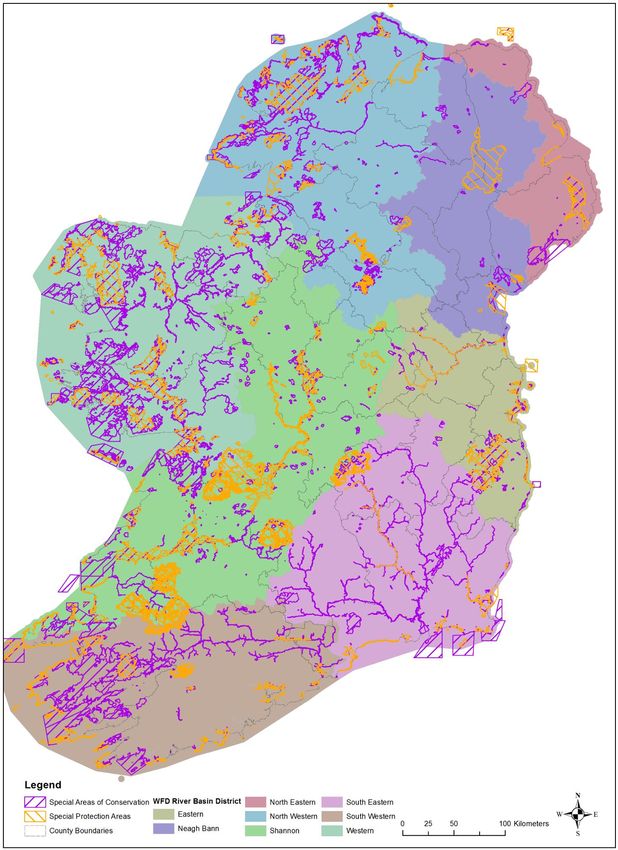
hydrologically separated from the Republic). There are 423 cSACs and 165 SPAs in ROI, with a further 57 SACs,
SCIs or cSACs and 16 SPAs in Northern Ireland. The sites and qualifying features are listed in Appendix 1 of the
AA Screening Report and so are not repeated in this document.
2.4.3 Appropriate Assessment
The assessment must consider the effects of the Plan on the conservation objectives of those European sites that
could be affected. The National Parks and Wildlife Service (NPWS) are in the process of developing conservation
objectives for all European sites; these are essentially as follows:
For SACs, “To maintain or restore the favourable conservation condition of the Annex I habitat(s)
and/or the Annex II species for which the SAC has been selected”.
9
It should be noted that Irish case law suggests that avoidance or mitigation measures can (and should) be considered at the
screening stage. In a recent (August 2014) preliminary judgment (Rossmore and Killross v An Bord Pleanála, the State and
Eirgrid) the High Court stated that “where the mitigating factor in question is an intrinsic part of the work to be carried out it
makes no sense [to not take it into account]”. In this the High Court followed the reasoning of an example from UK case law
known as the ‘Dilly Lane’ judgement (Hart District Council v Secretary of State for Communities and Local Government
[2008] EWHC 1204).
© Amec Foster Wheeler Environment & Infrastructure UK Limited
January 2015
Doc Reg No. rbri07iir9
For SPAs, “To maintain the bird species of special conservation interest for which the SPA has listed,
at favourable conservation status”.
For some sites more detailed targets are provided by which the conservation objectives can be measured.
However, given that the WSSP is not spatially specific and does not direct development to particular areas there is
limited merit in undertaking a detailed examination of all European sites, their interest features and their
conservation objectives to try and determine which might (in theory) be more or less vulnerable to the imagined
outcomes of the Plan. Indeed, this may be counterproductive by creating an unjustified focus on particular
European sites and particular features. Therefore, the European sites, interest features and conservation objectives
have been referred to during the assessment process for information, but the effects of each strategy are not
explicitly assessed on a site-by-site basis.
The assessment of any strategic plan primarily considers the potential outcomes of the individual strategies and
policies (in this case, of the WSSP its aims and strategies) and the associated development of measures (generally
wording changes) to ensure that significant adverse effects are not a likely outcome of a Plan.
The WSSP aims and strategies may have effects in their own right, or they may be used to control potential effects
or prevent them occurring. When considering the likely effects of a strategy or policy, it is recognised that some
policy or strategy ‘types’ cannot result in impacts on any European sites. This can be applied to the emerging Plan
or its components to help shape the strategies and identify those aspects requiring further detailed consideration. It
can also be used to determine whether more detailed assessment of any strategy or aspect is required. Different
guidance documents suggest various classification and referencing systems to help identify those strategies that can
be safely assessed as having no effect or no significant adverse effects; the general characteristics of these policy or
strategy types are summarised in Table 2.1.
© Amec Foster Wheeler Environment & Infrastructure UK Limited
January 2015
Doc Reg No. rbri07iir10
Table 2.1 Policy or strategy ‘types’ that can usually be excluded from further consideration
Broad Type Notes
General statements of policy / The European Commission recognises* that plans or plan components that are general statements
aspiration of policy or political aspirations cannot have significant effects; for example, general commitments to
sustainable development. This would generally include policies which may promote change but
where effects on any particular European site cannot be identified, because the proposal is too
general (e.g. it is not known where, when or how the proposal may be implemented).
General design / guidance criteria or A general ‘criteria based’ policy expresses the tests or expectations of the plan-making body when it
policies that cannot lead to or trigger comes to consider proposals, or relates to design or other qualitative criteria which do not
development themselves lead to development (e.g. controls on building design); however, policies with criteria
relating to specific proposals or allocations should not be screened out.
External plans / projects Plans or projects that are proposed by other plans and are referred to in the plan being assessed for
completeness (for example, Highways Agency road schemes; specific waste development proposals
promoted by a County Minerals and Waste Plan).
Environmental protection policies Policies designed to protect the natural or built environment will not usually have signifcant or
adverse effects (although they may often require modification if relied on to provide sufficient
safeguards for other policies).
Policies which make provision for Policies or proposals which cannot affect a European site (no impact pathways and hence no effect;
change but which could have no for example, proposals for new cycle path several kilometres from the nearest European site) or
conceivable effect which cannot undermine the conservation objectives, either alone or in combination, if impact
pathways exist (no significant effect).
* EC, 2000, Managing Natura 2000 sites: the provisions of Article 6 of the ‘Habitats’ Directive 92/43/EEC April 2000 at 4.3.2
It must be noted that it is inappropriate to apply a classification tool uncritically. There will obviously be some
occasions when a strategy or similar may have potentially significant effects, despite being of a ‘type’ that would
normally be screened out.
The criteria in Table 2.1 were applied critically to the assessment of the draft strategies within the draft WSSP to
identify the following strategy groups:
‘No effect’ strategies: strategies that will have ‘no effect’ (i.e. strategies that self-evidently would not
have any effect on a European site due to the type of strategy or its operation; for example, a broad
strategy directing the preparation of a lower tier plan, which does not compromise or constrain the
lower tier plan). Note that ‘no effect’ strategies cannot have in combination effects.
‘No significant adverse effect’ strategies: strategies where impact pathways theoretically exist but the
effects will not be significant and adverse (alone or in combination).
‘Uncertain effect’ strategies: strategies where the precise effects on European sites (either alone or in
combination) are uncertain, and hence additional investigation through the appropriate assessment
stage or policy modification is required (note that further investigation will often demonstrate that
there is no significant effect or allow suitable mitigation or avoidance measures to be identified to
ensure this).
‘Likely significant adverse effect’ strategies: strategies which are likely to have a significant effects
(either alone or in combination) and hence which require additional investigation or modification.
Note that ‘likely significant adverse effect’ strategies are more likely to require that the strategy be
amended, abandoned or re-worked to avoid significant adverse effects.
© Amec Foster Wheeler Environment & Infrastructure UK Limited
January 2015
Doc Reg No. rbri07iir11
‘Cannot be assessed’ strategies: strategies that cannot be meaningfully assessed at this level in the
planning hierarchy.
2.4.4 ‘In combination’ Assessment
Article 6(3) of the Habitats Directive requires that the potential effects of the Plan on European sites must also be
considered ‘in combination with other plans or projects’. The ‘in combination’ assessment must also consider
within-plan effects (i.e. between strategies). The consideration of ‘in combination’ effects is not a separate
assessment, but is integral to the screening and AA stages and the development of avoidance/ mitigation measures.
There is limited guidance available on the scope of the ‘in combination’ element, particularly which plans should
be considered. However, the assessment should not necessarily be limited to plans at the same level in the planning
hierarchy and there is consequently a wide range of plans that could have potential ‘in combination’ effects with
the WSSP due to its regional scale.
The plans identified by the SEA and the screening report have provided the basis for the assessment of ‘in
combination’ effects; these plans were reviewed to identify any potential effects and these were then considered (as
necessary) within the AA. Completion of the ‘in combination’ assessment is directly related to the strategy
wording, and it will often be possible to remove any risk of ‘in combination’ effects through careful strategy
construction.
2.4.5 Mitigation and Avoidance
The development of avoidance or mitigation measures is key to the AA and Plan development process. Avoidance
measures are those that are incorporated into the Plan during its development to prevent significant effects on
European sites occurring; mitigation measures are used where significant effects are identified in order to prevent
adverse effects on a site’s integrity.
Avoidance or mitigation measures should aim to reduce the probability or magnitude of impacts on a European site
until ‘no likely significant effects’ are anticipated. These will generally involve the development and adoption of,
for example, wording changes or additional strategies. Measures must be specific and targeted, and likely to work:
it is not appropriate to re-state existing legislation, such as by adding “and must have no significant effect on any
European site” (or similar) to every strategy. It should be noted that high-level strategies such as the WSSP often
benefit from the use of overarching or cross-cutting protective strategies, particularly where effects cannot be
meaningfully assessed at the Plan-level, and lower tier plans are relied on to avoid significant adverse effects.
© Amec Foster Wheeler Environment & Infrastructure UK Limited
January 2015
Doc Reg No. rbri07iir12
3. Appropriate Assessment of WSSP Strategies
3.1 Strategy Review
The assessment of the WSSP strategies is summarised in Table 3.2. This considers each strategy under each aim,
and takes account of any cross-cutting protective strategies and aims (e.g. EN1). This is designed to identify those
strategies that are likely to have a significant adverse effect on the Natura 2000 network of European protected
sites, and any appropriate mitigation or avoidance measures that may require inclusion in the adopted Plan to avoid
this. Recommendations for strategy changes or amendments are made (i.e. to be included in the final, adopted plan)
but it should be recognised that these are not intended to be prescriptive and a number of approaches for ensuring
‘no significant adverse effects’ may be acceptable. The colour coding used in the table is as follows:
Table 3.1 Colour coding for review of strategies
Cannot be assessed – outcomes of strategy cannot be meaningfully assessed at this level; lower tier assessment required
No effect – strategies that will have no effect on any European sites (generally no impact pathways, e.g. direction to prepare a plan)
No significant adverse effect (SAE); strategy will not/ cannot affect any Europeansites and so can be excluded from further assessment
No effect or no SAE, but amendments suggested that may enhance the strategy or plan regards protection of European sites
Strategy requires changes to avoid significant effects (e.g. minor re-wording; referencing mitigating strategies), or effects are uncertain.
Significant adverse effects likely; strategy should be abandoned or re-worked to include specific mitigation (may apply to policy groups)
Note that the inclusion of a strategy in the ‘red’ or ‘yellow’ category does not mean that significant adverse effects
are certain and cannot be avoided since in many instances the assessment reflects an uncertainty that may need to
be explored through further assessment. For some strategies a more detailed assessment may be required, even if
there is some confidence that identified mitigation will be successful in avoiding significant adverse effects, to
demonstrate that the potential effects have been suitably considered. The review also included an assessment of ‘in
combination’ effects between strategies.
The likely outcomes of many of the strategies cannot be meaningfully assessed at this level (for example, the
effects of Strategy WW1c “Implement Capital Investment Plans for Wastewater Infrastructure” are entirely
dependent on the content of those lower-tier plans, which have not yet been prepared) and in this instance it is
necessary to rely on future assessments of lower-tier plans to ensure that significant adverse effects are avoided.
However, it is usually appropriate for the higher-tier plan to ensure (as far as it can) that effects on European sites
are explicitly considered during the development of the lower tier plans and strategies; there are a number of
approaches to this, but it commonly involves the inclusion of an over-arching policy statement or supporting text
that sets out the expectations for the development of lower-tier plans.
© Amec Foster Wheeler Environment & Infrastructure UK Limited
January 2015
Doc Reg No. rbri07iir13
Table 3.2 Assessment of draft strategies under each WSSP aim
Strategy and overview Predicted Effects Likely outcomes and assessment rationale Recommendations for strategy
Alone In combination*
Aim CE1 – Establish both Customer Trust and a Reputation for Excellent Service
CE 1a Create and operate a lean and No effects - This strategy aims to deliver best practice in customer operations. This is None
effective Customer Operation a general statement of policy / aspirations and therefore there is no
impact pathway.
CE1b Build and maintain accurate No effects - This strategy aims to ensure accurate customer services and billing; it is None
customer databases a general statement of policy / aspirations and therefore there is no
impact pathway.
CE 1c Establish sustainable customer No effects - This strategy aims to secure funding necessary to deliver efficient and None
revenue effective water services; it is a general statement of policy / aspirations
and therefore there is no impact pathway.
CE1d Establish effective communication No effects - This strategy aims to develop a Customer Communication Strategy; it is None
channels with customers a general statement of policy / aspirations and therefore there is no
impact pathway.
CE1e Establish national customer service No effects - This strategy aims to develop appropriate customer expectation and None
standards and robust customer deliver to these; it is a general statement of policy / aspirations and
protection measures therefore there is no impact pathway.
CE1f Fully support the work of the Public No effects - This strategy aims to address the comments and suggestions of the None
Water Forum Public Water Forum in relation to the performance by Irish Water of its
functions; it is a general statement of policy / aspirations and therefore
there is no impact pathway.
© Amec Foster Wheeler Environment & Infrastructure UK Limited
January 2015
Doc Reg No. rbri07iir14
Strategy and overview Predicted Effects Likely outcomes and assessment rationale Recommendations for strategy
Alone In combination*
Aim WS1 – Manage the quality of drinking water from source to tap to protect human health
WS1a Prepare a National Water Resources No effect - Strategy requires the preparation and implementation of a National Strategy safeguards can be introduced to
Plan and implement on a phased Water Resources Plan (NWRP); the direction to prepare a Plan would the WSSP to specify that Appropriate
basis not in itself lead to any effects (no impact pathway), and the NWRP will Assessment of lower tier plans will be
be subject to Appropriate Assessment during its development. The required, and that these will not be
WSSP does not constrain how the NWRP is drafted or implemented, and considered compliant with the WSSP if
therefore the WSSP cannot have significant effects (although the significant adverse effects on European sites
outcomes of the lower tier Plan could conceivably affect European sites). are not avoided or suitably mitigated; this
Any risk of effects can be avoided through overarching strategy setting can be addressed in the supporting text to
out the expectations for the NWRP. EN1e (see Section 3.3).
WS1b Prepare and implement Drinking No effect - Strategy requires the preparation and implementation of Drinking Water
Water Safety Plans for all Water Safety Plans (DWSP); these will be used to assess risks to safety within
Supply Zones. the drinking water system and may result in capital investment or other
measures to address these risks. The direction to prepare and
implement a plan would not in itself lead to any effects (no impact
pathway), and the DWSP is also unlikely to result in significant effects
(identifying quality problems and investment needs does not constrain
how those quality issues are addressed). The WSSP does not constrain
how the DWSP is drafted or implemented, and therefore the WSSP
cannot have any effects.
WS1c Implement Standard Operational No effect - The direction to prepare and implement a Best Practice Guidelines or Any risk of effects due to the lower tier Plans
Procedures for all water treatment Standard Operations Procedures (SOPs) would not in itself lead to any can be avoided through an overarching
plants, water storage facilities and effects (no impact pathway); the effects will ultimately depend on the strategy setting out the expectations and
distribution networks. Best Practice Guidance and Standard Operational Procedures requirements for lower tier Plans regards
themselves, and the extent to which European sites are safeguarded by European sites; this can be addressed in the
the operational procedures. This can only be determined at the guidance supporting text to EN1e (see Section 3.3)
/ SOP level, although any risk of effects can be avoided through
overarching strategy setting out the expectations for the SOPs.
WS1d Develop and Implement Capital No effects - Strategy requires the preparation and implementation of Capital Any risk of effects due to the lower tier Plans
Investment Plans to improve Investment Plans (CIP); these will provide a prioritised list of can be avoided through an overarching
Drinking Water Quality. programmes and projects for targeted investment, aimed at (inter alia) strategy setting out the expectations and
improving compliance with Drinking Water Standards. The direction to requirements for lower tier Plans regards
prepare and implement a plan would not in itself lead to any effects (no European sites; this can be addressed in the
impact pathway), and identifying investment needs does not constrain supporting text to EN1e (see Section 3.3).
how those quality issues are addressed.
© Amec Foster Wheeler Environment & Infrastructure UK Limited
January 2015
Doc Reg No. rbri07iir15
Strategy and overview Predicted Effects Likely outcomes and assessment rationale Recommendations for strategy
Alone In combination*
WS1e Prepare and implement a 'Lead No effects - Strategy requires the preparation and implementation of a Lead Strategy None
Compliance Strategy' to address plumbo-solvency issues and potential contamination of
supplies. As before, the direction to prepare and implement a Plan would
not in itself lead to any effects (no impact pathway).
WS1f Prepare and implement strategies to No effects - As for WS1e (direction to prepare and implement a Plan would not in None
manage other quality issues in water itself lead to any effects (no impact pathway)).
supplies.
© Amec Foster Wheeler Environment & Infrastructure UK Limited
January 2015
Doc Reg No. rbri07iir16
Strategy and overview Predicted Effects Likely outcomes and assessment rationale Recommendations for strategy
Alone In combination*
Aim WS 2 – Manage the availability and resilience of water supply now and into the future
WS2a Implement risk assessments for all No effect - Strategy requires the preparation of supply risk assessments to identify None
water supply areas in terms of short, areas where supply improvements may be required to meet service
medium and long term risks to standards. The direction to prepare a risk assessment would not in itself
customer supply. lead to any effects (no impact pathway), and identifying areas requiring
service improvement does not constrain how those improvements are
addressed.
WS2b Manage existing water resources No significant No significant Managing water resources sustainably to help meet the WFD objectives None.
and plan for new resources taking a adverse effect adverse effect will ultimately benefit European sites.
regional view of needs and having
regard to the objectives of the Water
Framework Directive (WFD).
WS2c Develop long-term sustainable water No significant No significant Development of water resources could theoretically affect European Ensure that ‘sustainable’ is defined in the
sources with resilience to climate adverse effect adverse effect sites although this can only be meaningfully assessed at the lower tier WSSP, and that this definition includes
change. plans and projects when specific locations or sources are known; the reference to having no significant adverse
commitment to ‘sustainable’ sources minimises the risk of effects, and effects on European sites.
any risk of effects due to the lower tier plans and projects can be avoided
through an overarching strategy setting out the expectations and
requirements for lower tier plans and projects regards European sites.
The strategy does not constrain the outcome or dictate how sustainable
water sources may be delivered.
WS2d Develop methodologies to build No effect - Strategy requires the development of methods; the direction to prepare None.
strategic resilience and network these would not in itself lead to any effects (no impact pathway),
connectivity into resource planning. Introducing strategic resilience and network connectivity could
theoretically affect European sites although this can only be meaningfully
assessed at the lower tiers when specific locations or proposals are
known. Any risk of effects due to the lower tier plans and projects can be
avoided through an overarching strategy setting out the expectations and
requirements for lower tier plans and projects regards European sites.
WS2e Manage future regulatory No effect - Strategy essentially requires the development of integrated water Any risk of effects due to the lower tier Plans
requirements for abstraction resources planning; the direction to prepare these would not in itself lead can be avoided through an overarching
licencing, headroom in treatment to any effects (no impact pathway), and the WSSP does not constrain strategy setting out the expectations and
facilities and population growth. how these strategies/plans might be delivered. requirements for lower tier Plans regards
European sites; this can be addressed in the
supporting text to EN1e.
© Amec Foster Wheeler Environment & Infrastructure UK Limited
January 2015
Doc Reg No. rbri07iir17
Strategy and overview Predicted Effects Likely outcomes and assessment rationale Recommendations for strategy
Alone In combination*
WS2f Match water abstraction to No effect - Strategy essentially requires the development of integrated water Any risk of effects due to the lower tier
availability and quality using surface resources planning; the direction to prepare these water abstraction strategies or plans can be avoided through
water and groundwater sources. strategies would not in itself lead to any effects (no impact pathway), and overarching strategy setting out the
This is known as Conjunctive Use. the WSSP does not constrain how these strategies might be delivered. expectations and requirements for lower tier
Any risk of effects due to the lower tier strategies or plans can be strategies/plans regarding European sites
avoided through overarching strategy setting out the expectations and
requirements for lower tier strategies/plans regarding European sites.
WS2g Prepare Regional Water No effect - Requires production of strategies to reduce demand; likely to have a None.
Conservation Strategies and positive effect on European sites, but the direction to prepare strategies
implement on a phased basis would not in itself lead to any effects (no impact pathway), and
identifying areas requiring service improvement does not constrain how
those improvements are addressed.
© Amec Foster Wheeler Environment & Infrastructure UK Limited
January 2015
Doc Reg No. rbri07iir18
Strategy and overview Predicted Effects Likely outcomes and assessment rationale Recommendations for strategy
Alone In combination*
Aim WS 3 – Manage the affordability of water supplies -
WS3a Adopt an asset management based No effect - This strategy relates to asset management procedures, particularly None.
approach to capital maintenance improving the knowledge of assets through planned National Data
and capital investment. Gathering and Asset Condition Exercises; this will allow for maintenance
etc. requirements to be identified at an early stage and appropriate
capital investment decisions made. This is not likely to have an effect on
any European sites.
WS3b Optimise the unit cost of water No effect - Minimising the unit cost of delivering water to the customer whilst None
supply through proper water meeting environmental compliance will result in the rationalisation of
resource and treatment planning. water supply areas over time and, subject to funding ability, will focus on
a smaller number of sustainable sources, standardising treatment
processes and using high quality raw water sources. This rationalisation
approach will be developed within the National Water Resources Plan by
the end of 2018. The strategy requires the preparation and
implementation of a National Water Resources Plan (NWRP); the
direction to prepare a Plan would not in itself lead to any effects (no
impact pathway), and the NWRP will be subject to Appropriate
Assessment during its development. The strategy is likely to ultimately
reduce abstraction pressure on some European sites.
WS3c Prepare and implement water No significant No significant Effects on European sites would depend on implementation, which None.
conservation strategies including adverse effect adverse effect cannot be meaningfully identified or assessed at this level. Any risk of
demand management. effects due to the lower tier strategies can be avoided through an
overarching strategy setting out the expectations and requirements for
lower tier strategies regard European sites. However, water conservation
strategies would generally be expected to benefit European sites.
WS3d Optimise capital and operational Cannot be - The strategy promotes the development of robust cost benefit analysis Strategy could usefully be strengthened by
investments in water supply. meaningfully models and prioritization models for works and strategies, agreed to by referencing the need to consider impacts on
assessed the regulators (the CER and the EPA). In theory an effect is possible if Natura 2000 sites as part of the cost-benefit
investments are prioritised purely on a least-cost model; although, analysis (rather than solely economic
regulation by the EPA can be relied on to ensure that effects on drivers).
European sites are appropriately considered. Effects of strategy cannot
be meaningfully assessed.
© Amec Foster Wheeler Environment & Infrastructure UK Limited
January 2015
Doc Reg No. rbri07iirYou can also read


