Three-Year School Capital Plan 2021 2024 - Presented March 3, 2020 Approved March 10, 2020 - Calgary Board ...
←
→
Page content transcription
If your browser does not render page correctly, please read the page content below
Three-Year School Capital Plan

                2021 – 2024

                  Presented March 3, 2020
                 Approved March 10, 2020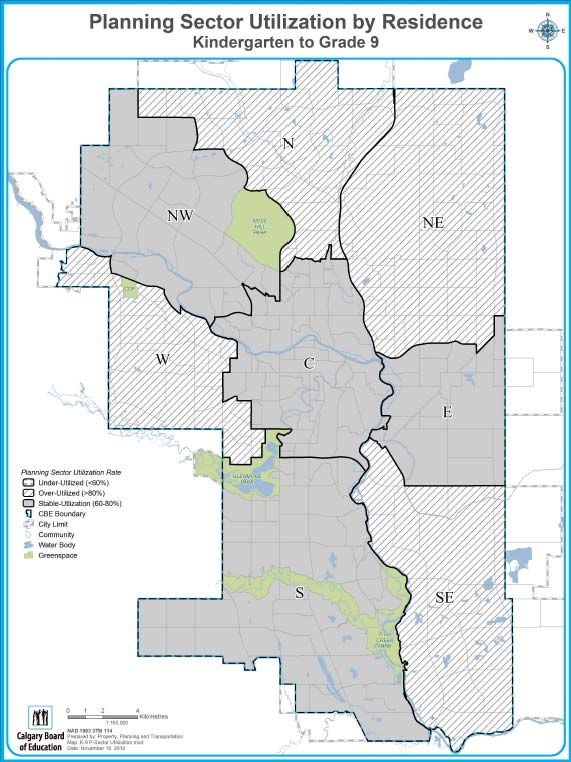

TABLE OF CONTENTS

EXECUTIVE SUMMARY................................................................................................ i
1.0 INTRODUCTION ................................................................................................... 1
       1.1    CBE Student Enrolment .................................................................................. 1
       1.2    Calgary Suburban Growth and Development .................................................. 4
       1.3    Framework for Growth and Change ................................................................ 6
       1.4    City of Calgary Annexation .............................................................................. 6

2.0      CAPITAL STRATEGIES .................................................................................... 9
       2.1    Calgary Board of Education ............................................................................ 9
       2.2    Three-Year Education Plan ........................................................................... 10
       2.3    Administrative Areas and Space Utilization ................................................... 11
       2.4    Planning for Students .................................................................................... 15
       2.5    New School Construction and School Approvals .......................................... 17
       2.6    School Major Modernization .......................................................................... 19
       2.7    Collaborative Initiatives with The City of Calgary .......................................... 20

3.0 NEW SCHOOL CONSTRUCTION CAPITAL PLAN CRITERIA .................. 20
       3.1    Construction Planning Criteria ....................................................................... 21
       3.2    Construction Ranking: Kindergarten to GR9 ................................................ 26
       3.3    Construction Planning Criteria: Senior High Schools ................................... 27
       3.4    Construction Priorities: Senior High Schools ................................................ 27

4.0 THREE-YEAR SCHOOL CAPITAL PLAN 2021-2024 - SUMMARY........... 30
5.0 2021-2024 SCHOOL CAPITAL PLAN NEW CONSTRUCTION ................ 35
6.0 2021-2024 SCHOOL CAPITAL PLAN MAJOR MODERNIZATION ........... 39
APPENDIX I:              Capacity and Utilization ............................................................. 55
APPENDIX II:             Modernization Information .......................................................... 61
APPENDIX III:            Community Ranking for New Schools ......................................... 63
APPENDIX IV:             CBE System Utilizations ........................................................... 70
GLOSSARY OF TERMS .................................................................................... 71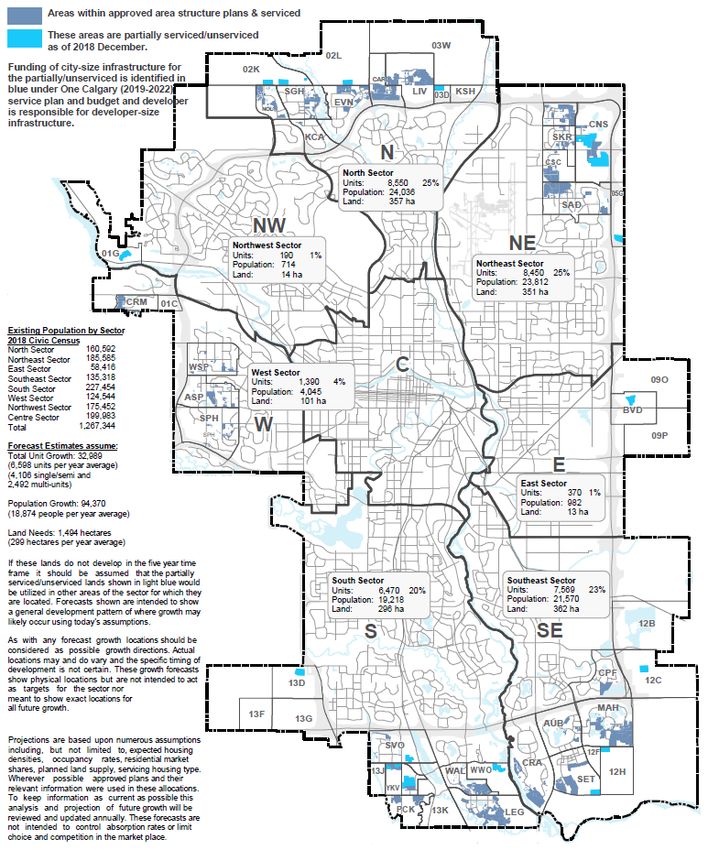
EXECUTIVE SUMMARY
         This Three-Year School Capital Plan 2021-2024 is an analysis of the Calgary Board of
         Education’s (CBE) forecasted school capital needs, as assessed at the present time.

     1. Calgary Population
              Since 2015 Calgary’s
              population growth has
              averaged 13,750 people
              per year. In the Calgary &
              Region Economic Outlook
              2019-2024 (Fall 2019), the
              City of Calgary (the City) is
              forecasting that the
              population of Calgary will
              reach 1,381,000 by 2024,
              an increase of 95,000
              persons over the next five
              years. This average
              yearly increase of
              approximately 19,000
              people per year will be
              driven primarily by net
              migration.

     2. Student Enrolment
              The CBE’s current student
              enrolment of 125,809 is an
              increase of 2,390 students
              compared to the previous
              year. Taking into
              consideration the past five-
              year average enrolment
              increase of just over 2,200
              students per year CBE is
              projecting a conservative
              level of growth over the
              next five years. Total
              enrolment is forecast to
              increase to 134,472
              students by 2024.

                                              Note: Enrolment includes Home Education, Outreach/Unique Settings,
                                                  Chinook Learning and CBeLearn.

Three-Year School Capital Plan 2021-2024                                                                           i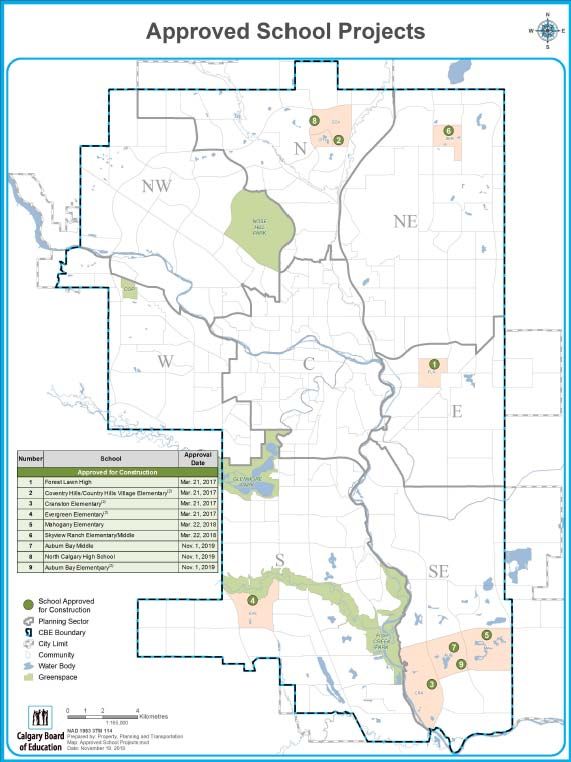
3. Calgary Suburban Growth and Development
              A geographical reporting and analysis of data is required to understand where
              population and student enrolment growth will occur in the future. Starting with the
              School Capital Plan 2019-2022 the CBE began aligning with City of Calgary planning
              sectors for capital planning purposes. The map below shows the planning sectors.

              The following infographic regarding anticipated distribution of population growth from
              2019-2023 is from the City’s Suburban Residential Growth 2019-2023.

Three-Year School Capital Plan 2021-2024                                                           ii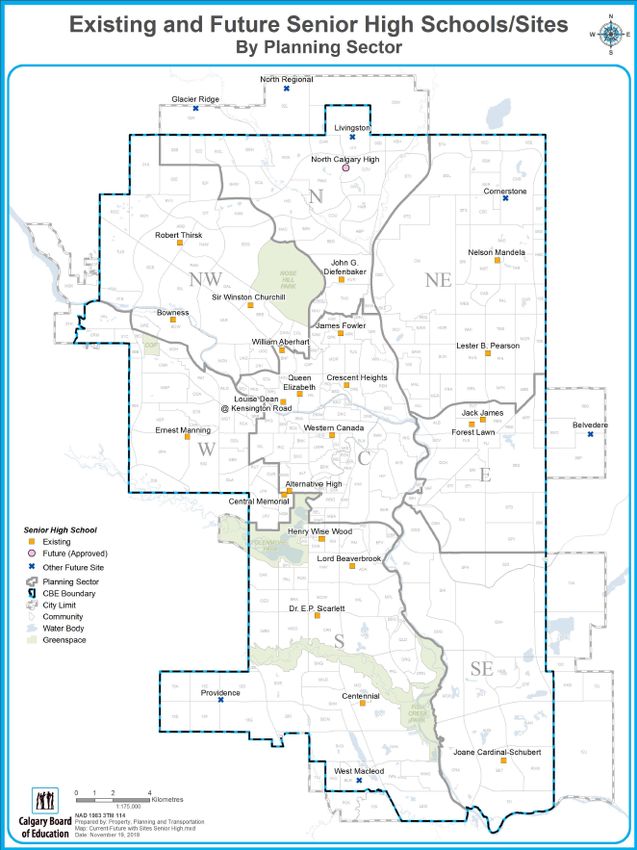
4. Three-Year Education Plan
                    Alberta Education requires school boards to maintain and update three-year plans
                    annually. School boards are responsible for carrying out their education plans; for
                    reporting annually to parents, communities, and government on results and use of their
                    resources; and, for using results information to improve education for students. The
                    Board of Trustees approved the combined Annual Education Results Report 2018-
                    2019 and the Three-Year Education Plan 2019-2022 in January 2020.

               5. Schools Under Construction and Approvals
                    Eight new school construction projects and one high school major modernization
                    project are currently under development.

                    The table below summarizes the projects under development, their approval dates and
                    their projected opening/completion date.

                                                     Schools Under Construction and Approvals

  Projected
 School Year                                                                                              Approved     Approval
  Opening               School/Community                             Project Type         Grade           Capacity       Date
                        Coventry Hills/Country Hills Village                                                          Mar. 21, 2017
                                                                     New Construction     Grades K-4           600
                        Elementary (2) (Northern Lights School)

                        Cranston Elementary (2) (Sibylla Kiddle                                                       Mar. 21, 2017
                                                                     New Construction     Grades K-4           600
   2020-2021            School)

                        Evergreen Elementary (2) (Dr. Freda Miller                                                    Mar. 21, 2017
                                                                     New Construction     Grades K-4           600
                        School)

                        Forest Lawn High (Spring 2021)               Modernization        Grades 10-12          n/a   Mar. 21, 2017

                        Mahogany Elementary                          New Construction     Grades K-4           600    Mar. 22, 2018
        TBD
                        Skyview Ranch Elementary/Middle              New Construction     Grades K-9           900    Mar. 22, 2018

                                                                     Design Only                                      Mar. 22, 2018
                        Auburn Bay Middle                                                 Grades 5-9           900
                                                                     New Construction                                 Nov 1, 2019

        TBD                                                          Design Only                                      Mar. 22, 2018
                        North Calgary High School                                         Grades 10-12        1,800
                                                                     New Construction                                 Nov 1, 2019

                        Auburn Bay Elementary (2)                    New Construction     Grades K-4           600    Nov 1, 2019

                                                                            Total School Space Capacity       6,600
        (2)
Note:         denotes second school of that type in the community.

Three-Year School Capital Plan 2021-2024                                                                                            iii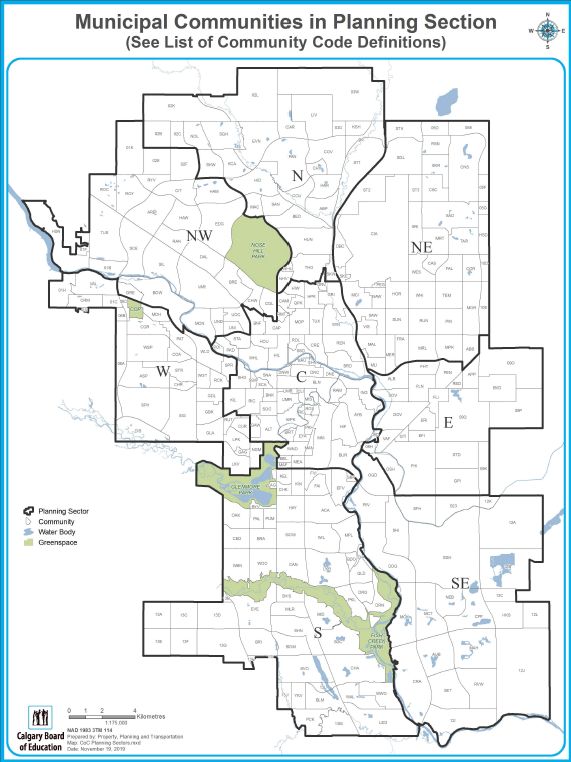
6. Capital Priorities – New School Construction
                    There are 3 new school construction projects identified in the Three-Year School
                    Capital Plan 2021-2024. Two of the projects are being requested for design funding
                    initially in Year 2 and then construction funding in Year 3.

                                               Table 1: New School Construction
   Three-Year School Capital Plan 2021-2024 Priorities
   Priority Ranking – Project Description                                                                                      Number of Years
   YEAR 1                                                                                                                      Previously Listed
   Community/School                                              Grade Project Status Request Type             2020 Cost ($)    in Capital Plan
   C-1         Evanston Middle                                   5-9       New Request Full buildout to 900      31,736,000              7
                                                                                               YEAR 1 TOTAL      31,736,000
   YEAR 2
   Community/School                                              Grade Project Status Request Type             2020 Cost ($)
                                     (2)
   C-2         Saddle Ridge Middle                               5-9       New Request Design for 900             1,147,000              1
   C-3         Cornerstone High School                           10-12     New Request Design for 1800            2,293,000              1
                                                                                               YEAR 2 TOTAL       3,440,000
   YEAR 3
   Community/School                                              Grade Project Status Request Type             2020 Cost ($)
                                     (2)
   C-4         Saddle Ridge Middle         *                     5-9       New Request Construction for 900      28,388,000              1
   C-5         Cornerstone High School*                          10-12     New Request Construction for 1800     63,178,000              1
                                                                                               YEAR 3 TOTAL      91,566,000
                                                                                               GRAND TOTAL     126,742,000
           1
   Note:    Senior high schools are not ranked using point criteria. See page 27.
         (2)
           = second school of that type for the com m unity.
         * Year could change, dependent on w hen site is ready for construction.

Three-Year School Capital Plan 2021-2024                                                                                            iv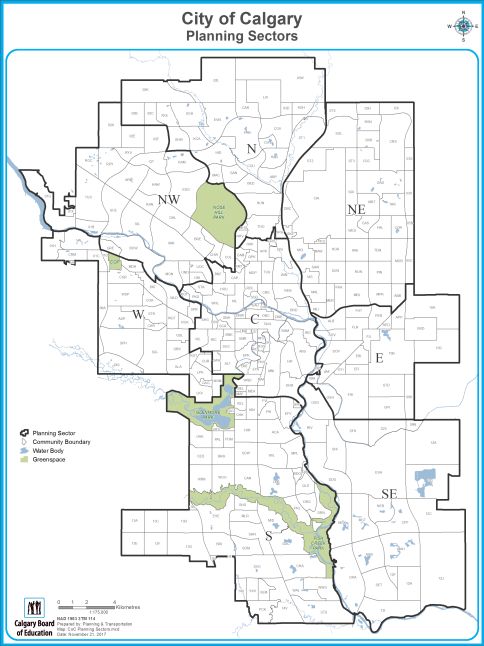
7. Capital Priorities – Major Modernization Projects
              There are 10 major modernization projects identified in the Three-Year School
              Capital Plan 2021-2024.

                                         Table 2: School Major Modernizations
Three-Year School Capital Plan 2021-2024 Priorities
Priority Ranking – Project Description                                                                                      Number of Years
YEAR 1                                                                                                                      Previously Listed
Community/School                                      Grade Project Status            Request Type          2020 Cost ($)   in Capital Plan
M-1   John G. Diefenbaker High School                 10-12   Modernization Request   Major Modernization     28,146,000            11
M-2   Nickle School                                   5-9     Modernization Request   Major Modernization     14,595,000            12
                                                                                            YEAR 1 TOTAL      42,741,000
YEAR 2
Community/School                                      Grade Project Status            Request Type          2020 Cost ($)
M-3   Ernest Morrow School                            6-9     Modernization Request   Major Modernization     16,679,000            6
M-4   A.E. Cross School                               7-9     Modernization Request   Major Modernization     18,764,000            3
M-5   Janet Johnstone School                          K-4     Modernization Request   Major Modernization      9,069,000            5
M-6   Annie Foote School                              K-6     Modernization Request   Major Modernization     10,841,000            5
                                                                                            YEAR 2 TOTAL      55,353,000
YEAR 3
Community/School                                      Grade Project Status            Request Type          2020 Cost ($)
M-7   Cedarbrae School                                K-6     Modernization Request   Major Modernization      8,132,000            5
M-8   Altadore School                                 K-6     Modernization Request   Major Modernization      8,132,000            12
M-9   Ranchlands School                               K-6     Modernization Request   Major Modernization     12,197,000            5
M-10 Queen Elizabeth School                           K-6     Modernization Request   Major Modernization      9,069,000            5
                                                                                            YEAR 3 TOTAL      37,530,000
                                                                                            GRAND TOTAL      135,624,000

Three-Year School Capital Plan 2021-2024                                                                                        v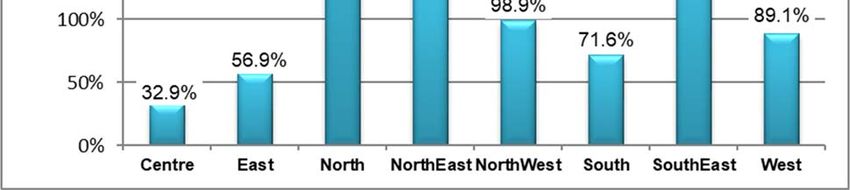
8. Capital Priorities – New Construction & Major Modernizations
                     There are 13 new construction and major modernization projects identified in the
                     Three-Year School Capital Plan 2021-2024. Two of the projects are being requested
                     for design funding initially in Year 2 and then construction funding in Year 3.

                                   Table 3: New School Construction and Major Modernizations
 Three-Year School Capital Plan 2021-2024 Priorities
 Priority Ranking – Project Description                                                                                                   Number of Years
 YEAR 1                                                                                                                                   Previously Listed
 Community/School                                                  Grade Project Status           Request Type            2020 Cost ($)    in Capital Plan
 1       Evanston Middle                                           5-9      New Request           Full buildout to 900      31,736,000            7
 2       John G. Diefenbaker High School                           10-12    Modernization Request Major Modernization       28,146,000            11
 3       Nickle School                                             5-9      Modernization Request Major Modernization       14,595,000            12
                                                                                                        YEAR 1 TOTAL        74,477,000
 YEAR 2
 Community/School                                                  Grade Project Status           Request Type            2020 Cost ($)
                                    (2)
 4       Saddle Ridge Middle                                       5-9      New Request           Design for 900             1,147,000            1
 5       Cornerstone High School                                   10-12    New Request           Design for 1800            2,293,000            1
 6       Ernest Morrow School                                      6-9      Modernization Request Major Modernization       16,679,000            6
 7       A.E. Cross School                                         7-9      Modernization Request Major Modernization       18,764,000            3
 8       Janet Johnstone School                                    K-4      Modernization Request Major Modernization        9,069,000            5
 9       Annie Foote School                                        K-6      Modernization Request Major Modernization       10,841,000            5
                                                                                                        YEAR 2 TOTAL        58,793,000
 YEAR 3
 Community/School                                                  Grade Project Status           Request Type            2020 Cost ($)
                                    (2)
 10      Saddle Ridge Middle                                       5-9      New Request           Construction for 900      28,388,000            1
 11      Cornerstone High School                                   10-12    New Request           Construction for 1800     63,178,000            1
 12      Cedarbrae School                                          K-6      Modernization Request Major Modernization        8,132,000            5
 13      Altadore School                                           K-6      Modernization Request Major Modernization        8,132,000            12
 14      Ranchlands School                                         K-6      Modernization Request Major Modernization       12,197,000            5
 15      Queen Elizabeth School                                    K-6      Modernization Request Major Modernization        9,069,000            5
                                                                                                        YEAR 3 TOTAL       129,096,000
                                                                                                        GRAND TOTAL 262,366,000
         1
 Note:       Senior high schools are not ranked using point criteria. See page 27.
      (2)
            = second elem entary school for the com m unity

Three-Year School Capital Plan 2021-2024                                                                                                     vi
1.0     INTRODUCTION

        The CBE is a global leader in public education. Recognized as the largest school district
        in Western Canada, the CBE provides a full range of educational services for all
        instructional programs from kindergarten through to Grade 12. The CBE addresses the
        complexity and diversity of our 125,809 students in over 246 schools with approximately
        14,000 staff and an operating budget of $1.38 billion.
        Over the past decade, Calgary has experienced varying levels of population growth.
        Calgary’s population has increased by approximately 55,000 people since 2015, an
        average of 13,750 people per year.
        The population grew from 1,267,344 in April 2018 to 1,285,711 in April 2019 (2019 Civic
        Census), an increase of 18,367 (1.45%). The population growth consisted of a natural
        increase of 8,807 people with a net migration of 9,560 people (2019 Civic Census).
        The City of Calgary’s report, Calgary and Region Economic Outlook 2019-2024 (Fall
        2019), identifies continued growth for Calgary. The City forecast contained in the report
        projects the population of Calgary will reach 1,381,000 by 2024, an increase of 95,000
        people from the 2019 total of 1,286,000. This population forecast averages 19,000
        people per year during this period and is a decrease from the previous five-year
        forecast. This population increase is expected to be driven primarily by net migration.

                                        Calgary Total Population (,000s)
                                 Actual                                Projected
               2015      2016     2017     2018      2019      2020    2021    2022    2023    2024
               1,231     1,235     1,246   1,267     1,286     1,304   1,322   1,341   1,360   1,381
             Calgary & Region Economic Outlook 2019-2024 (Fall 2019)

           1.1     CBE Student Enrolment

         Total enrolment of 125,809 students was reported on September 30, 2019, and
         consists of 121,527 pre-kindergarten to Grade 12 students plus 4,282 students enrolled
         in Home Education, Outreach Programs, Unique Settings, Chinook Learning and CBe-
         learn.

         Enrolment increased by 2,390 students from September 30, 2018, to September 30,
         2019, with a notable increase in Grades 7-9 (1,375 students). This enrolment growth
         was higher than the previous overall enrolment growth of 1,729 students between 2017
         and 2018.

         Students continue to access program choices offered by the CBE. Enrolment in
         alternative programs is 26,203; this is an increase of 721 students over the previous
         year. The alternative programs with the highest enrolment are French Immersion
         (9,045), Traditional Learning Centre (TLC) (6,850) and Spanish Bilingual (3,790).

         The following table provides a summary of enrolments including Unique Settings,
         Outreach Programs, Chinook Learning, and CBe-learn from September 30, 2015, to
         September 30, 2019.

Three-Year School Capital Plan 2021-2024                                                               1
Five-Year History of CBE Enrolments by Division
2015-2019
2015 2016 2017 2018 2019
Pre-Kindergarten 180 197 228 195 215
Kindergarten 9,209 9,106 9,053 8,740 9,030
Grades 1-3 28,888 29,410 29,080 29,073 28,972
Grades 4-6 24,441 25,715 27,183 28,265 28,626
Grades 7-9 22,624 23,292 24,267 25,321 26,696
Grades 10-12 26,375 26,443 27,035 27,567 27,988
Sub-Total (pre-k to grade 12) 111,717 114,163 116,846 119,161 121,527
Home Education 270 249 267 262 209
Outreach and Unique Settings 2,060 2,066 2,141 2,304 2,408
CBe-learn 611 458 463 576 541
Chinook Learning Services 2,327 2,211 1,974 1,116 1,124
Sub-Total 5,268 4,984 4,845 4,258 4,282
Total 116,985 119,147 121,691 123,419 125,809
Chinook Learning and CBe-learn register students continually throughout the year. The
enrolment reported for both Chinook Learning and CBe-learn represent students who are
only enrolled in either of those two programs and not accessing programming at another
CBE school. Students enrolled in other CBE schools, that are accessing one or more
courses at either Chinook Learning or CBe-learn, are reported in the pre-kindergarten to
Grade 12 enrolment. The enrolment reported for Chinook Learning includes students
enrolled in academic success programs (high school classes) only and does not include
students in Adult English Language Learning (ELL) or Continuing Education (personal and
professional development).
In September 2018, CBE implemented a new delivery model for Chinook Learning.
Chinook Learning academic success programs (high school classes) were transitioned
into James Fowler High School and Lord Beaverbrook High School. In this new model
student age is limited to those who are 19 years of age by September 1 in the year they
enrol in classes. This year there was an increase in enrolment at Chinook Learning of 8
students from September 30, 2018 to September 30, 2019.
Five-Year Enrolment Projections
The CBE uses the Cohort-Survival methodology in preparing enrolment projections. The
cohort survival projection methodology uses historic birth data and historic student
enrolment data to “age” a known population (cohort) through their school grades. The
cohort survival ratio is calculated to see how a group of potential students first enter the
system at kindergarten and Grade 1 (market share) and how this group of students grows
or shrinks over time (retention rates). Enrolment patterns emerge that are used for
projections.
Three-Year School Capital Plan 2021-2024 2Pre-school census information, which is currently collected annually for all communities,
combined with historic intake rates at kindergarten and Grade 1 is used to project how
many students will enter our system each year. The annual September 30 enrolment data
is used as a base for establishing retention rates that are used to project how existing
student populations move through the system from one year to the next.
City of Calgary population projections are not a direct factor in CBE’s enrolment
projections but they do provide context for comparison. Trends reported by the City with
respect to net migration and natural increase (births minus deaths) are considered when
evaluating future student growth.
CBE’s current enrolment of 125,809 students is forecast to increase to 134,472 students
by 2024. A total increase of 8,663 students is projected averaging approximately 1,733
additional students annually. These enrolment projections assume a conservative level of
enrolment growth in the future. Enrolment in kindergarten to Grade 3 is projected to
decrease over the next five years with increases projected for Grades 7-9 and Grades 10-
12 during the same period.
The number of students eligible to start kindergarten each year has declined over the past
few years and enrolment in kindergarten has declined accordingly. Data collected during
the 2019 census indicate the number of children eligible for kindergarten is expected to
continue to decline over the next four years. The peak number of students eligible to start
kindergarten was 16,910 in 2017.
Bill 28: School Amendment Act identified that “establishing a common age of entry” of five
years of age on December 31 will come into effect for the 2020/21 school year. This
common age is a change to the end of February date currently established for the CBE
and will impact kindergarten enrolment projections in 2020.
Over the past three years, approximately 90% of students enrolled in kindergarten had a
birthdate before January 1 of the year they were eligible to start kindergarten. Based on
this trend, a one-year increase of approximately 800 kindergarten students, over and
above the decline expected as a result of the reduced pre-school census data, is
anticipated in 2021 as students born in January and February 2020 will not be eligible for
kindergarten until the next year.
Three-Year School Capital Plan 2021-2024 3A summary of the September 2019 actual student enrolments and September
2020-2024 projected enrolments are below:
CBE Five-Year Enrolment Projections
2019-2024
Actual Projected
2019 2020 2021 2022 2023 2024
Pre-Kindergarten 215 245 245 245 245 245
Kindergarten 9,030 8,813 9,637 8,840 8,445 8,445
Grades 1-3 28,972 29,098 29,408 29,827 29,637 28,732
Grades 4-6 28,626 28,488 28,479 28,295 28,365 28,663
Grades 7-9 26,696 28,109 29,073 29,454 29,311 29,300
Grades 10-12 27,988 28,836 29,879 31,504 33,168 34,309
Sub-Total (pre-k to grade 12) 121,527 123,589 126,721 128,165 129,171 129,694
Home Education 209 213 217 222 225 227
Outreach and Unique Settings 2,408 2,456 2,497 2,561 2,590 2,611
CBe-learn 541 576 613 653 695 740
Chinook Learning 1,124 1,200 1,200 1,200 1,200 1,200
Sub-Total 4,282 4,445 4,527 4,636 4,710 4,778
Total Student Count 125,809 128,034 131,248 132,801 133,881 134,472
totals may not add due to rounding
CBe-learn and Chinook Learning accept registrations on an on-going basis.
All projections are subject to annual review and update.
Projections use September 30, 2019 enrolments as a base.
1.2 Calgary Suburban Growth and Development
The City of Calgary supports an actively competitive land
The top ten developing
market in all areas of the city and there over 27 new and communities by number of units
developing municipal communities in various stages of from new residential building
development. The large number of concurrently developing permit applications in Calgary
communities puts increased pressure on the CBE to meet the for 2018 were:
expectations of parents for school construction in their • Seton (SE)
community. Although the number of communities has • Skyview Ranch (NE)
• Mahogany (SE)
declined slightly over the last decade, the size of the • Redstone (NE) tie
communities being planned and built today are much larger • Walden (S) tie
than they have been historically. • Legacy (S)
• Livingston (N)
• Carrington (N)
Forecasted Suburban Growth • Cornerstone (NE)
• Sage Hill (N)
The City of Calgary prepares a suburban residential growth
• Evanston (N)
forecast each year and publishes the final version of this
report after the timiline for CBE’s annual capital plan each (Source: Suburban Residential
Growth 2019-2023, p. A3-6, A3-7)
year. As such, the suburban growth information used in the
Three-Year School Capital Plan 2021-2024 is based on the
City’s Suburban Residential Growth 2019-2023 document published in August
2019. This document allocates future population growth to the eight city planning
sectors. This information provides CBE with a context for where student
population growth will be expected in the future.
Three-Year School Capital Plan 2021-2024 4The largest population growth projected over the next five years is in the north,
northeast and southeast. A summary of the five-year period forecast from the
City’s Suburban Residential Growth 2019-2023 document for suburban locations
is as follows:
City of Calgary Planning Sectors
New Suburban Growth Forecasts 2019-2023
Three-Year School Capital Plan 2021-2024 51.3 Framework for Growth and Change
The Municipal Development Plan (MDP), Plan It Calgary, was implemented April
1, 2010, and is the overarching policy that documents municipal development
and transportation. Plan It Calgary identifies a goal of reducing the amount of
growth allocated to the developing communities, which was essentially 100% in
the late 1990’s and to intensify growth within the inner-city and established areas.
The 30-year target of the MDP for growth into established areas is 33% and the
60-year target is 50% growth to established areas. In August 2018 the City
indicated although growth is moving in line with the idealized balanced growth in
old and new communities, new communites captured 91% of the population
growth from 2014-2018 making it challenging to meet the MDP goals in the next
20 years or so.
The City supports an actively competitive land market in all The communities that grew by more
areas of the city and there are 27 new and developing than 1,000 residents between 2018 and
municipal communities in various stages of development. In 2019 were:
August 2018, Calgary City Council voted in favour of • Mahogany (SE): 1,948
developing 14 new Greenfield communities, some of which • Legacy (S): 1,116
are part of approved Area Structure Plans (ASP’s) within the • Nolan Hill (N): 1,051
currently active developments. The large number of • Cornerstone (NE): 1,019
• Redstone (NE): 1,002
developing communities puts increased pressure on the
CBE to meet the expectations of parents for new school (Source: 2019 Civic Census)
construction in their community.
1.4 City of Calgary Annexation
Previously Annexed Lands
The majority of the 36,000 acres annexed to the City of Calgary, from the MD of
Foothills in 2005 and MD of Rocky View in 2007, remain outside of the CBE’s
jurisdictional boundary.
The Minister of Education has identified it is in the best interest of the students to
retain the existing school boundaries until urban development warrants change.
The Minister has indicated that annexed lands would be brought into the CBE
inventory as area structure plans are finalized and urban development proceeds.
The Calgary City Council has approved regional context studies to guide
development in the newly annexed lands:
East Regional Context Study (April 2009) with an eventual population of
160,000 persons and approximately 22,000 jobs upon full build-out.
West Regional Context Study (April 2010) with an eventual population of
22,000 people and 7,000 jobs upon full build-out.
North Regional Context Study (June 2010) with an eventual population of
216,000 persons and approximately 69,000 jobs on full build-out.
Three-Year School Capital Plan 2021-2024 6Map 1 on page 8 identifies these locations.
Detailed Area Structure Plans (ASP) have been, or are being, undertaken to
guide future planning in the annexed lands. The CBE participated in meetings,
discussions and plan preparation, to enable long-term school planning in the
following areas:
The Ricardo Ranch Area Structure Plan is currently under development
and is anticipated to accommodate a population of approximately 18,300
persons. This area is currently in the CBE’s boundary.
The West View Area Structure Plan is currently under development and is
anticipated to accommodate a population of approximately 10,500 to 10,800
persons.
The Keystone Hills Area Structure Plan was approved July 16, 2012 and
will accommodate a population of approximately 60,000 persons.
The Belvedere Area Structure Plan on the east was approved April 8, 2013
and will accommodate a future population of approximately 61,000 persons.
The South Shepard Area Structure Plan was approved May 6, 2013 and
will accommodate a population of approximately 28,000 persons.
The West Macleod Area Structure Plan was approved June 10, 2014 and
will accommodate a population of approximately 34,000 persons.
The Haskayne Area Structure Plan was approved July 22, 2015 and will
accommodate a population of approximately 13,000 persons.
The Glacier Ridge Area Structure Plan was approved December 7, 2015
and will accommodate a population of approximately 58,000 persons.
Once house construction begins, CBE will request, on an as required basis, that
the Minister include these lands as part of CBE school boundaries.
In alignment with the request by the Ministry of Education that urban
development be occuring, in June 2018 the Minister of Education approved that
the west section of the Crestmont community and the northern portion of the
Livingston community (north of 144 Avenue NE) be incorporated into the CBE
boundary.
In addition, in June 2019 the Minister of Education approved the communities of
Belmont and Yorkville (in the West McLeod ASP) be incorporated into the CBE
boundary for the 2019-2020 school year.
The CBE continually monitors growth in the City and and on November 19, 2019
requested the addition of the Haskayne ASP, part of the Belvedere ASP, and the
remainder of West Macleod ASP for the 2020-21 school year. Information on
new communities can be found on the City’s website.
Three-Year School Capital Plan 2021-2024 7Map 1 Three-Year School Capital Plan 2021-2024 8
2.0 CAPITAL STRATEGIES
2.1 Calgary Board of Education
CBE has identified the following drivers for capital planning:
Program Delivery – Projects that are required to enable the delivery of
school programs e.g. Career and Technology Studies (CTS) and Career
and Technology Framework (CTF).
Community Schools – New schools required in rapidly growing communities
in order to minimize student travel times and meet needs for a local school
in their community.
Aging Facilities – Older schools that require modernization, rehabilitation or
replacement to provide appropriate learning environments for students.
The province estimates the value of required deferred maintenance in CBE
schools to be in excess of $160 million.
Optimizing School Utilization Rates – Ensuring appropriate school
utilization rates can optimize the programming opportunities available to
students within the limited public resources entrusted to the CBE.
A balanced approach for the plan is developed to ensure the CBE is pursuing
capital funding opportunities that recognize the changing needs of students and
are focused on building strong ties with parents, partners, and the community.
More specifically, the CBE recognizes:
Provincial funding is required for new school construction in new and
developing communities;
Parents desire schools to be closer to home, especially for younger students;
Increasing public demand for program alternatives;
Transitions for students with minimal disruption are valued as they provide
continuity of learning with consistent peer cohorts.
This approach to planning anticipates a system of core elementary feeder
schools for local school communities (attendance areas), complemented with
middle/junior high, and senior high schools serving larger geographic areas.
Projects are also required to ensure programming requirements are met through
school modernizations. High priority program delivery projects are listed below.
CTS – CBE received funding approval March 21, 2017, for Forest Lawn
(northeast sector). Once complete, this modernization will support delivery of
CTS curriculum and provide access to state of the art spaces for students
living within the northeast sector of the city.
Three-Year School Capital Plan 2021-2024 92.2 Three-Year Education Plan
Alberta Education requires school boards to maintain three-year plans, updated
annually. School boards are responsible for carrying out their education plans;
for reporting annually to parents, communities, and government on results and
use of their resources; and, for using results information to update plans and
improve education for students. The Board of Trustees approved the combined
Annual Education Results Report 2018-2019 and the Three-Year Education Plan
2019-2022 on January 7, 2020.
Long-range education plans will continue to be developed and these plans will
inform the Three-Year School Capital Plan and the Ten-Year Student
Accommodation and Facilities Strategy to ensure that programs and services for
students are provided in suitable facilities that are well situated and fiscally
sustainable. Education planning information will be based on: the Three-Year
Education Plan and other program development undertaken through the Chief
Superintendent’s office, School Improvement, and the respective Area Offices.
This information, in conjunction with the Three-Year School Capital Plan, Three-
Year System Student Accommodation Plan and facility information, will be used
to inform school program and facility upgrade strategies for schools.
Facility and capital project plans will be developed through the Facilities and
Environmental Services Unit based upon approvals obtained for new school
construction, replacement schools, modernizations, facility maintenance, facility
upgrades and other projects, as identified in this and other plans approved by the
Board of Trustees.
Three-Year School Capital Plan 2021-2024 102.3 Administrative Areas and Space Utilization
In Spring 2017, CBE added two new administrative areas and changed the
methodology for grouping schools into areas. The CBE is now divided into seven
administrative areas. This new area structure is based on relationships between
schools rather than geography.
A geographical reporting and analysis of data is required to understand where
population and student enrolment growth will occur in the future. Starting with the
School Capital Plan 2019-2022 the CBE began using City of Calgary planning
sectors for capital planning purposes (Map 2).
Within each of these planning sectors, the CBE annually reviews new and
developing communities for new school construction eligibility. The Province has
indicated that utilization is reviewed when evaluating a jurisdiction’s capital
priorities; however, the utilization rate in a sector is not a firm requirement but
rather a guideline.
The CBE strives to maintain a utilization rate in the high 80% range. Ensuring
healthy school utilization rates contributes to ensuring that facilities are optimized
for educational purposes, maintaining flexibility within the system to meet
demand for emergent considerations while balancing the financial obligations
and sustainability of the system. Currently, the CBE’s overall utilization rate by
enrolment is 87%. The utilization rate is 86% for K-GR9 students and 93% for
Grades 10-12 students.
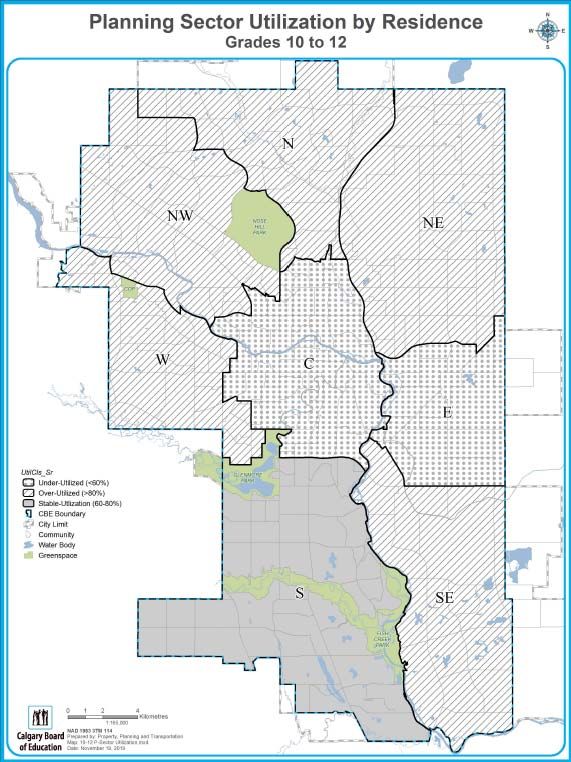
A summary of utilization by enrolment and by residence follows and is included in
detail in Appendix I.
Utilization by enrolment identifies the number of students attending schools
expressed as a percentage of the total capacity. Utilization by enrolment
represents the actual utilization currently experienced at schools within the
planning sector.
Utilization by residence identifies the number of students residing in the planning
sector expressed as a percentage of the total school capacity within that planning
sector. Utilization by residence represents the utilization rate that would exist if
the CBE were not able to accommodate students in facilities in other planning
sectors but rather accommodated the students in the facilities that exist within the
planning sector where they live.
Three-Year School Capital Plan 2021-2024 11Projections for 2024-2025, in the charts below, account for additional school
capacity that has been approved and is currently under construction but does not
include additional capacity for schools approved for design only or requested in
this capital plan:
Planning Sector Utilization by Student Enrolment
(Actual & Projected)
2019-2020 Actual 2024-2025 Projections
Sector K-12 K-12
Utilization Utilization
Centre 89% 100%
East 75% 76%
North 92% 88%
NorthEast 92% 95%
NorthWest 91% 91%
South 80% 83%
SouthEast 93% 85%
West 85% 87%
Total 87% 89%
Planning Sector Utilization by Student Residence
(Actual & Projected)
2019-2020 Actual 2024-2025 Projections
Sector K-12 K-12
Utilization Utilization
Centre 52% 62%
East 66% 67%
North 154% 139%
NorthEast 102% 104%
NorthWest 80% 80%
South 68% 71%
SouthEast 129% 113%
West 84% 85%
Total 86% 88%
Three-Year School Capital Plan 2021-2024 12Map 2 Three-Year School Capital Plan 2021-2024 13
Municipal Community Code Definitions

ABB    Abbeydale                            FLN   Forest Lawn                     QLD   Queensland
ACA    Acadia                               GAG   Garrison Green                  RAM   Ramsay
ALB    Albert Park/Radisson Heights         GAW   Garrison Woods                  RAN   Ranchlands
ALT    Altadore                             GLA   Glamorgan                       RGW   Rangeview
APP    Applewood Park                       GBK   Glenbrook                       RED   Red Carpet
ARB    Arbour Lake                          GDL   Glendale                        RSN   Redstone
ASP    Aspen Woods                          GRV   Greenview                       REN   Renfrew
AUB    Auburn Bay                           GRI   Greenview Industrial Park       RIC   Richmond
BNF    Banff Trail                          GRE   Greenwood/Greenbriar            RID   Rideau Park
BNK    Bankview                             HAM   Hamptons                        RIV   Riverbend
BYV    Bayview                              HAR   Harvest Hills                   ROC   Rocky Ridge
BED    Beddington Heights                   HSN   Haskayne                        RDL   Rosedale
BEL    Bel-Aire                             HAW   Hawkwood                        RMT   Rosemont
BLM    Belmont                              HAY   Haysboro                        RCK   Rosscarrock
BLN    Beltline                             HID   Hidden Valley                   ROX   Roxboro
BVD    Belvedere                            HPK   Highland Park                   ROY   Royal Oak
BDO    Bonavista Downs                      HIW   Highwood                        RUN   Rundle
BOW    Bowness                              HIL   Hillhurst                       RUT   Rutland Park
BRA    Braeside                             HSD   Homestead                       SAD   Saddle Ridge
BRE    Brentwood                            HKS   Hotchkiss                       SGH   Sage Hill
BRD    Bridgeland/Riverside                 HOU   Hounsfield Heights/Briar Hill   SAN   Sandstone Valley
BRI    Bridlewood                           HUN   Huntington Hills                SCA   Scarboro
BRT    Britannia                            ING   Inglewood                       SSW   Scarboro/Sunalta West
CAM    Cambrian Heights                     KEL   Kelvin Grove                    SCE   Scenic Acres
CAN    Canyon Meadows                       KSH   Keystone Hills                  SET   Seton
CAP    Capitol Hill                         KIL   Killarney/Glengarry             SHG   Shaganappi
CAR    Carrington                           KCA   Kincora                         SHS   Shawnee Slopes
CAS    Castleridge                          KIN   Kingsland                       SHN   Shawnessy
CED    Cedarbrae                            LKB   Lake Bonavista                  SHW   Sherwood
CHA    Chaparral                            LKV   Lakeview                        SIG   Signal Hill
CHW    Charleswood                          LEG   Legacy                          SIL   Silver Springs
CHN    Chinatown                            LPK   Lincoln Park                    SVO   Silverado
CHK    Chinook Park                         LIV   Livingston                      SKR   Skyview Ranch
CHR    Christie Park                        LMR   Lower Mount Royal               SOM   Somerset
CIT    Citadel                              MAC   MacEwan Glen                    SOC   South Calgary
CSC    Cityscape                            MAH   Mahogany                        SOV   Southview
CLI    Cliff Bungalow                       MAN   Manchester                      SOW   Southwood
COA    Coach Hill                           MPL   Maple Ridge                     SPH   Springbank Hill
COL    Collingwood                          MRL   Marlborough                     SPR   Spruce Cliff
CPF    Copperfield                          MPK   Marlborough Park                STA   St. Andrews Heights
COR    Coral Springs                        MRT   Martindale                      STR   Strathcona Park
CNS    Cornerstone                          MAF   Mayfair                         SNA   Sunalta
CGR    Cougar Ridge                         MAL   Mayland Heights                 SDC   Sundance
CHV    Country Hills Village                MCK   McKenzie Lake                   SSD   Sunnyside
COU    Country Hills                        MCT   McKenzie Towne                  TAR   Taradale
COV    Coventry Hills                       MEA   Meadowlark Park                 TEM   Temple
CRA    Cranston                             MDH   Medicine Hill                   THO   Thorncliffe
CRE    Crescent Heights                     MID   Midnapore                       TUS   Tuscany
CRM    Crestmont                            MLR   Millrise                        TUX   Tuxedo Park
CUR    Currie Barricks                      MIS   Mission                         UND   University District
DAL    Dalhousie                            MOR   Monterey Park                   UNI   University Heights
DRG    Deer Ridge                           MON   Montgomery                      UOC   University of Calgary
DRN    Deer Run                             MOP   Mount Pleasant                  UMR   Upper Mount Royal
DIA    Diamond Cove                         NEB   New Brighton                    VAL   Valley Ridge
DIS    Discovery Ridge                      NOL   Nolan Hill                      VAR   Varsity
DDG    Douglasdale/Glen                     NGM   North Glenmore Park             VIS   Vista Heights
DOV    Dover                                NHV   North Haven                     WAL   Walden
DNC    Downtown Commercial Core             NHU   North Haven Upper               WHL   West Hillhurst
DNE    Downtown East Village                OAK   Oakridge                        WSP   West Springs
DNW    Downtown West End                    OGD   Ogden                           WGT   Westgate
EAG    Eagle Ridge                          PAL   Palliser                        WHI   Whitehorn
EAU    Eau Claire                           PAN   Panorama Hills                  WLD   Wildwood
EDG    Edgemont                             PKD   Parkdale                        WIL   Willow Park
EPK    Elbow Park                           PKH   Parkhill                        WND   Windsor Park
EYA    Elboya                               PKL   Parkland                        WIN   Winston Heights/Mountview
ERI    Erin Woods                           PAT   Patterson                       WBN   Woodbine
ERL    Erlton                               PEN   Penbrooke Meadows               WOO   Woodlands
EVN    Evanston                             PCK   Pine Creek                      YKV   Yorkville
EVE    Evergreen                            PIN   Pineridge
FAI    Fairview                             POI   Point McKay
FAL    Falconridge                          PUM   Pump Hill
FHT    Forest Heights                       QPK   Queen’s Park Village

Three-Year School Capital Plan 2021-2024                                                                            14
2.4    Planning for Students

                   Sites for New Schools

                   The identification and establishment of school sites within any new community in
                   Calgary is a complex process. The CBE works with The City of Calgary, the
                   Calgary Catholic School District (CCSD) and community developers to select
                   school sites based on catchment areas within future developments. There is a
                   balance between population, number and type of residential units, location and
                   land dedication.

                   Land for high school sites, which serve a larger geographic region, is purchased
                   through the Joint Use Coordinating Committee (JUCC). The requirement to
                   purchase land for a high school is identified during the regional context study
                   phase when developments that are planned for a minimum of 50,000 to 60,000
                   residents are considered for approval by the City of Calgary.

                   In the case of land for elementary and middle schools, land from the 10%
                   dedication requirement in the Municipal Government Act (MGA) of Alberta is
                   used. The number and type of school sites required is based on the Joint Use
                   Site Calculation Methodology. This methodology uses the estimated number of
                   single and multi-family units in an Area Structure Plan (ASP) multiplied by the
                   average number of children aged 5-14 per housing unit by type.

                   As a more general guideline to determine an approximate number of schools,
                   one can use a target of one elementary school for every 10,000 residents, one
                   middle school for every 15,000 to 20,000 residents, and a high school for every
                   50,000 to 60,000 residents. Many of the new communities in Calgary are large
                   enough that once full build out has been achieved, the community will require a
                   minimum of one elementary and one middle school to accommodate the
                   students living in the community. Larger communities, once they are fully built-
                   out, will require two elementary schools and one or two middle schools to
                   accommodate students.

                   Working with Stakeholders

                   CBE is committed to working with stakeholders and has developed a Dialogue
                   Framework to guide this work. This framework guides public engagement when
                   CBE considers the future use of existing learning space in schools.

                   The CBE’s dialogue framework is available at http://www.cbe.ab.ca/get-
                   involved/public-engagement/Pages/default.aspx

                   System Student Accommodation Plan

                   The CBE prepares a Three-Year System Student Accommodation Plan annually
                   to inform appropriate decision-making and engagement for community members
                   and parents in CBE accommodation planning. The process applies to and
                   informs recommendations regarding all school and program accommodation
                   issues. The Three-Year System Student Accommodation Plan is developed to

Three-Year School Capital Plan 2021-2024                                                              15
support and reflect the Three-Year Education Plan, Three-Year School Capital
Plan, and the Ten-Year Student Accommodation and Facilities Strategy.
Student accommodation needs are identified by the Property, Planning &
Transportation department in consultation with Education Directors in each area.
Administration is responsible for using CBE’s Dialogue framework to engage
internal and external stakeholders regarding student accommodation challenges
that may be resolved through one or more possible scenarios. The Three Year
System Student Accommodation Plan 2019-2022 was presented for information
at the June 18, 2019, Board of Trustees meeting and is available on the CBE
website at: https://www.cbe.ab.ca/FormsManuals/Three-Year-System-Student-
Accommodation-Plan.pdf
Program Opportunities for Students
The CBE is committed to a balance among equity, access, excellence, and
choice within the school system and consequently offers a wide variety of
programs for students of all ages. Programs are designed to enrich the lives of
students and to promote quality learning. We recognize the many diverse ways
of learning and the many interests and abilities of students. Through the Three-
Year System Student Accommodation Plan, these programs are initiated where
space is available and as close as possible to where demand for the programs
exists. Information about programming opportunities for students can be found
at:
http://www.cbe.ab.ca/programs/Pages/default.aspx
Three-Year School Capital Plan 2021-2024 162.5 New School Construction and School Approvals
Eight new school construction projects and one high school major modernization
project are currently under development.
The table below summarizes the projects under development, their approval dates
and their projected opening/completion date.
Schools Under Construction and Approvals
Projected
School Year Approved Approval
Opening School/Community Project Type Grade Capacity Date
Coventry Hills/Country Hills Village Mar. 21, 2017
New Construction Grades K-4 600
Elementary (2) (Northern Lights School)
Cranston Elementary (2) (Sibylla Kiddle Mar. 21, 2017
New Construction Grades K-4 600
2020-2021 School)
Evergreen Elementary (2) (Dr. Freda Miller Mar. 21, 2017
New Construction Grades K-4 600
School)
Forest Lawn High (Spring 2021) Modernization Grades 10-12 n/a Mar. 21, 2017
Mahogany Elementary New Construction Grades K-4 600 Mar. 22, 2018
TBD
Skyview Ranch Elementary/Middle New Construction Grades K-9 900 Mar. 22, 2018
Design Only Mar. 22, 2018
Auburn Bay Middle Grades 5-9 900
New Construction Nov 1, 2019
TBD Design Only Mar. 22, 2018
North Calgary High School Grades 10-12 1,800
New Construction Nov 1, 2019
Auburn Bay Elementary (2) New Construction Grades K-4 600 Nov 1, 2019
Total School Space Capacity 6,600
(2)
Note: denotes second school of that type in the community.
Three-Year School Capital Plan 2021-2024 17Map 3 identifies the location of future school projects approved since March 21, 2017.
Map 3
Three-Year School Capital Plan 2021-2024 182.6 School Major Modernization
School major modernization projects provide for the renovation of whole or part
of a school building for both present and future educational programs. These
modernizations address physical obsolescence and/or improve functional
adequacy and suitability. School major modernization projects should not
exceed 75% of the replacement value of the school building as per provincial
guidelines.
To support the delivery of new CTS curriculum, a modernization of Forest Lawn
High school has been approved to include the following improvements:
Focus on upgrading CTS spaces
Improvements to the Learning Commons and development of new
computer lab spaces
Partial mechanical and electrical systems upgrades
Minor building envelope and interior upgrades
Building code and barrier free access upgrades
The CBE has a current count of over 264 owned facilities of which 175 were built
before 1980. This represents approximately 66% of CBE’s school building
inventory. The current inventory by decade of CBE school buildings is shown in
the following graph:
Age Distribution of Facilities
80
68
70
60
52
50
36 36
40
30
22 20
20
11 11
10
1 3 3 1
0
1900 1910 1920 1930 1940 1950 1960 1970 1980 1990 2000 2010
Number of Facilitiies Opened
In 2004, the Province undertook a rolling condition assessment of schools in the
Renewal Capital Asset Planning Process (RECAPP) and planned to audit CBE
facilities every five years. In the spring of 2009, Alberta Infrastructure
recommenced evaluations starting with the former 2004 assessments, thus
continuing the five-year assessment cycle. Approximately 40 to 50 facilities are
audited every year. Findings of the re-evaluation are incorporated into
maintenance, modernization, and facility planning for CBE projects. This
Three-Year School Capital Plan 2021-2024 19Provincial audit information, now called VFA, factors into CBE’s assessment in
determining modernization priorities.
The CBE continues to rank facilities for major modernizations. The criteria used
for establishing major modernization priorities are reviewed periodically. The
most recent criteria review began in May 2014 and revisions recommended as a
result of the review were presented to the Board of Trustees and approved on
October 7, 2014. Details of major modernization ranking can be found in
Appendix II.
2.7 Collaborative Initiatives with The City of Calgary
For many years, the CBE and The City of Calgary have enjoyed a strong working
relationship. This relationship involves both city-wide initiatives and specific
initiatives focused on property, leasing, and infrastructure. The following
initiatives are examples of the CBE working together with the City:
The CBE is party to the Joint Use Agreement and participates on the Joint
Use Coordinating Committee (JUCC) with the City and the CCSD dealing
with the determination of municipal and school reserve sites.
The CBE is a member of the Site Planning Team (SPT) with the City and the
CCSD that meets every two weeks to review and discuss development
applications and issues related to public access of City and school facilities.
CBE representatives have been involved in many city-wide initiatives such as
the Traffic Safety Community meetings, review of new Area Structure Plans,
neighbour redevelopment plans, and main street initiatives.
The CBE has also worked collaboratively with the City and CCSD on a
tripartite City Charters Memorandum of Understanding. More recently, this
work has grown to include the Government of Alberta’s Urban School
Planning Collaboration Sub-Table with the objective of maximizing the
benefits derived from school sites for students and the public.
3.0 NEW SCHOOL CONSTRUCTION CAPITAL PLAN CRITERIA
The CBE does not rank alternative programs for new school construction. As
schools are opened in new suburbs, vacancies are created in the bus receiver
schools where those students attended prior to the opening of the new school.
Administration works to identify opportunities to expand or relocate alternative
programs into these existing spaces, where resources allow, as they become
available.
In the new and developing municipal communities, elementary school
communities generally reflect municipal community boundaries. The junior high
and middle school communities can serve one large municipal community or two
or more small-to-medium-sized municipal communities. In the inner-city and
established areas, school communities tend to cover larger geographic areas for
elementary, junior high, and middle schools, and do not always align with
municipal community boundaries as there is a wide range in municipal
community sizes and demographics.
Three-Year School Capital Plan 2021-2024 203.1 Construction Planning Criteria
The ranking of new school construction priorities is an important issue for all
community stakeholders. The CBE first established ranking criteria for new
construction priorities in January 2002. The model was designed to be
transparent, objective and impart equity and fairness to all Calgary communities.
Over the years, these criteria have been reviewed and adjusted periodically as
necessary. The most recent criteria review began in May 2014 and revisions
recommended as a result of the review were presented to the Board of Trustees
and approved on October 7, 2014.
There are two types of criteria in the evaluation process used to rank school
communities for capital building priorities in the Three-Year School Capital Plan.
These are as follows:
1. Eligibility Criteria acts as a screening filter for new capital projects and
must be met before a school project proceeds to the ranking phase.
2. Ranking Criteria that will be used to further evaluate and prioritize new
capital projects.
Eligibility Criteria
Eligible School Communities
All new and developing municipal communities are evaluated and ranked for new
school construction. Inner-city and established communities are not ranked.
Most municipal communities have an elementary school site and are ranked
individually as a school community. When determining whether to group
communities, the CBE uses the projected population based on the full build-out
of the community, not the existing population in any given year. If two
communities were combined for a new school ranking based on current
population, even though the projected population at build-out indicates that each
community will require their own school in the longer term, one of the
communities would need to be moved to a different school in the future. Past
experience has shown that stakeholders are resistant to designation changes
once a school exceeds capacity.
In certain cases, the CBE will continue to combine communities for new school
ranking when the build-out populations of the combined communities are such
that the school is anticipated to accommodate the students from both
communities in the long term. Two small municipal communities will be
combined for elementary school ranking where they do not exceed a combined
projected community population threshold of approximately 10,000 people.
In the case of middle/junior high schools, adjacent municipal communities may
be combined if they do not exceed a combined projected population threshold of
approximately 24,000 people. Community build-out projections may vary from
year to year due to ongoing adjustments to densities and other factors as
determined by the City. Large municipal communities that can sustain a
middle/junior high school are ranked individually as a school community.
Three-Year School Capital Plan 2021-2024 21Accommodation Options
This criterion is used to evaluate student accommodation options for eligible
school communities. In some cases, an accommodation option may exist in a
nearby community and a school community may not need to be ranked for new
school construction.
One example would be the accommodation of Bridlewood GR7-9 students in
Samuel W. Shaw School, located in the adjacent community of Shawnessy. As
a result of this accommodation option, the CBE does not currently rank
Bridlewood as a priority for a middle/junior high school.
Site Availability and Readiness
High school sites require larger land parcels that will service multiple
communities. As such the land required for these sites is acquired under the
Joint Use Agreement, a tripartite agreement between the City, CBE and CCSD.
The requirement to purchase land for a high school is identified during the
regional context study phase when developments that are planned for a
minimum of 50,000 to 60,000 residents are considered for approval by the City of
Calgary. Accordingly, new high school construction is only considered where a
site is available - see Map 4 on page 29 for locations of CBE high school sites.
With the Province recently providing staged funding for new schools, the CBE
can request design funding before a site is ready, subject to the site being
available for construction within 2-3 years. The school would then be ranked
twice in the Three-Year School Capital Plan: once for design funding and once
for construction funding. This approach is not available for schools chosen by
the Province to be delivered utilizing the Public-Private Partnership (P3) delivery
model.
Where a site is not ready and design funding only is being requested, the school
site is still ranked using the ranking criteria as well as taking into account the
estimated timeline for when the site will be available. Site readiness is reviewed
and assessed on an annual basis.
Developers are required to obtain both Final Acceptance Certificate (FAC) and
Construction Completion Certificate (CCC) from the City. These certificates
ensure that developers have met all obligations and sites are ready for ‘turn-over’
to the future landowners which means sites are ready for building construction.
Site readiness includes, but is not limited to:
receiving land title for the site, complete with legal description and
appropriate zoning
services (water, sewer, electricity, etc.) are in place and ready for hook up
site has suitable topography and no geotechnical or foundational concerns
(for construction)
environmental site assessments are complete; normally already completed
by the developer through FAC and CCC obligations to the City
confirmation the site exists outside of the 1:500 year floodplain
site has adequate access for both construction and usage
The CBE prefers to receive sites with both FAC and CCC finalized, but, in
emergent cases, where the site is required for immediate construction needs, a
Three-Year School Capital Plan 2021-2024 22developer can be released from their obligations over the building envelope area,
with those obligations being transferred to the CBE to complete. Examples of
these obligations would be site grading, landscaping, site drainage and
connections to City services.
Ranking Criteria:
For school communities that meet the eligibility criteria, an analysis is undertaken
using criteria in three categories: Community Growth Profile, Busing and Travel
Time, and Accommodation. Points for each of the profiles are totalled and used
to rank priorities for new school construction.
Design Only
When there has been government approval for the design of a school in a
community in advance of full funding approval to construct the school, an
exception to the standard ranking methodology will be made so that resources
committed for the design of the school are maximized and construction occurs in
a timely manner. For this reason, a community with design phase approval will
not be assessed through the points ranking criteria and will be retained at the top
of the next year’s list.
Preschool Census
Total preschool census numbers are used for each community not just public
school supporters. This provides a true reflection of the total number of potential
students in a community.
Enrolment in CBE Schools (K-GR4 and GR5-9)
Actual September 30 enrolment numbers are used and include all students from
the community who are accessing any CBE school. If a community already has
a school, the capacity of the school will be subtracted from the number of
students enrolled in the CBE. For example, in a community with 1,200 K-GR4
students and a 600 capacity K-GR4 school, the number of students counted in
assessing enrolment for a second elementary school would be 600.
Population Growth
A matrix is used that takes into account the five year projected population growth
by sector (based on City of Calgary projections) and the ratio of the number of
CBE students per housing unit in a given community. The City of Calgary does
not prepare population projections for individual communities but does annually
prepare a population forecast by city sector in their Suburban Residential Growth
document. Utilizing these sector population projections takes future growth into
consideration. The use of these two measures together in a matrix results in the
greatest number of points, in this category, being assigned to communities with
the highest number of students per household that are located in areas of the city
that are projected to have the highest population growth.
Travel Time
A matrix is used that takes into account median travel time as well as distance
from the community to the designated school. Utilizing Bus Planner software,
Three-Year School Capital Plan 2021-2024 23You can also read


