News filtering topic detection and tracking
←
→
Page content transcription
If your browser does not render page correctly, please read the page content below

news filtering
topic detection and tracking

some   slides   (c)   James Allan@umass
some   slides   (c)   Ray Larson @University of California, Berkeley
some   slides   (c)   Jian Zhang and Yiming Yang@Carnegie Mellon University   1
some   slides   (c)   Christopher Cieri @University of Pennsylvania
outline
•   news filtering
•   TDT
•   advanced TDT
•   novelty detection

                        2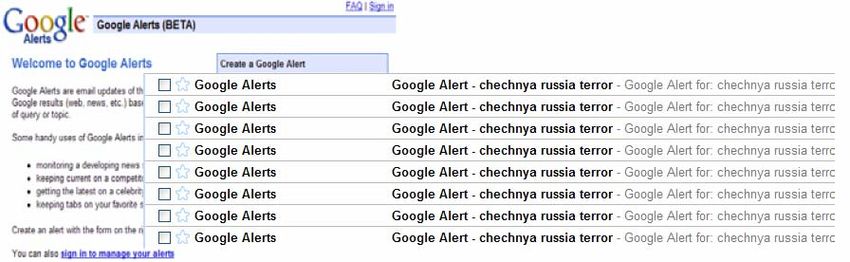
Google news

              3
Google alerts

                4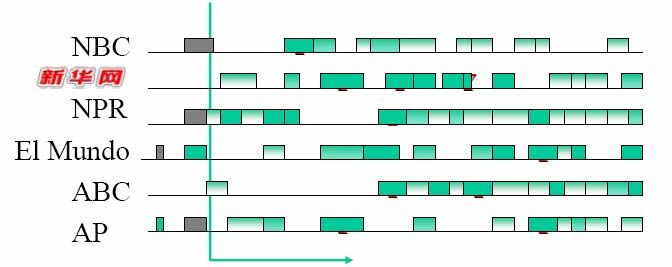
RSS feeds
http://www.washingtonpost.com/wp-dyn/rss/index.html#what

• XML feeds

• Lots of News sites
  provide it now

• Web content
  providers can easily
  create and
  disseminate feeds of
  data that include
  news links, headlines,
  and summaries

                                                       5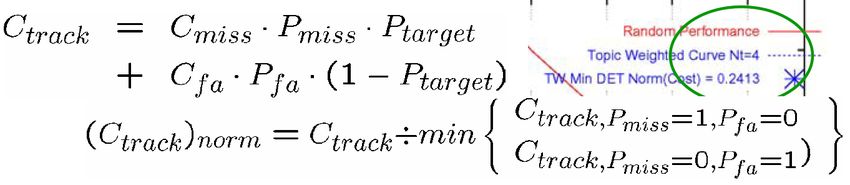
news filtering

• TDT and TREC.
• Usually the starting point is a few example
  documents on each topic.
• TDT topics are events in news.
• TREC topics are broader.
• TREC gives room for user feedback. New
  feature in TDT.
• Some of the assumptions are unrealistic.

                                                6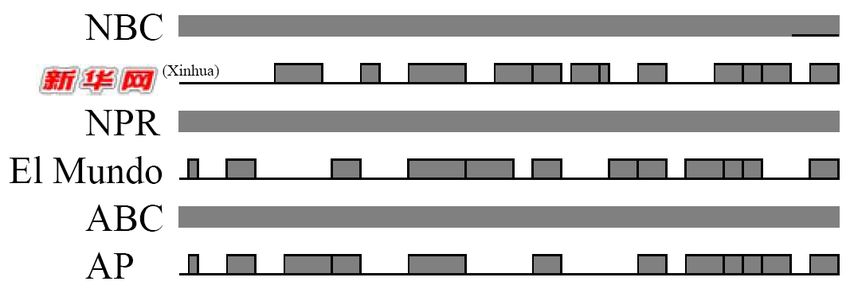
TDT
• Intended to automatically identify new topics –
  events, etc.
  – from a stream of text and follow the
    development/further discussion of those topics

• Automatic organization of news by events
  – Wire services and broadcast news
  – Organization on the fly--as news arrives
  – No knowledge of events that have not happened

• Topics are event-based topics
  – Unlike subject-based topics in IR (TREC)

                                                     7
TDT Task Overview
• 5 R&D Challenges:
– Story Segmentation
– Topic Tracking
– Topic Detection
– First-Story Detection
– Link Detection
8TDT
• Topic Detection and Tracking
– focused on detecting and tracking events in news
• novelty detection: does this story discuss a new event
• topic tracking: given an example story, track it through
time
• topic detection: organize news stories as they come in
– targets automatically-recognized radio, TV broadcasts
• Different evaluation: Misses and False Alarms
• Impact of recognition errors:
– Topic Tracking: minimal
– Novelty Detection: quite sensitive (unusual problem)
– very sensitive to absence of story boundaries!
9TDT3 corpus
• TDT3 Corpus Characteristics:
– Two Types of Sources:
• Text • Speech
– Two Languages:
• English 30,000 stories
• Mandarin 10,000 stories
– 11 Different Sources:
• ˙8 English˙˙ 3 Mandarin
ABC CNN VOA
PRI VOA XIN
NBC MNB ZBN
APW NYT
10news, TDT
A topic is …
a seminal event or activity, along
with all directly related events and
activities.
A story is …
a topically cohesive segment of news
that includes two or more
DECLARATIVE independent clauses
about a single event.
11Example Topic
Title: Mountain Hikers Lost
– WHAT: 35 or 40 young Mountain
Hikers were lost in an avalanche in
France around the 20th of January.
– WHERE: Orres, France
– WHEN: January 1998
– RULES OF INTERPRETATION: 5.
Accidents
12TDT Process
(c) Christopher Cieri- University of Pennsylvania
Boundary
Transcription Segmentation Table
Automatic SGML-encoded Topic Relevance
Formatting Text Files Labelling Table
Machine Translated Files
Translation
TDT Corpus
13The Segmentation Task:
To segment the source stream into its constituent stories,
for all audio sources.
Transcription:
text (words)
Story:
Non-story:
(for Radio and TV only)
14Story Segmentation Conditions
• 1 Language Condition: Both English and Mandarin
manual transcription
• 3 Audio Source Conditions: ASR transcription
original audio data
• 3 Decision Deferral Conditions:
Maxim um Decision Deferral Period
Text Audio
English Mandarin English & Mandarin
(words) (characters) (seconds)
100 150 30
1,000 1,500 300
10,000 15,000 3,000
15in reality
• Events/topics are not given
• Do not know story boundaries for
broadcast sources
• Do not know where all of the news is in
broadcast sources
16TDT : from this
17to this
18TDT data
• TDT4 corpus
• Oct 2000 – Jan 2001
• News in Different Languages
Machine Translated
SYSTRAN
19TDT data
• TDT4 corpus
• – Oct 2000 – Jan 2001
• News from different sources
20TDT data
• TDT4 corpus
• – Oct 2000 – Jan 2001
• News from different sources
21The Topic Tracking Task:
To detect stories that discuss the target topic,
in multiple source streams.
• Find all the stories that discuss a
given target topic
– Training: Given Nt sample stories
that discuss a given target topic,
– Test: Find all subsequent stories
that discuss the target topic.
training data
test data on-topic
New This Year:
not guaranteed unknown
to be off-topic unknown
22Topic Tracking Conditions
Training Both
English Mandarin
• 9 Training Conditions: Language Sources
Nt 1 (E) 1 (M) 1 (E), 1(M)
English (E) 2 (E) 2 (M) 2 (E), 2(M)
Mandarin (M) 4 (E) 4 (M) 4 (E), 4(M)
• 1 Language Test Condition:
Both English and Mandarin
• 3 Source Conditions:
text sources and manual transcription of the audio sources
text sources and ASR transcription of the audio sources
text sources and the sampled data signal for audio sources
• 2 Story Boundary Conditions:
Reference story boundaries provided
No story boundaries provided
23topic tracking
24the tracking task
• The system is given one training
document Tj per story.
• Stories come in sequence S1… Sn
25the tracking task
• Stories with similarity above a threshold
threshyes/no to the training story are
marked YES
26the tracking task
• misses and false alarms
27tracking task - adaptation
• Consider that sim(Tj, S4) > threshadapt
28tracking task - adaptation
• add story S4 to topic Tj and
recompute model
• Danger of adapting with a false
alarm story
29tracking task - adaptation
• Adaptation
– If sim(Tj, Si) > threshyes/no then story
Si is on topic Tj
– If sim(Tj, Si) > threshadapt add story Si
to topic Tj and recompute model
– threshadapt > threshyes/no
30vector space for tracking
• Treat stories as “bags of words”
• Really as a vector of weighted features
– Features are word stems (no stopwords)
– Weights are a variant of tf-idf
31vector space for tracking
• Compare vectors by cosine of angle
between the story and the topic.
– If use same words in same
proportion,stories are the same
– If have no words in common, are about
different topics
32measuring progress in TDT
• All tasks viewed as detection tasks
(yes/no)
– Is there a story boundary here?
– Is this story on the topic being tracked?
– Are these two stories on the same topic?
• Evaluations based on miss and false
alarm
• Use linear combination as cost function
33Evaluating tracking
• Perfect tracker says YES to on-topic
stories and no to all other stories
• In reality, system emits confidence of
topic
34evaluating tracking
• At every score, there is a miss and false
alarm rate
– Any on-topic stories below score are misses
– Any off-topic stories above score are false
alarms
• Plot (false alarm, miss) pairs for every
score
– Result is an ROC curve
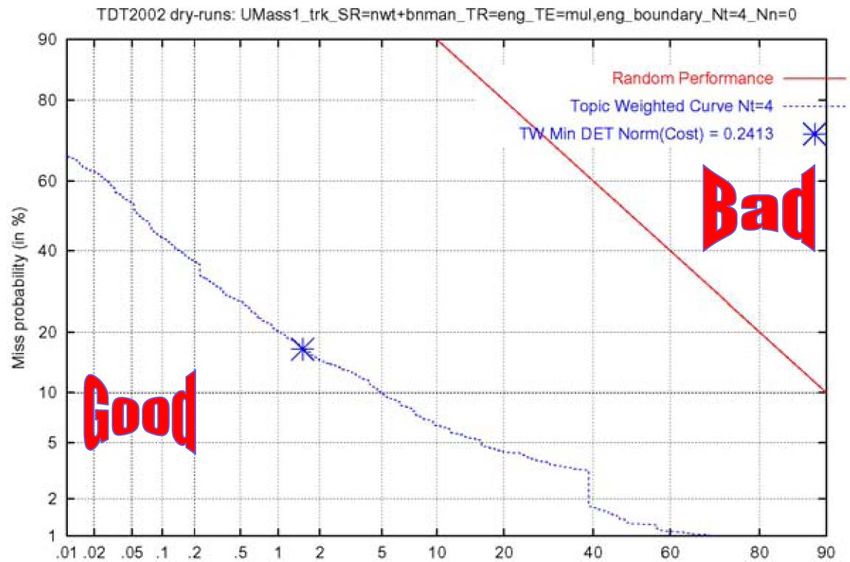
– TDT uses a modification called the “DET
curve” or “DET plot”
35DET plots
36normal deviate ?
• Assume scores normally
distributed with means µ0 and
µ1
• Replace score with normal
deviation
– Normal distributions end up as
straight lines
– Intercept set by spread
– Slope set by variance
• If µ0=µ1 then miss and false
alarms in sync
– Random performance
• Separation, d=(µ1-µ0)0.5
• Graphs from Martin et al, “The
DET curve in assessment of
detection task performance.”
Eurospeech, 1997.
37DET plot
38tracking DET curve (umass)
39cost function
• Systems must choose “hard” decision point
– Score that optimizes system performance
– Determines a miss and false alarm pair
• Measure by cost (e.g., “tracking cost”)
• Topic Weighted
40TDT Topic Tracking
41The Topic Detection Task:
To detect topics in terms of the (clusters of) stories
that discuss them.
a topic!
– Unsupervised topic training
A meta-definition of topic is
required −
independent of topic
specifics.
– New topics must be detected as
the incoming stories are processed.
– Input stories are then associated
with one of the topics.
42Topic Detection Conditions
• 3 Language Conditions:
English only
Mandarin only
English and Mandarin together
• 3 Source Conditions:
text sources and manual transcription of the audio sources
text sources and ASR transcription of the audio sources
text sources and the sampled data signal for audio sources
Maximum decision deferral
period in # of source files
• Decision Deferral Conditions: 1
10
100
• 2 Story Boundary Conditions:
Reference story boundaries provided
No story boundaries provided
43TDT summary
• Five technology evaluation tasks
– Story segmentation – find story boundaries in
broadcast news
– Topic tracking – given sample stories, find rest on
same topic
– First story detection – detect onset of new event in
the news
– Cluster detection – group stories into events
(unsupervised)
– Story link detection – decide if two stories discuss
same event
• Tracking and detection on event-based topics
– Though most approaches are the same as those used
for subject-based tasks
• All tasks are on-line (not batch) evaluations
– Cluster detection task has a “retrospective” variation
44outline
• news filtering
• TDT
• advanced TDT
• novelty detection
45more realistic topic tracking
[Leuski, Allan]
• Unrealistic assumptions about the user’s
behavior.
– TREC filtering : forces the user to judge every
document it labels relevant.
– TDT tracking : avoids any dialog with the user.
• Intermediate scenario where the system may
request the user’s judgments for some of the
returned documents but it does not ask her to
judge all of them.
• Also the user may ignore some of the
documents requested by the system.
46more realistic topic tracking
47modeling interactive tracking
• System decides
whether to involve the
user and check if the
user is interested in
making the judgment
48modeling interactive tracking
• Consider a situation where the user
interacts with the system at discrete
time intervals.
– At the beginning of each session the system
lists the documents in the buffer for the
user.
• Assumption is that the user will start at
the top to the list and follow it down.
the order of the documents in the
session buffer is very important.
– After it receives the user’s feedback it adapts
the topic representation and possibly re-
orders the rest of the list
49evaluate interactive tracking
• Where Cmiss and Cfa are the costs of a
missand false alarm.
• Pmiss is the conditional probability of a miss.
• Pfa is the condition probability of a false
alarm.
• Ptarget is the priori target probability.(1 )
target
50evaluate interactive tracking
• In this paper, we compute the
normalized version of the cost
• measure Cost = C/Cmin,
• • where
51evaluate interactive tracking
• 4 types of documents:
– the presented documents are labeled as
relevant by the system.
– the examined documents are the ones that
the user reads.
– the judged documents are the documents
that user labeled as relevant or non-relevant
for the system.
• TREC filtering:
presented=examined=judged.
• TDT tracking:
– presented = examined
– judged documents=ø
52evaluate interactive tracking
53evaluate interactive tracking
• Defer its labeling decisions until the
user’s next session.
• When the user begins the session, the
system orders the documents in the
buffer and presents them to the user.
• The user’s goal is to locate the
relevantmaterial in the news stream as
quickly aspossible.
– i.e relevant documents at the top of the list.
• Feedback should be as early as possible.
• i.e. close to the top of the list
54evaluate interactive tracking
conclusion
• Highlighted the simplifications that were made for evaluation purposes
in the TREC and TDT news filtering tasks.
• A more realistic model of interaction.
• Smaller amount of necessary judgments from a user with only a small
cost penalty.
• Documents may be“batched up” with no significant impact on cost,
although the precision of the batch improves when the batches are
smaller.
• Optimal cost : q, y+, y.
• If the user stops providing necessary judgments early, the cost of the
final output is noticeably higher.
• However, if the user examines enough of the batch to be confident
that the remainder is non-relevant, the cost stays low.
55Exploration Exploitation
Trade-off
• The importance or usefulness of negative
feedback.
• Filtering is essentially online classification. But
is a high precision task.
• Satisfy the users immediate need-- exploitation.
• All methods discussed this far cared only about
exploitation
56outline
• news filtering
• TDT
• advanced TDT
• novelty detection
57TDT Novelty Detection
58The First-Story Detection Task:
To detect the first story that discusses a topic,
for all topics.
First Stories
= Topic 1 Time
= Topic 2
Not First Stories
• There is no supervised topic
training
(like Topic Detection)
59First-Story Detection Conditions
• 1 Language Condition: English only
• 3 Source Conditions:
text sources and manual transcription of the audio sources
text sources and ASR transcription of the audio sources
text sources and the sampled data signal for audio sources
• Decision Deferral Conditions:
Maximum decision deferral
period in # of source files
1
10
100
• 2 Story Boundary Conditions:
Reference story boundaries provided
No story boundaries provided
60novelty detection
• Novelty Detection Approaches
– VSM + Clustering Techniques
– Learning with multiple features
– Support Vector Machines
– Non-parametric Bayesian method
• TDT 2004 Evaluation Results
61VSM + Clustering Techniques
• Vector Space Model (traditional IR
technique)
– Documents are represented as vectors
– TFIDF term weighting is used, and similarity
measure is chosen (e.g. cosine)
• Clustering
– Lookahead window: GAC clustering
• Slight improvement (appr. 3%)
– Past window: incremental clustering
• No improvement
Reference: CMU TDT 2002/2003
reportSupervised learning with informative
features
• Convert novelty detection to a
supervised learning task
– Positive/Negative data: novel/non-novel
stories
• Build the model
– Choose a learning algorithm (Logistic
regression, SVM, etc.)
– Try to select good features (features we
tried: cosine score, cluster size, time stamp)
• Gives better story-weighted results in
the past evaluations
Reference: CMU TDT 2002/2003
reportSupport Region Estimation
with SVM
• Treat the problem as “density
estimation”
• Use one-class Support Vector Machines
– One of the best performing supervised
learning algorithms
– Suitable high dimensional, sparse data
– Has been successfully applied to novelty
detection in hand-written digits
• Performance in novelty detection task
– Worse than “VSM + clustering”
– Unsupervised kernel selection is hard
[Reference]Non-parametric Bayesian method
(Dirichlet Process Mixture Model)
• Density estimation method in statistics
– Converges to empirical distribution
asymptotically
– Recently has been applied in machine
learning/bio-informatics community
• Advantages:
– Handle increasing number of clusters
– Probabilistic interpretation
• Performance:
– Comparable to “VSM+clustering”
– More expensive
[Reference]TDT 2004 NED Task
• Dataset
– Large size: around 280k documents
– Time period: Apr. 2003 – Sep. 2003
(6 months)
• Submitted Method:
– VSM + GACINCR clustering
• System parameter tuning:
– Use TDT3 corpus
66TDT 2004 NED Results
New Event Detection Cost
1
0. 95
0. 9
0. 85 CMU
I BM
0. 8
SHAI
0. 75 Umass
0. 7
0. 65
0. 6
1
67TDT 2004 NED DET-Curve
68References
• CMU TDT 2001/2002/2003 report.
• Yiming Yang, Tom Pierce and Jaime Carbonell. A Study on
Retrospective and Online Event Detection. SIGIR 1998.
• Yiming Yang, Jian Zhang, Jaime Carbonell and Chun Jin.
Topic-conditioned Novelty Detection. SIGKDD 2003.
• Jian Zhang, Yiming Yang and Jaime Carbonell. New Event
Detection with Nearest Neighbor, Support Vector Machines
and Kernel Regression. CMU Tech. Report CMU-CS-04-118
(CMU-LTI-04-180).
• Jian Zhang, Zoubin Ghahramani and Yiming Yang. A
Probabilistic Model for Online Document Clustering with
Applications to Novelty Detection. NIPS 2004.
69The Link Detection Task
To detect whether a pair of stories discuss the same topic.
same topic?
• The topic discussed is a free variable.
• Topic definition and annotation is
unnecessary.
• The link detection task represents a basic
functionality, needed to support all
applications (including the TDT applications
of topic detection and tracking).
• The link detection task is related to the topic
tracking task, with Nt = 1.
70Link Detection Conditions
• 1 Language Condition:
English only
• 3 Source Conditions:
text sources and manual transcription of the audio sources
text sources and ASR transcription of the audio sources
text sources and the sampled data signal for audio sources
• Decision Deferral Conditions:
Maximum decision deferral
period in # of source files
1
10
100
• 1 Story Boundary Condition:
Reference story boundaries provided
71Example Performance
Measures:
Tracking Results on Newswire Text (BBN)
1
Normalized Tracking Cost
0.1
0.01
rin
h
lis
a
g
nd
En
Ma
72You can also read


