Opportunities and obstacles to electrifying transport - Green Emotion - GEM David Newbery - DIW Berlin
←
→
Page content transcription
If your browser does not render page correctly, please read the page content below
Green Emotion - GEM

         Opportunities and obstacles to
             electrifying transport

                  David Newbery
          EPRG and Imperial College London
                  Berlin 11th October 2013

Page 0      May 2012    Green eMotion Review Meeting - Bruxelles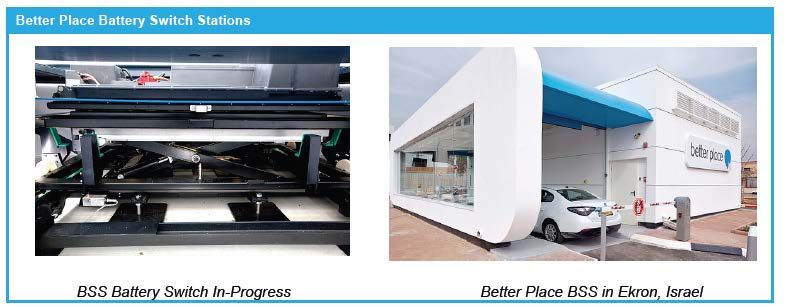
Outline
• Statement of the problem
         • Quick overview of vehicles
         • Structure of Green eMotion and Imperial College activities
 • Business models currently under trial
• The economics of EVs
         • Social cost benefit vs “Business case”
         • The challenge of electricity pricing and cost reduction
  • Prospects for 2020 – challenging
  • Possible more promising futures
  • Commercial and regulatory barriers

         Four year project, field trial data slow to arrive

Page 1            May 2012         Green eMotion Review Meeting - Bruxelles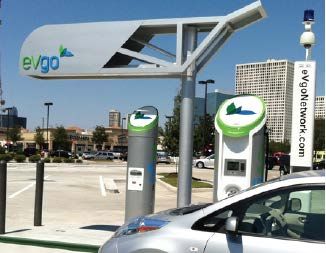
Statement of problem

• What are the characteristics of EVs?
    •    High capital, low running cost
• What does this mean for the opportunities?
    •     High utilisation combined with convenient charging
         => taxis, buses and rental models for mass use?
         => or as second cars? Or via PHEVs?
• What are the obstacles?
    •    doubtful social profitability? How to measure?
    •    Business case vs. economic case
• What are the commercial and regulatory barriers?

Page 2         May 2012     Green eMotion Review Meeting - Bruxelles
Summary
• Social profitability doubtful before 2020’s?
• Main problems – reducing cost, improving batteries
• How far can PHEVs drive technology? What business
models might work? What and how to support the
transition to mass use?
• Business case vs. economic case
• Subsidies may be justified to overcome some barriers
• Road fuel tax provides considerable subsidy
• Not sustainable at scale, move to road pricing?
• Commercial and Regulatory barriers
• Electricity pricing and charging issues
• Interoperability, roaming, battery exchange
Page 3 May 2012 Green eMotion Review Meeting - BruxellesQuestions and comparisons
• What are we comparing?
• Cars only: Battery Electric Vehicles (BEVs), Plug-in Hybrids
(PHVs) with conventional internal combustion vehicles (ICVs)
• What are the main differences?
• Hold car characteristics constant (size, acceleration, carrying
capacity, etc.) then:
• Battery cost and weight, refuelling time, range, fuel price
• Will EVs be attractive (at some scale) by, say, 2020?
• With future fuel, electricity and carbon prices
• And future battery costs and ICV performance?
Need to distinguish economic from business case
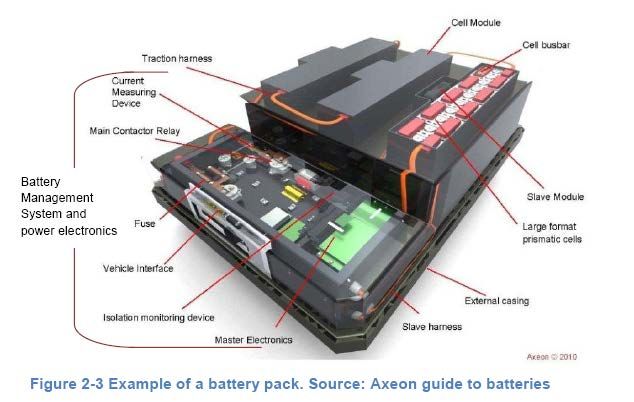
Page 4 May 2012 Green eMotion Review Meeting - BruxellesNissan Leaf BEV • Motor: 80 kW; battery Li-Ion 24 kWh, 300kg, guarantee: 8ys or 160,000 km, charge time: 4 hrs @ 32 amp; DC 500V fast charge in 30 mins. Price UK £21,000 (£70/month battery lease for 36 months
Battery Pack – not just a battery

 .

Source: Element Energy (2012
 Page 6         May 2012       Green eMotion Review Meeting - Bruxelles
Chevy Volt 2012 PHEV (Vauxhall Ampera)

 • Engine: 1.4 L 63 kW; Motor: 111 kW; Battery: 16 kHh Li-Ion
   10.8kWh available, wt 200kg, guarantee: 8ys or 160,000 km
 • 55 kW generator, 0–97 km/h = 9.2secs electric, 9secs both
 • Performance 5.9km/kWh = 0.17 kWh/km EV, 20km/L petrol
 • 4.7 L/100 km as hybrid. UK price £34-37,000
 • Range: 55 km EV; 610 km total, charge time: 4 hrs @ 240 V

 Page 7     May 2012     Green eMotion Review Meeting - Bruxelles
Toyota Prius 2012 PHEV
• Engine: 1.8 L 73kW; Motor: 60 kW; Battery: 4.5 kw-hr Li-Ion; 42
  kW generator, 0 to 100 km/h in 10.7 secs
• Performance 5.5km/kWh = 0.18 kWh/km
• Passenger vol 90ft3 . Price £22,000
• combined city/highway rating 4.7 L/100 km as hybrid
• Range: 20 km EV, 860 km total; charge time: 1.5 hrs @ 240 V

Page 8      May 2012     Green eMotion Review Meeting - Bruxelles
Experience of PHEV:

Prius experience after 497,100 miles driven
• 66% of commute trips < 20 km = the expected EV range
• > 33% of participants > 100 km trip at least once a week.
• Prius PHV consumed 36% less fuel than the comparable, best-
   in-class diesel vehicle, and almost 50% less than the best-in-
   class petrol vehicle.

Page 9      May 2012     Green eMotion Review Meeting - Bruxelles
My relationship to the ICL WP9 Tasks

                                                Task 9.1
                                               Consumer
                                               acceptance
                                                       Customer
                                                       preferences
                            Areas with                           Env. impact of
                           added value                          electricity supply
          Task 9.3                               Task 9.2                              Task 9.4
          Business                           System economic                         Environmental
           models                              performance                             impacts
                          Participation in                      Env. performance
                             system                               parameters
                           management                   Economic performance
                                                        indicators
                                                 Task 9.5
                                                  Policy
                                             recommendations

10   7 October 2013
Current Business Models
• Main obstacles: high capital cost and slow charging
• Battery switch stations designed to overcome both
• as fast as gas station, no need to own battery
• but infrastructure cost very high and demand very low
=> bankruptcy
• Home charging with battery charging stations by road
• Most trips are short enough to not need road-side charging
• Probably mainly second cars?
• Bus trials planned in Milton Keynes
• Charge at end of route during change round
Page 11 May 2012 Green eMotion Review Meeting - BruxellesBattery exchange versus
charging points
• Cost of battery exchange has three elements:
1. the net cost of the electricity supplied,
2. the use cost, interest + depreciation of battery, and
3. the service cost, i.e. the cost of providing the
service (including all the handling and comms
charges).
• Compare with cost of owning or renting battery
($12,000)
• but still need home charger $2,000 or access to charging
points
Page 12 May 2012 Green eMotion Review Meeting - BruxellesBattery Switch Stations
• Battery exchanged at Battery Switch Stations
• Automated - change takes 4 mins (same as fueling IC V).
Page 13 May 2012 Green eMotion Review Meeting - BruxellesBetter Place model
• Israeli-based Better Place start-up (partner
Renault) raised $786m + $50 m debt, owns
batteries
• Planned to install charging points in homes
($2,000 each), work places, and various public
locations and offer services and DSM to DNOs.
• Communication System provides data on
battery, charging stations, battery exchange,
GPS, etc
• Filed for bankruptcy in May 2013
Failed business model
Page 14 May 2012 Green eMotion Review Meeting - BruxellesCharging stations eVgoSM "Freedom Station" with one Level 2 charger (left) and one DC fast charger (right) at a Houston supermarket Page 15 May 2012 Green eMotion Review Meeting - Bruxelles
eVgoSM subscription model

• NRG installed its first Freedom Station in Dallas/Fort
  Worth on April 8, 2011, as part of eVgoSM‘s network
  of charging stations.
     • Fast charger: delivers 150 miles of charge per hour at 44kW
     • Level 2 charger: delivers up to 25 miles per hour.
     • Plans 70 Freedom Station sites in the Dallas/Fort Worth area
       and 50 in the Houston area, (17 already in place in Houston
       and 23 installed in Dallas/Fort Worth at October 2013)
    • Install a Level 2 (240v) charger at home, avoid $2,000 for
        $59/month for single family; $69 multi-family
    • at work-place from $29/month – per person, multi purpose
        use
Page 16      May 2012     Green eMotion Review Meeting - Bruxelles
Building the Business Model
• A sustainable business case for the long-term requires
• The economy as a whole benefits
=> need to use correct prices for evaluation
• Each agent in the value chain makes a profit
• Medium run will require subsidies
• to overcome barriers and coordination problems
• to stimulate demand => higher production => lower long
run costs => commercialisation
• to offset pricing distortions elsewhere:
Carbon not adequately priced, road fuel heavily taxed
Page 17 May 2012 Green eMotion Review Meeting - BruxellesPossible EV developments • Initially BEVs as niche product • second car, limited local use, range not critical • charging at home/work, some outlets • Plug-in Hybrids (PHVs) as bridging technology • stimulates battery and control development • removes range anxiety as charging outlets expand • Eventually BEVs competitive as sole vehicle • cost-effective against ICVs • adequate charging infrastructure developed • various business models – rental, battery swap, etc Page 18 May 2012 Green eMotion Review Meeting - Bruxelles
Projecting the future

• Carbon, electricity and oil prices will change
 • Scenarios consistent with decarbonising imply high C prices
• High BEV penetration requires road tax changes
  • road fuel tax very high, pays for roads
     • gives high advantage to EVs at present
  • notionally replace by road pricing for all vehicles
• ICVs will improve
 • under tightened emissions/efficiency standards
  • substantial improvements possible (weight, engine)
          BEV competitiveness is a moving target
Page 19      May 2012      Green eMotion Review Meeting - Bruxelles
Social cost benefit analysis and
the business model
• Social cost benefit analysis requires the use of efficient,
not market prices
• For road fuel this is exclusive of road fuel excise duty (88 €₵/L
for UK diesel), but plus the CO2 and air pollutant costs
• For electricity prices it is the nodal spot price with the scarcity
price of any transmission and distribution networks
=> Domestic efficient electricity prices for controllable EV
charging times can be low: 5 €₵/kWh or less
• But peak prices might be 45 €₵/kWh (fast charging outlets)
• The subsidy is the difference between the required
market price for profitability and the efficient price
Page 20 May 2012 Green eMotion Review Meeting - BruxellesData requirements
• Need to specify oil, carbon and electricity prices
• several scenarios, take from EU Roadmap?
• Need margins from oil to pump for gasoline, diesel
• then add CO2 cost + other corrective charges => “fuel cost”
• Project fuel efficiency of ICVs in 2015, 2020, 2025
• for comparable size and power
• calculate “fuel cost” per km for different C prices
• Calculate break-even running cost per km of BEVs
• electricity + battery interest + depreciation separately
=> target electricity and battery costs rel to C price
Page 21 May 2012 Green eMotion Review Meeting - BruxellesOther data issues
• Assumes equality of BEVs and ICVs of same size
• But BEVs and ICVs differ in other respects
• that affect consumer willingness to pay
• For BEVs: range anxiety vs reduced maintenance
costs and increased functionality
• varies according as main or second car and driving pattern
• Balance between purchase and operating costs
• possibly different tax treatment
Need information on willingness to pay for different
vehicle types of similar power
Page 22 May 2012 Green eMotion Review Meeting - BruxellesOil prices are volatile, margins less so
Real US oil and product prices
$1,600 US imported crude
gasoline
$1,400 diesel
gasoline margin
$1,200 diesel margin
US$(2009) per tonne
$1,000
$800
$100/bbl
$600
$400
$200
$0
80
82
84
86
88
90
92
94
96
98
00
02
04
06
08
10
12
n-
n-
n-
n-
n-
n-
n-
n-
n-
n-
n-
n-
n-
n-
n-
n-
n-
Ja
Ja
Ja
Ja
Ja
Ja
Ja
Ja
Ja
Ja
Ja
Ja
Ja
Ja
Ja
Ja
Ja
Page 23 May 2012 Green eMotion Review Meeting - BruxellesTarget electricity + battery cost
• Varying oil and C price together and assuming all efficiencies
are negatively correlated with fossil fuel costs and 2020
pollution costs are 50%, 75% and 100% of 2000 levels
2012 prices
Low Med High
Oil price $/bbl $95 $125 $150
CO2 €/EUA 25 50 75
• Target electricity plus battery cost €¢/kWh
Diesel: 10.4 14.2 18.4
Gasoline: 12.4 17.0 27.5
Page 24 May 2012 Green eMotion Review Meeting - BruxellesSocial profitability
• EVs are socially profitable if competitive against
ICVs, based on true economics costs and benefits
=> conduct all SCBAs at efficient, not market, prices
=> Main corrections to fuel, carbon and electricity prices
• EV Economics depend on battery cost, carbon & oil
price and the local price of electricity at CP
• The carbon price is more potent than the oil price
• Efficient electricity prices vary enough to make EVs
either economic or costly
Page 25 May 2012 Green eMotion Review Meeting - BruxellesCurrent and projected PHEV battery cost
2011: $800/kWh for pack; 100 Wh/kg, $21,000 range = 150km
2030: possibly 300Wh/kg, $6,400 for a range of 250km.
Source: Element Energy (2012)
Page 26 May 2012 Green eMotion Review Meeting - BruxellesCell plus packing costs for various BEV types
Source: Element Energy
(2012) Cost and performance
of EV batteries
for CCC at
SW7 2DL
http://www.element-
energy.co.uk/wordpress/wp-
content/uploads/2012/06/CCC-
battery-cost_-Element-Energy-
report_March2012_Finalbis.pdf
Page 27 May 2012 Green eMotion Review Meeting - BruxellesProjected PHEV battery cost Page 28 May 2012 Green eMotion Review Meeting - Bruxelles
Example of battery costs (revised)
  • Suppose battery costs /kWh                        2020 L     2020 H
                                                      $350       $500
                                                      €280       €400
  • Consider three cycle lifetimes:
                            2,000        2,500       3,000
  Years                     8            10          12
  • Ignoring discounting, this translates into €¢/kWh
  2020L:                    €¢14        €¢11.2       €¢9.3
  2020H:                    €¢20          €¢16       €¢13.3
  Cf target electricity + battery cost €¢15 (€¢10-28)/kWh
Page 29    May 2012   Green eMotion Review Meeting - Bruxelles
UK average domestic electricity prices include some
tax-like charges but under-estimate carbon cost
Price is forecast to rise from 14.9p/kWh to 18.3p/kWh by 2020
and 20.1p/kWh by 2030
Page 30 May 2012 Green eMotion Review Meeting - BruxellesImpact of charging strategies on the need for conventional
plant capacity and emissions and prices of electricity
100 100
Non-optimised EV charging Net demand Optimised EV charging (MW) Net demand
90 90
80 80
70 70
60 60
GW
50
GW
50
40 40
30 30
20 20
Net demand = Net demand =
10 10
Non EV demand - Wind Non EV demand - Wind
0 0
1 25 49 73 97 121 145 1 25 49 73 97 121 145
Time (hours) Time (hours)
• Calculate delivered electricity price (including same price of
carbon) assuming efficient charging strategy
• Including cost of extra generation, transmission, distribution assets
• which with efficient charging could be zero
• and spot price of power, lower if wind at the margin
Page 31 May 2012 Green eMotion Review Meeting - Bruxelles
31Preliminary conclusions
• BEV Economics depend on battery cost, carbon &
fuel cost and the local price of electricity at CP
• Carbon + pollution tax element < current fuel excises
• Battery cost and life are critical determinants
• At 2,500 cycles battery should last 10 years and
might cost €¢11-16/kWh by 2020
• At $125/bbl, CO2 at €50/EUA, modest ICV efficiency
gain, possibly competitive at €¢14-17/kWh (D or G)
• So could pay €¢1-6/kWh for charging
BEVs viable only with higher oil and carbon prices
or cheaper batteries?
Page 32 May 2012 Green eMotion Review Meeting - BruxellesWork back to current supports
• If there is a viable economic case for BEVs by e.g. 2020
• examine existing support via road fuel tax exemption
• correct for efficient pricing of electricity
• may need extra support until pricing improves
• Is this sufficient to cover difference in BEV – ICV cost?
• estimate support needed to make vehicles viable at
some earlier date – e.g. 2015?
• offer this as capital rebate on battery? Subsidies to charging
points (including in home)
• Then compute business case with these subsidies
Page 33 May 2012 Green eMotion Review Meeting - BruxellesPossible futures
• ICT rapidly developing
=> finding suitable rental vehicles simpler?
• Problem is delivery and recovery after trip
=> Solution – driverless delivery and recovery?
• Intermediate solutions: ZIP car model at charging points
• Rental locations have a variety of models with differing ranges
• BEVs, PHEVs, extended range EVs, etc
• Can optimise charging to minimise variable cost
Page 34 May 2012 Green eMotion Review Meeting - BruxellesWho should build charging infrastructure?
• Some charging pole (CP) business models site-specific
• Offices, supermarkets, parking at shopping centres
• Benefits accrue to users (both sides – company and
worker, shop and customers)
=> provide stand-alone cost recovery
• => Various viable ownership models including site owner
• En-route CPs have less clear business model
• Likely to be underused as charging slow(ish)
• Likely to be commercially risky
• Could be treated as regulated/subsidized infrastructure
Page 35 May 2012 Green eMotion Review Meeting - BruxellesCase for and against DNO ownership
Arguments for
• DNOs can optimise site of CPs given network constraints
• Can internalise DSM with low transaction costs
• DNO may be able to justify this as a regulated business
• Financed by club access fees with roaming agreements
• C.f. cross-border tariffication for EU transmission
Arguments against
• DNOs have no special transport expertise
• Vertically integrated incumbent advantage blocks competition
• Restricts market area when long-distance routes needed
Page 36 May 2012 Green eMotion Review Meeting - BruxellesCommercial barriers to road-side CPs
• Parking with CPs – option of slow/controlled cheap charging
• Can offer DSR and hence discounted charging
• “Fuel stations” – offer rapid charging at any time of day
• Little/no scope for DSR => high uniform charge price
• Possibly varying by time-of-day
• Concerns over low use – more as emergency service?
• “Fuel station + rental facility”
• Can offer DSR for its rental fleet and do some internal DSM
=> cheaper business model for CP?
Page 37 May 2012 Green eMotion Review Meeting - BruxellesPolicy implications
• BEV economics depend on costs of battery, carbon &
road fuel and local cost of electricity at CP
• Carbon + pollution tax element < current fuel excises
• Battery costs and cycle lives are critical determinants
⇒ conduct all SCBAs at efficient prices
⇒ Main corrections to fuel, carbon and electricity prices
⇒ Economics look doubtful even by 2020 without
subsidy or much higher C and oil price
• Consider possible contract designs between DSOs,
aggregators and EV owners
Page 38 May 2012 Green eMotion Review Meeting - BruxellesConclusions
• Many interesting questions to research
• On battery performance – what is the potential in power
density, hence size and range, and cost?
• On network management – how can charging be managed to
deliver cheap low-C power without more investment?
• For the Distribution Service Operator – how to access
frequency control and demand side response (LCNF projects)
• On driving behaviour – what would reduce range anxiety? Or is
the BEV just the second car?
• On business models – own or rent/lease; own or swap battery?
Page 39 May 2012 Green eMotion Review Meeting - BruxellesGreen Emotion - GEM
Opportunities and obstacles to
electrifying transport
David Newbery
EPRG and Imperial College London
Berlin 11th October 2013
Page 40 May 2012 Green eMotion Review Meeting - BruxellesYou can also read


