OZEANEUM STRALSUND: FASCINATING LIGHTING DESIGN
←
→
Page content transcription
If your browser does not render page correctly, please read the page content below
Text: Sigi Riedelbauch
                                                                                                   Pictures: Johannes-Maria Schlorke

    OZEANEUM STRALSUND:
    FASCINATING LIGHTING DESIGN

    The Ozeaneum in Stralsund, Germany, is the largest Baltic Sea museum. In four areas, the visitor can discover
    the oceanic worlds of the Baltic Sea, the North Sea, the North Atlantic and the Arctic Ocean. It’s an experience
    that is unique for many reasons, not the least of which is the perfect lighting design. Walter Bamberger was
    responsible for the planning and implementation; he relied on Helvar DIGIDIM routers and DALI for the lighting
    control.

    FOYER                                                          AQUARIUMS: NORTH SEA AND
                                                                   BALTIC SEA
    The foyer forms the link for visitors between the four
    structures: North Sea, Baltic Sea, Exhibitions and Giants      Such large aquariums are usually designed from the point
    of the Seas.                                                   of view of a diver in the South Seas. For the northern
                                                                   oceans, modifications were necessary in order to create a
    During the day, the light-flooded glass hall looks so          realistic impression of these bodies of water. Most impor-
    transparent that the soft sculpted structures appear like      tantly, the light had to simulate the various water depths in
    they are large pebbles with water swirling around them.        a convincing manner.
    So that this metaphor could also be appreciated at night,
    the lighting here is predominantly provided by special         Depending on the theme of the aquarium, a wide beam
    ground spotlights, which continue to the outside. There        base light is used with fluorescent lamps in cool (4,000 K)
    they illuminate the steel shell, but not in a static manner.   and cold full-spectrum (8,000 K) colors up to blue light.
                                                                   For sun or the illusion of direct daylight, metal halide lamps
    Keeping with the basic theme of the ocean, they create         between 4,000 K and 6,500 K are used. The control of
    a flowing movement that swirls around the structures like      the type and amount of light makes it possible to present
    waves – an ocean current made of light. This is achieved       a realistic ocean world that is fascinating for the observer.
    through individually dimmable fluorescent ring lights that     In the large tank for schooling fish, for example, the fish
    are scattered about and that can create movement using         literally come out of the darkness and swim past the pane,
    differences in brightness.                                     seemingly close enough to touch.

8        News • 2 / 2009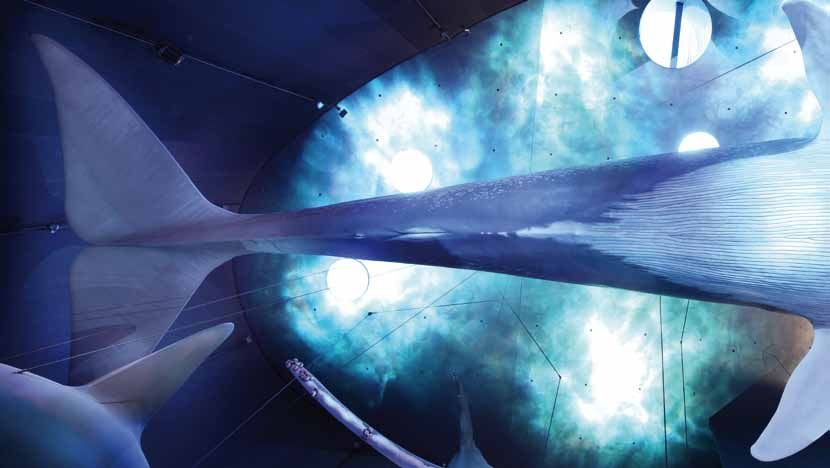
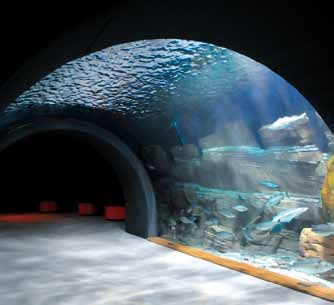
In the aquarium
tunnel, the visitor is
surrounded by water and
fish. Through the design of the
aquarium casing, in an almost black base tone and with minimal use of light, the
gaze of the viewer is drawn to the aquarium panes themselves and the fish swim-
ming behind them. The lighting design was chosen so that it would also be suitable
for the fish: There are bright areas in which sunlight is simulated and in which the
visitor can study the natural behavior of the fish, but there are also darkened areas
that serve as a refuge.

EXHIBITIONS
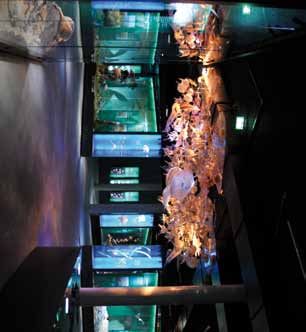
In the “World Ocean” and “Baltic Sea” levels, the goal was to design the display
cases optimally. A special high-performance LED spotlight system was developed
for this. Integrated magnet adaption makes it possible without tools to place any
spotlight onto contact rails that are flush with the display case profile. As a result,
every point in the display case can be illuminated. The LEDs cause the display
cases to appear to be independent luminous bodies.

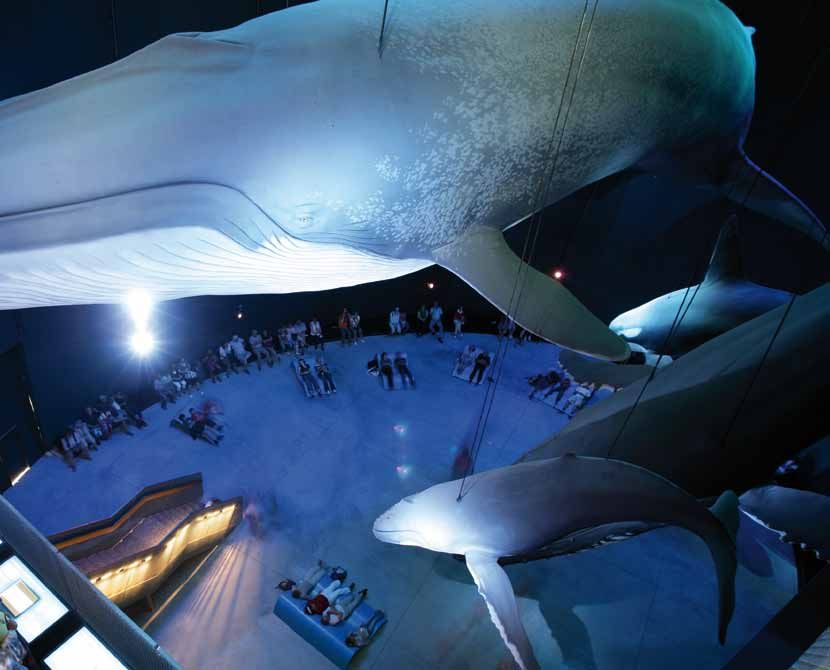
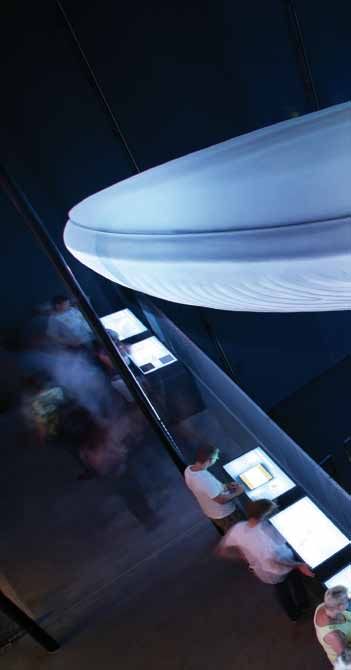
GIANTS OF THE SEAS
For this area, artists created life-size models of whales that impart through their
size an impressive sense of the largest mammals in the world. In order to achieve
the most realistic presentation possible, twelve projectors are used to create an
underwater surface on the ceiling with water currents as would be experienced by

                                                                                          2 / 2009 •   News   9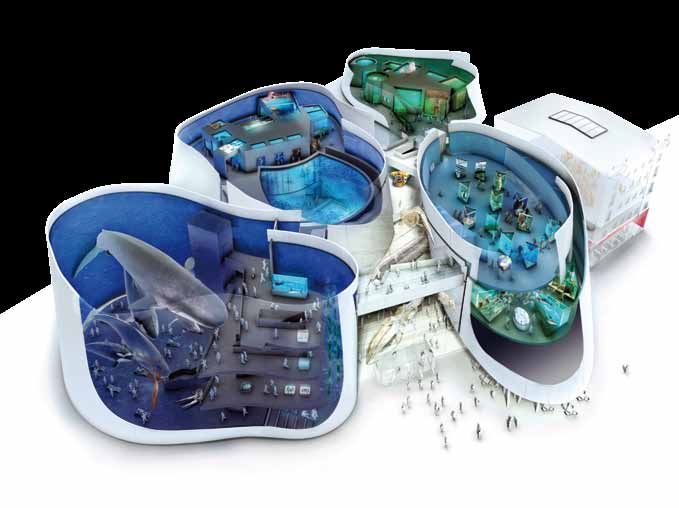
a diver surfacing with the sun shining from above. Visitors
     feel like they are in the ocean amid the whales. Whale
     songs intensify this impression. Rotating structural panes,
     various lighting technologies and blue filters create the
     desired atmosphere.

     The special ambience in this area is especially suited for
     events. In order to give organizers as much freedom in
     lighting design as possible, appropriate lighting control
     interfaces have been provided. With DMX in and DMX
     out, organizers can feed their own show effects into the
     area’s light control system. A passive DMX network with
     256 addresses is also available. The entire infrastructure
     for this was also implemented with DALI.

     TECHNOLOGY
     In all, 15 Helvar DIGIDIM routers were installed. The high
     reliability of Helvar DIGIDIM routers and DALI components
     ensure fail-safe operation.

     “We are very pleased that our lighting controls are used
     with such demanding projects, as this demonstrates the
     high quality of our components,” said Christian Wein,
     Managing Director of Helvar GmbH.

     In the foyer, there is a central control unit in the form of a
     17” touch panel on which the entire lighting system can
     be visualized. In addition, there are a total of 12 other
     local control units available with 8” touch panels for local
     control.

     MAXIMUM ENERGY EFFICIENCY
     A special feature is the integrated load balancing that
     makes energy consumption calculable. A peak load was
     specified for all building services that is not permitted
     to be exceeded. If the building services management
     system signals that the peak load has been reached, indi-
     vidual lighting scenes can be switched off automatically
     for a specified length of time. The necessary parameters
     for this were set in advance. This, for example, allows
     the cooling of the aquarium to have priority over the light-
     ing system. The operating panels display whether load
     shedding is active and which lighting scenes the system
     has switched to temporary use.

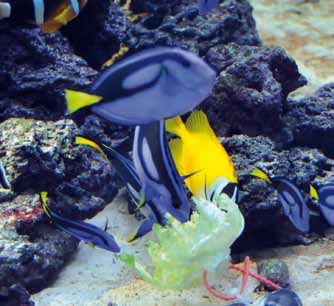
                          The lighting is essential for each resident
                          of the Ozeaneum; wether it’s simulated
                          sunlight for a living Baltic sea fish or high-
                          lighting the giants of the seas.

10          News • 2 / 2009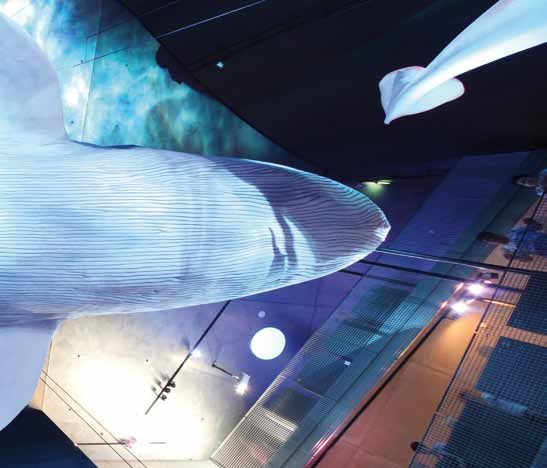
2 / 2009 • News 11
You can also read


