PATHWAYS TO SUCCESS 2021 2024 - Yardleys School
←
→
Page content transcription
If your browser does not render page correctly, please read the page content below
Yardleys School
       Working together for a better future

  PATHWAYS
     TO
   SUCCESS
       2021 – 2024
It’s time to make your preferences known

             Year 8 Options
Please read through this booklet and make your
 preferences online. See the page on the VLE -
Student Area/Year 8 Options (2021) for further
          information and instructions
CONTENTS

                                               Page

Information for parents/carers and students     2
Student timetable information                   3
Advice for making preferences                   4
How careers and option choices are linked       5
Things to think about and Subject Leads         6

CORE Subjects
  English Language                              8
  English Literature                            9
  Mathematics                                  10
  Triple Science                               11
  Guided Reading / General Studies / Core PE   12

Optional Subjects
   Art & Design                                14
   Computer Science                            15
   Design & Technology                         16
   French                                      17
   Geography                                   18
   History                                     19
   IT                                          20
   iMedia                                      21
   Religious Education                         22
   Spanish                                     23
   Sport Science                               24

Making your preferences (instructions)          25

                                                      1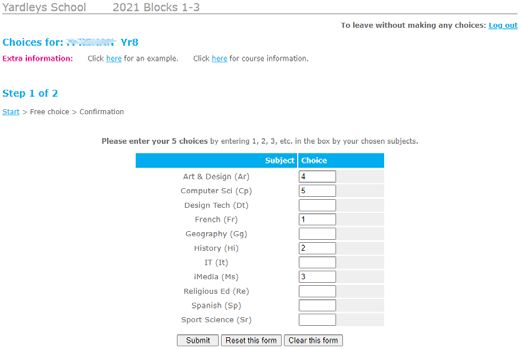
IMPORTANT INFORMATION FOR PARENTS/CARERS
               AND STUDENTS

At Key Stage 4 (Years 9, 10 & 11) all students have to study these core subjects:

ENGLISH LANGUAGE & ENGLISH LITERATURE (GCSE)

MATHEMATICS (GCSE)

TRIPLE SCIENCE (GCSE)

This ensures that all students have a balanced curriculum, including the literacy and
numeracy skills required for Further Education and the world of work.

For Parents or Carers, this is a really important time for your son or daughter. They
now need to think carefully about the option subjects they want to study for the
next few years. In some subjects, there is a controlled assessment or coursework
portfolio element, which may run from the beginning of the course. In others, there
are terminal examinations only.

By working together, we can make sure that your son or daughter leaves school
with the best possible qualifications that will enable access to the most appropriate
post-16 pathway to cater for their needs.

As Parents or Carers, your support and encouragement will be vital over the coming
years.

                                                                                        2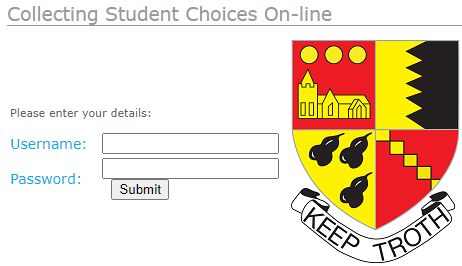
OPTION SUBJECTS
Some of these subjects will be new to students and some are an extension of Key
Stage 3. Students will study 3 optional subjects in addition to the core subjects. The
timetable allocation for each option subject is 2 lessons per week in year 9, with 3
lessons per week in years 10 and 11.
These subjects will help students to access the wide range of courses on offer in
colleges when they leave school.

             If you need any further help or information please contact:
                             Mr Pohl on 0121 464 6821

                 STUDENT TIMETABLE
All students will have a timetable made up of 25 lessons (each of 55 minutes in
length), together with a 50 minute ‘Enrichment Period’ on Wednesday afternoons.

                                               Yr9 Weekly Lesson
                        Subject
                                                   Allocation
               Core compulsory subjects
                         English                        5
                      Mathematics                       5
                     Triple Science                     6
                        Core PE                         2
                    General Studies                     1

                    Option subjects
                       Option 1                         2
                       Option 2                         2
                       Option 3                         2

                                                                                     3
MAKING YOUR PREFERENCES -
ADVICE TO STUDENTS
Remember – you have to study English, Mathematics and Science.
You will need to choose 5 optional subjects, in preference order, but will only
study 3 of these. The additional choices are required should an option not run or
the combination of choices not allow an exact timetable fit. We will try to
provide you with your top 3 choices, but this may not always be possible.
The subjects that you choose will ‘open the doors’ to future learning pathways
and careers. It is vital that you choose wisely and work hard to achieve the best
grades possible!
Choose the subjects:
1. THAT YOU LIKE
2. THAT YOU ARE INTERESTED IN
3. THAT ‘OPEN THE DOORS’ TO FUTURE PATHWAYS & CAREERS
4. THAT YOU THINK YOU WILL DO WELL IN
DO NOT choose a subject just because your friend has chosen it – you
may not be placed in the same group!
REMEMBER
The qualifications you achieve at KS4 are yours for life! You can use them at any
time in your life to get onto a further education course.
Every grade at examination level is of value. There are many different courses to
study from age 16 onwards. There are college courses to suit everyone (please
feel free to VLE message Mrs Price, our Careers Education Advisor, should you
require more information).
EBacc
The English Baccalaureate (EBacc) is a performance measure for schools, awarded
when students secure a good pass across a core of five academic subjects – English,
mathematics, history or geography, the sciences and a language. It is not a
qualification in itself. Whilst we don’t make this qualification compulsory, we do
encourage high achieving students to choose a language subject with history or
geography.
4How are careers and option choices linked?
Here at Yardleys School each student will receive careers interviews from a highly
trained Careers Advisor, with at least one session within the last year at school (to
ensure they are prepared and aware of their Post 16 options).
During these interviews the students
are encouraged to explore the topics
in the highlighted pathway which then
in turn encourages them to set
aspirational career goals.
What am I
interested in
doing? The interviews are at the designated
key points in their academic route to
allow students to develop their
understanding of possible careers early
What options will
suit me best?
on, but also to revisit the topic once
they develop a wider understanding of
world around them and reach their
GCSE exams.
What's my next
step for towards
the career I want? Having multiple interviews, with a
sufficient gap between them, also helps
to improve their drive and
determination to do well, setting them
up for a career they feel passionate
about.
To help students and parents have meaningful conversations about the wide range of
opportunities we have in the employment sector in the UK, we recommend the
following website for starting your careers search:
https://www.careerpilot.org.uk/information/careerometer
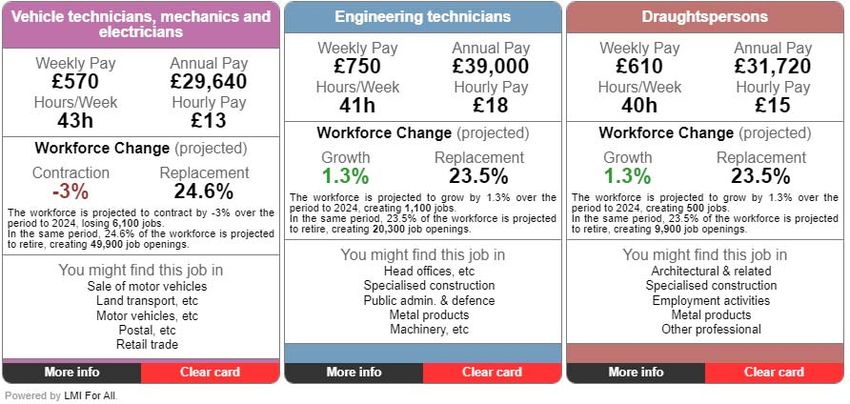
This website allows you to compare up to three careers at once and gives
information on (see example below):
‐ Pay
‐ Hours of work
‐ Projected workforce changes (very useful in an ever changing labour market)
‐ Common tasks required for the role (‘more info’ link at the bottom of the card)
5THINGS TO THINK ABOUT
When you are reading the information about the different subjects, think about what
will suit you.
Some subjects have some controlled assessment or coursework portfolio
element – this helps you to gain marks towards your final grade BUT you may
have to do extra at various times throughout the course in preparation.
Some subjects require more reading and writing than others.
Some subjects are more practical than others (but all have reading, writing and
exams).
Some subjects, like Sport Science, may require special skills as well as written
work and exams.
If you need advice – speak to the teacher who teaches you in Year 8 or
VLE message the staff below for the following areas –
Art and Design - Ms Sydenham
Computer Science / ICT - Ms Chauhan-Rowe
Design & Technology - Mr Deaves
English – Ms Austin
French / Spanish - Ms Cuniappen
Geography - Mr Porter
History – Mr Vaughan
iMedia – Mr Armstead
Maths – Ms Soliman
Sport Science – Ms Townsend
Religious Education – Ms Waldron
Triple Science – Ms Hiley
Careers Education Advisor - Ms Price
6CORE SUBJECTS
(All students will study these in year 9)
English Language and English Literature
Mathematics
Triple Science
Guided Reading* / General Studies* / Core PE*
*These are non-examined
IMPORTANT NOTES REGARDING GCSE REFORMS
Grading
The Government announced some years ago that there would be changes made to
the current grading system and, when your child receives his/her grades, they will be
in the form of numbers and not letters. The grading system will run from 9 to 1, with
9 being the highest grade.
Specification changes
The information contained on the following pages represents existing course
formats. Over the coming months, some examination boards may continue to
release specification updates for some courses. One thing that has changed from
previous specifications is the examination and controlled assessment weighting.
There is generally now a greater emphasis on the examination component within the
course.
Parents/carers will be kept informed by the School of any major changes
to course specifications that may affect their child.
7English Language
Qualification Type: GCSE Qualification Level: 2
Examination Board: Pearson/Edexcel
Qualification Weighting: Single Award (Note: This is separate to English Literature)
Examination / Coursework Breakdown
Paper 1 – Fiction and Imaginative Writing (1 hour 45 minutes - 40%):
Section A (Reading)
Fiction (1 hour)
A series of short answer and extended essay questions on an unseen 19th century fiction extract.
Students will be required to analyse and evaluate the language, structure and ideas in the
extract.
Section B (Writing)
Imaginative Writing (45 minutes)
A choice of two writing tasks - the tasks will be based on the same theme as the reading extract.
Vocabulary, spelling, punctuation and grammar are assessed.
Paper 2 – Non-Fiction and Transactional Writing (2 hours 5 minutes - 60%):
Section A (Reading)
Non-Fiction (1 hour 15 minutes)
A series of short answer and extended essay questions on two thematically linked, unseen 20th
and 21st century non-fiction extracts.
Students will be required to analyse, evaluate and compare the language, structure and ideas
in the texts.
Section B (Writing)
Transactional Writing (45 minutes)
A choice of two writing tasks - the tasks will be based on the same theme as the reading extracts.
Vocabulary, spelling, punctuation and grammar are assessed.
Course Description
English Language and Literature is a combined GCSE course leading to the award of two GCSE grades.
Students have four hours of English per week in Years 9-10 and five hours in Year 11.
The new GCSE has enabled the English department to bring in new and exciting themes at KS4 which
students will study as they prepare for their Language and Literature GCSEs. Specifically, in preparation for
their Language examinations, students will examine and create a range of non-fiction texts; compare and
contrast a variety of transactional and literary non-fiction texts; and analyse and create their own imaginative
fiction texts using their Literature texts as inspiration.
Students will complete all GCSE exams at the end of the course; Exams are no longer tiered.
Benefits
English is a core subject and therefore compulsory for students to study. The study of fiction and non-fiction
texts in English Language demonstrates effective writing and allows us to delve into a range of themes and
issues that are both historically important and extremely relevant to our lives today. Furthermore, by
developing students’ written and spoken language, we equip students with the transferrable skills needed to
be successful in further and higher education and to confidently and accurately express themselves in all
aspects of adult life.
Student Voice
“I enjoy this subject because when we come to English, we get to express ourselves and share our own experiences
with our peers; even though the work is challenging, we cover topics that I can relate to my life.”
Year 10 Student
“English is helping me to become a better writer. We’re also encouraged to link key words and skills to what we’re doing
in other subjects; even my other teachers have noticed that my grammar is improving and that’s definitely because of my
English teacher!”
Year 10 Student
8English Literature
Qualification Type: GCSE Qualification Level: 2
Examination Board: Pearson/Edexcel
Qualification Weighting: Single Award (Note: This is separate to English Language)
Examination / Coursework Breakdown
Paper 1 (1 hour 45 minutes, 50%):
Section A (1 hour)
Shakespeare, ‘Romeo and Juliet’
Two questions – one based on an extract of approximately 30 lines and one on the whole
play
Section B (45 minutes)
Post- 1914 British Drama or Fiction, ‘Animal Farm’
Choice of essay questions.
Vocabulary, sentence structure, spelling and punctuation are all assessed.
Paper 2 (2 hours 15 minutes, 50%):
Section A (1 hour)
19th Century Fiction, ‘Frankenstein’
Two questions – one based on an extract of approximately 400 words (provided), and
one based on whole novel, (closed text exam).
Section B (1 hour 15 minutes)
Poetry
One question comparing one named poem from poetry anthology and another anthology
poem of students’ choice.
One question asking students to compare two unseen contemporary poems.
Course Description
English Language and Literature is a combined GCSE course leading to the award of two GCSE grades.
Students have four lessons of English per week in year 9.
The new GCSE has enabled the English department to bring in new and exciting themes at KS4 which
students will study as they prepare for their GCSE. Students will study Language and Literature alongside one
another, and, in preparation for their Literature examinations will explore poems from the ‘Clashes and
Collisions’ anthology as they examine presentations of war and conflict; debate the role of nature and nurture
as they explore the novel ‘Frankenstein’; debate the role of loyalty in the play ‘Romeo and Juliet’; and finally
assess the significance of the satirical allegory ‘Animal Farm’.
Students will complete all GCSE exams at the end of the course. Exams are no longer tiered.
Benefits
English is a core subject and therefore compulsory for students to study. The study of Literature- novels,
poetry and plays – models effective writing and allows us to explore in lessons: social, moral, spiritual and
cultural values, concerns and debates. Subsequently, students have better access to a range of subjects within
their studies, and are encouraged to read widely and independently thereby leaving school with the emotional
maturity and skills needed to support future learning.
Student Voice
“What I like most about studying literature in English is that it is a great way to expand your vocabulary; finding new
words you can then use in your own writing. I also like the way our teacher makes links between the texts we study in
class and modern writings – books, film, music and even computer games! It’s amazing to see how older texts are
often inspirations for some of the more modern novels that are popular today.”
Year 10 Student
9Mathematics
Qualification Type: GCSE Qualification Level: 2
Examination Board: AQA
Qualification Weighting: Single Award
Examination / Coursework Breakdown
Examination: 100%
Course Description
AIMS:
To encourage students to develop confidence, understanding and a broad range of mathematical skills.
To provide opportunities for students to think and communicate mathematically, in clearly written, spoken
and graphical forms.
To develop students' problem solving skills so that they can apply their mathematical knowledge and ability
in a wide variety of situations - practical or theoretical, familiar or unfamiliar.
To comprehend, interpret and communicate mathematical information in a variety of forms appropriate to
the information and context
To build a firm foundation from which to study mathematics further.
GCSE mathematics is an important foundation for many courses and careers. Almost all jobs and
careers require mathematics.
There has been an increase in the breadth and depth of content to be covered at both Foundation and
Higher tiers.
The new structure of the papers will see fewer questions targeted at the lowest grades and more
questions targeted at the highest grades at both tiers.
The number of formulae that students can be provided with in the examinations has been reduced, so
students will need to memorise some formula.
The assessments will cover the following content headings:
Number.
Algebra.
Ratio, proportion and rates of change.
Geometry and measures.
Probability.
Statistics.
ASSESSMENT:
The qualification consists of three equally-weighted written examination papers at either
Foundation tier or higher tier.
All three papers must be at the same tier of entry
Paper 1 (non-calculator) – 1 hour 30 mins – 80 marks
Paper 2 (calculator) – 1 hour 30 mins – 80 marks
Paper 3 (calculator) – 1 hour 30 mins – 80 marks
Tiers of entry:
Higher: Grades 9 – 4
Foundation: Grades 5 – 1
Benefits
Mathematics is a core subject and therefore compulsory for students to study. It teaches you practical
applications for everyday finance and budgeting. Problem solving skills and logical thinking will open doors to
many industries ranging from Architecture to Engineering to Medicine and even Law.
Student Voice
“Maths is used in all subjects. It’s really important! My teacher helps me address my weaker areas and how I can
improve. ‘Mymaths’, `MathsWatch` and ‘iamlearning’ are really good resources and help me a lot.”
Year 11 Student
10Triple Science
Qualification Type: GCSE Qualification Level: 2
Examination Board: Pearson/Edexcel
Qualification Weighting: Triple Award (3 separate GCSE’s)
Assessment
GCSE Route
Examination: 100%
Biology Chemistry Physics
GCSE Two Papers Two Papers Two Papers
Combined Paper 1 and Paper 2 Paper 1 and Paper 2 Paper 1 and Paper 2
Science Each test = 1hr 45 min Each test = 1hr 45 min Each test = 1hr 45 min
Course Description
Studying Triple Science leads to three separate GCSE awards in Biology, Chemistry and Physics.
The new GCSE course does not have a coursework element and has a 100% terminal exam – which means that all
of their exams will be sat at the end of Year 11. To cover the practical aspects of the course students are required
to complete 8 core practical experiments for each different specialism (24 in total). The practical skills and
knowledge gained during practical experiments are assessed within the written exams at the end of Year 11.
Students will study a variety of interesting topics throughout the course, but some of the new material being
covered includes:
Biology - Disease and the development of medicines, the eye and brain.
Chemistry - Fuel cells
Physics - Astronomy, and nuclear physics
If you would like more information on the new specification please look at the following website:
http://qualifications.pearson.com/en/qualifications/edexcel-gcses/sciences-2016.htmlm
Suitability and Benefits
Everybody will study triple Science. This means you are able to sit separate tiers for each specialism, e.g. Higher for
Biology and Foundation Chemistry to support you if you are weaker in one of the three Sciences
For students interested in scientific careers such as Medicine, Dentistry, Pharmacy, Engineering, Research Science,
triple science provides an excellent precursor to college level study in these areas.
However, even those who are not interested in pursuing a ‘science career’ will benefit from an enhanced
understanding of the world around you. Studying triple Science also teaches you valuable transferrable skills
applicable to everyday life e.g. recording data accurately, evaluating a method and suggesting improvements as well
as learning how to manipulate data effectively.
Student Voice
“Triple science focuses on all subjects equally, and I enjoy it more than KS3 because we go into more detail”
Year 9 student
“The most interesting part about science is understanding why things happen – and there is so much I didn’t know I didn’t
know until I studied triple science.” Year 10 student
“You do lots of practical experiments and it helps with our learning. We get plenty of opportunity to practise our skills. My
favourite so far has been dissecting a real heart” Year 11 student
“You get 3 teachers for triple science, so the teacher is always an expert on the topic” Year 9 student
11Guided Reading
All students start off their morning reading together as a tutor group. The texts they read have
been selected both to expose students to a wider vocabulary, but also to widen their experience
and provide them with access to unfamiliar ideas and settings. The texts are sequenced to ensure
that they become more challenging as a student progresses through school, both in the demands
of reading, but also the subject matter. The sessions aim to develop both the comprehension and
inference skills of students; enabling them to comfortably read and understand any text they are
presented with; however we also want to increase their Cultural Capital and ensure that all
students have been exposed to great works of both fiction and non-fiction.
General Studies
General Studies runs under the Humanities Faculty and is an interdisciplinary course which means
it covers a wide variety of subjects. It is designed to allow students to learn and understand the
overall development of the universe, life on earth and humanity. It will focus not just on events
but also different human ideas, theories and beliefs that have helped us to understand the world
around us. The course will be based on a chronological historical framework in order to make it
coherent and memorable given our innate ability as humans to follow and remember stories. This
in turn will help students to identify and understand key concepts such as change, continuity,
causation and consequence. Students will also make connections between topics/subjects studies
in school as well between current events and features of the outside world. The course will be
delivered through whole class reading, discussion and the use of media such as video. In terms of
assessment there is no formal GCSE or other exam qualification. However we will assess
students’ learning through termly assessments which will be designed to show they have
understood and remembered the general developments and the ways in which these
interconnect.
Core PE (dependent on Covid restrictions)
Students will have the opportunity to plan and participate in a regular, frequent and balanced
programme of PE that, among other things, contributes to, and helps to sustain, a healthy and
active lifestyle. Students will be provided with the skills to be competitive in the following
activities in Yr 9:
Term 1: Basketball and Rugby
Term 2: Dance, Gymnastics, Fitness and Indoor Cricket
Term 3: Striking and Fielding Games and Athletics
It is intended that lessons will provide students with the opportunity to refine techniques
required to perform fundamental skills confidently, and learn new techniques necessary to
demonstrate sport specific advanced skills in practice and game scenarios. From this it is hoped
that there will be an increased likelihood of taking part in competitive sports and activities outside
school through community links or sports clubs. During lessons Students will analyse their
performances compared to previous ones, suggesting appropriate strategies and practices to
ensure improvement, so they can achieve their personal best. Students are encouraged to work
in a team and play a role as leader, developing skills to solve problems, either individually or as
part of a group.
12OPTION SUBJECTS
(Up to three subjects will be studied from this list)
Art and Design (GCSE)
Computer Science (GCSE)*
Design & Technology (GCSE)
French (GCSE)*
Geography (GCSE)*
History (GCSE)*
IT (BTEC)
iMedia (OCR)
Sport Science (OCR)
Religious Education (GCSE)
Spanish (GCSE)*
*EBacc Subject
13Art and Design
Qualification Type: GCSE Qualification Level: 2
Examination Board: AQA
Qualification Weighting: Single Award
Assessment Schedule
Component 1 Portfolio – worth 60%
Students create a series of sketchbooks for various department-led themes, concluding with a final outcome,
usually created during a mock examination style assessment. This component is made up of a series of
supporting studies and a sustained focus project.
Autumn 1 Autumn 2 Spring 1 Spring 2 Summer 1 Summer 2
Year 9 Introductory Introductory Introductory Portraiture Portraiture Portraiture
Project Project Project
Year 9 will work on developing foundation skills over a range of disciplines with a practise examination in the summer
term.
Year 10 Detail and Detail and Insects Insects Identity Identity
Texture Texture (project) (project)
In year 10 students will produce two projects with two mock examinations to create their final outcome. In the
summer term students will begin their sustained focus project which continues through the Autumn term of year 11.
Year 11 Identity Identity Component 2 Component 2 Final Exam
(project) (project)
Component 2 Externally Set Assignment – worth 40%
In January of year 11 students receive an Externally Set Assignment from the exam board AQA. Students are
expected to respond to a chosen theme in much the same manner as the sustained project, navigating
through the four assessment objectives and concluding in a final outcome created in the final exam.
The assessment objectives are evidenced through each project over the course:
Assessment Objective 1 – Develop through artists, critical understanding and sources.
Assessment Objective 2 – Refine via experimentation of ideas, media, techniques and content.
Assessment Objective 3 – Record primary observations, insights and sources.
Assessment Objective 4 – Present through final outcomes and aesthetics.
Course Description
Students will learn how to refine and improve a range of painting, drawing, mixed media and printing
disciplines throughout the art course using a variety of equipment, some of which is not experienced in KS3.
They will investigate and develop themes, showing how they address the four assessment objectives to create
an informed and relevant final outcome for each project. Students are encouraged to experiment with a range
of media to find their strengths within Art and Design and develop their individual artistic practice.
Enrichment / Extra-curricular opportunities
Students are encouraged to attend the after school art club sessions and would benefit from visiting the free
art galleries in the local area. Trips are planned throughout the course to enhance students’ artistic
experiences and enable primary observations.
Suitability and Benefits
GCSE Art and Design requires students to be able to work independently both at school and at home
for sustained periods of time.
GCSE Art and Design allows and encourages creative work, using a range of art materials and
techniques. This should equip students with a range of transferrable artistic skills for future study at
college or preparation to become an artistic practitioner in an increasingly wide range of sectors.
Art and Design is a therapeutic tool for self-expression.
Students opting for the course should have a basic understanding of how to draw from observation.
Student Voice
“Choosing Art as an option is a good idea if you enjoy expressing yourself through colour and imagination. I enjoy using
different styles of art to portray my ideas. I enjoy experimenting with materials and techniques.”
Year 11 Student
14Computer Science
Qualification Type: GCSE Qualification Level: 2
Examination Board: OCR
Qualification Weighting: Single Award
Assessment Schedule
Schedule: 2 exams at the end of year 11 (90 minutes each)
Examination: 100%
Course Description
This qualification has real relevance in our modern world. While learners will no doubt already have some
knowledge of computers and related areas, the course will give an in-depth understanding of how computer
technology works and a look at what goes on “behind the scenes”. Computer Science will encourage
students to:
understand and apply the fundamental principles and concepts of Computer Science, including
abstraction, decomposition, logic, algorithms, and data representation
analyse problems in computational terms through practical experience of solving such problems,
including designing, writing and debugging programs
think creatively, innovatively, analytically, logically and critically
understand the components that make up digital systems, and how they communicate with one
another and with other systems
understand the impacts of digital technology to the individual and to wider society
apply mathematical skills relevant to Computer Science.
Units of work to be completed
Component 01 (50%) Computer Systems
Component 02 (50%) Computational Thinking, Algorithms and Programming
Suitability and Benefits
Information technologies continue to have a growing importance. This means there will be a bigger demand
for professionals who are qualified in this area. If learners want to go on to higher study and employment in
the field of Computer Science, they will find that this course provides a superb stepping-stone.
Learners who have taken Computer Science GCSE and who then progress to study the subject at AS Level
and A Level or university will have a sound underpinning knowledge of this subject area. The qualification
will also provide a good grounding for other subject areas that require computational thinking and analytical
skills.
Skills and qualities needed to be successful on this course
Hard working
Independent learner
Good at problem solving
Critical thinking and analysis
Mathematical mind
Ability to write down solutions to problems for other people to understand
Student Voice
“I really enjoy Computer Science; it’s a great course if you are interested in the technical side of computers.
Computing is quite Mathematical so if you enjoy Maths you will certainly enjoy Computing.”
Year 10 student
15Design and Technology
Qualification Type: GCSE Qualification Level: 2
Examination Board: Eduqas (part of WJEC)
Qualification Weighting: Single Award
Assessment
Assessment Objective 1 - Investigate and Identify the Needs of the User – 10%
Assessment Objective 2 - Design and Make Prototypes and Products – 30%
Assessment Objective 3 - Analyse and Evaluate Wider issues in D&T – 20%
Assessment Objective 4 - Apply Technical Principles and Designing and Making Skills – 40%
Examination: 50% NEA (Non-Examined Assessment – Coursework): 50%
2 hour paper sat in the Consisting of three elements:
summer of Year 11 Informal Evidence – Sketchbook;
Formal Evidence – Portfolio;
Final Prototypes/Product.
Course Description
A GCSE in Design and Technology allows students to identify and solve real problems. Students are
encouraged to work creatively, apply technical knowledge and practical skills to design and make products
that meet the needs of a specific user. They will have opportunities to learn about and use a wide range of
modern materials and processes, including Computer Aided Design and Computer Aided Manufacture. The
Exam Board set a range of Contextual Challenges that forms the basis of their final NEA in Year 11.
Year 9
Students are taught Core Knowledge and Understanding about Materials, Processes and Design and
Technology in the Modern World.
Students will undertake a Mini-Project that is structured in the same way as their final NEA.
Year 10
Students further develop their Core Knowledge and Understanding, including a wider range of Modern
and Smart Materials and Electronic and Mechanical Systems.
Students will undertake a more detailed Design and Make Project that is structured and assessed in the
same way as their final NEA Coursework.
Their final GCSE NEA is launched by Eduqas at the end of the summer term.
Year 11
Students will undertake their final GCSE NEA up until the end of the Spring Term in Year 11.
They will submit all evidence for final assessment which will then be moderated internally and by the
examination board.
They will sit their final exam in the summer of Year 11.
Suitability and Benefits
This course would suit those wishing to study Product Design at A/S or A level at college.
Careers leading from Design and Technology include Engineering, Graphic Design, Product Design,
Media, Construction, Fashion Design, Interior Design etc
Student Voice
“The course allows you to build loads of skills in designing and making. I not only developed my use of various hand
tools, but also learnt how to use the new CAD/CAM equipment, including the 3D printer and scanner!”
Year 10 student
16French
Qualification Type: GCSE Qualification Level: 2
Examination Board: AQA
Qualification Weighting: Single Award
Assessment
Schedule: Listening, Speaking, Reading, Writing Exams in summer of Year 11. Each skill is
worth 25%.
Examination: 100 % Controlled Assessment: N/A
Course Description
French GCSE develops upon content studied at Key Stage 3, delving into topical teenage issues.
Content will be covered in an engaging manner, enabling students to not only develop a life-long love of
language learning, but also developing linguistic skills and an understanding of grammatical structures.
Students who study a Modern Foreign Language at GCSE will grow in confidence and gain a greater
understanding of other cultures and of the multi-cultural society in which we live.
Suitability and Benefits
Students taking a Modern Foreign Language must be hardworking, independent learners who can show
resilience and dedication. We recommend that this option will be suitable for you if you are currently
working at a Grade 5 at KS3.
French GCSE is regarded as a highly academic subject, which is greatly valued by reputable colleges and
universities. It would suit and support any career path offering opportunities to work abroad or with
foreign companies. It is also one of the subjects included on the E-Bacc, should you decide to go down the
academic route.
By taking French GCSE, you will be able to demonstrate to colleges, universities and employers that you
have a variety skills and qualities that you can use cross-curricular and in the world of work.
Student Voice
“I have been learning French for five years and really enjoy this subject. This is because learning a new language
allows you to integrate into a different culture and it brings people together. I would recommend GCSE French to
students that strive to connect links between other nationalities. In addition, this helps me break the language
barrier with different speakers and allows me to communicate with them. Moreover having a language is highly
regarded by colleges as they are more likely to accept students with language GCSE.”
Year 11 student
17Geography
Qualification Type: GCSE Qualification Level: 2
Examination Board: AQA
Qualification Weighting: Single Award
Assessment
Schedule: 3 exams at the end of year 11, 2 knowledge based and 1 a skills paper
Examination: 100%
Course Description
Over the course you will cover lots of interesting topics in two main areas:
Living with the physical environment (Physical Geography)
Discover more about the challenge of natural hazards and the living world, physical landscapes of the
United Kingdom and human interaction with them. This unit develops an understanding of the different
processes and features in different environments (the science of planet Earth). It provides you with the
knowledge about the need for different ways to manage our planet for the future and different ways
humans have changed our planet in both positive and negative ways. We will also look at the challenges of
climate change.
Challenges in the human environment (Human Geography)
This unit is all about human processes and how these change across time and place. You will develop an
understanding of the factors that produce a wide variety of human environments; the constantly changing
nature of the places where people live and how to safely manage those places for our and our children’s
future.
Geographical enquiry (Fieldwork skills)
You are guaranteed a minimum of 5 days of fieldwork to prepare you for the skills exam. Some of these
trips include a day in central Birmingham to look at how our city is changing, a day at Carding Mill Valley
investigating the physical world and the science behind nature and a day at Birmingham Botanical Gardens
– the closest we can get to a tropical rainforest and a hot desert. We also run optional residential trips to
different rural areas and are looking at the possibility of field trips abroad.
Suitability and Benefits
Take this subject if -
You want to know about the world you live in and how it is changing.
You want to go to college – as an academic subject and a part of the E-BAC, both colleges and
universities like to see Geography.
You want to give your opinions on real world problems and suggest solutions, justifying what you
think and why – an important skill!
You want a career in business management, law, the financial, environmental or media sectors – the
main career routes of Geography graduates. This subject provides many transferable skills and
abilities that employers are looking for. In 2019 it was the most employable of all degree subjects
with 95% of all graduates employed within a year of completion (UCAS)
Student Voice
“You should really choose Geography if you enjoy science and you are interested in things to do with nature. There
are many fieldtrips involved so there are many chances for you to explore different places”
“Choosing Geography as a GCSE subjects allows you to learn the problems of the world and the solutions people
are working on to solve them. Geography is an interesting subject as some of the problems might affect you and
you can get a good job helping to solve them”
“Geography and Duke of Edinburgh went really well together”
“Geography helps you with other subjects, particularly Biology and Physics as some topics appear in both”
Year 11 students
18History
Qualification Type: GCSE Qualification Level: 2
Examination Board: Pearson/Edexcel
Qualification Weighting: Single Award
Assessment
Schedule: 3 exams to be taken at the end of Y11
Examination: 100%
Course Description
In History, students will study –
Year Nine: Paper 1 (30%)
Medicine through time – a study of how medicine changed from 1250 to the present day. Students
will look at how beliefs went from the supernatural to scientific and follow the journey from Medieval
star charts to today’s MRI and CAT scans.
Year 10: Paper 2 (40%)
Elizabethan England 1558-88 – How Elizabeth ruled England, the threats that she faced and what
England was like at the time. Students understand how one of England’s first female monarchs
balanced enemies both inside and outside her country and get the chance to see the life of the
average Elizabethan.
Superpower Relations and the Cold War 1941-1991 – The origins of the Cold War, its crises and
how the Cold War ended. This is a study of one of the most dangerous times in world history,
looking at how World War Three very nearly happened and why the world is the way it is today.
Year 11: Paper 3 (30%)
The USA 1954-65: this unit covers the Civil Rights Movement and the Vietnam War. We study the
growth, development and success of African American Civil Rights, then study how America fought
and lost the war in Vietnam.
Suitability and Benefits
You should consider GCSE History if:
• You want to find out about the past and how it links into the present and future.
• You are considering going to college (especially if you are doing A-Levels)
• You want to have excellent skills of communication, enquiry, research, and argument which look
good on your CV and to future employers and colleges.
• You are interested in law, media, medicine, business, sociology or economics.
Student Voice
“You should pick History as the department is incredibly hard-working as they provide useful booklets that help if you
are struggling with a lesson or need to catch up.”
“History is a challenging and interesting subject allowing you to see things from a different perspective.”
“History is great because it helps to develop your curiosity in the past and how life was before we even existed. My
favourite topic is Civil Rights.”
“What made the subject good is because the teachers are fun and make History interesting.”
“It seems to be taught like a story, rather than long, boring content. It’s easy and fun to learn.”
“History is an interesting and fun subject to learn as it gives you a greater understanding as to how History has shaped
the world we live in today.”
Current GCSE History students
19IT
Qualification Type: BTEC Tech Award in Digital IT Qualification Level: 2
Examination Board: Pearson/Edexcel
Qualification Weighting: Single Award
Assessment
Component Component Title Weighting Assessment
1 Exploring User Interface Design Principles and 30% Coursework
Project Planning Techniques
2 Collecting, Presenting and Interpreting Data 30% Coursework
3 Effective Digital Working Practices 40% 90 minute
exam
Course Description
The Award gives learners the opportunity to develop sector-specific knowledge and skills in a
practical learning environment.
The main focus is on four areas of equal importance, which cover the:
• development of key skills that prove your aptitude in digital information technology, such as project
planning, designing and creating user interfaces, creating dashboards to present and interpret data
• process that underpins effective ways of working in digital information technology, such as project
planning, the iterative design process, cyber security, virtual teams, legal and ethical codes of conduct
• attitudes that are considered most important in digital information technology, including personal
management and communication
• knowledge that underpins effective use of skills, process and attitudes in the sector such as how
different user interfaces meet user needs, how organisations collect and use data to make decisions,
virtual workplaces, cyber security and legal and ethical issues.
This Award complements the learning in GCSE programmes such as GCSE in Computer Science by
broadening experience and skills participation in different type of performance activities with the
opportunity to practically apply your knowledge and skills, through project work such as developing
ideas and performing for specific audiences.
Suitability and Benefits
Information technologies continue to have a growing importance. This means there will be a bigger
demand for professionals who are qualified in this area. If learners want to go on to higher study and
employment in the field of Information Technologies, they will find that this course provides a superb
stepping-stone.
Learners who generally achieve at Level 2 might consider progression to:
• A Levels as preparation for entry to higher education in a range of subjects
• study of a vocational qualification at Level 3, such as a BTEC National in IT, which prepares learners
to enter employment or apprenticeships, or to move on to higher education by studying a degree in
the digital sector.
Skills and qualities needed to be successful on this course:
Hard working
Independent learner
Good at problem solving
Sticking to deadlines
Good written skills
Ability to write down solutions to problems
Student Voice
“I really enjoy IT, it is a great course to learn how IT projects are completed in the real world, there is a lot
more to it than you actually think.”
Year 10 student
20iMedia
Qualification Type: Cambridge National Certificate Qualification Level: 2
Examination Board: OCR
Qualification Weighting: Single Award
Assessment
Year 9: Research, planning, creating and evaluating a variety of media products including a van
wrap, Marvel trainers, a comic and a website. Exam skills and extended project work related to the
exam.
Year 10: RO94 Visual Identity and digital graphics. RO93 EXAM Creative iMedia in the media
industry (mock exam).
Year 11: RO95 Characters and comics. RO93 EXAM Creative iMedia in the media industry.
Course Description
Digital Media is a key part of many areas of our everyday lives and vital to the UK economy.
Production of digital media products is a requirement of almost every business so there is huge
demand for a skilled and digitally literate workforce. This qualification will help students develop
specific and transferable skills such as research, planning, and review, working with others and
communicating creative concepts. The qualification’s hands-on approach has strong relevance to
the way young people use the technology required in creative media.
The students sit TWO mandatory units of the iMedia industry and creating digital graphics which
serve to underpin the qualification and reflect key industry skills. The Creative iMedia in the media
industry unit (RO93) is assessed through an examination and R094 is assessed through a practical
task-based assessment with OCR-set tasks. A further unit R095 (Characters and comics) is
assessed through a practical task-based assessment with OCR-set tasks.
Suitability and Benefits
This subject is suitable for those who possess good English and ICT skills. There are opportunities
to incorporate elements of Drama, Photography, English and of course, IT. Media Studies offers the
chance to be imaginative and creative and good ideas and inquisitive thinking will always be
rewarded with high marks.
Media Studies is relevant for a wide range of careers as the mass media plays an increasingly
important part in everyone's lives. It would benefit you if you are thinking of entering careers such
as business and marketing, advertising, research, film, TV, radio, newspaper/magazine publishing,
website or game designing to name just a few.
Student Voice
“I enjoy making my own digital graphics like game adverts and book covers and now want to work as a
graphic designer.”
Year 11 student
“I love using all the different software to create different media products.”
Year 10 student
21Religious Education
Qualification Type: GCSE Qualification Level: 2
Examination Board: AQA
Qualification Weighting: Single Award
Assessment
Schedule: Christianity and Islam 1.45 hour paper Applied Ethics 1.45 hour paper
5 questions per topic question. Ranging from 1 to 12 marks. 12 marks are essay based answers. Four topics
must be answered within each paper.
Examination: 100% Exam taken in Yr11 3 hours in total over 2 papers.
Course Description
The RE department is a high-achieving and popular department within the school. This is because the GCSE is
interesting, challenging and relevant, and lends itself to debate and critical thinking. Students have the
opportunity to discuss and debate past, present and future global issues, covering a broad range of topics such
as the importance of marriage, the rights of animals and the concept of a just war. The two religions covered
within theology are Islam and Christianity. Students will be learning the core beliefs both religions have and
then how religious people put them into practice.
Course Content:
Islam - Core beliefs and practices. Beliefs: the history of Islam, including the main prophets such as Ibrahim
and Muhammad (PBUH) and the main articles of faith within Sunni and Shia Islam. Practices: the Five Pillars
and religious festivals.
Christianity - Core beliefs and practices. Beliefs: the history of Christianity and the life of Jesus. Practices:
sacraments including baptism and the Eucharist.
Ethics - Religion and Relationships (marriage, divorce and family life). Religion and Life (the treatment of
animals, euthanasia, abortion). Religion, Crime and Punishment (capital punishment, corporal punishment
and the aims and purpose of punishment). Religion, Peace and Conflict (protest, terrorism, just war).
Year 9: Islam and Christianity (2 lessons per week.)
Years 10/11: Ethics (3 lessons per week.)
Suitability and Benefits
RE is such a relevant subject to study in school since it helps students develop their own personal, spiritual and
moral character. It encourages them to value themselves and those within the community around them. It
provides them with the opportunity to ask questions and challenge misconceptions. From studying RE students
also gain a greater knowledge of global issues and it motivates them to justify their own beliefs and values. The
GCSE allows students to improve their skills in essay writing, research, explanation and justification. It
compliments other subjects in school, especially History, Geography, English, Science and Media.
Religious Education does require a lot of essay writing, learning quotes and being able to remember and apply
academic keywords. Students are guided on how to do this over three years and all of our teachers have GCSE
experience and extensive knowledge about Islam and Christianity, but you must be aware of and
comfortable with the written demands of this subject. The exam layout for each topic follows the
structure: 1, 2, 4, 5 and 12 mark questions.
Student Voice
“I love RE because I can learn more in-depth knowledge about my own and another religion. Paper 2 is my favourite, I
get to learn about the world and some controversial topics; such as terrorism and the death penalty. It has made me
more confident to voice my opinion and learn how to write an essay similar to A-levels in college. Therefore it has also
prepared me for the next steps in my education.’’
Year 10 student
22Spanish
Qualification Type: GCSE Qualification Level: 2
Examination Board: AQA
Qualification Weighting: Single Award
Assessment
Schedule: Listening, Speaking, Reading, Writing Exams in summer of Year 11. Each skill
is worth 25%.
Examination: 100 % Controlled Assessment: N/A
Course Description
Spanish GCSE develops upon content studied at Key Stage 3, delving into topical teenage issues.
Content will be covered in an engaging manner, enabling students to not only develop a life-long
love of language learning, but also developing linguistic skills and an understanding of grammatical
structures.
Students who study a Modern Foreign Language at GCSE will grow in confidence and gain a greater
understanding of other cultures and of the multi-cultural society in which we live.
Suitability and Benefits
Students taking a Modern Foreign Language must be hardworking, independent learners who can
show resilience and dedication. We recommend that this option will be suitable for you if you are
currently working at a Grade 5 at KS3.
Spanish GCSE is regarded as a highly academic subject, which is greatly valued by reputable colleges
and universities. It would suit and support any career path offering opportunities to work abroad
or with foreign companies. It is also one of the subjects included on the E-Bacc, should you decide
to go down the academic route.
By taking Spanish GCSE, you will be able to demonstrate to colleges, universities and employers
that you have a variety skills and qualities that you can use cross-curricular and in the world of
work.
Student Voice
‘’Spanish – the world’s 3rd most spoken language. Why choose this language to study for your GCSE? –
Because it’s a useful language that will strengthen your CV and career prospects as employers highly value
candidates that know more than 3 languages as the language industry is expanding rapidly. As hard as it
may seem, it is easy to learn and comprehend.’’
Year 11 student
23Sport Science
Qualification Type: Cambridge National Certificate Qualification Level: 2
Examination Board: OCR
Qualification Weighting: Single Award
Examination Assessment Practical Assessment
1 Written exam - Over two units, students are assessed in scenario
based coursework.
40% of Qualification 60% of Qualification
Course Description
The course is made up of three units, two worth 40% of your overall grade and one worth 20%. The
first two units will be assessed by assignments tasks based on theory and practical elements. The last
unit will be assessed by examination.
Your Cambridge National Award will comprise of the three units below -
1. Applying the principles of training: fitness and how it affects skill performance (40%)
2. Nutrition and sports performance (20%)
3. Reducing the risk of sports injuries and dealing with common medical conditions (40%)
Suitability
Skills and Qualities that students need to be successful include –
A keen interest in Physical Education and Sport
Enjoying working as part of a team and to be able to work independently
Ability in demonstrating content understanding through coursework and assignment based
tasks
Being organised and managing time effectively
Displaying a good understanding of Sciences, particularly Biology
Student Voice
“I like the fact that my sporting abilities can help me to achieve in this subject. I enjoy the theory lessons,
where we get to discuss some of the issues affecting sports professionals such as dietary requirements or
drugs. This is by far my favourite subject!”
Year 11 student
“I like the fact we get to design and complete our own training programme as part of our assessment for the
‘Applying principles of training’ unit. I have really seen my fitness improve and have learnt lots about training
methods and principles of training which I can use outside of school at the gym.”
Year 9 student Year 10 student
“I really enjoy how most of my work is coursework assessed; I find I show my understanding better through
assignments rather than written exams. I also like how by the end of year 9 20% of my GCSE equivalent
award will have been completed, easing the pressure for my year 11 studies.”
Year 9 student
24Choosing your Subject
Preferences (2021)
This needs to completed on-line by 9am Friday 23rd April 2021.
1) Login to the School VLE at
www.yardleys-vle.com
2) Select ‘Year 8 Options (2021)’ from the ‘Student Area’
menu
3) Follow the link on the page
4) Login to the online Options system using
the same login credentials you use for IXL.
Your username is your 4 digit VLE username
and your password is your date of birth in 8
digit format (for example, 1st March 2007
would be 01032007)
5) Confirm that your name
appears on the next screen and
make your choices – you need
to choose 5 subjects in order of
preference and will study 3
(sometimes, it may not be
possible to study your top 3
choices).
Check your choices carefully
and then press ‘Submit’. You
will not be able to change these
online after they are submitted.
6) You will be offered the facility to receive email
confirmation of your subject choices, but you will
need to supply a valid email address for this.
25You can also read


