PRIMARY SCHOOL EduCatiOn - Preparing Your Child For Tomorrow
←
→
Page content transcription
If your browser does not render page correctly, please read the page content below
PRIMARY
SCHOOL
Education
Preparing Your Child For Tomorrow

Your Child’s Best                                                     01   Schooling for Every Child
Interests at Heart
The primary school years are an important phase of your
                                                                      02   Nurturing our Young for
child’s education. During these formative years, the Ministry of           the Future
Education (MOE) wants to build every child’s confidence and
desire to learn. We also want to expose your child to a broad
range of activities for him to discover his talents and interests.    03   Curriculum for Well-rounded
                                                                           Learning
Primary School Education at a Glance
•   Six years of compulsory education.
                                                                      05   Language Mastery
•   No school fees for Singapore Citizens except for a standard
    monthly miscellaneous fee of $6.50 and another second-tier
    miscellaneous fee of $6.50 maximum as required by schools.
                                                                      06   Conducive Learning
    For more information on school fees payable for your child,            Environment
    please visit www.moe.gov.sg/education/primary/ and
    www.moe.gov.sg/education/admissions/international-
    students/general-info/#monthly-school-fees.                       08   Holistic Education :
•   Subject-based Banding offers your child a combination of               Learn and Play
    standard or foundation subjects, depending on his strengths.
• Your child is encouraged to take part in Co-curricular
	Activities.                                                          10   Choosing the Right School
•   At the end of six years, your child sits for the Primary School
    Leaving Examination (PSLE).                                       12   Financing your Child’s
                                                                           Schooling
    Your Child’s Education Milestones
                                                                      15   Parents and Schools as
    Primary
                                                                           Partners
    Pre-Pri 1
    - Choosing a Primary School
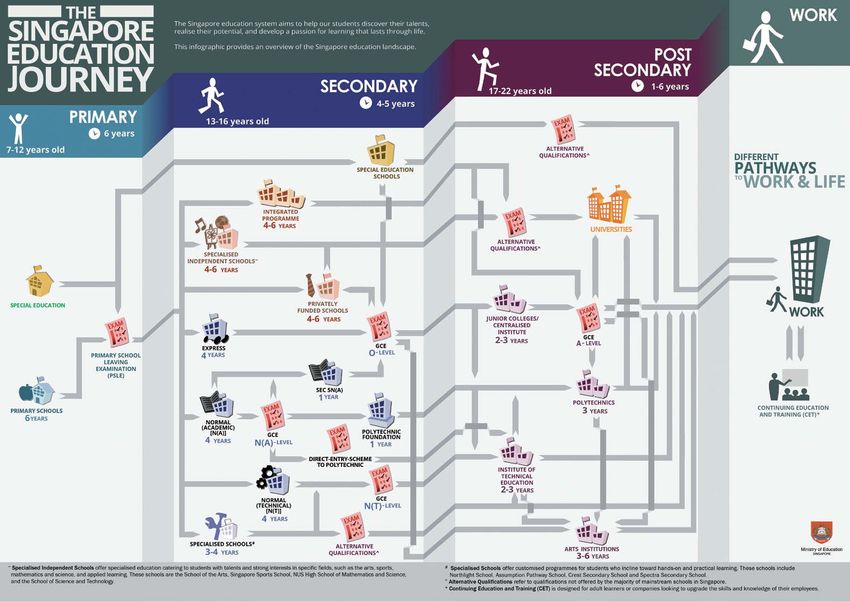
                                                                      17   Singapore’s Education System :
    Pri 4                                                                  An Overview
    - Choosing a Subject Combination

    Pri 6
    - PSLE
                                                                      19   Support and Contact
    - Choosing a Secondary School

    Secondary                                                                   The Ministry of Education (MOE) directs
                                                                                the formulation and implementation of
    Sec 2                                                                       education policies. It has control of the
    - Choosing a Subject Combination                                            development and administration of the
                                                                                Government and Government-aided primary
    Sec 4/5                                                                     schools, secondary schools, junior colleges,
    - GCE O- or N-Level                                                         and a centralised institute. It also registers
    - Choosing a Post-Secondary Institution                                     private schools.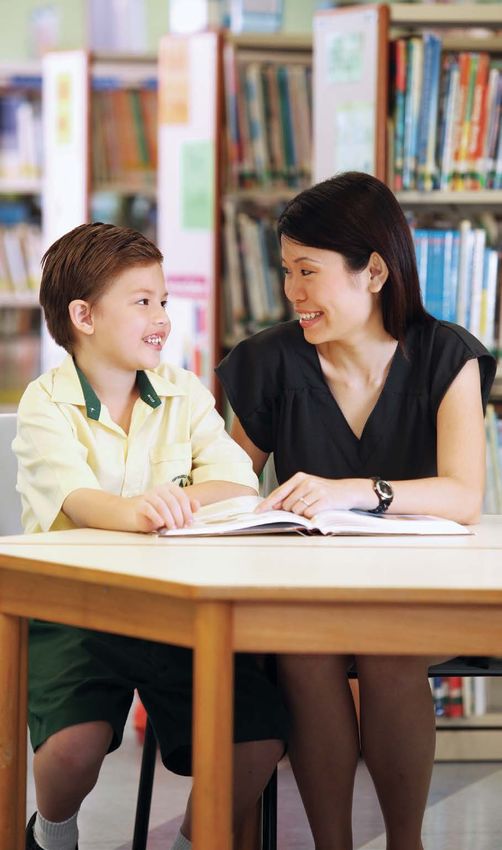
01                                                                                                                                                                                         PRIMARY
                                                                                                                                                                                           SCHOOL
                                                                                                                                                                                         EDUCATION
                                                                                                                                                                                                       02

Schooling for Every Child                                                                          Nurturing our Young for the Future
In Singapore, every child receives a six-year compulsory primary school education, during
which he will be nurtured for his future.

How do our schools prepare each child to thrive in a future driven by globalisation and
technological advancements?

Our schools develop in each child 21st century competencies so that he is equipped with
skills to navigate a fast-changing world and grows up to become:

•   a confident person who has a strong           •   an active contributor who is able to
    sense of right and wrong, is adaptable 		         work effectively in teams, is
    and resilient, knows himself, is discerning       innovative, exercises initiative, takes
    in judgment, thinks independently and 		          calculated risks and strives for
    critically, and communicates                      excellence; and
    effectively;
                                                  •   a concerned citizen who is rooted
•   a self-directed learner who questions, 		         to Singapore, has a strong sense of civic
    reflects, perseveres and takes                    responsibility, is informed about
    responsibility for his own learning;              Singapore and the world, and takes an
                                                      active part in bettering the lives
                                                      of others around him.

                                                                                                          In school, your child will be able to gain the    All these values and competencies are an
                                                                                                          knowledge, skills and values he needs to          integral part of the total curriculum.
                                                                                                          thrive in the 21st century.
                                                                                                                                                            Teachers develop these values and
                                                                                                          Our framework for the 21st century                competencies in their students through
                                                                                                          competencies encapsulates values and              subject disciplines, Character and
                                                                                                          competencies which we have identified             Citizenship Education (CCE), enrichment
                                                                                                          as being particularly important for the           programmes, as well as teachable
                                                                                                          development of every child. The framework         moments.
                                                                                                          incorporates:
                                                                                                                                                            The diverse range of Co-curricular Activities
                                                                                                          •   Core values (respect, responsibility, 		      (CCA) offered in each school also provides
                                                                                                              resilience, integrity, care, harmony);        a natural platform for students to apply
                                                                                                          •   Social and emotional competencies 		          these values and competencies, while
                                                                                                              (self-awareness, self-management, 		          discovering their interests and talents.
                                                                                                              social awareness, relationship
                                                                                                              management, responsible decision-		           As part of our efforts to enhance the
                                                                                                              making); and                                  development of 21st century competencies
                                                                                                          •   Emerging competencies (critical               in our students, the MOE has strengthened
                                                                                                              and inventive thinking; communication;        the quality of Physical Education, Art and
                                                                                                              collaboration and information skills; civic   Music education. These subjects contribute
                                                                                                              literacy, global awareness and cross-		       to the students’ holistic education. They
                                                                                                              cultural skills).                             enable our students to develop physical
                                                                                                                                                            robustness, enhance their creative and
                                                                                                                                                            expressive capacities, and shape their
                                                                                                                                                            personal, cultural and social identity.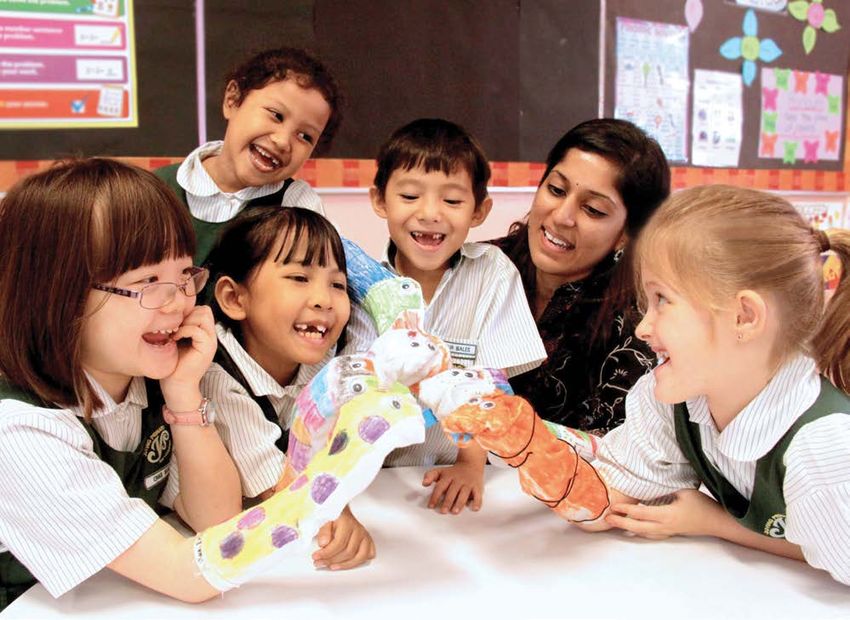
03 PRIMARY
SCHOOL
EDUCATION
04
Curriculum for
Well-rounded Learning
Primary school education is designed to give your child approach. This enables students to use the full
a strong foundation that includes: range of knowledge skills, work together and
clearly demonstrate what they have learnt.
- Nurturing sound values
- Loving Singapore • Character development is facilitated through daily
- Developing language and numeracy skills teacher-student interactions, as well as
programmes in the non-academic curriculum.
The primary school curriculum offered by the ministry They focus on instilling sound values in your child to
focuses on three main aspects of education – take him through life as a responsible adult. Your
subject disciplines, knowledge skills and character child will have many opportunities to develop skills
development. for life and a love for Singapore through
Character and Citizenship Education, Social and
• Subject disciplines comprise subject areas such as Emotional Learning, National Education, and Co-
languages, humanities & the arts, and mathematics curricular Activities.
& sciences, designed to give your child a good
grounding in different fields of study. Following the introduction of Subject-based Banding,
your child will be offered English, Mother Tongue
• Knowledge skills focus on developing your child’s Language, Mathematics and Science as either
thinking, process and communication skills. foundation or standard subjects at Primary 5 and 6,
Knowledge skills are taught through a variety of depending on his needs and ability.
subjects and often through a project work
PRIMARY SCHOOL curriculum SUBJECTS TESTED IN PSLE#
Standard Subjects:
English, Mother Tongue Language,
Mathematics, Science
LANGUAGES Foundation Subjects:
Foundation English, Foundation
English Mother Tongue Language, Foundation
Mother Tongue Mathematics, Foundation Science
Optional Subject:
Knowledge Higher Mother Tongue Language
Skills
LIFE LEGEND
SKILLS CCA Co-curricular Activities
CCE Character and Citizenship
CCA, CCE^, Education
humanities PAL+, PE MATHEMATICS PAL Programme for Active Learning
& the arts & SCIENCES
PE Physical Education
Social Studies, PW~ Mathematics PW Project Work
Art, Music Science*
#
Students offer standard or foundation subjects
based on their aptitude in each subject.
* Science is taught from Primary 3 onwards.
^
CCE includes National Education (NE), Values
in Action (VIA) and Form Teacher Guidance
Period (FTGP).
+
PAL will be progressively rolled out to all
primary schools by 2017.
~
Project Work is conducted during curriculum
time but is not an examinable subject.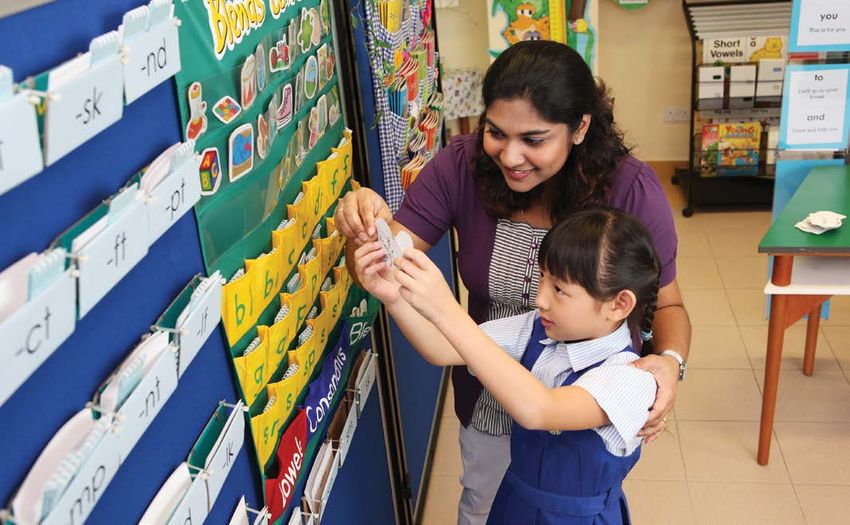
05 PRIMARY
SCHOOL
EDUCATION
06
Language Mastery Conducive Learning Environment
Learning Support Programmes
Schools have Learning Support Programmes to ensure
that help is at hand for students who need it.
These programmes, which provide learning support for
students entering Primary 1 with either weak literacy or
numeracy skills, ensure that students are able to keep up
with core subjects like English and Mathematics.
Learning Support Programmes include daily lessons with
smaller groups of students taught by specially trained
teachers. These programmes use structured teaching
approaches that meet the learning needs of these
students.
Programmes for Intellectually
Gifted Students
The Gifted Education Programme (GEP) caters to
students who are intellectually gifted.
Your child’s school will invite him to sit for a screening test
when he is in Primary 3 to determine his eligibility for the
English and Mother Tongue Languages GEP.
Your child will learn English as a first language in primary school. English is the lingua franca of international business,
science and technology. Therefore, the ability to speak and write English well remains an essential skill to develop in The GEP students will be placed in selected primary
our young. schools for Primary 4 to Primary 6. They will receive an
advanced curriculum that matches their abilities in the
Your child will learn his Mother Tongue Language (Chinese Language, Malay Language or Tamil Language) as a academic subjects in separate classes. They will be
second language. Bilingualism, a cornerstone of our education system, has been a valuable asset to our students, taught by teachers specially trained in these subjects,
enabling them to tap the opportunities that can be found in the global environment. while they intermingle with fellow students for other
lessons and activities.
With more Primary 1 students coming from households where English is the dominant language spoken at home,
we will continue to refine the teaching of Mother Tongue Languages. Schools adopt differentiated teaching For students with high abilities in specific subject
approaches to cater to students from different backgrounds of languages spoken at home. disciplines, who are not in the GEP, there are opportunities
to enrich their learning through both school-based and
We promote the functional use of the Mother Tongue Languages, with greater emphasis on listening and speaking skills. MOE centrally-run activities during or after school hours.
Co-Curricular Activities
W Revised Mother Tongue Language Curriculum : Key Features Co-curricular activities are an integral part of a well-
rounded education and play an important role in
Chinese Language Curriculum (Modular) Malay Language Tamil Language
building character. They help nurture in your child
Curriculum Curriculum
qualities such as resilience, tenacity, confidence and
perseverance, which prepare him to adapt and thrive
• More emphasis on listening, speaking and reading.
• More emphasis on oral interaction and written interaction skills. in a rapidly changing world.
• Teaching tailored to meet the different learning needs of students.
• More engaging and appealing teaching materials that capture students’ interest. There is a whole spectrum of exciting co-curricular
activities for your child to choose from, ranging from
• All students will take the Core Module. • Students will be taught • Students will be given physical sports, uniformed groups, visual and performing
according to their more opportunities to arts, to clubs and societies.
• Students with little or no exposure to the Chinese different levels of practise Spoken Tamil.
Language will take Bridging Modules achievement.
• Students with the interest and ability to go further
will take the Enrichment Modules.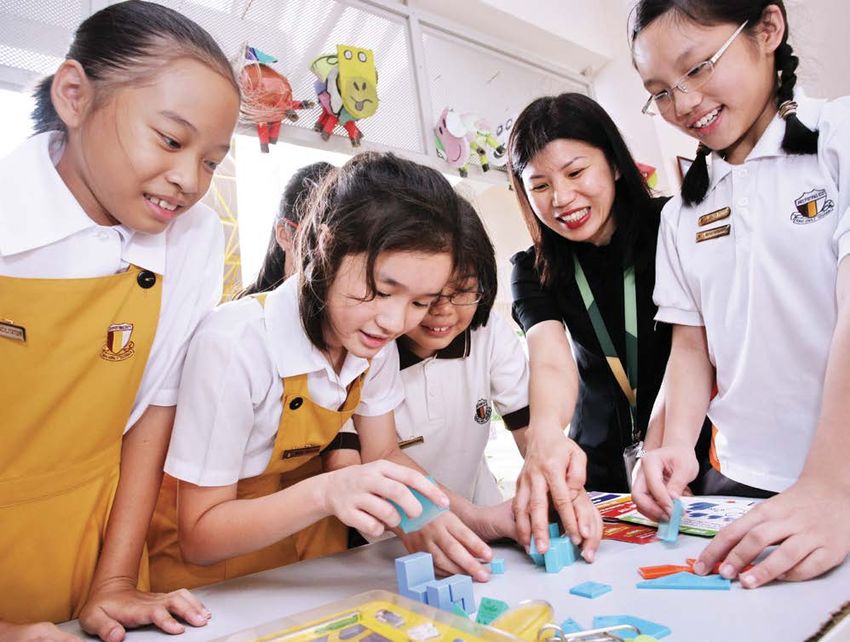
07                                                                                                                                                                                                                                 PRIMARY
                                                                                                                                                                                                                                   SCHOOL
                                                                                                                                                                                                                                 EDUCATION
                                                                                                                                                                                                                                                08
Subject-Based Banding
Subject-based Banding begins in Primary 5 and continues till Primary 6.                                                  Holistic Education : Learn and Play
It provides greater flexibility for your child by offering him the option of a combination of standard or foundation
subjects, depending on his strengths. This will help him focus on and stretch his potential in the subjects that he is
strong in while building up the fundamentals in the subjects that he needs more support in.

W                        How does Subject-based Banding work?

 At Pri 4

 Student sits for school-based examinations
 School recommends a subject combination based on the student’s results.
 Parents fill up an option form indicating the preferred combination.

 At Pri 5

 Student takes subject combination chosen by parents
 English, Mathematics, Science and Mother Tongue Language are available at standard and foundation levels.
 Mother Tongue Language is also available at a higher level.

 END OF PRI 5

 Takes 1 or more foundation subject(s) and        Takes standard subjects and          All other students
 does very well in the subject(s)                 has difficulty coping                School will allow them to
 School may allow him to upgrade 1 or 2           School may allow him to take 1       continue the same subject
 subjects to standard level if school believes    or more subjects at foundation       combination in Pri 6.
 he can cope.                                     level in Pri 6.

 At Pri 6

 Student takes subject combination decided by his school

 End of Pri 6

 Student sits for the Primary School Leaving Examination (PSLE)                                                          The MOE has progressively implemented a series of             PAL is being introduced progressively to all Primary 1
                                                                                                                         enhancements to primary school education from 2009            and 2 students by 2017.
                                                                                                                         onwards, so as to incorporate the recommendations
                                                                                                                         made by the Primary Education Review and                      Holistic Assessment to
                                                                                                                         Implementation (PERI) committee. These enhancements           Support Learning
                                                                                                                         aim to make learning more enjoyable and meaningful            Assessment is an important aspect of learning and
                                                                                                                         for your child, and seek to develop in them a better          teaching.
                                                                                                                         balance of skills and values.
                                                                                                                                                                                       Holistic Assessment emphasises the development
                                                                                                                         More Engaging Teaching Methods                                of skills and values, as well as the acquisition of
                                                                                                                         Our teachers are adopting more creative learning              knowledge to enable your child to build greater
                                                                                                                         strategies in the curriculum to make lessons come             confidence and develop a stronger desire to learn.
                                                                                                                         to life. For example, your child will be able to learn        This will in turn help him to fully develop his potential.
                                                                                                                         mathematical concepts through investigative tasks and
                                                                                                                         real-life activities, and language skills through role-play   With Holistic Assessment, schools are moving beyond
                                                                                                                         and drama.                                                    tests and examinations and using other means of
                                                                                                                                                                                       assessment to provide useful information that supports
                                                                                                                         Programme for Active Learning                                 your child’s learning and holistic development.
                                                                                                                         To encourage learning beyond the classroom, we offer
                                                                                                                         the Programme for Active Learning (PAL), which will give      At Primary 1, less emphasis will be placed on semestral
                                                                                                                         your child the chance to discover new interests, learn        examinations so that your child can ease into formal
                                                                                                                         new skills and develop his character.                         schooling more smoothly.

                                                                                                                         Your child will have the opportunity during curriculum        As parents, you will receive richer and more regular
                                                                                                                         time to try out activities in sports and outdoor education,   feedback to highlight areas where your child has done
                                                                                                                         as well as in the performing and visual arts.                 well, and also ways to improve his learning.
09                                                                                                                                                                                                                                 PRIMARY
                                                                                                                                                                                                                                   SCHOOL
                                                                                                                                                                                                                                 EDUCATION
                                                                                                                                                                                                                                               10
Form Teacher Guidance Period
As form teachers play a central role in shaping the
                                                             A single-session structure does not mean a full day of
                                                             school; it only means an extension of one to two hours
                                                             on certain days to facilitate your child’s non-academic
                                                                                                                           Choosing the Right School
development of their young charges, the Form Teacher
Guidance Period (FTGP) has been introduced in all            activities. Schools will also be given the flexibility to
primary schools since 2012.                                  adjust when to do so based on their specific needs.

The allocated one period per week carves out time for        New infrastructure will be put in place for support.
more quality teacher-student interaction, and allows         School facilities and spaces are being redesigned, and
teachers to equip students with social and emotional         this includes outdoor learning spaces and additional
competencies.                                                venues for performing arts.

Single-Session Primary Schools                               School-Home Partnership
The majority of government primary schools will transit to   As a parent, you play a critical role as our partner in the
single session by 2016. This means schools will have more    mission to prepare our young for the future. We need
time and space to focus on non-academic aspects              your support so that your child can benefit fully from a
such as leadership training and character building.          balanced and holistic primary education.

                                                             Visit our primary education website at:
                                                             www.primaryeducation.sg/ for the latest information.

                                                                                                                           To help you choose a school that matches the needs of your child, below are some possible factors to consider.

                                                                                                                           Travel Time and Distance to                                Your Child’s Interests
                                                                                                                           School                                                     Consider your child’s non-academic interests like sports,
                                                                                                                           A shorter distance from the school to your home means      performing arts, music and technology, and find out if
                                                                                                                           a shorter travelling time and reduced transport costs.     the school offers activities that match these interests.
                                                                                                                           It also provides better opportunities for you to forge a
                                                                                                                           strong relationship with the school of your choice.        •   Co-Curricular Activities
                                                                                                                                                                                          Schools offer a variety of co-curricular activities that
                                                                                                                           Stronger ties with the school means better co-operation        include physical sports, uniformed groups and visual
                                                                                                                           in raising and educating your child.                           and performing arts.

                                                                                                                           For a list of schools near (within 1 km and 1-to-2 km)     •   School-Based Programmes or School’s Niche Areas
                                                                                                                           your residential address, visit the Singapore Land             If your child has specific interests in sports or dance,
                                                                                                                           Authority’s One Map School Query Service                       for example, you may want to check out the schools
                                                                                                                           (www.onemap.sg).                                               that offer these as part of their niche areas.

                                                                                                                           Mother Tongue Languages                                    School’s Identity
                                                                                                                           There are Mother Tongue Language options offered at        Each school has its own special strengths. Learning
                                                                                                                           the school. Parents should note that:                      about the school will enable you to find out about the:
                                                                                                                           • Chinese Language is offered in all schools;              • School’s vision and mission;
                                                                                                                           • Malay Language is offered in all except Special 		       • Culture of the school; and
                                                                                                                               Assistance Plan schools; and                           • Parent Support Groups.
                                                                                                                           • Tamil Language is offered in most schools, but do
                                                                                                                               confirm this with the school of your choice.
11                                                                                                                                                                                                                                 PRIMARY
                                                                                                                                                                                                                                   SCHOOL
                                                                                                                                                                                                                                 EDUCATION
                                                                                                                                                                                                                                               12

                                                                                                                            Financing your Child’s Schooling
                                                                                                                            Fees
                                                                                                                            The MOE has put in place initiatives to help children whose parents may be financially strapped to put them
                                                                                                                            through school.

                                                                                                                            School and miscellaneous fees in our local schools have been kept affordable so that every child can enjoy the
                                                                                                                            benefits of primary school education.

                                                                                                                                                      SCHOOL FEES AND MISCELLANEOUS FEES : MONTHLY FEES PAYABLE IN
                                                                                                                            W                         GOVERNMENT AND GOVERNMENT-AIDED PRIMARY SCHOOLS

                                                                                                                                                     School          Standard
                                                                                                                                                                                            Second-tier Miscellaneous Fees
                                                                                                                                                      Fees      Miscellaneous Fees

                                                                                                                             Singapore Citizen           $0               $6.50             The fees are decided by the school but are
                                                                                                                                                                                            capped at a maximum of $6.50. Your child may
                                                                                                                                                                                            use his Edusave account to pay for these fees.

                                                                                                                             Singapore PR             $90.00              $6.50             The fees are decided by the school but are
                                                                                                                                                                                            capped at a maximum of $6.50.
                                                                                                                             Note: Fees may change in 2016.

                                                                                                                             For more information on school fees payable for your child, please visit www.moe.gov.sg/education/primary/
                                                                                                                             and www.moe.gov.sg/education/admissions/international-students/general-info/#monthly-school-fees.

Affiliated Schools                                          Special Needs                                                   Edusave Scheme
Some primary schools (mostly those with religious/ clan     Special provisions have also been made to help                  The Edusave Scheme maximises educational opportunities for all Singaporean children by providing both the
associations) have close ties with certain secondary        children with mild learning disabilities.                       children and schools with funds to pay for enrichment programmes, or to purchase additional resources. It also
schools, in the form of affiliation.                                                                                        rewards those who perform well, or who make good progress in their academic and non-academic work.
                                                            If your child has mild learning disabilities such as Dyslexia
Your child can enjoy priority for admission to the          and Autism Spectrum Disorder (ASD), schools have                Your child will receive an annual contribution in his Edusave account, if he is a Singapore Citizen. The amount
secondary school affiliated to his primary school,          teachers trained in special educational needs and               contributed for 2015 is $200.
provided he meets the school’s admission criteria, and      Allied Educators (Learning and Behavioural Support) to          W
he indicates the affiliated secondary school as his first   help them integrate into the school environment.
choice.                                                                                                                      Edusave Pupils Fund                                                    Edusave Grants
                                                            There are also designated schools with full facilities           Your child may use the funds in his Edusave account to pay for:        Your child’s school will also receive annual
Special Assistance Plan Schools                             for students with physical disabilities, and designated          • Enrichment programmes organised by his school; and                   grants to purchase teaching tools or
Special Assistance Plan schools nurture in their students   secondary schools for students with visual and hearing           • Second-tier miscellaneous fees in government or government-          organise enrichment activities that will
a deep understanding of the Chinese Language,               impairment. These schools are located in different parts           aided primary schools.                                               benefit your child.
culture and heritage, and enable them to be effectively     of Singapore to provide convenient access to students.
bilingual in both English and Chinese.                      (Please see Primary One Registration insert in back
                                                            cover pocket for a list of designated schools.)
Special Education Schools
Special Education (SPED) Schools provide an
alternative education pathway for children with special       Need to Know More?
educational needs who are unable to benefit from              Please visit www.moe.gov.sg
mainstream education.                                         Information on individual primary schools is
                                                              available in the School Information Services section
SPED Schools provide customised educational and               on the MOE website.
training programmes to cater to the diverse needs of
children with special needs.                                  To find out more about the school of your choice,
                                                              visit the school’s website, attend the school’s
There are 20 government-funded SPED Schools run by            Open House, or call the school.
Voluntary Welfare Organisations. Visit www.moe.gov.sg/
education/special-education/ for more details.
13 PRIMARY
SCHOOL
EDUCATION
14
Edusave Awards
The Edusave Awards are available to reward and motivate students who perform well in school.
Your child may qualify for Edusave Awards if he is a Singapore Citizen, has good conduct, and performs well in
different areas in school (see the eligibility criteria below):
W
Edusave Awards Eligibility Value (per year)
• Edusave Character Outstanding students from each school who demonstrate • $200 for Pri 1 to Pri 3
Award exemplary character and personal qualities through their • $350 for Pri 4 to Pri 6
behaviour and actions (2% of Singaporean students from
each school).
• Edusave Scholarship Top 10% of students in Pri 5 and Pri 6 in each school based • $350
on academic performance.
• Edusave Awards for 10% of Singaporean students from Pri 4 upwards in each • $250 for Pri 4 to Pri 6
Achievement, Good school, who display leadership qualities, perform service to
Leadership and community and schools and achieve excellence in non-
Service (EAGLES) academic activities.
• Edusave Merit Bursary Top 25% of students in each level from each school based • $200 for Pri 1 to Pri 3
on academic performance and with gross household • $250 for Pri 4 to Pri 6
income not exceeding $6,000 per month, or per capita Financial Assistance Schemes
income* not exceeding $1,500. Financial assistance schemes are available to ensure that no child is denied an education because of his financial
situation.
• Edusave Good Top 10% of students from Pri 2 upwards in each level from • $100 for Pri 2 to Pri 3
Progress Award each school who make significant improvements in their • $150 for Pri 4 to Pri 6 The MOE Financial Assistance Scheme (FAS) provides needy students with free textbooks, school attire, free
academic performance compared to the previous year. breakfast, transport subsidy and waiver of standard miscellaneous fees.
* Per capita income is the Gross Household Income divided by the number of household members which include the student, his parents,
unmarried siblings and grandparents. In addition, schools also provide discretionary assistance (e.g. meal coupons) using school-based funds. This school-
based assistance can benefit those who do not meet the qualifying criteria for the MOE FAS, as well as provide
additional assistance to those on the MOE FAS.
Parents and students can approach the schools directly if they require financial assistance.
MOE FINANCIAL ASSISTANCE SCHEME (FAS) FOR GOVERNMENT AND
W GOVERNMENT-AIDED PRIMARY SCHOOLS
Standard
School
Eligibility Miscellaneous Textbook Breakfast Transport
Attire
Fees
• Family with gross household 100% waived Free Free Free (under Students taking
income not exceeding the School school bus: 50% of
$2,500 per month Breakfast school bus fares
programme)
• Per Capita Income* not Students taking
exceeding $625 per month public transport:
$120 transport
credit per annum
* Per capita income is the Gross Household Income divided by the number of household members which include the student, his parents,
unmarried siblings and grandparents.
Opportunity Fund
Beyond the financial assistance schemes, schools have the Opportunity Fund which provides further subsidies to students
from lower income families. The fund allows them to own personal computers and to participate in developmental
programmes. This ensures that they will not be denied learning opportunities due to family circumstances.
15 PRIMARY
SCHOOL
EDUCATION
16
Parents and Schools as Partners
Building Your Child’s
Character
Parents play a key role in values education.
In the primary school CCE curriculum, a
new segment titled ‘Family Time’ has been
included to promote parent-child bonding
through suggested activities that parents
and children can carry out together. This
helps to reinforce what is taught in school.
• Understand your child’s strengths and
weaknesses. Help your child develop his
strengths further.
• Have realistic expectations and
achievable goals for your child.
• Set step-by-step goals to enable your
child to achieve them and experience
success.
• Discipline with empathy and care. Your
child’s misbehaviour, though incorrect,
may be his best attempt to meet his
needs at that moment. Misbehaviours
require correction with understanding
and love. Help your child understand why
his chosen behaviour is wrong, and what
the right way is to meet his needs without
hurting himself and others.
Bringing up a child is a voyage, and as a parent, you are the key navigator of your child’s Value Your Child
growth. His development is set primarily at home and in school, and when these two • Value your child for who he is, not just Help and Guide Your Child
environments are attuned to each other, your child benefits the most. Working hand-in- what he has achieved. in his Learning
hand with schools will help you better understand the needs and development of your • Help your child to develop a routine for
child, so that you may give him the necessary family care, support and reinforcement at • Maintain a good relationship with your school and homework.
home. child. Respect his opinions and listen to
what he has to say. • Create a conducive learning
Here are some tips on how you can help your child in his early years of education so he can environment that suits your child’s
enjoy his learning experience while in primary school. • Love your child regardless of his results. learning style or habits.
• Appreciate your child’s effort – focus on • Teach your child to monitor his own
Help Your Child Know his • Encourage your child to practise skills
the process, not the marks or grades. behaviour so as to develop
School Environment such as asking for permission, buying
self-discipline.
The earlier your child becomes familiar with food, organising his school bag and
• Avoid comparing your child’s
his new environment, the more positive he passing of messages between his school
performance with that of others. • Be alert to his needs and fears. Seek
will feel about going to school. and parents.
help from school personnel such as the
• Be generous with your praise. Form Teacher, School Counsellor,
• Visit or tour the school grounds with your • Help him to know the sources of help
Head of Department (Student Welfare),
child or show him pictures of the school. available in school (such as his Form
• Make time to play with your child and Learning Support Coordinator, or other
Teacher or School Counsellor) and how
enjoy his company. professionals, if necessary.
• Talk to your child about the new routines he can seek assistance. You can even
he will be going through every day, such role-play with your child.
• Encourage your child, especially when
as wearing a school uniform, going to he is disheartened.
the canteen and playing with his peers • Get him excited about new experiences,
at recess. such as making new friends or learning
• Listen to your child’s needs.
new things.17 PRIMARY
SCHOOL
EDUCATION
18
Singapore’s Education System : An Overview19
19 Support and
Contact
SUPPORT AND CONTACT
Find out more about the various school For the latest news on education and
programmes and be in regular contact features on schools and teachers, please
with your child’s teachers. The partnership visit www.schoolbag.sg.
established between parents and the school
will help you stay constantly informed and Parents keen to serve in their child’s school
involved in your child’s progress. can consider joining its Parent Support
Group (PSG). As part of the PSG, parents
Your child’s holistic development is the focus will have opportunities to work with school
of our schools’ efforts. Together, we can help personnel on programmes and projects that
your child realise his full potential. will benefit their child and the school.
Visit MOE’s website at www.moe.gov.sg or The MOE regularly organises education
call the MOE Customer Service Centre at seminars for parents on primary and
6872 2220 if you need further information on secondary school education. For the latest
primary school education. updates and details, please refer to
www.moe.gov.sg.
PRIMARY SCHOOL EDUCATION1 North Buona Vista Drive Singapore 138675
Tel: 6872 2220
Email: contact@moe.gov.sg
www.moe.gov.sg
The information in this booklet is correct as of MAY 2015
Produced by the MOE Communications and Engagement GroupYou can also read


