Product Line Engineering Solutions for Systems and Software - Engineer your product line portfolio as a single production system rather than a ...
←
→
Page content transcription
If your browser does not render page correctly, please read the page content below

Product Line Engineering Solutions
for Systems and Software

                                     Engineer your product
                                     line portfolio as a single
                                     production system rather
                                     than a multitude of products
2

What if the innovation, economy of scale, competitive advantage
and profitability of your product line were limited only by your
imagination, instead of the capacity of your engineering team?
For businesses to be competitive, today’s product development organizations
must deliver a product line – a portfolio of similar products or systems with
variations in features and functions – rather than just an individual product.

Systems and software product line engineering is an innovative approach that
enables organizations to develop, deliver and evolve an entire product line
portfolio, through each stage of the development lifecycle, with much higher
degrees of efficiency than have been possible before.

                                                                                 33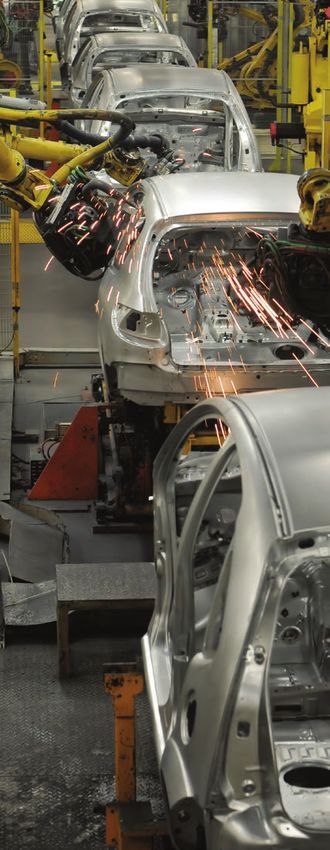
The characteristic that distinguishes the systems and                               Product lines and profitability
    software product line engineering (PLE) approach from                               In the world of hard goods, a product line refers to the
    previous efforts is when an organization invests in a                               variations on a common theme, where multiple similar
    means of production that enables it to efficiently create a                         products are combined into one line that offers different
    product line of similar systems from a consolidated set of                          sizes, colors, features and functions, with a common goal
    soft assets such as requirements, designs, source code                              of filling customer need for a particular kind of item. Econ-
    and test cases. Manufacturers of hard goods have long                               omy of scale is a key aspect of the product line concept,
    employed analogous engineering methods to create a                                  where greater profitability is achieved by investing in an
    product line of similar systems using a common factory                              efficient means of production that can be used to deploy
    that assembles and configures parts from a supply chain                             different “flavors” of a product.
    designed to be shared across the product line.
                                                                                        As product differentiation and innovation expands from
    BigLever Software provides the industry’s leading PLE                               simple physical attributes to complex systems and
    solution, offering your organization the infrastructure,                            software features – such as automotive cruise control
    tools, best practices and methods needed to create an                               that adapts to ambient traffic conditions, ships that can
    advanced and efficient means of production for your                                 shoot down an errant satellite, wind turbines optimized
    product line. Companies that invest in a more efficient                             for different environments and mobile phones that guide
    means of production for product line engineering and                                you back to where you parked your car – economy of
    delivery can experience a discontinuous jump in produc-                             scale and profitability become dependent on an efficient
    tivity, quality, time to market and product line scalability.                       means of production for different “flavors” of products
                                                                                        and the soft assets from which they are engineered, such
    The BigLever PLE solution opens new frontiers in inno-
                                                                                        as requirements, designs, source code and test cases.
    vation, economy of scale, competitive advantage and
    profitability, impacting the fundamentals of how you                                In development organizations today, virtually all systems
    compete with your product line.                                                     and software engineering is performed in the context of
                                                                                        a product line. Nobody builds just one. Systems and soft-

    Figure 1: An efficient means of production for systems and software product lines

4
Requirements         Requirements                                    Requirements                                                              Requirements
                                                         Requirements                                                                  Requirements
              Engineers                                     Engineers                                                                     Engineers

                                                                                                    Design                                                                  Design
                                               Design                                                                                                                       Models
                 Architects                    Models              Architects                       Models                                       Architects

                                                                                                                                                                                     Source Code
                                                 Source Code                                                Source Code

                                                                                Developers                                                                     Developers
                        Developers

                                                                                                                                                                                                   Test Cases
                                 Quality                                                                                  Test Cases                                           Quality

                                                                                                                                                              ...
                                                          Test Cases                              Quality                                                                   Assurance
                              Assurance                                                        Assurance
                                                          Product A                                                       Product B                                                                Product N

Figure 2: Complex interdependencies resulting from the product-centric perspective

ware product lines can be found in every industry across                                                                  However, these product-centric tools do not indepen-
the spectrum, including aerospace, defense, automo-                                                                       dently or collectively offer an effective means to engineer
tive, medical, consumer electronics, computer systems,                                                                    and deliver a product line. With product-centric tools, it is
alternative energy, telecommunications, semiconduc-                                                                       left as an exercise for tool users to craft the homegrown
tor fabrication, software applications, computer games,                                                                   techniques for managing the “commonalities and vari-
e-commerce and industrial automation systems. Sys-                                                                        abilities” among products during the development of their
tems and software product lines can be found in every                                                                     product line portfolios.
business model, including retail products, government
contractors, original equipment manufacturers (OEMs),                                                                     The repercussions of taking a product-centric perspec-
business-to-business, value-added resellers and custom                                                                    tive in a product line setting are shown in Figure 2. The
product development.                                                                                                      vertical gold bars highlight the product-centric focus
                                                                                                                          on the development lifecycle of the individual products
As businesses everywhere strive to gain competitive                                                                       (A, B through N) in a product line. The red lines illustrate
advantage and achieve greater profitability, the need for                                                                 the complex, tangled and labor-intensive interactions,
an efficient means of production for systems and soft-                                                                    dependencies and coordination activities required to
ware product lines has become universal.                                                                                  take advantage of what is common and to manage all the
                                                                                                                          variations among the similar products as the product line
Product-centric thinking impedes portfolio production                                                                     portfolio evolves over time.
Throughout the first five decades of the systems and
software engineering field, the methods and tools of the                                                                  The crux of the problem in Figure 2 is that the number
trade have predominantly promoted a product-centric                                                                       of red interdependency lines grows by the square of the
perspective. The state of the industry today is a bevy                                                                    number of products in the product line, explaining why
of sophisticated product-centric development tools                                                                        complexity and effort increase exponentially faster than
and processes that can be effectively applied to the                                                                      the growth of the product line. Making matters worse,
development lifecycle of an individual product – from                                                                     the conventional product-centric traceability relation-
early inception through design, implementation, testing,                                                                  ships between the different stages of the lifecycle for an
deployment and maintenance.                                                                                               individual product interact with the red product interde-
                                                                                                                          pendency relationships, multiplying the complexity and
                                                                                                                          introducing dissonance across the stages of the lifecycle.

                                                                                                                                                                                                                5
“We can’t solve problems by using the
                                                                      same thinking we used to create them.”
                                                                                                            —Albert Einstein

    These tactical development challenges are so large that           focus on that singular means of production rather than a
    they impede a company’s ability to achieve strategic busi-        focus on the multitude of products.
    ness objectives, such as hitting marketplace windows,
    offering competitive pricing while maximizing profitability,      Figure 3 shows the single production line perspective for
    meeting product quality demands, and expanding the                producing the same product line as in Figure 2, where
    scale and scope of the organization’s portfolio. Com-             now the focus is on the means of production inside the
    paring the ad hoc, complex and labor-intensive nature             red box. The same products, A through N (on the right
    of the product-centric perspective to the sophisticated           side of the diagram), are automatically produced by a
    means of production found in semiconductor fabrication            singular means of production composed of:
    or in automotive manufacturing makes clear that there
                                                                      • Feature profiles (top) that describe optional and vari-
    is an extraordinary need and opportunity for dramatic
                                                                        able features for the products in the product line, where
    improvements in systems and software product line engi-
                                                                        each product in the product line is uniquely defined by
    neering and delivery.
                                                                        its own feature profile.

    A shift in perspective to an efficient means of production        • Shared PLE assets (left) such as requirements, archi-
    Organizations mired in the complexity, inefficiency and             tectures, designs, models, source code components,
    pain of product line engineering from a product-centric             test cases and documentation that can be configured
    perspective experience a PLE epiphany when a shift in               and composed in different ways to create all instances
    perspective reveals a simpler solution to the problem.              of soft assets and products in a product line. Variation
    Analogous to engineering a product line of hard goods,              points shown within these PLE assets support feature-
    it is much more effective to view systems and software              based variation management.
    product line engineering as creating a means of produc-
                                                                      • Product configurator (center) that automatically com-
    tion – a single system capable of automatically producing
                                                                        poses and configures products from the shared PLE
    all of the products in a product line – rather than viewing it
                                                                        assets, using the feature profiles to determine which
    as creating a multitude of interrelated products. The pow-
                                                                        shared assets to use and how to configure variation
    erful, though subtle, essence of the PLE epiphany is the
                                                                        points within the assets.

6
As highlighted by the gold bars in Figures 2 and 3, tilting The BigLever Gears PLE Lifecycle Framework
your head 90 degrees provides the critical shift in per- and PLE Methodology
spective, from the vertical product-centric focus of Figure
BigLever Software’s proven and pragmatic PLE solution,
2 to the horizontal PLE production line focus in Figure 3.
BigLever Software Gears™, enables you to take the single
production line perspective and create an automated, opti-
By shifting perspective to focus on the singular means
mally efficient means of production for your systems and
of production rather than the multitude of products,
software product lines. With BigLever’s industry-standard
the products are relegated from the primary focus to
Gears PLE Lifecycle Framework™ and 3-Tiered PLE Meth-
a consequential corollary of the automated means of
odology™, you have all the essential elements you need,
production. The exponential complexity of manually
out of the box, to make a discontinuous jump in capability
managing product interdependencies is eliminated and
from product-centric approaches into the new frontier of
replaced by automated production, resulting in dramatic
PLE innovation, efficiency and profitability.
increases in the number of products that can be effec-
tively created, deployed and maintained.
BigLever provides the software infrastructure, tools, inte-
grations, methodology, best practices and expertise to
With the PLE production line perspective, the scale of a
guide you through a systematic and incremental transi-
product line and the scope of diversity within the product
tion to an operational Gears production line, precisely as
line can be based on business opportunities and profit-
illustrated in Figure 3. By focusing both your business and
ability rather than the complexity limitations imposed by
engineering teams on the operation of your production
the product-centric perspective.
line, your organization can plan, develop, deploy and evolve
your product line portfolio, seamlessly and efficiently,
Feature
Product Line Profiles
Management Profile
A
Requirements
Requirements
Requirements
Engineers Requirements
Requirements
Design Models
Design
Architects Design
Models Design
Models
Models
Source Code
Source
Developers Source
Code Source
Code
Code
Test Cases
Quality Test
Assurance Test
Cases Test
Cases
Cases
...
Shared PLE Assets
Key Product A Product B Product N
Variation Points
Figure 3: Simple and efficient means of production resulting from the PLE production line perspective
7
across every stage of your development and delivery life-
     cycle – from business case and analysis, to requirements,
     design, implementation, testing, delivery, maintenance and
     evolution.

     The award-winning Gears PLE Lifecycle Framework
     provides a set of industry-standard PLE concepts and
     constructs that augment your tools, assets and processes
     across the entire lifecycle:

     • A feature model that you use to express the feature
       diversity (optional and varying feature choices) among
       the products in your product line.

     • A uniform variation point mechanism that is available
       directly within your tools and their associated assets,
       to manage feature-based variations in all stages of the
       engineering lifecycle.

     • A product configurator you use to automatically assem-
       ble and configure your assets and their variation points
       – based on the feature selections you make in the fea-
       ture model – producing all of the assets for each product
       in your product line with the push of a single button.

     A key capability of the Gears PLE Lifecycle Framework
     is the integration of PLE concepts into your tools, assets
     and processes across the systems and software devel-
     opment lifecycle. Gears is compatible off-the-shelf
     with many of the industry standards in programming
     languages and compilers, integrated development
     environments, requirements management, change and
     configuration management, build systems, quality man-
     agement, model driven development, word processors
     and documentation. Figure 4 illustrates how the different
     PLE concepts and constructs expand your collection of
     tools and processes – making them product line aware –
     in three dimensions of distinct and synchronous PLE
     concerns:

     • Multi-product. The feature-based variation manage-
       ment and automated production line necessary to
       engineer and deliver the multiple products in a product
       line are provided directly by the Gears feature model,
       variation point mechanism and product configurator.

     • Multi-phase. The tools necessary to support the mul-
       tiple phases of a product line engineering lifecycle are
       the same tools you use today, augmented by the Gears
       PLE Lifecycle Framework to provide consistent variation

88
Baseline 1                 Baseline 2    Baseline 3    Baseline 4   ...   Baseline M

                                                       Test Cases
  management and PLE operations.

                                                                         Multi-phase
  Traceability mechanisms that are                   Source Code
  traditionally used for managing
  the interdependencies among the
                                                                                                              Multi-baseline
                                                    Design Models
  assets across multiple phases of
  the engineering lifecycle are also                 Requirements

  extended to become product line
  aware, where traceability relation-                        Product A

  ships and consistency analysis                                     Product B
                                                                                 ...
  becomes aware of the implications                                                    Product N
  of a variation point at either or both
  ends of a traceability relationship.              Figure 4: Synchronous concerns of a PLE solution

• Multi-baseline. Change man-
  agement and configuration                                                                 • Base tier (1): Feature-Based Variation Management
  management for a product line are done on multiple                                               and Automated Production: Tools, integrations and
  evolving baselines of the PLE assets rather than on a                                            infrastructure for engineering product line features,
  multitude of individual product baselines. Analogous to                                          product feature profiles, product line hierarchy, fea-
  the supply chains for automotive manufacturing being                                             ture-based variation points in assets, and automated
  aligned on baselines for different model years, the                                              feature-based configuration of product line assets into
  supply chain of soft assets for systems and software                                             products and deliverables.
  product lines are aligned on baselines at different points
                                                                                            • Middle tier (2): Feature-Based Asset Engineering: Pro-
  in time, to synchronize complete and consistent sets of
                                                                                                   cesses and organizational structures for engineering
  assets for the delivery of products in a product line.
                                                                                                   the full lifecycle of product line assets – from require-

The final piece of the BigLever Gears solution is the                                              ments to architecture, design, implementation and test

3-Tiered PLE Methodology, shown in Figure 5. This                                                  – on multiple delivery streams in a production line.

pragmatic new-generation PLE methodology enables a                                          • Top tier (3): Feature-Based Portfolio Management:
practical tiered approach that allows you to remove bar-                                           Business-wide management of a product line portfolio
riers, make a non-disruptive transition and successfully                                           by the features offered and the profile of features allo-
operate your Gears production line. Each tier builds upon                                          cated to each product.
and is enabled by the previous tier:

                       Figure 5: Pragmatic 3-Tiered Product Line Engineering Methodology
                                                                                                                                                                  9
Industry-leading successes, experience and expertise           • A reduction in time to market for new and updated prod-
     With over a decade of experience, successes and indus-           ucts, and an increased agility to assertively react to new
     try leadership, BigLever’s technology, methodology and           opportunities and changing marketplace conditions.
     expertise has played an instrumental role in establishing      • An increase in product quality, a reduction in defect
     many of the industry’s most acclaimed PLE practices.             density and improved risk management.
     BigLever customers, including four Software Product Line
     Hall of Fame inductees, have received significant industry     The exciting thing about discontinuous jumps in capability
     recognition for their innovation and breakthrough success      is that they open up new frontiers in innovation, competi-
     in implementing PLE approaches.                                tive advantage and profitability, offering new possibilities
                                                                    that were not easily conceivable in the past. By using
     The BigLever PLE solution now offers you out-of-the-box        PLE to more quickly deliver larger numbers of precisely
     capabilities to initiate and operate your own systems and      targeted products, with better quality and with less effort
     software production line, and to begin reaping the dra-        than your competitors, you can successfully capture mar-
     matic benefits in the new PLE frontier.                        ketplace leadership.

     Benefits of systems and software product line                  A pivotal strategic benefit of the BigLever PLE solution is
     engineering and delivery with BigLever Software Gears          the shift away from product-centric product marketing to
     With the BigLever PLE solution, your business and engi-        feature-based portfolio marketing. The diversity of prod-
     neering organization can shift perspective to focus on a       ucts that can be automatically produced by a BigLever
     singular production line capable of automatically pro-         production line is a direct consequence of the scope of
     ducing the products in your product line from a supply         the feature variations designed into the production line.
     chain of PLE assets, rather than focusing on the manual        Thus, the traditional role of product marketing – defin-
     creation of a multitude of products. With this shift in per-   ing the individual products to take to market – is elevated
     spective, the complexity of managing multiple products         to product line portfolio marketing. With feature-based
     with their exponential interdependencies is eliminated         portfolio marketing, the scale and scope of the portfolio
     and replaced by the automated means of production.             are defined in terms of the common features and feature
                                                                    diversity supported by a Gears production line and the
     Similar to what is seen when adopting an efficient manu-       feature profiles that describe each of the products deliv-
     facturing system, the resulting benefits give rise to a        ered to market.
     discontinuous jump in capability, not measured in per-
     centage points but more often measured in multiples or         Some of the dramatic strategic benefits that come from
     order-of-magnitude strategic improvements such as:             the new paradigm of feature-based portfolio marketing
                                                                    include:
     • An increase in the scope of product diversity and the
       scale of different products that can be effectively deliv-   • Portfolio features become the lingua franca among
       ered in a product line.                                        product marketing professionals, business executives,
                                                                      engineering managers and even the automated Gears
     • An increase in productivity and efficiency, a reduction
                                                                      production line, which can significantly improve com-
       in per-product development cost and overhead, and
                                                                      munication and alignment among stakeholders.
       higher profit margins.

10
• Adding a new product to the portfolio can now be a fundamental PLE shift in perspective allows you to focus
simple matter of creating a new feature profile to drive the business and engineering teams for your product line
the automated Gears production line. on creating an efficient means of production – a Gears
• Adding, updating or extending the portfolio with a new production line – rather than creating a multitude of prod-
feature or feature combination is now a simple matter ucts.
of delta engineering – extending the Gears production
The BigLever PLE solution provides advanced, proven
line to support the new feature, either as a common
and pragmatic PLE capabilities. The BigLever Gears PLE
feature for all products or as a varying feature option
Lifecycle Framework offers a consistent and integrated
available in a subset of the products.
product line engineering solution for the tools and assets
• Because of the low cost and effort required to extend that span the systems and software development life-
the product line portfolio, new products become com- cycle. The incremental 3-Tiered PLE Methodology offers
modities rather than resource-intensive investments. non-disruptive and seamless transitions from current
Even small, niche, one-off or low-margin opportunities practices into a more efficient and effective PLE practice.
can be profitable to pursue. Our expert services can help you apply the new genera-
tion of proven, practical and successful PLE practices to
Using the BigLever PLE solution, you can define the scale
the specific needs of your organization.
and scope of your product line portfolio based on busi-
ness opportunities and revenue optimization. You no What if the innovation, economy of scale, competitive
longer have to be constrained by the complexity and advantage and profitability of your product line were lim-
limitations of product-centric approaches. ited only by your imagination, instead of by the capacity of
your engineering team?
Stepping into the new PLE frontier
The BigLever PLE solution opens new frontiers for innova-
tion and profitability in systems and software product line
engineering and delivery, as illustrated in Figure 6. The
Figure 6: Discontinuous jump into the new frontier for systems and software product lines
11“Give me a lever big enough
and I will move the world.”
—Archimedes
For more information
To learn more about the BigLever Gears
Product Line Engineering Tool and
Lifecycle Framework, contact:
info@biglever.com
www.biglever.com
+1-512-777-9552
Gartner, “Cool Vendors in Product Design and Life
Cycle Management 2015” by Marc Halpern, Janet
Suleski, Rick Franzosa, April 8, 2015.
Gartner does not endorse any vendor, product or
service depicted in its research publications, and
does not advise technology users to select only those
vendors with the highest ratings or other designation.
Gartner research publications consist of the opinions
of Gartner's research organization and should not be
construed as statements of fact. Gartner disclaims all
warranties, expressed or implied, with respect to this
research, including any warranties of merchantability
or fitness for a particular purpose.
Copyright © 2015 BigLever Software, Inc. All rights reserved. BigLever Software, Gears,
and their respective logos are trademarks of BigLever Software, Inc. in the United States
and other jurisdictions. All other company or product names mentioned are used only
for identification purposes and may be trademarks or registered trademarks of their
respective companies.
BigLever Software Gears is protected by U.S. Patent Nos. 7,543,269, 8,156,470, and
8,918,754. Patents Pending.
BigLever Software, Inc.
10500 Laurel Hill Cove
Austin, TX 78730
U.S.A.You can also read


