Project Administration Manual - People's Republic of China: Shandong Groundwater Protection Project - Asian ...
←
→
Page content transcription
If your browser does not render page correctly, please read the page content below
Project Administration Manual

Project Number: 47047
Loan Number: LXXXX-PRC
June 2016

People’s Republic of China: Shandong Groundwater
Protection Project
Contents
ABBREVIATIONS
I.    PROJECT DESCRIPTION                                                     1
      A.   Rationale                                                          1
      B.   Impact and Outcome                                                 2
      C.   Outputs                                                            3
II.   IMPLEMENTATION PLANS                                                    5
      A.   Project Readiness Activities                                       5
      B.   Overall Project Implementation Plan                                6
III.  PROJECT MANAGEMENT ARRANGEMENTS                                         7
      A.   Project Implementation Organizations—Roles and Responsibilities    7
      B.   Key Persons Involved in Implementation                             9
      C.   Project Organization Structure                                    11
IV.   COSTS AND FINANCING                                                    11
      A.   Cost Estimates Preparation and Revisions                          11
      B.   Key Assumptions                                                   11
      C.   Detailed Cost Estimates by Expenditure Category                   13
      D.   Allocation and Withdrawal of Loan Proceeds                        14
      E.   Detailed Cost Estimates by Financier                              15
      F.   Detailed Cost Estimates by Outputs                                16
      G.   Detailed Cost Estimates by Year                                   17
      H.   Contract Awards and Disbursement S-curve                          18
      I.   Fund Flow Diagram                                                 19
V.    FINANCIAL MANAGEMENT                                                   20
      A.   Financial Management Assessment                                   20
      B.   Disbursement                                                      20
      C.   Accounting                                                        21
      D.   Auditing and Public Disclosure                                    21
VI.   PROCUREMENT AND CONSULTING SERVICES                                    22
      A.   Advance Contracting and Retroactive Financing                     22
      B.   Procurement of Goods, Works and Consulting Services               23
      C.   Procurement Plan                                                  24
      D.   Consultant's Terms of Reference                                   36
VII.  SAFEGUARDS                                                             47
      A.   Environment                                                       47
      B.   Ethnic Minorities                                                 49
      C.   Land Acquisition and Resettlement                                 49
VIII. GENDER AND SOCIAL DIMENSIONS                                           54
      A.   Social and Gender Action Plan                                     54
IX.   PERFORMANCE MONITORING, EVALUATION, REPORTING AND
      COMMUNICATION                                                          61
      A.   Project Design and Monitoring Framework                           61
      B.   Monitoring                                                        64
      C.   Evaluation                                                        62
      D.   Reporting                                                         63
      E.   Stakeholder Communication Strategy                                63
X.    ANTICORRUPTION POLICY                                                  63
XI.   ACCOUNTABILITY MECHANISM                                               63
XII.  RECORD OF PAM CHANGES                                                  64
APPENDIX 1. Draft Terms of Reference for Environmental Positions
Project Administration Manual Purpose and Process

1. The project administration manual (PAM) describes the essential administrative and
   management requirements to implement the project on time, within budget, and in accordance
   with the Government of the People’s Republic of China (government) and the Asian
   Development Bank (ADB) policies and procedures. The PAM includes references to all
   available templates and instructions either through linkages to relevant URLs or directly
   incorporated in the PAM.

2. The Shandong Provincial Government, represented by Shandong Water Resources Department
   (SWRD), the executing agency; and the county governments of Changle, Gaomi, Huantai,
   Qingzhou, and Shouguang, the implementing agencies are wholly responsible for the
   implementation of the project, as agreed jointly between the borrower and ADB; and in
   accordance with the government and ADB policies and procedures. ADB staff is responsible to
   support implementation including compliance by the SWRD of their obligations and
   responsibilities for project implementation in accordance with ADB policies and procedures.

3. At loan negotiations, the borrower and ADB agreed to the PAM and ensured consistency with
   the loan and project agreements. In the event of any discrepancy or contradiction between the
   PAM and the loan and project agreements, the provisions of the loan and project agreements
   shall prevail.

4. After ADB Board approval of the project's report and recommendations of the President,
   changes in implementation arrangements are subject to agreement and approval pursuant to
   relevant government and ADB administrative procedures (including the project administration
   instructions) and upon such approval they will be subsequently incorporated in the PAM.
Abbreviations

ADB    =   Asian Development Bank
CSC    =   construction supervision companies
DMF    =   design and monitoring framework
EIA    =   environmental impact assessment
EMP    =   environmental management plan
EMS    =   environmental monitoring systems
FMA    =   financial management assessment
ICB    =   international competitive bidding
GRM    =   grievance redress mechanism
LAR    =   land acquisition and resettlement
LIEC   =   loan implementation environment consultant
MIS    =   management information systems
NCB    =   national competitive bidding
NCP    =   Northern China Plain
PCR    =   project completion report
PIO    =   project implementation office
PMO    =   project management office
PPMS   =   project performance monitoring systems
PPTA   =   project preparatory technical assistance
PRC    =   People’s Republic of China
SFD    =   Shandong Finance Department
SGAP   =   social and gender action plan
SGE    =   some gender elements
SOE    =   statement of expenditure
SPG    =   Shandong Provincial Government
SPS    =   Safeguard Policy Statement
SSS    =   single-source selection
SWRD   =   Shandong Water Resources Department
TOR    =   terms of reference
I.     PROJECT DESCRIPTION

A.        Rationale

1.     Falling groundwater tables as a result of over extraction of groundwater is a major
concern in the People’s Republic of China (PRC), particularly in the northern parts of the
country. The PRC heavily depends on extraction of groundwater, with an estimated 20% of its
annual water supply coming from groundwater, reportedly ranging from 110 billion cubic meters
(m3) to 150 billion m3 per year. The largest groundwater user is the agricultural sector (60%),
with domestic and industrial usage sharing the remaining 40%. There are more than 100 large
cones of groundwater depression with an estimated total area of 150,000 square kilometers in
the PRC. In the North China Plain (NCP), the total area of the cone of groundwater depression
already extends to 70,000 square kilometers.

2.      Weifang and Zibo prefectures in Shandong Province also depend heavily on
groundwater, especially for its intensive and high-value agricultural production. Domestic and
industrial water use, although still less than agricultural water use, is also on the rise as a result
of the rapid economic development in the area. The project area, covering Changle and Huantai
counties, and Gaomi, Qingzhou, and Shouguang cities, is the main vegetable producer for
Beijing and has a high concentration of greenhouses. The greenhouses that use drip irrigation
require fresh and sediment-free water, which, in most cases, is provided from shallow
groundwater sources. As a result of extensive groundwater abstraction, the project area has
become the largest overexploited aquifer in Shandong Province, and the second largest in the
PRC.1 In some downstream areas, agricultural production stopped due to lack of suitable water
sources. Some of the industrial or domestic water users that are still using groundwater are
encouraged by the government to switch to surface water.2

3.       Current groundwater recharge of both shallow and deep groundwater resources is
insufficient to recover from the excessive pumping during the dry periods. Seasonal rainfall
fluctuates widely, with an average of 70% of the rainfall occurring from June to September,
followed by drought during the rest of the year. Flooding occurs during the summer months, but
storm waters flow to the sea unutilized. The pattern of irregular rainfall is expected to worsen as
a result of climate change, and rainfall is predicted to decrease. Excessive groundwater usage
also occurs because of lack of pricing of the resource, a weak licensing and permitting system,
and insufficient abstraction metering and groundwater level monitoring.

4.      The consequences of the current unsustainable groundwater utilization are serious: (i)
pumping costs have increased; (ii) groundwater quality is deteriorating due to seawater intrusion
and environmental pollution; (iii) domestic water supplies and agricultural (particularly
vegetable) production are at risk; and (iv) the project area is suffering from significant financial
and economic damages caused by land subsidence. Seawater intrusion and upconing has
extended 35 kilometers inland from the coast, and some areas have already experienced
subsidence of more than 2 meters.3 The process of land subsidence is irreversible, and urgent
action is needed to avoid worsening.

1
     The overexploited area of the Weifang–Zibo aquifer covers approximately 5,422 square kilometers.
2
     Usage of shallow (unconfined) groundwater causes overexploitation of groundwater sources that are used by
     many farmers. The use of deep (confined) groundwater causes land subsidence.
3
     Process by which saline water underlying freshwater in an aquifer rises upward into the freshwater zone as a
     result of pumping water from the freshwater zone.
2
5. Acknowledging the serious concerns, the PRC Government selected Shandong
Province as a demonstration province for modernized water administration. The Shandong
Provincial Government (SPG) has already taken multiple initiatives to address water scarcity in
the NCP, including promoting water productivity and reuse, and introducing regulations on
groundwater pumping. Several water-saving technologies, such as drip irrigation, are already
widely used in the project area.4 The results have been successful, but more efforts are needed
to fully address the risk of further decline of groundwater levels in the NCP. 5 The national
government has constructed the South–North Water Transfer Project, which started providing
additional water for Shandong Province in 2014. The diverted water, which is mainly intended
for domestic and industrial use, will not be sufficient to mitigate the current overexploitations of
the groundwater resources in the NCP.
6. Lessons learned from past and ongoing support for the water sector, including the
preparation of policy recommendations for the PRC’s Thirteenth Five-Year Plan, 2016–2020,
show that there is still lack of good examples of implementing integrated water management
approaches and increasing water productivity in the PRC. Most counties in the project area lack
(i) integration of good international practices to provide new alternatives for groundwater
conservation, (ii) adequate implementation of water-saving strategies and regulatory stipulations,
and (iii) introduction of up-to-date water environmental monitoring technologies. Existing
government programs also lack the support to link efficient and reduced groundwater usage
with the retention of surface and storm water to increase groundwater recharge and water
availability for water-scarce areas.
7. The project will be the first Asian Development Bank (ADB) supported major investment
in the PRC that specifically focus on groundwater resources protection, recognizing the strategic
importance of these resources. Moreover, the project will support the development and
introduction of economic policy instruments, critical to controlling groundwater usage. The
project will contribute to the PRC’s Thirteenth Five-Year Plan, 2016–2020, which pursues
regionally balanced and environmentally sustainable growth; and the PRC’s first National Plan
to Protect the Safety of Groundwater Resources, 2011–2020.6 The project will support the PRC
in achieving the Sustainable Development Goals, in particular Goal 2: End hunger, achieve food
security and improved nutrition and promote sustainable agriculture and Goal 6: Ensure
availability and sustainable management of water and sanitation for all. The project is in line
with the country partnership strategy, 2016–2020 for the PRC of ADB in supporting the
government’s overarching strategic goal by focusing on environmentally sustainable growth.7
The project will contribute to ADB's Water Operational Plan, 2011–2020 to (i) increase water
productivity across the range of users; (ii) embed integrated water resources management,
including improved risk management, to mitigate floods, droughts, and other water-related
4
In Shouguang City, which is among the worst affected in the project area, two-thirds of the farmers reportedly
apply drip irrigation already.
5 3 3
The amount of groundwater usage in Shandong Province declined from 13.4 billion m in 2001 to 8.9 billion m in
2012.
6
On 10 October 2011, the PRC Government approved the National Plan to Protect the Safety of Groundwater
Resources, 2011–2020. The adoption of the plan is an important step to mobilize additional financial resources to
protect groundwater resources in the PRC. On 16 April 2015, the government also announced an associated
action plan that includes a list of measures to tackle water pollution, with the aim of improving the quality of the
water environment around the country by 2030. With regards to groundwater, the plan envisages that by 2020,
groundwater overdraft will be reduced and the aggravated pollution of groundwater will be preliminarily controlled.
7
ADB. 2016. Transforming Partnership: People’s Republic of China and Asian Development Bank, 2016–2020.
Manila.3
disasters; and (iii) expand knowledge and capacity development that uses technology and
innovation more directly.8
B. Impact and Outcome
8. The impact will be a sustained groundwater supply for the agriculture sector in the
Weifang–Zibo area. The outcome will be improved conservation and sustainable use of
groundwater resources in Weifang and Zibo prefectures. The project will serve as a
demonstration of different integrated approaches for environmental restoration and improved
management of overexploited groundwater areas. The project will promote the integration of
innovative demonstration activities like (i) groundwater recharge through water harvesting and
storage in smart greenhouses; (ii) demonstration of comprehensive water management
information systems; and (iii) capacity development in water resources management, including
water resource policy and regulation, water pricing, and water markets.
C. Outputs
9. The project will have three outputs: (i) groundwater recharged and conserved, (ii)
surface water allocation improved and monitored, and (iii) capacity development for water
resources management enhanced. Demonstration activities will be implemented in Changle and
Huantai counties, and Gaomi, Qingzhou, and Shouguang cities in Weifang and Zibo, which are
representative for critical water-scarce conditions in intensive agricultural production bases in
the Weifang–Zibo area.
10. Output 1: Groundwater recharged and conserved. Output 1 will support the
introduction of groundwater recharge technologies in the project area to increase shallow
groundwater recharge and reduce usage of deep groundwater. Output 1 will have two
components: (i) rehabilitation and construction of about 880 hectares of wetland areas, including
canals, which will contribute to the recharge of shallow groundwater resources; 9 and (ii)
technological innovation for monitoring shallow groundwater recharge in Huantai County. Under
component 1, two wetland areas will be rehabilitated in Huantai County and Shouguang City to
improve the reservoir and ecological functions of the wetlands, and increase shallow
groundwater recharge through the canal network. These wetland areas currently suffer from
water shortages and are not operational. Component 2 includes the development of a
comprehensive management information system for water resources monitoring and
management in Huantai County, including monitoring and dissemination of groundwater levels,
quality, and abstraction. The management information system will be developed to complement
an existing urban water supply management system. The existing system will be expanded to
include monitoring of water resources, data analysis, optimizing the allocation of water
resources, water regime forecasting, and decision-making support for flood control.
11. Output 2: Surface water allocation improved and monitored. Output 2 will improve
water allocation and monitoring to increase water availability in water-scarce parts of the project
area and indirectly reduce the pressure on groundwater resources. The output will have three
components: (i) improvement of surface water allocation, (ii) retention of storm water, and (iii)
establishment of hydrological facilities in Changle County. Through the improvement of surface
8
ADB. 2011. Water Operational Plan, 2011–2020. Manila.
9
The wetlands to be rehabilitated or constructed are all modified habitats, but may have important ecological
values.4 water resources allocations, the exploitation of groundwater can be reduced. Component 1 will support Gaomi and Qingzhou cities and Huantai County to rehabilitate surface water flow systems and construct connections between the wide network of small rivers, canals, and small- sized reservoirs that exist in the Weifang–Zibo area. The connections will enable the local governments to supply areas with additional surface water resources to reduce the pressure on groundwater resources. Similarly, component 2 will support Changle County and Gaomi City to increase their reservoir capacity for improved storage of surface water. It is envisaged that the total storage capacity of the Nanzhai and Juchenghe reservoirs will be increased from 3.7 million m3 per year to 8.3 million m3 per year. Output 3 will support Changle County to establish precipitation and flow monitoring capabilities in the Nanzhai Reservoir watershed. 12. Output 3: Capacity development for water resources management enhanced. Output 3 will have two components: (i) institutional strengthening of ADB’s project management procedures and policy development support, and (ii) project management. Component 1 will provide support for and training on groundwater policy and new approaches and techniques in water management, including wetland management, water-saving technologies for the agriculture sector such as smart greenhouses, the establishment of a groundwater trading system through pilot water user associations, and an integrated circuit card-controlled water usage system to be developed in Huantai County for monitoring and managing groundwater demand for agricultural and rural water users. Knowledge products will be prepared to document the experiences and achievements. Component 1 will also support capacity development and training of staff from the SPG and local governments in ADB project management procedures, technical design and implementation, and safeguard supervision and monitoring. Component 2 will provide overall project implementation support for staff from the SPG and cities and counties, including the implementation of land acquisition and resettlement.
5

                                                           II.           IMPLEMENTATION PLANS

A.             Project Readiness Activities

                                                                            2015               2016
                    Indicative Activities                                                                                      Responsible Agency(s)
                                                                    3 4 5 6 7 8 9 10 11 12 1 2 3 4 5 6 7 8 9 10 11 12
Advance contracting actions                                                                                             executing and implementing agencies
Retroactive financing actions                                                                                           executing and implementing agencies
Submission and approval of FCUP                                                                                         government
Establishment of project implementation arrangements                                                                    executing and implementing agencies

ADB Board approval                                                                                                      ADB
Loan signing                                                                                                            government
Government legal opinion provided                                                                                       ADB, government

Government budget inclusion                                                                                             executing agency
Loan effectiveness                                                                                                      ADB, executing agency, and government
ADB = Asian Development Bank, FCUP = foreign capital utilization plan.
6
B. Overall Project Implementation Plan
Indicative Activities City Year 1 Year 2 Year 3 Year 4 Year 5 Year 6
Q1 Q2 Q3 Q4 Q1 Q2 Q3 Q4 Q1 Q2 Q3 Q4 Q1 Q2 Q3 Q4 Q1 Q2 Q3 Q4 Q1 Q2 Q3 Q4
Output 1: Groundwater recharged and conserved
1.1 Wetland construction and rehabilitation
1.1.1 Judian Lake wetland rehabilitation (Q2 2015–Q2 2018) Shouguang
1.1.2 Mata Lake wetland rehabilitation (Q3 2018–Q3 2020) Huantai
1.2 Technological innovation for recharge and water saving
1.2.1 Management information system (Q4 2017–Q3 2019) Huantai
Output 2: Surface water allocation improved and monitored
2.1 Surface water allocation improvement
River diversion works from Renhe Reservoir to Heihu Mountain and Qiyi reservoirs (Q1 2017–Q1
2.1.1 Qingzhou
2019)
2.1.2 River works for connection of Qiyi Reservoir to Yaowanghu Reservoir (Q2 2015–Q2 2017) Qingzhou
2.1.3 River rehabilitation works for Beiyang River (Q2 2015–Q4 2017) Qingzhou
2.1.4 Irrigation channel works for diversion of Mihe River to Bagouzi Reservoir (Q1 2015–Q1 2018) Qingzhou
2.1.5 Other works (Q2 2016–Q3 2017) Qingzhou
2.1.6 River ecological control engineering works (Q2 2016–Q1 2018) Shouguang
2.1.7 Water diversion works (Q3 2016–Q2 2019) Huantai
2.1.8 River rehabilitation works (Q3 2015–Q4 2018) Huantai
2.1.9 River infrastructure (Q3 2015–Q4 2018) Huantai
South route: Water works to connect Wangwu Reservoir, Jucheng River Reservoir and Chengnan
2.1.10 Gaomi
Reservoir (Q3 2016–Q1 2018)
2.1.11 Other works (Q4 2015–Q1 2017) Gaomi
2.2 Storm water retention
2.2.1 Capacity expansion of Nanzhai Reservoir (Q2 2015–Q2 2017) Changle
West Route: Water transmission pipe from Xiashan Rservoir to Chengbei Reservoir (Q4 2015–Q2
2.2.2 Gaomi
2017)
2.3 Water flow and quality monitoring
2.3.1 Hydrological Monitoring Station construction (Q3 2016–Q3 2018) Changle
Output 3: Capacity development for water resources management enhanced
3.1 Institutional strengthening
3.1.1 Recruit and mobilize consultants (Q1 2016–Q3 2016)a
3.1.2 Establish project management system (Q2 2016–Q4 2016)
3.1.3 Establish PPMS system (Q3 2016–Q2 2017)
3.1.4 Recruit and mobilize consultants (Q2 2016–Q4 2020)
3.2 Project management
3.2.1 Project design support (Q1 2016–Q4 2017)
3.2.2 Project management (Q1 2016–Q2 2020)
3.2.3 Project supervision (Q2 2016–Q4 2020)
PPMS = project performance monitoring system.
a
Proposed for retroactive financing.7
III. PROJECT MANAGEMENT ARRANGEMENTS
A. Project Implementation Organizations—Roles and Responsibilities
Executing agency:
Shandong Water Resources Responsible for overall implementation of the
Department (SWRD), including project
comprehensive project Supervise the implementing agencies
management office (PMO), Facilitate disbursement through Shandong
representing the Shandong Finance Department (SFD)
Provincial Government (SPG) Facilitate auditing of project accounts
Responsible for ensuring timely counterpart
funds by the implementing agencies
Provide oversight and daily management of the
project preparation and implementation
Ensure coordination across sectors
Responsible for overall guidance, coordination,
supervision, and management for
implementation of the project, including
recruitment of project consultants and all project
plans [including procurement plan, environmental
management plan (EMP), etc.]
Review withdrawal applications prepared by the
implementing agencies and facilitate submission
to the Asian Development Bank (ADB) through
SFD
Update procurement plan
Provide ADB with (i) quarterly progress reports,
(ii) semiannual environment progress reports, (iii)
annual audit reports, and (iv) project completion
report
Coordinate training and capacity development
activities
Maintain separate accounting records for the
project
Carry out project performance and compliance
monitoring
Disclose project-related information and
documents in accordance with ADB guidelines
Shandong Finance Department Provide overall project guidance and
coordination
Establish and manage the project imprest
account
Submit withdrawal applications to ADB
Manage and supervise loan repayment
Weifang and Zibo municipal Coordinate between implementing agencies and
and/or prefecture finance SFD for financial transactions and payment
bureaus Review withdrawal applications prepared by the
implementing agencies and facilitate submission
to ADB through the PMO8
Implementing agencies:
Huantai County (through the Responsible for implementing Mata wetland
county PIO) areas and channel rehabilitation subproject
Responsible for implementing Management
Information System Development subproject
Responsible for site-level implementation of the
project EMP, in close coordination with PMO
environment officer
Responsible for providing counterpart funds
Prepare withdrawal applications for relevant
project expenses
Participate in training and capacity development
activities
Maintain separate accounting records for the
project
Qingzhou City (through the city Responsible for implementation and
PIO) management of Renhe Reservoir and River
Water Diversion subproject
Responsible for site-level implementation of the
project EMP, in close coordination with PMO
environment officer
Responsible for providing counterpart funds
Prepare withdrawal applications for relevant
project expenses
Participate in training and capacity development
activities
Maintain separate accounting records for the
project
Responsible for providing counterpart funds
Shouguang City (through the city Responsible for implementation and
PIO) management of Judian Lake Wetland System
Construction subproject
Responsible for site-level implementation of the
project EMP, in close coordination with PMO
environment officer
Responsible for providing counterpart funds
Prepare withdrawal applications for relevant
project expenses
Participate in training and capacity development
activities
Maintain separate accounting records for the
project
Changle County (through the Responsible for implementation and
county PIO) management of Nanzai Reservoir Expansion
subproject
Responsible for site-level implementation of the
project EMP, in close coordination with PMO
environment officer
Responsible for providing counterpart funds
Prepare withdrawal applications for relevant
project expenses
Participate in training and capacity development
activities9
Maintain separate accounting records for the
project
Responsible for implementation and
Gaomi City (through city PIO) management of Surface Water Diversion and
Allocation subproject
Responsible for site-level implementation of the
project EMP, in close coordination with PMO
environment officer
Responsible for providing counterpart funds
Prepare withdrawal applications for relevant
project expenses
Participate in training and capacity development
activities
Maintain separate accounting records for the
project
Asian Development Bank Provide the executing and implementing
agencies with guidance to ensure smooth project
implementation and achieve the desired
development impacts and their sustainability
Conduct regular loan review, midterm review,
and project completion review missions
Review and approve procurement actions
Approve withdrawal applications and disburse
loan proceeds
B. Key Persons Involved in Implementation
Executing Agency
Shandong Water Resources Mr. Xu Zhangwen
Department on behalf of the Shandong Deputy Director General
Provincial Government Shandong Water Resources Department
Shandong Provincial Government
Telephone No.: +86 531 86974222
Office address: Jinan City, Iishan Road 127#,
Shandong Province
Implementing Agencies
Huantai County Mr. Tian Maolin
Director General
Huantai County Water Resources Bureau
Telephone No.: +86 533 8210528
Office address: Huantai County Huaiyin Road 334#
Shandong Province
Qingzhou City Mr. Zhao Huazhang
Director General
Qingzhou City Water Resources Bureau
Telephone No.: +86 536 3221701
Office address: Qingzhou City, Zhengfa Street 138#
Shandong Province
Shouguang City Mr. Yuan Yilin
Director General
Shouguang City Water Resources Bureau
Telephone No.: +86 536 5221156
Office address: Shouguang City, Business10
Community 5# Building, The Fourth Floor
Shandong Province
Changle County Mr. Zang Xiping
Director General
Changle County Water Resources Bureau
Telephone No.: +86 536 6221329
Office address: Changle County, Chengguan
Business Community
Shandong Province
Gaomi City Mr. Du Qinde
Director General
Gaomi City Water Resources Bureau
Telephone No.: +86 536 2322394
Office address: Gaomi City, Renmin Street 127#
Shandong Province
Asian Development Bank Mr. Qingfeng Zhang
Director
Environment, Natural Resources, and Agriculture
Division (EAER), East Asia Department (EARD)
Telephone No.: +63 2 632 6161
Fax No.: +63 2 636 2534
E-mail: qingfengzhang@adb.org
Mission Leader Mr. Frank Radstake
Principal Environment Specialist, EAER, EARD
Telephone No.: +63 2 632 5636
Fax No.: +63 2 636 2534
E-mail: fradstake@adb.org11
C. Project Organization Structure
Shandong Water Resources
Department
(executing agency)
Shandong
project management office
Zibo Prefecture Weifang Prefecture
Huantai Qingzhou Shouguang Changle Gaomi City
County City City County
IV. COSTS AND FINANCING
13. The government has requested a loan of $150 million from ADB’s ordinary capital
resources to finance the project. The loan will have a 25-year term, including a grace period of 5
years, will follow the straight-line method, 10 will have an annual interest rate determined in
accordance with ADB’s London interbank offered rate (LIBOR)-based lending facility, a
commitment charge of 0.15% per year on undisbursed funds (the interest and other charges
during construction will be capitalized), and such other terms and conditions set forth in the draft
loan and project agreements. The average maturity is 15.25 years, and the maturity premium
payable to ADB is 0.10% per annum.
A. Cost Estimates Preparation and Revisions
14. Preparation. The project management office (PMO) prepared the cost estimates in
consultation with the implementing agencies and project preparatory technical assistance
(PPTA) consultants, and under the guidance of ADB project officer. The file entitled “Shandong
Project-Financial and Economic Model-V14” in MS Excel format was retained at the PMO and
by ADB project officer.
15. Revisions. The PMO staff will revise the cost estimates when deemed necessary, under
the guidance of ADB project officer during implementation based on the government’s request
for project cost reallocation and subsequent ADB’s approval.
10
This is based on the loan terms and the government’s choice of repayment option and dates.12
B. Key Assumptions
16. The following key assumptions underpin the cost estimates and financing plan:
(i) Exchange rate: CNY6.4741 = $1.00 (as of 3 May 2016).
(ii) Price contingencies based on expected cumulative inflation over the
implementation period are as follows:
2016 2017 2018 2019 2020 2021 2022 Average
Foreign rate of price 1.5% 1.4% 1.5% 1.5% 1.5% 1.5% 1.5% 1.5%
inflation
Domestic rate of price 1.7% 2.0% 2.1% 2.1% 2.1% 2.1% 2.1% 2.0%
inflation13
C. Detailed Cost Estimates by Expenditure Category
(CNY million) ($million)
Local Foreign Local Foreign
Item Total Costa Total Costa
Currency Exchange Currency Exchange
A. Base Costsb
1 Civil Works 1,215.40 0.00 1,215.40 198.92 0.00 198.92
2 Machinery and Equipment 34.15 8.54 42.68 5.59 1.40 6.99
3 Land Acquisition, Compensation and Resettlement 294.06 0.00 294.06 48.13 0.00 48.13
4 Project Management 105.22 0.00 105.22 17.22 0.00 17.22
5 Survey and Design 97.13 0.00 97.13 15.90 0.00 15.90
6 Consulting Services 0.00 10.88 10.88 0.00 1.78 1.78
7 Training 0.00 2.44 2.44 0.00 0.40 0.40
Subtotal(A) 1,745.96 21.86 1,767.82 285.75 3.58 289.33
B. Contingenciesc
1 Physical contingency 0.00 117.90 117.90 0.00 19.30 19.30
2 Price contingency 0.00 167.48 167.48 0.00 27.41 27.41
Subtotal(B) 0.00 285.38 285.38 0.00 46.71 46.71
C. Interest and Commitment Chargesd
1 Interest during implementation 43.92 0.00 43.92 7.19 0.00 7.19
2 Commitment charge 4.88 0.00 4.88 0.80 0.00 0.80
Subtotal(C) 48.80 0.00 48.80 7.99 0.00 7.99
Total Project Cost (A+B+C) 1,794.76 307.24 2,102.01 293.74 50.29 344.03
ADB = Asian Development Bank.
Note: Numbers may not sum precisely because of rounding.
a Includes taxes and duties of $11.68 million to be financed from government resources and ADB loan resources. ADB loan will cover taxes and duties on items financed by ADB.
Financing of taxes and duties is proposed because the due diligence showed that (i) the amount of taxes and duties is within the reasonable threshold identified in the country
partnership strategy, (ii) the amount does not represent an excessive share of investment plan, (iii) taxes and duties apply only in respect to ADB-financed expenditures, and (iv)
financing of the taxes and duties is relevant for the success of the project.
b In 2015 prices.
c Physical contingencies computed at 8% for all expenditure categories. Price contingencies computed based on cost escalation factors at 1.7% for 2016, 2.0% for 2017, and 2.1% for
2018–2022 on local currency costs; and 1.5% for 2016, 1.4% for 2017, and 1.5% for 2018–2022 on foreign exchange costs.
d Includes interest and commitment charges. Interest during construction for OCR loan has been computed at the 5-year US dollar (USD) fixed swap rate plus an effective contractual
spread of 0.5% and maturity premium of 0.1%. Commitment charges for an OCR loan are 0.15% per year to be charged on the undisbursed loan amount.
Source: Asian Development Bank estimates.14
D. Allocation and Withdrawal of Loan Proceeds
CATEGORY ADB FINANCING BASIS
Total Amount Allocated for ADB
Financing Percentage and Basis for Withdrawal
Number Item $ from the Loan Account
Category Subcategory
Civil Works 137,279,561
Qingzhou 24,515,110 65% of total expenditure claimed
Shouguang 45,889,121 71% of total expenditure claimed
1
Changle 18,105,110 74% of total expenditure claimed
Huantai 22,172,110 64% of total expenditure claimed
Gaomi 25,998,110 62% of total expenditure claimed
Greenhouse 600,000 100% of total expenditure claimed
2 Machinery and Equipment 2,653,089 100% of total expenditure claimed
3 Consulting Services 1,680,300 100% of total expenditure claimed
4 Training 400,000 100% of total expenditure claimed
5 Interest and Commitment Charges 7,987,050 100% of amounts due
Total 150,000,000E. Detailed Cost Estimates by Financier
Qingzhou City ShouGuang Changle Huantai County Gaomi City
ADB TOTAL
Government City County Government Government
Item % of
Amount % Amount % Amount % Amount % Amount % Amount % Amounta Total
Cost
A Base Costsb -
1 Civil Works 198.92
1.1 Qingzhou 24.5 e 64.6 13.3 35.4 37.6 10.9
1.2 ShouGuang 45.9 f 71.0 18.3 29.05 63.1 18.3
g
1.3 Changle 18.1 73.7 6.2 26.3 23.7 6.9
h
1.4 Huantia 22.2 63.6 12.3 36.4 33.7 9.8
1.5 MIS (Non-ADB financing) 0.0 0.0 0.3 100.0 0.3 0.1
1.6 Gaomi 26.0 i 61.5 15.4 38.5 39.9 11.6
1.7 Greenhouse 0.6 100.0 0.6 0.2
2 Machinery and Equipment
ADB financing 2.7 100.0 6.8 2.0
Non-ADB financing 0.1 100.0 0.1 0.0
3 Land Acquisition, Compensation and Resettlement 1.6 3.3 7.7 15.92 28.5 59.1 6.9 14.3 3.5 7.3 48.1 14.0
4 Project Management 2.9 16.6 5.1 29.53 2.0 11.8 3.6 20.8 3.7 21.4 17.2 5.0
5 Survey and Design 4.0 25.3 5.1 31.77 1.8 11.2 2.3 14.3 2.8 17.5 15.9 4.6
6 Consulting Services
ADB Financed 1.7 100.0 1.7 0.5
Government 0.1 1.0 0.1 0.0
7 Training 0.4 100.0 0.4 0.1
Subtotal (A) 142.0 49.1 8.5 7.5 17.8 12.48 32.3 13.4 12.7 8.7 10.0 8.8 280.6 81.6
B Contingenciesc
Physical contingency 3.6 18.7 6.1 31.39 2.3 11.9 3.5 18.0 3.9 20.0 19.3 5.6
Price contingency 4.5 16.3 8.0 29.03 5.3 19.3 4.7 17.3 4.9 18.0 27.4 8.0
Total Contingencies (B) 8.1 17.3 14.0 30.01 7.6 16.3 8.2 17.6 8.8 18.8 46.7 13.6
C Interest and Commitment Chargesd
Interest during implementation 7.2 100.0 0.0 0.0 0.0 0.00 0.0 0.0 0.0 0.0 0.0 0.0 7.2 2.1
Commitment charge 0.8 100.0 0.0 0.0 0.0 0.00 0.0 0.0 0.0 0.0 0.0 0.0 0.8 0.2
Financial Charges (C) 8.0 100.0 0.0 0.0 0.0 0.00 0.0 0.0 0.0 0.0 0.0 0.0 8.0 2.3
TOTAL PROJECT COSTS (A+B+C) 150.0 43.6 29.9 8.7 50.1 14.57 46.3 644.6 33.5 9.7 34.1 9.9 344.0 100.0
ADB = As ian Developm ent Bank.
Note: Num bers m ay not s um precis ely becaus e of rounding.
a Includes taxes and duties of $11.68 m illion to be financed from governm ent res ources and ADB loan res ources . ADB loan will cover taxes and duties on item s financed by ADB. Financing of taxes and duties is
propos ed becaus e the due diligence s howed that (i) the am ount of taxes and duties is within the reas onable thres hold identified in the country partners hip s trategy, (ii) the am ount does not repres ent an
exces s ive s hare of inves tm ent plan, (iii) taxes and duties apply only in res pect to ADB-financed expenditures , and (iv) financing of the taxes and duties is relevant for the s ucces s of the project.
b In 2015 prices .
c Phys ical contingencies com puted at 8% for all expenditure categories . Price contingencies com puted bas ed on cos t es calation factors at 1.7% for 2016, 2.0% for 2017, and 2.1% for 2018–2022 on local
currency cos ts ; and 1.5% for 2016, 1.4% for 2017, and 1.5% for 2018–2022 on foreign exchange cos ts .
d Includes interes t and com m itm ent charges . Interes t during cons truction for OCR loan has been com puted at the 5-year US dollar (USD) fixed s wap rate plus an effective contractual s pread of 0.5% and m aturity
prem ium of 0.1%. Com m itm ent charges for an OCR loan are 0.15% per year to be charged on the undis burs ed loan am ount.
e The am ount includes $218,069 for as s ociated equipm ent.
f The am ount includes $1,127,741 for as s ociated equipm ent.
g The am ount includes $646,740 for as s ociated equipm ent.
h The am ount includes $728,082 for as s ociated equipm ent.
i The am ount includes $1,470,744 for as s ociated equipm ent.
15
Source: As ian Developm ent Bank es tim ates .F. Detailed Cost Estimates by Outputs
16
USD Million
Capacity
Groundwater Surface water development for
Total recharged and allocation improved water resources
No. Item
conserved and monitored management
Costa
enhanced
% of Cost % of Cost % of Cost
Amount Amount Amount
Category Category Category
A. Base Costb
1 Civil Works 198.9 59.1 29.7 139.2 70.0 0.6 0.3
2 Machinery and Equipment 7.0 1.7 24.1 5.1 73.5 0.2 2.4
3 Land Acquisition, Compensation and Resettlement 48.1 6.8 14.1 41.3 85.9 0.0 0.0
4 Project Management 17.2 4.3 24.8 13.0 75.2 0.0 0.0
5 Survey and Design 15.9 3.9 24.4 12.0 75.6 0.0 0.0
6 Consulting Services 1.8 0.6 33.7 0.1 0.0 1.1 60.7
7 Training 0.4 0.0 0.0 0.0 0.0 0.4 100.0
Total Base Cost (A) 289.3 76.4 26.4 210.7 72.8 2.3 0.8
B. Contingenciesc
C. Interest and Commitment Chargesd
Total Project Cost (A+B+C) 344.0 89.8 26.1 252.0 73.2 2.3 0.7
% of Total Project Cost 100.0 26.1 73.2 0.7
ADB = Asian Development Bank.
Note: Numbers may not sum precisely because of rounding.
a Includes taxes and duties of $11.68 million to be financed from government resources and ADB loan resources. ADB loan will cover taxes and duties on items financed
by ADB. Financing of taxes and duties is proposed because the due diligence showed that (i) the amount of taxes and duties is within the reasonable threshold
identified in the country partnership strategy, (ii) the amount does not represent an excessive share of investment plan, (iii) taxes and duties apply only in respect to
ADB-financed expenditures, and (iv) financing of the taxes and duties is relevant for the success of the project.
b In 2015 prices.
c Physical contingencies computed at 8% for all expenditure categories. Price contingencies computed based on cost escalation factors at 1.7% for 2016, 2.0% for 2017,
and 2.1% for 2018–2022 on local currency costs; and 1.5% for 2016, 1.4% for 2017, and 1.5% for 2018–2022 on foreign exchange costs.
d Includes interest and commitment charges. Interest during construction for OCR loan has been computed at the 5-year US dollar (USD) fixed swap rate plus an
effective contractual spread of 0.5% and maturity premium of 0.1%. Commitment charges for an OCR loan are 0.15% per year to be charged on the undisbursed loan
amount.
Source: Asian Development Bank estimates.17
G. Detailed Cost Estimates by Year
Year 1 Year 2 Year 3 Year 4 Year 5 Year 6 Totala
b
A Base Costs
1 Civil Works 9.9 19.9 29.8 59.7 49.7 29.8 198.9
2 Machinery and Equipment 0.3 0.7 1.0 2.1 1.7 1.0 7.0
3 Land Acquisition, Compensation and Resettlement 2.4 4.8 7.2 14.4 12.0 7.2 48.1
4 Project Management 0.9 1.7 2.6 5.2 4.3 2.6 17.2
5 Survey and Design 0.8 1.6 2.4 4.8 4.0 2.4 15.9
6 Consulting Services 0.1 0.2 0.3 0.5 0.4 0.3 1.8
7 Training 0.0 0.0 0.1 0.1 0.1 0.1 0.4
Subtotal (A) 14.5 28.9 43.4 86.8 72.3 43.4 289.3
B Contingenciesc
Physical Contingency 1.0 1.9 2.9 5.8 4.8 2.9 19.3
Price Contingency 0.2 1.1 2.8 8.0 8.8 6.5 27.4
Total Contingencies (B) 1.1 3.0 5.7 13.8 13.6 9.4 46.7
C Interest and Commitment Chargesd 0.0 0.0 0.0 0.0 0.0 0.0 0.0
Interest During Implementation 0.1 0.3 0.7 1.3 2.1 2.7 7.2
Commitment Charge 0.2 0.2 0.2 0.1 0.1 0.0 0.8
Total Financial Charges (C) 0.3 0.5 0.8 1.4 2.2 2.7 8.0
TOTAL PROJECT COSTS (A+B+C) 15.9 32.4 49.9 102.1 88.1 55.6 344.0
% of Total Project Cost 4.6 9.4 14.5 29.7 25.6 16.2
ADB = Asian Development Bank.
Note: Numbers may not sum precisely because of rounding.
a Includes taxes and duties of $11.68 million to be financed from government resources and ADB loan resources. ADB loan will cover taxes and duties on
items financed by ADB. Financing of taxes and duties is proposed because the due diligence showed that (i) the amount of taxes and duties is within the
reasonable threshold identified in the country partnership strategy, (ii) the amount does not represent an excessive share of investment plan, (iii) taxes and
duties apply only in respect to ADB-financed expenditures, and (iv) financing of the taxes and duties is relevant for the success of the project.
b In 2015 prices.
c Physical contingencies computed at 8% for all expenditure categories. Price contingencies computed based on cost escalation factors at 1.7% for 2016, 2.0%
for 2017, and 2.1% for 2018–2022 on local currency costs; and 1.5% for 2016, 1.4% for 2017, and 1.5% for 2018–2022 on foreign exchange costs.
d Includes interest and commitment charges. Interest during construction for OCR loan has been computed at the 5-year US dollar (USD) fixed swap rate plus
an effective contractual spread of 0.5% and maturity premium of 0.1%. Commitment charges for an OCR loan are 0.15% per year to be charged on the
undisbursed loan amount.
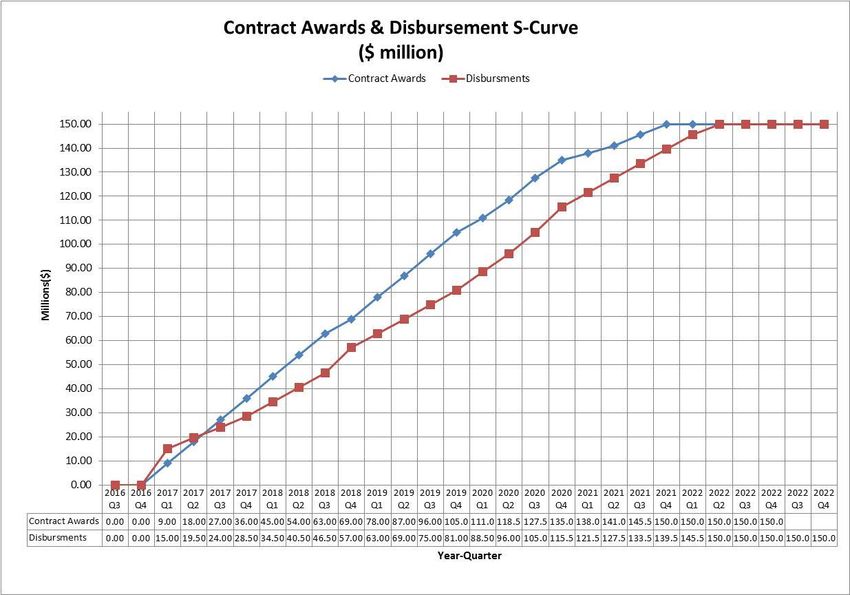
Source: Asian Development Bank estimates.18 H. Contract Awards and Disbursement S-curve
19

I.     Fund Flow Diagram

            Ministry of Finance
     (on behalf of the Government of the                                 Asian Development Bank
         People’s Republic of China             Loan agreement

                            On-loan agreement                     Project agreement

                           Shandong Financial Department (Imprest Account)
                            (on behalf of the Shandong Provincial Government)

        Finance Bureau of Zibo                                               Finance Bureau of
              Prefecture                                                     Weifang Prefecture

          Huantai                   Qingzhou             Shouguang           Changle        Gaomi
          County                       City                 City             County          City
        (pass-through              (pass-through         (pass-through         (pass-       (pass-
           account)                   account)              account)          through      through
                                                                              account)     account)

                             Contractors, consultants, and other service providers

                            Loan and on-lending agreements and loan repayment
                            ADB Funds flow
                            Payments to service providers with ADB funds

                            Payments to service providers with ADB and counterpart funds
20
V. FINANCIAL MANAGEMENT
A. Financial Management Assessment
17. The financial management assessment (FMA) was conducted in January 2015 in
accordance with ADB’s Guidelines for the Financial Management and Analysis of Projects and
the Financial Due Diligence: a Methodology Note to assess the financial management capacity
of the executing and implementing agencies. The FMA includes fund flow arrangements,
staffing, accounting policies and procedures, internal and external auditing arrangements,
reporting and monitoring, and financial information system. The FMA concluded that the pre-
mitigation financial management risk of the executing and implementing agencies is “low”.
Based on the assessment, the key financial management risks identified are limited to the
implementing agencies and include a lack of experience of ADB project management, lack of
accounting staff for review procedure, and insufficient internal auditing. Agreed mitigation
measures include to (i) conduct training on ADB's disbursement procedures and project
accounting requirements; and (ii) engage consultant services support to the PMO, implementing
agencies, and other project agencies on project management and supervision. The identified
risks in financial management will be closely monitored during project implementation. The
overall financial management risk of the executing and implementing agencies with the
mitigation measures is considered is “low”.
B. Disbursement
1. Disbursement Arrangements for ADB
18. The loan proceeds will be disbursed in accordance with ADB’s Loan Disbursement
Handbook (2015, as amended from time to time),11 and detailed arrangements agreed upon
between the government and ADB. Online training for project staff on disbursement policies and
procedures is available at http://wpqr4.adb.org/disbursement_elearning. Project staffs are
encouraged to avail of this training to help ensure efficient disbursement and fiduciary control.
19. To facilitate project implementation through timely release of loan proceeds, the SPG,
through Shandong Finance Department (SFD) will establish an imprest account promptly after
loan effectiveness at a commercial bank acceptable to ADB.12 The SFD, who will establish the
imprest account in its name, is accountable and responsible for proper use of advances made to
the imprest account. The government may request for initial and additional advances to the
imprest account based on 6 months estimated expenditures to be financed through the imprest
account. The imprest account will be established, managed, and liquidated in accordance with
ADB’s Loan Disbursement Handbook (2015, as amended from time to time) and detailed
arrangements agreed by the government and ADB. The handbook describes which (i)
supporting documents should be submitted to ADB, and (ii) should be retained by the
government for liquidation and replenishment of an imprest account.
20. The PMO will submit project level disbursement projections to ADB based on projections
prepared by the implementing agencies. The implementing agencies will be responsible for
arranging counterpart financing or requesting budgetary allocations for counterpart funding, as
appropriate. The implementing agencies will prepare disbursement claims and collect
11
Loan Disbursement Handbook: http://www.adb.org/Documents/loan-disbursement-handbook.
12
The bank charges incurred in the operation of the imprest account may be financed from the loan proceeds.21
supporting documents, which will then be passed to the PMO for review and endorsement
before onward transmission to their prefecture finance bureaus. Cities and counties are
responsible for initiating payments by the SFD and the SFD is responsible for sending loan
withdrawal applications to ADB.
21. The minimum value per withdrawal application is $100,000 equivalent. Individual
payments below this amount should be paid from the imprest account or by the executing
agency and subsequently claimed to ADB through reimbursement, unless otherwise accepted
by ADB.
22. The statement of expenditure (SOE) procedure may be used for reimbursement of
eligible expenditures or liquidation of advances to the imprest account(s). 13 Supporting
documents and records for the expenditures claimed under the SOE should be maintained and
made readily available for review by ADB's disbursement and review missions, upon ADB's
request for submission of supporting documents on a sampling basis, and for independent
audit. Before the submission of the first withdrawal application, the SPG, through SFD, should
submit to ADB sufficient evidence of the authority of the person(s) who will sign the withdrawal
applications, on behalf of the borrower, together with the authenticated specimen signatures of
each authorized person.
2. Disbursement Arrangements for Counterpart Fund
23. The SPG will ensure that (i) all local and foreign currency counterpart funds, including
cash advances, necessary for the smooth and successful completion of the project are provided
in a timely manner; and (ii) additional funds, as and when needed, will be provided to meet any
project shortfall or cost overruns. The SPG will also ensure that operation and maintenance of
all project facilities is fully funded from the government budget.
C. Accounting
24. The Shandong Water Resources Department (SWRD), on behalf of the executing
agency, will maintain, or cause to be maintained, separate books and records by funding source
for all expenditures incurred on the project. The SWRD will prepare consolidated project
financial statements annually following international accounting principles and practices or those
prescribed by the government's accounting laws and regulations.
D. Auditing and Public Disclosure
25. The SWRD, on behalf of the executing agency, will cause the detailed consolidated
project financial statements to be audited in accordance with International Standards on
Auditing and the Government Auditing Standards of the PRC (where these are consistent with
International Standards on Auditing), by an auditor acceptable to ADB. The audited project
financial statements will be submitted in English language to ADB within 6 months of the end of
the fiscal year by the executing agency.
26. The annual audit report for the project financial statements will include a management
letter and auditor’s opinions which cover (i) whether the project financial statements present a
13
The relevant forms are available in Appendix 9B and 9C of ADB’s Loan Disbursement Handbook (2015, as
amended from time to time).22
true and fair view or are presented fairly, in all material respects, in accordance with the
applicable financial reporting standards; (ii) whether the proceeds of the loan were used only for
the purpose(s) of the project; (iii) whether the borrower or executing agency was in compliance
with the financial covenants contained in the legal agreements (where applicable); (iv) use of
the imprest fund procedure; and (v) use of the SOE procedure certifying the eligibility of those
expenditures claimed under SOE procedure, and proper use of the SOE and imprest
procedures in accordance with ADB’s Loan Disbursement Handbook (2015, as amended from
time to time), and project documents.
27. Compliance with financial reporting and auditing requirements will be monitored by
review missions and during normal program supervision, and followed up regularly with all
concerned, including the external auditor.
28. The government, SWRD, and the five implementing agencies have been made aware of
ADB’s approach to delayed submission, and the requirements for satisfactory and acceptable
quality of the audited project financial statements.14 ADB reserves the right to require a change
in the auditor (in a manner consistent with the constitution of the borrower), or for additional
support to be provided to the auditor, if the audits required are not conducted in a manner
satisfactory to ADB, or if the audits are substantially delayed. ADB reserves the right to verify
the project's financial accounts to confirm that the share of ADB’s financing is used in
accordance with ADB’s policies and procedures.
29. Public disclosure of the audited project financial statements, including the auditor’s
opinion on the project financial statements, will be guided by ADB’s Public Communications
Policy (2011).15 After review, ADB will disclose the audited project financial statements and the
opinion of the auditors on the project financial statements no later than 30 days of ADB’s
confirmation of their acceptability by posting them on ADB’s website. The management letter,
additional auditor’s opinions, and audited entity financial statements will not be disclosed.16
VI. PROCUREMENT AND CONSULTING SERVICES
A. Advance Contracting and Retroactive Financing
30. To expedite project implementation, the government requested ADB to approve advance
contracting and retroactive financing of consultant services and works packages. Use of
retroactive financing of eligible expenditures will be restricted to 20% of the loan amount. When
14
ADB’s approach and procedures regarding delayed submission of audited project financial statements:
When audited project financial statements are not received by the due date, ADB will write to the executing
agency advising that (i) the audit documents are overdue; and (ii) if they are not received within the next 6
months, requests for new contract awards and disbursements, such as new replenishment of imprest accounts,
processing of new reimbursement, and issuance of new commitment letters will not be processed.
When audited project financial statements are not received within 6 months after the due date, ADB will withhold
processing of requests for new contract awards and disbursements, such as new replenishment of imprest
accounts, processing of new reimbursement, and issuance of new commitment letters. ADB will (i) inform the
executing agency of ADB’s actions, and (ii) advise that the loan may be suspended if the audit documents are
not received within the next 6 months.
When audited project financial statements are not received within 12 months after the due date, ADB may
suspend the loan.
15
Public Communications Policy: http://www.adb.org/documents/pcp-2011
16
This type of information would generally fall under public communications policy exceptions to disclosure. ADB.
2011. Public Communications Policy. Paras. 97(iv) and/or 97(v).23
undertaking implementation activities under ADB retroactive financing facility, it is the
responsibility of the SPG to ensure that all relevant aspects of ADB’s Safeguard Policy
Statement (2009) and project specific safeguard plans are fully adhered to.
31. Advance contracting will include (i) tendering and bid evaluation for civil works
packages, (ii) preparation of tendering documents for procurement of materials and equipment,
and (iii) recruitment of consultants. The issuance of invitations to bid under advance contracting
will be subject to ADB’s approval. According to the preliminary procurement plan, 10 civil works
contracts, 1 equipment contract, and 3 individual consultant contracts will be procured through
advance contracting. In preparing the bidding documents under the advance contracting
arrangement, the SPG, through the PMO, must ensure that the provisions of all loan
assurances agreed at loan fact-finding (or as modified at loan negotiations) are incorporated in
their latest form. These assurances include monitoring and reporting requirements placed on
contractors, compliance with labor laws and regulations, specific measures in the environmental
management plan (EMP), and social and gender action plan (SGAP).
B. Procurement of Goods, Works and Consulting Services
32. All procurement of goods and works will be undertaken in accordance with ADB’s
Procurement Guidelines (2015, as amended from time to time).17 Except as ADB may otherwise
agree, the following process thresholds shall apply to procurement of goods and works.
33. Civil works contracts estimated to cost $25 million and above, and contracts for goods
estimated to cost $3 million and above will be procured using international competitive bidding
(ICB) procedures. Contracts for works and goods estimated to cost less than the ICB values but
equal to $100,001 and above will be procured through national competitive bidding (NCB). NCB
will be conducted in accordance with the PRC Tendering and Bidding Law (2000), subject to
modifications agreed with ADB. Contracts for goods and works estimated to cost less than the
above NCB values will be procured using shopping procedures. The relevant sections of ADB's
Anticorruption Policy (1998, as amended from time to time) will be included in all procurement
documents and contracts.
34. For NCB, the first draft English language of the procurement documents
(prequalification, bidding documents, and draft contract) should be submitted for ADB’s approval
regardless of the estimated contract amount. Subsequent procurements are subject to post
review. All ICB contracts are subject to prior review and ADB’s approval of the procurement
documents (bidding and contract) is required.
35. A procurement plan over the life of the project including the first 18-month procurement
contract packages starting from July 2015 has been prepared and agreed with the PMO and the
implementing agencies, which indicates procurement method, estimated costs of contracts,
threshold and review procedures, goods, works, and consulting service contract packages, and
NCB guidelines. The details are in section C.
36. Consulting services will be required for (i) project management support, (ii) capacity
development for water policy and conservation demonstration activities, and (iii) software
development for the MIS in Huantai County. The outline terms of reference (TOR) for each of
the three consulting services packages are described in section D.
17
http://www.adb.org/documents/procurement-guidelinesYou can also read


