Property Strategy 2018-2021 - Bayside City Council
←
→
Page content transcription
If your browser does not render page correctly, please read the page content below
Property Strategy 2018-2021
Contents
   1. 1. Executive Summary .................................................................................... 3
        Introduction ........................................................................................................ 3
        Structure of the Strategy .................................................................................... 3
        Purpose.............................................................................................................. 3
        Scope ................................................................................................................. 3
        Council’s role/s .................................................................................................. 3
        Key Principles .................................................................................................... 4
        Key issues and findings ..................................................................................... 4
        Vision statement ................................................................................................ 4
        Goals and strategic objectives ........................................................................... 5
   2. 2. Action Plan ................................................................................................... 6
   3. 3. Glossary ..................................................................................................... 13
   4. 4. Purpose ...................................................................................................... 13
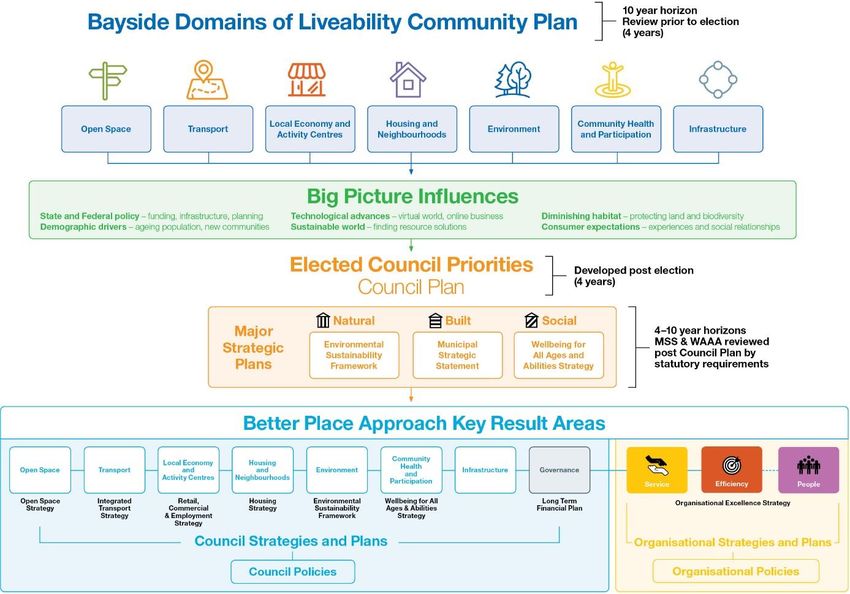
   5. 5. Council’s Better Place Strategic Planning Framework ......................... 14
   6. 6. Scope .......................................................................................................... 14
   7. 7. Vision statement, Principles, Goals and strategic objectives .............. 16
   8. 8. Key issues and findings ........................................................................... 17
   9. 9. Background ................................................................................................ 17
        9.1       History ................................................................................................... 17
        9.2       Previous strategy .................................................................................. 18
        9.3       Key stakeholders .................................................................................. 18
   10. 10. Legislative and policy and context ........................................................ 20
   11. 11. Key trends ................................................................................................ 20
   12. 12. Infrastructure/ assets .............................................................................. 22
        12.1          Nature and type of assets ................................................................. 22
        12.2          Buildings Service Driven Asset Management Plan .......................... 23
        12.2.1        Asset Remaining Life ........................................................................ 23
        12.2.2        Building Condition ............................................................................. 23
   13. 13. Financial analysis .................................................................................... 24
        13.1          Asset Category Quantities & Replacement Costs ............................ 24
        13.2          Property Income for Leased Assets ................................................. 25

Property Strategy 2018-2021                                                                                                         2
1. Executive Summary
Introduction
Council owns or controls a significant number of properties and buildings that are used for a variety of
purposes that contribute to the delivery of all of the domains of liveability outlined in the Bayside Community
Plan.
Council’s property portfolio has been assembled over many decades and has not always been guided by a
coherent approach to the acquisition, use and disposal of property. The current portfolio includes land and
buildings that are used for:
direct service delivery by Council
the delivery of community based services by not for profit organisations
recreational and sporting pursuits
commercial activity
passive open space, environmental management and car parking
Improved management of the property portfolio presents a significant opportunity to improve the public value
derived from these assets through improved utilisation and financial performance.
Structure of the Strategy
The Strategy identifies the Vision, principles goals and objectives that guide the manner in which Council
property is to be utilised and managed. It also outlines the priority actions to be undertaken to achieve the
goals and objectives and the measures that will be used to assess the success of the strategy.
Purpose
The purpose of the strategy is to ensure that Council property delivers the highest possible public value
through effective planning, utilisation and management.
Scope
The scope of the strategy is Council Freehold land, Crown Land under Committee of Management, discontinued
roads and rights of way, property that is leased, licenced or otherwise occupied by third parties and easements.
Property that is used for public open space, roads, bushland reserves and parkland is outside the scope of this
strategy.
Council’s role/s
Council has a range of roles in managing property. These roles include planning for the long term delivery of
Council services, land and property maintenance, management of tenancy arrangements with community and
commercial tenants and the strategic use of property assets to achieve broader community benefit.
Property Strategy 2018-2021 3Key Principles
This Strategy is based on the following guiding principles:
1. Council property is to be used to deliver the highest possible community value
2. Property assets are to be fit for purpose, well maintained and financially sustainable
3. Property occupied by community and not for profit groups will have high levels of
utilisation and generate demonstrable benefits to the broader community
4. Decisions on the future use of property will be transparent and deliver equitable
outcomes
5. Council property will be used to leverage strategic outcomes and commercial return
where appropriate
Key issues and findings
• Many of Council’s buildings are aging and were built for a specific type of service delivery that in
many cases has not kept up with changes in service needs.
• Recent increases in funding for maintenance and renewal has eliminated the renewal gap and the
overall standard of Council’s building stock is now gradually improving. However, many of these
buildings are not designed to meet the needs of contemporary community service delivery.
• Council has 256 occupancy agreements in place with a variety of community and sporting groups.
Most of these agreements are leases which grant exclusive occupancy regardless of the level of
usage of the facility. Many community groups are resistant to sharing facilities.
• The current use of some Council land is not maximising the potential community or economic return
of the asset.
• Some leased facilities are in poor condition as the tenant organisations have not kept up the
maintenance of the buildings.
• There has been limited assessment of the alignment of a group to Council objectives, capacity to
contribute to the ongoing management of property and the benefit derived by the use.
• The majority of Council properties occupied by community groups are provided at a minimal rental
and do not always consider the capacity of the user groups to contribute further to support the
management of the property.
• The contribution by the user group and the cost to maintain the property occupied has not been
transparently or openly reported over time.
• Council has not historically funded or planned for the future upgrade to many commercial facilities.
• The financial constraints as a result of rate capping create a need to ensure community assets deliver
effective service outcomes at an affordable cost.
• Utilisation and capacity data has proven difficult to accurately collect. A number of leases do not
require utilisation data to be provided by tenants and the accuracy of tenant generated data is
sometimes variable.
Vision statement
Council’s property portfolio is strategically aligned with its service delivery
objectives and community needs. Council properties are well utilised, well
maintained and generate high levels of public value.
Property Strategy 2018-2021 4Goals and strategic objectives
Goal 1. The service needs of the community are supported by property now and into the future
1.1 The Property portfolio is well planned to meet current and future service needs
1.2 Utilisation of property assets is maximised through colocation of services in multi use facilities
Goal 2. Use of Council property by community groups delivers maximum public value
2.1 Decisions on property use consider the broader public benefit
2.2 User contributions to support ongoing management of property are equitable and linked to capacity to
pay and public value contribution
2.3 Utilisation of property is increased through colocation of community groups and decommissioning of
buildings that are nor delivering strong public value
2.4 Innovative funding models and strategic partnerships are explored as a way of delivering asset
enhancement
Goal 3. Commercial property holdings deliver sustainable return to the community
3.1 Council’s property holdings are used to leverage strategic outcomes
3.2 Commercial properties have long term management and renewal plans in place
Goal 4. Open and transparent management systems & reporting
4.1 Robust Property data and analysis supports transparent decision making
4.2 Transparent reporting on property utilisation is regularly provided
Performance Indicators
% return on Leased/Licensed assets - target >2.61% increasing to 3% in 2021. This indicator measures the
return to Council from leased/licenced assets with an increasing reflective of a greater overall contribution.
% of Occupancy agreements that are current - target >95%. This indicator measures the ability to ensure
groups occupying Council facilities that are not in over holding.
% of Occupancy agreements that have multiple users in a facility – increasing % as leases are
renewed/renegotiated. This indicator measures the change in occupancy patterns from single user facilities to
multi user facilities.
% of Council facilities with a condition rating average, good or excellent – target >90%. This indicator is
reflective of the ongoing maintenance and renewal of Council buildings.
Property Strategy 2018-2021 52. Action Plan
Goal 1. The service needs of the community are supported by property now and into the future
1.1 The Property portfolio is well planned to meet current and future service needs
1.2 Utilisation of property assets is maximised through colocation of services in multi use facilities
Strategy Action Action/s Time frame Costs Department Deliverable
Item
No
Property Portfolio is 1.1.1 Document and prioritise land required to be 20/21 $10,000 Commercial Prioritised land
well planned to acquired for Open Space and service delivery Services acquisition plan
meet current and needs
future services Open Space
needs Recreation and
Wellbeing
1.1.2 Determine four year property needs related to 18/19 nil Commercial Prioritised property
service plans and identify changes required for Services/ Strategy asset plan
property use and Performance
1.1.3 Ensure service driven asset use changes Ongoing Nil Commercial Property reviewed for
incorporate consideration of highest and best use of Services highest and best use
property
1.1.4 Develop management plans for Council historic 20/21 $60,000 Commercial Historic properties
properties to ensure complimentary uses support Services assessment of
ongoing service (Black Rock House, Kamesburgh, beneficial use and long
Billilla, Masonic Hall) Service Areas term management
plans
Property Strategy 2018-2021 6Utilisation of 1.2.1 Complete upgrade of Masonic Hall and 18/19-20/21 City Assets and Funded upgrade of
property assets is Sandringham Library to collocate community Projects Sandringham library
maximised through groups including and community
colocation of Communications facilities
services in multi Decommission and sale of Abbott Street Customer and
use facilities Decommission and sale of Karrakatta Street Cultural Services
Commercial
Services
Community
Services
1.2.2 Acquire CSIRO land 18/19 $15M Urban Strategy, Land available for
Commercial service use
Develop multi use community facility 20/21 Services,
City Assets and
Projects,
Communications
Customer and
Cultural Services
1.2.3 Complete Hampton Hub Feasibility Study 18/19 $50,000 Open Space Plan for service and
Recreation and property needs
Complete Brighton Recreation Centre Feasibility Wellbeing
Study
Property Strategy 2018-2021 7Goal 2.Use of Council property by community groups delivers maximum public value
Strategic objective
2.1 Decisions on property use consider the broader public benefit
2.2 User contributions to support ongoing management of property are equitable and linked to capacity to pay and public value contribution
2.3 Innovative funding models and strategic partnerships are explored as a way of delivering asset enhancement
Strategy Action Action/s Time frame Costs Resourcing Deliverable
Item
No
Decisions on 2.1.1 Review each lease at renewal to determine the Ongoing Operational Commercial Consistent Lease
property use current and proposed community benefit (lease budget Services documents
consider the renewal)
broader public
benefit
2.1.2 Develop mechanism to ensure property projects 18/19 Operational Commercial Mechanism to
consider highest and best use of land to maximise budget services consider maximum
overall community benefit (including additional uses community benefit
and costs)
User contributions 2.2.1 Complete leases / licences in over holding with 18/19-19/20 Operational Commercial All properties have
to support ongoing focus to maximise community benefit Budget Services current occupancy
management of (use/utilisation/contribution) arrangements
property are
equitable and
linked to capacity to
pay and public
value contribution
Community groups 2.3.1 Develop a mechanism to support co-contribution or Operational Commercial Mechanisms in place
develop innovative prioritisation of projects with significant or full Budget Services to support funding and
funding models and funding from alternative sources partnerships for asset
strategic Open Space enhancement
partnerships for Recreation and
asset enhancement Wellbeing
Property Strategy 2018-2021 82.3.2 Negotiate sinking funds as part of new lease Ongoing Operational Commercial Lease agreements
requirements for community groups with exclusive Budget services with surface renewal
use of court surfaces plans
Open Space
Recreation and
Wellbeing
Property Strategy 2018-2021 9Goal 3. Commercial property holdings deliver sustainable return to the community
Strategic Objective
3.1 Council’s property holdings are used to leverage strategic outcomes
3.2 Commercial properties have long term management and renewal plans in place
Action Action/s Time frame Costs Resourcing Deliverable
Item
No
Council’s property 3.1.1 Determine opportunities to go to market for 18/19 Operational Commercial Lease of assets with
holdings are used commercial operators which support co-investment Budget Services renewal plan
to leverage where appropriate
strategic outcomes
3.1.3 Finalise review of Black and Well Street parking for 17/18 $50,000 Commercial Completion of Feasibility
commercial return and increase in parking Services study for increased
parking that is self
funding
3.1.4 Finalise construction and sale of remaining bathing 18/19 $65k approx. City Assets Bathing Box Sale
box at Dendy Beach $300k and Planning
income
Commercial
Services
3.1.5 Discontinue and sell laneways, roads, right of ways ongoing Nil out of Commercial Income from Ongoing
and drainage reserves where ownership is not pocket Services rationalisation of old
required in Council name to protect the community lanes/roads reserves
benefit
Commercial 3.2.1 Identify any facilities without long term plans in 19/20 $60,000 Commercial Plans for future of
properties have place and undertake site planning Services and Council properties
long term Service
management and Managers
renewal plans in
place
Property Strategy 2018-2021 103.2.2 Determine future timing and scope for renewal of 18/19 $170,000 Open Space Masterplan
the Sandringham Family Leisure Centre Recreation
and Wellbeing
2.3.2 Undertake lease for Dendy Beach Café (pending 18/19 $10,000 Commercial Lease agreement
outcome of VCAT) Services
3.2.3 Complete planning and determine upgrade and 18/19 Open Space Masterplan
future leasing approach for: Recreation
and Wellbeing
Ricketts Point café
North Point café Commercial
Jetty Road Kiosk Services
Property Strategy 2018-2021 11Goal 4. Open and transparent management Systems & Reporting
Strategic objective/s
4.1 Robust Property data and analysis supports transparent decision making
4.2 Transparent reporting on property utilisation is regularly provided
Strategic indicator/s
Strategy Action Action/s Time frame Costs Resourcing Deliverable
Item
No
Robust Property 4.1.1 Implement annual audit program and robust ongoing In budget City Assets Improved asset
data and analysis procedures to support improved management of and Projects management
supports Council properties
transparent Commercial
decision making Services
4.1.2 Develop a data capture system to allow 18/19 In budget City Assets System changes to
assessment of utilisation of properties in and Projects support data capture
accordance with lease
Commercial
Services
4.1.3 Incorporate annual reporting requirements on 19/20 in budget Commercial Ongoing reporting by
utilisation of facilities into lease agreements Services facility users on
utilisation
Transparent 4.2.1 Prepare an annual report on the level of subsidy 18/19 0 Commercial Annual report on
reporting on provided to building occupants including the Services subsidy
property utilisation maintenance and renewal costs
is regularly
provided
Property Strategy 2018-2021 123. Glossary
Lease A right granted by the owner of land (landlord) to another person
(tenant) to have exclusive possession of that land, or part thereof, for
a fixed duration in return for rental payment. A lease creates an
interest in land that is binding on third parties and is capable of being
assigned, unless the lease specifies to the contrary.
Licence Permits a person (licensee) to occupy land (or part thereof) on
particular conditions. The main feature that distinguishes a licence
from a lease is that a licence does not permit exclusive occupancy of
the land. Unlike a lease, a licence does not create any interest in the
land and the rights created by a licence are personal and do not run
with the land.
Occupancy Agreement A lease or licence over Council land
Commercial property Council asset used by a third party to undertake a business activity
under a lease or licence arrangement such as a Café, golf course
4. Purpose
To set the strategic direction to ensure Council property is managed for the long term community
benefit that maximises the social, cultural, recreational, environmental and economic outcomes for
which the land is held.
Property is a significant and highly valuable resource that directly underpins the capacity and
performance of a wide range of Bayside City Council’s services. Whilst essential, it is costly to run
and maintain so it is imperative that the property portfolio meets the service and community needs it is
maintained for.
Property Strategy 2018-2021 135. Council’s Better Place Strategic Planning Framework The Property Strategy supports the Community Plan and Council Plan by ensuring the service needs of Council and community expectations are supported with appropriate, fit or purpose property assets to deliver the short and long term objectives of Council. This strategy is significantly influenced by other Council strategies which provide direction for Council assets. The key supporting plans include the Recreation Strategy, Open Space Strategy and the Buildings Service Driven Asset Management Plan which provide direction on the development of Council recreation, open space and building infrastructure. It does not seek to replicate these, however planning for open space and Council owned and managed infrastructure creates the direction for where property must be retained and managed or where changes to the property portfolio are required. This may include acquisition, decommissioning, changing uses or disposal to support the delivery of Council objectives. 6. Scope Whilst the Strategy covers all land retained by Council to meet community service delivery needs it particularly focuses on Council Freehold land, Crown Land under Committee of Management, roads and rights of ways either owned or vested in Council and no longer used for public access purposes, leases, licences, tenancies and easements. Council property portfolio includes assets worth over $1.7 Property Strategy 2018-2021 14
Billion. Much of this relates to public open space, roads, reserves and parkland which are specifically
outside the scope of this strategy.

From time to time Council will also seek to acquire or dispose of land, undertake a multiuse
development or put in place occupancy arrangements for particular service delivery needs. In these
cases it works to support the outcomes articulated in the specific service strategy. Where more detail
in terms of land management exists in another strategic plan or master plan the reference in the
property strategy will be on the work to ensure delivery of the property asset associated with that plan.

The following are specifically excluded from the Strategy:
  Roads that continue to be used for public access                         Road Management Plan

  footpaths and curbs, drainage assets

  Public toilets (unless they form part of a public building)              Public Toilet Strategy

  Open Space (except where acquisition, disposal or change in use          Open Space Strategy
  are contemplated)

  Foreshore assets including car parks, boat ramps jetties and areas       Coastal Management Plan
  of the coast

The Property Strategy builds on the work already undertaken by Council (via existing property policies
and other service strategies) and to provide the framework to systematically review Council’s existing
property portfolio, to improve the performance of key property assets and assist Council in delivering its
Community Plan.

Property Strategy 2018-2021                                                                           15
7. Vision statement, Principles, Goals and
  Strategic Objectives
Vision:
Council’s property portfolio is strategically aligned with its service delivery objectives and
community needs. Council properties are well utilised, well maintained and generate high
levels of public value.

PRINCIPLES

1. Council property is to be used to deliver the highest possible community value
2. Property assets are to be fit for purpose, well maintained and financially sustainable
3. Property occupied by community and not for profit groups will have high levels of utilisation and
   generate demonstrable benefits to the broader community
4. Decisions on the future use of property will be transparent and deliver equitable outcomes
5. Council property will be used to leverage strategic outcomes and commercial return where
   appropriate

             The service needs     Use of Council          Commercial            Open and
             of the community      property by             property holdings     transparent
Goals        are supported by      community groups        deliver sustainable   management
             property now and      delivers maximum        return to the         Systems &
             into the future       public value            community             Reporting
Strategic    The Property          Decisions on            Council’s property    Robust Property
Objectives   portfolio is well     property use            holdings are used     data and analysis
             planned to meet       consider the broader    to leverage           supports transparent
             current and future    public benefit          strategic outcomes    decision making
             service needs

             Utilisation of        User contributions to   Commercial            Transparent
             property assets is    support ongoing         properties have       reporting on property
             maximised through     management of           long term             utilisation is regularly
             colocation of         property are            management and        provided
             services in multi     equitable and linked    renewal plans in
             use facilities.       to capacity to pay      place
                                   and public value
                                   contribution

                                   Innovative funding
                                   models and strategic
                                   partnerships are
                                   explored as a way of
                                   delivering asset
                                   enhancement

  Property Strategy 2018-2021                                                                 16
8. Key issues and findings Much of Council property is held in public open space, roads, drainage, environmental and municipal uses. Only a small portion of Council land is used for direct Council service delivery with a number of facilities that support community and commercial activities. Council Strategic Building Asset Management Plans has identified long term issues with maintenance and renewal of Council facilities and incorporates an approach to funding the long term management of Council assets. This shows that there is a need to improve the management of assets occupied by community groups, commercial users and council services. The asset consumption ratio of 2.54% from this figure from modelling will be used to report the cost of an asset. The assets occupied or used by community groups do not provide a financial return to offset the cost of managing and maintaining the assets. The broader community benefit of providing the heavily subsidised property assets needs to be considered against the financial cost as part of open and transparent reporting to the community. The services or uses provided by the community include community support services by not for profit groups, sporting, educational and social activities which may not otherwise be available. Historically Council and community groups have not significantly invested in capital for asset renewal. The capital investment profile by Council has changed significantly in recent years with investment in pavilions, sports grounds and other community buildings. Asset management plans and Master Plans have identified changes to service needs and capital investment required into the future for some assets. The ongoing development of service plans and associated asset management plans for assets which do not yet have these is required. Occupancy agreements in place have traditionally supported single user groups, some that have funded the initial capital investment in infrastructure as part of occupancy. Not all these groups have the capacity to fund and maintain the infrastructure they occupy with significantly more legislative requirements for occupational health and safety, escalating maintenance and capital costs and declining capacity to raise funds. The need to maintain sustainable property assets, provide needed support for community groups aligned to Council objectives means some groups will need to consider shared use, merging or finding innovative funding models into the future. 9. Background 9.1 History Council has significant land holding which have been managed in different ways based on service delivery needs. The land uses include open active and passive space, buildings for direct service delivery, community uses, natural environment, car parking, roads, drains and other municipal purposes. The land encompasses over 1,100 individual land title parcels. The majority of these relate to public open space, golf courses and roads. Once these are stripped out the number of parcels is reduced to approximately 150 parcels which are mainly car parks (72) and assorted properties used for Council activities and by community groups (76). There are approximately 351 buildings on these properties with uses ranging from Council administration and services, halls, clubrooms and pavilions. Historically Council has provided land to support community uses such as tennis, bowls and other not for profit community group uses. Much of the community infrastructure on Council land was initially built by specific community groups including sports clubs, scouts groups and other organisations. Additionally Council has built its own infrastructure and in more recent years has commenced a program of capital renewal to significantly improve aging, not fit for purpose infrastructure. The ability of community groups to meet new legislation, raise funds and maintain the infrastructure they occupy has become increasingly challenging. Council currently has 256 occupancy agreements with various Property Strategy 2018-2021 17
tenants for a variety of community, social, recreational or commercial purposes on Council owned or
managed land. The majority of occupancy agreements are exclusive lease arrangements with only a
few shared use agreements in place. Council receives an annual rental income of $3.8 Million from its
leased/licenced assets predominantly from commercially leased assets (Golf, Café, Leisure Centre
and School use) with only minimal rental return from community leased assets of $242K.

The current renewal expenditure on buildings and facilities is $2 million and is expected to rise
annually to $6.9 million in 2022/23 then fall to $6.5 million in 2024/25, equating to an average annual
renewal cost of $5.4 million over 10 years. A ‘renewal spike’ is forecast to occur in between 2030 and
2050 reflecting the fact that many assets were built in the 1950 to 1970 time period.

9.2     Previous strategy
The 2014 Property Strategy was the first property strategy. The 2014 strategy was sent to all Council
tenants and publicised on Council website and local papers for commentary prior to adoption. There
is minimal change in the overall direction of the revised strategy which continues to address the issues
of well planned and managed community infrastructure.

Over the life of the strategy Council has undertaken strategic service reviews and commenced
improved service planning to identify asset needs. A number of significant property disposals and
acquisitions have occurred along with major property decisions related to changing use to meet
changing community needs and aspirations.

Whilst not all actions have been fully completed they have set a strong framework for the updated
strategy. Actions underway include finalisation and implementation of the updated Lease and Licence
Policy, implementation of changes to Council Golf Courses, planning for Council’s commercial assets
and improved transparency and reporting of property data.

No specific consultation has been undertaken on the updated property strategy as the issues identified
have not significantly changed from the previous strategy. The specific actions which are undertaken
as a result of the strategy are subject to consultation, much of this legislated. For example there are
significant statutory processes related to any sale of Council land or lease arrangements of 10 years
or more which mandate public advertising of the intention of Council and seeking public comment prior
to finalising any decision making.

9.3     Key stakeholders
The property strategy impacts a broad range of stakeholders including residents, visitors, business
operators and specific users of Council Property Assets.

  Internal Stakeholders
  Stakeholder Group            Role or Involvement
                               Custodian of the asset, with Councillors representing the community
  Council                      and setting strategic direction as per the Council and Operational
                               Plans.
                               To ensure that Asset Management policy and strategy is being
                               implemented as adopted, and to ensure that long-term financial needs
  Executive Team
                               to sustain the assets for the services they deliver are advised to
                               Council for its strategic and financial planning processes.
  Manager City Assets and      Coordinates the management of the building stock including asset
  Projects                     systems, condition monitoring, renewal, design standards and the

Property Strategy 2018-2021                                                                           18
Internal Stakeholders
development, monitoring and updating; Ensure provision of the
required/agreed level of operations, cleaning and maintenance
services, delivery of renewal of building components and delivery of
upgrade and new capital works. To ensure that buildings are
compliant with statutory responsibilities
Service managers are responsible for understanding expectations of
levels of service through effective, ongoing engagement with the
Service Area Managers community (users of the service). Planning for changes to operations
and maintenance, renewal and upgrade of existing buildings and the
construction of new buildings depending on the outcomes of the
community engagement and research on service level provisions;
Manage delivery of the Property Strategy and ensure property assets
are available to support service delivery plans.
Manager Commercial Provide oversight and transparency of Council property.
Services Ensure effective delivery of Council Lease and Licence Policy and
tenants comply with lease conditions / requirements with respect to
renewal, maintenance and insurance.
To ensure that appropriate policy practices are carried out and to
Internal auditors
advise and assist on improvements
External Stakeholders
Stakeholder Group Role or Involvement
Community General users/beneficiaries of the services
Including community user
groups
Service Providers / External organisations that provide services to the community utilising
Leaseholders Council owned building and facilities.
Maintenance contractors To ensure provision of the required/agreed level of maintenance
(external) services for assets.
Utility Service Providers Agencies that provide utility services such as electricity, gas, water,
sewerage, telecommunications necessary to facilitate services within
a building.
State and Federal Periodic provision of advice, instruction and support funding to assist
Government with management of the building stock.
Departments Legislation and regulatory frameworks for managing Council property
Council’s Insurer. Insurance and risk management issues.
Property Strategy 2018-2021 1910. Legislative and policy and context Local Government Act 1989. Local Government (General) Regulations 2004. Retail Leases Act 2003. Retail Leases Regulations 2003. Crown Land (Reserves) Act 1978 (Vic). Occupational Health and Safety Act 2004. Residential Tenancies Act 1997. Planning and Environment Act 1987. Health Act 1958. Children’s Services Act 1998. National Competition Policy Charter of Human Rights Environment Protection Authority, Planning permit provisions (including liquor licence provisions) Council Leasing Policy Council Discontinuance and sale of roads, right of ways and drainage easements Policy Building Act 1993 & Building Regulations 2006 Building Code of Australia (BCA) Heritage Act 1995 Planning and Environment Act 1987 Council Planning Scheme All relevant Australian Standards Occupational Health and Safety Regulations All other relevant State and federal Acts and Regulations All Local Laws and relevant policies of the Organisation 11. Key trends There is an increasing expectation that assets will be available for multiple purposes and uses. This supports a focus on maximising utilisation and developing a more sustainable asset base. This is a shift away from single use single user buildings which Council has historically constructed. Changing demographics in the Community: Asset based building services must be managed to ensure they effectively support the changing community needs and priorities. The community in Bayside has several specific demographic attributes. An increasing proportion of the community is aging, there is also a significant and growing representation of the very young. Key changes in Bayside through to 2028 are expected to see growth in seniors aged 70-84 years and growth in 'empty nesters' and retirees. This will require ongoing evaluation of the services offered by Council, other entities and the community to meet the changing demographic profile. Over this period population will continue to increase with 8,146 additional residents and 4,473 additional dwellings. Property Strategy 2018-2021 20
Market need for services: services that are provided externally by either for-profit or not-for-profit
organisations influence the need for Council to provide the same service. For example the Hampton
and Sandringham Childcare Centres were closed, and the buildings sold in 2014 and 2015
respectively. The expectation is however that significant community infrastructure will be required to
maintain facilities for families and mature/older adults and adapt service mix and infrastructure to cater
for needs of growing population of seniors, the elderly and adults aged 25-34. There will continue to
be demand for provision of leisure and learning facilities and activities (U3A, community centres)
currently supported by Council.

The increase participation of females in sport is creating a need to ensure facilities cater equitably for
all needs including gender participation and accessibility.

Financial Constraints: There is currently significant capital investment in facilities to overcome the
historic renewal gap. However, budgetary austerity due to rate capping will limit Council’s capacity to
provide resources to support new and upgraded facilities. Increased maintenance on public open
space both passive and active will create further pressure on Council finances.

Infrastructure upgrades will need to maximise facility use across all age groups and cater for
accessibility, easy physical access, demand for scooter paths & parking.

Legislative Changes: The legislative requirements governing delivery of asset based building
services are extensive and continually evolving. This is particularly so in the areas of Disability Access,
Health and Safety and also provision of regulated services such as Child Care facilities. There is also
greater pressure on maintenance of open space and physical infrastructure with increasing frequency
and cost of litigation against Council.

Climate Change: Climate change raises some specific issues for Council’s Building Assets. The
potential impacts of rainfall, wind and lightning events as well as increased temperature and solar
radiation may reduce the life of building elements.

Property Strategy 2018-2021                                                                             21
12. Infrastructure/ assets
12.1    Nature and type of assets
Council has over 1,100 individual land title parcels. However the majority of these relate to public open
space, golf courses and roads. Once these are stripped out the number of parcels is reduced to
approximately 150 parcels which are mainly car parks (72) and assorted properties used for Council
activities and by community groups (76). The map below provides an indication of the location of
Council land used for these purposes. The Open Space Strategy provides detailed information in
relation to areas of open space and open space requirements. There are approximately 351
buildings on these properties with uses ranging from Council administration and services, halls,
clubrooms and pavilions.

Property Strategy 2018-2021                                                                           22
12.2     Buildings Service Driven Asset Management Plan
The Buildings Service Driven Asset Management Plan (BAMP) identifies the requirements of Council
built assets. Below is an extract of key information related to Council facilities. Further extensive
information can be found in the BAMP, however the key issues related remaining life and condition are
noted below.

Service needs are determined through strategic plans, for example Municipal Early Years Plan and
the Open Space strategy. The identification of service driven asset requirements will determine where
Council may need to invest in infrastructure upgrade, renewal, decommissioning or disposal of
property. Service may be impacted by the condition of an asset, its fitness for the purpose that it is
being used including capacity, configuration and the expectations of the community users of the
service.

12.2.1 Asset Remaining Life
The remaining life of buildings is the useful life less life consumed. The table below presents the
remaining life of all buildings per asset class. The buildings have been grouped into those with less
than 5 years remaining life, those between 5 and 14 years remaining, 15-29 years, 30-50 years and
those with more than 50 years. It is noted that approximately 15% of the building stock classified as
Child Services and Recreational Facilities have less than 5 years remaining life. 70% of buildings
classed as municipal have less than 15 years remaining life.

These figures are based on asset life. It is likely that many buildings will have a shorter ‘life’ resulting
from the need to improve service performance of that building.

  Social Services
       Recreation…
Public Amenities                                                                            50 yrs
    Commercial
   Child Services

                     0%      20%           40%           60%           80%          100%

12.2.2 Building Condition
The graph below depicts the asset condition distribution for each building element type. For ease of
reading, the 10 point condition scale has been translated into 5 grades, where ‘Excellent’ is anything
at or below a rating of 2, ‘Good’ is 3-4, ‘Average’ 5-6, ‘Poor is 7-8 and anything above 8 is ‘Past
Intervention Level’. Less than 1% of assets are beyond intervention point and are addressed by the
annual building renewal program.

Over 90% of building assets are rated with condition ratings of either excellent, good or average and
due to the age of the building stock, no significant structural works due to asset condition are required
over the next 10 years. Again, this assessment is related to the condition of the asset and not service

Property Strategy 2018-2021                                                                                23
performance.
Building Component Condition Rating
Structure Long Life
Structure Short Life
Roof Cladding
Mechanical
Fitout
0% 10% 20% 30% 40% 50% 60% 70% 80% 90% 100%
Excellent Good Average Poor Past Intervention Point
13. Financial analysis
Council currently has 256 lease/licence agreements in place. The community assets occupied have a
combined property value of $100 Million.
Council receives an annual rental income of $3.8 Million from its leased/licenced assets. The majority
of this comes from commercially leased assets (Golf, Café, Leisure Centre and School use) with only
minimal rental return from community leased assets of $242K.
The current renewal expenditure on buildings and facilities is $2 million and is expected to rise
annually to $6.9 million in 2022/23 then fall to $6.5 million in 2024/25, equating to an average
annual renewal cost of $5.4 million over 10 years. A ‘renewal spike’ is forecast to occur in
between 2030 and 2050 reflecting the fact that many assets were built in the 1950 to 1970
time period.
Given the dual financial impact of rate capping and asset renewal, Council will need to deal with the
increasing expectations of the community for the assets they use, private benefit versus community
benefit for users, level of subsidy or equitable sharing of costs for provision of assets and the need to
rationalise both facilities and level of support provided.
13.1 Asset Category Quantities & Replacement Costs
Council is responsible for 351 building and facility assets with a current replacement value of over
$230 million. The table below shows the building categories and percentage by replacement value. It
shows that recreation facilities are the most significant class of buildings in terms of number (47.04%)
and replacement value (43.82%)
% by
Building Category No. Replacement Value % by Replacement Value
Number
Child Services 40 $13,303,600 5.77% 11.40%
Other/Misc 49 $28,364,050 12.30% 13.96%
Community 66 $49,122,140 21.30% 18.80%
Property Strategy 2018-2021 24Corporate Centre 3 $25,484,000 11.05% 0.85%
Libraries (3 are shared buildings) 4 $14,092,000 6.11% 1.14%
Municipal 14 $3,837,015 1.66% 3.99%
Public Amenities 44 $8,445,559 3.66% 12.54%
Recreation Facilities 127 $87,598,270 37.98% 36.18%
Social Services 4 $403,200 0.17% 1.14%
351 $230,649,834 100.00% 100.00%
13.2 Property Income for Leased Assets
Below is a breakdown of Occupancy Uses and Income for property leased or licenced to other parties.
Generally these relate to community groups at a minimum rental set by annual fees and charges,
however Council also has a number of commercial assets such as golf courses and café’s which
provide a market rental return to Council.
Use Number Income
Arts and Culture (includes artists in residence zero income) 19 $3,865
Kindergartens 19 $5,941
Life Saving Clubs and Coast Guard 7 $1,511
Scouts and Girl Guides 16 $3,774
Sporting (mixed commercial and community) 11 $123,097
Bowling Clubs 7 $13,109
Tennis (mixed commercial and community) 9 $224,796
Misc. Community Groups 10 $9,157
Council Depot 4 $421,460
Educational (Kamesburgh, Billilla) 6 $139,818
Golf Courses 4 $1,048,883
Leisure Centre 5 $625,455
Bathing Boxes 92 $78,439
Boat Sheds 13 $39,514
Foreshore Café 4 $550,301
Telecommunications 17 $468,539
Residential (purchased for future parking demand pending demolition) 1 $0
Mobile food vendors 8 $48,531
Carparks 3 $7,172
Total $3,813,326
Property Strategy 2018-2021 25Bayside City Council
76 Royal Avenue We acknowledge the Boonwurrung people of the
Sandringham VIC 3191 Kulin Nation as the traditional owners of this land
Tel (03) 9599 4444 and we pay respect to their Elders past and
Fax (03) 9598 4474 present.
enquiries@bayside.vic.gov.au
We acknowledge that together we share a
www.bayside.vic.gov.au
responsibility to nurture this land, and sustain it
for future generations.You can also read


