PROPOSAL FOR IDENTIFICATION OF A SUBSTANCE AS A CMR 1A OR 1B, PBT, VPVB OR A SUBSTANCE OF AN EQUIVALENT LEVEL OF CONCERN - ECHA
←
→
Page content transcription
If your browser does not render page correctly, please read the page content below
ANNEX XV REPORT – IDENTIFICATION OF SODIUM PERBORATE; PERBORIC ACID,
                                                   SODIUM SALT AS SVHC

                                 Annex XV report

PROPOSAL FOR IDENTIFICATION OF A SUBSTANCE AS A
CMR 1A OR 1B, PBT, vPvB OR A SUBSTANCE OF AN
EQUIVALENT LEVEL OF CONCERN

Substance Name:   Sodium perborate; perboric acid, sodium salt

EC Numbers:       239-172-9
                  234-390-0

CAS numbers:

Submitted by:     Denmark

                                                                      1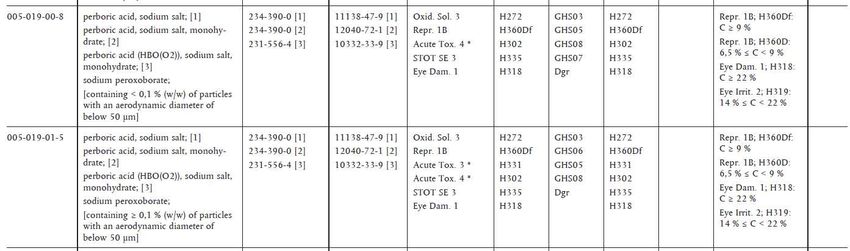
ANNEX XV – IDENTIFICATION OF SVHC FORMAT

                                                                           CONTENTS
PROPOSAL FOR IDENTIFICATION OF A SUBSTANCE AS A CMR CAT 1A OR 1B, PBT, VPVB OR A
SUBSTANCE OF AN EQUIVALENT LEVEL OF CONCERN ................................................................................ 3

PART I.......................................................................................................................................................................... 4

JUSTIFICATION ......................................................................................................................................................... 4

1 IDENTITY OF THE SUBSTANCE AND PHYSICAL AND CHEMICAL PROPERTIES ................................. 4

     1.1 Name and other identifiers of the substance ................................................................................................... 4

     1.2 Composition of the substance ......................................................................................................................... 8

     1.3 Physico-chemical properties ........................................................................................................................... 8

2 HARMONISED CLASSIFICATION AND LABELLING .................................................................................... 9

3 ENVIRONMENTAL FATE PROPERTIES ........................................................................................................... 9

4 HUMAN HEALTH HAZARD ASSESSMENT ..................................................................................................... 10

5 ENVIRONMENTAL HAZARD ASSESSMENT .................................................................................................. 10

6 CONCLUSIONS ON THE SVHC PROPERTIES ................................................................................................. 10

PART II ........................................................................................................................................................................ 11

INFORMATION ON USE, EXPOSURE, ALTERNATIVES AND RISKS ............................................................... 11

2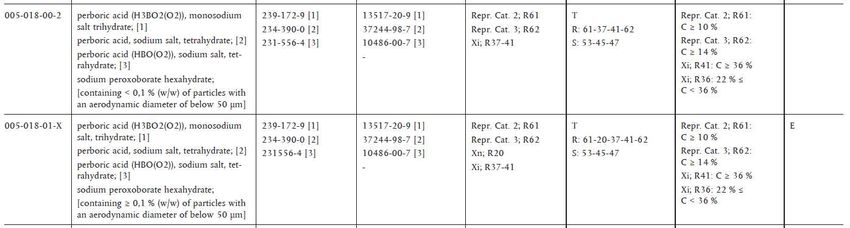
ANNEX XV REPORT – IDENTIFICATION OF SODIUM PERBORATE; PERBORIC ACID,
                                                      SODIUM SALT AS SVHC

PROPOSAL FOR IDENTIFICATION OF SODIUM PERBORATE;
PERBORIC ACID, SODIUM SALT AS SVHC

Substance Name:       Sodium perborate

EC Numbers:           239-172-9
                      234-390-0

CAS numbers:          -

•   The substances are proposed to be identified as substances meeting the criteria of Article 57 (c)
    of Regulation (EC) 1907/2006 (REACH) owing to their classification as toxic for reproduction
    category 1B.

Summary of how the substance(s) meet(s) the criteria set out in Article 57 of the REACH
Regulation
Sodium perborate; perboric acid, sodium salt are covered by Index numbers 005-018-00-2, 005-
018-01-X, 005-019-00-8, 005-019-01-5 of Regulation (EC) No 1272/2008 in Annex VI, Part 3,
Table 3.1 (the list of harmonised classification and labelling of hazardous substances) for
reproductive toxicity, Rep. 1B (H360Df: “May damage the unborn child. Suspected of damaging
fertility”).
Therefore this classification of the substance in Regulation (EC) No 1272/2008 shows that it meets
the criteria for classification as toxic for reproduction in accordance with Article 57(c) of REACH.

Registration dossiers submitted for the substance?

Yes

                                                                                                   3
ANNEX XV – IDENTIFICATION OF SVHC FORMAT
PART I
JUSTIFICATION
1 IDENTITY OF THE SUBSTANCE AND PHYSICAL AND CHEMICAL
PROPERTIES
1.1 Name and other identifiers of the substance
Please note that any other possible hydrate of sodium perborate which is not explicitly mentioned in
this Annex XV dossier is still, in principle, within the scope of the proposal.
4ANNEX XV REPORT – IDENTIFICATION OF SODIUM PERBORATE; PERBORIC ACID,
SODIUM SALT AS SVHC
Table 1: Substance identity
EC number:
239-172-9
234-390-0
EC name:
sodium perborate
perboric acid, sodium salt
CAS number (in the EC inventory):
15120-21-5
11138-47-9
CAS numbers: 10332-33-9e
13517-20-9 f
10486-00-7 g
37244-98-7h
90568-23-3i
125022-34-6j
CAS names: Perboric acid (HBO(O2)), sodium salt,
monohydrate e
Perboric acid (H3BO2(O2)), monosodium salt,
trihydratef
Perboric acid (HBO(O2)), sodium salt, hydrate
(1:1:4)g.
Perboric acid, sodium salt, tetrahydrateh
Borate(2-), tetrahydroxybis[µ-(peroxy-
κO1:κO2)]di-, sodium (1:2); molecular formula
B2H4O8.2Na)i
Borate(2-), tetrahydroxybis[µ-(peroxy-
κO1:κO2)]di-, sodium, hydrate (1:2:6); molecular
formula B2H4O8.6H2O.2Na)j
Deleted CAS numbers:
IUPAC name: Sodium perborate
5ANNEX XV – IDENTIFICATION OF SVHC FORMAT
Index number in Annex VI of the CLP Regulation 005-018-00-2,
005-018-01-X,
005-019-00-8,
005-019-01-5
Molecular formula: BHO3.Nab; BH3O4.Nac; BHO3.H2O.Nae;
BH3O4.3H2O.Naf; BHO3.4H2O.Nag
Molecular weight range: 99.8c
153.9g
Synonyms: PBS1
PBSM
Sodium perborate monohydrate
Sodium perborate tetrahydrate
PBS4
PBST
Structural formula (from EU RAR 2007a):
c ( monohydrate)
e
g (tetrahydrate)
Depending on the degree of hydration, several perboric acid, sodium salt compounds exist (EU
RAR (2007a) on perboric acid, sodium salt; RPA (2008) report on borates; SCCS (2010b) opinion
on sodium perborate and perboric acid).
6ANNEX XV REPORT – IDENTIFICATION OF SODIUM PERBORATE; PERBORIC ACID,
SODIUM SALT AS SVHC
Perboric acid, sodium salt is a white, odourless, water-soluble chemical compound with the
chemical composition NaBO3. It crystallises as the monohydrate NaBO3H2O, trihydrate
NaBO33H2O and tetrahydrate NaBO34H2O. The monohydrate and the tetrahydrate are the
commercially important forms.Different CAS numbers exist depending on the amount of water in
the compound. The EC# 234-390-0 and CAS# 11138-47-9 are generic entries that have been
presented as “collective” entries for the mono- and tetrahydrate of sodium perborate, even though
they do not specifically describe such structures.
According to EU RAR (2007a) the peroxoboron anions have a dimeric structure, i.e. they exist
either in anhydrous form or as hexahydrate.
This means that there may be in reality only 2 types of structures:
- The dimeric cyclic structure with 2 peroxy bridges:
This structure has historically been referred to as the “sodium perborate monohydrate”
(empirical formula NaBO3.1H2O). These old name and formula do however not take into
account the dimeric cyclic nature of the substance. The same structure may also have been
wrongly represented by the empirical formula NaBO2.H2O2.
In reality, there would not be any crystalline water in “sodium perborate monohydrate”.
Hydrates of that dimeric structure also exist. For instance, what was historically known as
“sodium perborate tetrahydrate” (empirical formula NaBO3.4H2O) is in fact the
hexahydrate of the dimeric structure.
- The “dehydrated” form of sodium perborate. It is obtained from the “sodium perborate
monohydrate” (which is not a true hydrate as explained above). The empirical formula is
NaBO3. This structure is presented in the EU RAR (2007a) as not well-defined. It is
supposed to consist of sodium borate and a boron oxygen radical.
However, it is still customary to use the “old” formulas and nomenclature of “sodium perborate
monohydrate” and “sodium perborate tetrahydrate”.
The perboric acid, sodium salt compounds listed above in Table 1, are all monosodium salts.
Several other CAS numbers exist for e.g. disodium salt perborate compounds. These are, however,
not described in this Annex XV dossier.
All perboric acids, sodium salt compounds, as listed in table 1, are available in different forms
divided into the following two types of compounds. The classification differs slightly for the two
types of compounds:
• containing < 0.1 % (w/w) of particles with an aerodynamic diameter of below 50 µm
• containing ≥ 0.1 % (w/w) of particles with an aerodynamic diameter of below 50 µm
7ANNEX XV – IDENTIFICATION OF SVHC FORMAT From all compounds listed in Table 1 only the perboric acid, sodium salt with the collective CAS number 11138-47-9 covering all mono- and tetrahydrates has been registered. However, this Annex XV dossier covers in addition also the remaining 7 CAS numbers, which all have the same harmonised classification as reproductive toxicant as the registered CAS number and a very similar structure. This is in line with the provisions of the Commission roadmap on substances of very high concern1, which states that there might be cases in which non registered substances can still be considered relevant for identification. One example might be a substance that is currently not produced or used in Europe, but might be used as an alternative to another relevant SVHC. This exemption is particularly relevant when the most appropriate approach is the category approach (i.e., analogous substances). Perboric acid, sodium salt and the mono- and tetrahydrates are in this dossier all referred to as “perboric acid, sodium salt (PBS)”. 1.2 Composition of the substance Mono-constituent Purity: ≥80% 1.3 Physico-chemical properties Not relevant for the identification of the substance as SVHC in accordance with Article 57(c). 1http://register.consilium.europa.eu/doc/srv?l=EN&t=PDF&gc=true&sc=false&f=ST%207664%202013%20INIT&r=ht tp%3A%2F%2Fregister.consilium.europa.eu%2Fpd%2Fen%2F13%2Fst07%2Fst07664.en13.pdf 8
ANNEX XV REPORT – IDENTIFICATION OF SODIUM PERBORATE; PERBORIC ACID,
                                                    SODIUM SALT AS SVHC

2       HARMONISED CLASSIFICATION AND LABELLING
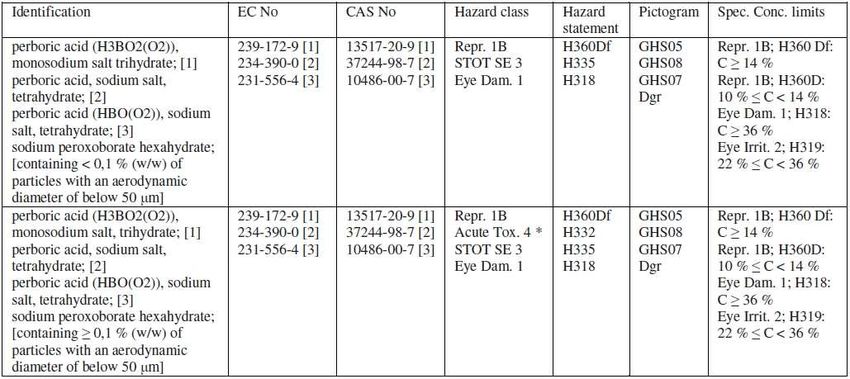
Sodium perborate; perboric acid, sodium salt (all CAS numbers as indicated above) are subjected to
harmonized classification with Repr 1B, H360Df with various specific concentration limits
depending on the degree of hydration of the substance.
Sodium perborate; perboric acid, sodium salt are reactive oxidants and liberate hydrogen peroxide
in aqueous solution under formation of sodium borate/ boric acid,which is considered to be the
cause of the induction of the adverse effects on development and fertility.
The classification as Repr. 1B and the specific concentration limits of PBS depend on the content of
boron in the substances. This is similar to the classification of the borates and their hydrated forms,
where the classification as Repr. 1B, H360Df and the specific concentration limits, depending on
the boron content of the substances. The specific concentration limits are listed below.
Table 2: Classification according to part 3 of Annex VI, Table 3.1 of Regulation (EC) No
1272/2008

3       ENVIRONMENTAL FATE PROPERTIES
Not relevant.

                                                                                                     9
ANNEX XV – IDENTIFICATION OF SVHC FORMAT 4 HUMAN HEALTH HAZARD ASSESSMENT With respect to CMR effects sodium perborate; perboric acid, sodium salt (all CAS numbers as indicated above) are subject to harmonized classification with Repr 1B, H360Df with various specific concentration limits depending on the degree of hydration of the substance). Sodium perborate; perboric acid, sodium salt are reactive oxidants and liberate hydrogen peroxide in aqueous solution under formation of sodium borate/ boric acid which is considered to be the cause of the induction of the adverse effects on development and fertility. The classification as Repr 1B and the specific concentration limits of sodium perborate; perboric acid, sodium salt depend on the content of boron in the substances. This is similar to the classification of the borates and their hydrated forms, where the classification as Repr 1B, H360Df and the specific concentration limits, depend on the boron content of the substances (see chapter 2). 5 ENVIRONMENTAL HAZARD ASSESSMENT Not relevant. 6 CONCLUSIONS ON THE SVHC PROPERTIES 6.1 PBT, vPvB assessment Not relevant. 6.2 CMR assessment Sodium perborate; perboric acid, sodium salt is classified with Repr 1B, H360Df. 6.3 Substances of equivalent level of concern assessment. Not relevant. 10
ANNEX XV REPORT – IDENTIFICATION OF SODIUM PERBORATE; PERBORIC ACID,
                                                      SODIUM SALT AS SVHC

                                              PART II

      INFORMATION ON USE, EXPOSURE, ALTERNATIVES AND
                           RISKS

7         INFORMATION ON MANUFACTURE, IMPORT/EXPORT AND USES –
          CONCLUSIONS ON EXPOSURE

Conclusions:
Based on the reported information below, the following conclusions can be drawn:

      • PBS is mainly used as bleaching agent in laundry detergents and machine dishwashing
        products.
      • PBS is (per mid 2013) only manufactured by two companies in Europe. Worldwide, no
        other production exists.
      • Exposure at the workplace (production and formulation) is by far the most important source
        of human exposure to PBS. Consumer exposure concentrations to PBS are in all situations
        expected to be very low.

7.1       Manufacturing sites
According to the dissemination website, three companies have registered PBS. It is, however, only
the collective CAS no. 11138-47-9 that has been registered, while none of the other perborate
compounds have been registered under REACH. These three companies are:
      • Belinka Perkemija d.o.o. (Slovenia)
      • Evonik Treibacher GmbH (Austria)
      • Solvay Chemicals GmbH (Germany)
For the preparation of the Risk Assessment Report of PBS in 2007 (EU RAR, 2007a), 12
production sites representing 7 producers were identified. However, at 4 of the identified sites the
production was ceased recently (in 2007 when the RAR was prepared). When comparing the
identified production companies from the EU RAR report (2007a) with the companies that have
registered PBS within the REACH system, it can be seen that in 2010 (when the registrations were
made) only 3 producing companies remained, and one of these has stated that they, per mid 2013,
have ceased the production of PBS. Thus, only two European producers remain (in 2013). One of
these producers (in Slovenia) is new compared to the listed producers in the EU RAR (2007a)
report.

7.2       Manufacture, import and export
All information given on manufacture, import/export and uses below concerns the collective CAS
number 11138-47-9 of PBS i.e. sodium perborate in general including the mono- and tetrahydrates.

                                                                                                 11
ANNEX XV – IDENTIFICATION OF SVHC FORMAT
7.2.1 Worldwide
Several older sources (RPA, 2008; EU RAR, 2007a; HERA 2002) report on the European
production of PBS, and from these figures it can be seen that in 2007 EU exported a large amount to
the rest of the world (72% of the production in the EU – see Table 2). According to CEFIC
(European Chemical Industry Council) only 1% of the total production quantity in Europe was
imported in 1997.
Information received (October 2013) from the European producers of PBS confirms that EU is
exporting most of the European production to the rest of the world. By October 2013 only two
producers are left worldwide, and these two producers are located in the EU.
7.2.2 EU
The annual production in Europe can be found in Table 2 below. The data from 1997 to 2007 is
based on older information from a RPA report (2008), and the newest information from 2010 is
based on REACH registration information from ECHA’s dissemination website. It is clearly shown
from the table below that the production in Europe has been declining over the past 10-15 years.
Furthermore, information received (October 2013) through contact with the producing companies
for preparation of this Annex XV dossier indicates that the production is still declining and will
continue to decline in the future.
Table 2: Production, sales and export of PBS in Europe (1997 – 2010). Source: RPA, 2008;
HERA, 2002; *ECHA (dissemination website); **An educated guess based on indications
received from companies (October 2013).
Year Sales in Exports (% of
Production Sales in Exports
Europe European
(tonnes/year) Europe (%) (tonnes/year)
(tonnes/year) production)
1997 569,900 421,600 74% 153,000 27%
2000 537,600 283,849 53% 223,375 41%
2003 318,750 188,000 59% 130,750 41%
2004 294,000 no information no information
2005 199,000 no information no information
2006 178,000 no information no information
2007 196,000 54,000 28% 142,000 72%
10,000 -
2010
100,000 *
Most of the
2013 < 40,000**
production
7.3 General trends of manufacturing
Information on production volumes from the dissemination website illustrates a decline in
manufacturing volumes from 2008 to 2010.
12ANNEX XV REPORT – IDENTIFICATION OF SODIUM PERBORATE; PERBORIC ACID,
SODIUM SALT AS SVHC
According to the RPA report (2008), one of the producers contacted at that time indicated that the
quantity of PBS being manufactured at their location had been constant during the last five years
(i.e. 2002-2007). At that time, the company expected a similar trend in the future as they exported
most of the PBS to markets outside of the EU. In these markets, the consumption of PBS in the
detergent industry is increasing due to increasing production of detergents as there are no suitable
substitutes for PBS in these regions.
7.4 Use
7.4.1 Function
During use, the PBS (NaBO2(OH2) x H2O) is intended to be decomposed to hydrogen peroxide
(H2O2) which is the acting agent in the bleaching and cleaning process. The decomposition also
results in the formation of sodium metaborate (NaBO2), which is mainly available as boric acid
(H3BO3) in aquatic solutions.
NaBO2(OH2) x H2O NaBO2 + H2O2 + x H2O
PBS is therefore mainly used as a bleaching agent in laundry detergents and machine dishwashing
products, but is also used in cleaning products and in cosmetic preparations (Sodium Perborate
REACH Consortium; HERA, 2002). In cosmetic products, PBS has according to the CosIng
database2 an oxidising function.
7.4.2 Sectors of use, types of preparations, articles and processes involved
PBSs are only used in chemical preparations such as bleaching agents, cleaning agents and cosmetic
products. No use of PBSs in articles has been identified. PBSs are hence only used in the detergent
industry and to some (smaller) degree in the cosmetic products industry.
According to AISE (International Association for Soaps, Detergents and Maintenance Products),
96% of the PBS used in detergent products in 1999 was used in heavy duty bleach-containing
powders or tablets, and 3% in machine dishwashing detergents (powders or tablets). (HERA, 2002).
Types of preparations involved
The Nordic countries have a common database where chemical substances contained in chemical
preparations are listed. According to this database (SPIN – Substances in Preparations in Nordic
countries), the following uses of PBS are reported for 2011:
• Washing agents for textile (detergents) – CAS 10486-00-7 (sodium perborate tetrahydrate)
• Cleaning/washing agents – CAS 10332-33-9 (sodium perborate monohydrate)
Other uses that have been reported for both the mono- and tetrahydrates from previous years (but
not any longer) are:
• Bleaching agents
2 CosIng is the European Commission database with information on cosmetic substances and ingredients.
http://ec.europa.eu/consumers/cosmetics/cosing/index.cfm?fuseaction=search.simple
13ANNEX XV – IDENTIFICATION OF SVHC FORMAT
• Washing-up detergents (machine)
• Non-agricultural pesticides and preservatives (minor use)
• Conductive agents (minor use)
• Cleaning/washing agents for dish washing (machines) (minor use)
In Denmark, the Danish EPA has, during the last 10 years, performed several surveys of cosmetic
products in Denmark. In five of these projects, a database of all ingredients in different types of
cosmetic products has been prepared. The five types of cosmetic products surveyed are hair styling
products, cosmetic products for children, sun tan lotions and body lotions for children, non-
preserved cosmetic products and hair dyes. PBS (CAS 11138-47-9) was found only in a few hair
dyes (3 from one producer out of 365 investigated hair dyes) (Danish EPA, 2013). This illustrates
that PBS may still be used in cosmetic products, but mainly in specific types of cosmetic products
where oxidising properties are necessary.
Concentrations used in preparations
In the EU RAR report (2007a) on PBS, content concentrations of PBS are listed for consumer
products. These are shown in Table 3 below. Typical concentrations in detergents range from 4-
25% PBS and typical concentrations in bleaching agents range from 5-50%.
Table 3: Content of PBS in consumer products (EU RAR report (2007a)).
Type of product Sodium perborate content Substance specification
(%)
Detergent products
Heavy duty laundry detergents 15-25% Mono- and tetrahydrate
Laundry additive 16-20% Not given
Automatic dishwasher detergents 4-18% Tetrahydrate
Bleaching agents
Denture cleansers 5-25% Mono- and tetrahydrate
Stain removers 5-50% Monohydrate
7.4.3 Operational conditions of use – existing legislation
PBSs are restricted in cosmetic products. According to Regulation No. 1223 on cosmetic products
(2009), borates and tetraborates are only allowed in certain types of cosmetic products and in the
concentrations listed in Annex III: “List of substances which cosmetic products must not contain
except subject to the restrictions laid down”.
14ANNEX XV REPORT – IDENTIFICATION OF SODIUM PERBORATE; PERBORIC ACID,
SODIUM SALT AS SVHC
Table 4: Restrictions on borates and tetraborates according to Regulation No. 1223/2009 on
cosmetic products – Annex III “List of substances which cosmetic products must not contain
except subject to the restrictions laid down”.
Annex III Substance/ Product type, body Max conc. in Wording of conditions of use
Ref. No. chemical parts ready for use and warnings
name preparation
Not to be used for children under
3 years of age.
Talc 5% (as boric acid)
Not to be used on peeling or
irritated skin.
Boric acid, Not to be swallowed.
1a borates and Oral products 0.1% (as boric acid) Not to be used for children under
tetraborates 3 years of age.
Other products Not to be used for children under
(excluding bath products 3 years of age.
3% (as boric acid)
and hair waving Not to be used on peeling or
products) irritated skin.
Not to be used for children under
Bath products 18% (as boric acid)
1b Tetraborates 3 years of age.
Hair products 8% (as boric acid) Rinse well.
Wear suitable gloves.
12% of H2O2 (40 Contains hydrogen peroxide.
Hair products volumes), present Avoid contact with eyes.
or released Rinse immediately if product
comes into contact with them.
Contains hydrogen peroxide.
4% of H2O2, Avoid contact with eyes.
Skin products
present or released Rinse immediately if product
Hydrogen
comes into contact with them.
peroxide and
Contains hydrogen peroxide.
other
2% of H2O2, Avoid contact with eyes.
compounds or Nail hardening products
12 present or released Rinse immediately if product
mixtures that
comes into contact with them.
release
Oral products, including Contains hydrogen peroxide.
hydrogen
mouth rinse, tooth paste ≤ 0.1% of H2O2, Avoid contact with eyes.
peroxide
and tooth whitening or present or released Rinse immediately if product
bleaching products comes into contact with them.
Concentration of H2O2 present or
released indicated in percentages.
> 0.1 % ≤ 6% of
Tooth whitening or Not to be used on a person under
H2O2, present or
bleaching products 18 years of age.
released
To be only sold to dental
practitioners.
Furthermore, PBS is included in Group 30 of Annex XVII of REACH Regulation (inserted with
Regulation (EC) No 109/2012) and is therefore not allowed as such and in mixtures for the general
public. This applies to concentrations above the specific concentration limits according to the
respective entries in Annex VI of the CLP Regulation (see Table 2). An exemption for detergents
expired on 1st of June 2013.
15ANNEX XV – IDENTIFICATION OF SVHC FORMAT
7.4.4 General trends of use
According to the SPIN database (Substances in Preparations in Nordic countries), PBS is used in
preparations in the Nordic countries, but its use is strongly decreasing. The following PBS
compounds are found in the SPIN database:
• CAS 11138-47-9 (collective CAS no. for the monohydrates and tetrahydrates)
• CAS 10332-33-9 (sodium perborate monohydrate)
• CAS 10486-00-7 (sodium perborate tetrahydrate)
The total use of these three sodium perborate compounds in the Nordic countries is illustrated in
Figure 1 below. There are very few data on the collective CAS number 11138-47-9, as most of the
data are confidential (typically when the number of preparations is below three). The green lines in
Figure 1 representing the collective CAS number 11138-47-9 are therefore only a compilation of
data from Finland for the years 2006 to 2008. All other data are confidential. The total use of CAS
11138-47-9 in the Nordic countries was 44.2 tonnes in 2006, which was reduced to 15.6 tonnes in
2008. These amounts cover Finland only as data for Sweden, Norway and Denmark are
confidential. CAS 11138-47-9 was used only in 4 preparations in 2006 and 2008.
The total use of sodium perborate monohydrate (CAS 10332-33-9) in the Nordic countries is
represented by the two red lines in Figure 1. The total use in the four Nordic countries peaked in
2004 with a total tonnage of 1,031.7 tonnes used in 97 different chemical preparations. Since then
the total use of CAS 10332-33-9 has been decreasing in all four Nordic countries to a total use of
18.4 tonnes in 29 different chemical preparations in 2011.
The total use of sodium perborate tetrahydrate (CAS 10486-00-7) in the Nordic countries is
represented by the two blue lines in Figure 1. The total use in the four Nordic countries peaked in
2001 with a total tonnage of 4,541.6 tonnes used in 172 different chemical preparations. Since then
the total use of CAS 10486-00-7 has been decreasing in all four Nordic countries to a total use of
107.6 tonnes in 53 different chemical preparations in 2011.
16ANNEX XV REPORT – IDENTIFICATION OF SODIUM PERBORATE; PERBORIC ACID,
SODIUM SALT AS SVHC
Figure 1: Overview of the use of PBS in preparations in the Nordic countries (2001-2011).
Left axis is the total amount of the different PBSs in tonnes used in preparations in the
Nordic countries. Right axis is the total number of preparations where PBSs are used in the
Nordic countries.
Tonnes Total use in preparations in Nordic countries (SPIN) No. of preparations
6000 200
180
5000
160
Total Nordic countries -
CAS 10332-33-9 (tonnes)
140
4000
Total Nordic countries -
CAS 10486-00-7 (tonnes)
120
Total Nordic countries -
CAS 11138-47-9 (tonnes)
3000 100
Total Nordic countries -
CAS 10332-33-9 (No. of
80 prep.)
Total Nordic countries -
2000 CAS 10486-00-7 (No. of
60 prep.)
Total Nordic countries -
CAS 11138-47-9 (No. of
40 prep.)
1000
20
0 0
2001 2002 2003 2004 2005 2006 2007 2008 2009 2010 2011
All in all the use of PBS in chemical preparations in the Nordic countries has been reduced
drastically from 2001 to 2011. The reduction in the tonnage is 98%, from 2001 to 2011 for both the
sodium perborate monohydrate and tetrahydrate CAS numbers. Similarly, the reduction in number
of preparations has been decreased by about 70% in 2011, for both the sodium perborate
monohydrate and tetrahydrate compared to the years where the substances were used in the highest
number of preparations.
Some of the companies that have registered the use of PBS in chemical products in the Danish
Product Register were contacted. All these companies gave the same statement that most, if not all,
applications of PBS in chemical products have now been phased-out following the harmonised
classification of PBS with Repr. 1B.
This confirms the general trend from the SPIN database and the picture from contact with the
producers indicating that PBS is no longer used, or at least decreased considerably in the EU.
7.4.5 Actors in the supply chain
The following actors in the supply chain of PBSs exist:
• Manufacturers of PBSs
17ANNEX XV – IDENTIFICATION OF SVHC FORMAT
• Formulators of laundry detergents, machine dishwashing products, cleaning products and
cosmetic products
• Distributors of the preparations containing PBSs
• Users – professional and consumers
7.5 Estimated releases and exposures
7.5.1 Exposure of humans
Exposure to PBS can take place at the workplace during the production and formulation of the
detergent products and bleaching agents, and during use of bleaching agents and detergent products
(during laundry washing and automatic dishwashing). Exposure to PBS will happen in the form of
exposure to sodium perborate dust/powder or tablets, but may also happen at the workplace in the
form of contact with chemical solutions (EU RAR, 2007a).
The expected exposure routes are mainly dermal exposure, but exposure in the form of inhalation of
dusts/powders may also occur.
As described earlier, the concentration of PBS in the detergent products and in the bleaching agents
lies between 4-25% and 5-50% respectively. Workers may be exposed to PBS in concentrated form,
whereas consumers will only be exposed to PBS in the diluted forms in the final detergent and
bleaching products.
In addition to the exposure to PBS, exposure to the degradation products, i.e. hydrogen peroxide
and boric acid, may also occur and must be taken into account in the exposure scenarios. An
indirect exposure of humans to PBS via the environment is unlikely as PBS is degraded in the
sewage treatment plants. However, boron from PBS may be ingested with drinking water coming
from fresh water containing boric acid from the use of detergent products and bleaching agents (EU
RAR, 2007a).
In the EU RAR (2007a) report it is concluded that exposure at the workplace is by far the most
important source of human exposure to PBS. Consumer exposure concentrations to PBS are in all
situations expected to be very low.
7.5.2 Exposure of the environment
During the use of consumer products containing PBS for cleaning and bleaching purposes, the
perborate is intended to be decomposed to hydrogen peroxide (which is the active agent in the
bleaching and cleaning process) and to sodium metaborate, which is mainly available as boric acid
under environmental conditions. From this it is concluded in the EU RAR (2007a) report that it can
be assumed that apart from releases of PBS during the industrial production and the formulation of
detergent products/bleaching agents, the aquatic environment will be mainly exposed to its
degradation products.
The aquatic compartment is by far the main target compartment of PBS due to the physical-
chemical properties and the use characteristics. From the degradation behaviour of PBS it is
concluded that in most cases boric acid is the relevant compound in the aquatic environment. Only
at production and formulation sites without standard temperature and pressure, hydrogen peroxide
releases into surface water can occur (EU RAR, 2007a).
18ANNEX XV REPORT – IDENTIFICATION OF SODIUM PERBORATE; PERBORIC ACID,
SODIUM SALT AS SVHC
8 CURRENT KNOWLEDGE ON ALTERNATIVES
Conclusions:
Based on the reported information below, the following conclusions can be drawn:
• In the EU sodium perborates have almost exclusively been replaced by the alternative
sodium percarbonate.
• It seems that sodium percarbonate directly can replace sodium perborate as bleaching agent
in the formulation of detergents and cleaning agents. However, the shelf life may be
decreased compared to using sodium perborate.
8.1 Current knowledge on alternatives
In the EU RAR (2007a) on sodium perborate the trends in the use of sodium perborate are
discussed. Here it is concluded that there is some evidence that PBS during the last two years (i.e.
2005-2006) partly was substituted by sodium percarbonate and that the importance of sodium
percarbonate as bleaching agent will increase further. In the RPA (2008) report carried out one year
later, it is stated that the use of PBS as bleaching agent in detergents is rapidly declining as the
substance is substituted by sodium percarbonate. Furthermore, it is stated that any reduction in the
use of PBSs would expect to be counteracted by an increased use of sodium percarbonates.
This trend in substitution (described in these reports from 2007-2008) is reflected by the lower
tonnage band reported in the dissemination website compared to the estimated use volume provided
by RPA in 2008.
• The production of PBS has drastically been decreased mainly due to PBS being substituted
by sodium percarbonate as bleaching agent.
• Most of the remaining production is being exported from Europe to markets elsewhere in the
world, where the substitution has not yet been carried out as effectively. However, according
to a producer of sodium percarbonate3, the alternative sodium percarbonate is now also
being widely used in the developing areas of South America, the Middle East and Africa.
According to the EU RAR (2007a), PBS was earlier the favourite bleaching agent over sodium
percarbonate as PBS could ensure a longer shelf life in the formulation of the detergent. In the RPA
(2008) report, it is stated that sodium percarbonate is found to deliver a similar technical
performance compared to PBS when used in a colder climate. In other words, alternatives to PBS
(for colder climates (i.e. in Europe)) have been tested and found feasible. It is not directly stated in
these reports, but it is assumed that sodium percarbonate directly can replace PBS as bleaching
agent in the formulation of detergents and cleaning agents. As producers today report of a wide use
of sodium percarbonate in the developing areas of South America, the Middle East and Africa, this
could indicate that the problems of using sodium percarbonate in warmer climates have been
overcome.
It can therefore be concluded that today PBS to a very large extent has already been substituted by
sodium percarbonate as bleaching agent in detergents and cleaning products. This is also illustrated
by the fact that the European 2010 production of PBS has been reduced to about 90% of the 1997
3 http://www.ocichemical.com/index.php/sodium-percarbonate
19ANNEX XV – IDENTIFICATION OF SVHC FORMAT
production, and that the use of PBS in the Nordic countries in 2011 has been reduced with 98%
compared to the use of PBS in 2001.
8.2 Information on the alternative: Sodium percarbonate CAS 15630-89-4
Sodium percarbonate is also called solid hydrogen peroxide and has the chemical formulation of
2Na2CO33H2O2.4 Sodium percarbonate has a high content of oxygen. When placed in water, it
releases H2O2 and Na2CO3.
Sodium percarbonate (disodium carbonate, compound with hydrogen peroxide (2:3), CAS no.
15630-89-4) has no harmonised classification, but has been notified to the ECHA C&L inventory
database. The notified self-classification submitted by industry on sodium percarbonate is
summarised in Table 5 below.
In total, 16 aggregated notifications with various classifications can be found in the ECHA C&L
inventory database. The classifications shown in Table 5 are the most widely used classification
notified by a total of 86 notifiers. A minority of the notifiers has applied other classifications such
as Ox. Sol. 1, H271; Skin Irrit. 2, H315; STOT SE 3, H335; Aquatic Acute 2, H401.
Table 5: Self-classification of sodium percarbonate (ECHA C&L inventory database, 2013)
according to the CLP Regulation (EC) no. 1272/2008 (CLP Regulation).
International chemical CAS No Classification
identification
Hazard Class and Hazard statement
Category Code(s) Code(s)
Disodium carbonate, 15630-89-4 Ox. Sol. 2 H272
compound with hydrogen
peroxide (2:3) Acute Tox. 4 H302
Eye Dam. 1 H318
Sodium percarbonate is not classified as reprotoxic (Repr. 1B, H360Df “May damage the unborn
child. Suspected of damaging fertility”) or as STOT SE 3 (H335 “May cause respiratory irritation”)
as PBS is. Otherwise, their classification is similar.
Sodium percarbonate has been registered under REACH in a tonnage band of 100,000 to 1,000,000
tonnes per annum.
Sodium percarbonate has been chosen as substitute for PBS, because it is less toxic. Sodium
percarbonate decomposes into hydrogen peroxide and natural soda (Na2CO3) – or sodium ions and
carbonate ions – when in contact with water. In the OECD (2006) report on sodium percarbonate, it
is concluded that the toxicity of sodium percarbonate can be predicted from the toxicity of hydrogen
peroxide. Sodium carbonate and hydrogen peroxide are very water soluble and will therefore
remain in the water phase. Hydrogen peroxide is a naturally occurring substance in the environment
and is rapidly degraded in a biological waste water treatment plant. Sodium carbonate will be
4 http://www.wlchem.com/template/js02_en.htm
20ANNEX XV REPORT – IDENTIFICATION OF SODIUM PERBORATE; PERBORIC ACID,
SODIUM SALT AS SVHC
neutralised in biological waste water treatment plants. Hydrogen peroxide adsorbs poorly to
sediment particles and is rapidly degraded, thus no accumulation in the sediment is expected. Both
hydrogen peroxide and sodium carbonate are inorganic chemicals which do not bioaccumulate
(OECD, 2006).
Similarly in the human body, most of the acute and local effects of sodium percarbonate can be
explained by the release of hydrogen peroxide. The degradation products of sodium percarbonate
are all naturally present in the human body. Hydrogen peroxide is expected to be degraded in the
body, making it unlikely that hydrogen peroxide is systemically available. Sodium percarbonate has
irritating effects, but is not sensitising. According to the OECD (2006) report, no genotoxic effects
are expected, but hydrogen peroxide has shown local carcinogenic effects. It is, however, concluded
that the carcinogenic properties of hydrogen peroxide should not be regarded as significant, as
hydrogen peroxide itself also is degraded in the body. Finally, the OECD (2006) report concludes
that it is expected that neither sodium percarbonate nor hydrogen peroxide and sodium carbonate
will be systemically available under human exposure conditions and are therefore unlikely to have
any relevant potential for toxicity to reproduction or developmental toxicity.
All in all the OECD (2006) report therefore concludes that sodium percarbonate does possess
properties indicating a hazard for human health and the environment, but the effects are related to
reversible effects (irritation) and acute toxicity which may become evident at high exposure levels.
Therefore no further work on the substance is necessary.
21ANNEX XV – IDENTIFICATION OF SVHC FORMAT
9 RISK-RELATED INFORMATION
Conclusions:
Based on the reported information below, the following conclusions can be drawn:
• The main health concern of sodium perborates is the fact that sodium perborates are
converted to boric acid, which suggests that sodium perborate may affect fertility (classified
as Repr. 1B; H360Df). Sodium perborate shows both maternal and developmental toxicity.
• The following concerns are therefore valid for sodium perborates:
o There is a need for limiting the risks to workers. This conclusion applies to highly
exposed workers in the production of sodium perborate via inhalation of the dust.
There is a concern for effects on the upper airways and for developmental effects.
o There is a need for limiting the risks to the aquatic compartment (incl. sediment).
This conclusion applies to production sites and formulation sites.
9.1 Risk-related information
PBS is listed in Annex VI of the CLP Regulation 1272/2008 with a harmonised classification and
labelling (see Table 2).
From Error! Reference source not found. it can be seen that the most severe classification is
found for PBS compounds containing ≥ 0.1% (w/w) of particles with an aerodynamic diameter of
below 50 µm compared to PBS compounds containing < 0.1%. Furthermore, the classification of
sodium perborate monohydrate is more severe than the classification of the tetrahydrates.
The following concerns have been identified based on available data and assessments (EU RAR
(2007a)):
22ANNEX XV REPORT – IDENTIFICATION OF SODIUM PERBORATE; PERBORIC ACID,
SODIUM SALT AS SVHC
• There is a need for limiting the risks to workers. This conclusion applies to highly exposed
workers in the production of PBS via inhalation of the dust. There is a concern for effects on
the upper airways and for developmental effects.
• There is a need for limiting the risks to the aquatic compartment (incl. sediment). This
conclusion applies to production sites and formulation sites.
A summary of the findings from different studies and observations on hazards and risk
identification for human health and the environment is presented in the next sections.
9.1.1 Human health
PBS is decomposed to hydrogen peroxide (H2O2) and to sodium metaborate (NaBO2), which is
mainly available as boric acid (H3BO3) in aquatic solutions. Hydrogen peroxide is further
hydrolysed in water and therefore no exposure to hydrogen peroxide is expected. However,
exposure to boric acid must be expected (EU RAR, 2007a).
It is therefore expected that the workers and consumers are exposed to the PBS through direct
contact to the powder or tablets, but no exposure to hydrogen peroxide or boric acid is expected.
However, humans may be indirectly exposed to boric acid via the environment.
According to the EU RAR (2007a) on PBS, the information on health effects is very weak for
sodium perborate hydrates. Sodium perborate tetrahydrate is less toxic than sodium perborate
monohydrate. This is in agreement with its higher water content. However, the differences are
considered as minor, compared to other uncertainties in the evaluation of the database.
The local toxicity of PBS is mediated by hydrogen peroxide and boric acid, as these are the
degradation products of PBS (HERA, 2004).
The following hazards and risks are observed for PBS (EU RAR, 2007a):
• Dermal absorption is considered to be very low, whereas oral absorption and absorption via
inhalation are considered to be high.
• Sodium perborate monohydrate is considered to be acutely harmful if swallowed and if
inhaled (Acute Tox. 4; H302 and H332) whereas the tetrahydrate has no acute toxicity due
to its lower toxicity.
• PBS causes serious eye damage (Eye Dam. 1; H318).
• PBS is not considered to be a skin sensitising substance. Furthermore, there is no concern
for respiratory sensitisation.
• Effects on the stomach, spleen and the haematopoietic system after repeated oral application
of PBS can be attributed to the degradation products.
• Studies on PBS show a genotoxic potential which may be due to the generation of hydrogen
peroxide.
• No carcinogenic effects of PBS are expected (HERA, 2004).
• Testicular toxicity of PBS cannot be dismissed. The fact that PBS is converted to boric acid
suggests that PBS may affect fertility (classified as Repr. 1B; H360Df). PBS shows both
maternal and developmental toxicity.
23ANNEX XV – IDENTIFICATION OF SVHC FORMAT The EU RAR (2007a) concludes that there is no concern for acute toxicity, irritation, sensitisation, mutagenicity and carcinogenicity for workers exposed in production and formulation of PBS and from exposure to the end product – either by inhalation or by dermal exposure. However, the situation is different for effects on the upper airways. As a worst case, the assumption can be made that all PBS is deposited in the upper airways and decomposed to hydrogen peroxide. This will result in a concern for irritative effects at worst case concentrations of 12 mg/m3. This fits very well to the actual experience with PBS (i.e. that accidentally effects have been reported) which probably can be related to high exposure concentrations. Therefore the conclusion is drawn that there is a need for limiting the risks for workers exposed in production and formulation of PBS. However, sufficient measures to mitigate the risks may already be in place. Furthermore, there is a need for limiting the risks regarding developmental effects for highly exposed workers in the production. Concerning consumers, the EU RAR (2007a) considers that there is no risk for exposure from any endpoints by handling of detergents either as a powder or as tablets as the exposure – inhalation, dermal exposure and oral exposure – is negligible. Hydrolysis of PBS to hydrogen peroxide is neither of any concern. The risk of exposure to boric acid is, however, of concern as boric acid has a harmonised classification of Repr. 1B; H360FD (“May damage fertility. May damage the unborn child”). Furthermore, consumers may be indirectly exposed to boric acid via the environment through drinking water containing boric acid. 9.1.2 Environment PBS is not classified as hazardous to the environment. PBS is instable in water and therefore it is the degradation products hydrogen peroxide and boric acid that are of importance for the environmental risks. In the EU RAR (2007a) report, it is concluded that the short-term effects are dominated by the presence of hydrogen peroxide whereas boric acid is assumed to be the relevant long-term degradation product. Hydrogen peroxide is almost exclusively found in the water compartment, when released to the environment. Hydrogen peroxide is normally a short-lived substance in the environment and is readily degraded in the environment by an enzyme-mediated process. No bioaccumulation is expected in the environment. Hydrogen peroxide is not considered to be acutely toxic according to mammalian toxicity data. This means that the environmental effects of hydrogen peroxide are expected to be low (EU RAR, 2003). The harmonised classification (Repr. 1B; H360FD “May damage fertility. May damage the unborn child”) of boric acid does not indicate environmental hazards of boric acid. However, boric acid may be of concern for humans when exposed to boric acid indirectly via the environment. 24
ANNEX XV REPORT – IDENTIFICATION OF SODIUM PERBORATE; PERBORIC ACID,
                                                     SODIUM SALT AS SVHC

10       CONCLUSION

The relevance for including PBS on the Candidate List for eventual inclusion in Annex XIV is in
accordance with the criteria suggested in the Commission SVHC 2020 roadmap:
     1. The substance is manufactured, imported and/or used in the EU in a relevant quantity; it has
        been registered under REACH.
     2. The substance has not only been registered for intermediate use, as it is used as bleaching
        agent mainly in household and professional detergents.
     3. The available information does not demonstrate a risk that is not adequately controlled and
        needs to be addressed at EU level. However, the risks to consumers from combined
        exposure to the degradation product, boric acid/borates, which have not been addressed in
        previous risk assessments, must be considered and may lead to significant risk
        characterisation ratios.
     4. The known uses of the substance are not exempted from the scope of authorisation and are
        not already regulated by other specific EU legislation providing a pressure for substitution.

Thus, the substance fulfils the relevancy criteria for inclusion in the Candidate List.
The perborates are already increasingly being phased out of products in the EU and replaced by
available alternatives. As alternatives exist, authorisation is considered a proportionate measure for
pushing the substitution of the remaining use of PBS. Furthermore, the SVHC identification of PBS
would ensure coherence with the SVHC identification of boric acid/borates.
It should be noted, that e.g. detergents containing PBS below the specific classification limits for
the Repr 1B classification (i.e. 6.5%, 9% or 10% depending of degree of hydration of the PBS) will
be out of the scope of a possible authorisation requirement.
In summary, based on the available information perboric acid sodium salts (PBS) qualify for
inclusion in the candidate list.

                                                                                                   25
ANNEX XV – IDENTIFICATION OF SVHC FORMAT REFERENCES CLP Regulation 1272/2008. “Regulation (EC) No 1272/2008 of the European Parliament and of the Council of 16 December 2008 on classification, labelling and packaging of substances and mixtures, amending and repealing Directives 67/548/EEC and 1999/45/EC, and amending Regulation (EC) No 1907/2006”. Danish EPA, 2013. “Survey and occurrence of PPD, PTD and other allergenic hair dye substances in hair dyes”. Survey of Chemicals in Consumer Products, No. 121, 2013. http://www.mst.dk/Publikationer/Publications/2013/February/978-87-92903-92-1.htm ECHA C&L inventory database, 2013: http://echa.europa.eu/web/guest/information-on- chemicals/cl-inventory-database EU RAR (2003). European Risk Assessment Report on hydrogen peroxide (CAS 7722-84-1). European Chemicals Bureau. EU RAR (2007a). European Risk Assessment Report on perboric acid, sodium salt (CAS 11138-47- 9). European Chemicals Bureau. EU RAR (2007b). European Risk Assessment Report on disodium tetraborate, anhydrous boric acid, boric acid, crude natural (CAS 1330-43-4; CAS 11113-50-1; CAS 10043-35-3). European Chemical Agency. HERA (2002). Human & Environmental Risk Assessment on ingredients of European household cleaning products. Perboric acid, sodium salt, mono and tetrahydrate, CAS No.: 11138-47-9 (10332-33-9 and 10486-007). OECD (2006). Sodium percarbonate. CAS 15630-89-4. OECD SIDS. 21 February 2006. Regulation No. 1223 on cosmetic products (2009). Regulation EC No. 1223/2009 of the European Parliament and of the Council of 30 November 2009 on cosmetic products. http://eur- lex.europa.eu/LexUriServ/LexUriServ.do?uri=CONSLEG:2009R1223:20130711:EN:PDF RPA (2008). Assessment of the Risk to Consumers from Borates and the Impact of Potential Restrictions on their Marketing and Use. Prepared for European Commission DG Enterprise and Industry. November 2008. SCCS (2010a). Opinion on boron compounds. Scientific Committee on Consumer Safety, 22 June 2010. SCCS/1249/09. SCCS (2010b). Opinion on sodium perborate and perboric acid. Scientific Committee on Consumer Safety, 22 June 2010. SCCS/1345/10. Sodium Perborate REACH Consortium. www.perborates.eu. Documents downloaded in October 2013. 26
You can also read


