PubChem in 2021: new data content and improved web interfaces - Oxford Academic Journals
←
→
Page content transcription
If your browser does not render page correctly, please read the page content below
D1388–D1395 Nucleic Acids Research, 2021, Vol. 49, Database issue                                           Published online 5 November 2020
doi: 10.1093/nar/gkaa971

PubChem in 2021: new data content and improved
web interfaces
Sunghwan Kim , Jie Chen , Tiejun Cheng , Asta Gindulyte , Jia He , Siqian He ,
Qingliang Li , Benjamin A. Shoemaker , Paul A. Thiessen , Bo Yu , Leonid Zaslavsky ,
Jian Zhang and Evan E. Bolton *

National Center for Biotechnology Information, National Library of Medicine, National Institutes of Health, Department
of Health and Human Services, Bethesda, MD, 20894, USA

                                                                                                                                                  Downloaded from https://academic.oup.com/nar/article/49/D1/D1388/5957164 by guest on 15 January 2021
Received September 14, 2020; Revised October 06, 2020; Editorial Decision October 08, 2020; Accepted October 11, 2020

ABSTRACT                                                                          tion resource for biomedical research communities in many
                                                                                  areas such as cheminformatics, chemical biology, medici-
PubChem (https://pubchem.ncbi.nlm.nih.gov) is a                                   nal chemistry and drug discovery. Importantly, PubChem is
popular chemical information resource that serves                                 widely used as a ‘big data’ source in machine learning and
the scientific community as well as the general                                   data science studies for virtual screening (5–9), drug repur-
public, with millions of unique users per month.                                  posing (10–13), chemical toxicity prediction (14–16), drug
In the past two years, PubChem made substan-                                      side effect prediction (17,18) and metabolite identification
tial improvements. Data from more than 100 new                                    (19–22) and so on.
data sources were added to PubChem, including                                        PubChem organizes its data into three databases (2): Sub-
chemical-literature links from Thieme Chemistry,                                  stance, Compound and BioAssay. The Substance database
chemical and physical property links from Springer-                               is a repository where depositor-provided chemical data are
Materials, and patent links from the World Intellectual                           archived. The Compound database stores unique chemi-
                                                                                  cal structures extracted from the Substance database. The
Properties Organization (WIPO). PubChem’s home-
                                                                                  BioAssay database stores biological assay descriptions and
page and individual record pages were updated to                                  test results. For each record in these databases, PubChem
help users find desired information faster. This up-                              provides a dedicated web page that presents its avail-
date involved a data model change for the data ob-                                able data. In addition, PubChem also provides alterna-
jects used by these pages as well as by programmatic                              tive views through web pages that present the data re-
users. Several new services were introduced, includ-                              lated to a specific gene, protein, pathway, and patent (ex-
ing the PubChem Periodic Table and Element pages,                                 amples of these pages are listed in Table 1). PubChem
Pathway pages, and Knowledge panels. Additionally,                                data can be downloaded interactively through web inter-
in response to the coronavirus disease 2019 (COVID-                               faces or programmatically through several web service ac-
19) outbreak, PubChem created a special data collec-                              cess routes including PUG-REST (23,24) and PUG-View
tion that contains PubChem data related to COVID-19                               (25).
                                                                                     As a public resource used by millions of users with di-
and the severe acute respiratory syndrome coron-
                                                                                  verse backgrounds, it is challenging for PubChem to sat-
avirus 2 (SARS-CoV-2).                                                            isfy the data needs of all users. For example, PubChem
                                                                                  needs to efficiently handle large amounts of heterogeneous
INTRODUCTION                                                                      data collected from hundreds of data sources in various
PubChem (https://pubchem.ncbi.nlm.nih.gov) (1–4) is a                             scientific domains, while simultaneously striving to limit
public chemical database at the National Library of                               data errors and handle important scientific data repre-
Medicine (NLM), an institute within the U.S. National In-                         sentation nuances. An increase in mobile users raises the
stitutes of Health (NIH). It collects chemical information                        need for responsive webpages that are rendered appro-
from more than 750 data sources and disseminates it to the                        priately on both large screens (e.g. desktops) and small
public free of charge. With more than four million unique                         screens (e.g. tablets and smartphones). To address these
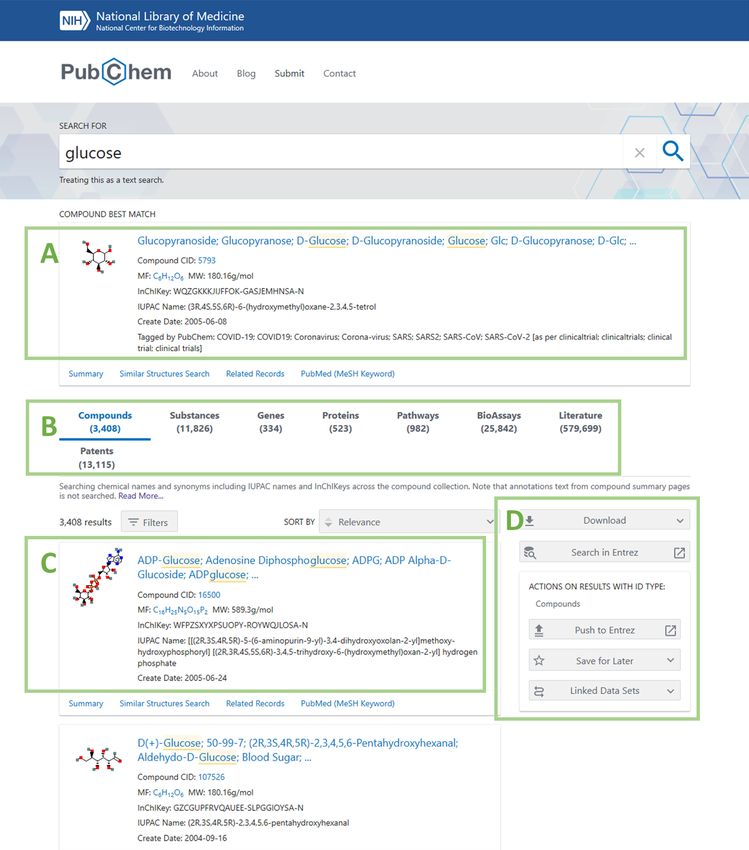
interactive users per month at peak time (see Figure 1),                          and other challenges, many changes have been made to
PubChem is one of the most visited chemistry web sites                            PubChem since our latest update paper published in this
in the world. PubChem serves as a key chemical informa-                           journal (1).

* To   whom correspondence should be addressed. Tel: +1 301 451 1811; Fax: +1 301 480 4559; Email: bolton@ncbi.nlm.nih.gov

Published by Oxford University Press on behalf of Nucleic Acids Research 2020.
This work is written by (a) US Government employee(s) and is in the public domain in the US.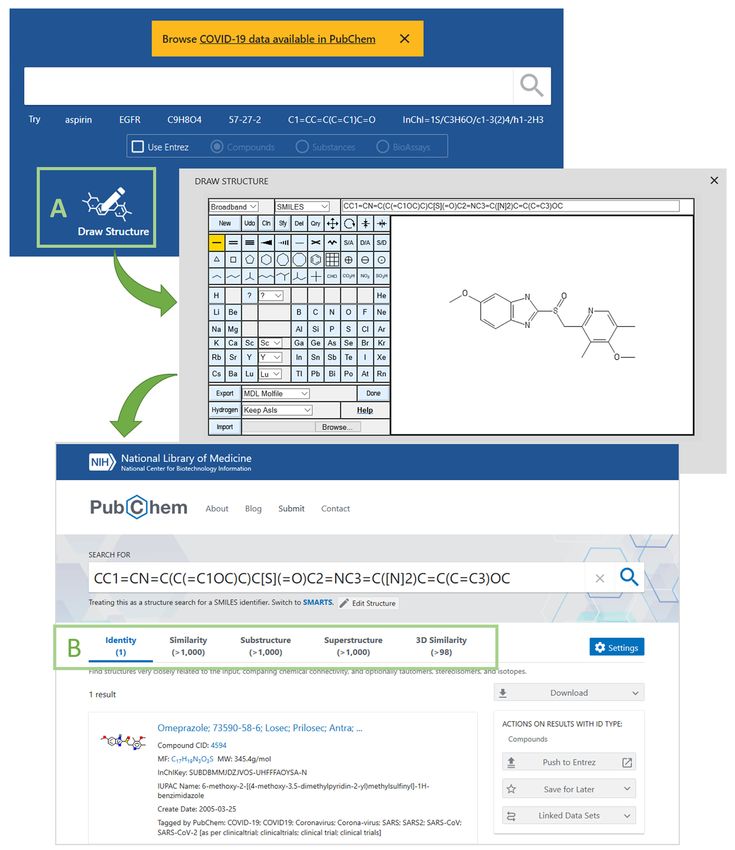
Nucleic Acids Research, 2021, Vol. 49, Database issue D1389

                                                                               Chemical-literature links
                                                                               PubChem added more than 1.35 million links between
                                                                               chemicals and scientific articles that mention them, thanks
                                                                               to data contributed by the publisher Thieme Chemistry
                                                                               (https://go.usa.gov/xEDCA). These data contain about 745
                                                                               000 chemicals, along with relevant articles and their meta-
                                                                               data (including the digital object identifier (DOI), publica-
                                                                               tion title, name of the journal or book, publication type,
                                                                               language, and publication year). The summary page of each
                                                                               compound contributed by Thieme Chemistry includes a
                                                                               table containing document links from Thieme Chemistry,
                                                                               as shown in the following example (for CID 9568614, es-

                                                                                                                                                  Downloaded from https://academic.oup.com/nar/article/49/D1/D1388/5957164 by guest on 15 January 2021
                                                                               omeprazole):
                                                                                  https://pubchem.ncbi.nlm.nih.gov/compound/
Figure 1. Growth of the number of unique PubChem users per month, as           9568614#section=Thieme-References
tracked by Google Analytics. The data shown here are for interactive users
who access PubChem through web browsers only and does not include                 The addition of Thieme Chemistry information drasti-
programmatic users.                                                            cally increased the number of chemical structures in Pub-
                                                                               Chem with links to the scientific literature. Of the 750 000
                                                                               chemicals, >40% were new to PubChem and 90% previ-
DATA CONTENTS                                                                  ously lacked literature links. Importantly, because many
                                                                               of these articles are about chemical synthesis, they are
With data integration from over 100 new sources for the                        often not found in PubMed, which focuses on literature
past two years, PubChem now contains more than 293 mil-                        in biomedical and life sciences. Therefore, these chemical-
lion depositor-provided substance descriptions, 111 million                    literature links dramatically expand the findability, accessi-
unique chemical structures, and 271 million bioactivity data                   bility, interoperability, and reusability (FAIR) of synthesis-
points from 1.2 million biological assays experiments (as                      related chemical information.
of August 2020). This corresponds to an increase in sub-
stances, compounds and bioactivities by 19%, 14% and
14%, respectively, compared to the statistics reported in our                  Links to molecular property data in SpringerMaterials
previous paper two years ago (1). This section highlights                      For >32 000 compounds, PubChem now provides links to
some of the notable new data added to PubChem.                                 hundreds of chemical and physical properties pertinent to
                                                                               material science and related fields, available from Springer-
                                                                               Materials (https://go.usa.gov/xvqfq). The summary page of
COVID-19 data set                                                              a compound with the SpringerMaterials link has a list
                                                                               of properties available at SpringerMaterials for that com-
The coronavirus disease 2019 (COVID-19) outbreak (26–                          pound in the ‘SpringerMaterials Properties’ subsection in
28), which began in early 2020, caused a serious global                        the ‘Chemical and Physical Properties’ section. For exam-
health crisis and scientific communities initiated various ef-                 ple, the following link shows the list of the material proper-
forts to stop this deadly disease. This created a huge de-                     ties for CID 702 (ethanol):
mand for convenient access to data pertinent to COVID-                            https://pubchem.ncbi.nlm.nih.gov/compound/
19 and the severe acute respiratory syndrome coronavirus                       702#section=SpringerMaterials-Properties
2 (SARS-CoV-2). In response to this urgent demand, Pub-                           Clicking on one of the properties in this list directs to the
Chem created a special data collection, which contains Pub-                    SpringerMaterials web page showing a list of articles con-
Chem data related to COVID-19 and SARS-CoV-2. This                             taining detailed information on that property. The Springer-
COVID-19 data collection can be accessed either from the                       Materials links help users to locate property data and re-
PubChem homepage or via the following URL:                                     lated literature available for chemicals.
   https://pubchem.ncbi.nlm.nih.gov/#query=covid-19.
   The data in this collection are collected from various
                                                                               Links to PATENTSCOPE at WIPO
authoritative sources, including several NCBI databases
(RefSeq, Gene, Protein, Structure, GenBank, Clinical-                          The World Intellectual Property Organization (WIPO)
Trials.gov) (4,29,30) as well as other external resources                      provided PubChem with >16 million chemical structures
(UniProt (31), RCSB Protein Databank (PDB) (32),                               searchable in its patent database called PATENTSCOPE
IUPHAR/BPS Guide to PHARMACOLOGY (33),                                         (https://go.usa.gov/xdhfK). For each chemical structure
WikiPathways (34), DrugBank (35), COVID-19 Disease                             contributed by WIPO, PubChem provides a direct link
Map (https://fairdomhub.org/projects/190), CAS COVID-                          to PATENTSCOPE, enabling PubChem users to search
19 Protein Target Thesaurus (https://www.cas.org/covid-                        PATENTSCOPE for patent documents relevant to that
19-protein-target-thesaurus), European Clinical Trials                         chemical structure. For example, the following URL directs
Register (https://www.clinicaltrialsregister.eu/ctr-search/                    users to the ‘WIPO PATENTSCOPE’ section of CID 3672
search?query=covid-19)). This data collection is updated                       (ibuprofen):
on a weekly basis and PubChem is actively seeking new                             https://pubchem.ncbi.nlm.nih.gov/compound/
relevant data to add to it.                                                    3672#section=WIPO-PATENTSCOPE.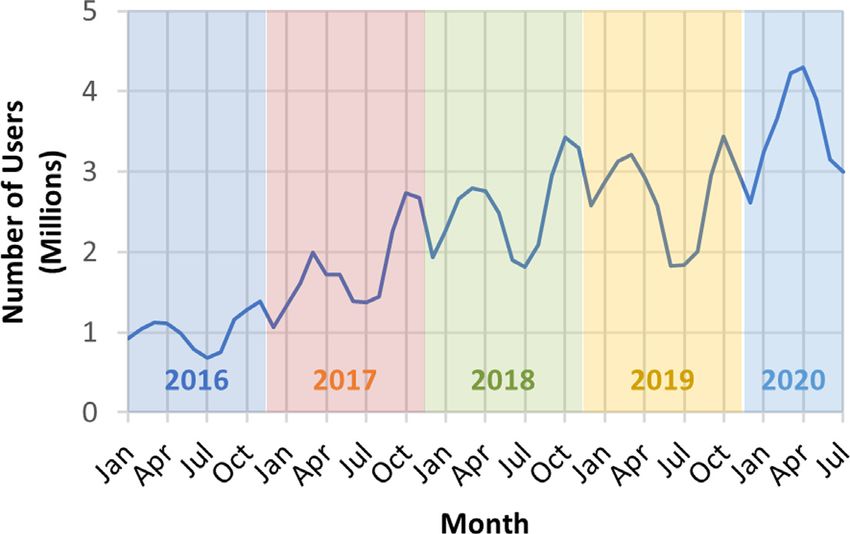
D1390 Nucleic Acids Research, 2021, Vol. 49, Database issue

Table 1. Links to examples of the pages that present data for various types of PubChem records
Record type                    Example ID                                      Link
Compound                       CID 1983                                        https://pubchem.ncbi.nlm.nih.gov/compound/1983
                               Chemical name ‘ibuprofen’                       https://pubchem.ncbi.nlm.nih.gov/compound/ibuprofen
Substance                      SID 138460                                      https://pubchem.ncbi.nlm.nih.gov/substance/138460
BioAssay                       AID 248                                         https://pubchem.ncbi.nlm.nih.gov/bioassay/248
Gene                           Gene ID 1956                                    https://pubchem.ncbi.nlm.nih.gov/gene/1956
                               Gene name ‘EGFR’                                https://pubchem.ncbi.nlm.nih.gov/gene/egfr
Protein                        Accession P00533                                https://pubchem.ncbi.nlm.nih.gov/protein/P00533
                               PDB Chain ID 1XKK A                             https://pubchem.ncbi.nlm.nih.gov/protein/1XKK A
Pathway                        Reactome ID R-BTA-177929                        https://pubchem.ncbi.nlm.nih.gov/pathway/Reactome:R-BTA-177929
Patent                         US7651687                                       https://pubchem.ncbi.nlm.nih.gov/patent/US7651687
Bioactivity                    AID 248 & SID 553777                            https://pubchem.ncbi.nlm.nih.gov/bioassay/248#sid=553777
                               Accession P00533 & CID 5328245                  https://pubchem.ncbi.nlm.nih.gov/protein/P00533#cid=5328245

                                                                                                                                                Downloaded from https://academic.oup.com/nar/article/49/D1/D1388/5957164 by guest on 15 January 2021
                               Gene ID 1956 & CID 5328245                      https://pubchem.ncbi.nlm.nih.gov/gene/1956#cid=5328245

   The link presented in this section allows users to search                 databases, but also hits from other collections (e.g., proteins,
PATENTSCOPE for patent documents relevant to ibupro-                         genes, pathways, assays, scientific articles, patents). In addi-
fen and further analyze returned hits using the tools avail-                 tion, the new search box accepts chemical structure queries,
able at PATENTSCOPE. The integration of WIPO’s chem-                         allowing users to perform various types of structure search,
ical information with PubChem makes it easier for Pub-                       including identity, similarity, substructure and superstruc-
Chem users to find pertinent patent information about                        ture searches (Figure 3). The query structure can be pro-
chemicals.                                                                   vided as SMILES (45–47) or InChI strings (48) or drawn
                                                                             using the PubChem Sketcher (49).
ToxNet migration
                                                                             Knowledge panels
ToxNet (36) was a collection of NLM databases that pro-
vided a wide range of toxicological information. As part of                  To help users quickly find important relationships among
a broad reorganization at NLM, ToxNet was retired in De-                     chemicals, genes, and diseases, we introduced knowledge
cember 2019 and PubChem is now hosting chemical toxi-                        panels. They show a list of a few selected chemicals, genes, or
cology information for several ToxNet databases, including                   diseases that are most commonly mentioned together with a
the Chemical Carcinogenesis Research Information Sys-                        given chemical or gene in scientific articles. For example, the
tem (CCRIS), Genetic Toxicology Data Bank (Gene-Tox)                         Compound summary page of CID 1983 (acetaminophen)
(37,38), and Hazardous Substances Data Bank (HSDB)                           has the following three knowledge panels:
(39,40). Text data from HSDB, ChemIDplus (41), LactMed
(42,43) and LiverTox (44) are integrated as annotations into                 • Chemical–chemical co-occurrences: https://pubchem.
compound records in PubChem. Chemical toxicity test re-                        ncbi.nlm.nih.gov/compound/1983#section=Chemical-
sults of chemicals from CCRIS and Gene-Tox are archived                        Co-Occurrences-in-Literature
as bioassay records and substances tested in them. More                      • Chemical–gene co-occurrences: https://pubchem.ncbi.
detailed information on the ToxNet integration into Pub-                       nlm.nih.gov/compound/1983#section=Chemical-Gene-
Chem can be found at: https://pubchemdocs.ncbi.nlm.nih.                        Co-Occurrences-in-Literature
gov/toxnet.                                                                  • Chemical–disease co-occurrences: https://pubchem.
                                                                               ncbi.nlm.nih.gov/compound/1983#section=Chemical-
                                                                               Disease-Co-Occurrences-in-Literature
WEB INTERFACES
                                                                               For each co-occurring entity listed on the knowledge
Redesigned webpages
                                                                             panel, a sample of relevant PubMed records is displayed as
To provide users with easier access to its content, we re-                   evidence (with a link to the full set). The content displayed
designed the PubChem homepage and the pages dedicated                        in knowledge panels is generated from statistical analysis
to individual records (e.g. compound, substance, bioassay,                   of mentions of chemicals, genes, and diseases in PubMed
gene, protein and patent) (Table 1). The new pages use re-                   records. This analysis involves annotating PubMed records
sponsive design that works on both desktop computers and                     using natural-language processing (NLP) software, called
mobile devices like smartphones and tablets. In addition,                    LeadMine (50), and matching the annotations with infor-
color-themes were introduced for different collections. For                  mation in PubChem and other databases. More detailed in-
example, compound pages have a light blue theme, while                       formation on this co-occurrence analysis can be found at:
substance pages use a yellow theme.                                          https://pubchemdocs.ncbi.nlm.nih.gov/knowledge-panels.
   Importantly, the new PubChem homepage provides im-
proved search capabilities. The new homepage has a single
                                                                             PubChem Pathway View page
search box that allows users to search multiple data collec-
tions simultaneously using a single query (Figure 2). For                    The PubChem Pathway page for a given biological path-
example, a text query ‘glucose’ in the search box returns                    way provides information on chemicals, proteins, genes and
not only hit chemicals from the Compound and Substance                       diseases involved in or associated with that pathway, and
Nucleic Acids Research, 2021, Vol. 49, Database issue D1391
Downloaded from https://academic.oup.com/nar/article/49/D1/D1388/5957164 by guest on 15 January 2021
Figure 2. Partial screen shot of the page returned from a text query ‘glucose’ (https://pubchem.ncbi.nlm.nih.gov/#query=glucose). PubChem interprets
the query and suggest the best record pertinent to the query (Box A). The new search interface allows the user to simultaneously search multiple collections
and hits returned from different collections can be viewed by click the corresponding tabs (Box B). Clicking one of the returned hits directs the user to the
page dedicated to the record (Box C). The user can perform additional tasks using the buttons available on the right column of the page (Box D).D1392 Nucleic Acids Research, 2021, Vol. 49, Database issue
Downloaded from https://academic.oup.com/nar/article/49/D1/D1388/5957164 by guest on 15 January 2021
Figure 3. Searching PubChem using a chemical structure input. The user can provide a chemical structure query by either using a line notation (e.g. SMILES
or InChI) or by drawing the input molecule with the PubChem Sketcher (Box A). The new search interface performs different types of structure searches,
including identity, similarity, substructure and superstructure searches (Box B).Nucleic Acids Research, 2021, Vol. 49, Database issue D1393
can be very important to provide a context to observed bi- State Transfer (REST)-style interface (62,63). It serves in-
ological activity. All pathway records were integrated from formation necessary to render interactive web pages but
existing pathway resources (34,51–59) without any attempt also allows one to programmatically access the chemical
to merge or combine them, meaning that a pathway may annotations and summary information in PubChem. In
have multiple records within PubChem, with each originat- 2019, major changes were made to the data model for
ing from a different source. Each page for a given pathway JSON/XML objects returned by the PUG-View server.
can be accessed via an URL of the form: More detailed information on these changes can be found
https://pubchem.ncbi.nlm.nih.gov/pathway/SOURCE: at https://go.usa.gov/xEHXj. While these changes do not di-
PATHID rectly affect web users, programmatic users need to update
where SOURCE is the information source for the path- the programs that retrieve and interpret data from PUG
way and PATHID is the record identifier used by that View.
source. For instance, the following URL directs to the path-
way page for the human glycolysis pathway from PathBank
Downloaded from https://academic.oup.com/nar/article/49/D1/D1388/5957164 by guest on 15 January 2021
SUMMARY
(ID: SMP0000040):
https://pubchem.ncbi.nlm.nih.gov/pathway/PathBank: The present paper describes the updates made to PubChem
SMP0000040 over the past two years. The data integration from more
PubChem Pathways resource supersedes the NCBI than 100 new sources to PubChem has greatly broadened
BioSystems database (60), which is no longer being up- the scope of its information content. Notable additions in-
dated. Many records in the BioSystems database are also clude the chemical-literature links from Thieme Chemistry,
available via PubChem Pathways. The Pathway pages for links to property data available from SpringerMaterials and
those records can be accessed via an URL containing NCBI links to PATENTSCOPE at WIPO. In addition, a substan-
BioSystems identifiers (BSIDs), as shown in the following tial amount of chemical toxicological information from sev-
example (for BSID 1458456): eral ToxNet databases has been integrated into PubChem.
https://pubchem.ncbi.nlm.nih.gov/pathway/BSID: These new additions significantly improved the FAIR-ness
1458456 of chemical information. It is also noteworthy that the spe-
Chemicals, proteins, and genes presented on PubChem cial data collection for COVID-19 was created to provide
Pathway pages are linked to the corresponding PubChem scientists with quick access to data critical to their efforts to
pages, providing quick access to more detailed information stop this deadly disease.
on these entities. In addition, the Pathway pages provide in- There were major changes to PubChem’s web interfaces.
formation on the interactions or reactions among these en- The PubChem homepage and pages dedicated to individ-
tities. The Pathway pages are searchable within PubChem ual records were redesigned to provide users with an easier,
Search. mobile-friendly access to PubChem data. These changes in-
volve a data model change for the objects used by the new
web pages as well as for programmatic users. Therefore, the
PubChem Periodic Table and Element pages
programs that retrieve and interpret data from PUG-View
The PubChem Periodic Table and Element pages (61) were should be updated accordingly.
introduced to help users navigate the abundant chemical el- In addition, several new services were introduced. The
emental data within PubChem, while providing a conve- new search interface allows users to search multiple data
nient entry point to explore additional chemical content, collections within PubChem simultaneously. It also accepts
such as biological activities and health and safety data avail- structure queries and supports different types of struc-
able in PubChem Compound pages for specific elements ture search (i.e. identity, similarity, substructure and super-
and their isotopes. The Periodic Table can be accessed from structure searches). The knowledge panels, which display
the PubChem homepage, from which Element pages for in- chemicals, genes, or diseases most-frequently mentioned in
dividual elements can be reached. The Periodic Table and PubMed articles together with a given chemical or gene,
Element pages are also available as widgets, enabling one were introduced to help users quickly identify important re-
to display PubChem’s element data on external web pages. lationships between these entities. The Pathway pages pro-
Because the widgets load data directly from PubChem, it vide information on chemicals, proteins, genes, and diseases
always shows the most current information in PubChem. involved in each pathway. The PubChem Periodic Table and
The data presented on the Periodic Table and Element Element pages assist users in exploring the abundant chem-
pages are integrated from scientific articles and authorita- ical element data.
tive data sources. The elemental data can be downloaded
in common file formats and imported into data analysis
DATA AVAILABILITY
programs (spreadsheet software like Microsoft Excel and
Google Sheets or computer scripts in python or R). In ad- All PubChem data, tools, and services are provided to the
dition, these data are not only available through the web public free of charge.
interfaces but also programmatically through PUG-REST
(23,24) and PUG-View (25).
ACKNOWLEDGEMENTS
We appreciate the hundreds of data contributors for mak-
DATA MODEL CHANGE
ing their data openly accessible within PubChem. Special
Among the multiple programmatic access routes to Pub- thanks go to the entire NCBI staff (especially to the help
Chem data is PUG-View (25), which is a Representational desk and systems support teams).D1394 Nucleic Acids Research, 2021, Vol. 49, Database issue
FUNDING 19. Ludwig,M., Duhrkop,K. and Bocker,S. (2018) Bayesian networks for
mass spectrometric metabolite identification via molecular
Intramural Research Program of the National Library of fingerprints. Bioinformatics, 34, 333–340.
Medicine, National Institutes of Health. Funding for open 20. Allen,F., Greiner,R. and Wishart,D. (2015) Competitive
access charge: Intramural Research Program of the Na- fragmentation modeling of ESI-MS/MS spectra for putative
metabolite identification. Metabolomics, 11, 98–110.
tional Library of Medicine, National Institutes of Health. 21. Shen,H.B., Zamboni,N., Heinonen,M. and Rousu,J. (2013)
Conflict of interest statement. None declared. Metabolite identification through machine learning - tackling
CASMI challenge using FingerID. Metabolites, 3, 484–505.
22. Heinonen,M., Shen,H.B., Zamboni,N. and Rousu,J. (2012)
REFERENCES Metabolite identification and molecular fingerprint prediction
1. Kim,S., Chen,J., Cheng,T., Gindulyte,A., He,J., He,S., Li,Q., through machine learning. Bioinformatics, 28, 2333–2341.
Shoemaker,B.A., Thiessen,P.A., Yu,B. et al. (2019) PubChem 2019 23. Kim,S., Thiessen,P.A., Bolton,E.E. and Bryant,S.H. (2015)
update: improved access to chemical data. Nucleic Acids Res., 47, PUG-SOAP and PUG-REST: web services for programmatic access
D1102–D1109. to chemical information in PubChem. Nucleic Acids Res., 43,
W605–W611.
Downloaded from https://academic.oup.com/nar/article/49/D1/D1388/5957164 by guest on 15 January 2021
2. Kim,S., Thiessen,P.A., Bolton,E.E., Chen,J., Fu,G., Gindulyte,A.,
Han,L., He,J., He,S., Shoemaker,B.A. et al. (2016) PubChem 24. Kim,S., Thiessen,P.A., Cheng,T., Yu,B. and Bolton,E.E. (2018) An
substance and compound databases. Nucleic Acids Res., 44, update on PUG-REST: RESTful interface for programmatic access
D1202–D1213. to PubChem. Nucleic Acids Res., 46, W563–W570.
3. Kim,S. (2016) Getting the most out of PubChem for virtual 25. Kim,S., Thiessen,P.A., Cheng,T., Zhang,J., Gindulyte,A. and
screening. Expert. Opin. Drug Discov., 11, 843–855. Bolton,E.E. (2019) PUG-View: programmatic access to chemical
4. Sayers,E.W., Beck,J., Brister,J.R., Bolton,E.E., Canese,K., annotations integrated in PubChem. J. Cheminform., 11, 56.
Comeau,D.C., Funk,K., Ketter,A., Kim,S., Kimchi,A. et al. (2020) 26. Guan,W., Ni,Z., Hu,Y., Liang,W., Ou,C., He,J., Liu,L., Shan,H.,
Database resources of the national center for biotechnology Lei,C., Hui,D.S.C. et al. (2020) Clinical characteristics of coronavirus
information. Nucleic Acids Res., 48, D9–D16. disease 2019 in China. N. Engl. J. Med., 382, 1708–1720.
5. Singh,N., Chaput,L. and Villoutreix,B.O. (2020) Fast rescoring 27. Richardson,S., Hirsch,J.S., Narasimhan,M., Crawford,J.M.,
protocols to improve the performance of structure-based virtual McGinn,T., Davidson,K.W. and Northwell,C.-R.C. (2020) Presenting
screening performed on protein-protein interfaces. J. Chem. Inf. characteristics, comorbidities, and outcomes among 5700 patients
Model., 60, 3910–3934. hospitalized with COVID-19 in the New York City area. JAMA-J.
6. Xiao,T., Qi,X.X., Chen,Y.Z. and Jiang,Y.Y. (2018) Development of Am. Med. Assoc., 323, 2052–2059.
ligand-based big data deep neural network models for virtual 28. Spinelli,A. and Pellino,G. (2020) COVID-19 pandemic: perspectives
screening of large compound libraries. Mol. Inf., 37, 1800031. on an unfolding crisis. Br. J. Surg., 107, 785–787.
7. Pasupa,K. and Kudisthalert,W. (2018) Virtual screening by a new 29. Madej,T., Lanczycki,C.J., Zhang,D.C., Thiessen,P.A., Geer,R.C.,
clustering-based weighted similarity extreme learning machine Marchler-Bauer,A. and Bryant,S.H. (2014) MMDB and VAST+:
approach. PLoS One, 13, e0195478. tracking structural similarities between macromolecular complexes.
8. Chen,J.J., Schmucker,L.N. and Visco,D.P. (2018) Pharmaceutical Nucleic Acids Res., 42, D297–D303.
machine learning: virtual high-throughput screens identifying 30. Sayers,E.W., Cavanaugh,M., Clark,K., Ostell,J., Pruitt,K.D. and
promising and economical small molecule inhibitors of complement Karsch-Mizrachi,I. (2020) GenBank. Nucleic Acids Res., 48,
factor C1s. Biomolecules, 8, 24. D84–D86.
9. Deshmukh,A.L., Chandra,S., Singh,D.K., Siddiqi,M.I. and 31. Bateman,A., Martin,M.J., Orchard,S., Magrane,M., Alpi,E., Bely,B.,
Banerjee,D. (2017) Identification of human flap endonuclease 1 Bingley,M., Britto,R., Bursteinas,B., Busiello,G. et al. (2019)
(FEN1) inhibitors using a machine learning based consensus virtual UniProt: a worldwide hub of protein knowledge. Nucleic Acids Res.,
screening. Mol. Biosyst., 13, 1630–1639. 47, D506–D515.
10. Huang,H., Nguyen,T., Ibrahim,S., Shantharam,S., Yue,Z.L. and 32. Burley,S.K., Berman,H.M., Bhikadiya,C., Bi,C.X., Chen,L., Di
Chen,J.Y. (2015) DMAP: a connectivity map database to enable Costanzo,L., Christie,C., Dalenberg,K., Duarte,J.M., Dutta,S. et al.
identification of novel drug repositioning candidates. BMC (2019) RCSB Protein Data Bank: biological macromolecular
Bioinformatics, 16, S4. structures enabling research and education in fundamental biology,
11. Crisan,L., Avram,S. and Pacureanu,L. (2017) Pharmacophore-based biomedicine, biotechnology and energy. Nucleic Acids Res., 47,
screening and drug repurposing exemplified on glycogen synthase D464–D474.
kinase-3 inhibitors. Mol. Divers., 21, 385–405. 33. Armstrong,J.F., Faccenda,E., Harding,S.D., Pawson,A.J.,
12. Gad,A., Manuel,A.T., Jinuraj,K.R., John,L., Sajeev,R., Priya,V.G.S. Southan,C., Sharman,J.L., Campo,B., Cavanagh,D.R.,
and Jaleel,U.C.A. (2017) Virtual screening and repositioning of Alexander,S.P.H., Davenport,A.P. et al. (2020) The IUPHAR/BPS
inconclusive molecules of beta-lactamase Bioassays-A data mining Guide to PHARMACOLOGY in 2020: extending
approach. Comput. Biol. Chem., 70, 65–88. immunopharmacology content and introducing the IUPHAR/MMV
13. Wang,J.M. (2020) Fast identification of possible drug treatment of Guide to MALARIA PHARMACOLOGY. Nucleic Acids Res., 48,
coronavirus disease-19 (COVID-19) through computational drug D1006–D1021.
repurposing study. J. Chem. Inf. Model., 60, 3277–3286. 34. Slenter,D.N., Kutmon,M., Hanspers,K., Riutta,A., Windsor,J.,
14. Lee,J.H., Basith,S., Cui,M., Kim,B. and Choi,S. (2017) In silico Nunes,N., Melius,J., Cirillo,E., Coort,S.L., Digles,D. et al. (2018)
prediction of multiple-category classification model for cytochrome WikiPathways: a multifaceted pathway database bridging
P450 inhibitors and non-inhibitors using machine-learning method. metabolomics to other omics research. Nucleic Acids Res., 46,
SAR QSAR Environ. Res., 28, 863–874. D661–D667.
15. Ciallella,H.L. and Zhu,H. (2019) Advancing computational 35. Wishart,D.S., Feunang,Y.D., Guo,A.C., Lo,E.J., Marcu,A.,
toxicology in the big data era by artificial intelligence: data-driven Grant,J.R., Sajed,T., Johnson,D., Li,C., Sayeeda,Z. et al. (2018)
and mechanism-driven modeling for chemical toxicity. Chem. Res. DrugBank 5.0: a major update to the DrugBank database for 2018.
Toxicol., 32, 536–547. Nucleic Acids Res., 46, D1074–D1082.
16. Zhu,X.Z., Ho,C.H. and Wang,X.N. (2020) Application of life cycle 36. Wexler,P. (2001) TOXNET: An evolving web resource for toxicology
assessment and machine learning for high-throughput screening of and environmental health information. Toxicology, 157, 3–10.
green chemical substitutes. ACS Sustain. Chem. Eng., 8, 11141–11151. 37. Auletta,A.E., Brown,M., Wassom,J.S. and Cimino,M.C. (1991)
17. Zhang,W., Zou,H., Luo,L.Q., Liu,Q.C., Wu,W.J. and Xiao,W.Y. Current status of the gene-tox program. Environ. Health Perspect., 96,
(2016) Predicting potential side effects of drugs by recommender 33–36.
methods and ensemble learning. Neurocomputing, 173, 979–987. 38. Cimino,M.C. and Auletta,A.E. (1994) The gene-tox program - data
18. Zhang,W., Liu,X.R., Chen,Y.L., Wu,W.J., Wang,W. and Li,X.H. evaluation of chemically-induced mutagenicity. In: Draper,WM (ed).
(2018) Feature-derived graph regularized matrix factorization for Environmental Epidemiology: Effects of Environmental Chemicals on
predicting drug side effects. Neurocomputing, 287, 154–162.Nucleic Acids Research, 2021, Vol. 49, Database issue D1395
Human Health. Amer Chemical Soc, Washington, Vol. 241, pp. 53. Schläpfer,P., Zhang,P.F., Wang,C.A., Kim,T., Banf,M., Chae,L.,
89–104. Dreher,K., Chavali,A.K., Nilo-Poyanco,R., Bernard,T. et al. (2017)
39. Fonger,G.C. (1995) Hazardous substances data bank (HSDB) as a Genome-wide prediction of metabolic enzymes, pathways, and gene
source of environmental fate information on chemicals. Toxicology, clusters in plants. Plant Physiol., 173, 2041–2059.
103, 137–145. 54. Naithani,S., Gupta,P., Preece,J., D’Eustachio,P., Elser,J.L., Garg,P.,
40. Fonger,G.C., Hakkinen,P., Jordan,S. and Publicker,S. (2014) The Dikeman,D.A., Kiff,J., Cook,J., Olson,A. et al. (2020) Plant
National Library of Medicine’s (NLM) Hazardous Substances Data Reactome: a knowledgebase and resource for comparative pathway
Bank (HSDB): background, recent enhancements and future plans. analysis. Nucleic Acids Res., 48, D1093–D1103.
Toxicology, 325, 209–216. 55. Whirl-Carrillo,M., McDonagh,E.M., Hebert,J.M., Gong,L.,
41. Tomasulo,P. (2002) ChemIDplus-Super source for chemical and drug Sangkuhl,K., Thorn,C.F., Altman,R.B. and Klein,T.E. (2012)
information. Med. Ref. Serv. Q., 21, 53–59. Pharmacogenomics knowledge for personalized medicine. Clin.
42. Tomasulo,P. (2007) LactMed-new NLM database on drugs and Pharmacol. Ther., 92, 414–417.
lactation. Med. Ref. Serv. Q., 26, 51–58. 56. Schaefer,C.F., Anthony,K., Krupa,S., Buchoff,J., Day,M., Hannay,T.
43. Anderson,P.O. (2016) LactMed update––an introduction. Breastfeed. and Buetow,K.H. (2009) PID: the Pathway Interaction Database.
Med., 11, 54–55. Nucleic Acids Res., 37, D674–D679.
44. Hoofnagle,J.H., Serrano,J., Knoben,J.E. and Navarro,V.J. (2013) 57. Wishart,D.S., Li,C., Marcu,A., Badran,H., Pon,A., Budinski,Z.,
Downloaded from https://academic.oup.com/nar/article/49/D1/D1388/5957164 by guest on 15 January 2021
LiverTox: a website on drug-induced liver injury. Hepatology, 57, Patron,J., Lipton,D., Cao,X., Oler,E. et al. (2020) PathBank: a
873–874. comprehensive pathway database for model organisms. Nucleic Acids
45. Weininger,D. (1988) SMILES, a chemical language and Res., 48, D470–D478.
information-system. 1. introduction to methodology and encoding 58. Yamamoto,S., Sakai,N., Nakamura,H., Fukagawa,H., Fukuda,K.
rules. J. Chem. Inf. Comput. Sci., 28, 31–36. and Takagi,T. (2011) INOH: ontology-based highly structured
46. Weininger,D., Weininger,A. and Weininger,J.L. (1989) SMILES. 2. database of signal transduction pathways. Database, 2011, bar052.
Algorithm for generation of unique smiles notation. J. Chem. Inf. 59. Karp,P.D., Billington,R., Caspi,R., Fulcher,C.A., Latendresse,M.,
Comput. Sci., 29, 97–101. Kothari,A., Keseler,I.M., Krummenacker,M., Midford,P.E., Ong,Q.
47. Weininger,D. (1990) SMILES. 3. Depict - graphical depiction of et al. (2019) The BioCyc collection of microbial genomes and
chemical structures. J. Chem. Inf. Comput. Sci., 30, 237–243. metabolic pathways. Brief. Bioinform., 20, 1085–1093.
48. Heller,S.R., McNaught,A., Pletnev,I., Stein,S. and Tchekhovskoi,D. 60. Geer,L.Y., Marchler-Bauer,A., Geer,R.C., Han,L.Y., He,J., He,S.Q.,
(2015) InChI, the IUPAC international chemical identifier. J. Liu,C.L., Shi,W.Y. and Bryant,S.H. (2010) The NCBI BioSystems
Cheminform., 7, 23. database. Nucleic Acids Res., 38, D492–D496.
49. Ihlenfeldt,W.D., Bolton,E.E. and Bryant,S.H. (2009) The PubChem 61. Kim,S., Gindulyte,A., Zhang,J., Thiessen,P.A. and Bolton,E.E.
chemical structure sketcher. J. Cheminform., 1, 20. (2020) PubChem Periodic Table and Element pages: improving access
50. Lowe,D.M. and Sayle,R.A. (2015) LeadMine: a grammar and to information on chemical elements from authoritative sources.
dictionary driven approach to entity recognition. J. Cheminform., 7, Chem. Teacher Int., 2, 20200006.
S5. 62. Fielding,R.T. (2000) Representational State Transfer (REST). In:
51. Jassal,B., Matthews,L., Viteri,G., Gong,C.Q., Lorente,P., Architectural Styles and the Design of Network-based Software
Fabregat,A., Sidiropoulos,K., Cook,J., Gillespie,M., Haw,R. et al. Architectures. University of California, Irvine.
(2020) The reactome pathway knowledgebase. Nucleic Acids Res., 48, 63. Fielding,R.T. and Taylor,R.N. (2000) Principled design of the
D498–D503. modern Web architecture. In: Proceedings of the 22nd International
52. O’Donnell,V.B., Dennis,E.A., Wakelam,M.J.O. and Subramaniam,S. Conference on Software Engineering, pp. 407–416.
(2019) LIPID MAPS: Serving the next generation of lipid researchers
with tools, resources, data, and training. Sci. Signal., 12, eaaw2964.You can also read


