Digital Forensic Approaches for Amazon Alexa Ecosystem - arXiv
←
→
Page content transcription
If your browser does not render page correctly, please read the page content below
DFRWS USA 2017 Accepted paper*

             Digital Forensic Approaches for Amazon Alexa Ecosystem
                                     Hyunji Chunga, Jungheum Parka, Sangjin Leea
         a
             Center for Information Security Technologies (CIST), Korea University, 145 Anam-ro, Seongbuk-Gu, Seoul, 08421, South Korea

Abstract

    Internet of Things (IoT) devices such as the Amazon Echo - a smart speaker developed by Amazon - are undoubtedly great
sources of potential digital evidence due to their ubiquitous use and their always-on mode of operation, constituting a human-life’s
black box. The Amazon Echo in particular plays a centric role for the cloud-based intelligent virtual assistant (IVA) Alexa
developed by Amazon Lab126. The Alexa-enabled wireless smart speaker is the gateway for all voice commands submitted to
Alexa. Moreover, the IVA interacts with a plethora of compatible IoT devices and third-party applications that leverage cloud
resources. Understanding the complex cloud ecosystem that allows ubiquitous use of Alexa is paramount on supporting digital
investigations when need raises. This paper discusses methods for digital forensics pertaining to the IVA Alexa’s ecosystem. The
primary contribution of this paper consists of a new efficient approach of combining cloud-native forensics with client-side
forensics (forensics for companion devices), to support practical digital investigations. Based on a deep understanding of the
targeted ecosystem, we propose a proof-of-concept tool, CIFT, that supports identification, acquisition and analysis of both native
artifacts from the cloud and client-centric artifacts from local devices (mobile applications and web browsers).
Keywords : Internet of Things; Cloud-based IoT; Intelligent virtual assistant (IVA); Amazon Alexa; Amazon Echo; Cloud native forensics;
Client centric forensics; CIFT;

1. Introduction                                                               device’s communication with Alexa. However,
                                                                              Amazon denied the request in the absence of a valid
   The Internet of Things (IoT) is evolving rapidly
                                                                              and binding legal demand [3].
along with the network of physical objects that contain
                                                                                  While there are many legal questions regarding the
embedded communication technology. Analysts
                                                                              use of this type of evidence, there are also important
predict that the worldwide IoT market will grow to
                                                                              technical considerations. Most importantly, to
$1.7 trillion in 2020 with a compound annual growth
                                                                              efficiently investigate these types of cases, it is first
rate (CAGR) of 16.9% [1]. Gartner predicts that 25%
                                                                              necessary to understand the digital forensic
of households using an intelligent virtual assistant
                                                                              characteristics of Amazon’s Alexa and its ecosystem.
(IVA) will have two or more devices by 2020 [2]. The
                                                                                  When Alexa-enabled, Amazon Echo is not only a
ubiquitous use of wearables, personal smart devices,
                                                                              smart speaker, but operates as an intelligent, intelligent
smart appliances, etc., will generate a large amount of
                                                                              virtual assistant. As a cloud service, Alexa interacts
digital data that can be a great source of digital
                                                                              with various Alexa-enabled devices such as Echo, and
evidence.
                                                                              it can communicate with other compatible IoT devices
   In several recent criminal investigations, law
                                                                              and third-party applications by converting the voice
enforcement officials, legal experts and forensics
                                                                              requests to other services’ native communication
experts attempted to use “always-on” IoT devices as
                                                                              protocol. Also, for customizing these Alexa-related
sources of forensic artifacts similar to human-life
                                                                              environments, users should access the cloud service
black boxes. In particular, one recent criminal
                                                                              using companion clients, such as PC or mobile
investigation case involving an Amazon Echo, gained
                                                                              (Android and iOS) devices. Thus, the ecosystem
widespread attention in the media. In November 2015,
                                                                              created by all these interconnected devices, third-party
James Bates was charged with first-degree murder of
                                                                              applications and companion clients is complex and
another man, who was found dead in Bates’ hot tub.
                                                                              heterogeneous [4]. In this paper, we will refer to this
Police in Arkansas seized Bates’ Alexa-enabled Echo
                                                                              ecosystem as the Amazon Alexa ecosystem.
smart speaker from his home, and asked Amazon to
                                                                                  We propose a new digital forensic approach for the
hand over any pertinent information regarding the

*   This is a pre-print of a paper accepted to appear at DFRWS USA 2017.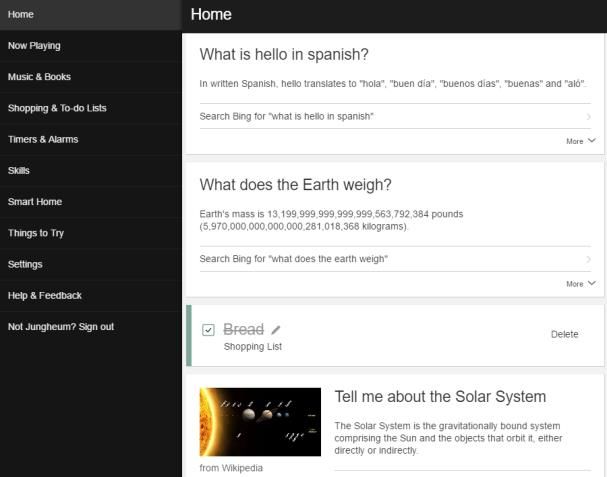
Amazon Alexa ecosystem combining cloud-side and             smart devices, which also includes Dot and Tap,
client-side forensics. The acquisition of cloud-native      connect to the intelligent cloud-based voice service,
artifacts from the Alexa is very important. Echo            Alexa Voice Service (AVS). With Alexa as a voice-
operations are based on Alexa, so the cloud includes        activated personal assistant, the Echo is capable of
many different types of artifacts related to user           doing various things, such as managing to-do lists,
behaviors. Unfortunately, this approach has two             playing music, setting alarms, placing orders,
limitations. First, it requires valid user accounts in      searching information, and controlling other smart
order to access the cloud. There is, of course, the         devices [4]. According to an industry report, the Echo
potential to discover access information through            family sold more than 11 million units between the
investigation or interrogation, but this information is     middle of 2015 and 2016 [6]. Additionally, as
not always available. Second, it is difficult to recover    announced at CES 2017, there is an interesting
deleted data on the cloud. Client-side forensics            convergence of the Alexa with various devices, such
approaches are needed to overcome these limitations.        as connected cars, smartww fridges, and robots, which
That is, when it is impossible to acquire cloud-native      indicates that the Amazon Alexa-related environment
artifacts, companion clients can offer important            will become an important source of potential digital
artifacts for digital investigations.                       evidence. For these reasons, the Echo and Alexa were
   As a result of our analysis, we introduce a proof-of-    selected as the first targets for studying digital forensic
concept tool for cloud-based IoT environments, CIFT:        approaches inside the IoT world.
Cloud-based IoT Forensic Toolkit, which can acquire
                                                            2.2. Amazon Alexa Ecosystem
cloud native artifacts from Alexa using unofficial APIs
and analyze client-side artifacts associated with the          Before presenting our analysis, we describe the
use of a web-based application. We also tried to            detailed architectures related to the target IoT
normalize all identified artifacts into a database file,    environment. As mentioned above, the Amazon Echo
and visualize them for evaluating our approach and          controls an interface for communicating with the
further supporting the work of the digital forensics        cloud-based service, Alexa. Cloud-based operations,
community. In a situation where existing tools and          such as Echo and Alexa, represent a general operating
procedures cannot meet the demand for this emerging         method of IoT consumer products because most are
IoT system, our findings and proof-of-concept tool          inseparable from cloud services in providing
will be helpful for investigators attempting to work in     interoperability with companion clients and
the Amazon Alexa environment.                               compatible devices for user convenience. Therefore,
   The rest of the paper is organized as follows.           this subsection describes the target IoT environment
Section 2 describes the target system and Section 3         focusing on its cloud service, Alexa.
reviews existing works. Section 4 presents our
findings for digital forensics and Section 5 introduces
                                                                                                            Cloud
an implementation based on our findings. Section 6                                                  Alexa                           Other Clouds
                                                                        Network
evaluates results with visualization techniques. Finally,
Section 7 discusses conclusions and next steps.
                                                                                                                                 Smart          Smart
                                                                                                        Network
                                                                                                                              Lighting Kits   Smoke Alarm
2. Amazon Alexa and Digital Forensics
                                                                                                                              Compatible IoT Devices
                                                                        Hardware                                     Client
2.1. Research Motivation
                                                                                                                                 Pizza
   In the IoT world, the do-it-yourself culture is              Echo Echo Dot       Smart Devices      Laptop       PC          Delivery
                                                                                                                                              Ridesharing

encouraged, meaning users themselves can develop            Alexa-enabled devices            Companion Clients                Third-party Applications

customized devices and applications for their IoT                               Figure 1. Amazon Alexa ecosystem
environments with tiny sensors and programmable
                                                               The Amazon Alexa ecosystem is composed of
brokers [5]. However, it is not easy for people who are
                                                            various components, as shown in Fig. 1. First, one or
unfamiliar with state-of-the-art technologies to build
                                                            more Alexa-enabled devices are required for talking to
customized IoT environments. Thus, most people tend
                                                            the Alexa cloud service. We should note our
to purchase IoT consumer products, including but not
                                                            description specifically relates to the ecosystem
limited to smart assistants, lights, sensors, switches,
                                                            associated with Amazon’s Echo devices, and other
hubs, thermostats, and fitness devices.
                                                            devices exist for communicating with the cloud
   Although a variety of products are available on the
                                                            service. Next, the Alexa in the figure represents all
market, we focused on one of the most famous
                                                            Amazon cloud platforms supporting operation of this
products, Amazon Echo. The Amazon Echo family of
                                                            ecosystem. So it includes various cloud services for
authentication, data management, and logging, as well 2.3.3. Cloud: Alexa cloud service
as the Alexa Voice Service. In addition to these core
As mentioned in Section 2.2, the Alexa is a core
components, one of the interesting aspects from the
component of the target ecosystem. Like other cloud
viewpoint of digital forensics is that companion clients
services, Alexa operates using pre-defined APIs to
are essential to managing the overall operating
transceive data, but unfortunately the available API
environment through access to the cloud server. The
list is not officially open to the public. As far as we
companion client means a personal device for
know, there is no literature for acquiring native
executing Alexa companion applications, such as the
artifacts from Alexa from the viewpoint of digital
Amazon Alexa App for Fire OS, Android, and iOS.
forensics. Thus, we performed an intensive analysis to
Although there is no official application for PC, users
reveal unofficial APIs used by Alexa and to acquire
can utilize web browsers for accessing the cloud, so
cloud-native artifacts for supporting investigations.
any kind of digital device with web browsing
capability may have potential digital evidence relating
2.3.4. Client: Alexa companion clients
to the use of the Alexa ecosystem. Furthermore, Alexa
can be expanded through connections to compatible Lastly, there is one more level of analysis relating
IoT devices and through addition of skills (third-party to Alexa companion clients. Interestingly, the use of at
apps) for utilizing various services, as shown in Fig. 1. least one companion client is essential to set up Alexa-
enabled devices and manage the operating
2.3. Analysis strategy
environment. For example, users can configure
Due to the characteristics of the Alexa ecosystem environment settings, review previous conversations
introduced above (summarized in Table 1), we with Alexa, and enable/disable skills using a mobile
considered multi-level forensic approaches similar to app or web-browser. In this process, a large amount of
that proposed by Zawoad et al. [7]. This subsection data associated with accessing Alexa can be stored
outlines multi-level forensic approaches for the target naturally in companion clients. This makes it necessary
ecosystem and also presents the scope of the study. to acquire these client-centric artifacts and consolidate
them along with cloud-native artifacts. For support of
2.3.1. Hardware: Alexa-enabled devices that effort, we attempted to discover all available
artifacts from both the cloud and client level.
Each Alexa-enabled device needs to be
decomposed for performing hardware-level analysis. Table 1. Analysis approaches for Amazon Alexa ecosystem
In this light, Clinton et al. introduced their research on Level Description Progress
analyzing Amazon Echo at the hardware level [8]. The - Acquiring cloud native artifacts from Alexa
Cloud
(when user credentials are available)
authors summarized their experiments for reverse - Identifying client-centric artifacts from mobile
Section 4
Client describes
engineering the device through available approaches, apps and web-browsers
the results
- Understanding the communication protocol
such as eMMC Root, JTAG, and debug ports. Network
and unofficial APIs used by Alexa
Although they explained some possible methods for Hardware - Reveling data stored in Alexa-enabled devices Future work
enabling access to the internal parts, including
soldered memory chips, the authors did not mention 3. Related works
details about data stored within the device. So, this 3.1. IoT and digital forensics
viewpoint will be included in one of our future projects,
expanding on the work presented here. There have been previous studies of digital forensic
frameworks for the IoT environment. Oriwoh et al.
2.3.2. Network: Communication protocol introduced hypothetical IoT crime scenarios that were
carried out by a suspect who used various IoTware to
As marked in Fig. 1, Alexa-enabled devices and commit crimes. Based on these scenarios, the authors
companion clients should communicate with the also discussed potential sources of digital evidence
Alexa through the internet. As a result of traffic [10]. Hegarty et al. and Liu established some
analysis using the Charles web debugging proxy [9], fundamental overarching challenges in the four main
we confirmed that most traffic associated with phases (identification, preservation, analysis, and
forensically meaningful artifacts are transferred over presentation) of digital forensics and identified key
an encrypted connection after creating a session with issues for IoT forensics [11, 12]. Zawoad et al. defined
a valid user ID and password. With this network IoT forensics as a combination of device, network, and
analysis, we were able to efficiently identify cloud- cloud forensics [7]. Also, Kebande et al. proposed a
native and client-centric artifacts. The results will be framework for digital investigations in the IoT domain
described in Section 4 in detail. and compared it with existing models. Theirframework provided a combination of three distinct As a result of our literature review, we decided to
processes, which included the proactive process, IoT combine two perspectives on cloud forensics in order
forensics, and the reactive process [13]. to propose an integrated IoT forensic system for the
Previous studies have proposed generic Amazon Alexa ecosystem. In detail, cloud-native
frameworks for defining theoretical models for the IoT forensics is essential for identifying user behaviors,
environment. With these studies as starting points for because most meaningful data are only saved on the
understanding the IoT world, we present a practical cloud side. However, acquiring data from the cloud
digital forensic approach for the Amazon Alexa has two fundamental limitations in that it requires
ecosystem that goes one step further. valid user credentials (usually a set of ID and
password), and it is practically impossible to respond
3.2. Cloud forensics
to a situation in which users try to delete data from the
As mentioned in Section 2, cloud forensics should cloud. To handle these limitations in practice, it is
play a key role in approaching the Amazon Alexa necessary to find client-centric artifacts stored within
ecosystem as a source of digital evidence. Existing companion clients, and, if available, use them to
studies have proposed two perspectives: client-based enhance results of cloud-native forensics. Furthermore,
cloud forensics and cloud-native forensics. because the client-centric artifacts, including local
In the first stage of research on cloud forensics, databases and cache files, are also closely related to
many researchers have performed client-based cloud the cloud-side data, it is necessary to first understand
forensics, acquiring and analyzing data that was the raw cloud data.
locally saved by applications or web browsers related
4. Forensic Artifacts on Amazon Alexa Ecosystem
to the use of famous cloud services, including but not
limited to Amazon S3, Google Docs, Dropbox, This section describes forensic artifacts from the
Evernote, and ownCloud [14, 15, 16, 17, 18]. use of Alexa-enabled devices and companion clients.
Next, recent research efforts have proposed
4.1. Test environment
examining cloud-native forensics to overcome the
fundamental limitation that there is still large amounts To identify meaningful artifacts on the target
data not stored in storage devices or just stored in ecosystem, a test environment was established, as
temporary caches. For example, Vassil et al. listed in Table 2. In this environment, we performed
introduced forensic approaches on native artifacts of experiments for about two months with two Amazon
Google Drive, Microsoft OneDrive, Dropbox, and Echo Dot products. This work also tested a variety of
Box using APIs supported by the cloud services. As a companion clients associated with Android, iOS, OS
result, the authors were able to implement cloud drive X, and Windows. In detail, the first two mobile
acquisition tools [19, 20]. devices were used for testing the Amazon Alexa app,
and the other clients were utilized to access the Alexa
3.3. Preliminary studies on Amazon Alexa forensics
web server using popular web browsers.
There have been several efforts to identify forensic
artifacts on IoT consumer products. For instance, a Table 2. Test environments
Item Description
research team briefly presented their findings on (1) Echo Dot (S/N: ***0L9***473***P)
Alexa-enabled
artifacts saved when users utilize Android mobile apps devices (2) Echo Dot (S/N: **90***964*****U)
* some characters of S/N are masked by asterisks
relating to IoT products, such as WinkHub, Amazon (1) Android 4.4.2 + Alexa app (1.24.1176.0)
Echo, Samsung SmartCam, and Nest products [21]. In Companion clients (2) iOS 10.1.1 + Alexa app (1.24.1176.0)
and applications (3) OS X 10.10.5 + Chrome (55.0.2883.87)
particular, regarding Amazon Echo, the team (4) Windows 10 + Chrome (55.0.2883.87)
mentioned SQLite databases and web cache files that Total test period 2016-11-18 ~ 2017-01-29
include meaningful information, such as accounts and Last verification date 2017-01-29
interactions with Alexa. Although their findings
include interesting data acquired by client-based cloud All findings introduced in this section were verified
forensics, the work was only partially useful for digital through repetitive tests conducted until Jan. 29, 2017.
forensics of the entire ecosystem. Similarly, Benson We should note that although the tests included
posted a python script to parse a SQLite database file popular web browsers, such as Internet Explorer, Edge,
of an Amazon Alexa app for iOS backed up via iTunes and Safari, they were excluded from the results of this
[22]. The python script was able to parse out objects paper because they did not store any meaningful cache
in to-do and shopping lists. data in the use of the Alexa web application.
3.4. Research direction affected by related works4.2. Cloud native artifacts identified by device-preference API. In addition, there
were also interesting values acquired by cards,
The key to an understanding the target ecosystem is
activities, and todos that included the rear part of a
identifying native data stored on the cloud side.
URL possessing a user’s voice file on the cloud. Thus,
it is possible to download the voice file using utterance
4.2.1. Revealing unofficial Alexa APIs
API if necessary.
The first attempt to go inside the target was to
understand the communication protocols and data cards
formats used by Alexa. For support of this work, we media
performed an intensive traffic analysis using a web third-party
proxy. Based on the analysis, we confirmed that most todos
traffic is transferred over encrypted connections, and notifications devices wifi
device- bluetooth
native artifacts are returned as JSON format. yourskills preferences wake-word
The next step was to reveal how to get specific data phoenix
from the cloud on the assumption that we have valid
activities
user credentials. Like other cloud services, the Alexa
cloud service also operates with pre-defined APIs to
third-party
transceive data. Although the API list is officially not First name
open to the public, there have been efforts to reveal
unofficial APIs of Alexa [23, 24]. In addition to this traffic
eon
information, we identified additional useful APIs and
interpreted their return values from the cloud in order
to discover configurations and user activities. Figure 2. Web-based application for Alexa
4.3. Client-centric artifacts
4.2.2. Understanding Alexa’s native artifacts
Appendix A lists our findings. The second column After understanding Alexa’s native artifacts, we
of the appendix shows unofficial Alexa APIs tried to find out client-centric artifacts from the use of
identified and used in this study. For ease of the companion applications listed in Table 2. To sum
terminology, each API has a name highlighted in bold. up our findings, Table 3 provides locations of artifacts
To clarify our findings, Fig. 2 shows the relationship having Alexa data in the companion devices.
between menus of the web-based application for Alexa
and APIs listed in the appendix. Also, regarding actual 4.3.1. Databases of the Alexa mobile app
JSON data returned by APIs, the last column of the With smart devices based on Android and iOS,
table summarizes important keys and values that users can manage their own Alexa ecosystem through
describe the meaning of APIs in summary. an official mobile application developed by Amazon
As a result of data analysis, each API is categorized like shown in Fig. 2.
as one of the following seven categories: account, In the Android system, the application uses two
customer setting, Alexa-enabled device, compatible SQLite files: map_data_storage.db and DataStore.db.
device, skill, user activity, and etc. These categories The first database contains token information about a
are closely connected with the data normalization user who is currently logged in. That is, all data in this
strategy (Section 5). As shown in Appendix A, we can database are deleted when a user signs out. Of course,
acquire forensically meaningful native artifacts from a part of the deleted records could be found from
the Alexa, such as registered user accounts, Alexa- unused areas of the SQLite database and its journal file,
enabled devices, saved Wi-Fi settings (including but this study did not cover a situation where data was
unencrypted passwords), linked Google calendars, and deleted. In addition, the other file includes to-do and
installed skill lists that may be used to interact with shopping lists. These lists can be acquired from the
other cloud services. cloud using todos API, as described in Appendix A.
One of the particularly interesting things we found In the case of the iOS system, the application
is that there is a large amount of data with timestamps. manages one SQLite file titled LocalData.sqlite. This
More specifically, JSON data acquired by APIs such file also includes to-do and shopping lists like
as cards, activities, media, notifications, phoenix, and DataStore.db in Android [22]. We should note that we
todos, contained values with UNIX timestamps. This solely analyzed files acquired by the iTunes backup
may provide sources of evidence that allow protocol. So, there was a limitation on accessible files
reconstruction of user activities with a time zone relating to the target application.Table 3. Client centric artifacts from companion clients discussed in this paper
OS Application Path Format Description
/data/data/com.amazon.dee.app/databases/map_data_storage.db SQLite Tokens of an active user
Android 4.4.2 Alexa 1.24.1176.0 /data/data/com.amazon.dee.app/databases/DataStore.db SQLite Todo and shopping list
/data/data/com.amazon.dee.app/app_webview/Cache/* WebView cache Cached native artifacts
iOS 10.1.1 Alexa 1.24.1176.0 [iTunes backup]/com.amazon.echo/Documents/LocalData.sqlite SQLite Todo and shopping list
OS X 10.10.5 Chrome 55.0.2883.87 ~/Library/Caches/Google/Chrome/Default/Cache/ Chrome cache Cached native artifacts
Windows 10 Chrome 55.0.2883.87 %UserProfile%\AppData\Local\Google\Chrome\User Data\Default\Cache\ Chrome cache Cached native artifacts
The results of database file examinations showed us of Chrome’s disk cache is already well known, this
that there was little information stored locally on paper outlines practical approaches to acquiring
companion devices by the application. Meanwhile, Alexa-related data from the cache structure.
although XML or PLIST files also exist for storing In the Chrome cache system, the data stream with
preferences, they were not in used in this study. Alexa native artifacts is usually stored inside the data
block files (data_#) for small amounts of data. Thus, it
4.3.2. Android WebView cache was necessary to parse all cache entries and verify
As the Amazon Alexa is basically a web-based their data streams inside the data block files. Although
application, it uses the WebView class to display the data stream may be stored as a separate file, there
online content in Android [25]. Thus, there is a chance is a small possibility because it is a compressed JSON
that cloud-native artifacts are cached by the WebView. string with gzip. Like normal cache entries, Alexa-
The cache directory described in Table 3 may related caches have two data streams: the first one is
contain multiple cache files. Each WebView cache file for HTTP headers, and the other is actual cached data.
(of Android 4.4.2) simply consists of a string with the These cache data, both Android WebView and
original URL and a data stream. Based on existing Chrome web caches, have great potential as sources of
comments [21, 26], Fig. 3 (a) describes the internal digital evidence. Although these caches are very
format of the WebView cache. We found an 8-byte helpful for understanding user behaviors, especially
fixed header and footer, and also a 4-byte field for when valid user credentials are not available or some
storing the length of a string with the original URL. As native artifacts are deleted from the cloud, it also has
an example of Alexa-related caches, Fig. 3 (b) shows inevitable limitations. For example, caches are only
a file cached after calling phoenix API. Because a data created when users click menus that trigger Alexa
stream of the example is gzip-compressed data, it was APIs, and they also can be deleted or overwritten at
necessary to decompress it to obtain the original JSON. any time.
Header(8) Unk(4) UrlLen(4) 305C72A71B6DFBFC 04000000 37000000
5. Design and Implementation
Unk(4) 2A790382 h t t p s : / / p i t a
This section explains the overall design concept
A string with the original URL n g u i . a m a z o n . c o m /
without a null character a p i / p h o e n i x ? _ = 1 4 and implementation of an integrated system to support
8 0 6 2 0 0 1 3 1 9 1 1F8B ... digital investigations on the Amazon Alexa ecosystem.
gzip-compressed data
returned by phoenix API
5.1. Design of CIFT
The CIFT (Cloud-based IoT Forensic Toolkit) is
Cached Data Stream
decompress
JSON designed based on forensic approaches proposed in
this paper. The CIFT provides a common interface for
users to execute forensic components implemented for
Footer(8) Unk(4) Unk(4) D8410D97456FFAF4 01000000 F86FF14D
various IoT consumer products. As an example, this
(a) WebView Cache Internals (b) Alexa cache as an example paper introduces a component for the Alexa ecosystem.
Figure 3. Android WebView cache format Fig. 4 shows the event flow diagram of an CIFT
component for Alexa. As shown in the figure, the
4.3.3. Chrome web cache component is composed of four modules: UIM, CNM,
As an alternative to the mobile app, users can utilize COM, and DPM.
any web browser for accessing the Alexa website, The user interface module (UIM) provides basic
https://alexa.amazon.com (= pitangui.amazon.com). interface methods for setting up environments, as well
After performing experiments with popular web as adding and processing user inputs. Each user input
browsers, we confirmed that there is a possibility of should consist of an operation type and pre-defined
acquiring cloud-native artifacts from local companion argument list for the operation. If an input is assigned
clients cached by Google Chrome. Because the format with an operation type relating to the cloud native, theUIM requests processing the input to the cloud-native Table 4. An example of executing Alexa modules of CIFT
Step Sample codes
module (CNM). In contrast, if an input is related to Create an amazon_alexa = AmazonAlexaInterface()
companion clients, the companion client module instance
amazon_alexa.basic_config(
Set up
(CCM) involves the following process. environments path_base_dir="~/CIFT-Result/",
browser_driver=CIFTBrowserDrive.PHANTOMJS)
To run the CNM, it is first necessary to create a web amazon_alexa.add_input(
CIFTOperation.CLOUD,
session with the target cloud system (Alexa in this "**n*h**@*mail.com", "my@1234#password")
paper) using an ID and password passed as arguments. amazon_alexa.add_input(
CIFTOperation.COMPANION_APP_ANDROID,
After a successful login, the CNM tries to acquire "~/Alexa/Android/com.amazon.dee.app/")
amazon_alexa.add_input(
(download) cloud-native artifacts from the server Add inputs CIFTOperation.COMPANION_APP_IOS,
using the unofficial APIs introduced in Section 4. "~/Alexa/iOS/com.amazon.echo/")
amazon_alexa.add_input(
When the server returns JSON data, the CNM requests CIFTOperation.COMPANION_BROWSER_CHROME,
"~/Alexa/Windows 1/chrome_cache/")
parsing them to the data-parsing module (DPM). The amazon_alexa.add_input(
CIFTOperation.COMPANION_BROWSER_CHROME,
DPM is in charge of parsing Alexa-related data, "~/Alexa/Windows 2/chrome_cache/")
storing original files to the evidence library, and Process inputs amazon_alexa.start()
inserting normalized records into a database file.
In the case of processing user inputs for companion 5.2.2. Data normalization
clients, the CCM operates internal methods according As mentioned above, the results of CIFT are saved
to a selected operation type, including but not limited in a database file. To support efficient analysis, we
to the Alexa app for Android, Alexa app for iOS, and proposed a normalized database schema for managing
the Chrome cache. For example, if the operation type Alexa-related artifacts from both cloud and local
is Alexa app for Android, a remaining argument systems. The current implementation supports our
should have a path to the root of the application normalization strategy, as shown in Appendix A and
directory. Thus, the CCM can acquire client-centric B. In particular, we tried to normalize forensic artifacts
artifacts from the databases or cache files introduced with timestamps based on the l2t_csv (by log2timeline)
in Section 4. Afterward, the following procedures are format. Appendix B shows an example of records
similar to flows of the CNM that include parsing raw stored in the TIMELINE table.
data and saving normalized records using the DPM. A sample database created by CIFT will be
explained using some visualization techniques in the
5.2. Implementation
next section.
5.2.1. CIFT for Alexa 6. Visualization and Evaluation
We developed a python package based on the
This section demonstrates the usefulness of CIFT
proposed design concept. Table 4 shows a sample
through visualization. Although there are of course
program using Alexa modules of CIFT. As shown in
various ways to achieve this purpose, as an example,
the table, the UIM provides three primary methods for
this paper utilizes a famous data processing
setting up environments (result directory and browser
environment called Elastic Stack (also known as ELK
driver) and adding/processing user inputs.
Stack), which is a group of open source products
For the verification and improvement, the source
including Elasticsearch, Logstash and Kibana in order
code will be released to the public in the near future.
to search, analyze and visualize data in real time [27].
Query
Cloud Native Module
INPUT 1 URLs found by DPM Result DB
INPUT 1 Create Acquire (download) Acquired File
CLOUD,
Set up Query
Environment a Web Session cloud native artifacts Account, Device, Setting
ID, Password
Unofficial APIs JSON data
Timeline
returned by
Alexa APIs Save
Try to create valid web sessions Request parsed
INPUT 2 using ID/PW list and credentials parsing results Insert saved
COMPANION_ Add (if detected and available)
APP_ANDROID, data info.
a user-input
Directory Path
Companion Client Module SQLite files Evidence Library
…
for Alexa app
JSON (Alexa API)
INPUT N
COMPANION_
Process INPUT 2 Process Process Process Save data
SQLite (Alexa app)
BROWSER_CHROME, user-inputs … Android App iOS App Chrome Cache to WAV (User’s voice)
Directory Path INPUT N … evidence …
library
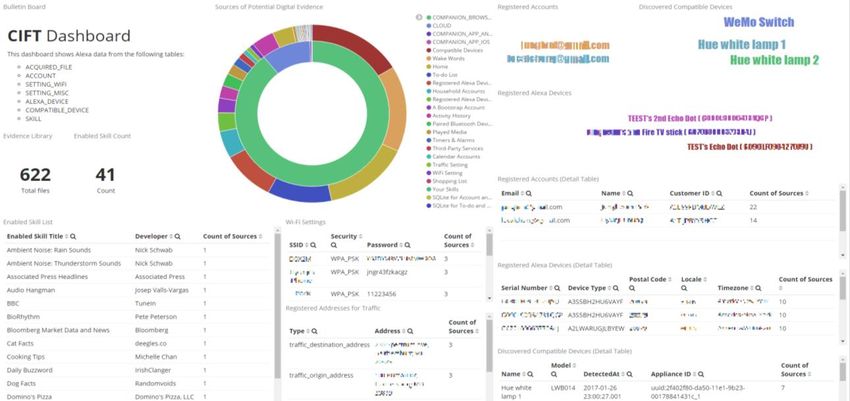
Figure 4. Event flows between Alexa modules of CIFTFigure 5. Visualization results of a database created by CIFT The Fig. 5 shows two dashboards designed for show when events relating to cloud native (square) and quick and efficient data analysis. The first dashboard is client centric (cross) artifacts occurred. The triangle created for displaying data stored within all tables symbols in this chart mean that artifacts occurred at except for TIMELINE table. On the left side of this these points might be deleted from the cloud, but they dashboard, two numbers show total files saved in an are identified from companion clients. There are also evidence library and skills enabled in Alexa two additional charts to support data analysis by respectively. More specifically, a pie chart displays subdividing artifacts into groups that represent sources detailed sources of potential digital evidence saved in of potential digital evidence. In addition to these charts, the evidence library. As a multi-series donut chart, the this dashboard includes a data table for actual records, inner circle represents operation types of CIFT as used and a tag cloud showing to-do and shopping items. in Table 4, and the outer circle shows types of data Although it is hard to objectively evaluate forensic sources identified by each operation. In addition, this approaches proposed here due to a lack of related dashboard provides various data tables that list studies, these visualization results support the claim meaningful information such as enabled skills, Wi-Fi that they will be useful and helpful for investigations. settings, user accounts, and compatible devices. For future improvements, a Logstash config file for The second dashboard is designed exclusively for processing data and two Kibana dashboards (including TIMELINE table. To provide an overview of artifacts, visualization objects) will be provided together with the top-middle chart displays various distributions that the source of CIFT.
7. Conclusion and Future works                                          International Conference on Services Computing, pp. 279-284.
                                                                            8. Clinton, I. Cook, L. and Banik, S. (2016). A Survey of Various
   Currently, IoT devices are evolving rapidly and
                                                                        Methods for Analyzing the Amazon Echo.
spreading widely in our lives. Many people are
                                                                            9. XK72. Charles: a web debugging proxy. https://www
becoming accustomed to interacting with various IoT
                                                                        .charlesproxy.com [Accessed Jan. 2017].
consumer products, such as virtual assistants, smart
                                                                            10. Oriwoh, E. Jazani, D. and Epiphaniou, G. (2013). Internet of
home kits, and fitness trackers. In these circumstances,
                                                                        Things Forensics: Challenges and Approaches. 9th IEEE
lots of data are being produced in real time in response
                                                                        International Conference on Collaborative Computing: Networking,
to user behaviors. Interestingly, these kinds of products
                                                                        Applications and Worksharing, pp. 608-615.
are closely connected with both cloud and local
                                                                            11. Hegarty, RC. Lamb, DJ. and Attwood, A. (2014). Digital
systems, so it is possible to conduct integrated analysis
                                                                        Evidence Challenges in the Internet of Things. Ninth International
of forensically meaningful data from both systems
                                                                        Workshop on Digital Forensics and Incident Analysis, pp. 163-172.
upon consideration of the target device’s ecosystem.
                                                                            12. Liu, J. (2015). IoT Forensics Issues, Strategies, and
   Until now, there has been little research reported on
                                                                        Challenges. A presentation at 12th IDF annual conference.
Amazon Echo and its ecosystem in terms of digital
                                                                            13. Kebande, VR. and Ray, I. (2016). A Generic Digital Forensic
forensics. As part of an effort to prepare for IoT, we
                                                                        Investigation Framework for Internet of Things (IoT). IEEE 4th
proposed a new integrative approach combining cloud-
                                                                        International Conference on Future Internet of Things and Cloud,
native and client-centric forensics for the Amazon
                                                                        pp. 356-362.
Alexa ecosystem. In addition, we introduced an
                                                                            14. Chung, H. Park, J. Lee, S. and Kang, C. (2012). Digital
implementation, CIFT, to acquire native artifacts from
                                                                        forensic investigation of cloud storage services. Digital
Alexa and analyze local artifacts from companion
                                                                        Investigation, 9(2), pp. 81-95.
clients. Our findings and a tool developed based on the
                                                                            15. Hale, J. (2013). Amazon cloud drive forensic analysis.
research will be valuable for digital investigations.
                                                                        Digital Investigation, 10(3), pp. 259–265.
   We have future plans for enhancing the results of
                                                                            16. Martini, B. and Choo, KKR. (2013). Cloud storage forensics:
this study, including but not limited to approaching the
                                                                        ownCloud as a case study. Digital Investigation, 10(4), pp. 287–299.
hardware level of Alex-enabled devices and
                                                                            17. Quick, D. and Choo, KKR. (2013). Dropbox analysis: data
performing memory forensics for delving into volatile
                                                                        remnants on user machines. Digital Investigation, 10(1), pp. 3–18.
artifacts. In addition, we will also expand our research
                                                                            18. Quick, D. and Choo, KKR. (2014). Google drive: forensic
with various IoT consumer products and implement
                                                                        analysis of data remnants. Journal of Network and Computer
new components of CIFT in order to support forensic
                                                                        Applications, 40, pp. 179–193.
activities relating to cloud-based IoT environments.
                                                                            19. Roussev, V. and McCulley, SH. (2016). Forensic analysis of
                                                                        cloud-native artifacts. Digital Investigation, 16(supplement), pp.
References
                                                                        S104-113.
    1. IDC. (2015). Explosive Internet of Things Spending to Reach          20. Roussev, V. Barreto, A. and Ahmed, I. (2016). API-Based
$1.7 Trillion in 2020 According to IDC. http://www.businesswire         Forensic Acquisition of Cloud Drives. Advances in Digital Forensics
.com/news/home/20150602005329/en/ [Accessed Jan. 2017].                 XII, pp. 213-235.
    2. Gatner. Gartner Says Worldwide Spending on VPA-Enabled               21. Rajewski, JT. (2016). Internet of Things Forensics. A
Wireless Speakers Will Top $2 Billion by 2020. https://www.             presentation at Enfuse 2016.
gartner.com/newsroom/id/3464317 [Accessed Jan. 2017]                        22. Benson, R. Obsidian Forensics - Alexa, Tell me your secrets.
    3. Techcrunch. An Amazon Echo may be the key to solving a           https://www.obsidianforensics.com/blog/alexa-tell-me-your-secrets
murder case. https://techcrunch.com/2016/12/27/an-amazon-echo-          [Accessed Jan. 2017].
may-be-the-key-to-solving-a-murder-case/ [Accessed Jan. 2017].              23. The Amazon Echo API. https://www.piettes.com/the-
    4. Amazon. Amazon Echo. https://developer.amazon.com/echo           amazon-echo-api/ [Accessed Jan. 2017].
[Accessed Jan. 2017].                                                       24. Accessing Amazon Echo Data with JavaScript.
    5. Roeck, D. Slegers, K. Criel, J. Godon, M. Claeys, L. Kilpi, K.   http://analyticphysics.com/Diversions/Accessing%20Amazon%20E
and Jacobs, A. (2012). Making Sense Through Design, I would             cho%20Data%20with%20JavaScript.htm [Accessed Jan. 2017].
DiYSE for it!: a manifesto for do-it-yourself internet-of-things            25. Android. WebView class - A View that displays web pages.
creation. The 7th Nordic Conference on Human-Computer                   https://developer.android.com/reference/android/webkit/WebView.
Interaction, pp. 170-179.                                               html [Accessed Jan. 2017].
    6. 1redDrop. Amazon Echo sold 11 Million deviced by Dec 1,              26. Meda, C. and Epifani, M. (2106). Study and analysis of
2016: Morgan Stanley. http://1reddrop.com/2017/01/23/amazon-            Orweb (and Orfox) anonymizer(s) on Android devices. A short
echo-sold-11-million-devices-by-december-1-says-morgan-stanley/         presentation at DFRWS EU 2016.
[Accessed Jan. 2017].                                                       27. Elastic, Elastic Stack, https://www.elastic.co/products
    7. Zawoad, S. and Hasan, R. (2015). FAIoT: Towards Building a       [Accessed Jan. 2017].
Forensics Aware Eco System for the Internet of Things. 2015 IEEE
Appendix A. Unofficial Alexa APIs
Unofficial Alexa APIs Data Normalization Brief excerpts from JSON data returned by APIs
Category Description
(‘{}’ should be filled with appropriate values) (Refer to Appendix B)
(Personal info. is masked by asterisks and italic text)
"authentication": {
https://pitangui.amazon.com/api/bootstrap "customerEmail": "email address",
Primary customer info. ACCOUNT "customerId": "customer id",
(https://pitangui.amazon.com/api/authentication) "customerName": "customer name"
}
Account
{
"email": "email address",
https://pitangui.amazon.com/api/household Household accounts ACCOUNT "fullName": "full name",
"id": "**E99***0L***Z"
}
{
"deviceOwnerCustomerId": "**E99***0L***Z",
Alexa devices such as "deviceType": "A3S5BH2HU6VAYF",
https://pitangui.amazon.com/api/devices/device ALEXA_DEVICE "macAddress": "**71**82**FD",
Echo, Dot and Fire TV "serialNumber": "**90***964*****U",
Alexa- "softwareVersion": "564196920"
enabled }
Device {
"deviceAddress": "registered address",
Preferences on registered "deviceSerialNumber": "**90***964*****U",
https://pitangui.amazon.com/api/device-preferences ALEXA_DEVICE "locale": "locale", "postalCode": "postal code",
Alexa devices
"timeZoneId": "time zone"
}
"values": {
"ssid": "SSID", "preSharedKey": "password (plain text)",
https://pitangui.amazon.com/api/wifi/configs Wi-Fi settings SETTING_WIFI "securityMethod": "WPA_PSK"
}
{
"address": "mac address",
https://pitangui.amazon.com/api/bluetooth Paired Bluetooth devices SETTING_MISC "friendlyName": "device name"
}
Location information for "destination": { "label": "address of a location" },
https://pitangui.amazon.com/api/traffic/settings SETTING_MISC "origin": { "label": "address of a location" }
the traffic update
{
Customer Wake word list for "deviceSerialNumber": "**90***964*****U",
Setting https://pitangui.amazon.com/api/wake-word SETTING_MISC "wakeWord": "ALEXA"
Alexa devices
}
{
"associationState": "ASSOCIATED",
https://pitangui.amazon.com/api/third-party Third party services SETTING_MISC "serviceName": "service name"
}
{
"emailId": "google account",
"calendarList": [{
https://pitangui.amazon.com/api/eon/householdaccounts Linked Google calendars SETTING_MISC "calendarId": "calendar id", "calendarName": "name"
}]
}
{
https://skills-store.amazon.com/app/secure/yourskills "title": "skill title",
"productDetails": { "releaseDate": "1456958015" },
Skill Skill list SKILL
* A HTTP header ‘Accept’ should have a specific type "developerInfo": { "name": "developer name" },
‘application/vnd+amazon.uitoolkit+json’. "entitlementInfo": { "accountLinked": true }
}
"uuid:uuid": {
"modelName": "model name",
"friendlyName": "white lamp 1",
Compatible Detected compatible COMPATIBLE_DEVICE "friendlyNameModifiedAt": 1481558860291,
https://pitangui.amazon.com/api/phoenix "applianceNetworkState": {
Device devices TIMELINE
"createdAt": 1481558860291
}
}
{
https://pitangui.amazon.com/api/todos? "createdDate": 1480350314486,
To-do list TIMELINE
type=TASK&size={} "lastupdatedDate" : 1480350314486,
"customerId": "**E99***0L***Z",
https://pitangui.amazon.com/api/todos? "originalAudioId": "URL of the voice file on the cloud",
Shopping list TIMELINE "text": "do the laundry"
type=SHOPPING_ITEM&size={}
}
{
"alarmTime": 1480363200000,
"createdDate": 1480355912857,
https://pitangui.amazon.com/api/notifications Timer and alarm list TIMELINE "deviceSerialNumber": "**90***964*****U",
"status": "ON", "type": "Alarm"
}
{
"cardType": "TextCard",
"creationTimestamp": 1484539461678,
Card list "playbackAudioAction": {
https://pitangui.amazon.com/api/cards? "mainText": "text what Alexa heard",
User (conversations between TIMELINE
beforeCreationTime={} "url": "URL of the voice file on the cloud"
Activity users and Alexa) },
"sourceDevice": { "serialNumber": "**90***964*****U" },
"title": "Do you know the muffin man?"
}
{
"activityStatus": "SUCCESS",
"creationTimestamp": 1484542204396,
https://pitangui.amazon.com/api/activities? History on voice "registeredCustomerId": "**E99***0L***Z",
TIMELINE "sourceDeviceIds": [{
startTime={}&size={}&offset=-1 interactions with Alexa "serialNumber": "**90***964*****U"
}],
"utteranceId": "URL of the voice file on the cloud"
}
{
https://pitangui.amazon.com/api/media/historical-queue?
"providerId": "provider",
Music Playing list TIMELINE "startTime": 1484542090384,
deviceSerialNumber={}&deviceType={}&size={}&offset=-1
"title": "80s 90s & Today - *****"
}
https://pitangui.amazon.com/api/utterance/audio/data? Accessing to audio data
ETC - -
id={originalAudioId or utteranceId} (actual user’s voice)Appendix B. Examples of a normalized database created by Alexa modules of CIFT
Example data
Table name Column name Description
(Personal info. is masked by asterisks and italic text)
id 1 Unique ID
operation CLOUD Operation type
src_path https://pitangui.amazon.com/api/bootstrap URL or file path
ACQUIRED_FILE
desc A Bootstrap Account Description
(File list stored at the
saved_path …(omitted).../a57665bd28e72163adb0245b51ac6fb02e45ed44.json File path saved in the evidence library
evidence library)
sha1 fffe474050329d0bb0691074d401b7a324a1b9a2 SHA-1 hash value of raw data
saved_timestamp 2017-01-29 20:56:27 Saved timestamp
timezone time zone Local time zone
customer_email **n*h**@*mail.com User account ID
customer_name First Last User name
ACCOUNT
customer_id **E99***0L***Z Customer ID
source_id 1 Foreign key (ACQUIRED_FILE)
device_account_name TEEST's 2nd Echo Dot Device account name
device_account_id **C10***ND***W Device account ID
customer_id **E99***0L***Z Customer ID
device_serial_number ***0L9***473***P Device serial number
device_type A3S5BH2HU6VAYF Echo’s device type
ALEXA_DEVICE sw_version 564197320 Software version
(Alexa-enabled devices) mac_address **63**6C**D5 Mac address
address address Home Address
postal_code zipcode Postal code
locale locale Locale
timezone time zone Time zone
source_id 9 Foreign key (ACQUIRED_FILE)
ssid SSID SSID
security_method WPA_PSK Security method
SETTING_WIFI
pre_shared_key password Wi-Fi password (plain text)
source_id 3 Foreign key (ACQUIRED_FILE)
name calendar_account Name of the value
{
"emailId": "***al**un*@*mail.com", Account name
SETTING_MISC "calendarList": [{
value "calendarId": "calendar id", "calendarName": "name" Calendar ID
(Misc settings)
}] Calendar name
}
source_id 5 Foreign key (ACQUIRED_FILE)
title NASA Mars Skill title
developer_name Jet Propulsion Laboratory Developer name
SKILL account_linked False True if a user account is linked
release_date 2016-11-29 20:05:25.000 Release date of this skill
source_id 61 Foreign key (ACQUIRED_FILE)
name **** Switch Device name
manufacture manufacture Manufacture name
model Socket Model name
created 2017-01-26 23:18:14.584 First detected time
name_modified 2017-01-26 23:18:14.584 Friendly name changed time
COMPATIBLE_DEVICE desc **** Switch Description
(Compatible devices type urn:******:device:controllee:1 Device type
around Alexa devices) reachable True Reachable or not
firmware_version ****_**_*.00.10885.*** Firmware version
appliance_id uuid:Socket-1_0-****26***008AD Appliance ID
alexa_device_serial_number **90***964*****U Device serial number
alexa_device_type A3S5BH2HU6VAYF Device type (it means Echo)
source_id 11 Foreign key (ACQUIRED_FILE)
date 2017-01-17 Date
time 08:10:44.175 Time
timezone time zone Time zone
MACB …B MACB time format
source CLOUD Operation type
sourcetype Activity History Detailed source type (‘Home’ menu)
type Created Type of timestamp
TIMELINE user **E99***0L***Z Customer ID
(An integrated table host **90***964*****U Serial number
for information short History Google calendar card
with timestamps) desc add driver license to to do list Google calendar
filename …(omitted).../7d40452a7ba57fd4f91a248f561cbf77dcb70882.json File path saved in the evidence library
notes SUCCESS Text what Alexa heard
format JSON JSON format
User's voice: "https://pitangui.amazon.com/api/utterance/audio/
data?id=A3S5BH2HU6VAYF:1.0/2017/01/17/13/
extra URL of the voice file on the cloud
**90***964*****U/10:38::TNIH_2V.f78ee15e-ef2e-45a8-890f-
690ef5e543abZXV"You can also read


