Investigating a Selection of Methods for the Prediction of Total Soluble Solids Among Wine Grape Quality Characteristics Using Normalized ...
←
→
Page content transcription
If your browser does not render page correctly, please read the page content below
ORIGINAL RESEARCH
                                                                                                                                               published: 11 June 2021
                                                                                                                                        doi: 10.3389/fpls.2021.683078

                                              Investigating a Selection of Methods
                                              for the Prediction of Total Soluble
                                              Solids Among Wine Grape Quality
                                              Characteristics Using Normalized
                                              Difference Vegetation Index Data
                                              From Proximal and Remote Sensing
                                              Aikaterini Kasimati *, Borja Espejo-Garcia , Eleanna Vali , Ioannis Malounas and
                                              Spyros Fountas

                                              Natural Resources Management and Agricultural Engineering, Agricultural University of Athens, Athens, Greece

                            Edited by:        The most common method for determining wine grape quality characteristics is to perform
                          Maria Balota,
           Virginia Tech, United States
                                              sample-based laboratory analysis, which can be time-consuming and expensive. In this
                       Reviewed by:
                                              article, we investigate an alternative approach to predict wine grape quality characteristics
                 Francesco Marinello,         by combining machine learning techniques and normalized difference vegetation index
             University of Padua, Italy
                                              (NDVI) data collected at different growth stages with non-destructive methods, such as
                    Alexandr Muterko,
  Institute of Cytology and Genetics,         proximal and remote sensing, that are currently used in precision viticulture (PV). The
Russian Academy of Sciences (RAS),            study involved several sets of high-resolution multispectral data derived from four sources,
                               Russia
                                              including two vehicle-mounted crop reflectance sensors, unmanned aerial vehicle (UAV)-
                   *Correspondence:
                     Aikaterini Kasimati
                                              acquired data, and Sentinel-2 (S2) archived imagery to estimate grapevine canopy
                     akasimati@aua.gr         properties at different growth stages. Several data pre-processing techniques were
                                              employed, including data quality assessment, data interpolation onto a 100-cell grid
                  Specialty section:
        This article was submitted to
                                              (10 × 20 m), and data normalization. By calculating Pearson’s correlation matrix between
Technical Advances in Plant Science,          all variables, initial descriptive statistical analysis was carried out to investigate the
              a section of the journal
                                              relationships between NDVI data from all proximal and remote sensors and the grape
           Frontiers in Plant Science
                                              quality characteristics in all growth stages. The transformed dataset was then ready and
           Received: 19 March 2021
            Accepted: 17 May 2021             applied to statistical and machine learning algorithms, firstly trained on the data distribution
           Published: 11 June 2021            available and then validated and tested, using linear and nonlinear regression models,
                               Citation:      including ordinary least square (OLS), Theil–Sen, and the Huber regression models and
  Kasimati A, Espejo-Garcia B, Vali E,
     Malounas I and Fountas S (2021)
                                              Ensemble Methods based on Decision Trees. Proximal sensors performed better in wine
  Investigating a Selection of Methods        grapes quality parameters prediction in the early season, while remote sensors during
      for the Prediction of Total Soluble
                                              later growth stages. The strongest correlations with the sugar content were observed for
     Solids Among Wine Grape Quality
      Characteristics Using Normalized        NDVI data collected with the UAV, Spectrosense+GPS (SS), and the CropCircle (CC),
Difference Vegetation Index Data From         during Berries pea-sized and the Veraison stage, mid-late season with full canopy growth,
        Proximal and Remote Sensing.
           Front. Plant Sci. 12:683078.
                                              for both years. UAV and SS data proved to be more accurate in predicting the sugars out
       doi: 10.3389/fpls.2021.683078          of all wine grape quality characteristics, especially during a mid-late season with full canopy

Frontiers in Plant Science | www.frontiersin.org                                    1                                             June 2021 | Volume 12 | Article 683078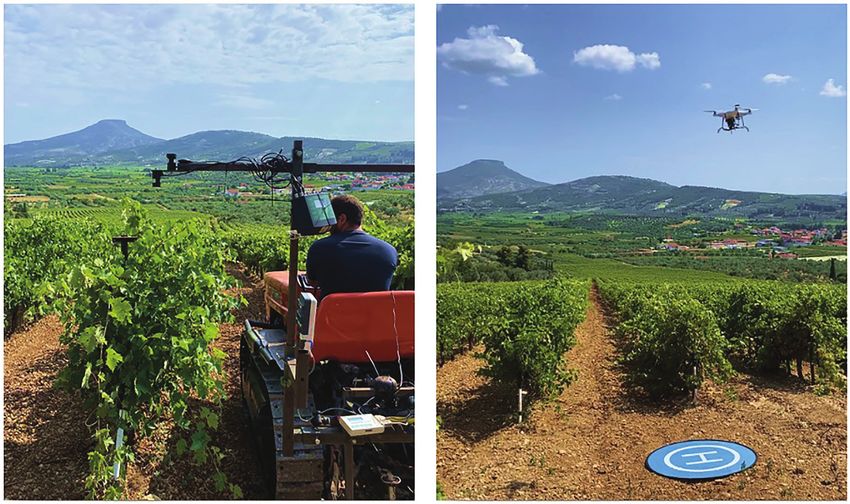
Kasimati et al.                                                                                                 Predicting Wine Grape Quality Characteristics

                                              growth, in Berries pea-sized and the Veraison growth stages. The best-fitted regressions
                                              presented a maximum coefficient of determination (R2) of 0.61.
                                              Keywords: normalized difference vegetation index, linear regression, ensemble methods, correlation,
                                              quality prediction, wine grape quality, remote sensing, precision viticulture

INTRODUCTION                                                                     (Magney et al., 2016; Sun et al., 2017; Petersen, 2018; Prasetyo
                                                                                 et al., 2018). An application on table grapes by Anastasiou
Precision viticulture (PV) is a strategy to manage vineyard                      et al. (2018) estimated yield and quality with the assessment
variability by utilizing spatiotemporal data and observations, to                of VIs derived from satellite and proximal sensing at different
enhance the oenological potential of a vineyard. In addition,                    growth stages, from veraison to harvest. The VIs exhibited
new technologies introduced in support of vineyard management                    different degrees of correlations with different measurement dates
allow for the efficiency and quality of production to be improved,               and sensing methods. This study showed that both satellite-
and in parallel, minimizing impacts on the environment (Balafoutis               based and proximal-based NDVI at both stages (veraison and
et al., 2017). This is particularly relevant in regions, where high              harvest) presented good correlations to crop quality characteristics,
wine production quality standards warrant adopting site-specific                 with proximal sensing proving to be the most accurate in
management practices to increase grape quality and yield.                        estimating table grape yield and quality characteristics. In addition
    Grape quality is a complex concept that refers to achieving                  to linear regression models, more advanced approaches for yield
optimal grape composition characteristics (Dai et al., 2011).                    estimation have been evaluated using ensemble methods. Boosted
Among these, sugar and titratable acidity are commonly used                      Regression Trees, Decision Trees, and Random Forests-based
to describe the quality of wine grapes at harvest. The sugar                     machine learning approaches were used to train the models to
content relates to the wine concentration of alcohol after                       estimate crop yield from a short time series of remotely sensed
fermentation, whereas the acid content determines the taste                      NDVI (Heremans et al., 2015; Bhatnagar and Gohain, 2020).
and stability of wine (Herrera et al., 2003). The most common                        While previous research has studied various correlation and
method used in determining wine grape quality characteristics                    regression models between VIs and crop production, machine
is to perform sample-based laboratory analysis by obtaining                      learning techniques for estimating grape quality and yield have
the chemical compounds of the grapes, which can be a time-                       not been thoroughly investigated yet. In this article, we propose
consuming, complex, and expensive process (Cortez et al., 2009).                 an alternative approach to predict wine grape quality
    In recent years, remote sensing is widely applicable in agriculture,         characteristics by combining machine learning techniques and
specifically crop growth monitoring and crop quality and yield                   NDVI data collected at different growth stages with
estimation. For example, the normalized difference vegetation                    non-destructive methods, such as proximal and remote sensing,
index (NDVI) is a vegetation index (VI) used for spatial decision-               that are currently used in PV. For this reason, extensively
making in vineyards (Acevedo-Opazo et al., 2008). Canopy                         used regression methods have been compared against more
response and NDVI can be obtained in a direct, precise, and                      complex methods that deal better with outliers. Finally, to
non-destructive way from various sensors and sensor configurations               evaluate and ensure the robustness of the machine learning
to acquire different bands, using proximal, aerial, and satellite                models used in this study, a 5-fold cross-validation procedure
platforms, based on the distance to the assessed crop (Hall et al.,              was followed across 20 experiments as a validation technique.
2011; Baluja et al., 2012). Presently, advanced sensing techniques
have had many applications beyond their original scope, especially
as computing power has drastically increased in recent years,
which have allowed for more complex machine learning techniques
                                                                                 MATERIALS AND METHODS
to be used to find patterns and correlations between NDVI and
                                                                                 Study Area
specific crop quality and yield characteristics (Pantazi et al., 2016;
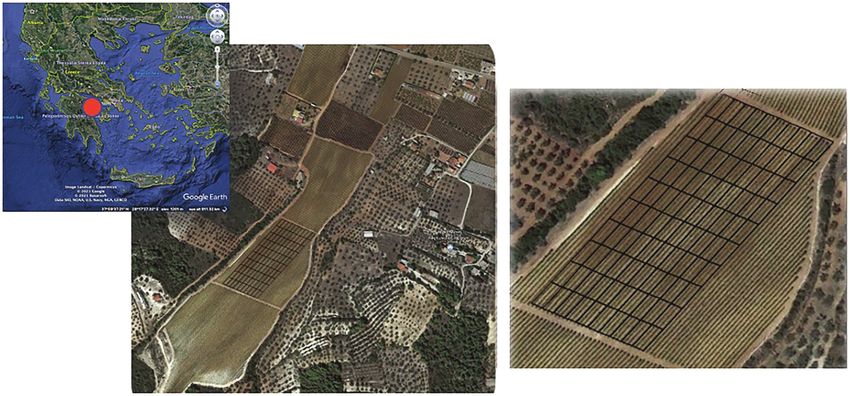
                                                                                 The field site where the study was conducted was a commercial
Kamilaris and Prenafeta-Boldú, 2018).
                                                                                 wine grape vineyard block on the Palivos Estate located in
    Previous research has been conducted to estimate crop quality
                                                                                 Nemea, Greece (37.8032°, 22.69412°, WGS84). The vineyard,
and yield with the assessment of VIs derived from various
                                                                                 planted with Vitis vinifera L. cv. “Agiorgitiko” for winemaking
sensors. A common approach is to perform statistical and
                                                                                 is located on a steep slope, and the experimental area selected
regression analysis, including descriptive statistics, Pearson’s
                                                                                 for data collection was approximately 2 ha. Wine grapes were
correlation, and regression models. The Pearson correlation
                                                                                 trained to a vertical shoot positioned, cane pruned double
coefficient has been quantified in various studies to identify
                                                                                 Guyot training/trellis system, with northeast-southwest row
the spatial correlation between NDVI and crop quality and
                                                                                 orientation and row distance of 2.2 m.
yield (Sun et al., 2017; He et al., 2018), research dedicated to
selecting key variables to predict the product quality and yield
with satisfactory performance directly. Linear and multivariate                  Canopy Reflectance Data Collection
regression models have been constructed and fitted to various                    Canopy reflectance was measured four times per growing season,
VIs to determine the field-wide production for multiple crops,                   during 2019 and 2020, starting in late May until the harvest in
such as wheat, corn, soybean, sorghum, rice, and grapes                          early September, to record the NDVI at different phenological

Frontiers in Plant Science | www.frontiersin.org                             2                                        June 2021 | Volume 12 | Article 683078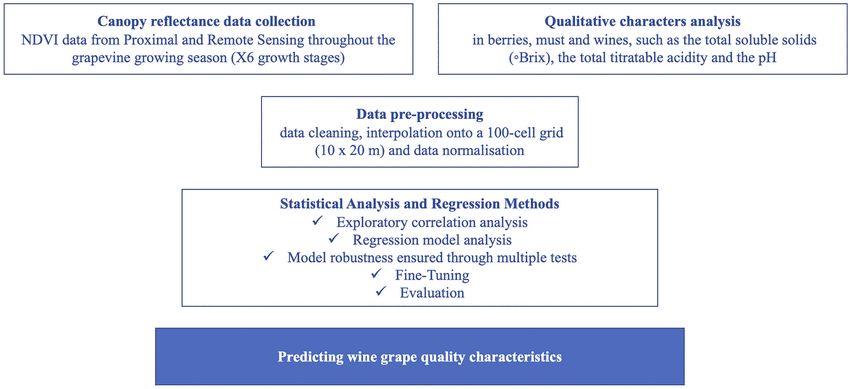
Kasimati et al.                                                                                                            Predicting Wine Grape Quality Characteristics

growth stages of the grapevines. Crop vigor was assessed at these                         Aerial imagery data were acquired on the same dates as the
four berry growth stages, namely, (i) Flowering, (ii) Setting, (iii)                      proximal measurements, with a Phantom 4 Pro UAV (Dà-Jiāng
Berries pea-sized, and (iv) Veraison, with two vehicle-mounted                            Innovations, Shenzhen, Guangdong, China) equipped with a
on-the-go proximal sensors, while an unmanned aerial vehicle                              multispectral Parrot Sequoia+ camera (Parrot SA, Paris, France)
(UAV) and Sentinel-2 (S2) satellite imagery were used to assess                           and its GPS, enabling to geotag all obtained images. The UAV
the crop vigor through remote sensing (Figure 1; Table 1). A                              data acquisition was performed on the same days as the proximal
CropCircle (CC), an active proximal canopy sensor (ACS-470,                               measurements, close to solar noon, with nadir flights at 30 m
Holland Scientific Inc., Lincoln, NE, United States), and a                               above ground height. The flight duration was approximately 10 min,
Spectrosense+GPS (SS) passive sensor (Skye Instruments Ltd.,                              and the capture interval of the multispectral camera was set at
Llandrindod Wells, United Kingdom) were mounted on a tractor,                             2 s. The UAV flight plan overlap and sidelap were 80 and 70%,
located at a height of approximately 1.5 m from the soil surface                          respectively, with a ground sampling distance (GSD) of the imagery
and according to each growth stage, and 0.5 m horizontally from                           ortho-mosaics ~3 cm. Specifically, atmospherically corrected S2
the vines, to record proximal reflectance measurements from the                           satellite images, 2A products with a 10 m pixel spatial resolution,
side and the top of the canopy, respectively, at a rate of 1 reading                      were downloaded from the official Copernicus Open Access Hub1
per second and moving at a constant speed of 8–10 km/h. Tractor                           for the closest dates available to the dates of the proximal and
steering and the relative position of the sensors remained consistent                     UAV surveys.
throughout the data collection since the row distance is 2.2 m.
All recorded data were georeferenced with a Garmin GPS16X
HVS (Garmin, Olathe, Kansas United States) and SS’s built-in GPS.                          https://scihub.copernicus.eu/
                                                                                          1

  FIGURE 1 | Two vehicle-mounted crop reflectance sensors, UAV-acquired data, and Sentinel-2 archived imagery were used to estimate grapevine canopy
  properties. UAV, unmanned aerial vehicle.

TABLE 1 | Grapevine seasonal EL growth stages of proximal and remote sensing data acquisition.

Stage                       EL No         Description                                                  Date range             Data acquisition date

                                                                                                                              CC; SS; UAV: 040619, 050620 S2:
Flowering                      23         16–20 leaves separated; 50% caps off                         June 1–June 20
                                                                                                                              130619, 190620
                                                                                                                              CC; SS; UAV: 040719, 140720 S2:
Setting                        27         Young berries enlarging, bunch at right angles to stem       June 20–July 20
                                                                                                                              050719, 120720
                                                                                                                              CC; SS; UAV: 010819, 110820 S2:
Berries pea-sized              31         About 7 mm in diameter                                       July 20–Aug 15
                                                                                                                              020819, 110820
                                                                                                                              CC; SS; UAV: 280819, 260820 S2:
Veraison                       35         Berries begin to color and enlarge                           Aug 15–Sept 10
                                                                                                                              280819, 280820

CC, CropCircle; SS, Spectrosense+GPS; UAV, unmanned aerial vehicle; and S2, Sentinel-2.

Frontiers in Plant Science | www.frontiersin.org                                     3                                           June 2021 | Volume 12 | Article 683078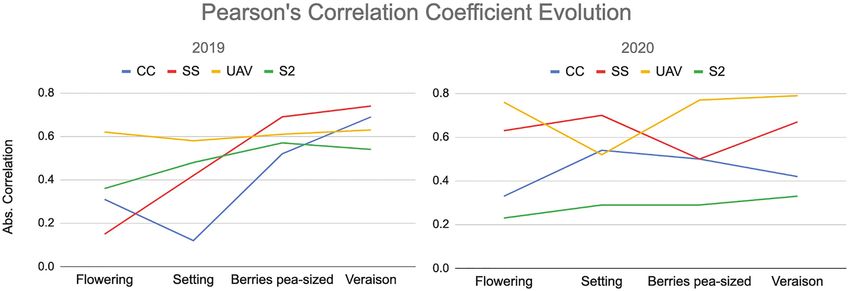
Kasimati et al.                                                                                                             Predicting Wine Grape Quality Characteristics

Data Preparation                                                                        to assess crop yield and wine grape quality. The total yield
All proximal canopy reflectance data was transformed to projected                       was determined by counting the total number of crates filled
coordinates (UTM Zone 34N), cleaned by removing the data                                with grapes per cell, multiplying it with the average crate weight
points located outside the field boundaries, and interpolated                           of the harvested wine grapes. Wine grape quality characteristics
(Taylor et al., 2007). The interpolated data was upscaled to                            were assessed by randomly picking 50 berries from each vineyard
10 × 20 m cells using ArcMap v10.3 (ESRI, Redlands, CA,                                 cell. The qualitative analysis of substances in berries, musts,
United States). This resulted in 100 plots across the study area                        and wines, namely, the total soluble solids (°Brix), the total
and generated NDVI maps’ time-series with 10 × 20 m spatial                             titratable acidity, and the pH were determined.
resolution, oriented parallel to the trellis lines (Figure 2).
Similarly, the UAV-acquired imagery was combined using Pix4D                            Statistical Analysis and Regression
software (Pix4D S.A., Prilly, Switzerland), and the generated                           Methods
NDVI ortho-mosaic was fitted to the vineyard’s boundaries.                              An initial descriptive statistical analysis was executed to assess
Radiometric calibration was applied to the generated ortho-                             proximal and remote sensing performance on the prediction
mosaic using the reference images of a radiometric calibration                          of wine grape quality. The exploratory correlation analysis
target (Airinov Aircalib), captured after each flight. The software                     included calculating Pearson’s correlation matrix to investigate
automatically recognized the albedo values for each band. The                           the relationships between NDVI data from all four proximal
data was then upscaled using a mean aggregation approach                                and remote sensors and the wine grape quality characteristics.
to the same 100 plots. The Sentinel-2 NDVI was calculated                                  Regression model analysis was also performed. Due to various
using bands 4 and 8, red and near-infrared, respectively,                               possible distributions found in the input data, several algorithms
obtaining imagery with 10 m pixel spatial resolution. To place                          were evaluated only for those data that presented Pearson’s
the raster dataset to the spatially correct geographic location,                        correlation, with absolute values higher than 0.5 (|r| > 0.50).
a spatial correction “shift,” based on ground control points                            The regression algorithms used were both linear and nonlinear,
from the UAV detailed map was carried out, following the                                depending on the output model generated. The linear models
boundaries of the experimental field before the satellite imagery                       used included Ordinary Least Square (OLS), Theil–Sen, and
was upscaled to the 10 × 20 m plots by averaging the NDVI                               Huber regression models.
of any pixel centroids within the management plots. The last
step of satellite image processing was to clip the NDVI according                         •   Ordinary least square: It is the most common estimation
to the border of the experimental field.                                                      method for computing linear regression models, which can
                                                                                              be found in related works (Prasetyo et al., 2018). The OLS
Qualitative Characteristics Analysis                                                          regression is a powerful analysis that can analyze multiple
Wine grapes were hand-harvested at the end of each growing                                    variables simultaneously to answer complex research
season, in mid-September. A regular 100-cell grid (10 × 20 m),                                questions. However, like many statistical analyses, it has
covering the total area, was configured to facilitate field sampling                          several underlying assumptions describing properties of the

  FIGURE 2 | Satellite images of the wine grapes commercial vineyard and the 100-cell grid developed parallel to the trellis lines (Google Earth Pro, 2021).

Frontiers in Plant Science | www.frontiersin.org                                    4                                              June 2021 | Volume 12 | Article 683078
Kasimati et al. Predicting Wine Grape Quality Characteristics
error term. Moreover, this method can be used only if the • Extremely randomized trees: Extra Trees are similar to the
data is normally distributed since outliers tend to pull the Random Forest, combining the predictions from many
fitted model far from the accurate result. decision trees (Geurts et al., 2006). However, it does not use
• Theil–Sen estimator method: Linear models are sensitive to bootstrap sampling but the entire original input sample. It
outliers, and few outliers can skew our predictions heavily creates many unpruned decision or regression trees from the
(Sen, 1968). Compared with the OLS estimator, the Theil–Sen training dataset, and predictions are made by averaging the
estimator is robust against outliers. Contrary to OLS, this prediction of the decision trees. It uses a random split for
algorithm uses a generalization of the median instead of the node creation to grow the trees, leading to a reduction
mean. Moreover, it is the most popular non-parametric in overfitting.
technique for estimating a linear trend and does not assume
the underlying distribution of the input data. Although tree-based methods provide an approach for
• Huber regression: It is also considered a robust linear overcoming the constraints of parametric models, their limitation
regression modeling method, less sensitive to outliers in data is that they are computationally more expensive than the
(Huber, 1973). Huber regression is aware of the possibility of traditional OLS. However, if the differences in the performances
outliers in a dataset and assigns them less weight than other are high enough, they should be a good approach for addressing
examples in the dataset, contrary to Theil–Sen that ignores the regression modeling problem.
their presence.
Fine-Tuning
Moreover, to improve our model’s predictive power, nonlinear Optimizing machine learning models relies on an empirical
methods, Decision Trees, and different Ensemble methods based approach, and specifically, in ensemble methods, the number
on Decision Trees, including AdaBoosting, Random Forests, of estimators is not predefined. Moreover, some tree-based
and Extra Trees were evaluated in the context of this research, hyperparameters, such as the ideal maximum depth of the
combining the predictions from multiple machine learning trees, are unknown until several values are evaluated. Thus,
algorithms together to make more accurate predictions than being able to test several model hyperparameters quickly is
the individual models. These ensemble methods take one or imperative in maximizing performance. For that reason, to
more decision trees and then reduce their variance and bias start the training process, several experiments were performed
by applying them to boost or bootstrap aggregation (bagging). by grid-search to find the best hyperparameters for this study.
Table 2 summarizes the primary hyperparameters that governed
• Decision trees: Although it can also be used for classification, the ensemble methods. In the results section, the ones that
the algorithm is suitable for regression problems. Decision Tree obtained the best performances will be stated.
models are the foundation of all tree-based models, visually
representing the “decisions” used to generate predictions. This Evaluation Methodology
method uses a non-parametric learning approach. Its main The prediction accuracy was assessed using the coefficient of
advantage is its straightforward interpretation. If the model is determination (R2), and root mean square error (RMSE) metrics.
not too complex, it can be visualized to understand better why Additionally, to test the generalization ability of every regression
the classifier made a specific decision. Its major disadvantage model and ensure their robustness, a 5-fold cross-validation
is that singular decision tree models are prone to overfitting, procedure was followed for each of them. Additionally, to
resulting in weak, unstable predictions that could have negative compute the final performances more accurately, the experiments
consequences if the input data contain noise. were repeated 20 times with different data splits.
• AdaBoost: The AdaBoost (adaptive boosting) algorithm uses
an ensemble-learning approach known as boosting (Freund
and Schapire, 1995). First, a decision tree is retrained several
times, increasing the emphasis on those data samples where TABLE 2 | Hyperparameters evaluated for optimizing the ensemble learning
the regression was inaccurate. Then, it combines the models.
predictions from multiple “weak learners,” simple decision
Hyperparameter Description Values
tree models, which are added sequentially to the ensemble,
correcting the predictions made by the model before it in The number of trees used
the sequence. Number of trees
in the ensemble. High
10, 50, 100, 200
• Random forest: A supervised learning algorithm that uses values could reduce
overfitting.
ensemble learning method for regression, aggregating many The maximum depth of the
decision tree regressors into one model, which have been Max. depth trees. Too high could lead No maximum, 1, 5, 7
trained on different data samples drawn from the input feature to overfitting.
(the NDVI in this study), with the bootstrap sampling The function to measure the
technique (Breiman, 2004). As a result, the trees in random quality of a node split. The
calculation of the Gini Index Information gain, Gini
forests run in parallel, and each tree draws a random sample Split criteria
is computationally faster, impurity
from the original dataset, adding some randomness that but it could lead to more
prevents overfitting. poor results.
Frontiers in Plant Science | www.frontiersin.org 5 June 2021 | Volume 12 | Article 683078Kasimati et al. Predicting Wine Grape Quality Characteristics
Software and Hardware The Pearson’s correlation coefficient evolution for both 2019
One main software package was used in this work: Scikit-Learn and 2020 is shown in Figure 4. The highest correlations between
machine learning library (version 0.23.2). In addition, all the the proximal‐ and remote-based spectral vegetation indices
experiments were run on Ubuntu 18.04 as the OS (Figure 3). and the wine grape total soluble solids at different crop stages
are recorded for the UAV, with the Spectrosense+GPS, the
CropCircle, and the Sentinel-2 imagery following. Even though
RESULTS no pattern was noted in the correlation coefficient evolution,
it is clear that mid-late season the NDVI correlates the best
Exploratory Correlation Analysis with wine grape quality characteristics.
The exploratory correlation analysis included calculating Pearson’s
correlation matrix to investigate the relationships between NDVI Regression Analysis
data from all four proximal and remote sensors and the wine Regression model analysis was performed only for those data
grape quality characteristics. The 2019 and 2020 correlation that presented Pearson’s correlation for NDVI
matrices generally indicated good absolute correlations between data from all four proximal and remote sensors and total
NDVI data from all four proximal and remote sensors and soluble solids, with absolute values higher than 0.5 (|r| > 0.50)
total soluble solids, the sugar content measured in °Brix, for the different crop stages. The regression algorithms used,
(|r| > 0.50). However, this was not the case for the other two both linear and nonlinear regression analysis, were performed
main wine grape quality characteristics, the total titratable using those highly correlated NDVI data to evaluate
acidity, and the pH, that presented no correlation with the their performance in assessing the wine grapes’ quality
NDVI data at any crop stage. characteristics. The regression models between NDVI data from
In the top two rows of Table 3, the best intra-sensor all four proximal and remote sensors and total
correlations between NDVI data and total soluble solids are soluble solids presented different degrees of accuracy, depending
presented. The signal stabilizes mid-late in the growing season. on the model fitted, the sensor used, and
The maximum correlation (|r| = 0.74) for 2019 was observed the growth stage assessed. The best fitted, linear, and
for Spectrosense+GPS data during Berries pea-sized and the nonlinear regressions were observed for UAV and
Veraison stage (i.e., mid-late season with full canopy growth). Spectrosense+GPS data during the mid-late season with full
For 2020, correlations were strongest for UAV data (|r| = 0.79), canopy growth in Berries pea-sized and the Veraison
at the same growth stages. All Sentinel-2 NDVI variables growth stages.
demonstrated relatively weak correlations (0.29 < |r| < 0.57) When using OLS, Theil-Sen and Huber linear regression
when correlated with the total soluble solids. For the given models the best fit for the models was for the estimation
stages of the growing season, it was noticed that during Veraison, of total soluble solids, during Veraison, with a coefficient
the NDVI data from UAV, Spectrosense+GPS, and the CC of determination R2 ranging from (0.38 < R2 < 0.61) for
sensors correlated the best with the total soluble solids for both 2019 and 2020. The maximum coefficient of
both years. determination for the linear regression models (R2 = 0.61)
FIGURE 3 | Workflow for investigating a selection of methods for predicting wine grape quality characteristics using normalized difference vegetation index (NDVI)
data from proximal and remote sensing.
Frontiers in Plant Science | www.frontiersin.org 6 June 2021 | Volume 12 | Article 683078Kasimati et al. Predicting Wine Grape Quality Characteristics
TABLE 3 | Selected best performed Pearson’s correlation coefficients comparisons between NDVI data from all four proximal and remote sensors and total soluble
solids (i) for a given sensor (rows 1 and 2) and (ii) for given growth stages of the season (rows 3 and 4; CC, CropCircle; SS, Spectrosense+GPS; UAV; and S2,
Sentinel-2).
Per sensor CropCircle Spectrosense+GPS UAV Sentinel-2
2019 0.69 (Veraison) 0.74 (Veraison) 0.63 (Veraison) 0.57 (Berries pea-sized)
0.52 (Berries pea-sized) 0.69 (Berries pea-sized) 0.62 (Flowering) 0.54 (Veraison)
2020 0.54 (Setting) 0.70 (Setting) 0.79 (Veraison) 0.33 (Veraison)
0.50 (Berries pea-sized) 0.67 (Veraison) 0.77 (Berries pea-sized) 0.29 (Setting)
Per growth stage Flowering Setting Berries pea-sized Veraison
2019 0.62 (UAV) 0.58 (UAV) 0.69 (SS) 0.74 (SS)
0.36 (S2) 0.48 (S2) 0.61 (UAV) 0.69 (CC)
2020 0.76 (UAV) 0.70 (SS) 0.77 (UAV) 0.79 (UAV)
0.63 (SS) 0.54 (CC) 0.50 (CC, SS) 0.67 (SS)
FIGURE 4 | Pearson’s correlation coefficients evolution throughout the growing seasons 2019 and 2020 (legend as for Table 3).
TABLE 4 | Selected best performed linear regression models performed using Decision Trees, including AdaBoosting, Random Forests, and
the highly correlated NDVI data from all four proximal and remote sensors to Extra Trees, were evaluated, aggregating the predictions from
evaluate their performance in assessing the wine grapes quality characteristics
(legend as for Table 3).
multiple machine learning algorithms together to make more
accurate predictions than the individual models. The best
Sensor_growth Method R2 (avg) RMSE fit for the nonlinear model was for estimating total soluble
stage solids, during Veraison, with the coefficient of determination
R2 ranging from (0.42 < R2 < 0.59) for both 2019 and 2020.
2019 SS_Veraison OLS 0.51 ± 0.09 1.45 ± 0.19
CC_Veraison OLS 0.42 ± 0.10 1.67 ± 0.35
The maximum coefficient of determination for the nonlinear
SS_Berries pea-sized Huber 0.41 ± 0.11 1.71 ± 0.24 regression models (R2 = 0.59) was observed for 2020 retrieved
UAV_Veraison Theil-Sen 0.38 ± 0.10 1.95 ± 0.55 with UAV data and using the AdaBoost algorithm. For 2019,
2020 UAV_Veraison Theil-Sen 0.61 ± 0.03 1.37 ± 0.19 the Extra Trees performs better using canopy reflectance
UAV_Berries pea-sized Huber 0.57 ± 0.04 1.55 ± 0.32
data from the CropCircle and the Spectrosense+GPS proximal
UAV_Flowering Theil-Sen 0.56 ± 0.06 1.75 ± 0.19
SS_Setting OLS 0.44 ± 0.07 1.73 ± 0.23
sensors. In the case of the Adaboost, the best hyperparameters
UAV_Setting OLS 0.44 ± 0.04 2.09 ± 0.45 were 50 decision trees with a maximum depth of 1. In the
case of the Extra Trees, the best hyperparameters were also
50 decision trees, but with a maximum depth of 7 and the
was observed for 2020 retrieved with UAV data and fitting split criteria based on Information Gain. This same
the Theil–Sen regression model. For 2019, the OLS seems configuration was the one that led to the highest performance
to perform better using canopy reflectance data coming from in Random Forest (SS_Berries pea_sized and UAV_Flowering).
the CropCircle and the Spectrosense+GPS proximal sensors. It is important to note that although the Decision Tree
The selected best-performed results of the linear regression classifier, as a standalone classifier, was also evaluated, its
analysis are presented in Table 4. performance was always lower than the ensemble methods.
Among the nonlinear methods, and to improve our models’ The selected best-performed results of the nonlinear regression
predictive power, different Ensemble methods based on analysis are presented in Table 5.
Frontiers in Plant Science | www.frontiersin.org 7 June 2021 | Volume 12 | Article 683078Kasimati et al. Predicting Wine Grape Quality Characteristics
TABLE 5 | Selected best performed nonlinear regression models performed using the highly correlated NDVI data from all four proximal and remote sensors to
evaluate their performance in assessing the wine grapes quality characteristics (legend as for Table 3).
Sensor_growth stage Method R2 (avg) RMSE
2019 SS_Veraison Extra Trees 0.46 ± 0.03 1.64 ± 0.14
CC_Veraison Random Forest 0.43 ± 0.5 1.68 ± 0.32
SS_Berries pea-sized Random Forest 0.43 ± 0.06 1.82 ± 0.29
UAV_Veraison Extra Trees 0.42 ± 0.05 2.05 ± 0.51
UAV_Flowering Random Forest 0.39 ± 0.07 2.11 ± 0.33
2020 UAV_Veraison AdaBoost 0.59 ± 0.05 1.41 ± 0.25
UAV_Berries pea-sized Extra Trees 0.53 ± 0.03 1.65 ± 0.22
UAV_Flowering Extra Trees 0.56 ± 0.05 1.72 ± 0.29
SS_Setting Extra Trees 0.43 ± 0.02 1.83 ± 0.33
UAV_Setting Extra Trees 0.41 ± 0.06 1.95 ± 0.35
DISCUSSION Sun et al. (2017), the best crop stage for estimating wine
grape yield characteristics from satellite-derived data is before
In this article, an alternative approach to predict wine grape harvest. The strongest correlations with the sugar content were
quality characteristics by combining machine learning techniques observed for NDVI data collected with the UAV,
and NDVI data collected at different growth stages with Spectrosense+GPS, and the CropCircle, during Berries pea-sized
non-destructive methods, such as proximal and remote sensing, and the Veraison stage, mid-late season with full canopy growth,
currently used in precision viticulture, is used in precision for both years. The weaker correlation coefficients recorded
viticulture proposed. While previous research has studied various with Sentinel-2 and assessed with an overhead “mixed pixel”
correlation and regression models between VIs and crop approach indicated less reliability for wine grapes quality
production, the use of machine learning techniques for the characteristics predictions, which is a sensible result, as Khaliq
estimation of grape quality and yield has not been thoroughly et al. (2019) also discussed that satellite imagery resolution
investigated yet (Sun et al., 2017; He et al., 2018; Liakos et al., could not be directly used to describe vineyard variability
2018). This study proved that advanced sensing techniques reliably. However, this was not the case for the other two
may have many applications, especially with the help of the main wine grape quality characteristics, the total titratable
increasing computing power, allowing for more complex machine acidity, and the pH, that presented no correlation with the
learning techniques to find patterns and correlations between NDVI data at any crop stage.
canopy reflectance data and specific crop quality characteristics. The performance of each sensor was different and affected
Furthermore, extensively used regression methods have been by data acquisition parameters, such as proximity to the vines
compared against more complex methods that deal better with and the specific technical characteristics of the equipment used.
outliers. In addition, to evaluate and ensure the robustness of The CropCircle and the Spectrosense+GPS proximal sensors
the machine learning models used in this study, a 5-fold cross- were mounted on a tractor, recording reflectance measurements
validation procedure was followed across 20 experiments. The from the side and the top of the canopy, respectively, while
validation technique avoids overoptimistic (or random) results the UAV and Sentinel-2 satellite imagery assessed the crop
based on hold-out evaluations. vigor through remote sensing from the top. The highest
Wine grapes quality refers to the achievement of optimal correlations between the proximal‐ and remote-based spectral
levels of all grape composition characteristics, with sugar content vegetation indices and the wine grape total soluble solids at
being a basic one, related to the wine concentration of alcohol different crop stages are recorded for the UAV, with the
after fermentation. The exploratory correlation analysis presented Spectrosense+GPS, the CropCircle, and the Sentinel-2 imagery
that the recorded canopy reflectance data from all four sensors, following. The Spectrosense+GPS and UAV seemed to perform
i.e., the pure vine NDVI extracted from two proximal sensors, better and in a similar way, most probably due to the scanning
a CropCirle and a Spectrosense+GPS and the “mixed pixel” orientation, which was the top side of the canopy at close
UAV and Sentinel-2 imagery, showed an increasing correlation proximity. Even though the UAV is classed as a remote sensor,
to the total soluble solids as the season progressed. Similar it provides high spatial resolution. Although no pattern was
results have also been found by other researchers (Tagarakis noted in the correlation coefficient evolution, it is clear that
et al., 2013; Fountas et al., 2014), with this study being aligned the NDVI correlates the best with wine grape quality
with Anastasiou et al. (2018), who estimated yield and quality characteristics in the mid-late season. The exploratory analysis
with the assessment of vegetation indices derived from satellite acted as an evaluation for performing predictive analytics on
and proximal sensing at different growth stages and their study the dataset.
showed that NDVI at late developmental stages of the vine The dataset was then used for training machine learning
growing season presented good correlations to crop quality algorithms, evaluating linear and nonlinear regression models,
characteristics. Also, García-Estévez et al. (2017) found that including OLS, Theil–Sen, and the Huber regression models
the highest correlation of NDVI derived from proximal sensing and Ensemble Methods based on Decision Trees. The regression
with yield parameters of wine grapes was at veraison. algorithms used, both linear and nonlinear regression analysis,
Frontiers in Plant Science | www.frontiersin.org 8 June 2021 | Volume 12 | Article 683078Kasimati et al. Predicting Wine Grape Quality Characteristics
were performed using those highly correlated NDVI data to The descriptive statistical analysis showed that the NDVI
evaluate their performance in assessing the wine grapes’ quality data from the UAV, Spectrosense+GPS, and the CropCircle,
characteristics. The regression models between NDVI data from during Berries pea-sized and the Veraison stage, mid-late season
all four proximal and remote sensors and total soluble solids with full canopy growth, have the strongest correlations with
presented different degrees of accuracy, depending on the model the sugar content for both years. At the same time, Sentinel-2
fitted, the sensor used, and the growth stage assessed. The imagery indicated less reliability for wine grapes’ quality
UAV and the Spectrosense+GPS data proved to be more accurate characteristics predictions. The predictive analysis indicated
in predicting the sugars out of all wine grape quality characteristics, that regression models between NDVI data from all four
especially during the mid-late season with full canopy growth, proximal and remote sensors and total soluble solids presented
in Berries pea-sized and the Veraison growth stages. different degrees of accuracy, depending on the model fitted,
All regression methods that were applied, both linear and the sensor used, and the growth stage assessed. All regression
nonlinear, the OLS, Theil–Sen, and Huber regression models, methods that were applied, both linear and nonlinear, performed
Decision Trees and Ensemble methods based on Decision Trees, similarly in wine grapes quality parameters prediction. The
including AdaBoosting, Random Forests, and Extra Trees UAV and the Spectrosense+GPS data proved to be more accurate
performed similarly in wine grapes quality parameters prediction, in predicting the sugars out of all wine grape quality
with the best-fitted models achieving a coefficient of characteristics, especially closer to the harvesting period.
determination of R2 = 0.61. These results confirm the findings Although correlation is not significant, it seems enough to
of Bhatnagar and Gohain (2020), who used decision tree and predict wine grape quality with satisfied approximation.
random forest-based machine learning approaches to estimate The investigation of a selection of methods, including OLS,
crop yield by comparing their values with NDVI values, and Theil–Sen, and Huber regression models, Decision Trees, AdaBoost,
they concluded with the result of R = 0.67. Therefore, the Random Forests, and Extra Trees, for the assessment of wine
implementation of machine learning techniques resulted in grape quality characteristics using spectral vegetation indices,
similar results as linear models. However, more precise wine presents a great potential for machine learning techniques to
grape quality predictions were obtained when NDVI data were be used as an alternative method, to the currently widely used
collected close to the harvest date, although promising results linear regression processes. Ensemble methods presented similar
were obtained for the early season, as noted by Ballesteros results to regression analysis, while dealing better with the outliers
et al. (2020). The fact that the ensemble methods performed and ensuring robustness through cross-validation techniques. This
in some cases slightly worse than the linear methods could research will be extended by assessing stacking learning techniques
be due to the limited dataset size in combination with the instead of boosting and bagging as a new ensemble method and
use of 5-fold cross-validation, which reduces the training set exploring if they could lead to better performances. Finally, given
to 80% of the total dataset size. However, this is considered the perennial nature of grapevines and the various environmental
necessary to provide reliable results. On the other hand, it and endogenous factors determining quality, seasonal calibration
could be discussed whether stacking learning techniques instead for quality prediction should be considered in future research.
of boosting or bagging could lead to better performances
(Wolpert, 1992; van der Laan et al., 2007).
DATA AVAILABILITY STATEMENT
CONCLUSION The raw data supporting the conclusions of this article will
be made available by the authors, without undue reservation.
In this paper, the use of machine learning techniques to estimate
wine grape quality characteristics is investigated. An alternative
approach investigating the combination of a selection of methods AUTHOR CONTRIBUTIONS
extensively used regression methods to more complex methods
that deal better with outliers, predicted wine grape quality All authors contributed to conception and design of the study.
characteristics using NDVI data, collected at different growth AK organized and realized the data collection and the data
stages from proximal and remote sensing, is proposed. This pre-processing and preparation, and drafted the manuscript outline.
study proved that advanced sensing techniques may have many BE-G, EV, and IM contributed to the statistical analysis and
applications, especially with the help of the increasing computing machine learning implementation. EV and IM wrote the first
power, allowing for more complex machine learning techniques draft of the introductory sections of the manuscript. AK, BE-G,
to find patterns and correlations between canopy reflectance and SF completed the results and discussion sections. All authors
data and specific crop quality characteristics. contributed to the article and approved the submitted version.
REFERENCES Anastasiou, E., Balafoutis, A., Darra, N., Psiroukis, V., Biniari, A., Xanthopoulos, G.,
et al. (2018). Satellite and proximal sensing to estimate the yield and quality
Acevedo-Opazo, C., Tisseyre, B., Guillaume, S., and Ojeda, H. (2008). The potential of table grapes. Agriculture 8:94. doi: 10.3390/agriculture8070094
of high spatial resolution information to define within-vineyard zones related Balafoutis, A., Beck, B., Fountas, S., Vangeyte, J., Wal, T. V. D., Soto, I., et al.
to vine water status. Precis. Agric. 9, 285–302. doi: 10.1007/s11119-008-9073-1 (2017). Precision agriculture technologies positively contributing to GHG
Frontiers in Plant Science | www.frontiersin.org 9 June 2021 | Volume 12 | Article 683078Kasimati et al. Predicting Wine Grape Quality Characteristics emissions mitigation, farm productivity and economics. Sustainability 9:1339. Herrera, J., Guesalaga, A., and Agosin, E. (2003). Shortwave–near infrared doi: 10.3390/su9081339 spectroscopy for non-destructive determination of maturity of wine grapes. Ballesteros, R., Intrigliolo, D. S., Ortega, J. F., Ramírez-Cuesta, J. M., Buesa, I., Meas. Sci. Technol. 14, 689–697. doi: 10.1088/0957-0233/14/5/320 and Moreno, M. A. (2020). Vineyard yield estimation by combining remote Huber, P. (1973). Robust regression: asymptotics, conjectures and monte carlo. sensing, computer vision and artificial neural network techniques. Precis. Ann. Stat. 1, 799–821. doi: 10.1214/aos/1176342503 Agric. 21, 1242–1262. doi: 10.1007/s11119-020-09717-3 Kamilaris, A., and Prenafeta-Boldú, F. X. (2018). Deep learning in agriculture: Baluja, J., Diago, M. P., Goovaerts, P., and Tardaguila, J. (2012). Assessment a survey. Comput. Electron. Agric. 147, 70–90. doi: 10.1016/j.compag.2018.02.016 of the spatial variability of anthocyanins in grapes using a fluorescence Khaliq, A., Comba, L., Biglia, A., Aimonino, D. R., Chiaberge, M., and Gay, P. sensor: relationships with vine vigour and yield. Precis. Agric. 13, 457–472. (2019). Comparison of satellite and UAV-based multispectral imagery for doi: 10.1007/s11119-012-9261-x vineyard variability assessment. Remote Sens. 11:436. doi: 10.3390/rs11040436 Bhatnagar, R., and Gohain, G. B. (2020). “Crop yield estimation using decision Liakos, K. G., Busato, P., Moshou, D., Pearson, S., and Bochtis, D. (2018). trees and random forest machine learning algorithms on data from terra Machine learning in agriculture: a review. Sensors 18:2674. doi: 10.3390/ (EOS AM-1) & Aqua (EOS PM-1) satellite data,” in Machine Learning and s18082674 Data Mining in Aerospace Technology: Studies in Computational Intelligence. Magney, T. S., Eitel, J. U., Huggins, D. R., and Vierling, L. A. (2016). Proximal Vol. 836. eds. A. Hassanien, A. Darwish and H. El-Askary (Cham: Springer), NDVI derived phenology improves in-season predictions of wheat quantity 107–124. and quality. Agric. For. Meteorol. 217, 46–60. doi: 10.1016/j.agrformet. Breiman, L. (2004). “Random forests,” in Machine Learning. Vol. 45. 5–32. 2015.11.009 Cortez, P., Teixeira, J., Cerdeira, A., Almeida, F., Matos, T., and Reis, J. (2009). Pantazi, X. E., Moshou, D., Alexandridis, T., Whetton, R. L., and Mouazen, A. M. Discovery Science, Lecture Notes in Computer Science. Berlin, Heidelberg: (2016). Wheat yield prediction using machine learning and advanced sensing Springer, 66–79. techniques. Comput. Electron. Agric. 121, 57–65. doi: 10.1016/j.compag.2015. Dai, Z. W., Ollat, N., Gomès, E., Decroocq, S., Tandonnet, J. P., Bordenave, L., 11.018 et al. (2011). Ecophysiological, genetic, and molecular causes of variation Petersen, L. K. (2018). Real-time prediction of crop yields from MODIS relative in grape berry weight and composition: a review. Am. J. Enol. Vitic. 62, vegetation health: a continent-wide analysis of Africa. Remote Sens. 10:1726. 413–425. doi: 10.5344/ajev.2011.10116 doi: 10.3390/rs10111726 Fountas, S., Anastasiou, E., Balafoutis, A., Koundouras, S., Theoharis, S., and Prasetyo, Y., Sukmono, A., Aziz, K. W., and Aji, B. J. P. S. (2018). Rice productivity Theodorou, N. (2014). The influence of vine variety and vineyard management prediction model design based on linear regression of spectral value using on the effectiveness of canopy sensors to predict winegrape yield and quality. NDVI and LSWI combination on landsat-8 imagery. IOP Conf. Ser. Earth In Proceedings of the International Conference of Agricultural Engineering, Environ. Sci. 165:12002. doi: 10.1088/1755-1315/165/1/012002 Zurich, Switzerland. 6–10. Sen, P. (1968). Estimates of the regression coefficient based on kendall’s tau. Freund, Y., and Schapire, R. E. (1995). A decision-theoretic generalization of J. Am. Stat. Assoc. 63, 1379–1389. doi: 10.1080/01621459.1968.10480934 on-line learning and an application to boosting. 550 EuroCOLT. 551. Sun, L., Gao, F., Anderson, M. C., Kustas, W. P., Alsina, M. M., Sanchez, L., García-Estévez, I., Quijada-Morín, N., Rivas-Gonzalo, J. C., Martínez-Fernández, J., et al. (2017). Daily mapping of 30 m LAI and NDVI for grape yield Sánchez, N., Herrero-Jiménez, C. M., et al. (2017). Relationship between prediction in California vineyards. Remote Sens. 9:317. doi: 10.3390/rs9040317 hyperspectral indices, agronomic parameters and phenolic composition of Tagarakis, A., Liakos, V., Fountas, S., Koundouras, S., and Gemtos, T. A. (2013). Vitis vinifera cv. Tempranillo grapes: hyperspectral indices, agronomic Management zones delineation using fuzzy clustering techniques in grapevines. parameters and phenolic composition of V. vinifera. J. Sci. Food Agric. 97, Precis. Agric. 14, 18–39. doi: 10.1007/s11119-012-9275-4 4066–4074. doi: 10.1002/jsfa.8366 Taylor, J. A., McBratney, A. B., and Whelan, B. M. (2007). Establishing Management Geurts, P., Ernst, D., and Wehenkel, L. (2006). Extremely randomized trees. Classes for Broadacre Agricultural Production. Agron. J. 99, 1366–1376. doi: Mach. Learn. 63, 3–42. doi: 10.1007/s10994-006-6226-1 10.2134/agronj2007.0070 Google Earth Pro (2021). Map showing location of the wine grapes commercial van der Laan, M. J., Polley, E. C., and Hubbard, A. E. (2007). Super learner. vineyard. Available at: https://earth.google.com/web/@37.80431086,22.6938956 Stat. Appl. Genet. Mol. Biol. 6:25. doi: 10.2202/1544-6115.1309 6,1360.70594953a,0d,35y,359.9995h,0t,0r?utm_source=earth7&utm_ Wolpert, D. (1992). Stacked generalization. Neural Netw. 5, 241–259. doi: 10.1016/ campaign=vine&hl=en S0893-6080(05)80023-1 Hall, A., Lamb, D. W., Holzapfel, B. P., and Louis, J. P. (2011). Within-season temporal variation in correlations between vineyard canopy and winegrape Conflict of Interest: The authors declare that the research was conducted in composition and yield. Precis. Agric. 12, 103–117. doi: 10.1007/s11119- the absence of any commercial or financial relationships that could be construed 010-9159-4 as a potential conflict of interest. He, M., Kimball, J. S., Maneta, M. P., Maxwell, B. D., Moreno, A., Beguería, S., et al. (2018). Regional crop gross primary productivity and yield estimation Copyright © 2021 Kasimati, Espejo-Garcia, Vali, Malounas and Fountas. This is using fused landsat-MODIS data. Remote Sens. 10:372. doi: 10.3390/rs10030372 an open-access article distributed under the terms of the Creative Commons Attribution Heremans, S., Dong, Q., Zhang, B., Bydekerke, L., and Orshoven, J. (2015). License (CC BY). The use, distribution or reproduction in other forums is permitted, Potential of ensemble tree methods for early-season prediction of winter provided the original author(s) and the copyright owner(s) are credited and that wheat yield from short time series of remotely sensed normalized difference the original publication in this journal is cited, in accordance with accepted academic vegetation index and in situ meteorological data. J. Appl. Remote Sens. practice. No use, distribution or reproduction is permitted which does not comply 9:97095. doi: 10.1117/1.JRS.9.097095 with these terms. Frontiers in Plant Science | www.frontiersin.org 10 June 2021 | Volume 12 | Article 683078
You can also read


