RECENT REGULATORY DEVELOPMENTS AND WHAT'S ON THE HORIZON FOR INTERNATIONAL STUDENT & SCHOLAR PROGRAMS - NAFSA
←
→
Page content transcription
If your browser does not render page correctly, please read the page content below
RECENT REGULATORY DEVELOPMENTS

 AND WHAT’S ON THE HORIZON FOR

    INTERNATIONAL STUDENT &

        SCHOLAR PROGRAMS

        Joann Ng Hartmann, Sr. Director IEM-ISS Services, NAFSA
      Steve Springer, Director of Regulatory Practice Liaison, NAFSA
            Katie Tudini, University at Buffalo, Chair of ISS-RP

                           Wednesday, May 30, 2018
Recent key developments
                 • Primarily changes to agency policy and adjudications
                           related to BAHA and “public safety” EOs
                           and memo on vetting/screening

                 What’s on the horizon
                 • Regulatory agenda
SCOPE & TOPICS   • Continuing/more difficult adjudications

                 What you can do
                 • Keeping up with developments
                 • Basic tips for navigating new environment
                 • Reporting problems and advocating

                 Beyond the scope of this session
                 • Congress, politics, elections (but we’ll suggest
                         other sessions on these)
                 • Media reports about possible changes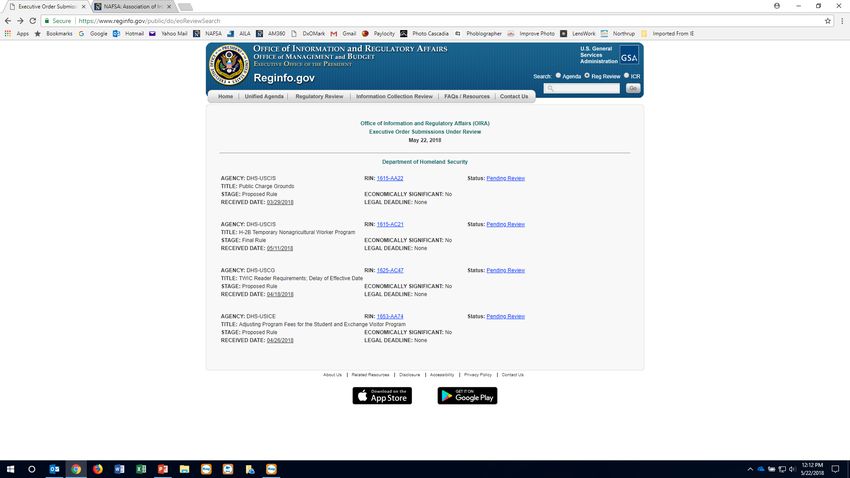
• “Travel ban” and litigation

                         • Multi-agency national vetting center announced

  RECENT KEY             • Department of State:
 DEVELOPMENTS                     • Instructed consulates to focus on thorough
                                     examination of visa eligibility factors
                                   • Implemented form DS-5535

 Department of State               • Proposed adding social media info. to DS-160
                                   • Expanded “30/60 day rule” to “90 day rule”
                                   • Added stricter residence abroad FAM language
U. S. Customs & Border
                                   • EO deleted 3-week goal for visa interviews
       Protection
                         • U. S. Customs & Border Protection
                                   • Expanded inspection of devices & social media
                                   • Enhanced security standards for flights to U.S.
• Several announcements re putting U.S. workers
first and combatting H-1B fraud/abuse
• USCIS:
• Rescinded deference policy in adjudicating NIV
extension petitions
RECENT KEY
DEVELOPMENTS • Rescinded policy of waiving AoS interview for
employment-based LPR applicants
• Requires COS “bridge applications,” making
COS impossible/impractical for most*
U. S. Citizenship & • For STEM OPT, strictly limits placement at
Immigration Services employer client-site (”3rd party site”)
• Proposed change to counting “unlawful
presence” time (toward 3- and 10-year bars on
entering U.S.) for Fs/Js/Ms after status violation
• Implementing “extreme adjudications” of OPT
applications and H-1B petitions (PWDs, CPT,
school attendance, etc.)Administrative Procedure Act (APA)
Refer to NAFSA’s “Basics of Rulemaking Under
the APA” for background on the rulemaking
WHAT’S ON THE process, where you will find, for example, an
HORIZON: explanation of the difference between a
proposed rule and a final rule
REGULATORY
General Path
AGENDA
1. Conceive, plan, develop, draft, vet
2. Regulatory Agenda
Background: The 3. OMB Review
Public Notice and 4. Proposed Rule Notice and Comment
Comment Process 5. Analyze Comments
6. OMB Review
7. Final Rule with Effective Date
8. Congressional Review Act“Unified Agenda of Regulatory and
Deregulatory Actions”
• Twice per year: Spring and Fall
• Each agency lists regulatory actions it expects to
complete in next 12 months
REGULATORY • Target dates are for planning and public notice only
AGENDA BASICS • Only title and descriptive blurb are listed
• Rules reported can be at any stage:
• Proposed
What the Unified • Interim Final
Regulatory Agenda is and • Final
where to find it • Long Term Action
To access it: NAFSA AM360 page/news feed:
www.nafsa.org/am (under “Trending Issues”)F-1 and M-1 Students
• Practical Training Reform
• Adjusting the SEVIS I-901 Fee
OVERVIEW: KEY F/J/M
• Strengthening Oversight of F and M
ITEMS – SPRING 2018 Schools
REGULATORY AGENDA • Eligibility Checks on DSOs and ROs
J Exchange Visitors
Published May 9, 2018 • “Final-Final” Subpart A
• DOS Presumption Against
Recommending 212(e) No-Objection
and Exceptional Hardship Waivers
• Summer Work Travel, Au Pair, and
Camp Counselor Categories• “Improve protections of U.S. workers
who may be negatively impacted by
employment of nonimmigrant students
on F and M visas”
PRACTICAL
• “New requirements that would
TRAINING reduce fraud and abuse in the practical
REFORM training programs”
• “Increased oversight of the schools
Proposed Rule Target and students participating in the
program to ensure compliance with
Date October 2018 requirements of the program”
• Unclear at this time how the rule
might affect 12-month OPT, 24-month
STEM extensions, or both• 2017 SEVP “comprehensive fee
study… determined that current fees
do not recover the full costs of the
services provided”
ADJUSTING THE SEVIS • “ICE will propose to adjust its fees for
I-901 FEE individuals and organizations to
establish a more equitable distribution
of costs and to establish a sustainable
revenue level”
Proposed Rule Target
Date September 2018 • “The SEVP fee schedule was last
adjusted in a rule published on
September 26, 2008”
• Proposed rule at OMB 4/26/2018• “Improve the capability of the
Student and Exchange Visitor
Program (SEVP) to oversee
STRENGTHENING DSOs”
OVERSIGHT OF F
AND M SCHOOLS • “Institute new eligibility and
training requirements for
DSOs”
Long-Term Action
• Would be published first as a
proposed rule with request for
public comment• “Requiring DSOs and ROs to undergo
an eligibility check”
• “Help DHS prevent potential criminal
activities or threats to national security
DSO AND RO that may result from non-compliance
by DSOs & SEVP-certified schools or
VETTING ROs and Exchange Visitor Program
(EVP) sponsors”
• “Necessary enforcement and
Long-Term Action accountability mechanisms built in to
the SEVIS to safeguard U.S. security
interests”
• Would be published first as a proposed
rule with request for public comment• “Encompass technical changes to the
General Provisions and address
public diplomacy and foreign policy
concerns, including the Department's
J-1 “FINAL FINAL” ability to monitor program sponsors
SUBPART A and to ensure the safety and well-
being of foreign nationals who come
to the United States as program
participants”
Final Rule Target Date
July 2018 • Incorporates any changes based on
public comments received on the
Interim Final Subpart A rule that
went into effect on January 5, 2015• Would create a presumption against
DOS recommending a waiver on the
basis of a no-objection letter or
exceptional hardship case
DOS PRESUMPTION
AGAINST • Would not eliminate waivers on those
RECOMMENDING bases, but it will likely create a new or
212(E) WAIVER revised burden of proof (e.g., requiring a
no objection letter plus establishing
whatever other factors DOS might
Interim Final Rule specify in the new regulation)
Target Date July 2018
• No further details from DOS are
available at this time. As an interim final
rule, it would go into effect once
published in the Federal Register, but
might still allow public commentH-1B Specialty Workers
• “Strengthening the H-1B Program”
OVERVIEW: KEY H, B/W, & • Registration requirement for employers filing
cap-subject petitions
HEALTHCARE WORKER • Discontinuing work authorization for H-4
ITEMS – SPRING 2018 dependent spouses seeking LPR
REGULATORY AGENDA Health care workers
• Updated English language proficiency
requirements for certain health care workers
Published May 9, 2018
B-1/B-2 and WT/WB Visitors
• DHS would Clarify the criteria for admission
Revise USCIS Motion/Appeal process
• “Revises requirements and procedures for
filing motions and appeals”• Would “revise the definition of
specialty occupation to increase
focus on obtaining the best and the
brightest foreign nationals”
“STRENGTHENING THE
H-1B PROGRAM” • Would “revise the definition of
employment and employer-
employee relationship to better
protect U.S. workers and wages”
Proposed rule target date • Note: recent USCIS memo focused on H-1B
January 2019 third-party placement and employer-employee
relationship
• Would impose additional
requirements to ensure employers
pay appropriate wages to H-1Bs• Would remove regulation
allowing work authorization
DISCONTINUE WORK (EADs) for certain H-4 spouses
AUTHORIZATION FOR of H-1B workers who are
H-4S SEEKING LPR seeking employment-based
Lawful Permanent Residence
Proposed rule target date
June 2018 • Pursuant to ongoing litigation,
DHS has announced a new June
target date• Would update the regulatory
English language requirements
UPDATED ENGLISH for those in any of the seven
REQUIREMENTS FOR non-physician health care
HEALTH CARE WORKERS professions addressed in the
regulation
Proposed rule target date • Secretary of HHS in
September 2018 consultation with Secretary of
Ed. will set new requirements,
identify appropriate tests and
minimum scoresVisas
• DOS to clarify that consular officer may
request U.S. employment history from
nonimmigrant visa applicant
OVERVIEW: KEY VISA, • Proposed rule target date: Oct. 2018
ENTRY/EXIT, & DOS Amend consular (visa) fee schedule
ITEMS – SPRING 2018 • “Better align fees with costs of providing
services”
REGULATORY AGENDA • Proposed rule target date: Dec. 2018
Collection of biometric data at entry/exit
• Expands current pilot program
Published May 9, 2018 • Interim final rule target date: August 2018
Organization of Dept. of State
• Deregulatory action to decrease burden on
public searching for DOS forms, addresses,
and information
• Final rule target date: July 2018OMB REVIEW OF DHS
& DOS REGULATORY
AGENDA ITEMS
http://www.reginfo.gov/public/do/eoPackageMainAs mentioned previously, stricter/extreme
scrutiny of all eligibility requirements –
visas, applications, petitions, etc.
WHAT ELSE IS
HAPPENING IN THE Extremely slow agency processing times
for some processes
AGENCIES?
Phasing out Temporary Protected Status
Phasing out DACA (currently enjoined by
the courts)
Increased worksite enforcement, or at
least many statements that it will increase• Expect difficult adjudications, critical scrutiny, and
don’t rely on prior leniencies or common sense
approaches by agencies
• Refresh your knowledge of regulations and agency
NAVIGATING THE guidance, form instructions, web information
NEW AGENCY
• Set realistic expectations for advisees, beneficiaries,
ENVIRONMENT departments, administration
• Fully inform advisees of risks (e.g., STEM OPT rule
supplementary information in addition to regulations)
Advising and
• Prepare petitions/applications as if process is
Application/Petition adversarial
• Analyze weaknesses and potential misunderstandings
Processing • How could it be denied within the law/regulations?
• Pursue appeals, Congressional assistance, legal
redress, and inform your advisees of these options• Keep up: AM360 page/news feed www.nafsa.org/am
• Report problems to IssueNet Report an Issue:
http://issuenet.nafsa.org/
• Inform campus leadership about how these
WHAT ELSE CAN developments may impact your campus
YOU DO?
• Express concerns to your Congressional leaders
• Submit comments when there’s an opportunity
• Simple (but thoughtful/careful) is good
Within Your • Also give NAFSA your comment ideas via IssueNet
Institution and • Participate in NAFSA Advocacy Day
Beyond http://www.nafsa.org/AdvocacyDay
• Participate in grass roots advocacy and get advocacy
tips by signing up for Connecting Our World
https://www.connectingourworld.org/• Attend the many agency-focused “Current Issues”
sessions proposed and led by ISS-RP members
• Other sessions/mtgs. that may be of interest:
WHAT CAN YOU
DO AT THIS • NAFSA Pavilion: Sharing the Value of International
Students and Scholars to the World: A NAFSA Public
CONFERENCE? Policy Engagement Opportunity, Wednesday, 3:00-3:30,
Hall E
• Guest Speaker: Immigration Policy in 2018 and Into the
Future, Thursday, 1:00- 2:00, Room 114
Other Sessions • Policymaking in International Education: The View
from Washington, Thursday, 9:00-10:15, Room 114
and Meetings
• Visit USCIS booth in the exhibit hall
• Speak with the agency officials here at the conference
when you see themPlease
complete
this session
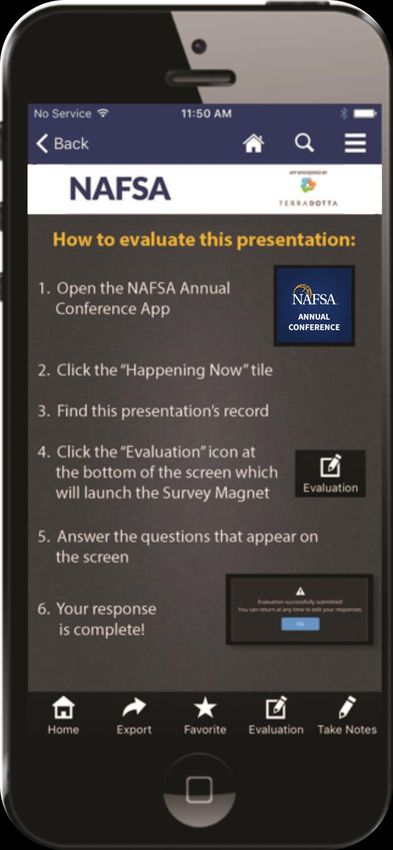
evaluation Or FAVORITE now
NOW! and EVALUATE
later!THANKS!
For a copy of the slides, go to the
NAFSA AM360 page:
www.nafsa.org/amYou can also read


