Recent Trends and Impact of COVID-19 in Brooklyn
←
→
Page content transcription
If your browser does not render page correctly, please read the page content below
Recent Trends and Impact of
               COVID-19 in Brooklyn
                                                    Brooklyn (coterminous with Kings County)
 Highlights                                         experienced the largest population growth among
 • Brooklyn has the largest population of the       New York City’s boroughs between 2010 and
   five boroughs with 2.7 million people in         2020 and appears poised to keep growing. With
   2020 and was the fastest growing borough         an extensive transportation network, respected
   over the last decade (9.1 percent).              educational institutions, and popular
                                                    entertainment and cultural amenities, Brooklyn is
 • Private sector employment in Brooklyn grew
                                                    a magnet for new residents. In addition to a large
   by 47.5 percent from 2010 to 2019, faster
   than citywide (28.7 percent).                    non-immigrant population, the borough has
                                                    attracted immigrants from countries like China,
 • Leisure and hospitality sector jobs grew the     Jamaica, the Dominican Republic, Haiti, Ukraine,
   fastest (by 109 percent), with nearly three-     Mexico, Trinidad and Tobago and Russia, putting
   quarters occurring in restaurants and bars.      it in the top 10 for highest share of immigrants
 • The pandemic and public health response          among the largest counties nationwide.
   led Brooklyn private sector employment to
   decline by 19.3 percent by the second            Population growth has supported economic
   quarter of 2020, from the second quarter of      gains, as employment, median incomes, and
   2019 level, better than the citywide rate of     businesses all saw increases exceeding those
   job loss (21.1 percent).                         citywide since 2010. However, there is significant
                                                    variation in economic outcomes, as some
 • Of the five boroughs, Brooklyn had the
                                                    neighborhoods remain well behind citywide and
   highest total COVID-19 cases,
   hospitalizations and deaths as of January        boroughwide levels. In addition, household and
   2022, reflecting its relative population size.   childhood poverty rates are still higher than
                                                    citywide, although the gaps have narrowed.
 • However, Brooklyn’s cumulative COVID-19
   case rate was second-lowest of the five          The COVID-19 pandemic has exacerbated this
   boroughs. Cumulative hospitalization and         inequality by devastating the City’s economy,
   death rates were third-lowest.                   which continues to face an uphill recovery across
 • As of the third quarter of 2021, Brooklyn        its sectors. Notably, the health care, retail trade,
   had regained over 100,000 jobs from the          leisure and hospitality, and business services
   start of re-opening, registering a faster pace   sectors (which together accounted for almost
   of improvement than citywide.                    one-quarter of borough employment) had not fully
                                                    recovered as of the third quarter of 2021. Even
 • Brooklyn businesses received one-fifth or
                                                    so, employment levels increased in all but two
   more of federal COVID relief loans and
   more than one-tenth of relief grants.            sectors since the re-opening, subway ridership
                                                    levels are rising, and Brooklyn continues to
 • The borough continues to be a technology         develop its innovation ecosystem with the support
   and innovation center of the City, with hubs     of City and State partners. For the City to
   for manufacturing and technology activity.       experience a full recovery, Brooklyn will have to
                                                    return to its pre-pandemic economic trajectory.

Report 2-2023 | May 2022                                                                               1
Introduction                                          entertainment and cultural amenities such as the
Brooklyn is the second largest in area (70.82         Brooklyn Academy of Music, Brooklyn Music
square miles) of the five boroughs after Queens       School, Theatre for a New Audience,
(108.53 square miles). Many of the early              the Brick Theater and Kings Theatre. Barclays
settlements are now a part of well-known              Center, the Coney Island Amusement Parks and
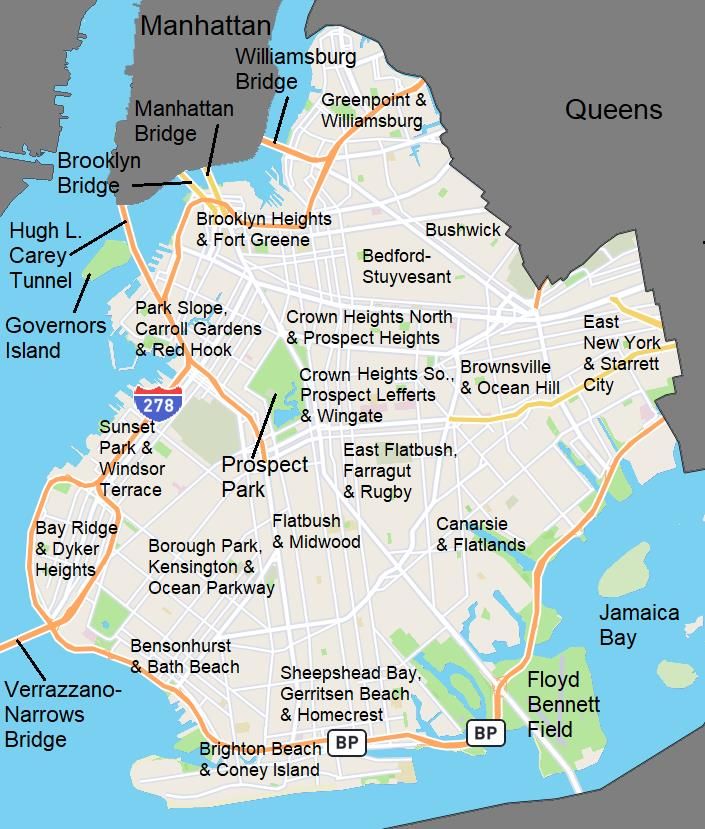
Brooklyn areas or neighborhoods (see Figure 1).       the New York Aquarium are also located in
                                                      Brooklyn.
As the borough has grown geographically, so has
its landscape, from historical brownstones to         Demographic Trends
mixed use to ultra-modern, luxury buildings.          According to the 2020 Census, the borough of
Recent efforts to improve and revitalize areas of     Brooklyn had the largest population of the five
Brooklyn included a focus on building industrial      boroughs and the fastest growth over the last
parks and technology and innovation districts. As     decade (see Figure 2). The borough gained
a result, Downtown Brooklyn is the City’s largest     nearly 230,000 residents from 2010 to 2020,
central business district outside of Manhattan.       accounting for 37 percent of the population
                                                      growth citywide.
Brooklyn has an extensive transportation network
consisting of mass transit (buses, subway lines,      FIGURE 2
rail lines and ferries) and roads, and is connected   Population Growth by Borough
to the rest of New York City by four bridges                                            Total
                                                                                                      Change
(including Brooklyn Bridge), the Brooklyn Battery      Borough                        Population
                                                                                                     2010-2020
                                                                                        2020
Tunnel and several subway tubes.
                                                       Brooklyn                          2,736,070         9.1%
                                                       Queens                            2,405,460         7.7%
The borough is home to 20 higher education
                                                       Manhattan                         1,694,250         6.8%
institutions, including five SUNY and CUNY             Bronx                             1,472,650         6.2%
locations.1 There are also well-known                  Staten Island                       495,750         5.6%
                                                       NYC                               8,804,190         7.6%
FIGURE 1                                              Sources: U.S. Census Bureau; OSC analysis
Map of Brooklyn
                                                      The trend through 2019 suggests that growth in
                                                      Brooklyn’s population was driven by an
                                                      expansion of the non-immigrant population.2
                                                      From 2010 to 2019, Brooklyn had a 6 percent
                                                      growth in the non-immigrant population, nearly
                                                      double the citywide rate. This was coupled with a
                                                      4.5 percent decline in the immigrant population,
                                                      the only borough to register a net decline in that
                                                      group over this period.

                                                      Still, more than 900,000 Brooklyn residents were
                                                      immigrants in 2019, representing 35.4 percent of
                                                      Brooklyn’s population, the second-highest share
                                                      among all the boroughs, after Queens with
                                                      47.6 percent. Brooklyn had the sixth-highest
                                                      share of immigrants among the 829 largest
                                                      counties nationwide.
Source: OpenStreetMap

2                                                                                                    Report 2-2023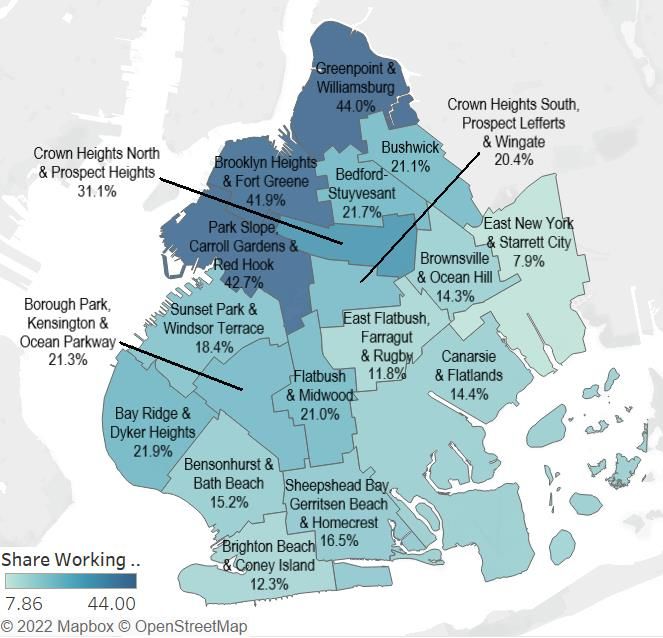
While immigrants in Brooklyn come from more                                    this category grew by 249 percent in Brooklyn
than 150 countries, the top 10 countries of origin                             since 2010, 124 percent citywide and 276 percent
account for more than half the immigrant                                       nationwide.
population (see Figure 3). Of these, Brooklyn had
more immigrants from each of the following                                     In Brooklyn, Asian American and Pacific Islanders
countries than any other borough: Jamaica, Haiti                               were the second-fastest growing segment (aside
and Trinidad and Tobago (with the largest                                      from those identified as “other”) of the population,
numbers located in the neighborhoods of                                        increasing by 41 percent over the decade. Both
Canarsie/ Flatlands, East                                                      the White and the Hispanic or Latino populations
Flatbush/Farragut/Rugby and Crown Heights                                      increased in Brooklyn over the period, but their
South/Prospect Lefferts/Wingate), and Ukraine                                  growth was more modest, at 8.4 percent and
and Russia (concentrated in the neighborhoods                                  3.4 percent, respectively. The only segment that
of Sheepshead Bay/Gerritsen Beach/Homecrest                                    showed a decline was Blacks or African
and Brighton Beach/Coney Island).                                              Americans (9.7 percent), which was greater than
                                                                               the decline citywide (5.1 percent).
FIGURE 3
Immigrant Population in Brooklyn                                               Nearly 40 percent of the residents of Brooklyn
                                                                               aged 25 or older had attained at least a
  Top 10 Countries of                    Number in                Brooklyn     bachelor’s degree as of 2019, a higher share than
        Origin                             2019                 Share of NYC   in any other borough except Manhattan. This
  China                                    122,700                      34%    represented an increase of 10.6 percentage
  Jamaica                                   67,300                      39%    points since 2010, far more than in any other
  Dominican Republic                        56,400                      14%    borough.
  Haiti                                     45,700                      54%
  Ukraine                                   41,400                      68%    From 2010 to 2019, the median age of Brooklyn
  Trinidad and Tobago                       41,000                      58%
  Russia                                    38,900                      62%    residents rose by 1.4 percentage points to reach
  Mexico                                    37,800                      24%    35.6 years, although it remained below the 37.2
  Guyana                                    37,000                      29%    years for all city residents.
  Ecuador                                   19,100                      17%
  Subtotal                                 507,150                      32%
                                                                               Household Income and Poverty
  Total                                    907,540                      30%
Note: Subtotal includes all other countries not listed in the figure.          The median household income in Brooklyn grew
Sources: U.S. Census Bureau; OSC analysis
                                                                               by 58.8 percent between 2010 and 2019. While
Of all Brooklyn residents (including both non-                                 this increase was far more than in any other
immigrants and immigrants), 35.4 percent of the                                borough, it remained below the citywide median
population reported their race/ethnicity as White                              (see Figure 4).
in 2020, 26.7 percent as Black or African                                      FIGURE 4
American, 18.9 percent as Hispanic or Latino,                                  Median Household Income by Borough
13.6 percent as Asian American and Pacific                                                                Median              Median
                                                                                                                                               Change
Islander and 4.1 percent as Two or More Races.                                  Borough                Household           Household
                                                                                                                                              2010-2019
                                                                                                      Income 2010         Income 2019
The 2020 Census revealed that the nation’s                                      Brooklyn                 $42,150             $66,900            58.8%
population is more multiracial and multiethnic                                  Manhattan                $63,800             $93,650            46.8%
than was measured in the past.3 The fastest                                     Queens                   $53,100             $73,700            38.9%
growing category of race/ethnicity in Brooklyn and                              Staten Island            $70,600             $89,800            27.3%
the City over the last decade was Two or More                                   Bronx                    $32,600             $41,400            27.2%
Races. The number of respondents who selected                                   NYC                      $48,700             $69,400            42.4%
                                                                               Sources: U.S. Census Bureau, American Community Survey,1-year estimates;
                                                                               OSC analysis

Report 2-2023                                                                                                                                             3
Seven of the 10 neighborhoods citywide with the differences than for citywide, resulting in narrower
highest growth rates in median household income gaps (see Figure 6).
from 2010 to 2019 were in Brooklyn. In fact, the
top three neighborhoods citywide were FIGURE 6
Greenpoint/Williamsburg, which grew by Household and Child Poverty Rates
134.7 percent, Crown Heights North/ Percent Percent
Area Difference
Prospect Heights, which grew by 93 percent, and in 2010 in 2019
Park Slope/Carroll Gardens/Red Hook, which Households
grew by 87.2 percent. Brooklyn 21.5 17.3 -4.2
New York City 18.7 16.4 -2.3
Brooklyn has a mix of low-, moderate- and high- Children
income neighborhoods. Of the borough’s Brooklyn 34.0 24.5 -9.5
18 Census-defined neighborhoods, median New York City 30.0 22.2 -7.8
Sources: U.S. Census Bureau, American Community Survey, 1-year estimates;
household income in 2019 varied from a high of OSC analysis
$155,250 in Park Slope/Carroll Gardens/
Among Brooklyn’s neighborhoods,
Red Hook to a low of $31,350 in Brownsville/
Brownsville/Ocean Hill had the highest household
Ocean Hill (see Figure 5).4
and child poverty rates (33.4 percent and
FIGURE 5 47.4 percent, respectively) while
Median Household Income by Neighborhood, Park Slope/Carroll Gardens/Red Hook had the
2019 lowest (7.1 percent and 6.6 percent, respectively)
in 2019.
The four neighborhoods with the largest
reductions in their child poverty rates between
2010 and 2019 within the borough
(Flatbush/Midwood, Crown Heights North/
Prospect Heights, East New York/Starrett City
and Bedford-Stuyvesant) had declines that
ranged from 16 percentage points to
24 percentage points.
More than one-fifth of Brooklyn households
(20.9 percent) received Supplemental Nutrition
Assistance Program (SNAP) benefits in 2019, a
higher share than citywide (18.6 percent), while
more than one-third of Brooklyn residents
(36.6 percent) received Medicaid, also a higher
Source: U.S. Census Bureau, American Community Survey, 2019. share than citywide (32.5 percent).
Household and child poverty rates in Brooklyn in At the neighborhood level, nearly 40 percent of
2019 (i.e., the share of households and children Brighton Beach/Coney Island households
living below the poverty level) were the second- received SNAP benefits, and 55 percent of
highest of the five boroughs (after the Bronx). Borough Park/Kensington/Ocean Parkway
Even so, both its household and child poverty residents received Medicaid, the highest shares
rates declined since 2010 and by larger of all neighborhoods in both cases.
4 Report 2-2023FIGURE 7 transportation and utilities with 124,230 jobs. The
Private Sector Employment in Brooklyn next largest sector, leisure and hospitality,
700 experienced the fastest growth between 2010
600 and 2019. In fact, the sector grew by 109 percent,
with nearly three-quarters of that growth located
Thousands of Jobs
500
in restaurants and bars.
400
300 Among Brooklyn’s neighborhoods, the three with
200 the most employment in 2019 (together
100
accounting for more than one-third of all jobs in
the borough) were Brooklyn Heights/Fort Greene,
0
Borough Park/Kensington/Ocean Parkway and
2010
2011
2012
2013
2014
2015
2016
2017
2018
2019
2020
Greenpoint/Williamsburg. The three
Note: 2020 is shaded in light blue for comparison.
Sources: NYS Department of Labor; OSC analysis neighborhoods with the fewest jobs were
Crown Heights South/Prospect Lefferts/Wingate,
Employment Growth Brownsville/Ocean Hill and East Flatbush/
Prior to the pandemic, Brooklyn added 216,460 Farragut/Rugby.
total private sector jobs from 2010 to 2019 (see Employment growth from 2010 to 2019 varied
Figure 7). This represented employment growth widely across the borough. Three neighborhoods
of 47.5 percent, which was far faster than in any doubled or nearly doubled their employment
other borough. Citywide job growth was levels: Bedford-Stuyvesant with a growth of
28.7 percent. 104.8 percent, Borough Park/Kensington/
Education and health services is the largest Ocean Parkway with 100.2 percent growth, and
employment sector in Brooklyn (as in all the other Sheepshead Bay/Gerritsen Beach/Homecrest
boroughs except Manhattan) with 289,260 jobs in with 93.5 percent growth (see Figure 9, next
2019 (see Figure 8). This is followed by trade, page). Brooklyn Heights/Fort Greene had the
slowest job growth with 20.2 percent and
East Flatbush/Farragut/Rugby experienced a
FIGURE 8
decline of 1.9 percent.
Brooklyn Employment by Sector, 2019
Education and Health
Services 43% Total wages in Brooklyn (which reflect both
average salaries and the number of jobs) grew by
74.5 percent from 2010 to 2019 to reach
Information 2% $30.5 billion, far faster than in any of the other
Trade,
Transportation boroughs, which ranged from 47 percent in the
and Utilities
Manufacturing
3% 18% Bronx to 58.6 percent in Queens.
Other Brooklyn’s growth in total wages was due more to
Services 5% job growth than the rise in average salaries,
Leisure and which only increased by 18.3 percent over the
Construction 5% Hospitality
10% same period, the lowest rate of all the boroughs.
Financial Activities
5%
Professional and Brooklyn also had the lowest average salary in
Business 9%
2019 at $45,400. All other boroughs were below
$53,000 except Manhattan with $131,800.
Sources: U.S. Census Bureau, American Community Survey, 1-year estimates;
OSC analysis
Report 2-2023 5FIGURE 9
Change in Employment by Brooklyn Neighborhood, 2010 to 2019
Number of Percent
Neighborhood 2010 2019 Jobs Added Change
Borough Park/Kensington/Ocean Parkway 38,864 77,820 38,956 100.2
Sheepshead Bay/Gerritsen Beach/Homecrest 26,586 51,431 24,845 93.5
Greenpoint/Williamsburg 48,839 73,126 24,287 49.7
Sunset Park/Windsor Terrace 36,878 51,875 14,997 40.7
Brooklyn Heights/Fort Greene 66,942 80,454 13,513 20.2
Bensonhurst/Bath Beach 20,621 33,222 12,600 61.1
Bushwick 16,128 27,450 11,321 70.2
Bedford-Stuyvesant 10,746 22,012 11,266 104.8
Canarsie/Flatlands 26,306 35,814 9,508 36.1
Brighton Beach/Coney Island 18,410 27,468 9,058 49.2
Flatbush/Midwood 19,040 27,020 7,980 41.9
Bay Ridge/Dyker Heights 17,465 25,217 7,752 44.4
Park Slope/Carroll Gardens/Red Hook 35,687 42,959 7,273 20.4
East New York/Starrett City 19,045 26,117 7,072 37.1
Crown Heights North/Prospect Heights 11,367 15,462 4,095 36.0
Brownsville/Ocean Hill 9,979 13,603 3,624 36.3
Crown Heights South/Prospect Lefferts/Wingate 8,465 11,400 2,935 34.7
East Flatbush/Farragut/Rugby 14,854 14,570 (284) (1.9)
Total Employment 446,223 657,021 210,798 47.2
Sources: NYS Department of Labor; OSC analysis
Business Growth sector businesses grew by 31.6 percent over this
Prior to the pandemic, Brooklyn experienced very period, faster than in any other borough.
strong business growth between 2010 and 2019 Brooklyn’s rate of growth was more than double
(see Figure 10) primarily because of the the rate in Staten Island, the Bronx and
expansion of microbusinesses, defined by the Manhattan and 50 percent higher than in Queens.
U.S. Small Business Administration as those with More than 80 percent of the growth was in
fewer than 10 employees. The number of private microbusinesses.
While expansion in the number of businesses
FIGURE 10 occurred across many sectors, the fastest
Brooklyn Private Sector Firms, 2010 to 2020
growing were information businesses, such as
70
telecommunications firms, film companies, radio
Thousands of Private Firms
60
and TV broadcasting, and cable programming
50 businesses (104.1 percent), leisure and
40 hospitality firms (62.3 percent, mostly restaurants
30 and bars) and business services firms
(51.4 percent). The latter two sectors accounted
20
for more than one-third of the new businesses in
10
the borough.
0
The number of businesses in each of Brooklyn’s
2010
2011
2012
2013
2014
2015
2016
2017
2018
2019
2020
Note: 2020 is shaded in light blue for comparison.
neighborhoods ranged from 1,110 in
Sources: NYS Department of Labor; OSC analysis
6 Report 2-2023Brownsville/Ocean Hill to 6,750 in Within Brooklyn, the share of the working
Greenpoint/Williamsburg. Many neighborhoods residents located in remote industries varied
experienced an increase in the number of widely across neighborhoods from 44 percent
businesses, while Bedford-Stuyvesant had the (Greenpoint/Williamsburg) to 7.9 percent (East
fastest increase of 75 percent from 2010 to 2019. New York/Starrett City) in 2019. Generally, the
higher the share of residents who worked in
Resident Work Force industries conducive to working remotely, the
Brooklyn had 1.2 million working residents in higher the median household income (and annual
2019, with average earnings of $64,600 average earnings per worker) for that
compared to $73,300 for the City as a whole.5 neighborhood (see Figure 11).
Among Brooklyn’s neighborhoods, three had
average earnings above $88,000 in 2019 and FIGURE 11
were among the top 10 citywide Share of Area Workforce in Remote Industries
(Park Slope/Carroll Gardens/Red Hook,
Brooklyn Heights/Fort Greene and
Greenpoint/Williamsburg). Five neighborhoods in
the borough had average earnings below $50,000
(Brighton Beach/Coney Island, Bushwick,
Bensonhurst/Bath Beach, East New York/
Starrett City and Brownville/Ocean Hill).
The pandemic has drawn attention to the extent
to which certain industries or occupations can
adapt to remote work. Those in face-to-face
industries, such as health care, retail trade,
accommodation and food services, transportation
and warehousing, construction, personal services
(e.g., nail salons and automotive repair), arts and
entertainment, and manufacturing, faced a higher
risk of contracting COVID-19 through work Source: U.S. Census Bureau, American Community Survey, 2019
activities and higher risk of becoming
unemployed.6 Citywide, more residents (over COVID-19 Health Impacts
three-quarters) work in these industries than in In the spring of 2020, New York City was the
those conducive to working remotely, such as epicenter of the COVID-19 pandemic in the
business services and financial activities. United States. Since then, the City has had
In 2019, nearly 23 percent of the workforce in multiple pandemic waves as the spread of
Brooklyn was employed in industries conducive to COVID-19 has ebbed and flowed with the
working remotely, in line with citywide (23.1 diffusion of new variants.7 With the development
percent). Among the five boroughs, Manhattan of vaccines and better treatments for the virus,
had the highest share of 40 percent, whereas in the severity of outcomes from getting infected has
Staten Island, Queens and the Bronx, less than improved, particularly among the vaccinated
19 percent of the workforce was employed in population.
remote industries.
Report 2-2023 7FIGURE 12
Cumulative Cases, Hospitalizations and Deaths from COVID-19 by Borough
Hospitalization Death
Borough Cases Hospitalizations Deaths Case Rates
Rates Rates
Bronx 406,702 34,411 7,715 28,677 2,426 544
Brooklyn 694,279 48,327 12,783 27,121 1,888 499
Manhattan 399,305 22,820 5,430 24,517 1,401 333
Queens 637,778 44,359 11,834 28,297 1,968 525
Staten Island 165,346 8,984 2,310 34,726 1,887 485
NYC 2,303,961 158,925 40,073 27,636 1,906 481
Note: Rates are per 100,000 people; data as of March 29, 2022.
Sources: NYC Department of Health and Mental Hygiene; OSC analysis
Looking at the cumulative impact of the pandemic Before the fifth wave of the pandemic took hold in
since its beginning, Brooklyn had the highest December 2021 (driven by the Omicron variant of
number of total cases, hospitalizations and the COVID-19 virus), the severity of the
deaths from COVID-19 as of March 2022, pandemic’s impact had been receding as monthly
consistent with the borough being the most hospitalization and mortality rates declined
populous of the City’s five (see Figure 12). In substantially in all boroughs. The variant caused
terms of rates, however, Brooklyn had the cases and positivity rates to surge to levels
second-lowest cumulative case rate, and third- exceeding the pandemic’s prior peak in the spring
lowest cumulative hospitalization and death rates of 2020, although the number of hospitalizations
among the five boroughs.8 and deaths have not risen as sharply.
Rates varied significantly across the 37 ZIP Code For Brooklyn, the monthly average hospitalization
areas of Brooklyn’s 18 neighborhoods.9 rate fluctuated downward from 136 people
Cumulative rates of 17,199 cases per 100,000 hospitalized per 100,000 residents in January
residents and 171 deaths per 100,000 residents
in Gowanus/Park Slope/Windsor Terrace (ZIP FIGURE 13
Monthly Average COVID-19 Hospitalization
Code 11215) were the lowest, and significantly
Rates (per 100,000 residents)
below the respective citywide averages shown in
Figure 12. Cumulative rates of 33,489 cases per 400
100,000 residents and 1,390 deaths per 100,000 350
residents in East New York (ZIP Code 11239) 300
250
were the highest, and well above the respective 200
citywide averages. 150
100
Although many factors affect the rate at which 50
residents have become infected and the severity 0
Nov-20
Dec-20
Oct-21
Nov-21
Dec-21
Apr-21
Aug-21
Sep-21
Jan-22
Jan-21
Jun-21
May-21
Feb-21
Mar-21
Feb-22
Jul-21
of COVID-19’s impact, there appears to be a
general correlation between neighborhoods with
higher median household incomes and lower Bronx Brooklyn Manhattan
poverty rates, and lower cumulative case rates Queens Staten Island
and death rates. Note: Data as of March 29, 2022
Sources: NYC Department of Health and Mental Hygiene; OSC analysis
8 Report 2-20232021 to 20 people in November 2021, then of residents fully vaccinated ranging from
increased sharply to reach 212 people in January 53 percent in Borough Park (ZIP Code 11219) to
2022 (see Figure 13). The mortality rate more than 100 percent in Sunset Park (ZIP Code
fluctuated downward from 28 deaths per 100,000 11220), as of March 29, 2022.11
people in January 2021 to four deaths per
100,000 people by November 2021, before Economic Impact of the
increasing sharply to reach 44 deaths per Pandemic
100,000 people in January 2022. Hospitalization In March 2020, the pandemic resulted in a
and mortality rates declined to 26 per 100,000 sudden economic shutdown, followed by a
people, and 13 per 100,000 people, respectively, phased re-opening. By the second quarter of
in February 2022. 2020 the City had 812,500 fewer private sector
jobs than in the previous quarter. (See Figure 15,
Seven-day positivity rates peaked in Brooklyn at next page. Data is not seasonally adjusted.) In
32.2 percent and across the City (35.0 percent), Brooklyn, the shutdown caused private sector
then declined. As of March 26, 2022, the seven- employment in the second quarter of 2020 to
day positivity rate was 2.5 percent for Brooklyn, decline by 145,000 jobs from the previous quarter
the same as for the City as a whole. (or by 129,400 jobs from one year earlier).
Businesses designated as non-essential which
Vaccinations
required face-to-face work were hit the hardest,
After the first vaccines against COVID-19 were while essential sectors and those that could
approved for adult use in the United States in transition to remote work had smaller
December 2020, eligibility was expanded in employment declines.
phases over the next year, so that by November
2021, all adults and all children ages 5 and over As shown in Figure 15, the pace of job recovery
were eligible. Accordingly, vaccination rates rose in Brooklyn, measured by the change from the
significantly from May 2021, when just 52 percent first quarter of 2020 employment level, is ahead
of the adult population across the City was fully of the City’s. In the second quarter of 2020,
vaccinated, to March 29, 2022, when 87 percent employment in Brooklyn was lower than in the
of adults were fully vaccinated (see Figure 14).10 previous quarter in all sectors except information,
reflecting the impact of the pandemic. By the third
FIGURE 14 quarter of 2021 employment had increased in all
COVID-19 Vaccinations by Borough sectors except financial activities and educational
Percent Fully Vaccinated services.
All Ages
Adults Adults
Borough May 2021 March 2022
March
Figure 15 also shows that, by the third quarter of
2022
Bronx 44% 85% 74% 2021, the social sector (which includes many
Brooklyn 46% 82% 71% face-to-face services) and the information sector
Manhattan 61% 88% 82% (which is suited to and facilitates remote work)
Queens 56% 94% 85% had the fastest jobs recovery in Brooklyn.
Staten Island 50% 85% 74% Conversely, job recovery appeared slowest in the
New York City 52% 87% 78% transportation and warehousing, construction,
Note: Percentage of respective populations, as of March 29, 2022.
Source: NYC Department of Health and Mental Hygiene and educational services sectors.
As with positivity rates, vaccination rates vary Overall, Brooklyn businesses showed a similar
widely across Brooklyn, with the share of all ages pattern to that of employment in the borough.
Report 2-2023 9FIGURE 15
Change in Employment in Brooklyn by Sector as of Third Quarter, 2021
Percent
Employment Levels Change in Employment Change From
Sector Q1 2020
Q1 2020 to Q2 2020 to Employment
Q1 2020 Q2 2020 Q3 2021 Q2 2020 Q3 2021 Level
Construction 33,765 22,587 29,601 -11,178 7,014 -12.3
Manufacturing 18,867 13,330 16,983 -5,538 3,653 -10.0
Wholesale Trade 22,715 17,712 20,381 -5,003 2,669 -10.3
Retail Trade 76,411 56,136 72,147 -20,274 16,011 -5.6
Transportation and
21,758 12,138 16,366 -9,621 4,228 -24.8
Warehousing
Information 13,068 11,981 12,835 -1,087 854 -1.8
Financial Activities 35,050 32,132 31,365 -2,917 -768 -10.5
Professional and
63,388 53,855 59,453 -9,533 5,599 -6.2
Business
Educational Services 33,862 29,098 27,865 -4,764 -1,233 -17.7
Health Care 189,979 165,842 182,669 -24,137 16,827 -3.8
Social Assistance 80,419 72,325 84,751 -8,094 12,426 5.4
Leisure and Hospitality 61,456 30,058 56,521 -31,398 26,463 -8.0
Other Services 35,979 24,588 34,224 -11,391 9,636 -4.9
Brooklyn Total 686,716 541,781 645,161 -144,935 103,380 -6.1
New York City Total 3,901,015 3,088,549 3,512,863 -812,467 424,315 -10.0
Note: Calculations are subject to rounding
Sources: NYS Department of Labor; OSC analysis
Between the first and second quarter of 2020 the rate was second highest of the five boroughs and
total number of private sector firms in the borough tended to be only slightly higher than the citywide
declined slightly, then increased by the third rate. After averaging 4.1 percent in the first three
quarter of 2021, measuring one-half percent months of 2020, unemployment in the borough
higher than at the start of the pandemic. rose rapidly (as it did throughout the City) to
Trends varied when viewed by business size. FIGURE 16
While Brooklyn businesses with 10 or more Unemployment Rates by Borough Since 2020
employees declined by 27.6 percent between the 30.0
first and second quarters of 2020, the number of 25.0
microbusinesses (those with fewer than 10
20.0
employees) increased by 4.5 percent. Although
Percent
the pattern reversed as the City re-opened, there 15.0
was still 1.6 percent more microbusinesses by the 10.0
third quarter of 2021 than at the start of the
5.0
pandemic, and 5.6 percent fewer firms of all other
sizes combined. Microbusinesses made up 0.0
84.7 percent of all Brooklyn businesses in 2019.
Unemployment Bronx Brooklyn Manhattan
Queens Staten Island
For the five years prior to the pandemic from
Sources: NYS Department of Labor; OSC analysis
2015 to 2019, Brooklyn’s annual unemployment
10 Report 2-2023reach 21.2 percent in May 2020 as the pandemic assistance sector accounted for the highest share
unfolded and non-essential face-to-face of residents’ employment.
businesses were shut down (see Figure 16).
Brooklyn’s unemployment rate has since Housing
gradually declined (as it has throughout the City) The pandemic has driven changes in the nation’s
to reach 6.3 percent as of March 2022, the lowest housing market. In the State, the City has been
level since the start of the pandemic, still slightly an outlier in terms of migration patterns that have
higher than the citywide rate (6.1) percent. influenced the market. Specifically, while
domestic migration to and within the City
Commuting to Work
increased from an average of 5.7 percent of its
The Brooklyn segment of the City’s public population over 2015 to 2019 to 6.7 percent in
transportation system is one of the most 2021, the rest of the State experienced a decline
extensive of the five boroughs, with more than 60 from an average of 7.3 percent to 6.2 percent,
local, limited and express bus routes, and 157 based on an analysis of the U.S. Census
subway stations and complexes. In 2019, Bureau’s Current Population Survey.14 This
Brooklyn had the second-highest share of divergence was due, in part, to persons moving
residents using public transportation to get to out of an existing household to establish a new
work (61 percent) among the five boroughs (after one during the pandemic.
the Bronx) and higher than the citywide share
(55 percent).12 The share of Brooklyn residents With the largest population among the boroughs,
that walked to work (8.4 percent) that year was Brooklyn also has the most housing units at
the second highest after Manhattan. nearly 1 million in 2019, over 30 percent of the
citywide total. Of these, 70 percent were rentals
In April 2020, Brooklyn subway ridership fell to compared to two-thirds citywide. The Bronx and
10.9 percent of the April 2019 level, the second Manhattan, however, had even higher shares of
highest after the Bronx (17.9 percent).13 By rental units than Brooklyn.
December 2021, the overall borough ridership
was still less than half of 2019 levels. At the According to the U.S. Census Bureau, the
median rent in Brooklyn was $1,480 in 2019, the
neighborhood level, ridership had recovered to
same as citywide. Rents in the borough grew by
one-half or more of the 2019 levels in
37.5 percent from 2010 to 2019, the fastest rate
Bensonhurst/Bath Beach, Borough Park/
Kensington/Ocean Parkway, Brighton Beach/ FIGURE 17
Coney Island and Sunset Park/Windsor Terrace Percent Change in Median Rent 2010 to 2019,
by February 2022. These were also among the New York City and Boroughs
10 neighborhoods across the City with the
highest ridership levels in that month,
NYC
neighborhoods with relatively low median
Staten Island
household incomes.
Bronx
The mean travel time to work for Brooklyn Queens
residents in 2019 was 43.8 minutes, higher than Manhattan
the mean time for all of the City (41.7 minutes). Brooklyn
For 10 Brooklyn neighborhoods, the mean travel 0.0% 10.0% 20.0% 30.0% 40.0%
time to work was higher than the borough
Sources: U.S. Census Bureau, American Community Survey, 1-year estimates;
average, and the health care and social OSC analysis
Report 2-2023 11among all the boroughs (see Figure 17). Within rate home value in Brooklyn was $700,640, and,
the borough, median rents ranged from among as of November 1, 2021, was $674,000, slightly
the highest of all the City’s 55 neighborhoods to below its February 1, 2020 value.
among the lowest. Park Slope/Carroll Gardens/
Red Hook had a median rent of $2,330 and More than one-third (36.6 percent) of
ranked fourth citywide, while Brighton Beach/ homeowners faced a housing cost burden in
Coney Island had the lowest median rent in 2019, while one-fifth (20.1 percent) faced a
Brooklyn ($1,080) and ranked 52nd citywide. severe housing cost burden. These were higher
than the shares of homeowners in the City overall
According to rental index data from Street Easy, that faced a housing cost burden (32.2 percent)
the median market-rate rent in Brooklyn reached and a severe housing cost burden (16.5 percent).
a high of $2,729 in March 2020, just as the
pandemic was beginning to take hold. As of COVID-19 Housing Relief
November 1, 2021, the median market-rate rent The pandemic brought a serious housing
has exceeded its pre-pandemic peak. affordability problem, in Brooklyn and throughout
the City, to the forefront, as job and income
Now, and even prior to the pandemic, housing
losses affected City residents’ ability to pay rent
affordability has been a key problem in Brooklyn
or cover housing costs. As with the rest of the
as it has been citywide (and nationally). Half of all
City, relief from possible eviction of renters in
rental households in Brooklyn faced a rent burden
Brooklyn came from the closure of housing courts
in 2019. These households had a rent equal to
between April and June of 2020, then from a
30 percent or more of their incomes (the
State eviction moratorium. The moratorium was
threshold at which housing costs are considered
extended three times before it expired on January
a burden). More than one-quarter (26.2 percent)
15, 2022.
faced a severe rent burden, also the same share
as citywide. These households had a rent equal The City’s average monthly eviction filings since
to at least half of their incomes. the courts re-opened have been less than 40
percent of the average level for 2016 through
Park Slope/Carroll Gardens/Red Hook had the
2018.15 With the moratorium expired, court
lowest share of households facing either a rent
actions across the City, including Brooklyn, are
burden (one-third) or a severe rent burden
expected to increase. In fact, as of January 23,
(13.6 percent) while Borough Park/
2022, eviction filings for Brooklyn ZIP Code areas
Kensington/Ocean Parkway and
11206, 11212 and 11224 (Williamsburg (South),
Brownsville/Ocean Hill (where median household
Ocean Hill-Brownsville and Brighton
income was lowest) had the highest shares of
Beach/Coney Island/Seagate, respectively) were
households facing a rent burden (nearly two-
above 90 percent of the historical levels.16
thirds of the households in each neighborhood)
and a severe rent burden (nearly 40 percent of While evictions were suspended, rent arrears
the households). mounted as renters faced pandemic hardships.
There were more than 290,000 owner-occupied To ease the burden for lower-income renters, the
housing units in Brooklyn in 2019. The value of State implemented the federally-funded
these homes has risen significantly over the past Emergency Rental Assistance Program (ERAP)
decade. According to the U.S. Census Bureau, to help make payments to landlords. The New
the median home value rose by 40 percent since York State Office of Temporary and Disability
2010 (faster than in any other borough) to reach Assistance reports a total of 320,545 ERAP
$794,000 in 2019, second only to Manhattan applications were received from New York State
($1,128,000). The pre-pandemic median market- residents as of March 23, 2022, and $2.0 billion
12 Report 2-2023was committed for payment.17 A total of The increase in food insecurity was reflected in
$1.7 billion was paid out to all State residents. Of higher demand at food pantries. Some 27 percent
that amount, $1.4 billion went to the City, with of Brooklyn residents used food pantries in 2020
Brooklyn receiving $421.7 million, a slightly compared to a pre-2020 four-year average of
smaller share than the 33 percent of low-income 12 percent.21 These rates were almost the same
rental households (or those earning less than 80 for the City as a whole. In response, almost
percent of the area median income) in the City.18 one-half of the City’s food pantries increased
hours of operation between March and June of
New York State COVID relief for property owners 2020, even as one-third were forced to close (in
through 2021 was made up mainly of a mortgage part because many volunteers were at higher risk
foreclosure moratorium and receipt of tenants’ for COVID-19 infections and so unable or
arrears payments through the ERAP. On January unwilling to work).22
3, 2022, the State launched a federally-approved
Homeowner Assistance Fund (HAF) to assist low- Measures taken to address the increase in food
insecurity at the local and federal levels
to moderate-income applicants with up to
complemented changes in the emergency food
$50,000. Eligible expenses include mortgage
network.23 Within weeks of the pandemic onset,
payments, property taxes, water and sewer bills,
in 2020, the City implemented a plan to ensure
cooperative and condo unit maintenance fees,
residents had access to adequate supplies of
and chattel loans and retail installment payments
food during the emergency. In February 2021, an
for manufactured homes.
interagency plan to meet residents’ food needs in
HAF applications are expected to exceed the near-, medium- and long-term was launched.
available funding of $539 million. While the HAF Immediate measures for food relief (up to 2022)
application window is now closed, pending included supporting food pantries, supplying
applications are still being processed. As of meals for pickup at local schools and delivering
March 21, 2022, New York City accounted for food to seniors at home.24 Medium-term (2023 to
44 percent of the 30,785 applications processed 2024) and long-term (2025 and onward)
for the State.19 Applications for mortgage measures included education campaigns, support
reinstatement made up 75 percent of the total, for food distribution workers, and improvement in
and the balance was for non-mortgage arrears. procurement, storage and distribution of food.
Food Insecurity State and federal measures included income
Hunger Free America estimates that the number support to households through temporary
expansion of unemployment insurance and the
of individuals who were food insecure in Brooklyn
SNAP, and through stimulus payments (grants) to
for the 2018 to 2020 three-year period was the
citizens during the heights of the pandemic.25
highest among the five boroughs, and amounted
to an average of 14.1 percent of borough Education and Broadband
residents.20 This was the same as the borough’s Internet
child food insecurity rate, and lower than the
City’s average food insecurity rate (19.0 percent). Education
Reflecting the impact of the pandemic, the The COVID-19 pandemic has exacerbated long-
borough’s food insecurity rate was higher than term trends of declining enrollment across City
the average of 11.5 percent for the 2015 to 2017 schools (see OSC’s report on the New York City
three-year period (when the City’s average rate Department of Education).26 Over the last five
was 12.8 percent).
Report 2-2023 13years, Brooklyn has accounted for slightly more FIGURE 18
than 30 percent of the City’s total Pre-K through Shares of Brooklyn Neighborhood Households
12th grade enrollment, and the borough’s with No Broadband Access, 2019
enrollment decline last year was above
3.3 percent. This was similar to all other Brgh Pk/Knsngton/Ocean Pkwy
boroughs except Staten Island, where enrollment Brownsville/Ocean Hill
Brighton Beach/Coney Island
declined less than one percent. Bedford-Stuyvesant
Bay Ridge/Dyker Hghts
In Brooklyn, the New York City Department of Flatbush/Midwood
E. Flatbush/Farragut/Rugby
Education served more than 330,000 students in Bensonhurst/Bath Beach
the 2020-21 school year, a 3.3 percent decline Bushwick
Sunset Park/Windsor Terrace
from the previous year according to official City Greenpoint/Williamsburg
data. Most of the decline was concentrated in Crown Hghts N./Prspct Hghts
E. New York/Starrett City
younger grade levels, with Pre-K and 3-K Crwn Hghts S./Prspct Lffrts/Wngte
enrollment declining by more than 15 percent and Shpshd Bay/Gerritsen Bch/Hmcrst
Brooklyn Hghts/Fort Greene
elementary enrollment declining by nearly Canarsie/Flatlands
4.4 percent in that year, mirroring citywide trends. Pk Slope/Carroll Grdns/Red Hk
0.0% 12.5% 25.0% 37.5% 50.0%
Of the borough’s 580 schools, 93 are charter
schools, which saw a 4.7 percent growth in Sources: U.S. Census Bureau, American Community Survey, 1-year estimates;
OSC analysis
enrollment despite the pandemic. This also
followed historical trends at the City level. incomes tended to have a higher percentage of
households with no broadband access.
The pandemic has disrupted historical methods of
tracking and measuring student progress (such The neighborhoods of Borough Park/
as standardized testing) and has lowered student Kensington/Ocean Parkway and Brownsville/
attendance rates, even though City schools Ocean Hill, which had the highest shares of
resumed in-person instruction for all students at households with no connection, were cited
the beginning of the 2021-22 school year. With among 11 areas that could benefit from the City’s
students back in the classroom full-time, daily efforts to improve broadband access in
lower-income communities, including the
attendance in Brooklyn averaged just
settlement of a years-long suit against a major
85.5 percent for the fall of 2021, lower than the
internet service provider (ISP). Other Brooklyn
91.6 percent average recorded over the six years
neighborhoods included were
prior to the pandemic (the same as citywide).
Crown Heights North/ Prospect Heights and
Broadband Internet Access Bushwick.
The COVID-19 pandemic highlighted existing Efforts to improve the ability of lower-income
inequalities in broadband internet access as families to access broadband service also
families shifted to working from home and to included the adoption of a federal Emergency
distance learning.27 While Brooklyn had the Broadband Benefit (EBB) program that provides
second-lowest share of households without payments of up to $50 per month for connectivity.
broadband internet subscriptions among the five As of November 23, 2021, Brooklyn residents
boroughs in 2019 (27.3 percent), there were wide accounted for the highest share (28.6 percent) of
disparities within the borough (see Figure 18).28 EBB subscriptions across the five boroughs. The
Neighborhoods with lower median household City accounted for just over one-half of all New
York State EBB subscriptions.
14 Report 2-2023Crime growth citywide (1 percent). Crime within
Major crime in Brooklyn (i.e., murder, rape, Brooklyn’s public housing increased by 10
robbery, felony assault, burglary, grand larceny, percent, outpacing the citywide growth in housing
and grand larceny auto) declined by 42 percent crime of 7 percent. The number of hate crimes in
between 2000 and 2010, similar to the rate Brooklyn grew by 44 percent to 134, mostly
citywide. In the following decade, the decline in consisting of anti-Jewish incidents (58). Citywide,
major crime slowed but still fell by 16 percent in hate crimes grew by 97 percent.
Brooklyn, compared to a 9 percent drop citywide.
Pandemic Relief Programs
The violent and property crime rates in Brooklyn As with other areas of the City, Brooklyn
in 2019, the last year comparable population data residents relied on federal, State and local
was published, were 419 crimes and 653 crimes, programs for pandemic relief through much of
respectively, per 100,000 residents. Brooklyn 2020 and 2021. Brooklyn businesses received
crime rates were lower than both the citywide one-fifth of all federal Paycheck Protection
violent and property crime rates (434 crimes and Program (PPP) loans and just under one-third of
713 crimes, respectively). federal Economic Injury Disaster Loans (EIDLs)
and advances for New York City (see
Citywide, major crime in 2021 grew by 7 percent Figure 19).29 The borough also accounted for
from 2020, greater than the slight increase in significant shares of the City’s Restaurant
Brooklyn (1 percent). A decrease in most major Revitalization Fund (RRF) and the Shuttered
crimes in Brooklyn was offset by increased Venue Operators Grant (SVOG) dollars.
incidents of grand larceny (10 percent), felony
assault (7 percent), and grand larceny auto Paycheck Protection Program
(1 percent). Shootings in Brooklyn, which
The PPP was the single largest COVID-19 relief
accounted for one-third of the citywide total,
program for small businesses at the federal level,
dropped by 20 percent, compared to a small
with lending rounds in 2020 and 2021.30
increase citywide which brought that total to its
Businesses with 2020 loans were allowed to
highest number since 2006 (1,562 shootings).
borrow again in 2021. Brooklyn businesses
Subway crime in Brooklyn in 2021 fell by 9 received the second-highest number of PPP
percent compared to 2020, contrary to the small loans and loan dollars among the five boroughs
for both years.
FIGURE 19
Federal COVID-19 Relief Resources Accessed by Brooklyn Small Businesses
Area Loan or
Grant or Forgiven Share of City Loan
Program Grant Dollars (in
Loan Share* and Grant Dollars
millions)
As of March 2022
Paycheck Protection Program $6,117 71.8% 19.9%
Restaurant Revitalization Fund $382 100.0% 13.8%
Shuttered Venue Operators Grant $193 100.0% 11.7%
As of December 2020
Economic Injury Disaster Loan $3,218 0.0% 32.4%
Economic Injury Disaster Loan Advance $218 100.0% 29.9%
*Figures in this column indicate the proportion of funds that are either forgiven (loans) or need no repayment (grants). Forgiveness is not
provided for EIDLs, which have repayment periods of up to 30 years with interest rates of no more than 3.2 percent.
Sources: U.S. Small Business Administration; OSC analysis
Report 2-2023 15Three neighborhoods (Greenpoint/Williamsburg, approved for Brooklyn area restaurants by
Brooklyn Heights/Fort Greene and June 30, 2021. This represented 24.3 percent
Borough Park/Kensington/Ocean Parkway) and 13.8 percent, respectively, of total RRF
accounted for just over one-quarter of all loans grants and grant dollars approved for the City.
and one-third of total loan dollars approved for In Brooklyn, women-owned businesses, as well
the borough. as businesses in either low- and moderate-
income (LMI) areas or historically underutilized
Brooklyn’s health care, business services and business (HUB) zones were awarded higher
construction were among the top-four borrowing shares of RRF grant dollars than citywide (see
sectors in both years of PPP lending and, along Figure 20).32
with the leisure and hospitality sector, accounted
for one-half of all PPP loan dollars approved for FIGURE 20
the borough in 2021, as well as for both years Share of Brooklyn and New York City RRF
combined. In 2020, the top-four borrowing sectors Grant Dollars by Equity Indicator
included retail trade.
Indicator Brooklyn NYC
First time borrowers in Brooklyn, as well as in the Low and Medium Income 38.1 15.3
Bronx and Queens, accounted for a higher share HUBZone 45.0 22.4
Socioeconomically
of first-draw loans and loan dollars approved for Disadvantaged 33.5 36.8
the City in 2021 than their respective borough Women-Owned 33.4 27.5
shares of PPP loans to the City in 2020. The Sources: U.S. Small Business Administration; OSC Analysis
share approved for Manhattan businesses was
lower, and that for Staten Island businesses was Shuttered Venue Operators Grants
the same. Reflecting measures to improve
As of March 28, 2022, Brooklyn businesses
access to PPP resources by the smallest
accounted for 11.7 percent of the SVOG grant
businesses, the share of Brooklyn loans taken up
dollars approved for the City, second to
by firms with fewer than 20 employees increased
Manhattan (with 84.4 percent). As with the rest of
from 91 percent in 2020 to 97 percent in 2021.
the City, most awards for venues in the borough
Economic Injury Disaster Loans and were approved in July of 2021, more than a year
Advances after the initial shutdown.
While data for 2021 COVID-19 EIDLs at the Organizations in Brooklyn Heights/Fort Greene,
county level or below is not available to the Bushwick, Greenpoint/Williamsburg and
public, a summary report shows that Park Slope/Carroll Gardens/Red Hook accounted
New York State received a total of $32.3 billion for just under three-quarters of awards to the
EIDLs, $652.3 million EIDL advances and borough. Live performing arts organization
$285.1 million supplemental targeted EIDL operators and live venue operators or promoters
advances as of March 24, 2022.31 Detailed data received 70 percent of SVOG grants to the
released for 2020 showed that Brooklyn received borough, compared to 46 percent in the City as
the highest shares of EIDL funding (among the a whole.
five boroughs) to the State, at 18.3 percent of
EIDLs and 16.3 percent of EIDL advances. Open Streets: Restaurants
In June 2020, the City expanded its Open Streets
Restaurant Revitalization Fund
program to allow restaurant service in designated
Data released on the RRF showed that a total of sidewalk, parking lot and roadway areas. As of
1,333 grants amounting to $382 million were March 28, 2022, Brooklyn restaurants accounted
16 Report 2-2023for just under one-quarter of all Open Streets: States presence in the borough, and several
Restaurants permits issued across the five public arts and performance projects were being
boroughs. Three neighborhoods (Greenpoint/ planned. As with the rest of the City, Brooklyn’s
Williamsburg, Brooklyn Heights/Fort Greene cultural and entertainment amenities were closed
and Park Slope/Carroll Gardens/Red Hook) through most of the shutdown period, and office
accounted for just under one-half of all sector workers have not returned to their offices
Brooklyn permits. at the same rate as prior to the pandemic.35
Economic Centers and Innovation Brooklyn Navy Yard
Districts In Brooklyn Navy Yard, an innovation district
Despite the slowdown caused by the COVID-19 located in the Brooklyn Heights/Fort Greene
pandemic, there have been notable neighborhood (as is Downtown Brooklyn and
developments across Brooklyn’s many economic DUMBO), robotics and 3D printing company
centers, suggesting that the borough is set to Nanotronics Imaging completed the conversion of
resume the pre-pandemic growth trend noted a historic building into a 45,000-foot ‘smart’
between 2010 and 2019. factory (accommodating some 100 workers) in
Beyond the Brooklyn Tech Triangle 2021. The project received financing from the City
($3.25 million) and the Regional Economic
The Brooklyn Tech Triangle is one of several Development Council (REDC) ($2.25 million).
innovation districts located across the borough.33
It includes the Downtown Brooklyn, DUMBO During the height of the pandemic in 2020, the
(Down Under the Manhattan Bridge Overpass) Brooklyn Navy Yard Development Corporation
and Brooklyn Navy Yard areas and is bordered at coordinated a pivot by tenants to production of
the southeast by Barclays Center. The strategic medical personal protective equipment (PPE).
plan for the development of the Triangle into a This response to the global shortage of PPE was
center of technological innovation was formulated facilitated by REDC funding of $31.6 million. The
in 2013 and adhered to for several years after. REDC reports that the effort resulted in 24 Navy
Yard firms producing more than 25 percent of all
Along with the area, the entire borough locally produced PPEs (face masks, face shields,
developed into an epicenter of technology and hospital gowns, hand sanitizers, protective
innovation, with firms like Etsy, Kickstarter and partitions and 3D printed ventilator valves) used
Livestream headquartered there. A review of across the City to fight the pandemic.36
36 Brooklyn based start-ups and tech companies,
updated in January 2022, showed 17 located in
Brooklyn Army Terminal, Bush Terminal
and Industry City
DUMBO and three located in Downtown Brooklyn
or the Brooklyn Navy Yard, and the remaining 16 Businesses located in other innovation districts,
located across the borough. These locations such as the Brooklyn Army Terminal and Bush
suggest that efforts to create innovation districts Terminal, also ramped up production of materials
in Brooklyn were successful.34 for COVID-19 response (such as ventilator parts).
Other developments included the establishment
Greater Downtown Brooklyn Area of a life sciences laboratory, BioBAT (projected to
In January 2020, a development boom consisting cost $5.1 million), and more recent approval of
of a number of mixed-use and residential REDC funding for expansion at that location.
buildings was underway in Downtown Brooklyn.
International firms were establishing a United
Report 2-2023 17MTA Enhancements neighborhoods in the borough that will need to be
remedied if a recovery will lift households across
Since 2020, the Metropolitan Transportation the borough. Despite these challenges, Brooklyn
Authority has undertaken accessibility saw a faster job growth increase in the decade
improvements at three subway stations and a prior to the pandemic than any other borough,
Long Island Rail Road (LIRR) station (see fueled by the leisure and hospitality sector. Given
Figure 21). The three subway stations are among the pre-pandemic reliance on the sector for
a list of 21 in Brooklyn for which work is planned employment, the borough now trails the national
in the MTA’s 2020-2024 capital program. Average employment recovery. However, in the year
ridership for these stations in 2019 was more following spring of 2020, Brooklyn regained a
than 18,600 per weekday and more than 23,100 larger percentage of jobs than citywide, led by the
per weekend. return of leisure and hospitality as well as by the
construction and transportation and warehousing
FIGURE 21 industries. As the recent Omicron variant of the
MTA and LIRR Station Accessibility COVID-19 virus recedes, job growth in these and
Improvement Projects Completed other industries will improve.
Station Line Date Agency
Completed Brooklyn also experienced less disruption on
Midwood/Ave H Q 11/2021 MTA quality-of-life indicators such as crime and
59th Street N,R 11/2020 MTA education while federal relief made its way to a
Brooklyn Museum 2,3 12/2020 MTA greater share of businesses in low-income
Nostrand Ave/ LIRR 10/2021 LIRR communities than citywide, providing a good
Atlantic Ave foundation for regenerating employment among
Sources: Metropolitan Transportation Authority Press Releases the borough’s small businesses.
The MTA is also installing resilient systems and Still, a return of employment may take some time,
storm-surge flood protection at the Coney Island meaning that basic needs such as food and
Yard Complex.37 Work completed under this shelter may be more difficult to meet for some
project as of October 2021 included installation of households, particularly in areas where
communication and power cables and related disparities existed prior to the pandemic. While
equipment, and construction of almost half of the the City has implemented immediate measures to
perimeter flood wall. The planned project ensure individuals and families do not experience
completion date was changed from September hunger and homelessness, it is likely that it will
2022 to December 2022, and the budget was have to continue these efforts for some time.
increased from $514 million to $520 million.38
As Brooklyn recovers, it will continue to attract
Looking Ahead innovative firms, jobs and people. It will be
Brooklyn is New York City’s largest and fastest important for City and State officials to collaborate
growing borough and is home to an increasingly with business owners and community leaders to
diverse and educated population. These trends continue to maintain a welcoming business
laid a foundation for improvement in boroughwide climate and effectively disseminate government
socioeconomic indicators in the decade prior to resources to area businesses, individuals and
the pandemic. However, there remain significant families that still need these resources, to ensure
disparities in income, health and affordability an equitable recovery in the borough.
between low-, moderate- and high-income
18 Report 2-2023Endnotes 1 This count excludes institutions for rabbinical studies and the SUNY Downstate Hospitals and includes accredited institutions that offer an associate’s degree or higher. 2 Analysis of neighborhood and household level trends are based on U.S. Census Bureau American Community Survey (ACS) data. Since the 2020 ACS survey exercise was affected by the pandemic, the Bureau released experimental data products only for that year. Consequently, much of the household and neighborhood level trend analyses in this report cover periods that end with the year 2019. 3 See the U.S. Census Bureau discussion at https://www.census.gov/library/stories/2021/08/improved-race-ethnicity- measures-reveal-united-states-population-much-more-multiracial.html 4 The U.S. Census Bureau defines 55 neighborhoods citywide (with 18 in Brooklyn) called Public Use Microdata Areas (PUMAs), whose boundaries are similar to New York City community districts in all but four cases (two in the Bronx; two in Manhattan), where the PUMAs encompass two community districts each. Reference to neighborhoods throughout this document will be to one or more of these 55 Census defined areas. 5 Working residents included full-time and part-time employees as well as individual contractors, sole proprietors and self- employed individuals. Their place of business could be within or outside of the borough. 6 For the concepts of essential, face-to-face and remote industries, this report draws on two reports by James A. Parrot and Linda Moe at the Center for New York City Affairs: The New Strain of Inequality: The Economic Impact of Covid-19 in New York City, April 15, 2020; and The Covid-19 New York City Economy, Three Months In: Re-opening and a Continuing Low- Wage Workers Recession, June 2020. 7 All health-related data is from the NYC Department of Health and Mental Hygiene, unless otherwise specified. 8 Cases include both confirmed and probable cases. Cumulative rates are based on totals from the start of the pandemic, per 100,000 people. 9 Cumulative hospitalization rates at the neighborhood level are not published by the NYC Department of Health and Mental Hygiene as part of their COVID-19 data portal, although monthly rates are. 10 According to the NYC Department of Health and Mental Hygiene, someone is counted as fully vaccinated if they have had two doses of the Pfizer, Moderna or AstraZeneca “primary vaccine series” or one dose of the Johnson & Johnson/Janssen “primary vaccine series.” 11 The NYC Department of Health and Mental Hygiene notes that vaccination rates may exceed 100 percent of the estimated population, especially for small geographies, for reasons including use of 2019 population estimates for the calculations and some individuals’ use of a non-home address. Such rates are reported as 99 percent. 12 U.S. Census Bureau, American Community Survey, 1-year estimates. 13 Ridership levels for each month are measured by total turnstile entries as a share of total entries for the corresponding month of 2019 prior to the pandemic. See https://www.osc.state.ny.us/reports/osdc/impact-covid-19-pandemic-subway- ridership-new-york-city for more details. 14 Sarah Flood, Miriam King, Renae Rodgers, Steven Ruggles and J. Robert Warren. (2021). Integrated Public Use Microdata Series (IPUMS), Current Population Survey: Version 9.0 [dataset]. Minneapolis, MN. https://doi.org/10.18128/D030.V7.0 15 Princeton University. Eviction Lab. https://evictionlab.org/eviction-tracking/new-york-ny/, downloaded February 28, 2022. 16 See endnote 15. 17 New York State Office of Temporary & Disability Assistance, “New York State Emergency Rental Assistance Program”, downloaded March 31, 2022, https://otda.ny.gov/programs/emergency-rental-assistance/program-reports.asp 18 U.S. Census Bureau, New York City Housing and Vacancy Survey, 2017. 19 New York State Homeowner Assistance Fund, https://www.nyhomeownerfund.org/reports, downloaded March 31, 2022. 20 See New York State and New York City Hunger Atlas and Annual Survey Report, Hunger Free America, 2021. 21 Calculated from responses to the annual Poverty Tracker survey, see Spotlight on Food Hardship in New York City: Lessons learned during the pandemic and where we go from here, Robin Hood Foundation, November 2021, https://www.robinhood.org/wp-content/themes/robinhood/images/poverty- tracker/pdfs/POVERTY_TRACKER_REPORT29.pdf. 22 Food Bank for New York City, Fighting More than COVID-19: Unmasking the State of Hunger in NYC During the Pandemic. 23 Spotlight on Food Hardship in New York City: Lessons learned during the pandemic and where we go from here, Robin Hood Foundation, November 2021, 6-7. 24 The City of New York, Feeding New York: The Plan to Keep Our City Fed During the COVID-19 Public Health Crisis, April 2021. 25 See report cited at endnote 23. 26 OSC, NYC Department of Education Response to the COVID-19 Pandemic, Report 8-2022, September 2021, at https://www.osc.state.ny.us/files/reports/osdc/pdf/report-8-2022.pdf Report 2-2023 19
You can also read


