Recommendations for Early Learning Additions to the NC CCIP 2020-2021/NCDPI Consolidated Application
←
→
Page content transcription
If your browser does not render page correctly, please read the page content below
Recommendations for Early Learning Additions to the
                  NC CCIP 2020-2021/NCDPI Consolidated Application
The North Carolina Early Childhood Foundation, the Office of Early Learning at the Department of Public
Instruction and EducationCounsel continue to partner to support Local Education Agencies (LEAs) and
early childhood community leaders in collaborating to incorporate early learning strategies into district
plans for the Every Student Succeeds Act (ESSA). ESSA can serve as one tool available to communities to
strengthen their birth-through-eight system and support children’s school success.
This document is designed to support LEAs as they develop their ESSA plans. It outlines opportunities
throughout the 2021 Consolidated Application to include activities to support young children’s
development beginning at birth.
In addition to the specific questions noted below, there are opportunities throughout the application to
include additional information related to early learning programs and policies.
We strongly encourage district leaders and their partners to understand whether and how funds are
being used for early childhood programming (see Title I, Question 9) and to work together on how to
address this section through a coordinated community plan.
Please refer to the federal guidance in Non-Regulatory Guidance Early Learning in the Every Student
Succeeds Act: Expanding Opportunities to Support our Youngest Learners for additional information and
requirements.
We recommend that district leaders review the application and this document with early childhood
leaders in their communities to develop a strong, coordinated plan that supports optimal development
for all children in the community.

                                                                                               1|P a g e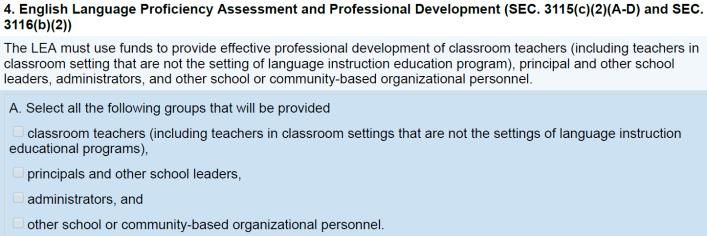
Recommendations for Early Learning Additions to the
                          NC CCIP 2020-2021/NCDPI Consolidated Application

                                                Table of Contents

Title IA Grant Details                                                                                  3
1.     Local Education Agency (LEA) Plans                                                               3
2.     Parent and Family Engagement                                                                     3
3.     Parent and Family Engagement – Use of Funds                                                      4
8a.    Homeless Children and Youth Services                                                             4
8b.    Foster Care                                                                                      4
9.     Early Childhood Education Programs                                                               5
10.    Coordination Requirements                                                                        7
12.    Reduce Overuse of Discipline Practices                                                           7
14.    Targeted Assistance Schools                                                                      8
16a.   District-wide Instructional Set-Aside                                                            8
16b.   Professional Development for Teachers Set-Aside                                                  8
Title II-A (PRC 103) Grant Details                                                                      8
1.     Activities                                                                                       8
2.     Professional Growth and Improvement                                                              9
3.     Comprehensive and Targeted Support and Improvement Prioritization                               10
4.     Use of Data and Ongoing Consultation to Update and Improve Activities                           10
Title III – Language Acquisition (PRC 104) Grant Details                                               10
2.     Parent, Family, and Community Engagement                                                        10
3.     Programs and Activities                                                                         10
4.     English Language Proficiency Assessment and Professional Development                            10
Title III – Language Acquisition (PRC 111) Grant Details                                               11
1.     Activities for LEAs Experiencing Substantial Increases in Immigrant Children and Youth          11
Title IV – Part A, Subpart 1 (PRC 108) – Student Support and Academic Enrichment Grants                11
1.     Consultation                                                                                    11
3.     Partnership(s)                                                                                  11
4.     Well-Rounded Education                                                                          12
5.     Safe and Healthy Students                                                                       12
6.     Effective use of Technology in Schools                                                          12
Migrant Education Program                                                                              13
A.     Pre-K                                                                                           13
Additional Resources                                                                                   13

                                                                                                2|P a g e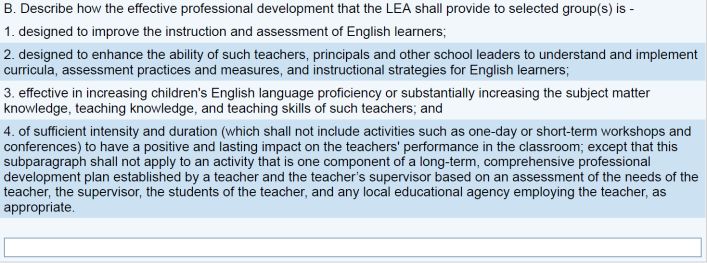
Recommendations for Early Learning Additions to the
                          NC CCIP 2020-2021/NCDPI Consolidated Application

Title 1A Grant Details

1. Local Education Agency (LEA) Plans (SEC. 1112)   Recommendation: Mark “Other” box and detail how the
                                                    early learning community has been involved in the
                                                    development of the LEA plan.
                                                    The process for including the early learning community
                                                    should be ongoing and should complement existing early
                                                    childhood planning and engagement structures. Partners
                                                    who should be consulted in the process of developing the
                                                    plan could include:
                                                    • Head Start grantee agencies, individual program
                                                      directors, and staff
                                                    • Smart Start agency leaders and staff
                                                    • NC Pre-K
                                                    • Child Care Resource and Referral
                                                    • Exceptional Children
                                                    • Private child care providers
                                                    • Home visiting staff
                                                    • Pediatricians
                                                    • Local health agencies

2. Parent and Family Engagement (SEC 1116 (a)(2))   Recommendation: Highlight how the district is working
                                                    with early learning providers to enhance parent and
                                                    family engagement by updating the Parent and Family
                                                    Engagement Policy that is posted on the website.
                                                    In the formal policy posted on the LEA website, it would
                                                    be useful to:
                                                    • Discuss transition plans so that families and their
                                                       children are supported as they move between early
                                                       learning settings and school-based programs in pre-
                                                       kindergarten, kindergarten or first grade.
                                                    • Identify a set of effective parent and engagement
                                                       practices based on Head Start (see, for example:
                                                       https://eclkc.ohs.acf.hhs.gov/school-
                                                       readiness/article/pfce-interactive-framework)
                                                    • Recommend that schools hold parent and family
                                                       engagement activities at times when working families
                                                       can attend and provide child-friendly activities and
                                                       food.
                                                    • Encourage parent and family outreach activities that
                                                       take place during the summer for families transitioning
                                                       from early childhood programs to school.
                                                    • Require that parent and family engagement resources
                                                       be available in languages that reflect the community
                                                       served by the school.

                                                                                              3|P a g e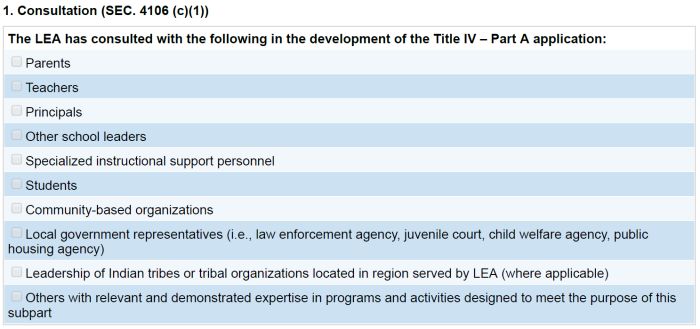
Recommendations for Early Learning Additions to the
                         NC CCIP 2020-2021/NCDPI Consolidated Application

                                                      • Encourage schools to support and train family liaisons
                                                        at each school to welcome new families.
                                                      • Identify parent and family ambassadors to welcome
                                                        new families and provide information and resources.

3. Parent and Family Engagement – Use of Funds (SEC   Recommendation: Mark last box (“Engage in any other
   1112 (b)(7))                                       activities and strategies...”) and ensure that parent and
                                                      family engagement plans include young children and
                                                      their families.

8a. Homeless Children and Youths Services (SEC.       Recommendation: Include in this section how preschool
  1112(b)(6))                                         children and their families who are homeless are
                                                      supported.
                                                      This might include:
                                                      • Training to all school and district personnel and
                                                         community providers to identify and serve children
                                                         who are homeless, including working with the local
                                                         Child Find staff to identify children who are both
                                                         homeless and in need of early intervention services.
                                                      • Improved enrollment procedures to identify and
                                                         connect all children (both school-age and younger)
                                                         who are homeless in a family as they enter school.
                                                      • Transportation for preschool-aged children to stay at
                                                         their original school of enrollment.
                                                      • Community outreach to identify preschool-aged
                                                         children who are or are at-risk of becoming homeless.
                                                      • Formal partnerships and/or agreements with Head
                                                         Start and other community providers to identify and
                                                         serve homeless children and provide support as they
                                                         transition into programs and school placements.
                                                      • Policies that require coordination and collaboration
                                                         within the LEA to support children and their families
                                                         who are homeless as they transition into programs
                                                         and school placements and then as they move
                                                         between grades.
                                                      • Information and resources to families who are
                                                         homeless on Early Head Start, Head Start, SNAP
                                                         (Supplemental Nutrition Assistance Program, formerly
                                                         Food Stamps), housing supports and other needed
                                                         supports.

8b. Foster Care (SEC. 1111(g)(1)(E)(iv))              Recommendation:
                                                      • Provide transportation for preschool children to stay
                                                        at their original school of enrollment, particularly

                                                                                                4|P a g e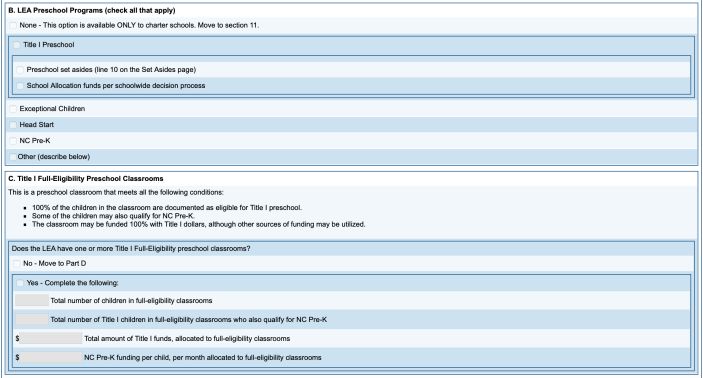
Recommendations for Early Learning Additions to the
                     NC CCIP 2020-2021/NCDPI Consolidated Application
                                                when the child has been taken into foster care (DSS
                                                care and placement/custody) or has had a
                                                placement disruption (changed foster care
                                                placements) and it is in the child's best
                                                interest through a Best Interest Determination (BID)
                                                meeting.
                                              • Coordinate the district plan in collaboration with the
                                                LEA foster care point of contact.
                                              • Establish formal partnerships and/or agreements with
                                                DSS to serve foster children and provide support as
                                                they transition into programs and school placements.
                                              • Collaborate with early learning partners to ensure
                                                foster children are considered and receive priority, as
                                                applicable, for enrollment.

9. Early Childhood Education Programs (SEC    Recommendation: Include any/all efforts by the district
   1112(b)(8))                                to coordinate services for young children with
                                              community providers.
                                              For “other,” consider a range of community partners.
                                              Partners who should be consulted in the process of
                                              developing the plan could include:
                                              • Smart Start agency leaders and staff
                                              • Home visiting staff
                                              • Child Care Resource and Referral agency staff
                                              • Pediatricians
                                              • Local health agencies
                                              Examples of coordination might include:
                                              • Participating in local early learning committees (such
                                                as NC Pre-K, Smart Start Partnerships, Head Start
                                                boards or advisory committees, etc.) in order to
                                                improve access to high quality services for all children
                                                birth to five.
                                              • Providing resources to increase access to high quality
                                                services in partnership with community providers
                                                (either in the community or in schools) for all children
                                                birth to five, including:
                                                 o Classroom-based instructional programs.
                                                 o Blended programs and/or dual enrollment in
                                                     school-based and community-based programs.
                                                 o Salaries and benefits for teachers and other staff.
                                                 o Home visiting programs.
                                                 o Extended day programs in Head Start or
                                                     community-based child care programs.
                                                 o Professional development for early childhood
                                                     professionals who serve Title I eligible children,
                                                     including providers in non-school settings.

                                                                                        5|P a g e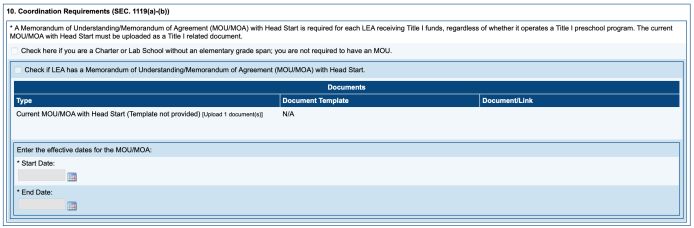
Recommendations for Early Learning Additions to the
 NC CCIP 2020-2021/NCDPI Consolidated Application
                             o Support services, such as nutrition, vision, dental,
                               and counseling services.
                             o Screening and diagnostic assessment.
                             o Summer enrichment programs for young children
                               and their families that are part of a larger strategy
                               to support young children.
                             o Full working day and year-round programs in
                               coordination with local early childhood providers
                               that support schedules for working families
                               beyond the school day.
                             o Transition programs.
                          • Developing agreements to share demographic and
                            other data on children transitioning from early
                            childhood settings to schools (see for example: Data-
                            Sharing Tool Kit For Communities: How To Leverage
                            Community Relationships While Protecting Student
                            Privacy, Data-Sharing: Federal Rules and Best
                            Practices to Improve Out-of-School-Time Programs
                            and Student Outcomes).
                          • Identifying and supporting opportunities for joint
                            professional development with community early
                            childhood partners.
                          • Creating formal transition plans at each school,
                            including:
                             o Create or adopt a transition self-assessment tool
                                 that meets the needs of the district (see for
                                 example: New York State's Tool to Assess the
                                 Effectiveness of Transitions from
                                 Prekindergarten to Kindergarten or Illinois Birth
                                 through Third Grade Self-Assessment and Action
                                 Planning Guide.
                             o Create or expand summer programs to give
                                 children a school experience.
                             o Identify and convene local providers to design
                                 and develop transition plans that convey joint
                                 expectations across settings, help to share
                                 information on what children know and are able
                                 to do, and create opportunities for partnership,
                                 collaboration and innovation.
                             o Hold a spring or summer Kindergarten Summit
                             o Develop a list of questions to help school and
                                 district leaders identify existing transition
                                 practices and supports for children moving from
                                 early childhood programs into school, and for
                                 students moving between kindergarten, first,
                                 second and third grades. The answers to these

                                                                    6|P a g e
Recommendations for Early Learning Additions to the
NC CCIP 2020-2021/NCDPI Consolidated Application
questions should be used to develop action
plans.
10. Coordination Requirements (SEC. 1119(a)-(b)) Recommendation: Agreements should be tailored to
suit the community’s unique needs and consider a
comprehensive approach, rooted in best practices. The
following activities must be addressed in a formal
agreement between the LEA and Head Start (for
information, see NC's Coordination Guidance).
• Data and Records Sharing
• Coordinating Services/ Communication
• Transition
• Professional Development
• Curriculum and Instruction
• Services for Children with Disabilities
• Family Engagement
Characteristics of a strong MOU/A
• Identifies the LEA, Head Start, and early childhood
programs covered by the MOU
• Includes a vision, goals and/or purpose of the MOU
(the why)
• Outlines the major activities to meet the coordination
requirements
• Describes the roles and responsibilities of each agency
• Describes the methods of communication
• Provides a realistic timeline for implementing the
activities
• Includes implementation and oversight
• Describes the length or term of the agreement
For additional information and resources, see:
• NHSA New Early Childhood Coordination
Requirements in ESSA Toolkit
12. Reduce Overuse of Discipline Practices (SEC Recommendation: Ensure that all policies described in
1112(b)(11)) this section (including data analysis and policies on in-
school or out-of-school suspensions, expulsions and
other disciplinary practices) include all children in the
school from pre-kindergarten on, and that policies are
developmentally appropriate for all children at each
grade.
This section can address:
• Policies/written plans to severely limit/eliminate
suspension and/or expulsion for children in pre-k
through 3rd grade with a focus on identifying and
7|P a g eRecommendations for Early Learning Additions to the
NC CCIP 2020-2021/NCDPI Consolidated Application
eliminating racial disparities among children in these
grades who may be suspended or expelled.
• Identifying and developing in-school resources to
support young children who may need additional help
to thrive in a classroom environment.
• Training for teachers on identifying developmental
delays or other developmental issues in young children.
• Professional development to help teachers and other
school staff support young children with restorative
justice approaches.
• The NC Preschool Pyramid Model Project, designed to
help improve child outcomes and increase
opportunities in least restrictive environments,
promotes healthy social-emotional development for
ALL children birth through five years of age.
• Use of special spaces in schools that are calming for
young children and include time with a counselor,
psychologist or other trained therapist.
• Use of play therapies.
• Data analysis that looks at trends in use of discipline
for young children from pre-kindergarten through
third grade disaggregated by race, gender, and IEP
status.
14. Targeted Assistance Schools (SEC 1115) Recommendation: Ensure that pre-kindergarten and
kindergarten-aged students are included in the
development of a plan and the selection criteria for
students to be served.
16a. District-wide Instructional Initiative Set-Aside Recommendation: When identifying district-wide needs
for new instructional support or programmatic changes,
include the needs of children birth to five in school-
based and community settings.
16b. Professional Development for Teachers Set-Aside Recommendation: Professional development for early
childhood teachers includes training related to
transition, trauma-informed approaches and social-
emotional learning, family engagement, etc.
Title II-A (PRC 103) Grant Details
1. Activities (SEC 2102(b)(2)(A) Recommendation: Ensure that professional development
funds are used to improve the quality of early learning
programs in the community and in schools and are
available to community providers, pre-kindergarten
through third grade teachers, and school and district
8|P a g eRecommendations for Early Learning Additions to the
NC CCIP 2020-2021/NCDPI Consolidated Application
leaders to advance understanding of early learning and
child development. This section can address:
• The identification of professional development
opportunities that promote coordination with the
early childhood community.
• Training to improve transitions for young children
from early childhood to school-based programs.
• Promoting an expanded understanding of child
development among teachers and other school staff
and leaders through leadership academies focused on
early childhood.
• Leveraging community resources to increase the
availability of joint professional development designed
to create common expectations between and across
early childhood and school-based settings for children
in programs from birth through third grade.
• Coordination of professional development resources
between the LEA, Head Start, Smart Start, NC Pre-K
and other providers.
2. Professional Growth and Improvement (SEC Recommendation: Create opportunities for teachers or
2102(b)(2)(B)) school leaders working with children in all settings in
prekindergarten through third grade to have
comprehensive, ongoing knowledge of child
development.
This section can address:
• Creation of early learning leadership academies for
principals and other school leaders.
• Development of coaching cadres composed of teachers
from school-based early childhood classrooms and
community-based early childhood programs to
improve the quality of teaching and learning.
• Development of resources for teachers to understand
the content of early childhood experiences before
school to help create scaffolded learning
opportunities.
• Use of Early Learning Inventory (ELI) data to develop
teaching and learning plans in kindergarten and first
grade.
• Agreements to share cohort information (in line with
FERPA) from assessments in early childhood programs.
9|P a g eRecommendations for Early Learning Additions to the
NC CCIP 2020-2021/NCDPI Consolidated Application
3. Comprehensive and Targeted Support and Recommendation: Ensure that teachers of children in
Improvement Prioritization (Sec 2102 (b)(2)(C)) pre-kindergarten through third grade in these schools
are receiving equitable supports.
4. Use of Data and Ongoing Consultation to Update and Recommendation: Ensure that data analysis includes
Improve Activities (SEC 2102(b)(2)(D)) teachers of children in early childhood programs,
including those in early intervention (birth to three) and
preschool special education services, Head Start, Title I,
NC Pre-K or other prekindergarten programs in the
district.
Title III – Language Acquisition (PRC 104) Grant Details Page
2. Parent, Family and Community Engagement (SEC Recommendation: Ensure that parents and other family
3115(c)(3)(A) & (B) and SEC 3116(b)(3)) members of young English Learners from birth through
third grade and the providers serving them both in
schools and in community settings are included in plans
to promote parent, family and community engagement.
3. Programs and Activities (SEC 3115(c)(1)(A) & (B) and Recommendation: Ensure that developmentally
SEC 3116(b)(1)) appropriate programs, resources, and professional
development are available for children who are English
Learners and their teachers in pre-kindergarten through
third grade programs.
This section might address:
• Creation of early learning leadership academies for
principals and other school leaders supporting large
numbers of young English Learners.
• Adoption of materials and resources for parents and
families of young English learners that are in the
appropriate language and can support home-based
activities to develop English skills.
• Partnerships and agreements with community
providers serving cohorts of English learners to develop
joint professional development, share materials and
resources, and design specific transition activities for
families of young English Learners.
4. English Language Proficiency Assessment and Recommendation: Ensure that early childhood teachers
Professional Development (SEC. 3115(c)(2)(A-D) and within the LEA and community-based providers are
SEC. 3116(b)(2)) included in the design and delivery of professional
development.
10 | P a g eRecommendations for Early Learning Additions to the
NC CCIP 2020-2021/NCDPI Consolidated Application
Title III – Language Acquisition (PRC 111) Grant Details Page
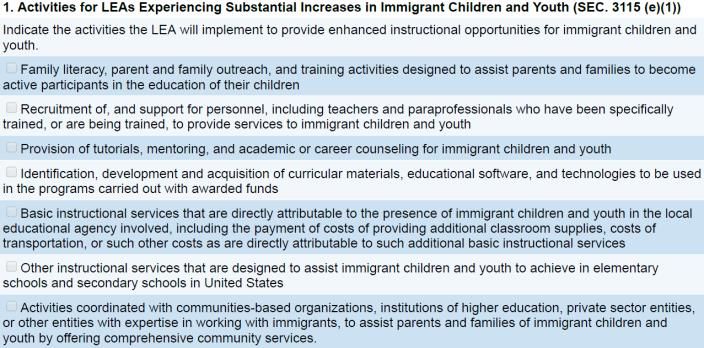
1. Activities for LEAs Experiencing Substantial Increases Recommendation: Ensure that parents and other
in Immigrant Children and Youth (SEC. 3115 (e)(1)) family members of young children in immigrant
families and the providers serving them both in
schools and in community settings are included in
plans to support immigrant children and youth.
Title IV – Part A, Subpart 1 (PRC 108) – Student Support and Academic Enrichment Grants (SSAE)
1. Consultation (SEC 4106(c)(1)) Recommendation: Mark last box (“Others with relevant
and demonstrated expertise in programs and activities.”)
and invite early childhood providers, before- and after-
school providers and other social service agencies working
with young children birth through third grade to
participate in the development of the grant-funded
programs.
3. Partnership(s) (SEC 4106 (e)(1)(A)) Recommendation: Partnerships should include at least
one early childhood provider.
Partnerships could include:
11 | P a g eRecommendations for Early Learning Additions to the
NC CCIP 2020-2021/NCDPI Consolidated Application
• Provision of high quality, developmentally appropriate
before- or after-care programs for young children.
• Development of anti-bullying programs that are
explicitly designed for use with children in pre-
kindergarten through third grade.
• Development of drug abuse prevention programs that
are explicitly designed for use with children in pre-
kindergarten through third grade.
Implementation of art, music and STEM programs that
are developmentally appropriate for children in pre-
kindergarten through third grade.
4. Well-Rounded Education (SEC. 4106 (e)(1)(B-D)) Recommendation: Include how funds are used to
support the specific activities for children in pre-
kindergarten through third grade.
These might include:
• Music, arts, science, and engineering programs that
provide scaffolded learning opportunities for children
in pre-kindergarten through third grade.
• Nutrition education and supports designed for young
children such as Farm to ECE, Be Active Kids, or I am
Moving I am Learning (Head Start).
5. Safe and Healthy Students (SEC. 4106 (e)(1)(B-D)) Recommendation: Include how funds are used to
support the specific activities for children in pre-
kindergarten through third grade.
These might include:
• Supports for drug and bullying prevention that are
developmentally appropriate for young children.
• Incorporation of the NC Preschool Pyramid Model
Project, which is designed to help improve child
outcomes and increase opportunities in least restrictive
environments and promote healthy social-emotional
development for all children birth through five years of
age.
• Support for restorative justice programs for all children
pre-kindergarten through third grade.
6. Effective use of Technology in Schools (SEC. 4109 Recommendation: Include how funds are used to
(e)(1)(B-D)) support the specific activities for children in pre-
kindergarten through third grade.
These might include:
• Training for teachers and support staff (including
before- and after-school staff) in how to identify and
use appropriate technology, including software and
12 | P a g eRecommendations for Early Learning Additions to the
NC CCIP 2020-2021/NCDPI Consolidated Application
hardware, with children in pre-kindergarten and
kindergarten.
Migrant Education Program
II. Supplementary Instructional Services (SEC. Recommendation: Include how funds are used to
1304(b)(2), SEC. 1306(a)(C)) support the specific activities for children in pre-
A. Pre-K (SEC. 1304(b)(1), SEC. 1304(c)(4)) kindergarten through third grade.
These might include:
• Increase in enrollment of migrant children in
preschool programs.
• PD for support staff on transition, family literacy,
early learning standards, etc.
• Home services for children not enrolled in preschool
programs.
• Appropriate at home activities for children and
families.
• Summer programming.
• Developmental screenings for children participating
in MEP activities.
Additional Resources:
• Webinar and Materials: Developing or Improving your MOU among Early Learning Partners
• LEA/Head Start Coordination Guidance
• Meeting Agendas for Local Collaborative Action Planning
• Regional Meetings: Using District ESSA Plans to Support Early Learning Agenda
• ESSA and Early Childhood: Exploring What’s Possible
• Pathways Data Book January 2018
• Research Basis for Pathways Measures of Success Framework
• Fact Sheet on NC’s Efforts to Strengthen the Birth-through-Eight Continuum
• Early Learning Requirements and Opportunities in the ESEA and Related Programs
• Policy Levers to Promote Early Literacy in ESSA State and Local Plans
• Planning for the Transition to Kindergarten: Why It Matters and How to Promote Success
• Attendance in the Early Grades: Why it Matters for Reading
• AttendaNCe Counts
• What is Title I Preschool?
• New Early Childhood Coordination Requirement in the Every Student Succeeds Act
13 | P a g eYou can also read


