REGIONAL EDUCATION, SKILLS AND JOBS PLAN QUEENSLAND - GOLD COAST 2012 - 2014 JULY 2013
←
→
Page content transcription
If your browser does not render page correctly, please read the page content below
\
REGIONAL EDUCATION, SKILLS AND JOBS PLAN

 QUEENSLAND – GOLD COAST
 2012 – 2014
 JULY 2013
This plan was first published in July 2012. This is the July 2013 edition.
Details in this report are correct at time of drafting.
This report can be found at the Regional Education, Skills and Jobs webpage (www.deewr.gov.au/resj) or the
My Region website (www.myregion.gov.au).
For more information about this plan, please contact:
The Office of Regional Education, Skills and Jobs
GPO Box 9880
Canberra ACT 2601
Email: oresj@deewr.gov.au
ISBN:
978-0-642-78645-6 [PDF]
978-0-642-78646-3 [DOCX]

With the exception of the Commonwealth Coat of Arms and where otherwise noted all material presented in this
document is provided under a Creative Commons Attribution 3.0 Australia licence
(http://creativecommons.org/licenses/by/3.0/au/).
The details of the relevant licence conditions (http://creativecommons.org/licenses/by/3.0/au/legalcode) are
available on the Creative Commons website (accessible using the links provided) as is the full legal code for the
CC BY 3.0 AU licence.
The document must be attributed as the Regional Education, Skills and Jobs Plan 2012-14 – Gold Coast.
Disclaimer about data used in this plan
Data used in the development of this plan comes from a variety of sources and was correct at time of drafting. This
document should not be used as a data source as data referred to may have been updated or reformulated since
the publication of the plan. Refer to primary sources for confirmation of data.

                                                                    Regional Education, Skills and Jobs Plan – Gold Coast 2
                                                                                                 www.deewr.gov.au/resj
CONTENTS
Regional Education, Skills and Jobs Plans ................................................................................ 4
Map of Gold Coast .................................................................................................................. 5
Executive summary ................................................................................................................ 6
Characteristics of the region ................................................................................................... 9
   Population ................................................................................................................................................. 9

   Early childhood education and care.......................................................................................................... 9

   School education ..................................................................................................................................... 10

   Tertiary education and training .............................................................................................................. 11

   Jobs, skills and workforce development ................................................................................................. 11

   Other characteristics ............................................................................................................................... 12

Issues, goals and strategies ................................................................................................... 13
   Issue 1 There is a need to increase sustainable employment and training opportunities for
   Aboriginal and Torres Strait Islander Australians. .................................................................................. 14

   Issue 2 Improving youth attainment in the region, especially with regard to school retention, and
   transition from school to employment or further education and training............................................. 16

   Issue 3 Training opportunities on the Gold Coast do not always reflect the needs of job seekers with
   learning difficulties.................................................................................................................................. 17

   Issue 4 The need for effective workforce planning to develop and diversify the economic base of the
   region and capitalise on growing industries. .......................................................................................... 18

   Issue 5 There are a significant number of apprentices from the Gold Coast region registered on the
   ‘Out-of-Trade’ register. ........................................................................................................................... 20

   Issue 6       Actively pursue opportunities being created in the resources sector throughout Queensland.
                 ................................................................................................................................................. 21

Appendices .......................................................................................................................... 22
   Appendix A — Stakeholders.................................................................................................................... 22

   Appendix B — Existing related plans and strategies ............................................................................... 23

Abbreviations ....................................................................................................................... 25

                                                                                              Regional Education, Skills and Jobs Plan – Gold Coast 3
                                                                                                                                    www.deewr.gov.au/resj
REGIONAL EDUCATION, SKILLS AND JOBS PLANS
The Australian Government announced the Regional Education, Skills and Jobs Plans initiative in the
2011–12 Budget, as part of the Building Australia’s Future Workforce package. The initiative addresses
four key areas of the Australian Government’s productivity and social inclusion agendas: early childhood
education and care; Year 12 attainment; participation in vocational and higher education; and local job
opportunities.
The Department of Education, Employment and Workplace Relations (DEEWR) has deployed 34 Regional
Education, Skills and Jobs (RESJ) Coordinators to work with local stakeholders to develop Regional
Education, Skills and Jobs Plans for the 46 Regional Development Australia (RDA) areas that cover non-
metropolitan Australia.
The plans present locally identified opportunities and challenges and outline local strategies to improve
education, skills and jobs outcomes in regional Australia.
For more information, including the contact details of your local RESJ Coordinator, please refer to the
Regional Education, Skills and Jobs webpage at www.deewr.gov.au/resj.
Strategies
Each plan reflects community priorities and includes goals and local strategies to achieve the
community’s objectives, based on four key themes: early childhood education and care; school
education; tertiary education and training; and jobs, skills and workforce development.
The plans build on the range of services and programs already offered by DEEWR and the strategies draw
on the programs of other government agencies and the opportunities arising from major local projects.
Community engagement
The plans were developed by RESJ Coordinators with close community engagement and include views
from young people, parents, employers, educators, service providers, peak bodies, community leaders,
government organisations and agencies, and other interested individuals and organisations. The plans
draw strongly upon existing strategic plans in each region, including the local RDA regional plan.
DEEWR acknowledges the traditional owners of the Gold Coast RDA region and their elders past and
present recognising their continuing connection to country. This plan strives to build and harness
mutually respectful relationships and reflect community priorities in education, skills and jobs
development for the region.
Implementation
The RESJ Coordinator, on behalf of DEEWR, will oversee the implementation of the strategies and
promote and coordinate linkages between the government agencies, providers and stakeholders
involved in this plan’s implementation.
Progress towards achieving the goals within each plan will be closely monitored, while stakeholders will
be kept informed through participation in plan strategies.
This edition incorporates strategies that respond to changes in local circumstances identified through
continuing community input or changing government priorities in regional Australia as well as access to
new data. The plans continue to be living and responsive documents that will be revisited throughout
their implementation to June 2014.
Regional Education, Skills and Jobs Plan – Gold Coast 4
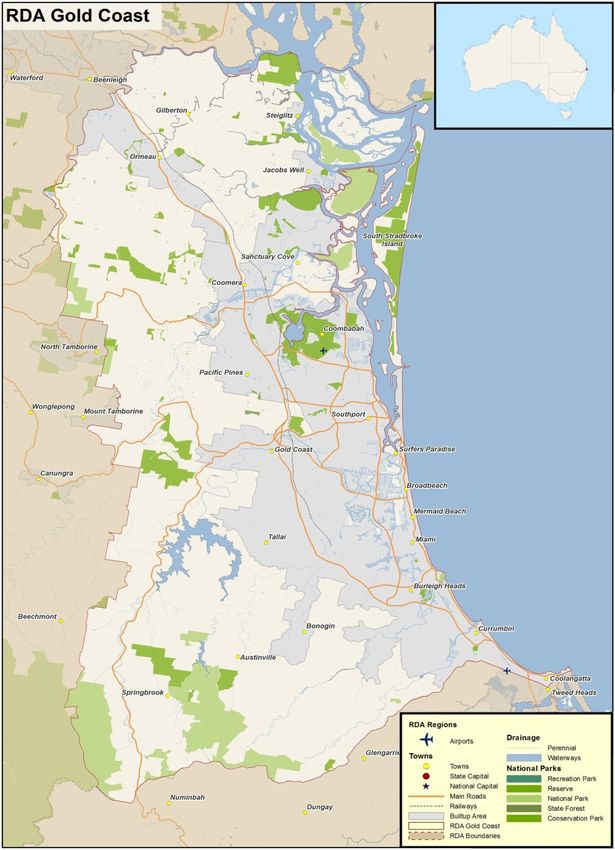
www.deewr.gov.au/resjMAP OF GOLD COAST
Source: Department of Regional Australia, Local Government, Arts and Sport
Regional Education, Skills and Jobs Plan – Gold Coast 5
www.deewr.gov.au/resjEXECUTIVE SUMMARY
The Gold Coast Regional Development Australia (RDA) region is located 80 kilometres south of the
Queensland state capital of Brisbane and covers the single Local Government Area of Gold Coast City
Council.
Covering an area of 1400 square kilometres, the city’s boundaries extend from Yatala in the north, down
to Coolangatta and the New South Wales border. Gold Coast City encompasses South Stradbroke Island
and part of Moreton Bay, extending west to the hinterland of Mount Tamborine and the Lamington and
Darlington Ranges.
The sunny subtropical climate, surfing beaches, canals and waterway systems combined with the high-
rise skyline of Surfers Paradise, nightlife and rainforest hinterland, make the Gold Coast one of
Australia’s major tourist destinations.
The Gold Coast region has a RDA Committee with a Regional Roadmap including education, skills and
employment opportunities. RDA Gold Coast has identified the following three short-term priorities:
promote and enhance job creation
strengthen the community and foster civic pride
enhance the lifestyle and environment.
This Regional Education, Skills and Jobs (RESJ) Plan complements the existing goals and strategies in the
RDA Roadmap.
A comprehensive environmental scan and community consultations have been carried out to identify the
key education, skills and jobs challenges for the region. The challenges include:
the need to increase sustainable employment and training opportunities for Aboriginal and
Torres Strait Islander Australians
the need for effective workforce planning to develop and diversify the economic base of the
region and capitalise on growing industries
the need to actively pursue opportunities being created in the mining sector throughout
Queensland
the scope for improvement with youth attainment in the region, especially with regard to
retention in school, and transition from school to employment or further education and training
the significant number of apprentices from the Gold Coast region registered on the Queensland
Government’s ‘Out-of-Trade’ register
training opportunities available in the Gold Coast region do not always reflect the needs of job
seekers with learning difficulties.
Regional Education, Skills and Jobs Plan – Gold Coast 6
www.deewr.gov.au/resjThe key goals of the RESJ Plan are to:
enable the region’s Aboriginal and Torres Strait Islander people to participate in the
development of, and benefit from, targeted strategies that aim to deliver on the Governments’
Closing the Gap targets
increase the number of Aboriginal and Torres Strait Islander Australians working in the early
childhood and child care industry
increase the number of people training in areas of skills shortages and industry growth
identify and support strategies to assist Gold Coast businesses and residents capitalise on
opportunities emerging from Queensland’s expanding resources sector
support the establishment of regional partnerships and strategies that enable effective and
tailored school retention and work transition options for students
identify and promote opportunities to assist apprentices to complete their trade qualifications
encourage the development of tailored vocational training packages to increase participation
amongst people with learning difficulties.
Some outcomes achieved by the RESJ Coordinator working with local stakeholders include:
Assisting a national employer to develop its 10 year Workforce Development Strategy and
Indigenous Employment Plan to address growth within the company, including an Australian
Government Skills Connect project. This project, developed in partnership with the Construction
and Property Services Industry Skills Council and supported by the Ipswich Logan Local
Employment Coordinator, local registered training organisations and Aboriginal and Torres Strait
Islander support services, will provide funding to train existing and new workers. There is a
potential for 3000 new jobs in the construction and manufacturing industries through this
project.
Collaborating with key stakeholders to ensure funding was available to deliver short skill set
courses across a number of industries including aged care, commercial laundry, housekeeping,
cookery and children’s services, which has led to 150 people being placed into employment.
Pursuing opportunities in the resources sector by supporting the new Gold Coast City Council’s
Industry Engagement Officer (Fly-In Fly-Out (FIFO) Coordinator) through their introduction to key
stakeholders and collaboration on a workforce development strategy. The RESJ Coordinator has
also worked with Resource Link Gold Coast to implement the FIFO Coordinator’s building
capacity strategy by:
o promoting the establishment of the Gold Coast Airport Terminal 2 as a potential FIFO
hub to leaders of the resources sector and airlines,
o building the capacity of Gold Coast businesses to become part of the supply chain to the
resources sector, and
o promoting the potential labour source located in the region.
Regional Education, Skills and Jobs Plan – Gold Coast 7
www.deewr.gov.au/resj Facilitating a workshop, in conjunction with the Queensland Government Department of
Aboriginal and Torres Strait Islander and Multicultural Affairs, with providers of Indigenous
services to discuss the needs of local Aboriginal and Torres Strait Islander people and identify
avenues to increase employment opportunities. As a result, communication channels have been
established to support the timely dissemination of information on Australian Government
initiatives and local opportunities. Two projects are also being developed utilising the Australian
Apprenticeship Access Program and Australian Government Skills Connect to create 2400 jobs
for Aboriginal and Torres Strait Islanders.
Facilitating a Jobs and Information Workshop for Queensland Workers which provided
70 redundant Queensland public servants with information regarding the local labour market,
assistance available from the Department of Human Services and professional recruitment
advice from a local Job Services Australia (JSA) provider.
Facilitating a Gold Coast forum, in partnership with the Department of Human Services, to create
linkages between JSA and Disability Employment Services (DES) providers and local Aboriginal
and Torres Strait Islander community organisations to encourage the provision of wrap around
services to address employment barriers and increase employment outcomes in the region.
Regional Education, Skills and Jobs Plan – Gold Coast 8
www.deewr.gov.au/resjCHARACTERISTICS OF THE REGION
This section sets out the characteristics of the region identified through a comprehensive environmental
scan and local consultations. The information detailed in this section is not exhaustive of the
characteristics of the region, but provides an overview and insight to some of the challenges facing the
region.
To guide the RESJ Coordinator’s identification of issues and engagement with the community, various
data sets have supported the development of this plan. Data used in the development of this plan was
sourced from DEEWR, the Australian Bureau of Statistics (ABS) and other relevant sources. Data referred
to may have been reformulated and was correct at time of drafting. Different data sets are refreshed at
different intervals, for example, unemployment rates are updated monthly for national and
state/territory figures and quarterly for regions.
Population
The Gold Coast is home to 513,954 people, approximately 1.3 per cent (6196) of whom identify as being
from Aboriginal or Torres Strait Islander background (2011 Census).
Two Aboriginal tribes traditionally inhabited the Gold Coast region, the Kombumerris who lived mainly in
the Bundall area, and the Yugambeh people who lived on Mount Cougal and the Springbrook valleys
(Australian Information Centres).
According to ABS data, 65.2 per cent of the Gold Coast population were born in Australia, with other
residents migrating from mainly English-speaking countries (North-West Europe 9.3% and Oceania and
Antarctica (excluding Australia) 8.7%).
Early childhood education and care
The early childhood education and care sector includes public, private for-profit and community-based
service providers and includes preschools, occasional care, family day care, long day care and outside
school hours care services.
The Australian Early Development Index (AEDI) measures young children’s development across five
domains: physical health and well-being; social competence; emotional maturity; school-based language
and cognitive skills; and general knowledge. 2009 AEDI data indicated that, at a national level,
23.6 per cent of children were vulnerable on one or more domain and 11.8 per cent were vulnerable on
two or more domains. The AEDI found that in the Gold Coast RDA region, the community of Gold Coast
East had the lowest proportions of vulnerable children for the region, falling below the national rate for
one or more domain, and just above the national rate for two or more domains. However, the AEDI
community of Gold Coast surrounds had the highest proportions of vulnerable children—more than
three per cent higher than the national averages on both measures.
Regional Education, Skills and Jobs Plan – Gold Coast 9
www.deewr.gov.au/resjIn January 2012, the Australian Government introduced the National Quality Framework for Early
Childhood Education and Care. The national approach to regulation and quality assessment processes,
including increasing the number of educators to educate and care for children, and the enhanced
educator qualification requirements will, over time, have a positive influence on the AEDI results for the
Gold Coast region.
One of the key priorities of the Queensland Government’s Early Childhood Education and Care
Workforce Action Plan 2011–2014 is to increase Aboriginal and Torres Strait Islander child care and early
childhood workers. In partnership with the Queensland Government, this RESJ Plan includes strategies to
achieve this priority which may positively influence developmental results for Aboriginal and Torres Strait
Islander children in the Gold Coast region through the provision of culturally relevant early childhood
services.
School education
The Gold Coast region has a number of education choices for school age children including government,
private and independent schools. In 2009, there were 29,988 students attending a government primary
school (Years 1 to 7) and 15,361 students attending a non-government primary school in the Gold Coast
City Local Government Area. In secondary school (Years 8 to 12) there were 18,315 government students
and 11,218 non-government students. As part of the Queensland Government’s education reform, from
2015 Year 7 will become the first year in high school.
In the 2011 Census, 57.7 per cent of Gold Coast residents (aged 15 years and over) stated their highest
level of schooling was Year 11 or 12 or equivalent. This compares to 55.3 per cent in Queensland.
A recent analysis of the 2012 Next Step survey by the Queensland Government Department of Education,
Training and Employment found that in the Gold Coast region:
the majority of Year 12 completers (90.0%) were studying or in paid employment
further study was a common destination for Year 12 completers, with 64.2 per cent continuing in
some recognised form of education or training in the year after they left school
students undertaking a university degree accounted for 41.1 per cent of all Year 12 completers in
the region. A further 8.1 per cent of Year 12 completers deferred a tertiary offer in 2011
23.1 per cent of all Gold Coast Year 12 completers were studying vocational education and
training (VET)
employment-based training accounted for 9.0 per cent of Year 12 completers in this region,
either in apprenticeships (6.1%) or traineeships (2.8%)
35.8 per cent did not enter post-school education or training, and were either employed (25.8%),
seeking work (8.1%) or not in the labour force, education or training (1.8%).
Increasing education participation and improving transition to work outcomes for young Australians are
the key objectives of the Council of Australian Governments National Partnership Agreement on Youth
Attainment.
The Australian Government funds the School Business Community Partnership Brokers Program focussed
on building partnerships to support young people to attain Year 12 or equivalent qualifications and reach
their full educational and social potential. The Gold Coast region has an active School Business
Community Partnership Broker being The Smith Family Partnership Brokers.
Regional Education, Skills and Jobs Plan – Gold Coast 10
www.deewr.gov.au/resjTertiary education and training
Gold Coast City has over 400 education and training providers, including four universities, several
research centres and a number of internationally recognised training institutes.
At the time of the 2011 Census, 56.2 per cent of people aged over 15 residing in the Gold Coast region
had post-school qualifications. This is higher than the Queensland rate of 54.2 per cent.
Of people aged 15 years and over with a qualification, 25.4 per cent had a bachelor degree or higher
(29.3% in Queensland as a whole), 15.6 per cent had an advanced diploma or diploma (13.9% in
Queensland as a whole), and 36.8 per cent had a certificate (36.6% in Queensland as a whole).
Community consultation has identified that there are limited vocational training opportunities
specifically tailored for people with learning difficulties. There is an opportunity therefore to develop
strategies that will assist people with learning difficulties to access flexible skills training with additional
learning support.
Jobs, skills and workforce development
Traditionally the Gold Coast has enjoyed a thriving economy, with a booming construction, boat building,
hospitality and tourism industry, and high workforce participation. The impact of the global financial
crisis and the strengthening of the Australian dollar had a significant impact on the region in recent
years. However, the ABS Labour Force Survey data indicates that, as at December 2012, the
unemployment rate in the Gold Coast region was 5.0 per cent, lower than both the Queensland rate
(5.8%) and Australian rate (5.1%).
At the time of the 2011 Census, the unemployment rate for Aboriginal and Torres Strait Islander people
aged 15 years and over on the Gold Coast was 16.3 per cent. This was more than double the rate for non-
Aboriginal and Torres Strait Islander people (7.3%) and leads to social and economic disadvantage. This
indicates a need to work at a local level to achieve the Australian Governments’ Closing the Gap targets
and improve the lives of these residents.
Community feedback is that the downturn in the construction industry across the region continues to
have an impact on employment and that, where work is available, vacancies are often being filled by
workers from outside the region. Additionally, the downturn has resulted in a large number of
apprentices now out of work and registered with the ‘Out of Trade Register’ funded by the Queensland
Government Department of Education, Training and Employment.
Skill shortages occur typically in growth periods when skilled workers are already employed and industry
cannot find the labour it needs. An analysis commissioned by the Gold Coast City Council in 2006 showed
that skill shortages existed predominantly in the construction and health related occupations. At the
time there were also widespread shortages in the marine industry. With the impact of the global
financial crisis and the slowing of the construction and boat building industries, skills shortages still exist
in these specialised areas but there are limited employment opportunities available.
Regional Education, Skills and Jobs Plan – Gold Coast 11
www.deewr.gov.au/resjThis RESJ Plan focuses on growth industries and common skill shortages across Queensland identified by
DEEWR, such as community services and health care, Aboriginal and Torres Strait Islander health
workers, trades and the mining sector. Over recent years, opportunities for both professional and skilled
workers have evolved across a number of industries servicing the resources sector. The Gold Coast City
Council, Queensland Government and Australian Government are working together to prepare
employment pathways into this industry, consistent with the National Resource Sector Workforce
Strategy, through employment expos, training and FIFO connections.
Following the Queensland Government’s decision in July 2012 to cease funding for labour market
programs, a number of strategies in this plan have been amended to remove reliance on partnering or
leveraging those former programs.
Other characteristics
The Gold Coast will be hosting the 2018 Commonwealth Games and stakeholders including the state and
local governments expect significant benefits to flow to the local economy. This plan will seek to
maximise local employment and training opportunities that arise from this opportunity.
Regional Education, Skills and Jobs Plan – Gold Coast 12
www.deewr.gov.au/resjISSUES, GOALS AND STRATEGIES
This section sets out the issues and goals identified through local consultation. It also details the specific
strategies that will help achieve the community’s objectives. The issues and strategies will be reviewed
and may be modified throughout the implementation of the plan to June 2014 to ensure they respond to
emerging issues and opportunities or changing community or government priorities in the Gold Coast
RDA region.
The programs and stakeholders listed in the following tables are indicative only. Both may vary over time
and any listing does not guarantee either the availability of program funding or stakeholder involvement.
Colour codes indicate how each issue relates to the four key themes of the Regional Education, Skills and
Jobs Plans initiative:
Early childhood education and care
School education
Tertiary education and training
Jobs, skills and workforce development
The numbering of each issue is for ease of reference only and does not indicate its priority within the
region. They are generally sequenced according to the life cycle of the four key themes listed above.
Regional Education, Skills and Jobs Plan – Gold Coast 13
www.deewr.gov.au/resjIssue 1 There is a need to increase sustainable employment and
training opportunities for Aboriginal and Torres Strait Islander
Australians.
Goal: To enable the region’s Aboriginal and Torres Strait Islander people to participate
in the development of, and benefit from, targeted strategies that aim to deliver on
the Governments’ Closing the Gap targets.
Early childhood education Tertiary education and Jobs, skills and workforce
School education
and care training development
Strategies Stakeholders Programs
Seek opportunities to establish new projects under Australian Australian
Australian Government Skills Connect, the Apprenticeship Access Apprenticeship Access
Australian Apprenticeship Access Program and Brokers Program
Indigenous Employment Program (IEP) that are Corporate Culcha Australian
targeted to future employment growth areas. Deadly Solutions Pty Government Skills
Work alongside the Indigenous Youth Career Ltd Connect
Pathways (IYCP) providers in their progression of Department of DES
traineeships for Aboriginal and Torres Strait Aboriginal and Torres IEP
Islander school students, particularly in areas of Strait Islander and IYCP
skills shortages. Multicultural Affairs JSA
Explore opportunities for employment programs (Qld)
identified at the ‘Indigenous All Stars Career and Department of
Employment Expo’. Education, Training
and Employment
(Qld)
Department of
Human Services
Department of
Industry, Innovation,
Climate Change,
Science, Research and
Tertiary Education
Disability Employment
Services (DES)
providers
IEP panel members
Industry Skills
Councils
IYCP providers
Job Services Australia
(JSA) providers
Pearls MiiHome
School Business
Community
Partnership Brokers
Regional Education, Skills and Jobs Plan – Gold Coast 14
www.deewr.gov.au/resjGoal: Increase the number of Aboriginal and Torres Strait Islander Australians working
in the early childhood and child care industry.
Early childhood education Tertiary education and Jobs, skills and workforce
and care training development
Strategies Stakeholders Programs
Identify partnering organisations to: Australian Australian
o maximise potential training and employment Apprenticeship Access Apprenticeship Access
pathways for new Aboriginal and Torres Strait Brokers Program
Islander early childhood workers Community Services Australian
o upskill existing workers to Certificate III or and Health Industry Government Skills
diploma-level qualifications Skills Council Connect
o promote Recognition of Prior Learning (RPL) Deadly Solutions Pty DES
Assessment Tools and Grants Ltd Inclusion and
o promote Australian Government Skills Connect Department of Professional Support
and the Australian Apprenticeship Access Aboriginal and Torres Program
Program, and explore potential opportunities Strait Islander and Indigenous Youth
for use. Multicultural Affairs Career Pathways
Partner with Indigenous organisations and industry (Qld) JSA
to identify strategies that will increase the number Department of RPL Assessment Tools
of Aboriginal and Torres Strait Islander workers in Education, Training and Grants
the child care industry. and Employment
(Qld)
Department of
Human Services
Department of
Industry, Innovation,
Climate Change,
Science, Research and
Tertiary Education
Disability Employment
Services (DES)
providers
Early childhood
education and care
services, including
Goodstart Early
Learning Centres
Heath and
Community Services
Workforce Council
Indigenous Youth
Career Pathways
(IYCP) providers
Job Services Australia
(JSA) providers
School Business
Community
Partnership Brokers
Regional Education, Skills and Jobs Plan – Gold Coast 15
www.deewr.gov.au/resjIssue 2 Improving youth attainment in the region, especially with
regard to school retention, and transition from school to
employment or further education and training.
Goal: To support the establishment of regional partnerships and strategies that enable
effective and tailored school retention and work transition options for students.
Tertiary education and Jobs, skills and workforce
School education
training development
Strategies Stakeholders Programs
Support the School Business Community Partnership Department of Indigenous Youth
Brokers to achieve their youth attainment and Education, Training Career Pathways
transition strategies, including the production of an and Employment School Business
educational tool for parents and youth on (Qld) - Quality Community
employment pathways. Pathways Team Partnership Brokers
Work alongside the Gold Coast City Council TechGC Gold Coast City
Steering Committee to support projects and Council
initiatives that increase the number of students RDA Gold Coast
undertaking mathematics, science and technology School Business
subjects, by contributing knowledge of government Community
programs, funding and opportunities in the region. Partnership Brokers
Support the Queensland Government’s Quality
Pathways Team in the development of strategies to
increase the number of students transitioning from
high school to higher education or employment in
industries of high growth.
Regional Education, Skills and Jobs Plan – Gold Coast 16
www.deewr.gov.au/resjIssue 3 Training opportunities on the Gold Coast do not always reflect
the needs of job seekers with learning difficulties.
Goal: Encourage the development of tailored training packages to increase
participation amongst people with learning difficulties and support their efforts to
gain sustainable employment.
Tertiary education and Jobs, skills and workforce
School education
training development
Strategies Stakeholders Programs
Collaborate with the Queensland Government, local Career Employment Australian
employers, Job Services Australia (JSA) and Disability Australia Government Skills
Employment Services (DES) providers and training Department of Connect
providers to encourage the creation of Communities, Child DES
contextualised vocational training packages focused Safety and Disability JSA
on key growth industries, including community and Services (Qld) Skills for Education
health services. Department of and Employment
Identify training organisations that offer flexible Education, Training formerly known as
training packages and learning support specifically and Employment Language, Literacy
for people with learning difficulties and disseminate (Qld) and Numeracy
information to employment services providers and Department of program
other stakeholders in the region. Industry, Innovation,
Climate Change,
Science, Research and
Tertiary Education
DES providers
Gold Coast Institute
of TAFE
JSA providers
Life Without Barriers
Registered training
organisations
Regional Education, Skills and Jobs Plan – Gold Coast 17
www.deewr.gov.au/resjIssue 4 The need for effective workforce planning to develop and
diversify the economic base of the region and capitalise on
growing industries.
Goal: Increase the number of people training in areas of skills shortages and industry
growth.
Tertiary education and Jobs, skills and workforce
School education
training development
Strategies Stakeholders Programs
Work alongside industry skills bodies to develop a Australian Australian
skills’ needs analysis for the region to prioritise Apprenticeship Apprenticeship
training and employment programs in growth Access Brokers Access Program
industries and areas of skills shortages, including Construction Skills Australian
health and community care, engineering and Queensland Government Skills
manufacturing. Department of Connect
Partner with regional stakeholders to develop an Education, Training DES
overarching health alliance strategy to meet the and Employment JSA
workforce needs of the Gold Coast health precinct (Qld) Skills for Education
and link training to future workforce projections. Department of and Employment
Partner with the Queensland Government and Gold Industry, Innovation, formerly known as
Coast City Council to target skills shortage areas and Climate Change, Language, Literacy
develop training utilising Australian and State Science, Research and and Numeracy
Government funding and linking with employment Tertiary Education program
service providers to create employment pathways. Disability
Employment Services
(DES) providers
Gold Coast City
Council
Gold Coast Primary
Care Partnership
Council
GoldLinQ
Group Training
Organisations
Job Services Australia
(JSA) providers
Pearls MiiHome
Queensland Health
RDA Gold Coast
Regional Education, Skills and Jobs Plan – Gold Coast 18
www.deewr.gov.au/resjGoal: Identify opportunities to leverage off emerging large-scale and infrastructure
projects planned for the Gold Coast.
Tertiary education and Jobs, skills and workforce
School education
training development
Strategies Stakeholders Programs
Collaborate with all levels of government to Australian Australian
promote the use of local labour for large Apprenticeships Apprenticeships
infrastructure projects. Centres Australian
Identify training opportunities to address workforce Construction Skills Government Skills
planning models for known large-scale events and Queensland Connect
projects like the light rail. DETE (Qld) DES
Liaise with Construction Skills Queensland to Department of JSA
identify infrastructure needs for the 2018 Industry, Innovation, Skills for Education
Commonwealth Games and the potential Climate Change, and Employment
employment, training and apprenticeship Science, Research and formerly known as
opportunities created, and collaborate with the Tertiary Education Language, Literacy
Queensland Department of Education, Training and Disability and Numeracy
Employment (DETE) to create training opportunities Employment Services program
for job seekers. (DES) providers
Promote funding incentives for apprenticeships and Gold Coast City
traineeships to employers. Council
Gold Coast Primary
Care Partnership
Council
GoldLinQ
Group Training
Organisations
Job Services Australia
(JSA) providers
Queensland Health
RDA Gold Coast
Pearls MiiHome
Regional Education, Skills and Jobs Plan – Gold Coast 19
www.deewr.gov.au/resjIssue 5 There are a significant number of apprentices from the Gold
Coast region registered on the ‘Out-of-Trade’ register.
Goal: Identify and promote opportunities to assist apprentices to complete their trade
qualifications.
Tertiary education and Jobs, skills and workforce
training development
Strategies Stakeholders Programs
Collaborate with the Queensland Government, local Australian Australian
employers, industry, Job Services Australia (JSA) and Apprenticeships Apprenticeships
Disability Employment Services (DES) providers to Centres Australian
maintain awareness of the ‘Out-of-Trade’ register Connecting Southern Government Skills
(tradeapprentices.com.au). Gold Coast Connect
Identify channels for connecting Gold Coast Construction Skills
apprentices to jobs in the resources sector and Queensland
other skill shortage areas across Queensland. DETE (Qld)
In collaboration with the Queensland Department of Department of
Education, Training and Employment (DETE), Industry, Innovation,
encourage industry to accelerate apprentices’ Climate Change,
competencies through Australian Government Skills Science, Research and
Connect. Tertiary Education
DES Providers
Gold Coast City
Council
Group Training
Association of
Queensland and
Northern Territory
Inc.
Group training
organisations
Industry skills bodies
JSA Providers
Pearls MiiHome
RDA Gold Coast
Regional Education, Skills and Jobs Plan – Gold Coast 20
www.deewr.gov.au/resjIssue 6 Actively pursue opportunities being created in the resources
sector throughout Queensland.
Goal: Identify and support strategies to assist Gold Coast businesses and residents to
capitalise on opportunities emerging from Queensland’s resources sector.
Tertiary education and Jobs, skills and workforce
training development
Strategies Stakeholders Programs
Collaborate with the Industry Engagement Officer Connecting Southern Australian
(Fly-In Fly-Out (FIFO) Coordinator), local and state Gold Coast Government Skills
governments to support increased take up of FIFO DETE (Qld) Connect
opportunities on the Gold Coast. Department of DES
In partnership with stakeholders such as the Human Services JSA
Queensland Department of Education, Training and Department of Resources Sector Jobs
Employment (DETE), the Kinetic Group, Energy Skills Industry, Innovation, Board
Queensland, Gold Coast City Council and Skills Climate Change,
Queensland, identify potential training and Science, Research and
employment opportunities for job seekers, including Tertiary Education
Aboriginal and Torres Strait Islander people. This Disability
includes exploring the viability of a drilling and coal Employment Services
seam gas training project. (DES) providers
Collaborate with local and state governments to Energy Skills
identify support networks for the families of mining Queensland
workers.
Gold Coast City
Council
Industry Engagement
Officer (FIFO
Coordinator)
Job Services Australia
(JSA) providers
Kinetic Group
RDA Gold Coast
Resource Link Gold
Coast
Regional Education, Skills and Jobs Plan – Gold Coast 21
www.deewr.gov.au/resjAPPENDICES
Appendix A — Stakeholders
Below is a list of organisations consulted during the development of this RESJ Plan, listed by sector.
Stakeholders involved in the RESJ Plan development
Sector Stakeholder
Local government Gold Coast City Council.
State government Department of Aboriginal and Torres Strait Islander and Multicultural Affairs;
Department of Communities, Child Safety and Disability Services; Department
of Education, Training and Employment (Qld); Department of Tourism, Major
Events, Small Business and the Commonwealth Games.
Education Department of Education, Training and Employment (Qld).
Vocational Education and
Department of Education, Training and Employment (Qld).
Training
Higher education Griffith University.
Youth Department of Education, Training and Employment (Qld); Gold Coast City
Council; School Business Community Partnership Brokers—The Smith Family.
Employment Department of Education, Training and Employment (Qld); Disability
Employment Services providers; Job Services Australia providers; Industry Skills
Councils.
Aboriginal and Torres Strait Department of Aboriginal and Torres Strait Islander and Multicultural Affairs;
Islander organisations Gold Coast Institute of TAFE—Indigenous Student Support; Kalwun
Development Corporation; Queensland Health—Indigenous Mental Health
Unit.
Regional development Regional Development Australia Gold Coast.
Regional Education, Skills and Jobs Plan – Gold Coast 22
www.deewr.gov.au/resjAppendix B — Existing related plans and strategies
This section includes some of the related strategic plans in the region which have:
influenced the direction of this RESJ Plan
have complementary goals and strategies and/or
have significance in the region in relation to education, skills and jobs.
It provides an overview of how each strategy or plan has had an impact on the RESJ Plan and how it may
be utilised to maximise outcomes.
How it can be
Plan or strategy Impact on RESJ Plan used/linked/expanded
Regional Development Australia The Regional Roadmap identifies This RESJ Plan supports shared
Gold Coast Regional Roadmap three key priorities for the region. priorities.
promote and enhance job
creation
strengthen the community
and foster civic pride
enhance the lifestyle and
environment.
South East Queensland Regional The plan suggests linkages with key There are commonalities within
Economic Development Plan goals of economic development the goals and strategies of this
(Queensland Government) through employment participation. RESJ Plan and the Regional
Economic Development Plan
through its links to employment
participation.
National Partnership Agreement These plans encompass existing The School Business Community
on Youth Attainment and strategies relating to youth Program Brokers strategic plan and
Transitions—South East Region attainment and transition. overarching strategy provide a
detailed collaborative plan with
School Business Community key goals and strategies for
Partnership Brokers Program and increasing youth attainment and
Department of Education, Training transition into higher education or
and Employment (Qld) overarching employment.
strategy The Higher Aspirations Framework
cements goals in this RESJ Plan in
Gold Coast City Council—Higher relation to industry engagement,
Aspirations Framework skilling and employment pathways.
Gold Coast City Council: The documents outline: The documents will assist with the
Economic development strategy a community consultation identification of future projects
Local Area Plans process for economic leading to employment
Corporate Plan 2009–2014 and development opportunities with the creation of
Bold Future strategy. projected future growth infrastructure and services.
indicators They will foster a collaborative
local government key long-term relationship with local government
objectives, goals and economic to achieve key accountabilities
development areas for the within plans and support expected
region. outcomes by identifying
employment opportunities.
Regional Education, Skills and Jobs Plan – Gold Coast 23
www.deewr.gov.au/resj How it can be
Plan or strategy Impact on RESJ Plan used/linked/expanded
Early Childhood Education and This plan outlines the Queensland There are commonalities within
Care Workforce Action Plan 2011– Government’s top priorities for the the key priorities of this RESJ Plan
2014 early childhood education and care and the Queensland Government
sector. plan for increasing Aboriginal and
Torres Strait Islander child care
workers.
Gold Coast City Council—TechGC This document outlines the There are commonalities in youth
TechGC initiative and the key focus transition and the creation of a
areas. skilled workforce.
Closing the Gap: National The document outlines the six The RESJ Plan identifies Aboriginal
Indigenous Reform Agreement, Closing the Gap targets for and Torres Strait Islander
Council of Australian Governments reducing disadvantage for disadvantage in the Gold Coast
Aboriginal and Torres Strait region and outlines strategies to
Islander people. contribute to the Closing the Gap
targets.
National Resource Sector The relevant recommendations Connecting job seekers and out of
Workforce Strategy from the National Resource Sector trade apprentices from the Gold
Employment Taskforce include: Coast to opportunities in the
increase the number of trade resource sector, including
professionals connecting to employers, relevant
strengthen workforce training and Fly-In Fly-Out (FIFO)
participation connections.
forge stronger ties between
industry and education.
Work for Queensland Resources Similar to the National Resource Connecting job seekers and out of
Skills and Employment Plan Sector Workforce Strategy, this trade apprentices from the Gold
document specifically identifies Coast to opportunities in the
the Gold Coast as a supply point resource sector, including
for labour and skills for the connecting to employers, relevant
resources sector. training and FIFO connections.
Regional Education, Skills and Jobs Plan – Gold Coast 24
www.deewr.gov.au/resjABBREVIATIONS
Abbreviation Full Term
ABS Australian Bureau of Statistics
AEDI Australian Early Development Index
DEEWR Department of Education, Employment and Workplace Relations
DES Disability Employment Services
DETE Department of Education, Training and Employment (Qld)
FIFO Fly-In Fly-Out
IEP Indigenous Employment Program
IYCP Indigenous Youth Career Pathways
JSA Job Services Australia
RDA Regional Development Australia
RESJ Regional Education, Skills and Jobs
RPL Recognition of Prior Learning
Regional Education, Skills and Jobs Plan – Gold Coast 25
www.deewr.gov.au/resjYou can also read


