REPRESENTATIONS BOLDON NEIGHBOURHOOD PLAN: SUBMISSION DRAFT (MARCH 2021) - ON BEHALF OF BELLWAY HOMES LIMITED
←
→
Page content transcription
If your browser does not render page correctly, please read the page content below
April 2021 | CM | P19-1962

 REPRESENTATIONS                TO           EAST   BOLDON
 NEIGHBOURHOOD               PLAN:    SUBMISSION     DRAFT
 (MARCH 2021)

 ON BEHALF OF BELLWAY HOMES LIMITED

 TOWN & COUNTRY PLANNING ACT 1990 (AS AMENDED)
 PLANNING AND COMPULSORY PURCHASE ACT 2004
CONTENTS:

                                                                                            Page No:

1.0   INTRODUCTION AND CONTEXT .................................................................. 1
2.0   POLICY AND LEGISLATIVE CONTEXT ......................................................... 3
3.0   COMMENTS ON THE OVERALL APPROACH .................................................. 6
4.0   COMMENTS ON POLICIES ......................................................................... 12
5.0   SUMMARY AND CONCLUSION ................................................................... 44

APPENDICES:

Appendix 1 – Copy of Representations Submitted at the Pre-Submission Stage

Appendix 2 – Bellway Homes Limited's Land Interests

| |
1.0        INTRODUCTION AND CONTEXT

1.1        These representations have been prepared on behalf of Bellway Homes Limited
           in relation to the Submission Draft of the East Boldon Neighbourhood Plan
           (2020-2036)       (EBNP)   which   has   been   prepared   by    the   East     Boldon
           Neighbourhood Forum (EBNF).

1.2        Bellway Homes Limited is a North-East based housebuilder which operates
           across the whole of the United Kingdom. They are committed to providing high
           quality and sustainable housing developments which seek to assist in the
           Government’s aim to significantly boost the supply of housing in order to put
           in place 300,000 new homes per annum. In this regard, Bellway Homes is
           recognised as providing high quality new homes through a 5 Star Housebuilder
           award by the Home Builder’s Federation (HBF).

1.3        They are active across South Tyneside and have a proven track record in
           delivering sustainable developments which create a sense of place and a well-
           designed environment. They are therefore keen to ensure that the EBNP is
           prepared in a positive and robust way which enables sustainable development
           and growth to take place over the entire plan period and that is able to adapt
           to changes in the development industry and the economy more widely.

1.4        To this end, Bellway Homes Limited submitted representations to the Pre-
           Submission Draft of the EBNP in November 2020. For completeness these are
           included in Appendix 1 of these representations. It is noted that these
           comments are registered in the Consultation Statement (February 2021)
           produced    by     the   EBNF   and   published   alongside     the    EBNP.     These
           representations refer to this Consultation Statement where relevant.

           Bellway Homes Limited's Land Interests

1.5        Bellway Homes Limited's primary land interest within the East Boldon
           Neighbourhood Area (EBNA, approved in January 2018) is at North Farm and
           is outlined in the plan found in Appendix 2 of these representations. Bellway

April 2021 | CM | P19-1962                                                                Page | 1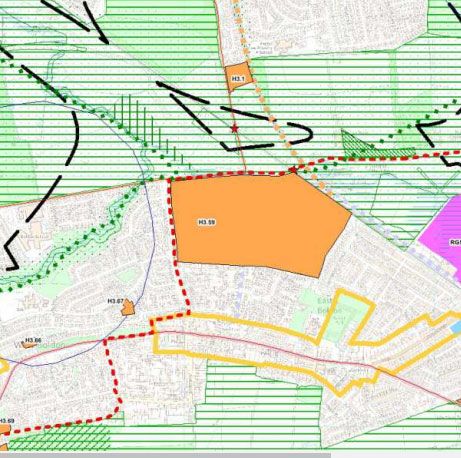
Homes Limited has actively promoted this land through South Tyneside's plan-
           making process and within the latest draft of the South Tyneside Local Plan
           (Pre-Publication Draft, August 2019) it is proposed to release this site from the
           Green Belt and allocate it (along with the parcel to the west) for residential
           development (allocation H3.59).

1.6        The land interest and wider allocation will assist in the ongoing sustainable
           growth of the Borough and will provide a deliverable housing site that will assist
           the Council in meeting its housing requirements over the plan period. It will
           provide a logical addition to the EBNA and ensure the area remains vibrant and
           successful into the future.

April 2021 | CM | P19-1962                                                          Page | 2
2.0        POLICY AND LEGISLATIVE CONTEXT

2.1        In order that the EBNP is able to progress towards the being a ‘made’
           Neighbourhood Plan (and therefore come into force as part of the wider
           development plan), it will be necessary for it to meet the ‘Basic Conditions’ and
           a number of other legal requirements. National planning policy in the shape of
           the National Planning Policy Framework (NPPF, February 2019) in paragraph
           37 and footnote 21 highlight that these are contained in Paragraph 8 of
           Schedule 4B of the Town and Country Planning Act 1990 (as amended). These
           are also replicated in the Planning Practice Guidance (PPG) which accompanies
           the NPPF and are:

               a) Having regard to national policies and advice contained in guidance
                    issued by the Secretary of State.

               b) Having special regard to the desirability of preserving any listed building
                    or its setting or any features of special architectural or historic interest
                    that it possesses. This however applies to Neighbourhood Development
                    Orders only (and so is not applicable in this case).

               c) Having special regard to the desirability of preserving or enhancing the
                    character or appearance of any conservation area. This however applies
                    to Neighbourhood Development Orders only (and so is not applicable in
                    this case).

               d) The making of the neighbourhood plan contributes to the achievement
                    of sustainable development.

               e) The making of the neighbourhood plan is in general conformity with the
                    strategic policies contained in the development plan for the area of the
                    authority.

               f)   The making of the neighbourhood plan does not breach, and is

April 2021 | CM | P19-1962                                                             Page | 3
otherwise compatible with, European Union obligations.

                g) Prescribed conditions are met in relation to the plan and prescribed
                    matters have been complied with in connection with the proposal for
                    the neighbourhood plan.

2.2        The NPPF is also clear with regards to the overall scope of neighbourhood plans
           and distinguishes this from strategic policies which should be contained in local
           plans. Paragraph 20 lists matters relating to strategic policies as:

           "…an     overall    strategy      for   the   pattern,    scale      and   quality    of
           development, and make sufficient provision for:

           a) housing (including affordable housing), employment, retail, leisure
           and other commercial development;

           b) infrastructure for transport, telecommunications, security, waste
           management, water supply, wastewater, flood risk and coastal change
           management, and the provision of minerals and energy (including
           heat);

           c) community facilities (such as health, education and cultural
           infrastructure); and

           d) conservation and enhancement of the natural, built and historic
           environment, including landscapes and green infrastructure, and
           planning     measures      to     address     climate    change      mitigation      and
           adaptation."

2.3        In   contrast,    non-strategic   policies    (those   which   can    be   covered    by
           neighbourhood plans) are outlined in paragraphs 28 – 30 of the NPPF and cover
           the following areas:

April 2021 | CM | P19-1962                                                               Page | 4
•       Allocating sites (in accordance with strategic policies);

                      •       The provision of infrastructure and community facilities at a local
                              level;

                      •       Establishing design principles;

                      •       Conserving and enhancing the natural and historic environment;
                              and

                      •       Setting out other development management policies.

2.4        The fundamental principle of this being that that the strategic policies in local
           plans are developed with an evidence base that is then subject to a more
           rigorous examination process compared to that of neighbourhood plans and so
           it is imperative that the scope of the neighbourhood plan policies flows from
           the strategic policies rather than the neighbourhood plan addressing strategic
           policies itself.

2.5        This is pertinent in this case as many of the comments made by Bellway Homes
           Limited previously relate to nature of the policies of the EBNP which in many
           instances appear more strategic in nature.

2.6        It is against this background that we set out Bellway Homes Limited's
           comments on the Submission Draft of the EBNP in the next sections of this
           document.

April 2021 | CM | P19-1962                                                                Page | 5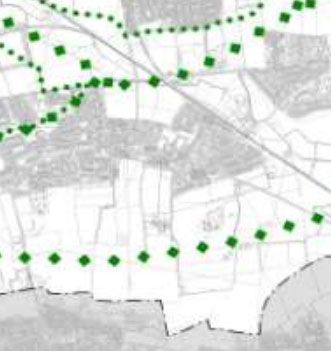
3.0        COMMENTS ON THE OVERALL APPROACH

           Strategic Approach

3.1        Our comments that were made in relation to the Pre-submission Draft raised
           a number of objections in relation to the overall approach within the EBNP (see
           Appendix 1).

3.2        Whilst the Pre-submission Draft of the EBNP did correctly identify that the
           policies of the plan needed to be consistent with the strategic policies of the
           development plan and identified these as the South Tyneside Core Strategy
           (2007) and accompanying Site-Specific Allocations (2012), the issue that this
           raises is that the EBNP is then effectively based on a strategic approach that is
           now nearly 14 years old (the Core Strategy). This makes the EBNP
           fundamentally flawed as this clearly does not reflect the growth requirements
           of the EBNA or the wider Borough over the next 15 – 20 years, rather its
           strategy for growth is based on figures derived from the Regional Spatial
           Strategy (RSS) which no longer forms part of the development plan.

3.3        Furthermore, our previous comments also highlighted that the plan period of
           the EBNP (2020-2036) misaligns with the Core Strategy which has a plan
           period up to 2021 (and so this document is becoming time-expired). It was not
           explained in the Pre-submission Draft how the EBNP can be based on the Core
           Strategy at all whilst also planning for some 15 years beyond its plan period.

3.4        It is noted that these comments have not been addressed in the Submission
           Draft of the EBNP (the content of paragraphs 1.6 – 1.8 remain the same) and
           whilst the Consultation Statement (February 2021) acknowledges the points
           raised, it does not address the fundamental problem with the EBNP being tied
           to strategic policies which are out of date and which do not comply with the
           approach to growth within the NPPF and PPG. The response in the Consultation
           Statement also does not address the points raised about the misaligning of the
           plan period between the EBNP and the Core Strategy and Site-Specific
           Allocations and how it seeks to resolve this; that is to say how does the EBNP

April 2021 | CM | P19-1962                                                         Page | 6
seek to plan positively for growth up to 2036 when the strategic policies it is
based on only plan up to 2021?
3.5 The Consultation Statement does acknowledge that the EBNP has also been
informed by the emerging South Tyneside Local Plan (paragraph 1.8), however
this is clearly not the case as the EBNP makes no allowances for emerging
allocations coming forward within the South Tyneside Local Plan. In fact, as
outlined elsewhere in the representations, it contradicts them and seeks to
frustrate the potential development of these allocations by seeking to apply
unjustified designations on them.
3.6 Given that our previous issues raised have not been adequately addressed in
the Submission Draft of the EBNP, then continue to object to the overall
approach of the EBNP on the basis that:
• It is based on strategic policies which are out of date and do not reflect
current national planning policy and guidance and does not sufficiently
take into account the emerging strategy coming forward for South
Tyneside in the emerging Local Plan.
• As a result of this the EBNP is based strategic policies which are nearly
time expired (up to 2021) and it is not explained that as this is the case,
how the EBNP is able to adequately and robustly plan for growth up to
2036.
3.7 Consequently, we continue to consider that the overall approach of the plan
fails the Basic Conditions as it is based on a strategy which is inconsistent with
national policies and guidance. In particular that plans are positively prepared
and be aspirational but deliverable (NPPF, paragraph 16). This is also echoed
in the PPG specifically for neighbourhood plans (Reference ID: 41-005-
20190509).
Vision and Objectives
April 2021 | CM | P19-1962 Page | 73.8 Our representations to the Pre-Submission Draft also raised issues with the
Vision of the EBNP (found in Chapter 3) on the basis that it is very much
focussed on the needs of current local residents and community rather than
also being forward facing and embracing growth by meeting the future needs
of the area to ensure it retains its vitality and viability. It was then pointed out
that this filters down to the EBNP's Objectives (also found in Chapter 3) which
do not explicitly promote housing growth in the area but do promote
employment growth (Objective 4). If this is the case, then such aspiration to
create additional jobs will need to be accompanied by housing growth if
sustainable patterns of development are to be provided.
3.9 It is noted that in EBNF's Consultation Statement that our previous comments
have not been taken into account in the Submission Draft of the EBNP. Indeed,
it considers that new development is promoted which is sensitive to the
character of the village and points to this being encapsulated in Objective 6
which states:
"Contribute to community wellbeing by ensuring that the
neighbourhood plan area’s community, especially its older and
younger people, have access to the services and facilities they need."
3.10 We do not consider that this does positively promote new development to
support the future success of the area, rather it addresses the needs of the
current community and the services and facilities they need. It is noted that
Objective 5 relates to housing but it is narrow in its aim which focusses on the
type of homes needed rather than the quantum and Objective 1 talks only
about meeting needs in very broad and non-specific terms.
3.11 We therefore continue to object to the Vision and Objectives found in Chapter
3 of the Submission Draft of the EBNP in that they do not explicitly promote
housing growth in the area and that they are not forward facing in meeting the
needs of future residents as well. As a result of this, they fail the Basic
Conditions in that they do not facilitate positive planning which is required
through the NPPF (paragraph 16) and seeking to meet the area's future needs
(paragraph 11 of the NPPF).
April 2021 | CM | P19-1962 Page | 8Bellway Homes Limited's Land and Green Belt Matters
3.12 As part of our comments on the Pre-Submission draft, we highlighted a number
of objections to the approach to Green Belt within the EBNP. We summarise
these points below:
• Bellway's Homes Limited's land is proposed to be released from the Green
Belt and allocated for residential development (alongside the parcel to the
west of Boker Lane) in the emerging South Tyneside Local Plan (allocation
H3.59). The justification for the site's release from the Green Belt is
contained within the evidence base that supports the emerging Local Plan.
This includes a detailed Green Belt Review (Stages 1, 2 and 3, July – August
2019) and a wider Strategic Land Review (January 2018) which considers
the designation within a wider planning context.
• However, this is not acknowledged to any degree within the EBNP which
instead seeks to maintain the site's Green Belt designation (see the
accompanying EBNP proposals map). It seeks to justify this based on
evidence predominantly provided in its Natural Environment Statement
(October 2020) and Natural Environment Background Paper (October
2020). However, this does not provide any detail or rationale to refute the
conclusions of the Council's Green Belt Review rather it chooses to ignore
its conclusions and the proposed residential allocation on the basis of
"unresolved objections" even though in the absence of a development plan
with an up to date strategy, the EBNP needs to have regards to the Council's
emerging strategy and strategic policies. This is outlined in the PPG
(Reference ID: 41-009-20190509).
• When the evidence base does discuss the Green Belt this is done in an
unstructured way with little reference to the purposes of Green Belt and
instead inferring that the Green Belt is an environmental designation
(conflating it with greenspace and biodiversity) rather than its purpose as
a planning designation. This is evident in the EBNF's attempt to persuade
the Council to add a sixth purpose of the Green Belt as a 'Carbon Sink'
(which would be contrary to the NPPF, paragraph 134) and underlines their
April 2021 | CM | P19-1962 Page | 9fundamental misunderstanding of the function of Green Belt land and the
fact that not all Green Belt land is of environmental value. This is certainly
the case with Bellway's Homes Limited's land interest, hence its suitability
to come forward for residential development.
• The EBNP's evidence base in its Natural Environment Statement (October
2020) also references a requirement to use brownfield land prior to any
greenfield sites. This again is a misinterpretation of the NPPF which
encourages the use of brownfield land rather than requires it to be used
ahead of greenfield land (paragraph 117).
• As matters relating to Green Belt are for strategic policies as they influence
the form and pattern of development in an area (see paragraph 20 of the
NPPF), the EBNP should not be addressing these matters at all, rather
should seek to align their approach to the emerging strategy in the South
Tyneside Local Plan. This will ensure their plan can cover the needs of the
area over the plan period.
3.13 Again, these comments are referenced in the Consultation Statement produced
by the EBNF but the document fails to address the fundamental aspects of our
objection; namely the disconnect and inconsistency between the approach to
the Green Belt in the EBNP and that in the emerging South Tyneside Local
Plan; meaning that the EBNP is tied to a strategic approach which is clearly out
of date with the consequences that it does not positively plan for growth over
its plan period. Whilst the Consultation Statement outlines that some of this is
guided by the strong views of the local community, this has to be balanced
with the need to ensure the EBNP is prepared in a positive and robust manner
which better accounts for the emerging strategy and which ties in with the
EBNP's plan period.
3.14 It is noted that the EBNF has now updated the Natural Environment
Background Paper (February 2021). Whilst this notes the environmental
designations that relate to the area, its conclusions have not changed and as
such, Bellway Homes Limited continues to object to the approach to Green Belt
in the Submission Draft of the EBNP based on the points raised above. This is
on the basis that the approach does not meet the Basic Conditions in being
April 2021 | CM | P19-1962 Page | 10inconsistent with national policy and guidance and is based on flawed and
unsound evidence.
April 2021 | CM | P19-1962 Page | 114.0 COMMENTS ON POLICIES
4.1 We comment on the specific policies of the Submission Draft EBNP below and
where applicable, reference our previous comments made and how the EBNF
has responded to these.
Policy EB1 – Sustainability Development
4.2 Whilst there is a requirement for planning policies to reflect the overall
approach to sustainable development reflected in the NPPF, paragraph 16 of
the NPPF does highlight that unnecessary duplication of policies that apply to
a particular area (including policies in NPPF itself) should be avoided. It is
therefore considered that as the content of this policy seeks to replicate areas
within the NPPF, it is superfluous and should be deleted or at the very least
substantially modified to strip out criteria which are not location specific.
4.3 This point was also raised in our previous representations however the EBNF
consider that the policy does provide local detail and so does not replicate the
NPPF. We disagree with this point as it is clear that the criteria (which have
been slightly amended in the Submission Draft) contain general and non-
specific measures including those in criteria a to g which are all replicated
within the NPPF. We therefore continue to object to the policy on this basis and
believe it does not meet the Basic Conditions in that it is inconsistent with
national policy.
4.4 Those that do appear more specific in relation to the EBNA, were objected to
in our previous representations. This specifically related to what are criteria H
and K in the Submission Draft. The reason for the objection is that the
documents referred to in these criteria (East Boldon Design Code and the East
Boldon Housing Needs Assessment, EBDC and EBHNA respectively) are not
themselves development plan documents rather they are pieces of evidence to
inform the EBNP's policies. However as phrased in Policy EB1 there is a
requirement to 'accord' with those documents. This effectively gives them
development plan status without having to be assessed as development plan
April 2021 | CM | P19-1962 Page | 12documents. We also object to the East Boldon Housing Needs Assessment more
generally (this is outlined later in these representations).
4.5 In response to this objection raised previously, the EBNF's Consultation
Statement agrees that both documents are not separate development plan
documents. As a result of this, it is clear that criteria H and K should be
amended or deleted as their wording currently gives development plan weight
to these documents. We note however that this has not been undertaken in
the Submission Draft. As such, our previous concerns still stand and we
continue to object to this policy on this basis.
4.6 Likewise, we previously raised concerns regarding how the EBNP's evidence
base has assessed Bellway Homes Limited's land in relation to flood risk
(contained in the Natural Environment Background Paper (October 2020) and
Natural Environment Statement (October 2020)). Whilst it is noted that the
Consultation Statement outlines that flood risk is a concern locally (which it
has drawn from comments from residents), there is nevertheless a need for
any evidence to be robust and to accord with national planning policy and
guidance and the existing information that is available. This clearly is not the
case when the EBNF's evidence is examined. It is noted that in relation to the
Submission Draft, the Natural Environment Background Paper has now been
updated (February 2021) but does not address the objections raised. We
therefore maintain our objection to this element of the policy on the basis that
it could be misapplied if the evidence base is followed.
4.7 As a result of our concerns outlined above, we continue to believe that Policy
EB1 of the Submission Draft of the EBNP does not meet the Basic Conditions
by virtue of the fact that it is inconsistent with national policy.
Policy EB2 – General Location of New Development
4.8 The policy, as drafted in the Submission Draft of the document, is identical to
that in the previous Pre-Submission Draft. We previously strongly objected to
the policy given that there is a requirement for the EBNP to positively plan for
growth over the plan period (see paragraphs 11 and 16 of the NPPF), yet by
April 2021 | CM | P19-1962 Page | 13providing such overly restrictive settlement boundaries it is clear that the EBNP
cannot achieve this.
4.9 We outlined previously that any settlement boundaries that should be drawn
need to be tied to the area's strategic policy and it is therefore important that
this is based on an up to date strategic approach which provides the growth
required for the area over the plan period.
4.10 Our previous comments highlighted that the EBNF appear to have tried to
circumvent this by producing their own East Boldon Housing Needs Assessment
(EBHNA, May 2019) which contains very low growth requirements for the area.
We do not consider the EBHNA itself a robust document (see our comments in
relation to Policy EB13).
4.11 The approach in the EBNP does not follow this and instead it appears that
settlement boundaries derive from very low growth requirements calculated
through the EBHNA. We believe this is not an appropriate way forward for
planning for growth within the EBNA, as it is not the role of a neighbourhood
plan to undertake such work, rather this is the remit of the Council's strategic
policies within the emerging South Tyneside Local Plan (see our response to
Policy EB13 below).
4.12 The Consultation Statement that has been produced by the EBNF highlights
that given the stage at which the South Tyneside Local Plan has reached, it
cannot be used as a strategic basis for the EBNP. However, the response fails
to recognise that the current development plan in South Tyneside is woefully
out of date when it comes to assessing the need for housing development (and
only covers up to 2021 in any event). The response also does not address the
fact that it is not the role of the EBNP itself to set housing need in the area (as
the EBHNA seeks to do) and consequently the document cannot be used as
evidence on housing requirement in the EBNA going forward.
4.13 The consequence of this is that the settlement boundaries themselves are
therefore fundamentally flawed and need to be reconsidered to align with the
South Tyneside Local Plan, as whilst this is not yet an adopted development
April 2021 | CM | P19-1962 Page | 14plan, it contains the latest information on quantum of development required
over the EBNP's plan period and the appropriate spatial strategy for addressing
this. To do this would be entirely consistent with the advice contained in the
PPG( (Reference ID: 41-009-20190509).
4.14 Given that Policy EB2 has remained unchanged in the Submission Draft and
that the Consultation Statement does not address our concerns raised
previously, we continue to object to Policy EB2 on the same basis set out
above.
4.15 Our previous comments also highlighted concerns regarding the robustness of
the evidence base used to support this policy; namely the Settlement Boundary
Background Paper (October 2020). This highlighted that the document took a
rather arbitrary view on settlement boundaries and despite referencing
evidence such as the emerging South Tyneside Local Plan and its evidence
base, it then simply concludes that Bellway Homes Limited's land interest at
North Farm is not considered suitable for including in the settlement boundary.
This is completely contrary to the assessments and conclusions drawn by South
Tyneside Council from its evidence base and is not substantiated in any way
rather it simply states that the site:
"Acts as an important green gap between Boldon and South Shields.
Development of the site would result in the loss of separation along
Boker Lane, effectively merging East and West Boldon. The site is rich
in wildlife and forms an important part of a wildlife corridor and is also
at risk from flooding."
4.16 At the time we strongly disputed this finding given that the land would clearly
be a logical infill between two existing forms of built development to the west
and east of the site and so would not represent urban sprawl in any way and
would be contained by defensible boundaries. The notion that the land would
result in a merging of West Boldon and East Boldon was challenged, and it was
pointed out that the site would be contained by road infrastructure and that a
degree of merging of West Boldon and East Boldon has already taken place to
the south of Bellway Homes Limited's site. It also detailed that matters relating
April 2021 | CM | P19-1962 Page | 15to wildlife corridors and flood risk were misleading as they are constraints
which affect the far north of the site and would not prevent future development
coming forward.
4.17 Whilst the EBNF has now updated its Settlement Boundary Background Paper
(February 2021), it has not changed its conclusions in this respect.
Furthermore, this is not acknowledged at all in the EBNF's Consultation
Statement and so we also continue to object to Policy EB2 on this basis as well.
4.18 Consequently, we continue to believe that the policy is fundamentally flawed,
inconsistent with national planning policy and guidance and so does not meet
the Basic Conditions.
Policy EB3 – Design
4.19 Whilst our Client supports matters relating to good design and believes this is
fundamental to achieving sustainable places, it has previously raised a number
of objections to this policy. Namely:
• Similar to the points raised in relation to Policy EB2, the wording of Policy
EB3 requires proposals to 'accord' with the East Boldon Design Code (EBDC)
document. This effectively gives the document development plan status
without it formally forming part of the development plan and being
scrutinised on that basis. This approach contradicts the NPPF (Annex 2)
which notes that such documents, should explain planning policy rather
than form part of planning policy. As such, references to the EBDC must be
removed from the policy.
• The EBDC is overly prescriptive in nature and seeks to impose certain styles
on the EBNA which could stifle innovation. This contradicts the approach in
paragraph 127 of the NPPF. We also do not believe a design code for such
a large area is the appropriate mechanism for securing design principles as
design codes are more suited to specific sites/developments.
• The EBDC also contains matters relating to energy efficiency and climate
change which we consider should be a strategic matter best dealt with
through the emerging South Tyneside Local Plan. Irrespective of this, such
April 2021 | CM | P19-1962 Page | 16measures would need to be viability tested and no such evidence of this
exists.
4.20 It is noted that the EBDC has been updated/reviewed for the Submission Draft
of the EBNP (February 2021) but this update does not address the objections
raised above.
4.21 Indeed we note that the Consultation Statement produced by the EBNF
acknowledges these comments and does confirm that the EBDC is not a
development plan document, however at the same time the policy in the
Submission Draft remains the same. As such, our previous objection raised still
stands; that the policy should not require adherence to the EBDC, otherwise it
effectively gives the EBDC development plan status.
4.22 Likewise, the Consultation Statement disagrees with our previous comments
in relation to its overly prescriptive nature although this is not substantiated
as to why they feel the requirements in the EBDC are seen as appropriate and
how they do not conflict with the part of the NPPF highlighted in our previous
representations.
4.23 It continues to also include requirements in relation to energy efficiency and
climate change and disagrees that these are matters best addressed through
strategic policies in the emerging South Tyneside Local Plan. However, the
Consultation Statement fails to elaborate on this and explain how the conflict
with paragraph 20 of the NPPF has been addressed (given that this explicitly
highlights that such policies are strategic in nature).
4.24 It is noted that the EBDC has been updated/reviewed for the Submission Draft
of the EBNP (February 2021) but this update does not address the objections
raised above.
4.25 We would disagree with the Consultation Statement which states that the EBDC
does not require to address viability. It clearly contains requirements over and
above what would ordinarily be expected for development sites (including the
aforementioned energy and climate change requirements). As such, there
April 2021 | CM | P19-1962 Page | 17needs to be certainty that such requirements would not adversely affect the
deliverability of development coming forward over the plan period. Again, the
NPPF is clear in paragraph 34 about this and this is supported by the PPG
(Reference ID: 10-001-20190509 and 10-002-20190509).
4.26 As it is the case, that the Consultation Statement does not adequately address
our objections that have been previously made, we continue to object to Policy
EB3 of the Submission Draft of the EBNP based on the above points. As there
is a clear conflict with the NPPF and PPG, we consider that it does not meet the
Basic Conditions.
Policy EB4 – Heritage Assets
4.27 This policy has been expanded since the previous draft of the EBNP which now
includes specific measures relating to the East Boldon Conservation Area. Our
comments on the Pre-Submission Draft highlighted our concern that the EBNP
seeks to add to the list of non-designated heritage assets in the area (contained
in the East Boldon Community Character Statement August 2019 referred to
in the policy). This is a matter which is beyond the remit of the EBNP and in
doing so, also seeks to give development plan weight to a document which sits
outside the plan (which is inconsistent with the NPPF).
4.28 These issues have not been acknowledged or addressed in the Consultation
Statement produced by the EBNF and continue to be included in the policy
(with paragraph 5.22 of the Submission draft seeking to add in a number of
additional heritage assets). Our previous objection therefore still stands on this
basis.
4.29 Whilst the additional elements added to the policy in relation to the East Boldon
Conservation Area are noted, it needs to be demonstrated that these tie in
specifically with the features and requirements of the conservation area.
Currently we cannot see the link between the two. We therefore deem this part
of the policy unjustified.
April 2021 | CM | P19-1962 Page | 184.30 On this basis we continue to object to Policy EB4 of the Submission Draft of
the EBNP and consider it needs substantial changes to meet the Basic
Conditions (referred to in our previous representations found in Appendix 1).
Policy EB5 – Green and Blue Infrastructure
4.31 We previously strongly objected to this policy on the basis that it seeks to
designate Bellway Land Limited's land interest entirely as Green Infrastructure.
This is despite that it is privately owned land that has never been identified as
Green Infrastructure previously, this includes in the emerging South Tyneside
Local Plan and in the adopted Green Infrastructure Strategy Supplementary
Planning Document (SPD). There is therefore no justification for this
designation and indeed its designation entirely contradicts and undermines the
emerging strategy in the South Tyneside Local Plan, which itself has its own
approach to Green Infrastructure provision.
4.32 We note in response, the ENBF has highlighted in its Consultation Statement
that the South Tyneside Council work only looks at Green Infrastructure on a
strategic basis whilst the EBNP looks at more locally important Green
Infrastructure. However, this raises a number of fundamental issues.
4.33 Firstly, this is not what is indicated within the Submission Draft of the EBNP,
where it says Green Infrastructure Corridors are informed by the emerging
South Tyneside Local Plan and the aforementioned SPD. It makes no reference
to then amending these and provides no solid evidence to justify the expansion
of the Green Infrastructure Corridor to go over Bellway Homes Limited's land
interests in its entirety. On this basis alone the designation should be rejected.
Again, there is need for consistency with the strategic policies of the
development plan and emerging development plan. The EBNF's approach in
this instance is entirely inconsistent.
4.34 Second, the response in the Consultation Statement talks about 're-wilding' of
the land and the presence of a 'Mature Hawthorn Copse' but again provides no
evidence that in fact the site has been 're-wilded' (for instance no detailed
ecological assessment or assessment of its Green Infrastructure credentials).
April 2021 | CM | P19-1962 Page | 19The Natural Environment Statement (October 2020) which accompanies the
EBNP as part of its evidence base highlights a range of birds and animals found
on the land but this is based entirely on local conjecture/anecdotal evidence
and has not been verified by detailed and robust ecological assessments. The
evidence to support it is therefore flimsy at best. The Consultation Statement
also mentions Tileshed Burn and mature hedgerows and trees on the
boundaries of the site, but this in itself does not provide robust justification for
the Green Infrastructure designation and it is entirely possible for such features
to be fully integrated into future development proposals for the land. Again, it
should be noted that this land is privately owned so any use by the public would
be considered trespassing.
4.35 Thus, we continue to object to this policy and the Green Infrastructure
designation proposed on Bellway Homes Limited's land interest within the
Submission Draft of the EBNP.
4.36 In addition to this, our previous representations outlined an objection in
relation to the wildlife corridor designated on Bellway Homes Limited's land
interest which extends much further south than portrayed in the existing and
emerging development plans as shown in Figures 1 and 2 below.
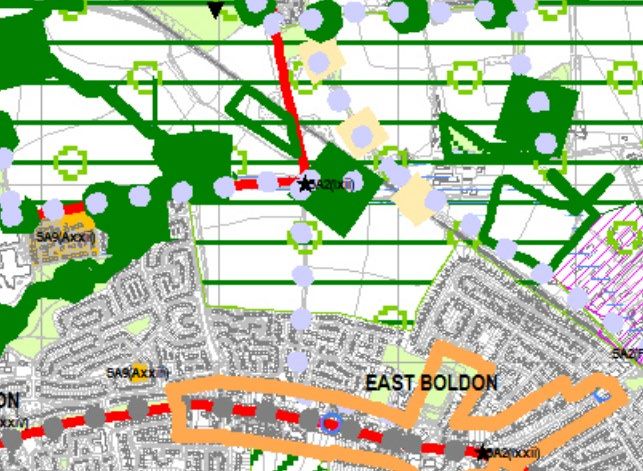
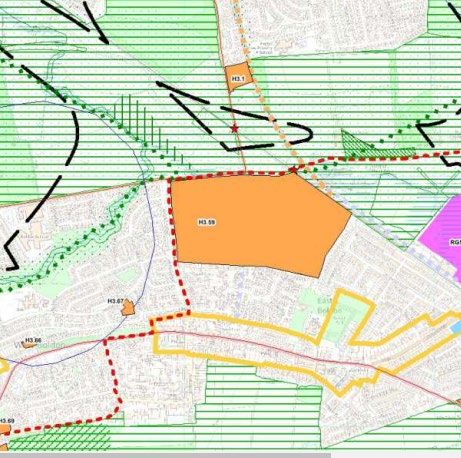
April 2021 | CM | P19-1962 Page | 20Figure 1 – Wildlife Corridor as shown in the Green Infrastructure SPD
(February 2013) and emerging South Tyneside Local Plan (Green
Diamonds)
April 2021 | CM | P19-1962 Page | 21Figure 2 – Wildlife Corridor as shown on the EBNP Proposals Map
(Green Diamonds)
4.37 It is therefore again inconsistent with the current and emerging development
plan. In response the Consultation Statement highlights that that the EBNF
consider that the Wildlife Corridor is accurately portrayed with reference to the
South Tyneside Site-Specific Allocations Document. We outline this extract in
Figure 3 below:
April 2021 | CM | P19-1962 Page | 22Figure 3 – Wildlife Corridor as shown on the South Tyneside Site
Specific Allocations Document (Green Diamonds)
4.38 Whilst the Green Diamonds in this document are unhelpfully large in scale
relative to the map, it is still nevertheless clear that this Wildlife Corridor is
consistent with those in Figure 1 above rather than that portrayed in the EBNP
Proposals Map (Figure 2). Irrespective of this, the diagrams in Figure 1
supersede that within the Site-Specific Allocations Document.
4.39 This therefore only serves to confirm our previous objection and we again
would request that this Wildlife Corridor is redrawn more accurately.
4.40 Given that our previous changes requested have not be undertaken we
therefore continue to object to Policy EB5 of the and accompanying policies
map as drafted in the Submission Draft of the EBNP for the reasons outlined
above and do not consider it meets the Basic Conditions given it is inconsistent
with national policy and the existing and emerging strategic policies for the
area.
April 2021 | CM | P19-1962 Page | 234.41 We note that a portion of Bellway Homes Limited's land interest is also
proposed to be designated as Local Green Space. We address this matter in
our comments relating to Policy EB17 below.
Policy EB6 – Landscape
4.42 This policy remains largely unaltered in the Submission Draft. Our previous
comments highlighted that:
• Matters relating to landscape (as portrayed in Policy EB6) should be covered
by strategic policies in the development plan. As the EBNP is to consider
non-strategic policies, it should not cover matters relating to landscape. On
this basis alone, this policy should be deleted.
• The policy wording also makes explicit reference to the EBDC and South
Tyneside Landscape Character Study and the need to be in accordance with
these documents. However, both of these are not development plan
documents and so should not be referenced within the policy as this
effectively gives them development plan weight and is contrary to the NPPF.
4.43 In response to this, the Consultation Statement disagree that such policies
should only be the remit of strategic policies but does not explain how it does
not conflict with paragraph 20 of the NPPF which is clear that such policies
which feature landscape designations are indeed strategic. The Consultation
Statement instead outlines that such policies are present in 'numerous plans'
but is not specific about which plans these are.
4.44 It also does not address the issue that the wording of the policy effectively
gives development plan weight to two documents referred to in second bullet
point above. This is clearly at odds with the NPPF and so still needs addressing.
4.45 Our previous comments also noted that in relation to Bellway Homes Limited's
land interest, a 'Mature Hawthorn Copse' has been identified on the site. It was
noted that it was unclear as to how this has been defined, how the EBNF has
accessed the land (as this would constitute trespassing) and whether the
April 2021 | CM | P19-1962 Page | 24relevant surveys have been undertaken to support this identification.
4.46 The EBNF's Consultation Statement does not provide any further information
in regards to this and merely states that
"…[it] is a haven for wildlife and is a pleasant rural feature of this re-
wilded site. The copse, together with other individual specimens and
groups across the site, are now maturing after more than 25 years of
growth. One of the well-established informal tracks on this site crosses
through the copse.
The hawthorn copse is clearly visible from the bridleway, without the
need for "trespass" and is clearly evident from aerial photographs
along with the paths and tracks. The site has been open for public
access at several positions, with no signage otherwise, for well over
25 years. Indeed, most of the paths and tracks, as well as the outline
of the hawthorn copse are indicated on the map submitted alongside
the comments."
4.47 There is no robust evidence submitted to prove that it is a 'haven' for wildlife
(or details of which species are apparent, and which are protected) and that
the land has been 're-wilded'. We do not consider the EBNF's Natural
Environment Statement (October 2020) or Natural Environmental Background
Paper (February 2021) provide such robust and comprehensive evidence as
this appears based on anecdotal information which has not followed relevant
guidance in undertaking ecological surveys. In fact the Consultation Statement
only confirms that there has been no detailed examination of the vegetation
on the site in any way. The response makes reference to informal tracks but
again, the use of these constitutes trespassing.
4.48 The Consultation Statement therefore does not address the objections raised
previously in our representations and as the policy remains largely unchanged,
we object to Policy EB6 of the Submission Draft for the reasons set out above
and consider that it does not meet the Basic Conditions by virtue of conflicting
with national policies.
April 2021 | CM | P19-1962 Page | 25Policy EB7 – Biodiversity
4.49 Whilst Bellway Homes Limited acknowledges the role that biodiversity plays in
helping shape places and development, our previous comments objected to
Policy EB7 in that it appeared to address matters which are more strategic in
nature and so are beyond the remit of the EBNP and contrary to the NPPF and
PPG. Indeed, the emerging South Tyneside Local Plan contains such a policy
(Policy NE2) with which this policy is inconsistent.
4.50 We note that this overall approach to the policy has not changed in the
Submission Draft and so we continue to object to this policy on this basis. We
also note that the policy now includes a requirement to achieve a minimum of
10% net gain in biodiversity. However, this 10% requirement (coming through
the Environment Bill) is not yet law and so should not be included in this policy.
4.51 In its Consultation Statement the EBNF believes that the policy does meet the
NPPF requirements but does not specifically point to which part of the NPPF
this is consistent with (when there is a conflict with paragraph 20). Our
objection in relation to this part of Policy EB7 of the Submission Draft therefore
still stands.
4.52 Our previous comments also objected to the identification of Bellway Homes
Limited's land interests as being of a higher ecological value in the absence of
any detailed ecological assessments. The response in the Consultation
Statement merely mentions either data collected by local residents. This data
has not been verified in any way or seemingly undertaken in accordance with
the relevant guidance with the data itself is not representative of an ecological
assessment. The information to support the assertion also relies on general
habitat designations which cover much wider areas and which are not specific
for this site. These combined do not result in information to classify the site as
having a higher ecological importance and references to 're-wilding' are again
unsubstantiated. The associated evidence base in this regard in the form of the
Natural Environment Statement (October 2020) and the Natural Environment
Statement (February 2021) do not provide a robust assessment and cannot be
relied upon in any way.
April 2021 | CM | P19-1962 Page | 264.53 As such we also object to Policy EB7 on this basis and overall consider the
policy does not meet the Basic Conditions as it is inconsistent with national
policies and not based on robust data.
Policy EB8 – Protecting Trees and Woodland
4.54 This policy remains unchanged in the Submission Draft of the EBNP and so our
previous objections still stand which are that:
• The policy is more strategic in nature and so should not be included in the
EBNP; and
• In relation to Bellway Homes Limited's land interest, a 'Mature Hawthorn
Copse' has been identified on the site. It is unclear as to how this has been
defined (without trespassing on private land) and whether the relevant
surveys have been undertaken to support this identification.
4.55 In the EBNF's Consultation Statement it confirms that no such detailed survey
has been undertaken in relation to the 'Mature Hawthorn Copse' to support the
assertions made.
4.56 We therefore object to Policy EB8 of the Submission Draft of the EBNP and
consider it should be deleted for failing to meet the Basic Conditions.
Policy EB13 – The Delivery of New Housing
4.57 Our comments on the Pre-Submission Draft of the EBNP strongly objected to
this policy (with the full rationale set out in Appendix 1). Fundamentally the
policy has been informed by the EBHNA document and as a result of this, there
is a clear conflict with national policy and guidance in that it is clear that
establishing housing requirements is the remit of local plans (given that
housing needs is a strategic concern). The PPG explains this by stating:
4.58 "Strategic policies should set out a housing requirement figure for
April 2021 | CM | P19-1962 Page | 27designated neighbourhood areas from their overall housing
requirement. Where this is not possible the local planning authority
should provide an indicative figure, if requested to do so by the
neighbourhood planning body, which will need to be tested at the
neighbourhood plan examination. Neighbourhood plans should
consider providing indicative delivery timetables, and allocating
reserve sites to ensure that emerging evidence of housing need is
addressed. This can help minimise potential conflicts and ensure that
policies in the neighbourhood plan are not overridden by a new local
plan." (Reference ID: 41-009-20190509).
4.59 Whilst the PPG does mention exceptional circumstances where a
neighbourhood area can determine its own figure, there is no evidence that
these circumstances are applicable in this case; especially as South Tyneside
Council has a draft Local Plan with a housing figure contained within it. Indeed,
the PPG is clear that in the absence of an up to date housing figure, the EBNF
should be considering up to date housing need evidence in the emerging
development plan:
4.60 "A draft neighbourhood plan or Order must be in general conformity
with the strategic policies of the development plan in force if it is to
meet the basic condition. Although a draft neighbourhood plan or
Order is not tested against the policies in an emerging local plan the
reasoning and evidence informing the local plan process is likely to be
relevant to the consideration of the basic conditions against which a
neighbourhood plan is tested. For example, up-to-date housing need
evidence is relevant to the question of whether a housing supply policy
in a neighbourhood plan or Order contributes to the achievement of
sustainable development." (Reference ID: 41-009-20190509).
4.61 As such, on these grounds alone the policy (and those related to it such as
Policy EB2) fail to meet the Basic Conditions in being inconsistent with national
policies.
4.62 The ENBF's response in their Consultation Statement outlines that the EBNP
April 2021 | CM | P19-1962 Page | 28does not identify a housing requirement but this is clearly incorrect given that
the EBHNA is part of the Council's evidence base, is referred to in the EBNP
and it is clear that is has influenced Policy EB13 and Policy EB2 (which relates
to settlement boundaries) and the fact that little housing growth is envisaged
within the EBNP. If this were not the case that the then why would the EBNF
commission such work?
4.63 As this fundamental issue has not been addressed in the Submission Draft of
the EBNP, we continue to object to Policy EB13 and believe it is flawed and
does not meet the Basic Conditions (given the conflict with national policy and
guidance).
4.64 Notwithstanding this, we also continue to consider that the EBHNA itself is a
fundamentally flawed document. As outlined in our comments on the Pre-
submission draft, the EBHNA itself addresses the matter of housing need
inadequately in that intends to adapt the standard method outlined in the PPG
to the EBNA, when it is specifically designed to determine housing at a local
authority level. This is evident by the fact that AECOM have had to calculate
the Borough-wide figure for South Tyneside and then seek to apportion it to
the population of the EBNA (which can only be done approximately). The
inherent flaw in this is that all the inputs which feed into the figure are borough-
based and not locally based (eg. the affordability ratio) which means getting
to an accurate housing needs figure is simply not possible and the figure
arrived at is deeply flawed.
4.65 The approach is further undermined by ignoring the emerging spatial strategy
within the South Tyneside Local Plan when examining the housing need figure
(even though it is meant to cover the same plan period) and through a lack of
commentary on whether a further uplift is required given that the PPG is clear
that the standard method figure is a minimum 'starting point' (Reference ID:
2a-010-20190220). The EBHNA itself appears to doubt the veracity of its work
and it notes in the text box after paragraph 28 that the EBNF should verify the
figure with the Council. This does not appear to have been done.
4.66 In its Consultation Statement, the EBNF's has not sought to justify AECOM's
April 2021 | CM | P19-1962 Page | 29approach at all or attempt to explain the identified deficiencies. Indeed, given
the defects in the EBHNA of identifying the quantum of housing within the
EBNA, it should be disregarded entirely as a piece of evidence.
4.67 As nothing has changed in relation to this in the Submission Draft, then we
continue to strongly object to the EBHNA and Policy EB13 on the same basis.
4.68 As outlined above, the consequence of using the EBHNA to inform Policy EB13
(and also Policy EB2) is that the EBNP itself provides no housing allocations
instead relying on windfall sites to come forward within the area's tightly drawn
settlement boundary. No testing has been undertaken to establish if there is
capacity within the settlement boundary to accommodate the required growth
and it is not explained within the EBNP or its evidence base how this constitutes
a positively prepared plan (according to paragraph 16 of the NPPF and
Neighbourhood Planning section of the PPG) and the potential effects this may
have on neighbouring areas.
4.69 We would again maintain that this demonstrates that the entire housing
strategy and accompanying policies in the plan (namely Policy EB2 and EB13
of the Submission Draft) do not meet the Basic Conditions and therefore need
to be deleted.
4.70 In our previous representations, we also outlined our objections to specific
criteria/requirements featured in Policy EB13. As these have not changed
substantially in the Submission Draft, we continue to object to these. We
therefore replicate these points in Table 1 below:
April 2021 | CM | P19-1962 Page | 30Table 1 – Commentary on Policy EB13
Policy Text Commentary
The delivery of new market and affordable As outlined in our response to Policy EB2
housing will be supported where it is and our response elsewhere to Policy
located within the settlement boundary on EB13, this approach, which relies on a low
sites that are not allocated for other uses housing growth figure (which is not
and where it complies with the relevant robustly prepared) and a tightly drawn
policies within the development plan. settlement boundary, is fundamentally
flawed and we strongly object to this
element of the policy. It is not positively
prepared (as required by national planning
policy and guidance) and will not assist in
meeting the needs of the area over the
plan period. Instead the approach should
seek to tie in with the emerging South
Tyneside Local Plan which is more
positively prepared and acknowledges the
growth requirements of the area over the
plan period and thus allocates land
accordingly.
The element of the policy which also seeks
to effectively block other uses coming
forward on an allocated site conflicts with
national planning policy and planning
legislation. This is clear that planning
applications should be determined in
accordance with the development plan
unless material considerations indicate
otherwise. The approach in this element of
the policy ignores the point about material
considerations which is a crucial part of the
English planning system. Given this
conflict, this part of the policy should be
removed.
April 2021 | CM | P19-1962 Page | 31New dwellings must be built in accordance We object to this element of the policy.
with the Nationally Described Space This is clearly a matter which should be
Standards or equivalent successor addressed as part of the strategic policies
standards. contained within the emerging South
Tyneside Local Plan and not the EBNP (see
paragraph 20 of the NPPF and the PPG
Reference ID: 56-020-20150327). This
requirement should therefore be removed.
It is noted that the current draft of the
Local Plan does not include this standard.
Furthermore, there is no evidence to
support the imposition of Nationally
Described Space Standards in terms of the
requirements set out in the PPG in relation
to need, viability and timing (Reference
ID: 56-020-20150327). As such, this
policy requirement is not justified and
further reinforces its case for deletion.
All new development proposals for the The requirement for a masterplan
delivery of ten or more residential approach to development would need to be
dwellings or on sites of 0.5 hectares or determined on a site by site basis as some
more must be informed by a development land may simply not require
comprehensive masterplan to be prepared such detail if a full planning application is
in consultation with the East Boldon to be submitted and there is no phasing
Neighbourhood Forum and the local involved. We therefore object to this
community. The level of detail contained requirement.
within the masterplan will be proportionate
to the size of the site, level of development The policy is also unclear on the role of the
and issues impacting on the development. EBNF in the masterplan process. As the
local planning authority, it will the Council
to who should be responsible for assessing
and approving the masterplan. This should
be in conjunction with the developer who
will ultimately be delivering the proposals.
April 2021 | CM | P19-1962 Page | 32We would therefore request that the
requirement for a masterplan is more
flexible and it is made clear that it would
be for the Council to assess and approve in
consultation with the developer bringing
forward the site.
Requirements of the masterplan (this As a general comment many of the criteria
based on a number of criteria). may not be applicable to all sites and so
this part of the policy should be caveated
accordingly.
Some of the policy criteria which relate to
housing mix (Part B), Parking Provision
(Part G), Highway Impact (Part H),
Flooding (Part K) and Biodiversity (Part L)
would require specific details to be
provided which would be more
appropriately provided at the detailed
planning application stage rather than the
masterplan stage. As such these criteria
need to be removed from the policy.
We also object to other criteria such as the
requirement to be in accordance with the
EBDC. We object to this document anyway
(see our response to Policy EB3) and it
should not be referred to in the policy text
of EB13 as it is not a development plan
document and should not be given such
weight through this policy. This reference
needs to be removed.
We would also seek removal of the need to
comply with 'Building for a Healthy Life' for
the same reasons. We do not regard this
as a nationally recognised document and
April 2021 | CM | P19-1962 Page | 33You can also read


