RESIDENTIAL AND LIGHT COMMERCIALAC - Sustainable Technologies for AC Workshop 18 November 2017
←
→
Page content transcription
If your browser does not render page correctly, please read the page content below

RESIDENTIAL AND LIGHT COMMERCIALAC
                                Sustainable Technologies for AC Workshop
                                                       18 November 2017

                                              Marc Chasserot, CEO, shecco Group

shecco © — All rights reserved                                             sheccobase.com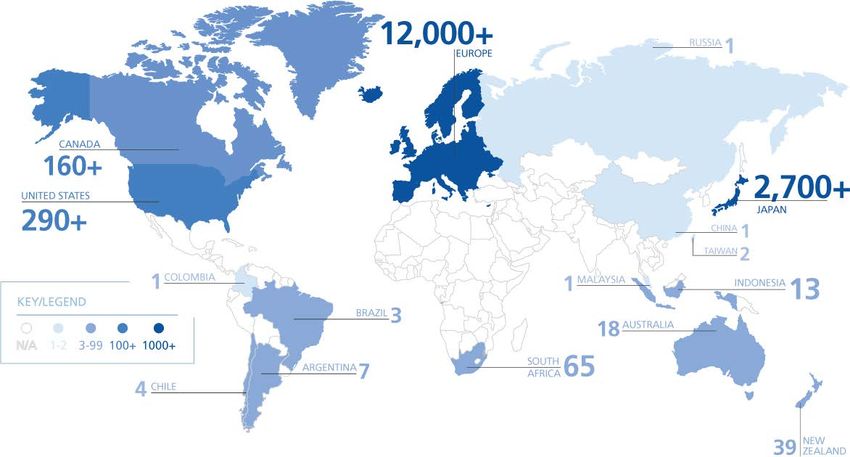
GLOBAL TRENDS

     Globally, the need for AC is set to
     increase = rising temperatures + growing
                                                  UNEP: 6 5 % of HFC use comes from AC
     middle class

     UNEP estimates global stock will reach
     over $1.5billion by 2030, with AC
     already representing 2 0 % of household
     energy consumption in warm climates

     United4Efficiency report - consumers
     could achieve $56billion in energy savings
     by 2030 by “improving air conditioner
     energy efficiency policies now”

     Main options:
     • R32 - GWP of 650
     • R290 - GWP of 3.3

shecco © — All rights reserved                                                     sheccobase.com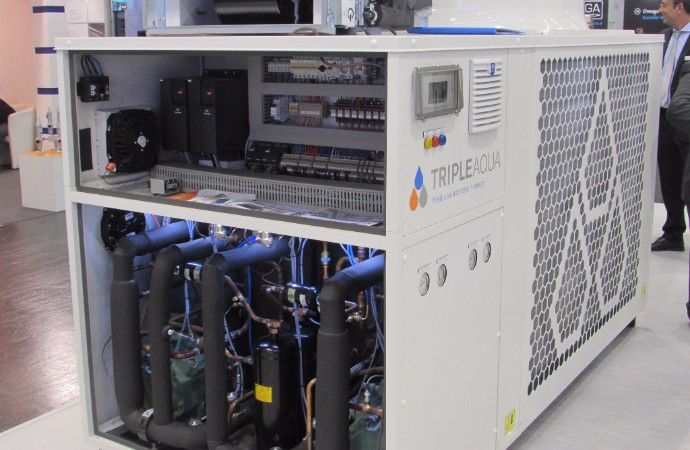
TRANSITION TO HFC-FREE REFRIGERANTS

     Pace and timing of transition away from HFCs /HCFCs depend on a number of
     factors and vary for each sector and region.

     The example of commercial refrigeration shows a strong trend towards
     natural refrigerants as a result of:

     • voluntary commitments (Consumer Goods Forum, individual pledges of
       large multinationals)

     • legislative pressure (HFC bans in EU F-Gas Regulation, SNAP Programme, etc.
       - clear signal to move away from fluorinated refrigerants)

     increased availability of HFC-free equipment /competition between NR
     technologies = decreasing costs

     technological advancements for warmer regions (ejectors, parallel
     compression, etc.)

shecco © — All rights reserved                                               sheccobase.com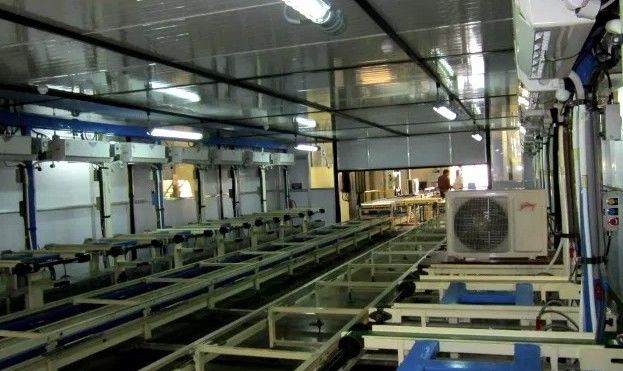
CO2 TC STORES GROWING GLOBALLY (SEPT 2017)

shecco © — All rights reserved                   sheccobase.com
CO2 TC MAJOR MARKETS: GROWTH TRENDS

                                      2015              2017           Growth

                       Europe         5.500           12.000            118%

                           USA          52              290             458%

                       Canada          139              160              15%

                         Japan        1.500            2.700             80%

                Other regional markets also emerging as a result of individual food
                                          retailers' efforts

shecco © — All rights reserved                                                        sheccobase.com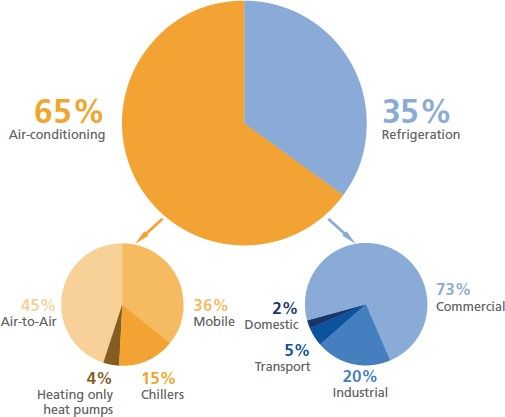
AIR CONDITIONING

                                      01

shecco © — All rights reserved                      sheccobase.com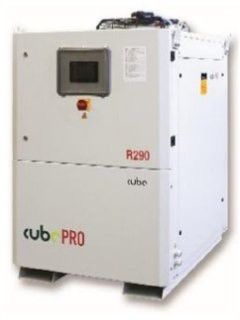
RESIDENTIAL AC - MARKET TRENDS

      Supply of split and window RAC units
      comes predominantly from Asia with
      main manufacturers being either Chinese
      or Japanese.

      China - world’s biggest manufacturer of
      RAC with market share of 85%, 100
      million AC units / year

      China and India established production
      of R290 RAC, BUT market uptake is slow

      = active policy support, update of
      safety regulations, and stronger
      industry commitment are needed to
      unlock full R290 RAC market potential

shecco © — All rights reserved                  sheccobase.com
INDIA MOVING TOWARDS R290 RAC
Split AC represents 8 0 % of total AC units sold
in India
India showing strong trend towards R290 RAC
• Currently 400,000+ units installed in the
market
Major leader: Godrej Appliances
• Replaced CFC, HFC and HCFC as early as
2002
• Efficient and green ACs using R290; first in
the world
• India’s first ACs with 7-star performance
• Earliest brand to opt for voluntary energy
labelling of its refrigerators
shecco © — All rights reserved sheccobase.comCHINA: R290 RAC PRODUCTION
Chinese market showing an interest towards R290 RAC
• established production capacity with potential to make 1.8
million R290 RAC units per year
• 1,300+ units installed already
• Major players: Midea, Gree, Haier
Midea case study:
• Nanyang Vocational and Technical College in Jiaxing, (the
country’s northern Zhejiang province).
• 1,060 R290 based ACs in the dormitories
• Installed in November 2016, no problems in operation so far
• Completed additional projects in warm ambient regions,
including Seychelles University in the Seychelles.
• Demonstration projects funded from the Multilateral Fund
for the Implementation of the Montreal Protocol.
shecco © — All rights reserved sheccobase.comEUROPE: PORTABLE IS MAKING HEADWAY
Europe has been moving towards R290 in portable AC
• 2 key manufacturers - Midea Germany, Delonghi
• EU F-Gas Regulation bans the use of HFCs with GWP >
150 in portable A C as of 2020
BUT, the move to R290 is slit A C has not happened yet in
Europe:
• Midea, Haier developed and certified R290 RAC units
for the European market (TUV), not marketed yet
• Barriers: lack of market demand, lack of ambitious
legislation, standards, high initial costs, lack of training,
etc.
Concerted effort of industry, consumers and legislators
needed to move the market
shecco © — All rights reserved sheccobase.comHC BASED HEAT PUMP & WATER CHILLERS
• Triple Aqua's efficient heat pump
using hydrocarbons is running in two
offices and a supermarket in the
Netherlands
• can save up to 5 0 % in heating and
cooling costs in commercial buildings
compared to traditional heat pumps,
with a COP (coefficient of performance)
between 4 to10
• The system employs propaene (R443A),
a mixture of the hydrocarbons propane Source: http://hydrocarbons21.com/articles/7250/
tripleaqua_s_dutch_debut
(R290) and propene (R1270), with a
global warming potential (GWP) of
3 and a charge of < 5 k g
shecco © — All rights reserved sheccobase.comHC BASED HEAT PUMP & WATER CHILLERS
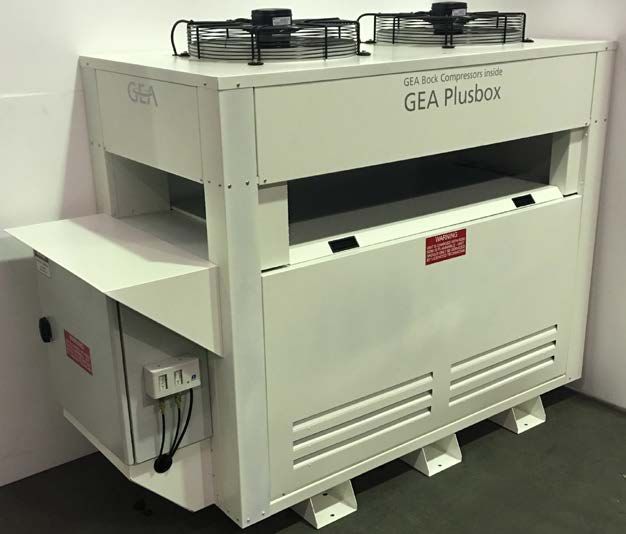
• HC based water chillers introduced by
several companies targeting
commercial air-conditioning and
process cooling applications
• RSA Cooling - water chiller for outdoor
installations, and are available with
cooling capacity from 3,0 to 15,0
kW
• HC water chillers in Australia, reliable
performance at 45C days this summer
shecco © — All rights reserved sheccobase.comJAPAN - RESEARCH - LOW-GWP HIGH EFFICIENCY AC
Japanese Government (METI) & New Energy Development Organisation (NEDO)
• 4 companies participated in the research projects to develop technologies for high
energy efficiency low-GWP based small and mid-size air-conditioning systems
• DENSO - development of CO 2 (R744) AC system with high efficiency ejector
• MITSUBISHI ELECTRIC - development of HC based room air-conditioning system
• project finished in September 2017, report on the outcome expected in 2018
高効率低GWP冷媒を使用した中小型空調機器技術の開発
shecco © — All rights reserved sheccobase.comTHANK YOU! shecco © — All rights reserved sheccobase.com
You can also read


