Review of the measles epidemic in children from Central Eastern Europe in the third millennium - Spandidos Publications
←
→
Page content transcription
If your browser does not render page correctly, please read the page content below
EXPERIMENTAL AND THERAPEUTIC MEDICINE 22: 816, 2021

                   Review of the measles epidemic in children from
                   Central Eastern Europe in the third millennium
                    ANA‑MARIA DAVITOIU1,2, LUMINITA SPATARIU1,2, DOINA‑ANCA PLESCA1,2,
                  MIHAI DIMITRIU1, CATALIN GABRIEL CIRSTOVEANU1,3 and SORINA CHINDRIS1,2

              1
              Department of Paediatrics, ‘Carol Davila’ University of Medicine and Pharmacy, 050474 Bucharest;
               2
                 Department of Paediatrics, ‘Dr. Victor Gomoiu’ Children Clinical Hospital, 022102 Bucharest;
            3
             Neonatal Intensive Care Unit, ‘Marie Curie’ Emergency Clinical Hospital, 077120 Bucharest, Romania

                                           Received March 3, 2021; Accepted April 2, 2021

                                                      DOI: 10.3892/etm.2021.10248

Abstract. Measles is an extremely contagious viral disease.             vaccinated children, Romania is facing a major increase in
Even though a safe vaccine exists for this disease, it remains          the cases of measles. Consecutively, a measles epidemic was
one of the leading causes of mortality and morbidity in                 declared in 2016 and an additional dose of mandatory MMR
infants and young children. We aimed to create a retrospec‑             trivaccine was introduced at the age of 9 months. After 4 years
tive descriptive study in which to analyze the evolution of the         of this schedule of administration, starting with August 2020,
measles epidemic at the European level. The documentation               the additional dose of MMR administered during infancy has
was carried out using European Centre for Disease Prevention            been discontinued. We propose an analysis of the factors that
and Control (ECDC) and World Health Organization (WHO)                  influenced the downward evolution of the measles epidemic
statistics. At the same time, we present the epidemic's evolution       in Romania at the beginning of the third millennium. Issues
in Romania, using data provided by the Romanian National                related to the limitation of interpersonal contact in the context
Institute of Public Health and Ministry of Health. European             of the social distancing imposed by the Sars‑CoV‑2 virus
statistical data indicate a high number of patients diagnosed           pandemic are discussed. We consider necessary a detailed
with measles both among children and adults. All European               documentation of the percentage of new disease cases that will
countries benefit from the measles vaccination in the form              appear in the pediatric population in the near future, in the
of the measles‑mumps‑rubella (MMR) trivaccine included                  context of the resumption of daily activity after the reopening
in their National Vaccination Programme. The vaccination                of nurseries, kindergartens and schools.
schedule varies from country to country. In the vaccination
scheme, most European countries include two doses of the                Introduction
MMR vaccine among the pediatric population. Romania
registered a limited number of cases of measles between 1980            Measles, tuberculosis, influenza, meningococcal disease,
and 2015 following the introduction of the measles vaccina‑             whooping cough and tetanus are all infectious diseases for
tion in the National Vaccination Programme. Since 2005, the             which there is a vaccine. And yet these are diseases that result
Romanian vaccination schedule includes two doses of MMR                 in a large number of deaths in the third millennium (1).
trivaccine, administered at 12 months and at 6‑7 years. After               Measles is an extremely contagious viral disease. It is one
2015, as a result of a significant decrease in the number of            of the leading causes of mortality and morbidity in infants and
                                                                        young children despite of the availability and safety of existing
                                                                        vaccines (2).
                                                                            Measles continues to circulate across Europe as a result
                                                                        of suboptimal vaccination coverage and population immunity
Correspondence to: Dr Catalin Gabriel Cirstoveanu, Neonatal             gaps (3); Eastern Europe being one of the most affected regions
Intensive Care Unit, ‘Marie Curie’ Emergency Clinical Hospital,         for the incidence of measles (2).
Boulevard Constantin Brancoveanu, Nr. 20, Sector 4, 077120 Bucharest,       A vaccine is a biological product that contains attenuated
Romania                                                                 pathogens capable of inducing a protective immune response
E‑mail: cirstoveanu@yahoo.com
                                                                        to a particular microbial aggression. The action of the vaccine
Abbreviations: MMR, measles‑mumps‑rubella; ECDC, European               can be quantified by specific antibodies that appear in the
Centre for Disease Prevention and Control; WHO, World Health            blood of the vaccinated patient (4). Over time, the administra‑
Organization; INSP, Romanian National Institute of Public Health        tion of vaccines has reduced the incidence of a large number
                                                                        of diseases that pose a major threat to health in the European
Key words: measles, children, vaccination, Romania, Central‑East        region and thus, vaccines have saved millions of lives.
Europe                                                                      In Central and Eastern Europe, in the totalitarian
                                                                        context imposed by the communist regimes, the vaccination
                                                                        schemes were rigorously structured and administered to the
2 DAVITOIU et al: MEASLES EPIDEMIC IN CHILDREN FROM CENTRAL EASTERN EUROPE IN THE 3rd MILLENNIUM
pediatric population for the entire time of the communist was 0.89. The numbers may be higher if we take into account
regime (5). As a result, there appears to be a low incidence of the deaths related to the complications of the disease (7). In
vaccine‑controlled infectious diseases at that time. addition, subacute sclerosing panencephalitis is a rare and
invariably fatal complication of the disease. This complica‑
Materials and methods tion develops years after the occurrence of the acute measles
episode and it increases the measles mortality rate (9).
We aim to create a retrospective descriptive study in The data provided by ECDC concerning Central and
which to analyze the evolution of the measles epidemic at Eastern Europe show significant variations from one country
the European level. The documentation was carried out to another. Between March 2019 and February 2020, the
using European Centre for Disease Prevention and Control number of measles cases in the analyzed countries had an
(ECDC) and World Health Organization (WHO) statis‑ overall downward evolution. Exceptions to this situation
tics from 2005 to 2020. At the same time, we present the include Romania and Bulgaria which continued to present an
epidemic's evolution in Romania, using data provided by the increased number of cases in the first two months of 2020 (10)
Romanian National Institute of Public Health and Ministry (Table I).
of Health. The monthly measles and rubella monitoring report
The schemes of the national vaccination program at the April 2020 of ECDC presented data concerning the incidence
level of European countries were analyzed retrospectively. of measles in the 29 EU/EEA member states, including the UK.
An attempt was made to establish correlations between It reported 11,576 cases of measles for the interval March 1,
vaccine coverage at the state level and the number of 2019 to February 29, 2020 (2). No country had zero cases
measles‑mumps‑rubella (MMR) vaccine doses in the National during that period. France ranked first (2,466 cases) followed
Vaccination Programme, respectively the number of new cases by Romania (1,542 cases), Italy (1,353 cases) and Bulgaria
of measles per 1,000 inhabitants. (1,347 cases). During the mentioned period, 8 deaths were
In Romania, we analyzed the evolution of the measles cases reported (25% of deaths being registered in Romania) (2).
during the communist regime compared with the number of
cases after 1990, in the context of the decrease in vaccine Particularities of the measles epidemic in Romania. Over
coverage. We aimed to identify the cause of the increase in the time, after the introduction of the measles vaccination in
percentage of cases in relation to the decrease in the percentage 1979, measles still produced several epidemics in Romania
of vaccination in the pediatric population. (in 1982, 1986, 1993, 1997, 2003, 2010 and 2016) but
The article goes into detail with regard to the statistical with new cases and the number of deaths lower than were
differences between the number of cases of measles in chil‑ registered in the prevaccination period (11). According
dren and adults before 2016, when the measles epidemic was to the data provided by the National Institute of Public
declared, and the number of cases subsequent to the decline Health, the D4 genotype of measles virus is endemic in
generated by the changes brought to the national programme Romania (11). In the context of the democratic approach
in terms of measles vaccination. The new vaccination of the last decade of the 20th century which associated a
schedule is presented. This one involves the administration free movement of the population on the background of open
of 2 doses of MMR trivaccine in the first year of life and one border circulation, two other genotypes of measles virus,
dose of booster vaccine at the age of 5 years. The decrease B3 and D8, considered imported genotypes were identified
in the disease incidence during 2016‑2020 is statistically in Romania (11,12).
demonstrated. Information provided by ECDC between February 1, 2016
and January 31, 2017, shows that eight European countries
Results and Discussion (Austria, Czech Republic, France, Germany, Ireland, Italy,
Spain, UK) reported 34 confirmed cases of measles (12). Based
Measles epidemic in Europe. The measles epidemic between on the circulated genotypes, ECDC supports the possibility
2010‑2020 in Europe is reflected in the large number of that their origin was from Romania (13).
measles cases that spread across the continent (6) (Fig. 1). Statistical data from Romania indicate that during the
The national vaccination schedule differs from country to 1960‑1980 period, the measles incidence remained high
country both in the epidemic time and the current period. It at about 120 new cases per 100,000 population. After the
should be noted that, for most countries, according to ECDC, introduction of the measles vaccination in 1979, there was a
the national vaccination schedule includes two doses of dramatic decrease in these numbers, below 40 new measles
measles vaccine from the MMR trivaccine (2). cases per 100,000 population (11) (Fig. 2).
A coverage of vaccination over 95% with two doses of In Romania, the vaccination schedule was modified since
measles vaccine is crucial to achieve, in order to eliminate the 2005 by introducing in the National Vaccination Program the
disease throughout Europe (2). The vaccine coverage rate in measles‑rubella‑mumps (MRM) trivaccine which is admin‑
Europe with two doses of measles vaccine is estimated at only istered at the age of 12 months with a booster at the age of
90% by 2018. As a result, in 2018 in Europe, 83,540 cases of 6‑7 years. Vaccine coverage was maintained at over 95%, the
measles were reported; almost four times more than in 2017 WHO target (14). As a result, the incidence of the disease
(25,870 cases) (7). continued to remain low from 2005 to 2015.
Measles‑related mortality is most often due to complica‑ After 2015, the incidence of measles in pediatric patients
tions of the disease such as pneumonia or encephalitis and less increased alarmingly (11). Researchers correlate this with a
to the disease itself (8). In 2019, the death rate per 1,000 cases significant reduction in the percentage of infants and youngEXPERIMENTAL AND THERAPEUTIC MEDICINE 22: 816, 2021 3
Figure 1. Measles cases (possible, probable, confirmed) between January 2010 and May 2020, reported by month and year in EU/EEA and the UK
(source TESSy)‑adapted from European Centre for Disease Prevention and Control (5). EU/EEA, European Union/European Economic Area.
Figure 2. Multiannual incidence of measles in Romania between January 1960 and July 2020. Adapted from Romanian National Institute of Public Health (9).
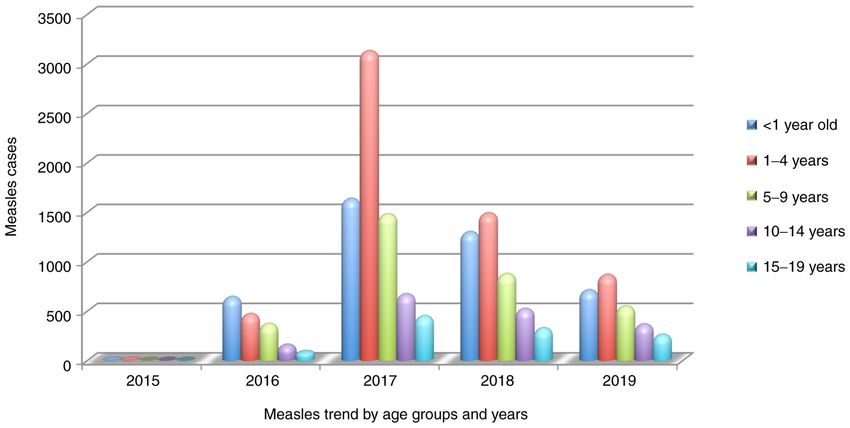
children vaccinated against measles secondary to a misunder‑ 3 times lower, and then the incidence declined for the age group
stood democracy consisting in vaccine delays and refusals of 5‑9 years to 108/100,000 population and was 35.3/1,000,000
vaccination (15). In addition, media coverage of Dr Andrew for the age group 15‑19 years (11). Thus, in September 2016,
Wakefield's publications, established a false correlation a measles epidemic was declared in Romania. Afterwards,
between MMR vaccination and autism, an idea which is widely for the next two years, the trend continued to be high for the
reported among parents (16). Consecutively, this resulted in 0‑4 age group as is shown in Fig. 3.
a decreased trend of vaccine coverage. In 2018, only 90% of Data from the ECDC showed that in the period of
the pediatric population from Romania was covered by MMR January‑December 2020 in Romania there were 1,004 new
vaccination at the age of 12 months (17). cases of measles among the population (17). According to
The distribution of measles cases among the pediatric INSP 85.74% of cases were in the age group 0‑19 years. No
population of Romania between 2005‑2019 is shown in deaths were reported (18).
Tables II and III based on data collected from ECDC and The current measles epidemic in Romania has particularly
INSP. affected children under 1 year old who were not eligible
Furthermore, Romania registered in 2016 a worrying for MMR vaccination according to the Romanian National
number of measles cases in both children and young adults. Program of Vaccination from that time. Starting with
The Romanian National Institute of Public Health stated that December 2016, the Ministry of Health and National Institute
the most affected were children under 1 year, with 723 new of Public Health established the obligation to administer two
cases/100,000 population, followed by the age group 1‑4 years, doses of MMR trivaccine in the first year of life, at the ages4 DAVITOIU et al: MEASLES EPIDEMIC IN CHILDREN FROM CENTRAL EASTERN EUROPE IN THE 3rd MILLENNIUM
Table I. Number of cases of measles in Central and Eastern Europe between March 1, 2019 and February 29, 2020 reported
monthly and per million population by country (adapted from ECDC).
Year
‑‑‑‑‑‑‑‑‑‑‑‑‑‑‑‑‑‑‑‑‑‑‑‑‑‑‑‑‑‑‑‑‑‑‑‑‑‑‑‑‑‑‑‑‑‑‑‑‑‑‑‑‑‑‑‑‑‑‑‑‑‑‑‑‑‑‑‑‑‑‑‑‑‑‑‑‑‑‑‑‑‑‑‑‑‑‑‑‑‑‑‑‑‑‑‑‑‑‑‑‑‑‑‑‑‑‑‑‑‑‑‑‑‑‑‑‑‑‑‑‑‑‑‑‑‑‑‑‑‑‑‑‑‑‑‑‑‑‑‑‑‑‑‑‑‑‑‑‑‑‑‑‑‑‑‑‑‑‑‑‑‑‑‑‑‑‑‑‑‑‑‑‑‑‑‑‑‑‑‑‑‑‑‑‑‑‑‑‑‑‑‑‑‑‑‑‑‑‑‑‑‑‑‑‑‑‑‑‑‑‑‑‑‑‑‑‑‑‑‑
Month
‑‑‑‑‑‑‑‑‑‑‑‑‑‑‑‑‑‑‑‑‑‑‑‑‑‑‑‑‑‑‑‑‑‑‑‑‑‑‑‑‑‑‑‑‑‑‑‑‑‑‑‑‑‑‑‑‑‑‑‑‑‑‑‑‑‑‑‑‑‑‑‑‑‑‑‑‑‑‑‑‑‑‑‑‑‑‑‑‑‑‑‑‑‑‑‑‑‑‑‑‑‑‑‑‑‑‑‑‑‑‑‑‑‑‑‑‑‑‑‑‑‑‑‑‑‑‑‑‑‑‑‑‑‑‑‑‑‑‑‑‑‑‑‑‑‑‑‑‑‑‑‑‑‑‑‑‑‑‑‑‑‑‑‑‑‑‑‑‑‑‑‑‑‑‑‑‑‑‑‑‑‑‑‑‑‑‑‑‑‑‑‑‑‑‑‑‑‑‑‑‑‑‑‑‑‑‑‑‑‑‑‑‑‑‑‑‑‑‑‑
2019 2019 2019 2019 2019 2019 2019 2019 2019 2019 2020 2020 Total Cases
Country Mar Apr May Jun July Aug Sept Oct Nov Dec Jan Feb cases per million
Romania 188 110 148 123 110 80 112 100 79 90 257 145 1,542 79.4
Bulgaria 185 279 281 236 84 42 17 5 21 34 81 82 1,347 192.4
Croatia 0 0 6 4 10 4 14 12 1 0 0 0 51 12.5
Cyprus 0 1 3 1 0 0 0 0 0 0 0 0 5 5.7
Czechia 198 90 49 20 14 4 2 1 4 0 0 3 385 36.1
Estonia 2 0 6 7 1 1 0 0 0 1 0 0 18 13.6
Greece 7 12 6 0 0 0 12 3 1 1 1 0 43 4
Hungary 4 2 9 0 1 0 0 0 0 0 0 0 16 1.6
Latvia 0 1 0 0 0 2 0 0 0 0 0 0 3 1.6
Lithuania 249 231 125 62 33 39 6 2 2 0 1 0 750 268.4
Poland 287 289 249 124 41 9 5 6 2 8 5 7 1,032 27.2
Slovakia 70 105 43 9 3 6 3 0 0 0 0 0 239 43.9
Slovenia 0 6 8 3 1 1 0 0 7 22 5 1 54 25.9
ECDC, European Centre for Disease Prevention and Control.
Table II. Distribution of measles cases among the pediatric population of Romania between 2005‑2019 (adapted from ECDC).
Year 2005 2006 2007 2008 2009 2010 2011 2012 2013 2014 2015 2016 2017 2018 2019
Cases 5,647 3,196 352 14 8 188 4,165 6,166 1159 59 7 1,780 7,326 4,477 2,718
ECDC, European Centre for Disease Prevention and Control.
Figure 3. Evolution of cases of measles in Romania by age group between January 2015 and December 2019. Adapted from ECDC and INSP (9).
ECDC, European Centre for Disease Prevention and Control; INSP, Romanian National Institute of Public Health.
of 9 and 12 months. The booster dose is maintained at the age Europe that administers 3 doses of MMR in children, 2 of
of five. Romania is the only country in Central and Eastern which are during infancy.EXPERIMENTAL AND THERAPEUTIC MEDICINE 22: 816, 2021 5
Table III. Distribution of the cases of measles according to age group in the pediatric population of Romania between 2015 and
2019 (according to INSP).
Age groups (0‑19 years of age)
‑‑‑‑‑‑‑‑‑‑‑‑‑‑‑‑‑‑‑‑‑‑‑‑‑‑‑‑‑‑‑‑‑‑‑‑‑‑‑‑‑‑‑‑‑‑‑‑‑‑‑‑‑‑‑‑‑‑‑‑‑‑‑‑‑‑‑‑‑‑‑‑‑‑‑‑‑‑‑‑‑‑‑‑‑‑‑‑‑‑‑‑‑‑‑‑‑‑‑‑‑‑‑‑‑‑‑‑‑‑‑‑‑‑‑‑‑‑‑‑‑‑‑‑‑‑‑‑‑‑‑‑‑‑‑‑‑‑‑‑‑‑‑‑‑‑‑‑‑‑‑‑‑‑‑‑‑‑‑‑‑‑‑‑‑‑‑‑‑‑‑‑‑‑‑‑‑‑‑‑‑‑‑-‑‑‑‑‑‑‑‑‑‑‑‑
Cases of measles6 DAVITOIU et al: MEASLES EPIDEMIC IN CHILDREN FROM CENTRAL EASTERN EUROPE IN THE 3rd MILLENNIUM
two doses of MMR at 9 and 12 months and a booster at the analytical methods. DAP supervised the literature review and
age of 5 years. data used. MD was involved in drafting the manuscript and
We take into consideration the possibility of an apparent revising it critically for important intellectual content in light
decline of the disease in the last 4 months in the context of the of the literature data. CGC also analyzed the data provided
Sars‑CoV‑2 virus epidemic in Romania (19). In the context of and gave final approval of the version to be published, investi‑
the pandemic, Romania was in the period of March‑May 2020 gate the aspects of the data and supervised the findings of this
under the incidence of the emergency state and later, from May work. All authors discussed the results and contributed to the
to August 2020, under the incidence of the alert state (20). The final version of the manuscript. All authors read and approved
recommendations for social distancing from this period led to the manuscript and agree to be accountable for all aspects of
the limitation of the infectious contact between people (21). the research.
We consider that indirectly this may have led to a decrease in
the measles incidence in Romania. Ethics approval and consent to participate
In conclusion, vaccination is the most effective protection
against measles disease and immunization in childhood is the Not applicable.
safest start to our road in life.
The measles epidemic appeared in Romania secondary to Patient consent for publication
a decline in vaccine coverage, a phenomenon that was miti‑
gated by adaptive measures that included the development of Not applicable.
a vaccination schedule with 3 doses of MMR vaccines which
means the introduction of an additional dose at the age of Competing interests
9 months, with the administration of the following doses at the
age of 12 months and 5 years. No competing interests exist with regard to the publication of
The national campaign to limit the measles epidemic the descriptive study.
had the desired effect. The decrease in the incidence of
measles cases among the pediatric population of Romania References
allowed the authorities to discontinue the MMR vaccine dose
administered during the infant period at 9 months starting 1. World Health Organization: Immunization, Vaccines and
with August 2020. Biologicals on Measles, 2020. Available from: https://www.who.
int/immunization/diseases/measles/en/.
We sought to evaluate the decision of the Ministry of 2. European Centre for Disease Prevention and Control: ECDC.
Health to discontinue the administration of an additional dose Monthly measles and rubella monitoring report, 2020. Available
of MMR vaccine during infancy. Early detection of epidemio‑ from: https://www.ecdc.europa.eu/sites/default/files/docu‑
ments/measles‑rubella‑monthly‑report‑april‑2020.pdf.
logical signals is important in order to prevent a new measles 3. Williams GA, Bacci S, Shadwick R, Tillmann T, Rechel B,
epidemic. Thus, it is necessary to dynamically monitor new Noori T, Suk JE, Odone A, Ingleby JD, Mladovsky P and Mckee M:
disease cases that will appear on the Romanian territory. Measles among migrants in the European Union and the European
economic area. Scand J Public Health 44: 6‑13, 2016.
Interdisciplinary monitoring of the pediatric patient will 4. Guglielmi G: Measles erases immune ‘memory’ for other
detect an increase in the incidence of measles. Consecutively, diseases. Nature: Oct 31, 2019 (Epub ahead of print). doi: 10.1038/
the second dose of vaccination during infancy may have to be d41586-019-03324-7.
5. Paul KT and Loer K: Contemporary vaccination policy in the
reintroduced. European Union: Tensions and dilemmas. J Public Health
We point out the possibility of an artificial decrease in the Policy 40: 166‑179, 2019.
number of measles diseases from January to July 2020 in the 6. Nicolay N, Mirinaviciute G, Mollet T, Celentano LP and Bacci S:
Epidemiology of measles during the COVID‑19 pandemic, a
context of the social distancing imposed by the Sars‑CoV‑2 description of the surveillance data, 29 EU/EEA countries and
pandemic. the United Kingdom, January to May 2020. Euro Surveill 25:
2001390, 2020.
7. European Centre for Disease Prevention and Control: ECDC.
Acknowledgements Monthly measles and rubella monitoring report, 2020.
Available from: https://www.ecdc.europa.eu/en/rubella/surveil‑
Not applicable. lance‑and‑disease‑data/monthly‑measles‑rubella‑monitoring‑reports.
8. World Health Organization: WHO EpiBrief. A report on the
epidemiology of selected vaccine‑preventable diseases in the
Funding European region, 2020. Available from: https://www.euro.who.
int/__data/assets/pdf_file/0006/431745/EpiBrief_1_2020_EN.pdf.
9. Dayan GH and McLean HQ: Measles: International Encyclopedia
No funding was received. of Public Health. 2nd edition. Quah SR (ed), Academic Press,
pp565‑569, 2017.
Availability of data and materials 10. Ferren M, Horvat B and Mathieu C: Measles encephalitis:
Towards new therapeutics. Viruses 11: 1017, 2019.
11. Lazar M, Stănescu A, Penedos AR and Pistol A: Characterisation
The datasets used and/or analyzed during the current study are of measles after the introduction of the combined measles‑mumps-
available from the corresponding author on reasonable request. rubella (MMR) vaccine in 2004 with focus on the laboratory data,
2016 to 2019 outbreak, Romania. Euro Surveill 24: 1900041, 2019.
12. Dascalu S: Measles epidemics in Romania: Lessons for public
Authors' contributions health and future policy. Front Public Health 7: 98, 2019.
13. Gindrovel D, Alexiu SA, Pistol A and Stănescu A: What have we
learnt from the measles outbreak? Medic Ro 2, 2017.
AMD conceived of the presented idea. SC developed the 14. Hayman DTS: Measles vaccination in an increasingly immunized
theory and performed the computations. LS verified the and developed world. Hum Vaccin Immunother 15: 28‑33, 2019.EXPERIMENTAL AND THERAPEUTIC MEDICINE 22: 816, 2021 7
15. Donadel M, Stanescu A, Pistol A, Stewart B, Butu C, Jankovic D, 19. Stoian AP, Pricop‑Jeckstadt M, Pana A, Ileanu BV, Schitea R,
Paunescu B and Zimmerman L: Risk factors for measles deaths Geanta M, Catrinoiu D, Suceveanu AI, Serafinceanu C,
among children during a nationwide measles outbreak‑Romania, Pituru S, et al: Death by SARS‑CoV 2‑a Romanian COVID‑19
2016‑2018. BMC Infect Dis 21: 279, 2021. multi‑center comorbidity study. Res Square 2: 1‑21, 2020.
16. Rao TS and Andrade C: The MMR vaccine and autism: Sensation, 20. Ceriello A, Stoian AP and Rizzo M: COVID‑19 and diabetes
refutation, retraction, and fraud. Indian J Psychiatry 53: 95‑96, 2011. management: What should be considered? Diabetes Res Clin
17. European Centre for Disease Prevention and Control: Number of Pract 163: 108151, 2020.
measles casesby month and notification rate per million population 21. Serban D, Smarandache AM, Cristian D, Tudor C, Duta L and
by country, January 2020‑December 2020, 2021. Available from: Dascalu AM: Medical errors and patient safety culture‑shifting
https://www.ecdc.europa.eu/en/publications‑data/number‑measles‑ the healthcare paradigm in Romanian hospitals. Rom J Leg
cases‑month‑and‑notification‑rate‑million‑population‑country‑27. Med 28: 195‑201, 2020.
18. European Centre for Disease Prevention and Control: ECDC.
Number of measles deaths by country, EU/EEA and the
UK, December 2019‑November 2020, 2021. Available from: This work is licensed under a Creative Commons
https://www.ecdc.europa.eu/en/publications‑data/number‑measles‑ Attribution-NonCommercial-NoDerivatives 4.0
deaths‑country‑eueea‑and‑uk‑december‑2019‑november‑2020. International (CC BY-NC-ND 4.0) License.You can also read


