Rules of the game - International Handball Federation
←
→
Page content transcription
If your browser does not render page correctly, please read the page content below
International
Handball
Federation

Rules
of the game

Edition: 1 July 2010

.
Table of Contents Page
Playing Rules, Hand Signals, Clarifications and
Substitution Area Regulations
Forward 3
Rules of the Game
1 Playing Court 4-8
2 Playing Time, Final Signal and Time-Out 9-13
3 The Ball 14
4 The Team, Substitutions, Equipment, Player Injury 15-18
5 The Goalkeeper 19-20
6 The Goal Area 21-22
7 Playing the Ball, Passive Play 23-25
8 Fouls and Unsportsmanlike Conduct 26-33
9 Scoring 34-35
10 The Throw-Off 36
11 The Throw-In 37
12 The Goalkeeper Throw 38
13 The Free Throw 39-42
14 The 7-Meter Throw 43-44
15 General Instructions for the Execution of the
Throws (Throw-Off, Throw-In, Goalkeeper Throw,
Free Throw and 7-Meter Throw) 45-48
16 The Punishments 49-53
17 The Referees 54-56
18 The Timekeeper and the Scorekeeper 57
Hand Signals 58-67
Clarifications to the Rules of the Game 68-82
Substitution Area Regulations 83-86
Guidelines for Playing Courts and Goals 87-90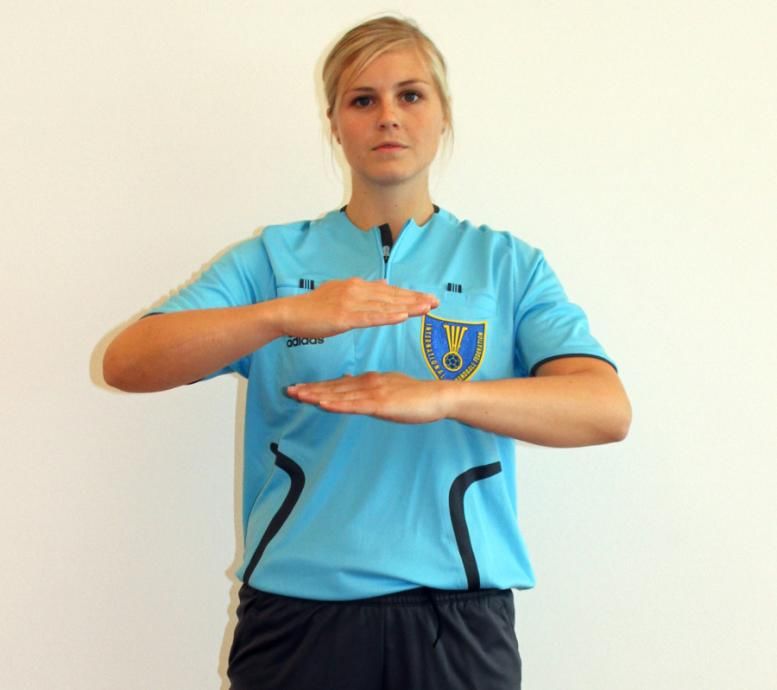
FOREWORD

These Rules of the Game will take effect on July 1, 2010.

The Rules Text, the Comments, the IHF Hand Signals, the Clarifications to the
Rules of the Game, and the Substitution Area Regulations are all components
of the overall Rules. This does not apply to the Guidelines for Playing Courts
and Goals, which are simply included in the rule book for the convenience of
the users of that text.

Note:

For the sake of simplicity, this rule book generally uses the male form of words
with respect to players, officials, referees and other persons.

However, the rules apply equally to male and female participants, except as
regards the rules for the size of the balls to be used (see Rule 3)

                                                                               3
Rule 1    Playing Court
1:1   The playing court (see diagram 1) is a 40 meter long and 20 meter
      wide rectangle, consisting of two goal areas (see 1:4 and 6) and a
      playing area. The longer boundary lines are called side lines, and the
      shorter ones are called goal lines (between the goalposts) or outer
      goal lines (on either side of the goal).

      There should be a safety zone surrounding the playing court, with a
      width of at least 1 meter along the side lines and 2 meters behind the
      goal lines.

      The characteristics of the playing court must not be altered during the
      game in such a way that one team gains an advantage.

1:2   A goal (see diagrams 2a and 2b) is placed in the center of each outer
      goal line. The goals must be firmly attached to the floor or to the walls
      behind them. They have an interior height of 2 meters and a width of 3
      meters.

      The goalposts are joined by a horizontal crossbar. The rear side of the
      goalposts shall be in line with the rear edge of the goal line. The
      goalposts and the crossbar must have an 8cm square cross section.
      On the three sides which are visible from the court they must be
      painted in bands of two contrasting colors, which also contrast clearly
      with the background.

      The goals must have a net, that should be attached in such a way that
      a ball thrown into the goal normally remains in the goal.

1:3   All lines on the court are fully part of the area that they enclose. The
      goal lines shall be 8cm wide between the goalposts (see diagram 2a),
      whereas all other lines shall be 5cm wide.

      Lines between two adjacent areas may be replaced with a difference in
      colors between the adjacent areas of the floor.

4
1:4      In front of each goal there is a goal area (see diagram 5, page 90). The
         goal area is defined by the goal-area line (6-meter line), which is drawn
         as follows :

         a)   a 3 meter long line directly in front of the goal ; this line is parallel
              to the goal line and 6 meters away from it (measured from the rear
              edge of the goal line to the front edge of the goal-area line);

         b)   two quarter circles, each with a radius of 6 meters (measured from
              the rear inner corner of the goalposts), connecting the 3 meter
              long line with the outer goal line (see diagrams 1 and 2a).

1:5      The free-throw line (9-meter line) is a broken line, drawn 3 meters
         outside the goal-area line. Both the segments of the line and the
         spaces between them measure 15cm (see diagram 1).

1:6      The 7-meter line is a 1 meter long line, directly in front of the goal. It is
         parallel to the goal line and 7 meters away from it (measured from the
         rear edge of the goal line to the front edge of the 7-meter line); (see
         diagram 1).

1:7      The goalkeeper‟s restraining line (the 4-meter line) is a 15cm long line,
         directly in front of the goal. It is parallel to the goal line and 4 meters
         away from it (measured from the rear edge of the goal line to the front
         edge of the 4-meter line) ; (see diagram 1).

1:8      The center line connects the midpoints of the two side lines (see
         diagrams 1 and 3).

1:9      The substitution line (a segment of the side line) for each team extends
         from the center line to a point at a distance of 4.5 meters from the
         center line. This end point of the substitution line is enhanced by a line
         which is parallel to the center line, extending 15cm inside the sideline
         and 15cm outside the sideline (see diagrams 1 and 3).

Note :

More detailed technical requirements for the playing court and the goals can
be found in the Guidelines for Playing Courts and Goals, starting on page 87.

                                                                                     5
Diagram 1: The Playing Court

      Dimensions indicated in cm

Goal area : see also diagram 5 (page 90)

6
Diagram 2a: The Goal

                       7
Diagram 2b: The Goal - lateral view

Diagram 3: Substitution lines and substitution area

The table for timekeeper and scorekeeper and the benches for substitutes has to be placed
in such a way that the scorekeeper/timekeeper can see the substitution lines. The table
should be placed closer to the side line than the benches, but at least 50cm outside the side
line.

8
Rule 2      Playing Time, Final Signal and Time-Out
Playing Time

2:1     The normal playing time for all teams with players of age 16 and above
        is 2 halves of 30 minutes. The half-time break is normally 10 minutes.

        The normal playing time for youth teams is 2 x 25 minutes in age
        group 12-16 and 2 x 20 minutes in age group 8-12. In both cases the
        half-time break is normally 10 minutes.

2:2     Overtime is played, following a 5-minute break, if a game is tied at the
        end of the regular playing time and a winner has to be determined. The
        overtime period consists of 2 halves of 5 minutes, with a 1-minute half-
        time break.

        If the game is again tied after a first overtime period, a second period
        is played after a 5-minute break. This overtime period also has 2
        halves of 5 minutes, with a 1-minute half-time break.

        If the game is still tied, the winner will be determined in accordance
        with the rules for the particular competition. In the case that the
        decision is to use 7-meter-throwing as tie-breaker to decide a winner,
        the procedures indicated below shall be followed.

Comment:

If 7-meter-throwing is used as a tie-breaker, players who are not suspended or
disqualified at the end of the playing time are entitled to participate (see also
Rule 4:1, 4th paragraph). Each team nominates 5 players. These players make
one throw each, alternating with the players of the other team. The teams are
not required to predetermine the sequence of their throwers. Goalkeepers may
be freely chosen and substituted among the players eligible to participate.
Players may participate in the 7-meter throwing as both throwers and
goalkeepers.

The referees decide which goal is used. The referees make a coin toss, and
the winning team chooses whether they wish to throw first or last. The
opposite sequence is used for all subsequent throws, if the throwing has to
continue because the score is still tied after the first five throws each.

                                                                                9
For such a continuation, each team shall again nominate five players. All or
some of them may be the same as in the first round. This method of
nominating five players at a time continues as long as it is necessary.
However, the winner is now decided as soon as there is a goal difference after
both teams have had the same number of throws.

Players may be disqualified from further participation in the 7-meter throwing in
cases of significant or repeated unsportsmanlike conduct (16:6e). If this
concerns a player who has just been nominated in a group of five throwers,
the team must nominate another thrower.

Final Signal

2:3     The playing time begins with the referee‟s whistle for the initial throw-
        off. It ends with the automatic final signal from the public clock or from
        the timekeeper. If no such signal comes, the referee whistles to
        indicate that the playing time is over (17:9).

Comment :

If a public clock with an automatic final signal is not available, the timekeeper
shall use a table clock or a stopwatch and end the game with a final signal
(18:2, 2nd paragraph).

2:4     Infractions and unsportsmanlike conduct that take place before or
        simultaneously with the final signal (for half-time or end of game, and
        also for the end of the halves in overtime) are to be punished, also if
        the resulting free-throw (under Rule 13:1) or 7-meter-throw cannot be
        taken until after the signal.

        Similarly, the throw must be retaken, if the final signal (for half-time or
        end of game, also in overtime) sounds precisely when a free-throw or
        a 7-meter throw is being executed or when the ball is already in the air.

        In both cases, the referees end the game only after the free-throw or 7-
        meter throw has been taken (or retaken) and its immediate result has
        been established.

10
2:5 For free-throws taken (or retaken) under Rule 2:4, special restrictions
apply regarding player positions and substitutions. As an exception to
the normal substitution flexibility in Rule 4:4, the only player
substitution allowed is for one player on the throwing team. Violations
are penalized under Rule 4:5,1st paragraph. Moreover, all the team
mates of the thrower must be positioned at least 3 meters away from
the thrower, in addition to being outside the free-throw line of the
opponents (13:7, 15:6; see also Clarification No. 1). The positions of
the defending players are indicated in Rule 13:8.
2:6 Players and team officials remain subject to personal punishment for
infractions or unsportsmanlike conduct which take place during the
execution of a free-throw or 7-meter throw in the circumstances
described in Rules 2:4-5. An infraction during the execution of such a
throw cannot, however, lead to a free-throw in the opposite direction.
2:7 If the referees determine that the timekeeper has given the final signal
(for half-time or end of game, also in overtime) too early, they must
keep the players on the court and play the remaining time.
The team that was in possession of the ball at the time of the
premature signal will remain in possession when the game resumes. If
the ball was out of play, then the game is restarted with the throw that
corresponds to the situation. If the ball was in play, then the game is
restarted with a free-throw in accordance with Rule 13:4a-b.
If the first half of a game (or an overtime period) has been terminated
too late, the second half must be shortened correspondingly. If the
second half of a game (or an overtime period) has been terminated too
late, then the referees are no longer in a position to change anything.
11Time out
2:8 A time-out is obligatory when:
a) a 2-minute suspension or disqualification is given;
b) a team time-out is granted;
c) there is a whistle signal from the timekeeper or the delegate;
d) consultations between the referees are necessary in accordance
with Rule 17:7.
A time-out is normally also given in certain other situations, depending
on the circumstances (see Clarification No. 2).
Infractions during a time-out have the same consequences as
infractions during the playing time (16:10).
2:9 In principle, the referees decide when the clock is to be stopped and
started in connection with a time-out. The interruption of the playing
time is to be indicated to the timekeeper through three short blasts on
the whistle and hand signal no. 15.
However, in the case of obligatory time-outs where the game has been
interrupted by a whistle signal from the timekeeper or Delegate (2:8b-
c), the timekeeper is required to stop the official clock immediately,
without awaiting a confirmation from the referees.
The whistle must always be blown to indicate the restart of the game
after a time-out (15:5b).
Comments:
A whistle signal from the timekeeper/Delegate effectively stops the game.
Even if the referees (and the players) do not immediately realize that the game
has been stopped, any action on the court after whistle signal is invalid. This
means that if a goal was scored after the whistle signal from the table, the
‘goal’ must be disallowed. Similarly, a decision to award a throw to a team (7-
meter throw, free-throw, throw-in, throw-off or goalkeeper-throw) is also
invalid. The game shall instead be restarted in the manner that corresponds to
the situation that existed when the timekeeper/Delegate whistled. (It should be
kept in mind that the typical reason for the intervention is a team time-out or a
faulty substitution).
12However, any personal punishment given by the referees between the time of
the whistle from the timekeeper/delegate and the time the referees stop the
action remains valid. This applies regardless of the type of the violation and
regardless of the severity of the punishment.
2:10 Each team has the right to receive one 1-minute team time-out in each
half of the regular playing time, but not in overtime (Clarification No. 3).
13Rule 3 The Ball
3:1 The ball is made of leather or a synthetic material. It must be spherical.
The surface must not be shiny or slippery (17:3).
3:2 The ball sizes, i.e. the circumference and weight, to be used by
different categories of teams are as follows:
58-60cm and 425-475g (IHF Size 3) for Men and for Male Youth
(over age 16) ;
54-56cm and 325-375g (IHF Size 2) for Women, Female Youth
(over age 14), and Male Youth (age 12 to 16) ;
50-52cm and 290-330g (IHF Size 1) for Female Youth (age 8 to
14) and Male Youth (age 8 to 12).
Comments :
The technical requirements for the balls to be used in all official international
games are described in the IHF Ball Regulations.
The size and weight of balls to be used for Mini-Handball are not regulated in
the normal playing rules.
3:3 For every game there must be at least two balls available. The reserve
balls must be immediately available at the timekeeper‟s table during
the game. The balls must meet the requirements of Rules 3:1-2.
3:4 The referees decide when to use a reserve ball. In such cases, the
referees should get the reserve ball into play quickly in order to
minimize interruptions and avoid time-outs.
14Rule 4 The Team, Substitutions, Equipment,
Player Injuries
The Team
4:1 A team consists of up to 14 players.
No more than 7 players may be present on the court at the same time.
The remaining players are substitutes.
At all times during the game, the team must have one of the players on
the court identified as a goalkeeper. A player who is identified as a
goalkeeper may become a court player at any time (note, however,
Rule 8:5 Comment, 2nd paragraph). Similarly, a court player may
become a goalkeeper at any time (see, however, 4:4 and 4:7).
A team must have at least 5 players on the court at the start of the
game.
The number of players on a team can be increased up to 14, at any
time during the game, including overtime.
The game may continue even if a team is reduced to less than 5
players on the court. It is for the referees to judge whether and when
the game should be permanently suspended (17:12).
4:2 A team is allowed to use a maximum of 4 team officials during the
game. These team officials may not be replaced during the course of
the game. One of them must be designated as the «responsible team
official». Only this official is allowed to address the timekeeper/
scorekeeper and, possibly, the referees (see, however, Clarification
No. 3 : team time-out).
A team official is generally not allowed to enter the court during the
game. A violation of this rule is to be penalized as unsportsmanlike
conduct (see 8:7, 16:1b, 16:3d and 16:6c). The game is restarted with
a free-throw for the opponents (13:1a-b; see, however, Clarification
No. 7).
The „responsible team official‟ shall ensure that, once the game has
started, no other persons than the (maximum 4) registered team
officials and the players who are entitled to participate (see 4:3) are
present in the substitution area. A violation of this rule leads to
progressive punishment for the „responsible team official‟ (16:1b,
16:3d, and 16:6c).
154:3 A player or team official is entitled to participate if he is present at the
start of the game and is included in the score sheet.
Players and team officials who arrive after the game has started must
obtain their entitlement to participate from the timekeeper/ scorekeeper
and must be entered into the score sheet.
A player who is entitled to participate may, in principle, enter the court
through the team‟s own substitution line at any time (see, however, 4:4
and 4:6).
The „responsible team official‟ shall ensure that only players who are
entitled to participate enter the court. A violation is to be penalized as
unsportsmanlike conduct by the „responsible team official‟ (13:1a-b,
16:1b. 16:3d, and 16:6c; see, however, Clarification No.7)
Player Substitutions
4:4 Substitutes may enter the court, at any time and repeatedly (see,
however, Rule 2:5), without notifying the timekeeper/scorekeeper, as
long as the players they are replacing have already left the court (4:5).
The players involved in the substitution shall always leave and enter
the court over their own team‟s substitution line (4:5). These
requirements also apply to the substitution of goalkeepers (see also
4:7 and 14:10).
The substitution rules also apply during a time-out (except during a
team time-out).
Comments:
The purpose of the concept of the ‘substitution line’ is to ensure fair and
orderly substitutions. It is not intended to cause punishments in other
situations, where a player steps over the sideline or outer goal line in a
harmless manner and without any intention of gaining an advantage (e.g.,
getting water or a towel at the bench just beyond the substitution line, or
leaving the court in a sportsmanlike manner when receiving a suspension and
crossing the sideline at the bench but just outside the 15cm line). Tactical and
illegal usage of the area outside the court is dealt with separately in Rule 7:10.
164:5 A faulty substitution shall be penalized with a 2-minute suspension for
the guilty player. If more than one player from the same team is guilty
of faulty substitution in the same situation, only the first player
committing an infraction is to be penalized.
The game is restarted with a free- throw for the opponents (13:1a-b;
see, however, Clarification No. 7).
4:6 If an additional player enters the court without a substitution, or if a
player illegally interferes with the game from the substitution area,
there shall be a 2-minute suspension for the player. Thus, the team
must be reduced by one player on the court for the next 2 minutes
(apart from the fact that the entering additional player must leave the
court).
If a player enters the court while serving a 2-minute suspension, he
shall be given an additional 2-minute suspension. This suspension
shall begin immediately, so the team must be further reduced on the
court during the overlap between the first and the second suspension.
The game is in both cases restarted with a free-throw for the
opponents (13:1a-b ; see, however, Clarification No. 7).
Equipment
4:7 All the court players on a team must wear identical uniforms. The
combinations of colors and design for the two teams must be clearly
distinguishable from each other. All players used in the goalkeeper
position on a team must wear the same color, a color that
distinguishes them from the court players of both teams and the
goalkeeper(s) of the opposing team (17:3).
4:8 The players must wear visible numbers that are at least 20 cm high in
the back of the shirt and at least 10cm in the front. The numbers used
shall be from 1 to 99. A player who is switching between the court
player and goalkeeper positions must wear the same number in both
positions.
The color of the numbers must contrast clearly with the colors and
design of the shirt.
174:9 The players must wear sports shoes.
It is not permitted to wear objects that could be dangerous to the
players. This includes, for instance, head protection, face masks,
bracelets, watches, rings, visible piercing, necklaces or chains,
earrings, glasses without restraining bands or with solid frames, or any
other objects which could be dangerous (17:3).
Players who do not meet this requirement will not be allowed to take
part until they have corrected the problem.
Flat rings, small earrings and visible piercing may be allowed, as long
as they are taped over in such a way that they are no longer deemed
dangerous to players. Headbands, head scarves and captains‟ armlets
are allowed, as long as they are made of soft, elastic material.
Player Injury
4:10 A player who is bleeding or has blood on the body or uniform must
leave the court immediately and voluntarily (through a normal
substitution), in order to have the bleeding stopped, the wound
covered, and the body and uniform cleaned off. The player must not
return to the court until this has been done.
A player who does not follow the instructions of the referees in
connection with this provision is deemed guilty of unsportsmanlike
conduct (8:7, 16:1b and 16:3d).
4:11 In the case of an injury, the referees may give permission (through
hand signals no. 15 and 16) for two of the persons who are entitled to
participate (see 4:3) to enter the court during a time-out, for the
specific purpose of assisting an injured player from their team.
If additional persons enter the court after two persons have already
entered, including persons from the team not affected, it shall be
punished as illegal entry, in the case of a player under Rule 4:6 and
16:3a, and in the case of a team official under Rules 4:2, 16:1b, 16:3d
and 16:6c. A person who has been permitted to enter the court under
Rule 4:11, 1st paragraph, but, instead of assisting the injured player,
gives instructions to players, approaches opponents or referees etc.,
shall be considered guilty of unsportsmanlike conduct (16:1b, 16:3d
and 16:6c).
18Rule 5 The Goalkeeper
The goalkeeper is allowed to:
5:1 touch the ball with any part of his body while in the act of defense
inside the goal area
5:2 move with the ball inside the goal area, without being subject to the
restrictions applying to court players (7:2-4, 7:7); the goalkeeper is not
allowed, however, to delay the execution of the goalkeeper- throw (6:4-
5, 12:2 and 15:5b);
5:3 leave the goal area without the ball and participate in the game in the
playing area; when doing so, the goalkeeper becomes subject to the
rules applying to players in the playing area (except in the situation
described in Rule 8:5 Comment, 2nd paragraph);
The goalkeeper is considered to have left the goal area as soon as any
part of the body touches the floor outside the goal-area line;
5:4 to leave the goal area with the ball and play it again in the playing area
if he has not managed to control it.
The goalkeeper is not allowed to:
5:5 endanger the opponent while in the act of defense (8:3, 8:5, 8:5
Comment, 13:1b);
5:6 leave the goal area with the ball under control; this leads to a free-
throw (according to 6:1, 13:1a and 15:7, 3rd paragraph), if the referees
had whistled for the execution of the goalkeeper-throw; otherwise the
goalkeeper-throw is simply repeated (15:7, 2nd paragraph); see,
however, the advantage interpretation in 15:7, if the goalkeeper were
to lose the ball outside the goal area after having crossed the line with
the ball in his hand;
5:7 touch the ball when it is stationary or rolling on the floor outside the
goal area, while he is inside the goal area (6:1, 13:1a);
5:8 take the ball into the goal area when it is stationary or rolling on the
floor outside the goal area (6:1, 13:1a);
5:9 re-enter the goal area from the playing area with the ball (6:1, 13:1a);
195:10 touch the ball with the foot or the leg below the knee, when it is moving
out towards the playing area (13:1a);
5:11 cross the goalkeeper‟s restraining line (4-meter line) or its projection
on either side, before the ball has left the hand of the opponent who is
executing a 7-meter throw (14:9).
Comment :
As long as the goalkeeper keeps one foot on the floor on or behind the
restraining line (4-meter line), he is permitted to move the other foot or any
other part of his body out over the line in the air.
20Rule 6 The Goal Area
6:1 Only the goalkeeper is allowed to enter the goal area (see, however,
6:3). The goal area, which includes the goal-area line, is considered
entered when a court player touches it with any part of the body.
6:2 When a court player enters the goal area, the decisions shall be as
follows :
a) goalkeeper-throw when a player of the team in possession enters
the goal area in possession of the ball or enters without the ball
but gains an advantage by doing so (12:1);
b) free-throw when a court player of the defending team enters the
goal area and gains an advantage, but without destroying a
chance of scoring (13:1b; see also 8:7f);
c) 7-meter-throw when a court player of the defending team enters
the goal area and because of this destroys a clear chance of
scoring (14:1a). For purposes of this rule, the concept “entering
the goal area” does not mean just touching the goal-area line, but
clearly stepping into the goal area.
6:3 Entering the goal area is not penalized when:
a) a player enters the goal area after playing the ball, as long as this
does not create a disadvantage for the opponents;
b) a player from one of the teams enters the goal area without the
ball and does not gain an advantage by doing so;
6:4 The ball is considered to be „out of play‟ when the goalkeeper controls
the ball in the goal area (12:1). The ball must be put back into play
through a goalkeeper-throw (12:2).
216:5 The ball remains in play, while it is rolling on the floor inside the goal
area. It is in the possession of the goalkeeper‟s team an only the
goalkeeper may touch it. The goalkeeper may pick it up, which brings it
out of play, and then put it back into play, in accordance with Rules 6:4
and 12:1-2 (see, however, 6:7b). It leads to a free-throw (13:1a) if the
ball is touched by a teammate of the goalkeeper while it is rolling (see,
however, 14:1a, in conjunction with Clarification 6c), and the game is
continued with a goalkeeper-throw (12:1 (III) if it is touched by an
opponent.
The ball is out of play, as soon as it is lying on the floor in goal area
(12:1 (II). It is in the possession of the goalkeeper‟s team and only
the goalkeeper may touch it. The goalkeeper must put it back into
play in accordance with 6:4 and 12:2 (see, however, 6:7b). It
remains a goalkeeper-throw if the ball is touched by any other
player of either team (12:1 2nd paragraph, 13:3).
It is permitted to touch the ball when it is in the air over the goal area,
as long as it is in conformity with Rules 7:1 and 7:8.
6:6 Play shall continue (through a goalkeeper-throw according to 6:4-5) if a
player of the defending team touches the ball when in the act of
defense, and the ball is caught by the goalkeeper or comes to rest in
the goal area.
6:7 If a player plays the ball into his own goal area, the decisions shall be
as follows:
a) goal if the ball enters the goal;
b) free-throw if the ball comes to a rest in the goal area, or if the
goalkeeper touches the ball and it does not enter the goal (13:1a-
b);
c) throw-in if the ball goes out over the outer goal line (11:1);
d) play continues if the ball passes through the goal area back into
the playing area, without being touched by the goalkeeper.
6:8 A ball that returns from the goal area out into the playing area remains
in play.
22Rule 7 Playing the Ball, Passive Play
Playing the Ball
It is permitted to:
7:1 throw, catch, stop, push or hit the ball, by using hands (open or
closed), arms, head, torso, thighs, and knees;
7:2 hold the ball for a maximum of 3 seconds, also when it is Iying on the
floor (13:1a);
7:3 take a maximum of 3 steps with the ball (13:1a); one step is
considered taken when:
a) a player who is standing with both feet on the floor lifts one foot
and puts it down again, or moves one foot from one place to
another;
b) a player is touching the floor with one foot only, catches the ball
and then touches the floor with the other foot;
c) a player after a jump touches the floor with one foot only, and then
hops on the same foot or touches the floor with the other foot;
d) a player after a jump touches the floor with both feet
simultaneously, and then lifts one foot and puts it down again, or
moves one foot from one place to another.
Comment :
It is in conformance with the rules, if a player with the ball falls to the floor,
slides and then stands up and plays the ball. This is also the case, if a player
dives for the ball, controls it and stands up to play it.
237:4 while standing or running:
a) bounce the ball once and catch it again with one or both hands;
b) bounce the ball repeatedly with one hand (dribble), and then catch
it or pick it up again with one or both hands;
c) roll the ball on the floor repeatedly with one hand, and then catch
it or pick it up again with one or both hands.
As soon as the ball thereafter is held in one or both hands, it must be
played within 3 seconds or after no more than 3 steps (13:1a).
The bouncing or dribbling is considered to have started when the
player touches the ball with any part of his body and directs it towards
the floor.
After the ball has touched another player or the goal, the player is
allowed to tap the ball or bounce it and catch it again (see, however,
14:6).
7:5 move the ball from one hand into the other one;
7:6 play the ball while kneeling, sitting or lying on the floor; this means that
is it permitted to execute a throw (for instance a free-throw), from such
a position, if the requirements of Rule 15:1 are met, including the
requirement of having a part of one foot in constant contact with the
floor.
It is not permitted to:
7:7 after the ball has been controlled, to touch it more than once, unless it
has touched the floor, another player, or the goal in the meantime
(13:1a); however, touching it more than once is not penalized, if the
player is „fumbling‟ the ball, i.e., failing to control it when trying to catch
or stop it;
7:8 touch the ball with a foot or leg below the knee, except when the ball
has been thrown at the player by an opponent (13:1a-b; see also
8:7e);
7:9 Play continues if the ball touches a referee on the court.
247:10 If a player with the ball moves outside the playing court with one or
both feet (while the ball is still inside the court), for instance to get
around a defending player, this shall lead to a free-throw for the
opponents (13:1a).
If a player from the team in possession takes up position outside the
court without the ball, the referees shall indicate to the player that he
must move into the court. If the player does not do so, or if the action is
later repeated by the same team, there shall be a free-throw awarded
to the opponents (13:1a) without any further forewarning. Such actions
shall not lead to personal punishment under Rules 8 and 16.
Passive Play
7:11 It is not permitted to keep the ball in the team‟s possession without
making any recognizable attempt to attack or to shoot on goal.
Similarly, it is not allowed to delay repeatedly the execution of a throw-
off, free-throw, throw-in, or goalkeeper-throw for one‟s own team (see
Clarification No. 4). This is regarded as passive play, which is to be
penalized with a free-throw against the team in possession of the ball
unless the passive tendency ceases (13:1a).
The free-throw is taken from the spot where the ball was when play
was interrupted.
7:12 When a tendency to passive play is recognized, the forewarning signal
(hand signal no. 17) is shown. This gives the team in possession of the
ball the opportunity to change its way of attacking in order to avoid
losing possession. If the way of attacking does not change after the
forewarning signal has been shown, or no shot on goal is taken, then a
free-throw is called against the team in possession (see Clarification
No. 4).
In certain situations the referees can call a free throw against the team
in possession also without any prior forewarning signal, e.g. when a
player intentionally refrains from trying to utilize a clear scoring chance.
25Rule 8 Fouls and Unsportsmanlike Conduct
Permitted actions
8:1 It is permitted:
a) to use an open hand to play the ball out of the hand of another
player;
b) to use bent arms to make body contact with an opponent, and to
monitor and follow him in this way;
c) to use one‟s trunk to block the opponent, in a struggle for
positions;
Comment:
Blocking means, preventing an opponent from moving into open space.
Setting the block, maintaining the block and moving out of the block must, in
principle, be done in a passive manner in relation to the opponent (see,
however, 8:2b).
Fouls that normally do not lead to personal punishment (consider,
however, the decision-making criteria in 8:3 a-d)
8:2 It is not permitted:
a) to pull or hit the ball out of the hands of the opponent;
b) to block the opponent with arms, hand, legs, or to use any part of
the body to displace him or push him away; this includes a
dangerous use of the elbow, both as a starting position and in
motion;
c) to hold an opponent (body or uniform), even if he remains free to
continue the play;
d) run into or jump into an opponent;;
26Fouls that warrant a personal punishment under Rules 8:3-6
8:3 Fouls, where the action is mainly or exclusively aimed at the body of
the opponent, must lead to a personal punishment. This means that,
in addition to a free-throw or 7-meter-throw, at least the foul is to be
punished progressively, beginning with a warning (16:1), then with 2-
minute suspensions (16:3b) and disqualification (16:6d).
For more severe fouls, there are 3 further levels of punishment on the
basis of the following decision-making criteria:
Fouls that are to be punished with an immediate 2-minute
suspension (8:4);
Fouls that are to be punished with a disqualification (8:5);
Fouls that are to be punished with a disqualification and where a
written report is required (8:6);
Decision-making criteria:
For the judgment as to which personal punishments are appropriate for
specific fouls, the following decision-making criteria apply; these
criteria are to be used in combination as appropriate in each situation:
a) the position of the player who commits the foul (frontal position,
from the side, or from behind);
b) the part of the body against which the illegal action is aimed
(torso, shooting arm, legs, head/throat/neck);
c) the dynamics of the illegal action (the intensity of the illegal body
contact, and/or a foul where the opponent is in full motion);
d) the effect of the illegal action:
the impact on the body and ball control
the reduction or prevention of the ability to move
the prevention of the continuation of the game
For the judgment of fouls the particular game situation is relevant, too
(e.g., shooting action, running into open space, situations with high
running speed).
27Fouls that warrant an immediate 2-minute suspension
8:4 For certain fouls, the punishment is a direct 2-minute suspension,
regardless of whether the player had received a warning earlier.
This applies especially for such fouls where the guilty player
disregards the danger to the opponent (see also 8:5 and 8:6);
Taking into account the decision-making criteria under 8:3, such fouls
could for instance be:
a) fouls that are committed with high intensity or against an
opponent who is running fast;
b) holding on to the opponent for a long time, or pulling him down;
c) fouls against the head, throat or neck;
d) hard hitting against the torso or throwing arm;
e) attempting to make the opponent lose body control (e.g., grabbing
the leg/foot of an opponent who is jumping; see, however, 8:5a);
f) running or jumping with great speed into an opponent.
28Fouls that warrant a disqualification
8:5 A player who is attacking an opponent in a way that is dangerous to
his health is to be disqualified (16:6a). The special danger to the
opponent‟s health follows from the high intensity of the foul or from the
fact that the opponent is completely unprepared for the foul and
therefore cannot protect himself (see Rule 8:5 Comment).
In addition to the criteria of 8:3 and 8:4, the following decision-making
criteria also apply:
a) the actual loss of body control while running or jumping, or during
a throwing action;
b) a particularly aggressive action against a part of the body of the
opponent, especially face, throat or neck; (the intensity of the
body contact);
c) the reckless attitude demonstrated by the guilty player when
committing the foul.
Comment:
Also a foul with a very small physical impact can be very dangerous and lead
to a severe injury, if the foul is committed in a moment when the player is
jumping in the air or running, and therefore is unable to protect himself. In this
type of situation, it is the danger to the opponent and not the intensity of the
body contact that is the basis for the judgment whether a disqualification is
warranted.
This also applies in those situations where a goalkeeper leaves the goal area,
for the purpose of catching a pass intended for an opponent. Here the
goalkeeper has the responsibility for ensuring that a situation does not arise
that is dangerous to the health of the opponent.
He is to be disqualified if he:
a) gains possession of the ball, but in his movement causes a
collision with the opponent;
b) cannot reach or control the ball, but causes a collision with the
opponent;
If the referees are convinced in one of these situations, that, without the illegal
action from the goalkeeper, the opponent would have been able to reach the
ball, then a 7-meter throw is to be awarded.
29Disqualification due to a particularly reckless, particularly dangerous,
premeditated or malicious action (also to be reported in writing)
8:6 If the referees find an action to be particularly reckless, particularly
dangerous, premeditated or malicious, they must submit a written
report after the game, so that the responsible authorities are in a
position to take a decision about further measures.
Indications and characteristics that could serve as decision-making
criteria in addition to those in Rule 8:5 are:
a) a particularly reckless or particularly dangerous action;
b) a premeditated or malicious action, which is not in any way related
to the game situation;
Comment:
When a foul under Rule 8:5 or 8:6 is committed during the last minute of a
game, with the purpose of preventing a goal, then the action is to be seen as
‘extremely unsportsmanlike conduct’ under Rule 8:10d and punished
accordingly.
30Unsportsmanlike conduct that warrants a personal punishment under
Rules 8:7-10
As unsportsmanlike conduct is considered any verbal and non-verbal
expressions that are not in conformity with the spirit of good sportsmanship.
This applies to both players and team officials, on the court and outside the
court. For the punishment of unsportsmanlike, seriously unsportsmanlike, and
extremely unsportsmanlike conduct, a difference is made between 4 levels of
actions:
Actions that are to punished progressively (8:7);
Actions that are to be punished with a direct 2-minute suspension
(8:8);
Actions that are to be punished with a disqualification (8:9);
Actions that are to be punished with a disqualification and a written
report (8:10);
Unsportsmanlike conduct that warrants progressive punishment
8:7 The actions listed below under a-f are examples of unsportsmanlike
conduct that is to be punished progressively, beginning with a warning
(16:1b):
a) protests against referee decisions, or verbal and non-verbal actions
intended to cause a specific referee decision;
b) harassing an opponent or teammate through words or gestures, or
shouting at an opponent in order to cause distraction;
c) delaying the execution of a formal throw for the opponents, by not
respecting the 3-meter distance or in some other way;
d) through „theater‟, trying to mislead the referees regarding the actions
of an opponent or exaggerating the impact of an action, in order to
provoke a time-out or an undeserved punishment for an opponent;
e) actively blocking a shot or pass by using a foot or lower leg; pure
reflex motions, e.g., moving the legs together, are not to be punished
(see also Rule 7:8);
f) repeated entering of the goal area for tactical reasons;
31Unsportsmanlike conduct warranting an immediate 2-minute suspension
8:8 Certain unsportsmanlike actions are by their nature seen as more
severe and warrant an immediate 2-minute suspension, regardless of
whether the player or the officials had received a warning earlier. This
includes:
a) protests involving loudness with forceful gestures, or provocative
behavior;
b) when there is a decision against a team in possession, and the
player with the ball does not immediately make it available to the
opponents by dropping it or putting it down on the floor;
c) blocking the access to a ball that went into the substitution area;
Seriously unsportsmanlike conduct warranting a disqualification
8:9 Certain forms of unsportsmanlike conduct are considered so serious
that they warrant a disqualification. The following are examples of
such conduct:
a) throwing or hitting the ball away in a demonstrative manner, after
a decision by the referees;
b) if a goalkeeper demonstratively refrains from trying to stop a 7-
meter-throw;
c) deliberately throwing the ball at an opponent during a stoppage in
the game; if it is done with a lot of force and from very short
distance, it is more appropriately regarded as a „particularly
reckless action‟ under 8:6 above;
d) when a 7-m shooter hits the goalkeeper‟s head, if the goalkeeper
is not moving his head in the direction of the ball;
e) when a free-throw shooter hits a defender‟s head, if the defender
is not moving his head in the direction of the ball;
f) an act of revenge after having been fouled.
Comment:
In the case of a 7-meter throw or a free-throw, the shooter has the
responsibility not to endanger the goalkeeper or the defender.
32Disqualification due to extremely unsportsmanlike conduct (also to be
reported in writing)
8:10 If the referees classify a conduct as extremely unsportsmanlike, they
must submit a written report after the game, so that the responsible
authorities are in a position to take a decision about further measures.
The following actions may serve as examples:
a) insulting or threatening behavior directed at another person, e.g.,
referee, timekeeper/scorekeeper, delegate, team official, player,
spectator; the behavior may be in verbal or non-verbal form (e.g.,
facial expression, gestures, body language or body contact);
b) (I) the interference by a team official in the game, on the playing
court or from the substitution area, or (II) a player destroying a
clear chance of scoring, either through an illegal entry on the court
(Rule 4:6) or from the substitution area;
c) if during the last minute of a game the ball is out of play, and a
player or team official prevents or delays the execution of a throw
for the opponents, in order to prevent them from being able to
take a shot on goal or to obtain a clear scoring chance; this is
considered extremely unsportsmanlike, and it applies to any type
of interference (e.g., with only limited physical action, intercepting
a pass, interference with the reception of the ball, not releasing
the ball);
d) if during the last minute of a game the ball is in play, and the
opponents, through an action falling under rule 8:5 or 8:6, prevent
the team in possession from being able to take a shot on goal or
to obtain a clear scoring chance; this is not just to be punished
with a disqualification under 8:5 or 8:6; a written report must also
be submitted;
33Rule 9 Scoring
9:1 A goal is scored when the entire ball has completely crossed the goal
line (see diagram 4), provided that no violation of the rules has been
committed by the thrower, a teammate or a team official before or
during the throw. The goal line referee confirms with two short whistle
signals and hand signal no. 12 that a goal has been scored.
A goal shall be awarded if there is a violation of the rules by a defender
but the ball still goes into the goal.
A goal cannot be awarded if a referee, timekeeper or delegate has
interrupted the game before the ball has completely crossed the goal
line.
A goal shall be awarded to the opponents if a player plays the ball into
his own goal, except in the situation where a goalkeeper is executing a
goalkeeper-throw (12:2, 2nd paragraph).
Comment:
A goal shall be awarded if the ball is prevented from going into the goal by
someone or something not participating in the game (spectators, etc.), and the
referees are convinced that the ball would otherwise have entered the goal.
9:2 A goal that has been awarded can no longer be disallowed, once the
referee has blown the whistle for the subsequent throw-off to be taken.
(See, however, Rule 2:9 Comment).
The referees must make clear (without a throw-off) that they have
awarded a goal, if the signal for the end of a half sounds immediately
after a goal is scored and before a throw-off can be taken.
Comment:
A goal should be entered on the scoreboard as soon as it has been
awarded by the referees.
9:3 The team that has scored more goals than the opponents is the
winner. The game is tied if both teams have scored the same number
of goals or no goals at all (see 2:2).
34Diagram 4: Scoring
35Rule 10 The Throw-Off
10:1 At the start of the game, the throw-off is taken by the team that wins
the coin toss and elects to start with the ball in its possession. The
opponents then have the right to choose ends. Alternatively, if the
team that wins the coin toss prefers to choose ends, then the
opponents take the throw-off.
The teams change ends for the second half of the game. The throw-off
at the start of the second half is taken by the team that did not have
the throw-off at the start of the game.
A new coin toss is undertaken prior to each overtime period, and all
the above-stated regulations under Rule 10:1 also apply to overtime.
10:2 After a goal has been scored play is resumed with a throw-off taken by
the team that conceded the goal (see, however, 9:2, 2nd paragraph).
10:3 The throw-off is taken in any direction from the center of the court (with
a tolerance sideways of about 1.5 meters). It is preceded by a whistle
signal, following which it must be taken within 3 seconds (13:1a, 15:7
3rd paragraph). The player taking the throw-off must take up a position
with at least one foot on the center line, and the other foot on or behind
the line (15:6), and remain in this position until the ball has left his
hand (13:1a, 15:7 3rd paragraph) (see also Clarification No. 5).
The teammates of the thrower are not allowed to cross the center line
prior to the whistle signal (15:6).
10:4 For the throw-off at the start of each half (incl. any period of overtime),
all players must be in their own half of the court.
However, for the throw-off after a goal has been scored, the opponents
of the thrower are allowed to be in both halves of the court.
In both cases, however, the opponents must be at least 3 meters away
from the player taking the throw-off (15:4,15:9, 8:7c).
36Rule 11 The Throw-In
11:1 A throw-in is awarded when the ball has completely crossed the side
line, or when a court player on the defending team was the last one to
touch the ball before it crossed his team‟s outer goal line.
It is also awarded when the ball has touched the ceiling or a fixture
above the court.
11:2 The throw-in is taken without whistle signal from the referees (see,
however, 15:5b) by the opponents of the team whose player last
touched the ball before it crossed the line or touched the ceiling or
fixture.
11:3 The throw-in is taken from the spot where the ball crossed the side line
or, if it crossed the outer goal line, from the intersection of the side line
and the outer goal line on that side. For a throw-in after the ball
touched the ceiling or a fixture above the court, the throw-in is taken at
the nearest point on the nearest side line in relation to the spot where
the ball touched the ceiling or fixture.
11:4 The thrower must stand with a foot on the side line (15:6) and remain
in a correct position until the ball has left his hand (15:7 2nd and 3rd
paragraph, 13:1a). There is no limitation for the placement of the
second foot.
11:5 While the throw-in is being taken, the opponents may not be closer
than 3 meters to the thrower (15:4, 15:9, 8:7c).
This does not apply, however, if they stand immediately outside their
own goal-area line.
37Rule 12 The Goalkeeper-Throw
12:1 A goalkeeper-throw is awarded when: (I) a player of the opposing team
has entered the goal area in violation of Rule 6:2a; (II) the goalkeeper
has controlled the ball in the goal area or the ball is stationary on the
floor in the goal area (6:4-5); (III) a player of the opposing team has
touched the ball when it is rolling on the floor in the goal area (6:5, 1st
paragraph) or (IV) when the ball has crossed the outer goal line, after
having been touched last by the goalkeeper or a player of the
opposing team.
This means that in all these situations the ball is considered out of
play, and that the game is resumed with a goalkeeper-throw (13:3) if
there is a violation after a goalkeeper-throw has been awarded and
before it has been executed.
12:2 The goalkeeper-throw is taken by the goalkeeper without whistle signal
from the referee (see, however, 15:5b), from the goal area out over the
goal area line.
The goalkeeper-throw is considered to have been taken, when the ball
thrown by the goalkeeper has completely crossed the goal-area line.
The players of the other team are allowed to be immediately outside
the goal-area line, but they are not allowed to touch the ball until it has
completely crossed the line (15:4, 15:9, 8:7c).
38Rule 13 Free-Throw
Free-Throw Decision
13:1 In principle, the referees interrupt the game and have it restarted with a
free-throw for the opponents when:
a) the team in possession of the ball commits a violation of rules that
must lead to a loss of possession (see 4:2-3, 4:5-6, 5:6-10, 6:5,
6:7b, 7:2-4, 7:7-8, 7:10, 7:11-12, 8:2, 10:3, 11:4, 13:7, 14:4-7,
15:7 1st paragraph, and 15 :8).
b) the opponents commit a violation of rules that causes the team in
possession of the ball to lose it (see 4:2-3, 4:5-6, 5:5, 6:2b, 6:7b,
7:8, 8:2).
13:2 The referees should allow continuity in the game by refraining from
interrupting the game prematurely with a free-throw decision.
This means that, under Rule 13:1a, the referees should not call a free-
throw if the defending team gains possession of the ball immediately
after the violation committed by the attacking team.
Similarly, under Rule 13:1b, the referees should not intervene until and
unless it is clear that the attacking team has lost possession of the ball
or is unable to continue their attack, due to the violation committed by
the defending team.
If a personal punishment is to be given because of rules violation, then
the referees may decide to interrupt the game immediately, if this does
not cause a disadvantage for the opponents of the team committing
the violation. Otherwise the punishment should be delayed until the
existing situation is over.
Rule 13:2 does not apply in the case of infringements against Rules
4:2-3 or 4:5-6, where the game shall be interrupted immediately,
normally through the intervention of the timekeeper.
3913:3 If a violation that would normally lead to a free-throw under Rule 13:1
a-b takes place when the ball is out of play, then the game is restarted
with the throw that corresponds to the reason for the existing
interruption.
13:4 In addition to the situations indicated in Rule 13:1 a-b, a free-throw is
also used as the way of restarting the game in certain situations where
the game is interrupted (i.e. when the ball is in play), even though no
violation of rules has occurred :
a) if one team is in possession of the ball at the time of the
interruption, this team shall retain possession;
b) if neither team is in possession of the ball, then the team that last
had possession shall be given possession again;
13:5 If there is a free-throw decision against the team that is in possession
of the ball when the referee whistles, then the player who has the ball
at that moment must immediately drop it or put it down on the floor, so
that it can be played (8:8b).
40Free-Throw Execution
13:6 The free-throw is normally taken without any whistle signal from the
referee (see, however, 15:5b) and, in principle, from the place where
the infraction occurred. The following are exceptions to this principle:
In the situations described under 13:4 a-b, the free-throw is taken, after
whistle signal, in principle from the place where the ball was at the time
of the interruption.
If a referee or delegate (of the IHF or a continental/national federation)
interrupts the game because of an infringement on the part of a player
or team official of the defending team, and this results in a verbal
caution or a personal punishment, then the free- throw should be taken
from the place where the ball was when the game was interrupted, if
this is a more favorable location than the position where the
infringement took place.
The same exception as in the previous paragraph applies if a
timekeeper interrupts the game because of violations under Rules 4:2-
3 or 4:5-6.
As indicated in Rule 7:11, free-throws called because of passive play
shall be taken from the place where the ball was when the game was
interrupted.
Notwithstanding the basic principles and procedures stated in the
preceding paragraphs, a free-throw can never be taken inside the
throwing team‟s own goal area or inside the free-throw line of the
opponents.
In any situation where the location indicated by the one of the
preceding paragraphs involves either one of these areas, the location
for the execution must be moved to the nearest spot immediately
outside the restricted area.
Comment:
If the correct position for the free-throw is at the free-throw line of the
defending team, then the execution must take place essentially at the precise
spot. However, the further away the location is from the defending team’s free-
throw line, the more of a margin there is for allowing the free-throw to be taken
a short distance away from the precise spot. This margin gradually increases
up to 3 meters, which applies in the case of a free-throw taken from just
outside the throwing team’s own goal area.
41The margin just explained does not apply following a violation of Rule 13:5, if
this violation is being punished in accordance with Rule 8:8b. In such cases,
the execution should always be from the precise spot where the violation has
been committed.
13:7 Players of the throwing team must not touch or cross the free-throw
line of the opponents before the free-throw has been taken. See also
the special restriction under Rule 2:5.
The referees must correct the positions of players of the throwing team
who are between the free-throw line and the goal-area line prior to the
execution of the free-throw, if the incorrect positions have an influence
on the game (15:3, 15:6). The free-throw shall then be taken following
a whistle signal (15:5b). The same procedure applies (Rule 15:7, 2nd
paragraph) if players of the throwing team enter the restricted area
during the execution of the free-throw (before the ball has left the
thrower‟s hand), if the execution of the throw was not preceded by a
whistle signal.
In the case where the execution of a free-throw has been authorized
through a whistle signal, if players from the attacking team touch or
cross the free-throw line before the ball has left the hand of the
thrower, there shall be a free-throw awarded to the defending team
(15:7, 3rd paragraph; 13:1a).
13:8 When a free throw is being taken, the opponents must remain at a
distance of at least 3 meters from the thrower. They are, however,
allowed to stand immediately outside their goal-area line if the free-
throw is being taken at their free-throw line. Interference with the
execution of the free-throw is penalized in accordance with Rules 15:9
and 8:7c.
42Rule 14 The 7-Meter Throw
7-Meter Decision
14:1 A 7-meter throw is awarded when:
a) a clear chance of scoring is illegally destroyed anywhere on the
court by a player or a team official of the opposing team;
b) there is an unwarranted whistle signal at the time of a clear
chance of scoring;
c) a clear chance of scoring is destroyed through the interference of
someone not participating in the game, for instance a spectator
entering the court or stopping the players through a whistle signal
(except when 9:1 Comment applies). By analogy, this rule also
applies in the case of a „force majeure‟, such as a sudden
electrical failure, that stops the game precisely during a clear
chance of scoring.
See Clarification No. 6 for the definition of clear chance of scoring.
14:2 If an attacking player retains full control of ball and body despite a
violation as in Rule 14:1a, there is no reason to give a 7-meter throw,
even if thereafter the player fails to utilize the clear scoring chance.
Whenever there is a potential 7-meter decision, the referees should
always hold off on intervening until they can clearly determine if a 7-
meter decision is indeed justified and necessary. If the attacking player
scores a goal despite the illegal interference from the defenders, then
there is obviously no reason to give a 7-meter throw. Conversely, if it
becomes apparent that the player really has lost ball or body control
because of the violation, so that a clear chance no longer exists, then
a 7-meter throw is to be given.
14:3 When awarding a 7-meter throw the referees may give a time-out, but
only if there is a substantial delay, for instance due to a substitution of
the goalkeeper or the thrower, and a time-out decision would be in line
with the principles and criteria stated in Clarification No. 2.
43You can also read


