Rural development in Namibia through electrification with Renewable energies - Namibia - unfccc
←
→
Page content transcription
If your browser does not render page correctly, please read the page content below
Rural development in Namibia through
electrification with Renewable energies

                     28-30 June 2016
           African Carbon Forum Kigali Rwanda

                        Namibia
                       By Paulus Ashili
        Ministry of Environment & Tourism, Namibia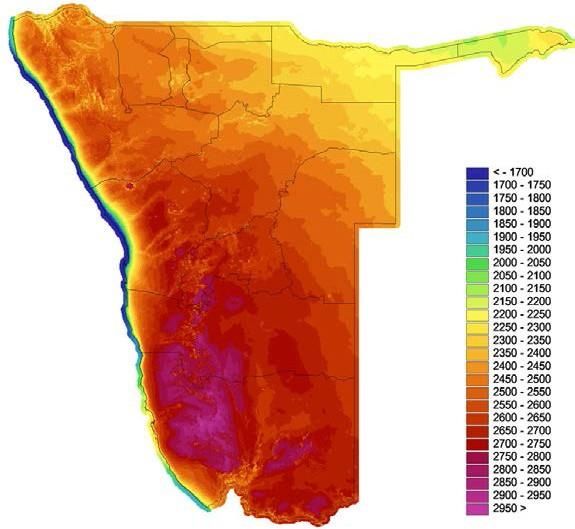
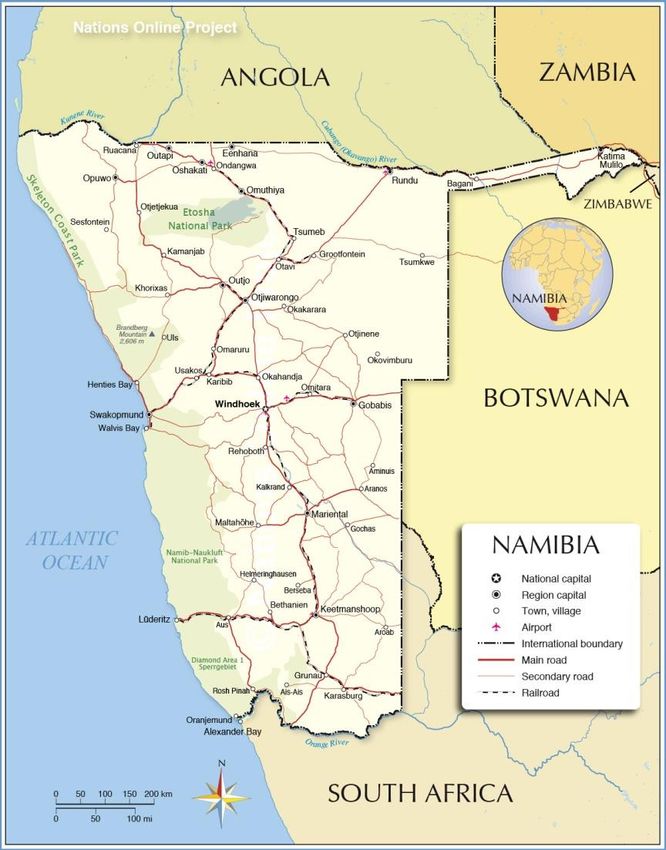
Facts about Namibia

          • The Republic of Namibia is situated
            in South-West Africa.
          • It is a vast, sparsely populated
            country with 2.3 million people.
          • With a surface area of 824,292 km2.
          • It has a 1,500 km long coastline on
            the South Atlantic Ocean.
National context

• The electricity demand through the national grid is supplied by
  domestic electric power plants (thermal and large- scale hydro).
• 41 % of Namibia’s electricity demand is supplied by domestic
  power plants;
• 59 % of electricity imported from the Southern African Power
  Pool (SAPP) member countries.
        -About 16 per cent of rural households
        -54 per cent of rural schools
        -59 per cent government buildings
Solar energy potential in Namibia • Solar energy potential is the most abundant renewable energy source in Namibia. • The country has an excellent sunshine regime, which can produce annual energy yields of between 1,600 kWh/kWp in coastal areas and up to 2,100 KWh/kWp in the southern part of the country.
Objectives of our NAMA
• Improve electricity access

• Improve the share of renewable energies

• Reduce GHG emissions

• Provide conditions for income generation and new business
 opportunities

• Increase private sector involvement

• Achieve additional SD benefits
Intervention areas
• Intervention A : Establishment of renewable energy based (solar,

 wind, hydro) mini grids in rural communities to provide services to

      • Households

      • Rural Productivity Zones (RPZ)

      • Public buildings

Intervention B: To support the installation of Energy Zones.

• The intervention B will promote new entrepreneurial activities-
 electricity for Internet cafes, sewing workshops, ice-making, agro-
 processing, etc.
Target of interventions • NAMA aims to establish 10 mini grids and 13 Energy Zones, under first phase of implementation. • This will provide electricity to around 1,400 households. • Estimated annual electricity generation under Intervention A is 110,000 kWh, while under intervention B it is18,000 kWh • Over the 15-year lifetime of the NAMA, around 80 new enterprises will be established through these two interventions. • Emission reductions will reach around 20,000 tCO2e over the 15-year lifetime of the NAMA.
Sustainable Development Benefits
Intervention A
                                                   Baseline value   Project value (assumed for 1
Parameter
                                                                                MG)
Number of health clinics electrified                      0                      1
Number of households electrified                          0                     100
People with access to RE electricity                      0                     600
Number of schools electrified                             0                      1
New income-generating activity (businesses)               0                      5
Number of new jobs (total)                                0                      2
Number of new jobs for women                              0                      1

Intervention B
Parameter                                          Baseline value   Project value (assumed for 1
                                                                                MG)
Households having access to electricity services          0                     30
People with access to RE electricity services             0                     180
Number of new women enterprises in the EZ                 0                      1
New sales point for RE&EE technologies                    0                      1
New income-generating activity (business)                 0                      2
National development strategies & Policies • Vision 2030 • The Fourth National Development Plan 2012/2013-2016/2017 • Off-Grid Energisation Master Plan (OGEMP) • The White Paper on Energy Policy 1998 • Rural electricity Distribution Master plan for Namibia 2010 • National Integrated Resources Plan (NIRP) 2013
Institutional arrangement
• Implementation will be led by the Ministry of Environment as
 the NAMA Coordinating Authority.
• The Environmental Investment Fund (EIF) will be the
 implementing entity supported by the Namibia Energy Institute
 (NEI).
• The Namibia Climate Change Committee (NCCC) will
 act as the supervisory board for the NAMA.
• NAMA Executing Entities (NEEs) are the companies and/or
 institutions which will implement projects under the two
 interventions. Each NEE will implement projects in compliance
 with the rules
NAMA Cost and Finance
The NAMA will be co-financed by the Government of Namibia
and international support partners.

National Finance: it is proposed that national finance will include
financial flows related to capacity building, grant contributions and
payments by customers.
International Finance: will be used for direct investment grants
in Interventions A and B.
• The contributions will be channelled directly from the partners
   to the NIE, to Executing Entities (EE) in both Intervention A and
   Intervention B.
• Total costs of the NAMA are estimated at around US$14 million.
   Namibian Government will contribute around 30%, 15% from
   private sector & 55% from donors.
Implementation steps and timeframe
Target                                           Timeline
Establishment of Institutional Structure         December 2015
National and International Financing             June 2016
Intervention A
Elaboration and promotion of tender              March 2016
Registration of potential NEEs                   September 2016
Publication of tender                            December 2016
Information activities and support               June 2017
Submission of proposals                          September 2017
Evaluation of proposals                          December 2017
Approval of proposals                            March 2018
Disbursement of funds                            Onward June 2018
Intervention B
Creation of long-list                            March 2016
Information for potential Energy Zone partners   March 2017
Expression of Interest                           June 2017
Evaluation of long-list                          September 2017
Selection of Energy Zones                        December 2017
Approval of proposals                            March 2018
Disbursement of funds                            Onward June 2018
MRV Plan and sustainable development

The MRV system focus
• Emission reductions: (UNFCCC) “Small-scale Methodology:
  AMS-I.L.: Electrification of rural communities using renewable energy,
  Version 03.0” will be used to monitor GHG emission reductions.

• Sustainable development: Sustainable Development Evaluation
 Tool (SD Tool) developed by UNDP will be used. The SD Tool divides
 the SD indicators into four different domains: environment; social;
 growth and development; and economic.
Where can you find more about our
                NAMA?
NAMA news:
http://namanews.org/news/2015/07/21/green-energy-in-rural-
namibia-getting-up-and-running/
UNFCCC-NAMA Registry:
http://www4.unfccc.int/sites/nama/_layouts/un/fccc/nama/Nama
SeekingSupportForPreparation.aspx?ID=123&viewOnly=1
UNDP:
http://www.undp.org/content/undp/en/home/librarypage/en
vironment-energy/mdg-carbon/NAMAs/nama-on-rural-
development-in-namibia-through-electrification-wit.html
National Contact
Mr. Paulus Ashili
Mitigation Lead focal point, DNA Namibia,
Ministry of Environment and Tourism
Phone: +264 612 842 568
paulusashili80@gmail.com/PaulusYou can also read


