SANOCEAN: the latest example of South Africa - Norway STI cooperation - SANOCEAN Launching Conference Port Elizabeth, 25-26 March 2019
←
→
Page content transcription
If your browser does not render page correctly, please read the page content below

1

SANOCEAN: the latest example
of South Africa – Norway STI
cooperation
SANOCEAN Launching Conference
Port Elizabeth, 25-26 March 2019
Jan Montevede Haakonsen, RCN
Teuns Phahlamohlka, NRF

25.03.2019

SANOCEAN, Launching Conference 2019
OVERVIEW:
• Background Information to the collaboration;
• Different funding instruments
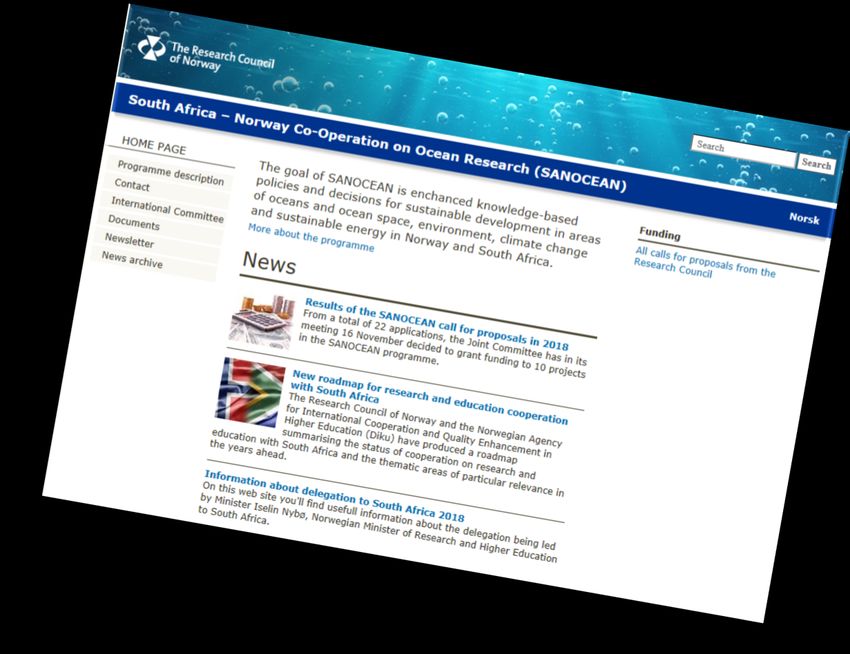
• SANOCEAN objectives & modalities;
• SANCOOP review;
• SANOCEAN Launching Conference Objectives

                                                 2
Norway and South Africa at a glance
A quick overview of NO – SA S&T cooperation Pre-1994: NO support higher education to exiles 1990’s: Bilateral institutional agreements, NUFU Nov. 2001: 1st Business Plan Norad – DACST/DOE Feb. 2002: First call of proposals under new bilateral programme May 2002: Sci. & tech. co-operation agreement May 2006: Business Plan II / Call for proposals Nov. 2009: NO State visit to SA Aug./Sep. 2011: SA State Visit to NO Sep. 2011: SA state visit to NO Feb. 2013: Signing of SANCOOP Agreement Nov 2013: HLC consultations i Norway Dec. 2013: Allocation of 19 SANCOOP grants May 2015: RCN participation in ESASTAP 2020 consortium June 2015: Decision to appoint Science Counsellor Apr. 2016: STI Counsellor to take up his post Oct/Nov 2016: SA – NO Science Week 2017: Preparation of new Framework Agreement (2018 – 2023) Dec. 2017: Second SA – NO Science Week Feb. 2018: Signing of SANOCEAN Framework Agreement
Norway – Research Cooperation Index
    Finland
   Denmark
    Sweden
       India
      Brazil
South Africa
      Japan
     Russia
      China
     France
  Germany
         UK
       USA

               0   0.5   1   1.5   2   2.5   3   3.5   4
Joint Publications Norway-South Africa
250

200

150

100

50

 0
         1994 1995 1996 1997 1998 1999 2000 2001 2002 2003 2004 2005 2006 2007 2008 2009 2010 2011 2012 2013 2014 2015

      Kilde: Web of Science bearbeidet av NIFU
Multilateral programmes and European Partnerships

                                           1
                                           2

         Research councils                 3
          from different                   4
             countries
                                           5
                                           6
                                           7
                                           8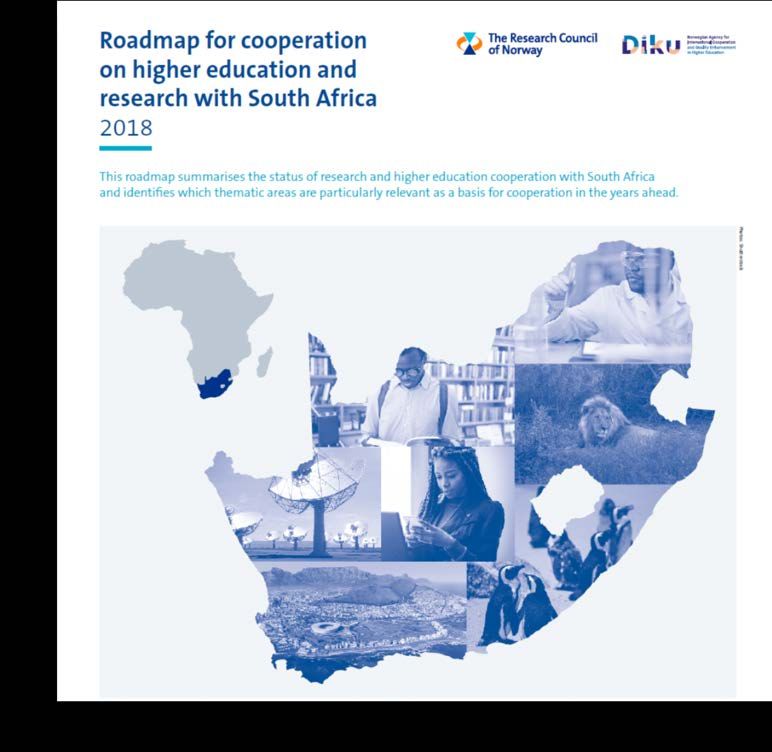
RCN’s international involvement

Instruments
• Horizon 2020
• Multilateral research programs
• Bilateral cooperation
High success rates in European Union
Research Programme

               31%

                               32%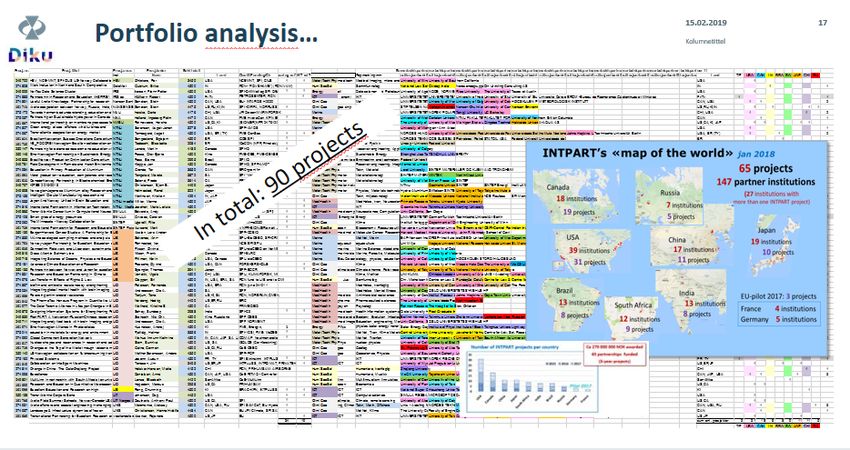
European Union Collaborative Instruments:
Bilateral cooperation
Brazil, Canada, India, Japan, China, Russia,
South Africa and USA.

Why South Africa?
• Parliamentary decision to prioritise 8 countries
  outside EU
• Collaborate with top research groups
• SA “most scientifically advanced in Africa”
• Further reinforced by Government’s «Panorama»
  strategy for collaboration with BRICS countries and
  Japan (Oct. 2015)
INTPART - International
Partnerships in Excellent
Education and Research
• Develop world-class research and
  education – through international
  partnerships.
• Enable long-term institutional
  partnerships.
• Strengthen integration of higher education
  - and research activities.
• Next call: June 2019 with application
  deadline 25 September
What can be funded in INTPART projects?

• Joint courses, seminars and educational programmes within the framework of
  the partnerships
• International joint degrees
• Mobility of students and researchers, as well as structures that support mobility
• Joint articles and publications between researchers and/or students in the
  partnerships
• New common research funding is one result!
• Cooperation with the business and public sectors, and innovation-oriented
  activities.
Targeted bilateral cooperation programmes

                                      Programme                                   South African      Norwegian
                                                                                  Contribution*     Contribution

         2002 – 2006 (1st Business Plan)                                             ZAR 3 mill. NOK 30 mill.

         2006 – 2011 (2nd Business Plan)                                             ZAR 6 mill. NOK 40 mill.

         2013 – 2017 (3rd programme – SANCOOP)                                       ZAR 10 mill. NOK 40 Mill.

         2018 – 2023 (4th programme – SANOCEAN)                                      ZAR 15 mill. NOK 30 mill.

         Total                                                                       ZAR 34 mill. NOK 140 mill.

 Have supported a total of 96 research projects, including the 10 SANOCEAN projects
         * In addition, South Africa contributed all administrative costs (salaries, travel, external experts, etc.)
Why SANOCEAN?
TEAM NORWAY

   In collaboration with
27.03.2019      18

                                                        Kolumnetittel

SANOCEAN 2018-2023
• The granted projects will start in 2019
• No more call for proposals in the programme periode
Background Information to SANOCEAN
SANOCEAN (2018 - 2023)
Key dates:
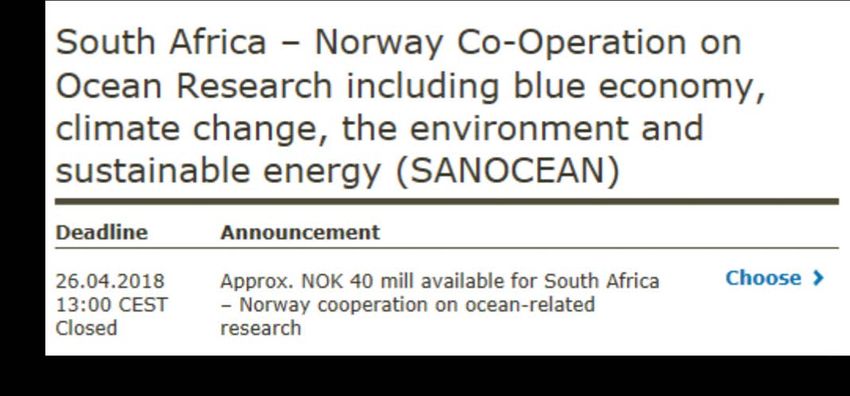
Call opened: 15 February 2018
Call closed: 25 April
International Committee & JC meeting for funding decision: November 2018
SANOCEAN Launching Conference 25 – 27 March 2019
19SA-Norway S&T Collaboration
• SA through the DST and the NRF has a long-term S&T collaboration with
Norway mainly through the Research Council Norway (RCN). The
collaboration is mostly through the joint funding of collaborative research
projects between the researchers.
• The bilateral has aimed to build S&T research capacity within the different
thematic areas.
• About 86 joint research projects and students’ training have been
supported through the bilateral cooperation in previous programmes.
20From SANCOOP to SANOCEAN
• SANCOOP, the third of these programmes,, was successfully reviewed
and the review was to assess the programme so as to inform a possible
follow-up Programme for the period 2018-2022.
• The outcomes of this review were quite positive highlighting a consistent
increase in the joint publications between the PIs with some of the projects
leading to further grant awards under the EU H2020 Programme.
21SANOCEAN Objectives
• Enhanced knowledge in the areas of oceans and ocean space (blue
economy), environment (with emphasis on oceans and pollution), climate
change and sustainable energy in both countries;
• Contribute to expanded research opportunities and improve research
cooperation;
• Sustainably strengthen quality research and capacity building both at
institutional and individual levels;
• Income and young entrepreneurs generation; and
• Contribute to achieving the Sustainable Development Goals (SDGs).
22SANOCEAN’s modalities
• exchange of project staff and post graduate students;
• exchange of scientific and technological information and
documentation;
• joint laboratory and field work;
• provision of equipment grants (only for disbursement to South African
institutions);
• dissemination of research findings; and
• joint participation in international research programmes.
23SANOCEAN modalities continued!
• mandatory participation in the SANOCEAN launching and concluding
conferences;
Multi- and interdisciplinary research is encouraged and funded projects will
be in the thematic areas of:
• Ocean Space and the Blue Economy;
• Climate System and impacts on society;
• Sustainable Energy; and
• Environment
24The objectives of the Launching Conference
• To allow research discussions and study visits/ field trips and excursions;
• The 10 funded joint projects, and researchers working within the area of
ocean research (including blue economy, climate change, the environment
and sustainable energy) will jointly, plan map out the targets and timelines
for their projects and network with the relevant stakeholders;
• To present the SANOCEAN projects to various stakeholders of the
programme, including the DST, the Embassy, the implementing agencies
(NRF and RCN) and any other interested parties;
• To create opportunities for collaborations between projects funded under
the programme;
25The objectives of the Launching Conference cont!
• To give an opportunity to discuss projects’ objectives and how to
achieving them;
• To allow researchers to share and discuss their proposals with their peers
both within SANOCEAN and other ocean-related STI representatives;
• To make indications of capacity building especially students ’involvement;
and
• To discuss how the bilateral cooperation can create synergies that can
help achieve the expected outcomes and innovation.
26Thank you for your attention Any questions?
You can also read


