NOTIFICATION OFFICE OF THE LOCAL COORDINATOR - Guru ...
←
→
Page content transcription
If your browser does not render page correctly, please read the page content below
OFFICE OF THE LOCAL COORDINATOR
  GLOBAL INITIATIVE FOR ACADEMIC NETWORKS (GIAN)
     GURUJAMBHESHWAR UNIVERSITY OF SCIENCE
      AND TECHNOLOGY HISAR-125001 (HARYANA)

                    NOTIFICATION
The Vice-Chancellor, on the recommendations of Local
Coordinator, GIAN has been pleased to approve the following
‘Scheme and Guidelines‘ to enable the teachers and scholars to
actively participate in this innovative GIAN Scheme Phase-III
sponsored by the MHRD, Government of India, New Delhi for
which our University has been nominated by the MHRD and IIT
Kharagpur. Hence, it may be brought to the notice of one and all.

               ‘SCHEME AND GUIDELINES‘
A.) BRIEF PLAN OF IMPLEMENTATION: GIAN SCHEME PHASE-III
  I. DATES OF PROPOSAL SUBMISSION
   a) Opening of portal for proposal submission : September 1, 2019
   b) Closing of portal for proposal submission   : October 15, 2019
  II. ELIGIBILITY OF PARTICIPATION
   a) All Institutions which had already participated successfully in
      GIAN Phase-I and GIAN Phase–II
   b) b. All Institutions which are in top 200 in NIRF overall rankings
      and having at least NAAC ‘A’ grade (3.0 and above)
  III. PROPOSAL FORMAT AND FUNDING
   a) All course proposals should have minimum 5-day duration.
   b) Minimum number of lecture hours (excluding tutorial/practical)
      should be 12 hrs.
c) Normally, course proposals are expected to be between 12-14
lecture hours in 5-day duration and 24-28 hours in 10-day
duration.
d) Minimum 8000 dollars (for 12-14 lecture hours in 5-day duration)
and maximum 12000 dollars (24-28 hours in 10-day duration) will
be paid for each course to support (i) travel and honorarium for
the foreign faculty (ii) honorarium for the host faculty & local
coordinator (iii) video recording (iv) incidental/contingency
expenses.
e) Course having more than 10-day duration/ 28 lectures may be
allowed with no extra financial support.
f) Course proposals should have mass appeal and shall be amenable
for conversion to MOOC. Necessary consent for this purpose from
the foreign faculty/expert should be explicitly included in the
proposal.
g) An institute is permitted to submit maximum 50 proposals with
maximum two proposals per host faculty/course coordinator.
h) Association of each foreign faculty/expert would be restricted to
maximum two distinctly different proposals.
i) Minimum 60% of the course including lectures and tutorials
should be taught by the foreign faculty.
j) Till date Rs. 68/ dollar was paid for each course. Now, this may
be set at current rate of Rs. 71 per dollar.
k) Contingencies and other expenses (excluding travel and
honorarium of foreign faculty) should not exceed 35% of the total
fund provided for a course.
l) A maximum of Rs. 5000/- per course may be earmarked (From
MHRD Grant) to the local coordinator for office expense and
honorarium, from the contingency expense of the course.
m) The National faculty / host faculty may get honorarium at the rate
of 3000/- per lecture hour and 2500/- per tutorial hour for a
course, subject to a maximum of total 12 lectures /tutorials. This
GJUS&T-HISAR : SCHEME AND GUIDELINES OF MHRD-GIAN PHASE-III
Page 2 of 29should be within the approved maximum allotment of 8000/12000
dollars for a course.
n) Optional conversion of GIAN courses to MOOC format will be
taken as an input during proposal submission. If the proposal is
approved, two sanction letters, one for GIAN and other for MOOC
will be generated by National Co-coordinating Institute.
Preference will be given to those proposals, which are having
MOOC conversion possibility. Cost of MOOC conversion will be
transferred to the concerned Institutes to be utilized as per the
Swayam Guidelines.
o) All other existing GIAN guidelines for proposal submission will also
continue to be applicable in GIAN phase III.
IV. PROPOSAL REVIEWING MECHANISM
a) Each proposal will be reviewed by reputed expert selected by the
chairperson of the concerned sectional/review committee.
b) Each reviewer would be paid Rs. 2000/- per review to be
completed within 3 weeks.
c) Chairperson of the sectional committee would be paid Rs. 500/-
per proposal for coordinating the review process and timely
recommendation of the proposal to the national coordinator.
d) Recommended proposals will be approved by the GIAN
implementation committee chaired by the Secretary(HE), MHRD
e) Sanction order for the approved courses will be issued by the
National Co-coordinating Institute
f) In case of MOOC conversion of an approved GIAN course, a
separate sanction order will be issued by the national coordinating
Institute
g) All other existing GIAN guidelines for proposal review will also
continue to be applicable in GIAN phase III.
GJUS&T-HISAR : SCHEME AND GUIDELINES OF MHRD-GIAN PHASE-III
Page 3 of 29V. CONDUCT OF APPROVED COURSES BY THE HOST INSTITUTES
Host Institute should take responsibility of the following:
a) Holding/organizing the approved courses as per the scheduled
date and duration of the proposals.
b) Video recording of all courses.
c) Registration of participants through the GIAN portal.
d) Conduct of examination for participants wishing to get graded for
the course.
e) Course lectures may be telecast through the Swayam Prabha
Channels for which the EMRCs may be authorized/ equipped by
providing inputs as desired. Necessary consent from the faculty
should be obtained for telecasting the lectures through Swayam
Prabha Channels.
f) Feedback of participants should be made mandatory. Participants
should give online feedback through the GIAN portal only.
g) The completed courses, for which MOOC conversion is approved,
should be converted to MOOC courses within three months either
using their own capability or utilizing resources of nearby
institutes having MOOC conversion facility.
h) Course coordinator/ local coordinator of the Host Institute should
submit the Online Course completion report.
i) Course coordinator/ local coordinator of the Host Institute should
submit the online fund utilization certificate for each course.
j) All other existing GIAN guidelines for conduct of approved GIAN
courses will also continue to be applicable in GIAN phase III.
GJUS&T-HISAR : SCHEME AND GUIDELINES OF MHRD-GIAN PHASE-III
Page 4 of 29B.) GIAN-MHRD SCHEME PHASE-III : THE DETAILED GUIDELINES
“The Scheme and Guidelines for University’s Global Initiative for
Academic Networks (GIAN) Scheme w.e.f. the Session 2019-20”
I. Backdrop to GIAN Scheme: Education aimed at tapping the
talent pool of scientists and entrepreneurs, internationally to
encourage their engagement with the institutes of Higher Education
in India so as to augment the country's existing academic resources,
accelerate the pace of quality reform, and elevate India's scientific
and technological capacity to global excellence. In order to garner
the best international experience into our systems of education,
enable interaction of students and faculty with the best academic
and industry experts from all over the world and also share their
experiences and expertise to motivate people to work on Indian
problems, there is a need for a Scheme of International Summer
and Winter Term. During the 'Retreat' of IITs with the then Minister
of Human Resource Development on 29th June, 2014 at Goa, it was
decided that “A system of Guest Lectures by internationally and
nationally renowned experts would be evolved along with a
comprehensive Faculty Development Programme not only for new
IITs, IIMs, IISERs but also other institutions in the country. GIAN is
envisaged to catalyse higher education institutions in the country,
and that it will initially include all IITs, IIMs, Central Universities,
IISc Bangalore, IISERs, NITs and IIITs subsequently cover good
State Universities where the spinoff is vast.
GJUS&T-HISAR : SCHEME AND GUIDELINES OF MHRD-GIAN PHASE-III
Page 5 of 29II. MHRD Scheme on International Summer/Winter Term
(ISWT) under GIAN: The Ministry of Human Resources
Development (MHRD), Government of India has approved a new
program titled Global Initiative of Academic Networks (GIAN) in
Higher Education. It envisaged achieving the following objectives:
1. To increase the footfalls of reputed international faculty
in the Indian academic institutes.
2. Provide opportunity to our faculty to learn and share
knowledge and teaching skills in cutting edge areas.
3. To provide opportunity to our students to seek
knowledge and experience from reputed International
faculty.
4. To create avenue for possible collaborative research with
the international faculty.
5. To increase participation and presence of international
students in the academic Institutes.
6. To create opportunity for the students of different
Institutes/Universities to interact and learn subjects in
niche areas through collaborative learning process.
7. To provide opportunity for the technical persons from
Indian Industry to improve understandings and update
their knowledge in relevant areas.
8. To motivate the best international experts in the world to
work on problems related to India.
9. Develop high quality course material in niche areas, both
through video and print that can be used by a larger
body of students and teachers.
10. To document and develop new pedagogic methods in
emerging topics of national and international interest.
III. The Broader Guidelines of GIAN Scheme : GIAN is an evolving
scheme which will initially include participation of foreign faculty in
Institutes as Distinguished / Adjunct / Visiting faculty / Professors of
GJUS&T-HISAR : SCHEME AND GUIDELINES OF MHRD-GIAN PHASE-III
Page 6 of 29Practice, etc., to participate in delivering Short or Semester-long
Courses. Other activities will be included in due course. The broader
framework is as follows:
1. What to be Done by Academic Institutions Admitted
Under GIAN : Academic Institute/Universities will identify
one or more subjects to be offered in this MHRD scheme.
This subject typically should not be offered in the regular
semesters/year and can be interdisciplinary/industry
oriented/ research oriented in nature and scope.
2. The Course Timings: Subjects should be offered in the
Summer and Winter vacation of the host Institute.
3. Duration of Course: The duration (number of
weeks/days) can be mutually decided by the host institution
and the visiting faculty.
4. Who can be Invited: Each subject should be taught by at
least one reputed international faculty jointly with one
faculty from the host Institute. One additional faculty may
be associated from another academic/ research organization
in India.
5. Academic Repute of Invited Faculty: The international
faculty should be:
a) An expert in the area specified in the subject.
b) Working in academic institutions / industry /
research organizations / independent researcher of
international repute.
c) Encouraged to engage in a long-term collaborative
research programme with faculty members of the
host Institute.
6. Broad Area of Interest: The GIAN proposal should be in
one of following areas:
a) Physical Sciences
b) Chemical, Bio-Chemical & Material Sciences
GJUS&T-HISAR : SCHEME AND GUIDELINES OF MHRD-GIAN PHASE-III
Page 7 of 29c) Mathematical & Computer Sciences
d) Life Sciences & Healthcare
e) Electronics, Electrical, Information &
Communication Technology
f) Mechanical Sciences & Infrastructure
g) Earth & Environment Sciences
h) Management
i) Social Sciences
j) Humanities & Liberal Arts
k) Architecture, Design, Planning and Heritage
l) Law
m) Other Interdisciplinary categories
7. Each subject should be designed as per following:
Duration of a lecture hour: one hour. Total number of
lectures: 30 Maximum lectures per day: 3 lectures and / or
tutorials (e.g. 2 lectures and 1 tutorial). Total duration: 10
working days. However, University may design one-week
course in which there can be 15 maximum lectures and that
may be conducted in 5 working days.
8. Credit Transfer Mechanism: The students can also
obtain academic credits for these subjects based on the
evaluation and grading process and agreed credit transfer
mechanism between that host institute and the home
institute of the students. The home university of the student
will be mainly responsible for transferring academic credits.
The host institute will only provide information on the
grading system, subject syllabus, and the academic policy.
9. Registration of Participants: A number of course should
be taught by the Institute during the International
Summer/Winter term. The participants have to register for
the subjects offered in this International Summer/Winter
GJUS&T-HISAR : SCHEME AND GUIDELINES OF MHRD-GIAN PHASE-III
Page 8 of 29Term (ISWT) scheme with payments of registration fee plus
the subject fee for each subject registered. While, the
registration fee would be a nominal fee for registering for
the course, once selected, the subject fee would depend on
the number of subjects, the participants chooses to take.
10. Local GIAN Course Participation Fee: In case of one-
week GIAN Course, the Participation Fee (excluding One-
time Online Registration Fee to be paid at National GIAN
Portal) will be Rs. 3000/- per academic participant (Rs.
12,000/- per participant if he/she is from Industry),
however, for two-week GIAN Course, the Local Registration
Fee will be Rs. 5000/- per participant for academic
participant (Rs. 18,000/- per participant if he/she is from
Industry). Such fee may be received by either Online (the
Bank Account Number have to be provided by the Accounts
Branch) or it may be received through ‘Demand-Draft’
drawn in favour of Registrar GJUS&T, Hisar, payable at
Hisar. After meeting all the legitimate approved
expenditures from a particular Course’s Participants Fees. if
some unspent balance is available, the same may be
transferred to University Account as a token infrastructure
charges. However, the Vice-Chancellor on the
recommendation of Local Coordinator, GIAN, can give the
students of the host department some concession in
participation fee.
11. Number of Participants: Each course should have
normally 50 participants. Preferably at least 30 participants
should be teachers and students from other institutions,
among whom at least 20 should preferably be teachers
from other Institutions.
12. Completion Certificates with Grades: After successful
completion of the subject, all participants, will get subject
participation certificates. Those participating in examinations
will get completion certificates with grades and credits.
GJUS&T-HISAR : SCHEME AND GUIDELINES OF MHRD-GIAN PHASE-III
Page 9 of 2913. Development of Repository: Host Institution will seek
prior approval from all speakers for dissemination, archival
and creation of repository of the activities conducted. A
digital repository of the activities under GIAN will be kept.
All permitted courses will be archived by the host institution
and made available for dissemination. One copy will also be
provided to the National Digital Library. Subsequently these
may be used as part of various activities under various on-
line programmes of MHRD.
14. Honorarium to International Faculty: A maximum
amount of US$ 8000 for 12 to 14 hours of lectures and US$
12000 for 20 to 28 hours of lectures will be paid to the
International experts covering their travel, honorarium and
video recording of their Lectures. Local hospitality will be
arranged by the Host Institution.
15. TA/DA to International Faculty: The invited
International faculty will be paid Travelling Allowance either
as per actual bill of Taxi produced by the International
faculty from Airport/Railway Station to our University (To
and Fro both) in case he/she travels own his/her or Rs. 16/-
per Km (To and Fro both) if the Local Coordinator/Course
Coordinator has arranged taxi to receive the International
Faculty from Airport/Railway Station to our University. When
the Invited International Faculty would depart after
completion of GIAN Course, the same amount (either of two
option exercised by the Invited International Faculty) will be
paid as travelling expenditure.
16. Local Hospitality to International Faculty: The Daily
Allowance will not be paid the Invited International Faculty
as the host institution will have to take care of his/her local
hospitality including boarding and lodging during his/her
stay in the University. Further, the food arrangements for
Invited International Faculty have to be made as per his/her
food habits and if necessary the food-arrangements may be
made outside the University preferably at Government
GJUS&T-HISAR : SCHEME AND GUIDELINES OF MHRD-GIAN PHASE-III
Page 10 of 29resorts like Blue-Bird or Flamingo and like. However, the
stay arrangements may be made at University Guest House.
17. Honorarium to University Local Coordinator, Course
Coordinators/Co-Coordinator: A maximum amount of
Rs. 25,000/- per Course (including Rs. 5000/- per course
from out of MHRD Grants and balance from fees collection
only) may be paid to each the University Local Coordinator
and Course Coordinator respectively. However, in case of
Co-Coordinator/Deputy Coordinator of Course, a maximum
amount of Rs. 15000/- per Course will be paid to each Co-
Coordinator or Deputy Coordinator of Course. This
honorarium to Local Coordinator, Course Coordinators, Co-
Coordinator/Deputy Coordinator will be paid out of fee-
collection (except Rs. 5000/- per course from out of MHRD
Grants to Local Coordinator) amount duly received from the
admitted participants for the particular GIAN Course.
18. Honorarium to Supporting Staff and Audit Staff: The
supporting staff, maximum one person for one Course, will
be deputed by the Course Coordinator on the
recommendation of Deputy/Assistant Registrar Accounts
Branch and he/she will assist the Course Coordinator and
will take care of all Filings/Noting, Registration of
Participants, Documentations, Procedures in Payments,
Purchases, Audit and Accounts including Advance
Adjustment and Utilization Certificate. Such supporting staff
may be paid an honorarium of Rs 6000/- per Course from
out of fee-collection from the participants for the particular
Course. Further, one technical staff may be engaged by the
Course Coordinator on the recommendation of Head, UCIC.
He/she will be responsible for all kind of technical support
including Live-Webcasting of particular GIAN Course,
therefore, such technical staff may be paid maximum of Rs.
3000 per Course under GIAN from out of fee-collection
from the participants for the particular Course.
GJUS&T-HISAR : SCHEME AND GUIDELINES OF MHRD-GIAN PHASE-III
Page 11 of 2919. Tax deduction at Source: If the Invited Foreign Faculty
under GIAN Course is subject to Income Tax Assessment in
India, at least 10% of his honorarium may be deducted as
TDS and Form 16A should be issued to the Invited Foreign
Faculty by the University. If the Invited Foreign Faculty
undertakes in-writing that he/she, as assessee, is not
subject to Income Tax Assessment in India, the clause of
TDS should not be insisted upon owing to the underlying
spirit of Income Tax Act, 1961.
20. International Faculty: Distinguished International
Faculty identified by the International Advisory Committee /
GIAN Implementation Committee / Participating Institutes /
various International Academies / Missions abroad and
approved by the GIAN Implementation Committee have
agreed to participate in the GIAN programmes at regular /
annual / bi-annual periods. Their programmes will be
developed by the National and Group Coordinating
Institutes or Members of the GIAN Implementation
Committee in consultation with the International Advisory
Committee.
21. Faculty / Expert from outside India: Foreign
faculty/experts from academic Institution, research
organization and Industry are welcome to participate in the
GIAN program. They can either submit a course proposal in
the format / template available at GIAN portal or send their
expression of interest to take part as International faculty
to the National Coordinator, GIAN.
IV. The Procedure for GIAN Implementation at Local University
Level: Proposal to offer a subject in the Template-Performa
available at GIAN portal should be submitted to local coordinator of
Institute. The procedure shall be as follows:
1. GIAN Course Proposal through Online National
Portal: All such proposals once approved by the
MHRD/National Coordinator/ Group Coordinator will be
GJUS&T-HISAR : SCHEME AND GUIDELINES OF MHRD-GIAN PHASE-III
Page 12 of 29implemented through the Local Coordinator and Advisory
Committee by the Course Coordinator in the respective
department.
2. GIAN Course Proposal Approvals: All necessary
approvals will be sought by the Course Coordinator from the
Vice-Chancellor through the Local Coordinator.
3. GIAN Course Payments/Utilization: The
payment/utilization process will be assisted by the Assistant
Registrar (Accounts) in consultation with the Local
Coordinator/Course Coordinator.
4. GIAN Course Financial Records: All records of financial
assistance received and expenditures made will be
maintained in the appropriate grants register by the
Accounts Branch itself.
5. GIAN Course Academic Records: The meetings, agenda,
proceedings and other documentary records of Advisory
Committee will be duly maintained by the Academic Branch.
6. GIAN Course Financial Powers: The financial power of
Local Coordinator and Course Coordinator will be same as in
case of Chairperson and Principal Investigator, from time to
time, respectively in the University.
7. GIAN Course Temporary Advances: The Course
Coordinator will withdraw, through Local Coordinator, two
different temporary advances one from the grant received
from IIT-Kharagpur (National Coordination GIAN) and
another from participation-fee received for the particular
GIAN Course.
8. GIAN Course Advances Adjustments and Utilization:
The Course Coordinator will submit the Utilization
Certificated, duly audited by the Local Audit, within one
month of the particular Course completion.
9. GIAN Course Online Payment System: Keeping into
‘Digital India’ headway, therefore, no APR be insisted upon
GJUS&T-HISAR : SCHEME AND GUIDELINES OF MHRD-GIAN PHASE-III
Page 13 of 29by the Audit and Accounts if all Online Payment are made
through digital mode including RTGS, NEFT, IMPS, MMID
and like. However, the legitimate evidences/proofs of such
digital payments have to be produced by the Course
Coordinator for the satisfaction of Local Audit and Accounts
Branch.
10. GIAN Course Miscellaneous/Unforeseen Issues: Any
unforeseen process or procedures, during the
implementation of GIAN-Scheme, will be finally
interpreted/approved by the Vice-Chancellor in the
guidelines of GIAN and on the recommendation of Local
Coordinator, GIAN.
V. Role of the Local University Coordinator: For this GIAN-
Scheme, selected Universities/ Institutions have been shortlisted for
extending the benefits of this scheme and for that purpose a senior
Professor is to be appointed as Local Coordinator by the respective
university/institution. Presently, Guru Jambheshwar University of
Science and Technology, Hisar has Appointed Prof. Karam Pal
Narwal, Haryana School of Business, Guru Jambheshwar University
of Science and Technology, Hisar as Local Coordinator, GIAN. The
Local Coordinator is supposed to maintain the proper coordination
among all stakeholders just for the smooth implementation of GIAN-
Scheme. After login to the GIAN portal (www.gian.iitkgp.ac.in) for
the first time, the Local Coordinator us supposed to do the
following:
1. Please circulate proposal template to your faculty for submitting
proposal to you. The proposal template can be downloaded from
the download section.
2. In the Menu of Local Coordinator, select Invite Proposal and type
course coordinator's email id and click Invite Proposal. The email
of Course Coordinator should be authentic. The course
coordinator will receive a mail including a link to upload the
Proposal. The proposals to upload should be in PDF format.
3. Once course coordinator uploads the proposal and clicks Final
Submit, Local coordinator will be able to view the proposal and
GJUS&T-HISAR : SCHEME AND GUIDELINES OF MHRD-GIAN PHASE-III
Page 14 of 29accept the proposal. Local coordinator may click on Reject
button for modification and resubmission of the Proposal by
course coordinator.
4. Once the Proposal is accepted by the Local Coordinator, the
proposal is forwarded to GIAN Office for document verification.
The proposal may be sent back to Course Coordinator with
comments if the required documents are not proper. If the
proposal is in order, then the proposal is sent to the Chairman of
appropriate sectional committee for arranging review of the
proposal. The status of the proposal will change to Submitted to
Section Coordinator for Review.
5. The status for the proposal will change continuously till it is
approved by the Apex body.
6. You will receive approval mail from the National Coordinator with
a request to upload the final brochure.
7. The official signed sanction letter with details of fund sanctioned
along with terms and conditions for each approved course will
be sent to your Institute with a copy marked to you.
8. You will coordinate with the course coordinator to upload the
final brochure for the course and the final dates of organization
of the course.
9. The fund allocated for the course will be released after the
course brochure is uploaded in the portal.
10. Once the brochure is uploaded for a course, the status of the
course will change to 'Brochure uploaded' and a mail containing
login details to course registration site will be sent to the course
coordinator's email address. Please confirm from the course
coordinator regarding the receipt of the mail otherwise contact
GIAN office at gian@iitkgp.ac.in
11. While the course is running, please enter the relevant data by
clicking the 'monitoring course' in the right hand pane.
12. Course coordinator should select the participants who are
attending the course, so that participants can fill the feedback
form online before the completion of the course.
13. The required documents for each course should be sent by the
respective Course-Coordinator through Local Coordinator to IIT
GJUS&T-HISAR : SCHEME AND GUIDELINES OF MHRD-GIAN PHASE-III
Page 15 of 29Kharagpur, National Coordinating Institute, which mainly
include: (a) Course Completion Report; (b) Fund Utilization
Certificate; and (c) Detailed Income and Expenditure Statement
of Course. The required templates for the above documents can
be downloaded from the download section.
14. In case you want to postpone a course because of non-
availability of the foreign expert or any other reason, you should
click 'Postpone' button against that course. The status of the
course will be automatically changed in the 'Upcoming Courses'
as postponed course.
15. In order to resume a course after postponement or reschedule a
course, you should upload the brochure with revised dates and
inform the GIAN office. The GIAN office will change the dates
and status of the course. For any contingency situation, the
Local Coordinator will contact the National Coordinator GIAN so
that the situation may be addressed in time. It is pertinent to
note that all approved courses of GIAN Scheme have to be
completed by 31st December every year.
16. The Local Coordinator, from time to time, may seek the advice
and academic support from the following Local Advisory
Committee of GIAN Scheme:
1. Prof. Usha Arora, Dean Academic Affairs Chairperson
2. Prof. Ashok Chaudhary, Dept of Bio & Nano Sciences Member
3. Prof. H C Garg, Dept of Mechanical Engineering Member
4. Prof. Yogesh Chaba, Dept of Computer Science & Engg Member
5. Prof. Devinder Kumar, Dept of Chemistry Member
6. Prof. Neeraj Dilbagi, Dept of Bio & Nano Sciences Member
7. Prof. Sandeep Rana, Dept of Applied Psychology Member
8. Prof. Sunita Srivastava, Dept. of Physics Member
9. Shri Mukesh Kumar, Head, UCIC Member
10. Sh. Shiv Dayal Ranga, D/R(Academic) Member-Secretary
17. The Local Coordinator GIAN will actively facilitate the respective
Course- Coordinators of GIAN Projects and guide them from time
to time for smooth implementation.
GJUS&T-HISAR : SCHEME AND GUIDELINES OF MHRD-GIAN PHASE-III
Page 16 of 29VI. Role of the Course Coordinator : A teacher who propose and
submit the course proposal under GIAN Scheme is named as Course
Coordinator and supposed to perform the following roles and
responsibilities :
1. You need to contact Local Coordinator of your Institute for
proposal submission under GIAN.
2. Once Local Coordinator invites course coordinator to submit a
proposal, the course coordinator will receive a mail including a
link to upload the Proposal. The proposals to upload should be in
PDF format.
3. The format of Foreign Faculty Consent Form should be
downloaded and sent to foreign faculty for his/her signed
consent. The scanned copy of the same should be uploaded in
PDF format while submitting the proposal.
4. Course coordinator should upload the proposal and click on Final
Submit.
5. If required, the proposal may be sent back to the course
coordinator for modification and resubmission.
6. The status of the proposal can be viewed from Proposal Tracking
link on the Home page of GIAN.
7. If the course is approved by APEX body, contact the Local
Coordinator for brochure format and further actions.
8. Once the brochure is uploaded for a course by the local
coordinator, a mail containing login details of course registration
site will be sent to the course coordinator’s email address. In
case this mail is not received, please contact local coordinator.
9. The Participants for a course will register in the GIAN
registration portal and apply for attending courses. Course
Coordinator should select the participants in the GIAN portal and
may inform the selected participants regarding mode and
amount of fee payment, course registration, venue etc. via mail
facility provided in the portal.
GJUS&T-HISAR : SCHEME AND GUIDELINES OF MHRD-GIAN PHASE-III
Page 17 of 2910. Course coordinator should select the participants who are
attending the course, so that participants can fill the feedback
form online before the completion of the course.
11. The required documents for each course should be completed
and submitted by the Course Coordinator: (a.) Course
Participation Certificate; (b.) Course Grade-Sheet; (c.) Course
Completion Report; (d.) TA Bill of Foreign Expert; and (e.) Fund
Utilization Certificate for the Course.
12. The Course Coordinator GIAN project will remain in-touch with
Local Coordinator GIAN and take required guidance from time to
time for smooth implementation.
VII. The Tentative Budget Template under GIAN : The tentative
budget outlines for one-week GIAN Course are as under:
Description of budgetary head per
S. No. Amount (INR)
Course
1. International Expert Air Fare 2,00,000
2. Honorarium to Expert (US$3300*71) 2,35,500
3. Lecture Notes/video-learning material 50,000
4. Contingency 73,500
5. Video recording expenses 40,000
6. Miscellaneous expenditure 55,000
7. Local Coordinator Honorarium 25,000
8. Course Coordinator and Staff Honorarium 50,000
(Item 1 to Item 6 should not exceed 8000 or
12000 USD)
GRAND TOTAL 7,29,000
GJUS&T-HISAR : SCHEME AND GUIDELINES OF MHRD-GIAN PHASE-III
Page 18 of 29Important Notes:
a) The honorarium is for one-week course, the actual
honorarium to be paid to the invited expert is subject to the
maximum of approved amount by the Funding Agency.
b) Actual cost could be lower or marginally higher depending
on specific proposal. The participants have to bear the food
and lodging expense during their stay in the host Institute.
c) Honorarium to Local Coordinator, Course Coordinator/Co-
Coordinator should be paid from the earning for the subject
through the fee collection.
d) A lump-sum amount of up to US$ 8000 for 12 to 14 hours of
contact and up to US$ 12000 for 20 to 28 hours of contact
can be paid to the foreign experts covering their travel and
honorarium.
e) Local hospitality will be arranged by the Host Institution.
f) The duration (number of weeks/days) can be mutually
decided by the host institution and the visiting faculty.
VIII. The VISA Guidelines for Foreign Faculty under GIAN: The
foreign academicians/ experts/faculty visiting India under GIAN
should apply for VISA for at least one month (preferably 2 months)
before the scheduled departure as per following guidelines:
1. VISA Type: Business VISA
2. Foreign Faculty should upload/submit following documents
along with the VISA application
a) Invitation letter from the host Institute/University
b) Copy of the sanction letter of the GIAN course
c) Copy of the course brochure
3. The above three documents should be provided by the Host
Institute/University.
GJUS&T-HISAR : SCHEME AND GUIDELINES OF MHRD-GIAN PHASE-III
Page 19 of 29XI. The Dedicated GIAN-Portal of the University: All above
scheme and guidelines would be made available, by the Local
Coordinator, GIAN, on the dedicated GIAN-Portal of our University at
following web link:
http://www.gjust.ac.in/gian/index.php
X. Important Documents : Following important documents are given
hereunder as ready reference for all the stakeholders:
(A) FOREIGN FACULTY CONSENT FORM
I have read the course proposal entitled submitted by of < host
Institute> under the GIAN scheme of MHRD, Government of India
and agreed to the course content and schedule. I hereby give my
consent to teach the course in the from to or any other mutually
convenient dates under the following terms and conditions:
1. The course should be approved by the GIAN Implementation
committee.
2. I do not object Video recording of my Lectures & Tutorials by
the host Institute, provided these recordings will not be used
for commercial purpose without my consent.
3. Conversion of my course lectures to massive open online
course (MOOC) format is agreed / not agreed (Default option:
not agreed).
4. The will (a) reimburse my economy class air fares and other
travel expenses (b) pay honorarium of US dollars per lecture
hour and US dollars per tutorial hour for my service and (c)
arrange for free local hospitality.
My contact details are given below:
Name: Affiliation: Phone: (Signature)
GJUS&T-HISAR : SCHEME AND GUIDELINES OF MHRD-GIAN PHASE-III
Page 20 of 29(B) UTILIZATION CERTIFICATE
Name of The Institute ………………………………………….
Utilization Certificate
Under GFR 19-A , Rule 212(1) for GIAN Programme
Sl No Letter No & Date Amount (Rs.)
TOTAL
1. Certified that out of Rs………………. of Grant–in-Aid sanctioned for the GIAN programme
in favour of (Name of the Institute) under MHRD/IIT, Kharagpur sanction vide letter Number given in
the above, a sum of Rs. ……………………. has been utilized for the purpose of GIAN Course for
which it was sanctioned and that the balance of Rs……………. remaining unutilized at the end of
the course has been surrendered to Bank Account - GIAN IIT KHARAGPUR , Number.
35639268920 (IFSC Code. SBIN0000202) vide UTR No……………… dated……………………..
2. Certified that I have satisfied myself that the conditions on which the Grant-in-Aid was
sanctioned have been duly fulfilled and that I have exercised the checks to see that the money
was actually utilized for the purpose for which it was sanctioned.
3. Statement of Expenditure and Auditors Certificate are enclosed
Prepared by: Signature :
Signature…………………………………… GIAN Course Coordinator
Name………………………………………… Designation with Seal:
Designation with Seal: Date:
(F.O./ A.O/ Equivalent officer in
Finance & Account Department)
Date:
Signature of GIAN Local Coordinator
Kinds of checks exercised
1. Ledgers.
2. Receipts and Payments Account.
GJUS&T-HISAR : SCHEME AND GUIDELINES OF MHRD-GIAN PHASE-III
Page 21 of 29Enclo: As stated above
Name of the Institute ……………………………………………………………
Statement of Expenditure under GIAN Programme
(Sanction Letter Number … ……………………………………………….. Dated……………………….)
Sl No. Head of Expenditure Amount (Rs.)
1 Honorarium to Foreign Expert
2 Travelling Expenditure of Foreign Expert
3 Expenditure on Lecture Note Preparation
4 Expenditure on Video Recording of the Course
5 Contingency & Miscellaneous Expenses
Total
Prepared by: Signature :
Signature…………………………………… GIAN Course Coordinator
Designation with Seal
Name………………………………………… Dated:
Designation with Seal:
(F.O./ A.O/ Equivalent officer in Signature GIAN LC
Finance & Account Department)
Dated:
Auditors’ Certificate
This is to certify that Grant of Rs……………given to (Name of the establishment) vide Sanction Letter
no……………………………. dated…………….. by IIT, Kharagpur for the purpose of GIAN Programme . An
amount of Rs………………… has been spent as per details given above at the end of the course. The
unspent balance of Rs…………………. at the end of the course has been surrendered to
GIAN IIT KHARAGPUR Bank A/c No. 35639268920 ,IFSC Code. SBIN0000202, vide UTR
No……………… dated………………………
We have checked all relevant vouchers, bank statements, bills, challans, letter &
correspondences regarding the GIAN Programme conducted at (Name of the establishment )and to the
best of my knowledge and belief, the aforesaid figures are correct and in conformity with the books
of accounts of the establishment.
Dated: Signature of Chartered Accountant
with seal and membership number
GJUS&T-HISAR : SCHEME AND GUIDELINES OF MHRD-GIAN PHASE-III
Page 22 of 29(C) INVITATION LETTER TO FOREIGN FACULTY
Date:
To
Dear Prof. ,
Greetings from Indian Institute of Technology Kharagpur, India.
I am happy to announce the commencement of Global Initiatives of Academic Network (GlAN),
an initiative of Ministry of Human Resource Development, Government of India, where national
and international participants will get an opportunity to seek knowledge and experience through
intensive study of subjects taught by reputed international faculty.
In this context I take great pleasure to invite you to participate in our Global Initiatives of
Academic Network (GIAN) program and deliver lectures on topics related to the course
“” from to . We believe that this course shall give an
excellent opportunity to participants from academic institutes and Industry to learn about this
unique subject from faculty of University of California, Berkley and IIT Kharagpur. lt shall also
provide the course instructor from both the Institute with a platform to initiate future teaching
and research collaboration.
Transport facility with economy class round trip air fare (preferably by Air India), all local
hospitality including rent free accommodation in our Guest House or hotel shall be provided to
ensure a smooth and comfortable stay at IIT Kharagpur. We would be honoured if you kindly
accept our invitation.
I would like to request Indian Embassy/consulate office to issue appropriate visa to (Passport Number : ------) for the period from < date> to < date> to
participate in the Global Initiatives of Academic Network (GIAN) program.
We hope that will have no difficulty in obtaining Research Visa to
take up this research and teaching assignment at IIT Kharagpur.
Thank you for your positive response and with warm personal regards,
Yours Sincerely,
GJUS&T-HISAR : SCHEME AND GUIDELINES OF MHRD-GIAN PHASE-III
Page 23 of 29(D). SPECIMEN PERFORMA FOR REPORT ON GIAN COURSE
Global Initiative of Academic Network (GIAN) Programme
< Name and address of Host Institute>
Report on Conduct of GIAN Course
Title of GIAN Course
GIAN Course ID
Period of Course to
Name and Department of Faculty from
Course Coordinator
Name
Department
Co-host Faculty, if any
Name
Department
Name and Affiliation of International Faculty
Name
Affiliation
Name and Affiliation of National Faculty, if any
Name
GJUS&T-HISAR : SCHEME AND GUIDELINES OF MHRD-GIAN PHASE-III
Page 24 of 29Affiliation
Structure of the Course
Duration of course (1 week or 2 weeks)
Number of credits (1 or 2)
Total number of lectures in the course
Number of lectures by International Faculty
Number of lectures by Host Faculty
Number of hours of laboratory/tutorial sessions
Participants of the Course
Number of student participants
Number of participants from Industry/ Research
Organisations
Number of Faculty participants
Total Number of participants
Number of participants who credited for the
course
Course Generated Fund
Sponsorship, if any (in Rs.)
Registration Fee Collected
Total amount
Interaction with International Faculty
Interaction of Host Faculty:
GJUS&T-HISAR : SCHEME AND GUIDELINES OF MHRD-GIAN PHASE-III
Page 25 of 29Interaction of other faculty from
Interaction of faculty/researchers from other institutes/organizations
Signature of Course Coordinator
Date of submission of report
GJUS&T-HISAR : SCHEME AND GUIDELINES OF MHRD-GIAN PHASE-III
Page 26 of 29(E). TRAVEL PERMISSION TO FOREIGN FACULTY
(F). SPECIMEN PERFORMA FOR FEEDBACK UNDER GIAN SCHEME
GJUS&T-HISAR : SCHEME AND GUIDELINES OF MHRD-GIAN PHASE-III
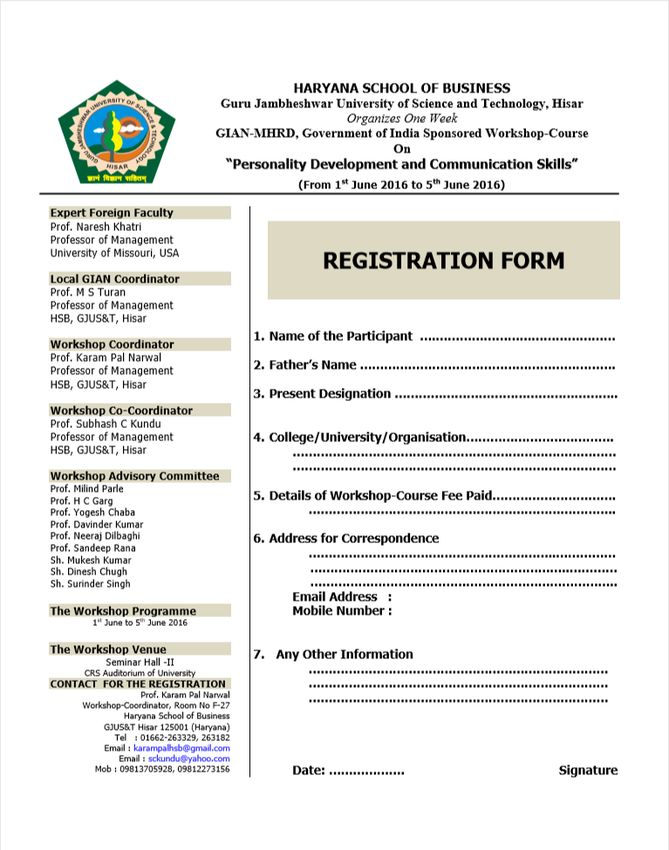
Page 27 of 29(G). SPECIMEN PERFORMA FOR REGISTRATION UNDER GIAN
LOCAL COORDINATOR, GIAN
Dated: 09-09-2019
GJUS&T-HISAR : SCHEME AND GUIDELINES OF MHRD-GIAN PHASE-III
Page 28 of 29Endst. No. Acad/AC-II/2019/GIAN/4498-4555 Dated 09-09-2019
A Copy of the above ‘Scheme and Guidelines‘ is forwarded to the
following for information and necessary action please:
1. All Statutory Officers/Directors/Deans/Chairpersons/Branch Officers,
GJUS&T, Hisar with the request to wider publicity amongst all the
stakeholders of the GIAN Scheme of the University please.
2. Head, UCIC with a request to upload these Guidelines on
University Website at appropriate places please.
3. Dy Registrar (Academic) with the request to maintain records of GIAN
Scheme related meetings, agenda, proceedigs and other
documentary records. Please.
4. Assistant Registrar (Accounts) with a request to maintain all
necessary records of financial assistance received and expenditures
made in the relevant grants register of University. Please.
5. Secy. to Vice-Chancellor (for kind information of the Vice-Chancellor),
GJUS&T, Hisar please.
6. OSD to Registrar (for kind information of the Registrar), GJUS&T,
Hisar please.
LOCAL COORDINATOR, GIAN
GJUS&T-HISAR : SCHEME AND GUIDELINES OF MHRD-GIAN PHASE-III
Page 29 of 29You can also read


