School-Age Desired Results Developmental Profile - DRDP-SA (2010)
←
→
Page content transcription
If your browser does not render page correctly, please read the page content below
Desired Results Developmental Profile
School-Age                            ©

                                            DRDP-SA© (2010)
                                            Simplified Version

       California Department of Education
       Child Development Division
       Sacramento, 2010
The Desired Results Developmental Profile – School-Age© (2010) was developed by the Center for Child and Family Studies at WestEd,
Sausalito, and the Berkeley Evaluation and Assessment Research (BEAR) Center at the University of California, Berkeley, to support the
implementation of the Desired Results system based on the guidelines and specifications of the Child Development Division, California
Department of Education. The complete DRDP-SA© (2010) is available on the Department Web site at www.cde.ca.gov and on the
Desired Results Training and Technical Assistance web site at www.desiredresults.us.

©2010 by the California Department of Education, Child Development Division
All rights reserved. Permission to reproduce only for instructional purposes.
Contents

I.     Overview of the Desired Results System................................................................................ i
II.    Introduction to the DRDP-SA© (2010)...................................................................................... i
III.   Structure and Components of the DRDP-SA© (2010)......................................................... ii
IV.    Information Page, Instructions, and Rating Record.......................................................... iv
V.     List of Measures within Domains..........................................................................................viii
VI.    DRDP-SA© (2010) Simplified Version..............................................................Measures 1-13

                       DRDP-SA Copyright © 2010 California Department of Education – All rights reserved
The Desired Results Developmental Profile© – School Age (DRDP-SA©) development of each child and to plan curriculum to support individual
assessment instrument is one of three instruments developed by the children’s learning. A teacher can use the foundations as a guideline to
California Department of Education, Child Development Division (CDE/CDD). understand the overall direction of all children’s learning in the program. A
The instruments represent the centerpiece of the Desired Results system. teacher may also use the foundations for general planning to support learning
and development.
I. Overview of the Desired Results System
The Desired Results (DR) system is designed to improve the quality of II. Introduction to the DRDP-SA© (2010)
programs and services provided to all children, birth through 12 years of age The DRDP-SA© is designed for teachers to observe, document, and reflect on
who are enrolled in early care and education programs or before- and after- the learning, development, and progress of all children in a before- or after-
school programs, and their families. The CDE’s Special Education Division has school program. The assessment results are intended to be used by the teacher
developed an accessibility instrument known as DR access. to plan curriculum for individual children and groups of children and to guide
Desired Results are defined as conditions of well-being for children and their continuous program improvement.
families. Each Desired Result defines an overall outcome. The DR system was The DR system consists of three DRDP© assessment instruments. The age
developed based on the following six Desired Results: periods are infant/toddler (birth to 36 months), preschool (three years to
Desired Results for Children kindergarten entry), and school-age (kindergarten through 12 years). Each
assessment instrument links to and overlaps with the instrument preceding or
DR 1: Children are personally and socially competent.
following its age period, and together the instruments support a continuous
DR 2: Children are effective learners. measurement of learning and development from birth through age 12. This
DR 3: Children show physical and motor competence. linkage between the assessment instruments is strengthened by the left-to-
DR 4: Children are safe and healthy. right representation of levels of development from earlier to later within each
Desired Results for Families instrument.
DR 5: Families support their child’s learning and development. The three DRDP© assessment instruments were developed for all children.
DR 6: Families achieve their goals. A universal design review was completed to ensure that descriptions
of observable behaviors are inclusive of all children. For children with
The DR system implemented by the CDE is a comprehensive approach that individualized education programs (IEPs), teachers should collaborate with
facilitates the achievement of the Desired Results identified for children providers of special education services to obtain input when completing the
and families. California is one of the very few states in the nation that has DRDP© assessment instrument and information about accommodations when
developed its own system designed specifically for measuring child progress planning curriculum. The three DRDP© assessment instruments are available
toward desired outcomes. The system is aligned to both the state’s learning through http://www.cde.ca.gov/sp/cd/ci/DRDPforms.asp and http://www.
and development foundations for early care and education programs and the wested.org/desiredresults /training/index.htm.
content standards for kindergarten.
The other components of the DR system are:
The DRDP© is aligned to the foundations and kindergarten content standards
in three ways. First, the DRDP© measures are organized by the foundation Ongoing Program Self Evaluation Tool (OPSET). The OPSET was
domains. Second, each measure is based on the same continuum of developed to promote high-quality programs and the achievement of the
development as the corresponding foundation or standard. Third, the DRDP© Desired Results. The OPSET addresses family and community involvement;
is grounded in the same research and child development literature as the governance and administration; funding; standards, assessment, and
foundations and standards. The DRDP© is an assessment that documents the accountability; staffing and professional growth; opportunity and equal
level of development on a continuum separately for each individual child. In educational access; and approaches to teaching and learning. Program
contrast, a foundation or standard identifies the specific competency, quality is assessed annually through the required self-
knowledge, or skill associated with a level of development on the same evaluation and the reviews conducted by CDE/CDD
continuum or learning pathway all children typically move along with program staff.
appropriate support. A teacher can use the DRDP© to identify the level of
DRDP-SA Copyright © 2010 California Department of Education – All rights reserved i Desired Results Parent Survey. The Parent Survey is designed to assist rate the same child at the same developmental level for each item or measure
programs in gathering information from families about (1) the family and arrive at the same results. For actual use in any real-world situation, a high
members’ satisfaction with their child’s program and how it supports the level of agreement between observers indicates the instrument is reliable.
child’s learning and development; and (2) family members’ perceptions of Perfect agreement between observers, however, is not required. In the DRDP©
their progress toward reaching the two Desired Results identified for studies, the level of agreement between observers documented for the DRDP©
families. The Parent Survey is available at http//:www.cde.ca.gov/sp/cd/ci/ measures consistently met and exceeded accepted standards for reliability.
DRDPforms.asp and http//:www.wested.org/desired results/training/
III. Structure and Components of the DRDP-SA© (2010)
index.htm.
There are two versions of the DRDP-SA© (2010) assessment instruments. The
The Environment Rating Scales. The four Environment Rating Scales complete version consists of 31 measures that include academic domains
(ERS) are used to measure the quality of the program environment (e.g., typically assessed by K–12 teachers. The simplified version presented here
child–teacher interactions, children’s interactions and activities, language has 13 measures and does not duplicate K–12 assessments. Teachers may
use, health and safety practices, space, and materials). The ERS are use either version to assess school-age children in before- and after-school
required instruments for yearly program self-evaluation and used for the programs.
reviews conducted by CDE/CDD program staff. Additional information on
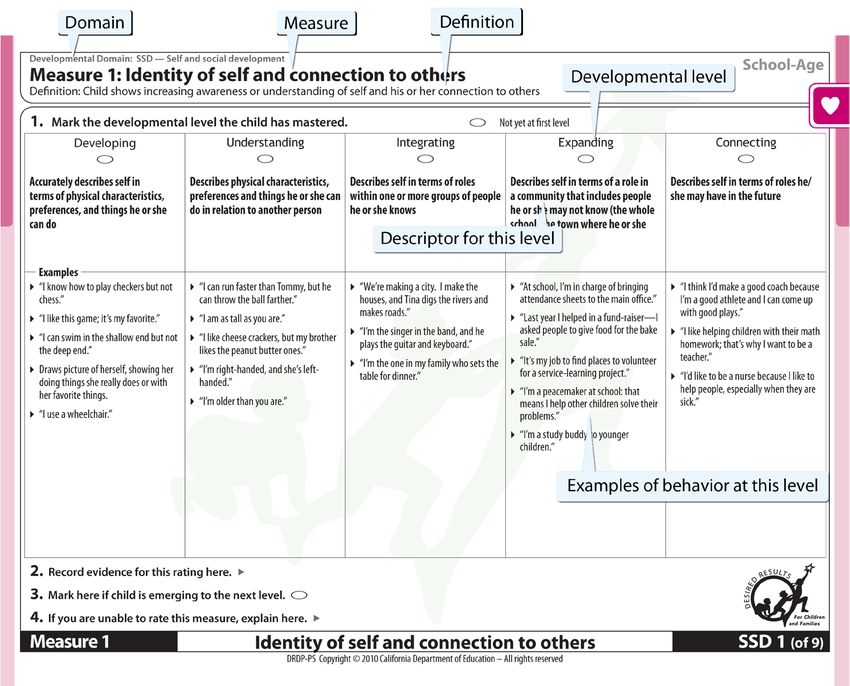
The six components of each DRDP-SA© (2010) measure are highlighted in the
the ERS is available at http://www.fpg.unc.edu/~ecers/.
sample measure below:
The three DRDP© assessment instruments involved the participation
of practitioners, program administrators, and experts from the fields of
assessment, program evaluation, child development, special education, and
K–12 education. Contributions were also made by experts in each of the
content areas , as well as experts and practitioners for each of the following
age groups: infant and toddler, preschool, and school age.
Extensive studies of the DRDP© assessment instruments have been
conducted over the years of development and refinement. These studies
have established the validity and reliability of the DRDP© instruments. An
assessment instrument is considered valid if there is evidence that it actually
measures what it is designed to measure. For the DRDP© instruments, this
evidence begins with the researchers whose contributions ensured that the
wording of the descriptors and of the examples is based on the science of
early development. The input of practitioners helped to ground the wording
based on their years of knowledge and experience with children at these
age levels. The evidence of validity also comes from the contributions of the
teachers using the DRDP© instruments in research studies. Teachers shared
their understandings to help make the wording clearer and to better reflect
what children actually do in early care and education programs. Additional
evidence of validity comes from the data analyses conducted by the
assessment experts. The analyses demonstrate that DRDP© measures work
together consistently, according to the intended assessment design, and that
DRDP© results are consistent with the results obtained from other assessment
instruments that measure the same aspects of child development.
The reliability of an assessment instrument constitutes further evidence of
validity. An assessment instrument is considered reliable if different observers
DRDP-SA Copyright © 2010 California Department of Education – All rights reserved ii A domain represents a crucial area of learning and development for Expanding: Children at this level more consistently apply their
young children. There are two domains in the DRDP-SA© (2010) simplified knowledge and skills, demonstrating a more advanced understanding
version: of themselves within the context of their community. They
Self and Social Development (SSD) understand themselves as an important member of their community;
understand and consider feelings, experiences, needs, and rules of
Health (HLTH) their group; propose solutions to conflicts; regularly follow safety
A measure focuses on a specific competency. A child’s observed behavior rules; and encourage others to practice good personal care routines.
is assessed along a continuum of developmental levels. Measures are the Connecting: Children at this level consistently apply their knowledge
individual observational items on the DRDP-SA© (2010). Several measures and skills and demonstrate a deeper understanding of themselves
make up a domain, with each measure covering one of the aspects of in relation to others outside of their community. They understand
development included in that domain. experiences of others beyond their community; and demonstrate an
The definition of a measure specifies the aspect of development that is understanding of rules for the broader community.
being observed. Each developmental level has a descriptor that describes observable child
The developmental levels for each measure represent a developmental behaviors associated with that developmental level.
continuum. Each level specifies a point along the developmental Each descriptor is illustrated with several examples of behaviors that
continuum. In the DRDP-SA© (2010) Simplified Version, measures in the are consistent with that developmental level. An example is one of many
SSD domain have five developmental levels and measures in the HLTH possible ways a child might demonstrate a particular developmental
domain have four developmental levels. The developmental levels in the level. It is anticipated that teachers will identify other examples as they
DRDP-SA© (2010) are defined as follows: complete their observations.
Developing: Children at this level demonstrate an awareness of
their behaviors and capabilities. They demonstrate an awareness of
their own feelings and needs; recognize differences and similarities
between themselves and others; engage in play with others while
focusing primarily on their own needs; and when reminded, respond
consistently to adult requests and directions around rules, safety,
personal care, and physical activity.
Understanding: Children at this level begin to gain knowledge of
their own skills and needs compared to those of others. They start to
compare their own characteristics, skills, and preferences to others;
consider the needs of others; and more consistently apply known
rules and expectations for social interaction, safety, personal care, and
physical activity with few reminders.
Integrating: Children at this level begin to apply their knowledge
of themselves and others. They begin to understand themselves in
relation to others; carefully consider other’s perspectives; resolve
conflicts; follow rules for safety; and engage in personal care routines
without reminders.
DRDP-SA Copyright © 2010 California Department of Education – All rights reserved iiiCalifornia Department of Education
Child Development Division
Desired Results Developmental Profile—School-Age© (2010)
DRDP-SA© (2010) Simplified Version
Kindergarten through age 12
Information Page
Instructions: Complete the Child Information and make a copy of this page. Use the copy for the 6-month follow-up assessment. At each assessment, complete the Observer Information and the date.
Date of assessment (mm/dd/yyyy):
Child Information Observer Information
1. Child’s name: 6. Agency/site name:
2. Child’s classroom: 7. Your name:
8. Title:
3. Birth date (mm/dd/yyyy):
9. Did another adult assist you with assessing this child?
4. Initial date of enrollment (mm/dd/yyyy):
Yes (role/relation):
5. Does this child have an Individualized Education Program (IEP)? No
Yes No Don’t know
For the following questions, check all that apply:
Accommodations/modifications? English Spanish Other (specify):
Yes (describe): 10. Child’s home language(s)?
______________
No
11. What language(s) do you ______________
Don’t know
speak with this child?
12. If you do not speak the child’s home language, did anyone
assist you who does speak it?
Yes (role/relation):
No
Additional comments:
DRDP-SA Copyright © 2010 California Department of Education – All rights reserved ivDesired Results Developmental Profile—School-Age© (2010) Simplified Version DRDP-SA© (2010)
Instruction Page — School-Age Instrument (Kindergarten through age 12)
Instructions for Completing the DRDP-SA© (2010) Completing the Information Page
Teachers may use either the DRDP-SA (2010) Simplified Version or
©
Complete the Child Information section and make a copy of the Information
DRDP-SA© (2010) Complete Version. Page. Use the original for the initial assessment and the copy for the six-
Use the DRDP-SA© (2010) with school-age children from kindergarten month follow-up assessment. At the time of each assessment, complete the
through 12 years old, including those who have an individualized Observer Information and enter the date ratings were completed.
education program (IEP). Child Information
The teacher who most frequently interacts with the child is to complete 1. Write the child’s first and last name.
the assessment instrument.
2. Write the name of the child’s classroom.
Complete the Child Information section of the Information Page before
beginning your observations. 3. Write the child’s birth date as mm/dd/yyyy (use this date format
throughout).
Use daily summaries, anecdotal records, notes from your recent
observations, and samples of work to assist in completion of the DRDP- 4. Write the date of the child’s first day of enrollment in the program. If there
SA© (2010). are multiple dates, write the earliest one.
Complete the DRDP-SA© (2010) within 60 calendar days of the child’s 5. Indicate if the child has or does not have an Individualized Education
enrollment and every six months thereafter. Program (IEP). Mark “Don’t know” if the child’s status is still being
determined or if you cannot answer this question.
Complete the DRDP-SA© (2010) for every child who attends the program
at least 10 hours or more each week. If the child has an IEP, identify whether accommodations/modifications
have been made in the program. Mark “Don’t know” if you do not know.
Include input from parents, other adults in the child’s life, and teachers
who frequently interact with the child. Observer Information
If the child has an IEP, collaborate with the special education service 6. Write the full name of your agency.
provider1 to obtain input when completing the assessment and planning 7. Write your full name.
curriculum. 8. Write your job title (e.g., associate teacher, lead teacher, master teacher).
9. If you received help in completing this DRDP-SA© (2010) from another
staff member, family member, or other adult who interacts with the child,
check “Yes” and indicate the relationship of that adult to the child.
10. If you are the child’s primary teacher, check “Yes.” If you are not, check
“No” and indicate your relationship to the child.
11. Specify what languages are regularly spoken in this child’s home.
12. Specify what languages you use when speaking with this child.
If relevant, provide the name and role of the person who
speaks this child’s home language and who assisted you in
communicating with this child.
1
The special education service provider may be a special education teacher, a speech thera-
pist, occupational therapist, or other specialist providing services specified in the child's IEP.
DRDP-SA Copyright © 2010 California Department of Education – All rights reserved vDesired Results Developmental Profile—School-Age© (2010) Simplified Version DRDP-SA© (2010)
Instruction Page — School-Age Instrument (Kindergarten through age 12)
Completing the Assessment Instrument Pages Note: If the child is rated at the final level of the developmental
continuum for a measure, “emerging” does not apply since the
1. For each of the 13 measures, fill in or check the bubble that corresponds
assessment instrument does not include the next developmental level.
to the developmental level the child has mastered at the time of the
assessment. Consider the descriptors and examples to determine the 4. In the rare circumstance you are unable to rate a measure, use the bottom
child’s level of mastery. section of the page to describe in detail why it was not possible to rate
the measure.
The descriptors describe observable behaviors for the developmental
level. Completing the Rating Record
The examples provide a sample of possible behaviors you might For the first assessment, record your ratings on the DRDP-SA© (2010)
observe for each developmental level. instrument. For the second assessment, you may use the Rating Record or
a new, unmarked DRDP-SA© (2010) instrument. In either case, it is important
A level is mastered if the child typically demonstrates the behaviors to complete each assessment without looking at the ratings of previous
in that level’s descriptor. Behaviors are considered typical if the child assessments. When you use the Rating Record, also use an unmarked
demonstrates them: instrument and review the definition and descriptors for each measure to
Easily and confidently determine your rating.
Consistently over time 1. Fill out the information at the top of the Rating Record.
2. For each of the 13 measures, mark the column of the corresponding
In different settings
developmental level the child has mastered.
Note: If a child has not mastered the first level of the developmental 3. If the child is emerging to the next level, mark the column labeled
continuum for a measure, mark the “Not yet at first level” bubble provided “Emerging.”
at step 1, above the descriptors.
4. If you are unable to rate a measure, mark the column labeled “Unable to
2. Use the space at the bottom of the page to write your evidence for the Rate.”
rating you chose and provide references to other documentation.
5. On a separate page, record your evidence or provide references to other
Write what you have observed the child doing that demonstrated documentation for each measure. Include any evidence of emerging
mastery at the level you marked or include references to your notes behaviors for any measure you marked “Emerging.” For any measure
and records for this child; notes made by others, such as parents marked “Unable to Rate,” describe the reason.
or other staff; the child’s portfolio; or another developmental
assessment. 6. Review and update the Child Information on the copy of the Information
Page that was filled out at the time of the first assessment. Complete the
3. If the child is emerging to the next level, indicate this by marking the “Yes” Observer Information. Enter the date the ratings were completed. Attach
bubble provided at step 3 on the lower left of the page. Use the bottom the Information Page to the Rating Record and the separate page(s) of
section of the page to document evidence of behaviors that indicate that documentation.
the child is emerging to the next level.
A child may be emerging to the next level by showing behaviors
associated with the next developmental level; however, the child does not
typically or consistently demonstrate the behaviors.
DRDP-SA Copyright © 2010 California Department of Education – All rights reserved viDesired Results Developmental Profile—School-Age© (2010) Simplified Version DRDP-SA© (2010)
Rating Record
Date of assessment: Child: Observer:
Classroom: Site: Agency:
Use an unmarked instrument to review the definition and descriptors for each measure to rate the child. Mark the column of the Developmental Level the child has mastered. Mark the column Emerging if the child is emerging to the next
level for a measure. Mark the column Unable to Rate in the rare circumstance you are unable to rate a measure. On a separate page(s), record your evidence for each measure. (See instructions for using the Rating Record, p. vi)
SA Not yet at Developmental Level Unable to
DOMAIN: Self and Social Development (SSD) Emerging
Measure first level Developing Understanding Integrating Expanding Connecting Rate
1 SSD1: Identity of self and connection to others
2 SSD2: Self-esteem
3 SSD3: Empathy
4 SSD4: Impulse control
5 SSD5: Follows rules
6 SSD6: Awareness of diversity: appreciation of differences and similarities
7 SSD7: Interactions with adults
8 SSD8: Friendship
9 SSD9: Conflict negotiation
SA Not yet at Developmental Level Unable to
Domain: Health (HLTH) Emerging
Measure first level Developing Understanding Integrating Expanding Rate
10 HLTH1: Safety
11 HLTH2: Understanding healthy lifestyle
12 HLTH3: Personal care routines
13 HLTH4: Exercise and fitness
DRDP-SA Copyright © 2010 California Department of Education – All rights reserved viiDesired Results Developmental Profile—School-Age© (2010) Simplified Version DRDP-SA© (2010)
List of Measures Within Domains
Domain Measure
Self and Social Development (SSD) 1 SSD1: Identity of self and connection to others
2 SSD2: Self-esteem
3 SSD3: Empathy
4 SSD4: Impulse control
5 SSD5: Follows rules
6 SSD6: Awareness of diversity: appreciation of differences and similarities
7 SSD7: Interactions with adults
8 SSD8: Friendship
9 SSD9: Conflict negotiation
Health (HLTH) 10 HLTH1: Safety
11 HLTH2: Understanding healthy lifestyle
12 HLTH3: Personal care routines
13 HLTH4: Exercise and fitness
DRDP-SA Copyright © 2010 California Department of Education – All rights reserved viiiDevelopmental Domain: SSD — Self and social development
School-Age
Measure 1: Identity of self and connection to others
Definition: Child shows increasing awareness or understanding of self and his or her connection to others
1. Mark the developmental level the child has mastered. O Not yet at first level
Developing Understanding Integrating Expanding Connecting
O O O O O
Accurately describes self in Describes physical characteristics, Describes self in terms of roles Describes self in terms of a role in Describes self in terms of roles he/
terms of physical characteristics, preferences and things he or she can within one or more groups of people a community that includes people she may have in the future
preferences, and things he or she do in relation to another person he or she knows he or she may not know (the whole
can do school, the town where he or she
lives)
Examples
“I know how to play checkers but not “I can run faster than Tommy, but he “We’re making a city. I make the “At school, I’m in charge of bringing “I think I’d make a good coach because
chess.” can throw the ball farther.” houses, and Tina digs the rivers and attendance sheets to the main office.” I’m a good athlete and I can come up
makes roads.” “Last year I helped in a fund-raiser—I with good plays.”
“I like this game; it’s my favorite.” “I am as tall as you are.”
“I’m the singer in the band, and he asked people to give food for the bake “I like helping children with their math
“I can swim in the shallow end but not “I like cheese crackers, but my brother sale.”
plays the guitar and keyboard.” homework; that’s why I want to be a
the deep end.” likes the peanut butter ones.”
“It’s my job to find places to volunteer teacher.”
“I’m the one in my family who sets the
Draws picture of herself, showing her “I’m right-handed, and she’s left- for a service-learning project.”
table for dinner.” “I’d like to be a nurse because I like to
doing things she really does or with handed.”
“I’m a peacemaker at school: that help people, especially when they are
her favorite things.
“I’m older than you are.” means I help other children solve their sick.”
“I use a wheelchair.” problems.”
“I’m a study buddy to younger
children.”
2. Record evidence for this rating here.
3. Mark here if child is emerging to the next level. O
4. If you are unable to rate this measure, explain here.
Measure 1 Identity of self and connection to others SSD 1 (of 9)
DRDP-PS Copyright © 2010 California Department of Education – All rights reservedDevelopmental Domain: SSD — Self and social development
School-Age
Measure 2: Self-esteem
Definition: Child makes positive judgments about self and his/her own abilities in increasingly broad contexts
1. Mark the developmental level the child has mastered. O Not yet at first level
Developing Understanding Integrating Expanding Connecting
O O O O O
Makes positive judgments about Makes positive judgments about Makes positive judgments about Makes positive judgments about Makes positive judgments about
personal characteristics, skills, or personal characteristics, skills, or self related to others in his or her self related to others in his or her self based on how he or she has
behavior behavior in relation to someone else group; describes personal role community including people he done in the past and may do in the
within group or she may not know (the whole future
school, the town where he or she
lives)
Examples
“I am good at drawing animals.” “I’m really good at handball—I can “I help other children in my class with “I helped my school’s recycling “I will do well in college because I
even beat Jose some of the time.” their math homework because I’m program by making signs and putting study a lot.”
Smiles proudly at picture or art project
good at math.” them on trash cans.”
she has made. “I’m glad that I was chosen for a big “I could go to the Olympics. I practice
role in the play.” “Whenever we play soccer, I’m the “I’ve helped other families by working every day.”
“I can run really fast!”
goal-keeper because I’m not afraid of on the food drive.”
“I could be a translator because I speak
the ball.”
“I like helping people in my English and Spanish/Chinese [my home
“My friends like me because I don’t tell community. I help every week in my language] well.”
their secrets.” school’s library.”
“I play soccer in the ‘rec’ league and
I’m a pretty good goalie.”
“Our band got second place in the state
competition!”
2. Record evidence for this rating here.
3. Mark here if child is emerging to the next level. O
4. If you are unable to rate this measure, explain here.
Measure 2 Self-esteem SSD 2 (of 9)
DRDP-PS Copyright © 2010 California Department of Education – All rights reservedDevelopmental Domain: SSD — Self and social development
School-Age
Measure 3: Empathy
Definition: Child shows increasing awareness of others’ feelings and experiences and responds appropriately through words or actions
1. Mark the developmental level the child has mastered. O Not yet at first level
Developing Understanding Integrating Expanding Connecting
O O O O O
Demonstrates awareness of own Shows awareness of feelings of Shows understanding of how Shows understanding of feelings Shows understanding of feelings
feelings others with appropriate words or someone else might feel in a certain and experiences through words or and experiences through words or
actions hypothetical situation actions for groups of people who actions for groups of people beyond
live in his or her community (may his or her immediate community
not know them)
Examples
“I feel really happy (sad, calm, “She’s happy because her grandma is Says her sister must be getting excited “I’m doing the walk-a-thon for the “I worry about children who don’t have
thankful).” coming to visit.” because her birthday is coming up. [local] children’s hospital to raise enough to eat.”
money for sick children.”
“I’m excited about our trip to the tide “My mom was really surprised and “My mom would be so proud if I won “I heard on the news that a girl
pools.” happy when we brought her breakfast this contest.” Helps collect clothes/toys/food for a is missing. Her parents must be
in bed.” family whose house burned down near worried.”
Draws picture to show how he feels. “Mark will feel so good if he finishes
the school.
Offers assistance to friend who is hurt, his model plane [because he’s been Writes a letter to a child who is sick in
such as giving a bandage or asking, working so hard on it].” “I feel sad for the children on the another state or country.
“Do you need a bandage?” school team because we lost the
“Sarah will be disappointed if she “I can’t even believe how hard it would
tournament.”
Points out a picture in a book and doesn’t place in the top 10, because be to lose everything I have in a flood.”
accurately identifies a feeling to match she has been practicing so much.”
“It would be hard to have to switch
the facial expression (happy, mad,
schools because you lost your home.”
sad).
Sends a letter to an unknown soldier
stationed abroad.
2. Record evidence for this rating here.
3. Mark here if child is emerging to the next level. O
4. If you are unable to rate this measure, explain here.
Measure 3 Empathy SSD 3 (of 9)
DRDP-PS Copyright © 2010 California Department of Education – All rights reservedDevelopmental Domain: SSD — Self and social development
School-Age
Measure 4: Impulse control
Definition: Child shows ability to regulate responses to internal and external stimuli in increasingly broad settings
1. Mark the developmental level the child has mastered. O Not yet at first level
Developing Understanding Integrating Expanding Connecting
O O O O O
Responds to adult reminder or Applies known rules to manage Controls impulses independently, Controls impulses based on what is Controls impulses based on the
direction to control inappropriate frustrating situations understanding the other person’s right or fair for his or her immediate needs of the greater community
impulses point of view group (people the child does not know)
Examples
Expresses her anger or frustration Raises hand and waits to be called on While waiting for a staff person, sits Refrains from participating in a group Turns in found items to lost and found
by using words instead of hitting or to make a comment or ask a question. down to draw, read, or play something that is teasing or bullying (because it’s (instead of keeping them for herself).
throwing toys when reminded by staff. without being directed to. not ‘fair’ or ‘nice’).
When frustrated by the actions of Returns money when he receives too
During circle time, if reminded to raise another, refrains from hitting and Suggests a reasonable compromise Waits until it is her turn. When asked much change back.
hand, child does so rather than call instead seeks help from an adult. between what he wants to do and why, might reply “because they were
Shows respect for others in the
out to make comment or answer a what peer wants to do. here first [and it’s only fair].”
While waiting for a turn on the community (doesn’t litter, doesn’t
question.
computer or in a game, chooses Indicates he will complete his Without prompting, child agrees to damage property).
Takes a toy from another child without another acceptable activity to do homework before going out to play, participate in a game of softball, even
asking, but waits for turn when (alternate activity may be suggested because his parents requested it. though she/he ‘voted for’ soccer,
reminded to. by staff). because she accepts ‘majority rules’ [as
what is most fair].
Resists peer pressure, instead choosing
to do what is ‘right’ or ‘fair.’
2. Record evidence for this rating here.
3. Mark here if child is emerging to the next level. O
4. If you are unable to rate this measure, explain here.
Measure 4 Impulse control SSD 4 (of 9)
DRDP-PS Copyright © 2010 California Department of Education – All rights reservedDevelopmental Domain: SSD — Self and social development
School-Age
Measure 5: Follows rules
Definition: Child shows ability to follow rules in increasingly broad settings and understands the purpose of having rules
1. Mark the developmental level the child has mastered. O Not yet at first level
Developing Understanding Integrating Expanding Connecting
O O O O O
Follows most program rules but Follows most rules and understands Follows rules without reminders, Knows and understands rules of the Knows and understands rules
often needs to be reminded reasons for rules, even if he or she even if he or she doesn’t want to, familiar group, and suggests ways for the broader community and
doesn’t always follow them and expects others to do the same to improve them so that they are suggests ways to improve them so
fair for everyone in the group that they are fair for everyone in the
community
Examples
Attempts to play with toys at Follows rules when suggested by peers Sits out willingly when it’s no longer Suggests that children pick names out Suggests that older children wait until
inappropriate times until reminded not or teachers, “You have to go to the end his turn. of a hat to decide teams because it’s 3:30 before using the playground so
to by staff. of the line because you’re out.” ‘only fair’ that everyone gets a chance that younger children can gain access
Expresses disappointment or
at the best players. to the play structures by themselves.
Tries to take an extra turn but Reminds others to “follow the rules.” disapproval when others do not follow
conforms to game rules when the rules. Suggests that game rules be changed Suggests changing the rules for
reminded by an adult. to include more people. dropping off children so it will be safer.
Puts name on list to use the computer
and waits turn; tells other child who is Suggests that it’s OK to change rules if Suggests that children who are traffic
trying to use it out of turn to “put your it’s ‘for a good reason.’ guards should be allowed an extra five
name on the list.” minutes before being marked late.
Suggests a rotating schedule/sign-
Readily goes to the back of the line up sheet for using the computer so
when ‘out’ or sits out when it’s no everyone gets a turn.
longer his turn.
2. Record evidence for this rating here.
3. Mark here if child is emerging to the next level. O
4. If you are unable to rate this measure, explain here.
Measure 5 Follows rules SSD 5 (of 9)
DRDP-PS Copyright © 2010 California Department of Education – All rights reservedDevelopmental Domain: SSD — Self and social development
School-Age
Measure 6: Awareness of diversity: appreciation of differences and similarities
Definition: Children show awareness, acceptance, understanding, and appreciation of others’ special needs, genders, family structures, ethnicities, cultures, and languages
1. Mark the developmental level the child has mastered. O Not yet at first level
Developing Understanding Integrating Expanding Connecting
O O O O O
Identifies physical differences and Expresses awareness of nonphysical Makes accommodations for others Takes action that shows interest in, Shows interest in promoting social
similarities between self and others differences and similarities between in the group who are different from and appreciation for, the similarities justice for people beyond his/her
self and others, such as those him or her and differences of people in his community
related to culture, language, family or her community (may not know
structure, or religion them)
Examples
“Her arms are stronger than mine.” “He lives with his grandma and Helps a child in a wheelchair get Writes a story about the meaning of Discusses the similarities and
cousins, and I live with my mom.” something off a high shelf. Martin Luther King Day. differences between women’s rights
Finds pictures in magazines of people
here and in other countries.
who look the same as and who look “We should make sure that we choose Suggests new rules for a game to Attempts to learn basic vocabulary
different from herself. food for the party that everyone can include a child with a disability. from a new language. Discusses human rights and talks
eat.” about ways to protect them.
“He and I both wear glasses.” “We should write a sign saying ‘hello’ “Let’s print the flyers in different
“We both speak English but Jose in different languages, so everybody languages so everyone’s parents can Talks about how people shouldn’t buy
speaks Spanish, too.” will feel welcome.” read them.” clothes made using child labor.
“My friend didn’t come to school Encourages peers to include children Voluntarily helps to research and plan
because he is having a special who are different. a field trip to visit different places of
celebration at home.” worship in his community.
Ensures that children who are learning
English understand the rules before Volunteers to participate in organizing
starting a game. a multicultural event (school potluck,
variety show, music night, recipe
book).
2. Record evidence for this rating here.
3. Mark here if child is emerging to the next level. O
4. If you are unable to rate this measure, explain here.
Measure 6 Awareness of diversity: appreciation of differences and SSD 6 (of 9)
DRDP-PS Copyright © 2010 California Department of Education – All rights reservedDevelopmental Domain: SSD — Self and social development
School-Age
Measure 7: Interactions with adults
Definition: Child develops positive relationships with increasingly larger groups of adults and acknowledges adult’s perspective while expressing clear sense of own self
1. Mark the developmental level the child has mastered. O Not yet at first level
Developing Understanding Integrating Expanding Connecting
O O O O O
Seeks out one or two trusted adults Interacts with a wider variety Listens to and considers adult’s Expresses clear sense of self as Expresses clear sense of self as
for guidance or companionship in of adults, displaying increasing perspective while expressing and separate from adults in community different from adults outside of
daily activities independence but still relying on defending own ideas (teachers, staff, parents, police their community, in the nation/
them for guidance or reassurance officer, mayor), but acknowledges world, but acknowledges adult’s
adult’s perspective perspective
Examples
Looks to trusted adults to determine Initiates activities independent of Acknowledges rules of adult, but states “If I get elected to the student council, “I know adults have to drive to work,
daily schedule/activities, or needs adults but within adults’ guidelines what she would like to be different— I’m going to tell the teachers that but they should think about carpooling
adults to suggest or initiate reasonable (starts an activity but needs help “If I were in charge, I’d make a rule children need more recess.” to help the environment.”
activities. maintaining it). that...”
“Most parents think we should go to “I know it would be hard, but if I were
Notices when particular adult is Comes back from independent play to “Can we have snack before we do bed by nine o’clock, but I think children the president, I would make sure there
absent. report what she is doing. homework because we had an early should go to bed when they are tired.” was a park in every neighborhood.”
lunch at school today?”
Seeks out favorite adult to sit next to Seeks recognition for a drawing or “They want to close the school because Writes a car company to ask for safer,
during group activities. other accomplishment. Helps point out strong points of other there aren’t enough children in the more energy-efficient cars.
players to coach. area, but I think they should leave it
Asks for reassurance while playing a
open because this is the school some
game—“Is this a good move?” Converses with adults about an idea
children are used to.”
or perspective, both giving own
perspective and listening to adults. “If I were in charge, I’d have a
skateboard ramp in every park, but
they think that children will get hurt.”
2. Record evidence for this rating here.
3. Mark here if child is emerging to the next level. O
4. If you are unable to rate this measure, explain here.
Measure 7 Interactions with adults SSD 7 (of 9)
DRDP-PS Copyright © 2010 California Department of Education – All rights reservedDevelopmental Domain: SSD — Self and social development
School-Age
Measure 8: Friendship
Definition: Child develops one or more close relationships with peers and extends concept of friendship beyond his/her community
1. Mark the developmental level the child has mastered. O Not yet at first level
Developing Understanding Integrating Expanding Connecting
O O O O O
Plays with other known children, Listens to and considers the needs On his or her own, considers and Considers the needs and interests of Demonstrates concern and caring
focusing on own needs and and interests of a friend when they acknowledges the perspectives of a group of friends and seeks ways for children outside his or her
making limited compromises with are expressed one or more close friends to balance those with own interests community
playmates and needs
Examples
Agrees to play pirates but only if Asks friend what he wants to do—“Do Soothes a friend who lost a game or Agrees to watch a movie that isn’t his Collects food or supplies to aid children
playmate agrees to go outside. you want to play inside or outside?” was eliminated. first choice because his friends are affected by natural disasters.
watching it.
Continues to play with playmate even “I’ll pick a game we play, then you pick “I know you like hopscotch, so let’s Writes letters or shows interest in
if unsuccessful in coaxing other child one.” play that first.” Compromises on game rules when children in different parts of the
into playing his or her way. necessary to keep a game moving. country or world.
Acknowledges and respects a friend’s
Tries to coax playmate into playing his opinion even if it is different from his Expresses unwavering support for the Sends cards to a children’s hospital.
way. own. team, school, or candidate that his
Exchanges e-mails with or reads blogs
friends or parents support.
Persists in playing one way despite “I know you like that book, but I don’t from children who live in other cities.
requests from playmate to play think it was good.”
another way.
Asks if a friend knows how to play a
game. If he says no, suggests another
game.
2. Record evidence for this rating here.
3. Mark here if child is emerging to the next level. O
4. If you are unable to rate this measure, explain here.
Measure 8 Friendship SSD 8 (of 9)
DRDP-PS Copyright © 2010 California Department of Education – All rights reservedDevelopmental Domain: SSD — Self and social development
School-Age
Measure 9: Conflict negotiation
Definition: Child resolves conflicts by proposing solutions that consider the needs of others and extends concept of negotiation beyond his/her community
1. Mark the developmental level the child has mastered. O Not yet at first level
Developing Understanding Integrating Expanding Connecting
O O O O O
During a conflict with another child, During a conflict, listens to desires Resolves conflicts by proposing Proposes solutions to conflicts Proposes solutions to conflicts that
expresses own needs and desires of another child and suggests solutions that address the desires or that address the desires or rights address the desires or rights of
or accepts a mutually agreeable rights of everyone in the group of everyone in the community people beyond his or her community
solution (even those who are not known
personally)
Examples
“I want to play with this now.” “If you give me a turn, I’ll give it right “Let’s vote on this, but when Susana “If they don’t want us skateboarding “If two contestants on a reality show
back to you.” gets back she gets to vote too.” on the stairs because it isn’t safe, they do very well, they should split the
“I got to the swings first, so I get to go
could build a skate park.” prize. It’s not fair that one gets second
first.” “His dad is picking him up in ten “We need to save some for David
place and doesn’t win anything.”
minutes, so he should go first.” because he’s out sick today, but he “I think children who are caught doing
Uses nonverbal communication, such
worked for this too.” graffiti should have to clean up all the “If someone finds a winning lottery
as pointing or gesturing, to show the When playing with dolls, shares the
walls in the neighborhood.” ticket that someone else lost, then the
toy she wants to play with. clothing. When playing basketball game of
person who bought it should get the
HORSE with younger children, gives Child is part of safety patrol.
Accepts caregiver’s suggestion, “Let’s prize.”
them two tries per turn instead of one.
do Rock, Paper, Scissors.”
Takes action to speak out against
“My friend is out sick today—can we
injustice (writes a letter, signs a
wait until tomorrow to pick parts for
petition).
the play so she doesn’t miss out?”
Participates in a discussion to
brainstorm ideas about how to reduce
violence in the world.
2. Record evidence for this rating here.
3. Mark here if child is emerging to the next level. O
4. If you are unable to rate this measure, explain here.
Measure 9 Conflict negotiation SSD 9 (of 9)
DRDP-PS Copyright © 2010 California Department of Education – All rights reservedDevelopmental Domain: HLTH — Health
School-Age
Measure 10: Safety
Definition: Child shows increasing independence in following rules for personal safety
1. Mark the developmental level the child has mastered. O Not yet at first level
Developing Understanding Integrating Expanding
O O O O
Follows safety rules only when reminded Follows safety rules sometimes or with few Follows safety rules independently and on a Participates in establishing rules and
reminders or little encouragement regular basis procedures that are safe for specific activities
Examples
When reminded, follows rule for safely entering Observes some safety boundaries, such as not Independently looks both ways before crossing Initiates procedures for safety, such as drawing
the room one at a time, instead of rushing and walking in front of and behind someone swinging the street. ‘boundaries’ for a game of jump-rope so people
pushing through the door. a bat, but may need reminders. who are passing by won’t get hurt.
Consistently carries scissors pointing down while
When reminded, keeps gate to playground closed. Uses caution when jumping off equipment walking. Reminds other children of safety rules.
sometimes, but not always.
When reminded, asks for assistance to retrieve Regularly uses caution when walking in front of Identifies potential safety problems—“Let’s store
something from a high or dangerous place (a ball Handles scissors safely (when using or carrying), moving swings or slide that others are using. the heaviest blocks on the lowest shelves so they
that is on the roof). but may need reminders. won’t fall on anyone.”
Stops a throwing game when someone walks
through the game (to avoid hitting person). “Let’s move the reading center away from the
door, so people don’t get hit when it’s opened.”
2. Record evidence for this rating here.
3. Mark here if child is emerging to the next level. O
4. If you are unable to rate this measure, explain here.
Measure 10 Safety HLTH 1 (of 4)
DRDP-PS Copyright © 2010 California Department of Education – All rights reservedDevelopmental Domain: HLTH — Health
School-Age
Measure 11: Understanding healthy lifestyle
Definition: Child shows increasing independence in making healthy lifestyle choices
1. Mark the developmental level the child has mastered. O Not yet at first level
Developing Understanding Integrating Expanding
O O O O
Makes healthy choices when reminded or Makes healthy choices with few reminders or Makes healthy choices independently and on Encourages others to make healthy choices
encouraged little encouragement a regular basis
Examples
Eats fruit for snack when it is provided. When allowed to make choices, sometimes When allowed to make choices, regularly chooses Debates benefit of alternatives to candy and soft
chooses healthful food. healthful food, such as fruits or vegetables. drinks on-site.
Wears hat on a sunny day when reminded.
Needs few reminders to plan ahead. Sets own schedule to complete work, avoiding Brainstorms with peers how to get school work
Follows suggestion to clean up art project early to
last-minute rush. done early to reduce stress.
be ready when parent arrives for pick-up. With little encouragement, agrees to put on
sunscreen when playing outside on a sunny day. Resists peer pressure to make unhealthy choices. Engages in discussion about resisting negative
peer pressure.
Independently chooses to avoid intense physical
activity when sick or tired. Makes posters for program about healthy lifestyle
choices.
Discusses the benefits of making food choices
using the food pyramid.
2. Record evidence for this rating here.
3. Mark here if child is emerging to the next level. O
4. If you are unable to rate this measure, explain here.
Measure 11 Understanding healthy lifestyle HLTH 2 (of 4)
DRDP-PS Copyright © 2010 California Department of Education – All rights reservedDevelopmental Domain: HLTH — Health
School-Age
Measure 12: Personal care routines
Definition: Child shows increasing independence in following personal care routines
1. Mark the developmental level the child has mastered. O Not yet at first level
Developing Understanding Integrating Expanding
O O O O
Follows rules of good personal care only when Follows rules of good personal care with few Independently practices good personal care Encourages good personal care among others
reminded reminders or little encouragement on a regular basis
Examples
Follows rules or routines to wash hands before or When given the choice, practices personal Washes hands before eating and after using the Helps younger child wash hands thoroughly.
after eating only when reminded by staff. hygiene in some situations or some of the time toilet without being asked or reminded.
Tells another to use soap when washing hands.
(sometimes covers mouth when coughing;
Covers mouth when coughing only when Independently uses tissues when needed.
remembers to wash hands after using the Reminds others to cover mouth when coughing or
reminded by staff.
bathroom but may forget to wash before eating). Covers mouth when coughing without being to use tissue when needed.
Ties or closes shoes when reminded. reminded.
Sometimes remembers to use tissues when Suggests to friend to get her raincoat because it is
When reminded, puts on warm clothes before needed, but sometimes needs reminder. Dresses warmly before going out in cold weather. raining outside.
going out in cold.
Remembers to dress warmly before going out in Independently keeps shoes tied or fastened. Notices and points out a friend’s shoe is untied
cold but sometimes needs reminders. during a running game.
2. Record evidence for this rating here.
3. Mark here if child is emerging to the next level. O
4. If you are unable to rate this measure, explain here.
Measure 12 Personal care routines HLTH 3 (of 4)
DRDP-PS Copyright © 2010 California Department of Education – All rights reservedDevelopmental Domain: HLTH — Health
School-Age
Measure 13: Exercise and fitness
Definition: Child shows increasing independence in participating in exercise and fitness activities
1. Mark the developmental level the child has mastered. O Not yet at first level
Developing Understanding Integrating Expanding
O O O O
Participates in active physical activity only Participates in active physical activity with Participates in active physical activity Encourages others to engage in regular
when strongly encouraged some reminders or little encouragement independently and on a regular basis physical activity
Examples
Participates in basketball or soccer game only Sometimes chooses to play outside but Independently chooses to play an outdoor sport Proposes formation of after-school soccer team.
when encouraged by another child. occasionally needs a reminder. game during free choice time.
Designs poster about benefits of regular exercise.
Participates in adult-guided physical Sometimes chooses to participate in organized Regularly participates in a variety of physical
Helps organize physically active game.
activities, such as a hike or nature walk, with physical activities, such as a dance or drill team. activities, such as a dance or drill team.
encouragement. “Let’s play soccer outside instead of sitting in front
of the computer.”
2. Record evidence for this rating here.
3. Mark here if child is emerging to the next level. O
4. If you are unable to rate this measure, explain here.
Measure 13 Exercise and fitness HLTH 4 (of 4)
DRDP-PS Copyright © 2010 California Department of Education – All rights reservedYou can also read


