Seasonal distribution of fish larvae in mangrove seagrass seascapes of Zanzibar (Tanzania)
←
→
Page content transcription
If your browser does not render page correctly, please read the page content below
www.nature.com/scientificreports
OPEN Seasonal distribution of fish larvae
in mangrove‑seagrass seascapes
of Zanzibar (Tanzania)
Barnabas Tarimo1,2, Monika Winder1, Matern S. P. Mtolera2, Christopher A. Muhando2 &
Martin Gullström3*
Fish larvae supply in nearshore vegetated habitats, such as seagrass meadows and mangroves,
contributes significantly to sustainable fish stocks. Yet, little information is available on distribution
patterns of fish larvae in mangrove and seagrass habitats of the western Indian Ocean. The present
study investigated the abundance, diversity and assemblage composition of fish larvae in mangrove
creeks, inshore seagrass meadows (located adjacent to mangroves) and nearshore seagrass meadows
(located in-between mangroves and coral reefs) in two coastal seascapes of Zanzibar (Tanzania)
across seasons for 1 year. The highest mean abundances of fish larvae were recorded in mangrove
creeks, while nearshore- and inshore seagrass meadows showed similar mean abundance levels.
Generally, fish larvae representing 42 families were identified, with the fourteen most abundant
families comprising 83% of all specimens. Fish larvae communities were dominated by specimens of
the postflexion growth stage in all habitats, except in mangrove creeks in one of the two seascapes
(i.e. Chwaka Bay) from April through June when abundances of the preflexion and very small-
sized individuals were exceptionally high. Slightly higher fish larvae abundances were observed in
mangroves during the southeast monsoon compared to the northeast monsoon, and there were
also differences across months within monsoon periods for all three habitats studied. Assemblage
composition of larvae did, however, not vary significantly in time or space. Our findings suggest that
mangroves and seagrass meadows are highly linked shallow-water habitats with high retention of
fish larvae contributing to similarity in assemblage compositions across shallow coastal seascapes.
Conservation and management efforts should prioritize connected shallow-water seascapes for
protection of fish larvae and to uphold sustainable coastal fisheries.
Shallow-water marine habitats are among the most productive areas on earth, providing numerous important
ecological and economic services, such as fisheries p roduction1–4. In tropical coastal seascapes, mangroves and
seagrass meadows are commonly the dominating shallow-water habitats and essential habitats for fish5,6, support-
ing a high abundance and diversity of fish at different life stages7. Fish distribution patterns in coastal seascapes
clearly indicate migration between mangroves and seagrass meadows as well as the usage of these habitats by
a large diversity of fish s pecies8. Numerous fish species use these vegetated coastal habitats also as nursery and
spawning grounds as the structural complexity provides shelter and avoidance of p redation9, while calm water
in protected environments, such as mangroves, are suitable for fish larvae to settle with often high plankton prey
availability10. Consequently, these habitats harbor high abundance of fish larvae11–13. However, environmental
conditions may change over the season and together with species life history affect spatiotemporal patterns of
fish larvae d istribution14. Yet, seasonal dynamics of fish larvae abundance and diversity are seldom studied in
tropical coastal systems. This knowledge is critical to determine variations in recruitment of marine fish species
based on the differences in larval settlement versus post-settlement mortality15, and to determine spawning
seasons of fish species16, which is useful information for ecosystem m anagement17.
While fish at early growth stages, particularly up to the preflexion stage, are expected to drift with currents,
behavioural adaptations, such as diel vertical movement and ontogenetic habitat utilization, may enable larvae
to maintain in certain habitats as larval development progresses18,19. At the late larval (postflexion) stage, fish can
have a directional swimming of up to 2 cm/min and strongly use taxa-specific environmental cues to sense and
move towards suitable h abitats20–23, where they settle as j uveniles19,24,25. Thus, the nature of a coastal area, such as
1
Department of Ecology, Environment and Plant Sciences, Stockholm University, Stockholm, Sweden. 2Institute
of Marine Sciences, University of Dar Es Salaam, Zanzibar, Tanzania. 3School of Natural Sciences, Technology and
Environmental Studies, Södertörn University, Huddinge, Sweden. *email: martin.gullstrom@sh.se
Scientific Reports | (2022) 12:4196 | https://doi.org/10.1038/s41598-022-07931-9 1
Vol.:(0123456789)
www.nature.com/scientificreports/
open or protected from the ocean or tidal dynamics, affects the abundance and assemblage composition of fish
larvae in shallow coastal a reas26–28. In addition, fish larvae distribution is influenced by spawning stock, spawning
aggregations and other mechanisms that promote reproductive success, which in turn affects the chance of fish
larvae survival, settlement and recruitment29–31. In tropical waters with low variation in biophysical variables,
seasonal dynamics are mainly related to adult fish spawning behaviour or larval survival (e.g.32). As a result, a
detailed description of the spatiotemporal distribution pattern of fish larvae in nearshore habitats is not only
contextualized fundamental information for ecologists but also of high relevance for efficient conservation and
management of coastal fisheries r esources33,34.
In tropical coastal seascapes of the western Indian Ocean, spatial and temporal distribution patterns of fish
larvae are scarcely e xplored35, which limits the knowledge about fish spawning location, timing and duration
(e.g.36). Additionally, insufficient knowledge in fish larvae distribution patterns limits the information in dispersal
patterns and source-sink relationships of fish larvae in their habitats37,38, which may hinder the conservation
practices39. A few studies have focused on spatial variability of fish larvae in coastal marine habitats of this
region. For instance, Little et al.40 studied fish larvae distribution at different sites of a Kenyan mangrove creek
and found a decreasing larval abundance (of non-resident species in particular) and diversity along a gradient
from the mouth towards the upper part of the creek system. Hedberg et al.41 reported little differences between
sites and among habitats (open waters, seagrass meadows and coral reefs) in coastal East Africa, with most fish
larvae families occurring in all three habitats without preference. In this region, mangroves and seagrass mead-
ows exist as highly connected habitat within the coastal seascape, with mangroves close to the land, followed
by seagrass meadows and coral reefs further o ffshore42. Nutrient cycling, larval export and migratory fauna
movements connect these habitats (i.e. mangroves, seagrass meadows and coral reefs). Mobile organisms, such
as fish, relocate between these habitats for a variety of reasons, including feeding, spawning, seasonal migrations,
and ontogenetic m ovements43,44. Habitat connectivity can be driven by water movements, such as tidal regimes
and currents, which help to connect different systems by promoting the export of larvae and plankton from one
environment to a nother45. Particularly, seasonal changes in the direction of the monsoon winds may influence
assemblages of plankton and fish larvae33,46. As a result of the lack of static borders and rather high seascape
connectivity, shallow-water habitats in tropical coastal seascapes require a broad seascape approach to properly
monitor, assess and conserve fish larvae p opulations42,45.
In the present study, we investigated seasonal distribution patterns of fish larvae in mangrove creeks, inshore
seagrass meadows (located adjacent to mangroves) and nearshore seagrass meadows (located in-between man-
groves and coral reefs) in two tropical coastal seascapes of Zanzibar (Tanzania) in Eastern Africa. Sampling
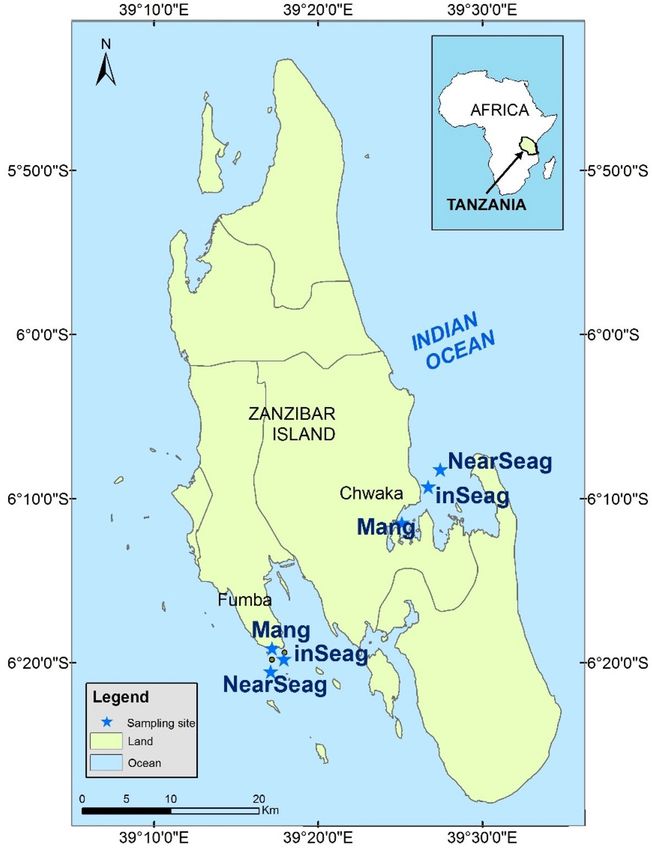
was conducted in Chwaka Bay, a semi-enclosed embayment, and Fumba, a non-estuarine coastal site (Fig. 1),
monthly between January and December 2018. We hypothesized that the three habitats are strongly interlinked
and harbour similar abundance, diversity and assemblage composition of fish larvae, and are linked to the
monsoon seasons.
Results
Environmental parameters. In all three habitats of Chwaka Bay and Fumba, pH was relatively consistent
throughout the year (Table S1). Water temperatures were generally higher during the NEM seasons (ranging
from 29.9 to 31.5 °C) compared to the SEM seasons (ranging from 26.5 to 27.3 °C) (Table S1). Dissolved oxy-
gen and salinity were higher during the NEM season than during the SEM season in all habitats in both sites
(Table S1). Chlorophyll-a levels were substantially higher in mangroves of Chwaka Bay during both the NEM
and SEM seasons compared to the levels in mangroves of Fumba and inshore and nearshore seagrass meadows
in both sites (Table S1).
General description of fish larvae assemblages and patterns of variability. A total of 2087 indi-
viduals of fish larvae of pelagic or pre-settlement phases were recorded throughout the sampling period, rep-
resenting a total assemblage of 42 families (Table S2). The majority of fish larvae families (22) were observed to
overlap in distribution across the three habitats (Table S2), while some few families were observed only in spe-
cific habitats at specific times. Six families were exclusively observed in mangrove creeks, one family in inshore
seagrass meadows, and three families in nearshore seagrass meadows, while ten families overlapped between
two habitats (Table S2). The 14 most abundant families comprised about 83% of the catch and included Ger-
reidae (18%), Gobiidae (12%), Sparidae (10%), Siganidae (6%), Apogonidae (6%), Lutjanidae (6%), Lethrinidae
(5%), Scaridae (5%), Labridae (4%), Syngnathidae (3%), Monacanthidae (3%), Blenniidae (3%), Nemipteridae
(2%) and Terapontidae (2%) (Fig. 2).
Overall, the mean abundance of fish larvae was slightly (while not significantly; Table 1) higher in mangrove
creeks compared to seagrass meadows, whereas inshore and nearshore seagrass meadows showed rather similar
mean abundances (Fig. 3a). A three-way ANOVA on mean larvae abundance revealed statistical significance only
between the two sites (with a higher mean abundance of fish larvae in Chwaka Bay compared to Fumba; Fig. 3a)
and for an interaction between season and habitat as well as for an interaction between season, site and habitat
(Table 1). Site-specific comparisons on habitat level showed that mangroves and nearshore seagrass meadows
displayed higher mean fish larvae abundances in Chwaka Bay compared to the same respective habitat in Fumba
(Holm–Sidak test at p < 0.01; Fig. 3a), which was also the case for inshore seagrass meadows (Fig. 3a), although
the difference was not significant. In a three-way ANOVA on family richness of fish larvae, only site came out as
a significant factor (Table 1) and which showed that the family richness was higher in Chwaka Bay compared to
Fumba (Fig. 3b). A site-specific comparison revealed higher fish family richness within inshore seagrass meadows
in Chwaka Bay compared to Fumba (Holm–Sidak test at p < 0.01; Fig. 3b), while no site-specific differences were
seen for either mangroves or nearshore seagrass meadows (Fig. 3b).
Scientific Reports | (2022) 12:4196 | https://doi.org/10.1038/s41598-022-07931-9 2
Vol:.(1234567890)www.nature.com/scientificreports/
Figure 1. Map of Zanzibar showing locations of study sites, including mangrove creeks (Mang), inshore
seagrass meadows (inSeag) (located adjacent to mangroves) and nearshore seagrass meadows (nearSeag)
(located in-between mangroves and coral reefs) in Chwaka Bay (Chwaka) and Fumba on Zanzibar (Tanzania).
Source: Institute of Marine Sciences Database, University of Dar es Salaam, Zanzibar (Tanzania).
Seasonal variations of fish larvae abundance and family richness. The three-way ANOVAs
showed no significant seasonal differences between SEM and NEM for either mean abundance or family rich-
ness of fish larvae (Table 1). The significant interactions (i.e. Season × Habitat and Season × Site × Habitat) on
abundance data (Table 1), however, indicate that the seasonal fish larvae abundance patterns are not consistent
in the two sites and/or in the three habitats (Fig. 4a). Specific seasonal comparisons on habitat level revealed that
the mean fish larvae abundance in mangroves was higher during SEM compared to NEM (Holm–Sidak test at
p < 0.05; Fig. 4a), whereas there were no significant monsoon-based differences in mean larvae abundance in any
of the two seagrass habitats (Fig. 4a). Considering monthly differences across monsoon seasons, the abundance
of fish larvae was clearly higher in mangrove creeks of Chwaka Bay during most of the SEM period (particu-
larly April–July) compared to the NEM period, with the highest peak in April (Fig. 4a). There were also a few
months in the NEM period with high peaks in abundance of fish larvae in inshore seagrass meadows (March
and particularly April) and nearshore seagrass meadows (January and particularly February) (Fig. 4a). The fish
larvae family richness varied slightly across monsoon seasons in the two sites and in the different habitats, with
pronounced peaks only observed in mangrove creeks (particularly in April but also in May) and inshore seagrass
meadows (April) of Chwaka Bay (Fig. 4b, Fig. S1). Seven fish larvae families were observed almost throughout
the year in all three habitats, including Gerreidae, Sparidae, Gobiidae, Apogonidae, Siganidae, Lutjanidae and
Syngnathidae (Fig. S1).
Fish larvae assemblage compositions. Abundance-based ANOSIM assessments of fish larvae revealed
no clear differences in assemblage structure across months, between monsoon seasons, among habitats, between
sites or for any combinations of these factors (Global R = − 0.075 to 0.253). The ANOSIM tests on postflexion
fish larvae also showed few discernible separations in assemblage structure (Global R = − 0.072 to 0.234). Never-
theless, we found clear separations in assemblage structure of postflexion larvae between mangrove creeks and
Scientific Reports | (2022) 12:4196 | https://doi.org/10.1038/s41598-022-07931-9 3
Vol.:(0123456789)www.nature.com/scientificreports/
200
180
Abundance (ind. 100 m-3) per habitat
160
140
120
100
80
nearSeag
inSeag
60
Mang
40
20
0
Gerreidae
Gobidae
Sparidae
Siganidae
Apogonidae
Lutjanidae
Lethrinidae
Scaridae
Labridae
Syngnathidae
Monacanthidae
Blenniidae
Nemipteridae
Uniidentified
Terapontidae
Carangidae
Haemulidae
Platycephalidae
Tetraodontidae
Scorpaenidae
Serranidae
Pomacentridae
Clupeidae
Diodontidae
Scombridae
Ammodytidae
Sphyranidae
Mullidae
Engraulidae
Bothidae
Kuhliidae
Monodactylidae
Ambassidae
Cirrhitidae
Balistidae
Chaetodontidae
Chanidae
Belonidae
Mugilidae
Hemiramphidae
Acanthuridae
Chirocentridae
Ostraciidae
Family
Figure 2. Mean abundance of fish larvae at family level in mangrove creeks (Mang), inshore seagrass meadows
(inSeag) (located adjacent to mangroves) and nearshore seagrass meadows (nearSeag) (located in-between
mangroves and coral reefs) in Chwaka Bay (Chwaka) and Fumba recorded for the whole sampling period (i.e.
January–December 2018). The families are ranked from highest (left) to lowest (right) abundance.
Aundance Family richness
Source of variation df MS F p MS F p
Season 1 0.024 0.53 0.469 0.013 1.36 0.247
Site 1 0.966 21.06 < 0.001 0.097 10.08 0.002
Habitat 2 0.034 0.74 0.482 0.021 2.21 0.119
Season × Site 1 0.067 1.45 0.233 0.014 1044 0.234
Season × Habitat 2 0.196 4.28 0.018 0.004 0.42 0.659
Site × Habitat 2 0.015 0.33 0.721 0.004 0.38 0.683
Season × Site × Habitat 2 0.182 3.97 0.024 0.005 0.49 0.615
Residual 60 0.046 0.010
Table 1. Summary of three-factor ANOVAs for fish larvae abundance and family richness. Significant values
(p < 0.05) are shown in bold.
either of the two seagrass habitats (Mang vs. inSeag: R = 0.38, p = 0.001; Mang vs. nearSeag: R = 0.37, p = 0.003),
while not between inshore and nearshore seagrass meadows, neither between monsoon seasons (visualized in
Fig. 5).
Growth stages and size composition. The majority of fish larvae (58%) were in the postflexion growth
stage, while about 34% and 8% were in the preflexion and flexion development stages, respectively. Most of
the fish larvae families were, however, composed of a mixture of individuals at all development stages. Man-
grove creeks appeared to retain a larger proportion of very early life stages of fish in terms of size (length) and
growth stage development compared to the two seagrass habitats (Fig. 6, Fig. S2). The fish larvae assemblages
in mangrove creeks were dominated by small-sized specimens of less than 2 mm from April to June, which was
particularly seen in Sparidae, Siganidae, Apogonidae, Lethrinidae, Scaridae and Labridae (Fig. S2). In compari-
son, mangrove creeks in Chwaka Bay appeared to support a much higher proportion of preflexion fishes (64%)
compared to Fumba, which in contrast supported a high number of postflexion fishes (> 90%) (Fig. 6).
Scientific Reports | (2022) 12:4196 | https://doi.org/10.1038/s41598-022-07931-9 4
Vol:.(1234567890)www.nature.com/scientificreports/
(a) Mang
50
inSeag
Abundance (ind. 100 m-3)
40 nearSeag
30
20
10
0
Chwaka Fumba Chwaka Fumba
NEM SEM
Season
(b)
Mang
Richness (no. families)
12
inSeag
10 nearSeag
8
6
4
2
0
Chwaka Fumba Chwaka Fumba
NEM SEM
Season
Figure 3. Mean abundance (± SE) of fish larvae (a) and mean number (± SE) of fish larvae families (b) in
mangrove creeks (Mang), inshore seagrass meadows (inSeag) (located adjacent to mangroves) and nearshore
seagrass meadows (nearSeag) (located in-between mangroves and coral reefs) in Chwaka Bay (Chwaka) and
Fumba recorded for the NEM (November–March) and SEM (April–October) seasons across the sampling
period (i.e. January–December 2018). NEM = northeast monsoon, SEM = southeast monsoon
Discussion
This study investigated the seasonal distribution patterns of fish larvae in mangrove-seagrass seascapes of Zan-
zibar (Tanzania) in the western Indian Ocean and revealed variability in abundance and family richness across
the different seasons and months, while there were no distinct seasonal patterns of fish larvae assemblage com-
position in the studied mangrove creeks and seagrass meadows. These findings suggest that many fish larvae at
pre-settlement stages are drifted and distributed stochastically within mangrove and seagrass habitats of this
shallow coastal environment and therefore are not clearly determined by habitat characteristics in terms of veg-
etation type and coverage, seagrass shoot density and seagrass canopy height. Rather, other factors might be of
importance. For instance, tidal current dynamics has been reported a strong driver of fish larvae abundance and
assemblage composition in tropical regions worldwide26,47,48. In addition, seasonal distribution of fish larvae in
shallow tropical coastal waters is commonly related to seasonal weather phenomena brought by monsoon winds
(most pronounced in the upper layer of the water column)49 and contemporary oceanographic c onditions50–52.
Moreover, differences in abundance and family richness of larvae may have been influenced by spawning strate-
gies and periods, recruitment success and abundance of adult fish stocks in the near s urrounding53,54, but it is
still unclear how these factors affect the overall fish larvae community composition in the habitats investigated.
Another possible reason for the observed results may be high adult site fidelity, which is when fishes return to the
ffspring55,56.
same location on a regular basis, thereby contributing to the similarity of assemblages of their larval o
Movement of adults and larvae, species-specific home range sizes57,58 and pelagic larval duration59 may have influ-
enced distribution patterns of fish larvae, as the majority of adults (parents) of the fish larvae families observed
in this study appear to have restricted home range sizes (a few km at most), in comparison to home range sizes
reported elsewhere (see e.g.60). A small home range size can influence the movement of adult fishes and finally
their offspring (larvae) that may only move between neighbouring habitats covering similar ecological functions,
Scientific Reports | (2022) 12:4196 | https://doi.org/10.1038/s41598-022-07931-9 5
Vol.:(0123456789)www.nature.com/scientificreports/
(a)
80
70
Chwaka Mang
60
Fumba Mang
Abundance (ind. 100 m-3)
Chwaka inSeag
50
Fumba inSeag
40 Chwaka nearSeag
Fumba nearSeag
30
20
10
0
Jan Feb Mar Apr May Jun Jul Aug Sep Oct Nov Dec
Month
(b)
25
20
Richness (no. families)
15
10
5
0
Jan Feb Mar Apr May Jun Jul Aug Sep Oct Nov Dec
Month
Figure 4. Mean abundance of fish larvae (a) and mean number of fish larvae families (b) in mangrove creeks
(Mang), inshore seagrass meadows (inSeag) (located adjacent to mangroves) and nearshore seagrass meadows
(nearSeag) (located in-between mangroves and coral reefs) in Chwaka Bay (Chwaka) and Fumba recorded for
each month during the whole sampling period (i.e. January–December 2018).
such as between mangroves and seagrass meadows61. According to Green et al.60, some important fish families in
coastal shallow-water habitats, also encountered in this study, appear to have small home range sizes, including
Syngnathidae, Pomacentridae, Chaetodontidae, Labridae, Lutjanidae, Serranidae, Scaridae, Mullidae and others.
These are as opposed to species with long dispersal potential (pelagic larval duration), which may not have a
significant impact on fish larvae distribution in coastal a reas59. As a result, this could be one of the reasons why
assemblage compositions of larvae did not differ significantly among habitats or across seasons (or even between
Scientific Reports | (2022) 12:4196 | https://doi.org/10.1038/s41598-022-07931-9 6
Vol:.(1234567890)www.nature.com/scientificreports/
Figure 5. Non-parametric multidimensional scaling (nMDS) ordination of assemblage structure of the
postflexion development stage of fish larvae in mangrove creeks (Mang), inshore seagrass meadows (inSeag)
(located adjacent to mangroves) and nearshore seagrass meadows (nearSeag) (located in-between mangroves
and coral reefs) in the southeast monsoon (SEM) period (April–October) and the northeast monsoon (NEM)
period (November–March) on pooled data from Chwaka Bay and Fumba (Zanzibar, Tanzania) recorded for the
whole sampling period (i.e. January–December 2018). The plot is based on square-root-transformed density
data. The statistical stress is 0.20.
Postflexion Flexion Preflexion
100%
80%
Fish larvae proportion
60%
40%
20%
0%
Chwaka Fumba Chwaka Fumba Chwaka Fumba
Mang inSeag nearSeag
Habitat
Figure 6. Proportion (%) of fish larvae in the different development stages (postflexion, flexion and preflexion)
recorded in mangrove creeks (Mang), inshore seagrass meadows (inSeag) and nearshore seagrass meadows
(nearSeag) in Chwaka Bay (Chwaka) and Fumba.
Scientific Reports | (2022) 12:4196 | https://doi.org/10.1038/s41598-022-07931-9 7
Vol.:(0123456789)www.nature.com/scientificreports/
the two sites) in this study. Within a lagoonal estuary, Able et al.48 also found a strong similarity in assemblage
composition of fish larvae in interconnected shallow-water environments, which they attributed to regular
movement of fish larvae driven by tidal exchanges between the estuary, the ocean and other nearby localities.
The majority of the fish larvae families in this study were found to overlap in distribution across the three
habitats, which is an indication of strong habitat connectivity within the shallow-water s eascapes43. Mangroves
and seagrass meadows are interlinked because they share similar ecological functions to fishes (and other organ-
isms), such as nursery grounds, foraging areas and shelter from predators62. The family richness of fish larvae
(42 families) recorded in this study was within the range of those reported from other shallow coastal vegetated
habitats of the western Indian Ocean region (varying between 29 and 51 fish larvae families), for instance tropi-
cal Tanzania, subtropical M ozambique41, coastal K enya16, and nearshore coastal and estuarine environments
27,63
of South Africa . The predominance of fish larvae (83% of the catch) in the mangrove-seagrass seascapes of
our study belong to families of Gerreidae, Gobiidae, Sparidae, Lutjanidae, Siganidae, Apogonidae, Lethrinidae,
Scaridae, Labridae, Monacanthidae and Syngnathidae, and agrees well with what other studies have recorded in
shallow-water vegetated habitats along the East African coast and in other Indo-Pacific a reas16,40,41,64–66, which
demonstrates the widespread phenomenon that many fish species commonly utilise aquatic vegetation as essen-
tial habitat during their larvae life-stages. The different types of fish larvae families found in these shallow-water
seascapes suggest that their parents live in a variety of coastal ecosystems, such as mangroves, seagrass meadows,
coral reefs and lagoonal estuaries, which could be related to the distance from the ocean67 and movement of adult
fishes between coastal habitats (e.g.24).
The higher fish larvae abundance in mangroves in SEM compared to NEM and the observed monthly peaks
in abundance and richness in both mangroves and seagrass meadows might correspond to high abundance
and peaks in food production and spawning periods for some of the parent fish s tocks68. A study by Ara et al.69
reported similar seasonal patterns of fish larvae abundance, richness and assemblage composition in mangrove
and seagrass ecosystems of Malaysia. However, Mwaluma et al.16 reported higher abundance and richness of
fish larvae in coastal Kenya during NEM compared to the SEM season. Seasonal differences in abundance and
assemblage composition of fish larvae are therefore likely area-specific70,71, and might depend upon to food
production and breeding season for some adult fish species.
We observed a weak but significant difference in assemblage composition of post-flexion larvae between
mangrove creeks and the two seagrass meadow habitats (i.e. inshore and nearshore seagrass meadows) of Chwaka
Bay, while in Fumba we did not find such differences in assemblage composition. As there was no seasonal influ-
ence, this suggests that the two sampling sites (Chwaka Bay and Fumba) are ecologically different and hence
characterised by different biogeophysical driving forces. While Chwaka Bay is a partially enclosed lagoon, Fumba
is a coastal area open towards the ocean and thus experiences a high variability in wave strength and circulation
of currents. Due to the fact that postflexion fish larvae can move and maintain a position in a relatively calm
area20,72, the reduced strength of currents due to a lagoon effect may help to maintain the distribution of post-
flexion fish larvae in Chwaka Bay habitats. This is in contrast to Fumba, where strong currents may accelerate
the random drifting of postflexion larvae among the different shallow-water habitats (e.g.73,74). Additionally,
the relatively high structural complexity of vegetation and calm environment in Chwaka Bay may have helped
to retain early-stage fish larvae13, which might have contributed to the higher proportion of preflexion larvae
observed in mangroves creeks of Chwaka Bay compared to Fumba. Meanwhile, the predominance of preflexion
and small-sized fish larvae in April–June enlightens the peak spawning seasons of some parent fish stocks in the
sampling areas (or near surroundings), which shows that preflexion and flexion fish larvae are likely distributed
within vegetated habitats and retained in calm waters of mangrove creeks and inshore seagrass meadows. The
overall high proportion of postflexion individuals observed in this study might partly be a result of the meth-
odology used, i.e. the daytime horizontal surface hauling using plankton net in very shallow, tidally influenced
nearshore areas, as smaller flexion and preflexion larvae may be found in deeper waters during d aytime75. The
mixture of individuals from all growth stages (including also 2% juveniles and adults sampled occasionally in the
plankton net), however, indicates that the majority of fish larvae recorded in this study completed their pelagic
phase in the same habitats, as shown by Pattrick & Strydom63.
Conclusion
Our study characterized the seasonal distribution patterns of fish larvae in mangrove creeks and seagrass mead-
ows in two coastal seascapes of the western Indian Ocean. The results showed differences in abundance and
richness of fish larvae across the different months and between habitats, whereas assemblage composition did
not show any distinguished seasonal or spatial patterns. Our findings suggest that mangroves and seagrass
meadows are highly linked shallow-water habitats with high retention of fish larvae contributing to similarity
in assemblage compositions across shallow coastal seascapes. Conservation and management efforts should
be directed to prioritize connected shallow-water seascapes for protection of essential fish larvae habitats that
together contribute to maintain healthy coastal fish stocks and sustainable coastal fisheries.
Material and methods
Study area description. Field sampling was conducted in Chwaka Bay and non-estuarine nearshore areas
of Fumba on Zanzibar Island (Unguja), Tanzania, from January to December 2018 (Fig. 1). Chwaka Bay is a
semi-enclosed embayment with a maximum average depth of 3.2 m at spring high tide and a total area of about
50 km2 at high water76. Mangroves are fringing the bay in the south with several creeks, while dense continued or
disconnected seagrass meadows (commonly mixed but sometimes monospecific) of different complexity char-
acterise large areas of the bay, which is bordered at the entrance by patch reefs77,78. Chwaka Bay is considered
nursery ground for various fish species of economic and ecological importance79,80. In contrast to Chwaka Bay,
Scientific Reports | (2022) 12:4196 | https://doi.org/10.1038/s41598-022-07931-9 8
Vol:.(1234567890)www.nature.com/scientificreports/
the sampling area of Fumba is an open, non-estuarine environment in the coastal area of the Menai Bay Conser-
vation Area (MBCA), where the main livelihood activities that surround the MBCA are fishing and a griculture81.
The study area of Fumba is extensively covered by seagrass meadows, macroalgal belts, mangroves with small
creeks and coral reefs with an average water depth of 10 m at high t ide82. Fishing activities in both Chwaka Bay
and Fumba are highly concentrated in nearshore areas with a subsequent pressure on the associated fish s tocks81.
The southeast monsoon (SEM), lasting from April to October, drives the climatic conditions and is charac-
terised by lower air temperatures, strong winds and rough sea, while the northeast monsoon (NEM) lasts from
November to March and is characterised by higher air temperatures, lower wind speed and calm sea. There are
two rainy seasons, including the long rain season from March to May and irregular short rains from September
to November49. Mangroves in Chwaka Bay and Fumba are dominated by a muddy bottom substratum and turbid
waters that fluctuate depending on runoff during different seasons, with average macroalgae coverage ranging
from 3 to 29% (Table S3). Thalassia hemprichii dominated both inshore and nearshore seagrass meadows in the
two study sites (Chwaka Bay and Fumba) (Table S3). All seagrass meadows, except inshore seagrass meadows in
Fumba, were to some degree mixed with different seagrass species (i.e. T. hemprichii, Enhalus acoroides, Cymo-
docea rotundata and/or Syringodium isoetifolium) (Table S3). Calcareous algae (Halimeda spp.) as well as other
macroalgae generally comprise a large part of seagrass meadows in Chwaka B ay77, while seagrass meadows of
Fumba comprised macroalgae, such as Gracilaria spp. and Chaetomorpha spp.
Habitat characterization, sampling of fish larvae and environmental parameters. In each sea-
scape area (Chwaka Bay and Fumba), sampling sites were established (0.5–5 km apart in each habitat) in man-
grove creeks (Mang), inshore seagrass meadows (inSeag) (located adjacent to mangroves) and nearshore sea-
grass meadows (nearSeag) (located in-between mangroves and coral reefs). Habitat characterizations in terms
of habitat cover (%), seagrass canopy height (cm) and seagrass shoot density (number of shoots per m−2) were
conducted along transects (100 m in length) at one occasion per month in January, March, July and September
2018 to capture potential differences across seasons. In each seagrass habitat, two transects were laid parallel to
the shoreline, while in mangrove creeks, two transects were laid from upstream towards the mouth of the creek.
Approximately 10 m apart, a quadrat of 0.5 m2 was thrown randomly five times in each transect. In each 0.5 m2
quadrat (n = 5), the percentage cover of seagrass, macroalgae and unvegetated area was quantified and seagrass
species composition determined. A quadrat of 0.0625 m 2, placed inside the 0.5 m
2 quadrat frame, was used to
assess seagrass canopy height and shoot density (n = 5). In addition, substrate bottom type was also determined
as either rocky, muddy or sandy.
Sampling of fish larvae was performed in the three habitats (mangroves and the two seagrass habitats) dur-
ing daytime (between 6:30 and 11:00 h) at high tide on a monthly basis from January through December 2018.
The sampling was carried out using an ichthyoplankton net (500-μm in mesh size and a cod end of the same
mesh size) with a mouth diameter of 0.5 m and a length of 2.5 m, fixed with a flowmeter in the mouth frame
to determine the filtered volume of water. The plankton net was towed horizontally (at an average depth of
1 m) behind a small boat for 15 min (with a very low speed of approximately 1–1.5 knots, which is equivalent
to 1.9–2.8 km per hr) and replicated two times in each habitat. After each tow, the fish larvae specimens were
placed in sample bottles, quickly fixed with 75% ethanol solution and transported to the laboratory for further
analysis. GPS coordinates were taken at each sampling site to be able to follow up the same locations throughout
all sampling occasions. In situ water environmental parameters were measured (in triplicate) at the water surface
in each habitat of the two sites (Chwaka Bay and Fumba) during every sampling occasion and included pH, water
temperature, dissolved oxygen (DO) and salinity. Water temperature and pH were recorded in the field using a
multiprobe pH meter with a temperature sensor (Model STX-3). A portable refractometer (HHTEC 4-i-1) was
used to measure salinity, and a DO meter was used to measure dissolved oxygen (Extech 407510). Triplicate
samples of 1.5 L of water for chlorophyll-a analysis was obtained using a water sampler at a depth of one meter,
placed in a cold box and transported to the laboratory for chlorophyll-a (phytoplankton biomass) determination.
Laboratory analyses. In the laboratory, fish larvae were separated from other zooplankton and debris
using a stereomicroscope (Zeiss Stemi 508). Using the specialized identification guides by Jeyaseelan83, Mwaluma
et al.84 and Leis and Carson-Ewart85, each fish specimen was taxonomically identified to family level and meas-
ured for total length (mm). The growth stage of each specimen was determined as either preflexion, flexion,
postflexion or juvenile, and in the case of syngnathiforms (seahorses and pipefishes), they were determined as
either larvae, juvenile or adult because they do not have differentiated growth stages as larvae. Distorted fish
larvae or very small larvae at the egg yolk stage, which were difficult to identify, were grouped as unidentified.
At the end of the sampling, some few late juveniles and adults (about 2% of the catch) were sampled occasionally
in the plankton net, particularly in seagrass habitats, and mostly from the family Syngnathidae (pipefishes and
seahorses), which are slow swimmers, and a few individuals from the families Serranidae, Scaridae and Apogo-
nidae. Chlorophyll-a concentrations were measured spectrophotometrically in the laboratory using a Shimadzu
UV–visible spectrophotometer, following protocols by Strickland and Parsons86.
Data analysis. Before estimating the abundance of fish larvae (per 100 m 3), all late juveniles (with all fea-
tures of adult fish) and adult fishes were recorded and excluded from the catch. Habitat characteristics (i.e. habi-
tat cover, seagrass canopy height and seagrass shoot density; Table S3) were compared among habitats, i.e. Mang,
inSeag, and nearSeag, using one-way ANOVAs in SPSS version 20. Differences in fish larvae abundance and
family richness were analysed using three-way model ANOVAs with Season (2 levels, fixed), Site (2 levels, fixed)
and Habitat (3 levels, fixed) as explanatory factors. Prior to the ANOVA analyses, the assumption of homogene-
ity of variances was checked to discover if the data were normally distributed, and when it was heteroscedastic,
Scientific Reports | (2022) 12:4196 | https://doi.org/10.1038/s41598-022-07931-9 9
Vol.:(0123456789)www.nature.com/scientificreports/
the data were transformed using either log10 (for abundance data) or square root (for richness data) transforma-
tions. A posteriori multiple comparison tests were carried out on data from the significant interactions using the
Holm-Sidak method. All analyses that concerned the three-way ANOVAs were performed in SigmaPlot version
14.0. Analysis of similarities (ANOSIM) was used to test for differences in assemblage structure across months,
between monsoon seasons, among habitats, between sites and based on combinations of these factors. Since the
postflexion growth stage comprised a large proportion of the catch, we did also separate multivariate analyses to
test for differences in assemblage structure of fish larvae at this development stage. Patterns of similarities from
one of the ANOSIM analyses were visualized using non-parametric multidimensional scaling (nMDS) based on
Bray–curtis similarity index measures and calculated based on abundance data after square-root transformation.
The multivariate analyses were performed using the PRIMER Software p ackage87.
Ethical statement. The study protocol was approved on the 23rd of January 2017 by the Department of
Ecology Environment and Plant sciences (DEEP), Stockholm University, in collaboration with the Institute
Postgraduate Studies Committee of the University of Dar es Salaam (UDSM) in compliance with the Tanzania
Fisheries Act (2003) and the Wildlife Conservation Act (1974). We confirm that the study was undertaken with
all procedures that minimize the pain and suffering, and improve animal welfare. The permit to sample and
transport the larval fishes from the field to the laboratory was issued by the Ministry of Livestock and Fisheries
and other local authorities for complying with the requirement of Fisheries Regulations (G.N. No. 308 of 2009).
Consent to participate. The authors declare their participation in the study.
Data availability
Data from this research are available from the corresponding author on reasonable request.
Received: 31 August 2021; Accepted: 22 February 2022
References
1. Beck, M. W. et al. The role of near shore ecosystems as fish and shellfish nurseries. Issues Ecol. 11, 1–12 (2003).
2. De la Torre-Castro, M., Di Carlo, G. & Jiddawi, N. S. Seagrass importance for a small-scale fishery in the tropics: The need for
seascape management. Mar. Poll. Bull. 83, 398–407 (2014).
3. Sheaves, M., Baker, R., Nagelkerken, I. & Connolly, R. M. True value of estuarine and coastal nurseries for fish: incorporating
complexity and dynamics. Estuar. Coasts 38, 401–414 (2014).
4. Nordlund, L. M., Unsworth, R. K. F., Gullström, M. & Cullen-Unsworth, L. C. Global significance of seagrass fishery activity. Fish.
Fish. 19, 399–412 (2018).
5. Kimirei, I. A., Nagelkerken, I., Griffioen, B., Wagner, C. & Mgaya, Y. D. Ontogenetic habitat use by mangrove/seagrass-associated
coral reef fishes shows flexibility in time and space. Estuar. Coast. Shelf Sci. 92, 47–58 (2011).
6. Unsworth, R. K. F. et al. Structuring of Indo-Pacific fish assemblages along the mangrove-seagrass continuum. Aquat. Biol. 5, 85–95
(2009).
7. Cocheret De La Morinière, E., Pollux, B. J. A., Nagelkerken, I. & van Der Velde, G. Post-settlement life cycle migration patterns
and habitat preference of coral reef fish that use seagrass and mangrove habitats as nurseries. Estuar. Coast. Shelf Sci. 55, 309–321
(2002).
8. Berkström, C., Lindborg, R., Thyresson, M. & Gullström, M. Assessing connectivity in a tropical embayment: fish migrations and
seascape ecology. Biol. Conserv. 166, 43–53 (2013).
9. Saenger, P., Gartside, D. & Funge-Smith, S. A review of mangrove and seagrass ecosystems and their linkage to fisheries and fisheries
management. FAO Regional Office for Asia and the Pacific, Bangkok, Thailand, 74 (RAP Publication, 2013).
10. King, A. J. Density and distribution of potential prey for larval fish in the main channel of a floodplain river: pelagic versus epi-
benthic meiofauna. River Res. Appl. 20, 883–897 (2004).
11. Carassou, L., Ponton, D., Mellin, C. & Galzin, R. Predicting the structure of larval fish assemblages by a hierarchical classification
of meteorological and water column forcing factors. Coral Reefs 27, 867–880 (2008).
12. Pinho Costa, A. C., Martins Garcia, T., Pereira Paiva, B., Ximenes Neto, A. R. & de Oliveira Soares, M. Seagrass and rhodolith
beds are important seascapes for the development of fish eggs and larvae in tropical coastal areas. Mar. Environ. Res. 161, 105064
(2020).
13. Muzaki, F. K., Giffari, A. & Saptarini, D. Community structure of fish larvae in mangroves with different root types in Labuhan
coastal area, Sepulu–Madura. AIP Conf. Proc. 1854, 020025 (2017).
14. Isari, S. et al. Exploring the larval fish community of the central Red Sea with an integrated morphological and molecular approach.
PLoS ONE, 12, e0182503 (2017).
15. Levin, P. S. Fine-scale temporal variation in recruitment of a temperate demersal fish: the importance of settlement versus post-
settlement loss. Oecologia 97, 124–133 (1994).
16. Mwaluma, J. M., Boaz Kaunda-Arara, B., Rasowo, J., Osore, M. K. & Vidar Øresland V. Seasonality in fish larval assemblage
structure within marine reef National Parks in coastal Kenya. Environ. Biol. Fish. 90, 393–404 (2011).
17. Reglero, P., Tittensor, D. P., Álvarez-Berastegui, D., Aparicio-González, A. & Worm, B. Worldwide distributions of tuna larvae:
revisiting hypotheses on environmental requirements for spawning habitats. Mar. Ecol. Prog. Ser. 501, 207–224 (2014).
18. Leis, J. M. Ontogeny of behaviour in larvae of marine demersal fishes. Ichthyol. Res. 57, 325–342 (2010).
19. Tzeng, W. N. & Wang, Y. T. Hydrography and distribution dynamics of larval and juvenile fishes in the coastal waters of the Tanshui
River estuary, Taiwan, with reference to estuarine larval transport. Mar. Biol. 116, 205–217 (1993).
20. Leis, J. M., Sweatman, H. P. A. & Reader, S. E. What the pelagic stages of coral reef fishes are doing out in blue water: Daytime field
observations of larval behavioural capabilities. Mar. Freshw. Res. 47, 401–411 (1996).
21. Leis, J. M. & Carson-Ewart, B. M. Complex behaviour by coral-reef fish larvae in open-water and near-reef pelagic environments.
Environ. Biol. Fish. 53, 259–266 (1998).
22. Leis, J. M. Are larvae of demersal fishes plankton or nekton?. Adv. Mar. Biol. 51, 57–141 (2006).
23. Faillettaz, R., Paris, C. B. & Irisson, J. O. Larval fish swimming behavior alters dispersal patterns from marine protected areas in
the North-Western Mediterranean Sea. Front. Mar. Sci. 5, 1–12 (2018).
24. Azeiteiro, U. M., Bacelar-Nicolau, L., Resende, P., Gonçalves, F. & Pereira, M. J. Larval fish distribution in shallow coastal waters
off North Western Iberia (NE Atlantic). Estuar. Coast. Shelf Sci. 69, 554–566 (2006).
Scientific Reports | (2022) 12:4196 | https://doi.org/10.1038/s41598-022-07931-9 10
Vol:.(1234567890)www.nature.com/scientificreports/
25. Irisson, J. O. & Lecchini, D. In situ observation of settlement behaviour in larvae of coral reef fishes at night. J. Fish Biol. 72,
2707–2713 (2008).
26. Teixeira Bonecker, F., de Castro, M. S. & Teixeira Bonecker, A. C. Larval fish assemblage in a tropical estuary in relation to tidal
cycles, day/night and seasonal variations. Pan-Am. J. Aquat. Sci. 4, 239–246 (2009).
27. Strydom, N. A. Patterns in larval fish diversity, abundance, and distribution in temperate South African estuaries. Estuar. Coasts
38, 268–284 (2014).
28. Lana, P. C. & Bernardino, A. F. (Eds). Brazilian estuaries: a benthic perspective. Brazilian Marine Biodiversity series. 212 (Springer,
Cham, 2018).
29. Donahue, M. J., Karnauskas, M., Toews, C. & Paris, C. B. Location isn’t everything: Timing of spawning aggregations optimizes
larval replenishment. PLoS ONE 10, 1–15 (2015).
30. Reynalte-Tataje, D. A., Zaniboni-Filho, E., Bialetzki, A. & Agostinho, A. A. Temporal variability of fish larvae assemblages: influ-
ence of natural and anthropogenic disturbances. Neotrop. Ichthyol. 10, 837–846 (2012).
31. Somarakis, S., Tsoukali, S., Giannoulaki, M., Schismenou, E. & Nikolioudakis, N. Spawning stock, egg production and larval
survival in relation to small pelagic fish recruitment. Mar. Ecol. Prog. Ser. 2018, 113–136 (2018).
32. Sampey, A., Meekan, M. G., Carleton, J. H., McKinnon, A. D. & McCormick, M. I. Temporal patterns in distributions of tropical
fish larvae on the North West Shelf of Australia. Mar. Freshw. Res. 55, 473–487 (2004).
33. Rezagholinejad, S., Arshad, A., Nurul Amin, S. M. & Ehteshami, F. The influence of environmental parameters on fish larval
distribution and abundance in the mangrove estuarine area of Marudu bay, Sabah, Malaysia. J. Surv. Fish. Sci. 2, 67–78 (2016).
34. Shuai, F. et al. Temporal patterns of larval fish occurrence in a large subtropical river. PLoS ONE 11, e0156556 (2016).
35. Nordlund, L. M. et al. Intertidal zone management in the Western Indian Ocean: assessing current status and future possibilities
using expert opinions. Ambio 43, 1006–1019 (2014).
36. De Oliveira, E. C. & Ferreira, E. J. G. Spawning areas, dispersion and microhabitats of fish larvae in the Anavilhanas Ecological
Station, rio Negro, Amazonas State Brazil. Neotrop. Ichthyol. 6, 559–566 (2008).
37. Caley, M. J. et al. Recruitment and the local dynamics of open marine populations. Ann. Rev. Ecol. Syst. 27, 477–500 (1996).
38. Crochelet, E. et al. Validation of a fish larvae dispersal model with otolith data in the Western Indian Ocean and implications for
marine spatial planning in data-poor regions. Ocean Coast Manag. 86, 13–21 (2013).
39. Gilroy, J. J. & Edwards, D. P. Source-sink dynamics: a neglected problem for landscape-scale biodiversity conservation in the trop-
ics. Curr. Landsc. Ecol. Rep. 2, 51–60 (2017).
40. Little, M. C., Reay, P. J. & Grove, S. J. Distribution gradients of ichthyoplankton in an East African mangrove creek. Estuar. Coast.
Shelf Sci. 26, 669–677 (1988).
41. Hedberg, P., Rybak, F. F., Gullström, M., Jiddawi, N. S. & Winder, M. Fish larvae distribution among different habitats in coastal
East Africa. J. Fish Biol. 94, 29–39 (2019).
42. Heylen, B. C. & Nachtsheim, D. A. Bio-telemetry as an essential tool in movement ecology and marine conservation. In: Jungblut,
S., Liebich, V. & Bode, M. (Eds), YOUMARES 8–Oceans Across Boundaries: Learning From Each Other. 83–107 (Springer, 2018).
43. Parrish, J. Fish communities of interacting shallow-water habitats in tropical oceanic regions. Mar. Ecol. Prog. Ser. 58, 143–160
(1989).
44. McMahon, K. W., Berumen, M. L. & Thorrold, S. R. Linking habitat mosaics and connectivity in a coral reef seascape. Proc. Natl.
Acad. Sci. USA 109, 15372–15376 (2012).
45. Carlson, R. R. et al. Synergistic benefits of conserving land-sea ecosystems. Glob. Ecol. Conserv. 28, e01684 (2021).
46. Mwaluma, J. M. et al. Assemblage structure and distribution of fish larvae on the North Kenya Banks during the Southeast Monsoon
season. Ocean Coast. Manag. 212, 105800 (2021).
47. Joyeux, J. C. The abundance of fish larvae in estuaries: Within-tide variability at inlet and immigration. Estuaries 22, 889–904
(1999).
48. Able, K. W., Valenti, J. L. & Grothues, T. M. Fish larval supply to and within a lagoonal estuary: Multiple sources for Barnegat Bay
New Jersey. Environ. Biol. Fish. 100, 663–683 (2017).
49. McClanahan, T. R. Seasonality in East Africa’s coastal waters. Mar. Ecol. Prog. Ser. 44, 191–199 (1988).
50. Aceves-Medina, G. et al. Distribution and abundance of the ichthyoplankton assemblages and its relationships with the geostrophic
flow along the southern region of the California current. Lat. Am. J. Aquat. Res. 46, 104–119 (2018).
51. Gray, C. A. & Miskiewicz, A. G. Larval fish assemblages in south-east Australian coastal waters: Seasonal and spatial structure.
Estuar. Coast. Shelf Sci. 50, 549–570 (2000).
52. Jiménez, M. P., Sánchez-Leal, R. F., González, C., García-Isarch, E. & García, A. Oceanographic scenario and fish larval distribution
off Guinea-Bissau (north-west Africa). J. Mar. Biolog. Assoc. UK 95, 435–452.
53. Mwaluma, J. M., Kaunda-Arara, B. & Rasowo, J. Diel and lunar variations in larval supply to Malindi Marine Park, Kenya. West
Ind. Ocean J. Mar. Sci. 13, 57–67 (2014).
54. Stephens, J. S. Jr., Jordan, G. A., Morris, P. A., Singer, M. M. & McGowen, G. E. Can we relate larval fish abundance to recruitment
or population stability? A preliminary analysis of recruitment to a temperate rocky reef. CalCOFI Rep. 27, 65–83 (1986).
55. Green, B. C., Smith, D. J., Grey, J. & Underwood, G. J. C. High site fidelity and low site connectivity in temperate salt marsh fish
populations: A stable isotope approach. Oecologia 168, 245–255 (2012).
56. Green, J. M. & Wroblewski, J. S. Movement patterns of Atlantic cod in Gilbert Bay, Labrador: Evidence for bay residency and
spawning site fidelity. J. Mar. Biolog. Assoc. UK 80, 1077–1085 (2000).
57. Grüss, A., Kaplan, D. M. & Hart, D. R. Relative impacts of adult movement, larval dispersal and harvester movement on the
effectiveness of reserve networks. PLoS ONE 6, e19960 (2011).
58. Luiz, O. J. et al. Adult and larval traits as determinants of geographic range size among tropical reef fishes. Proc. Natl. Acad. Sci.
USA 110, 16498–16502 (2013).
59. Macpherson, E. & Raventos, N. Relationship between pelagic larval duration and geographic distribution of Mediterranean littoral
fishes. Mar. Ecol. Prog. Ser. 327, 257–265 (2006).
60. Green, A. L. et al. Larval dispersal and movement patterns of coral reef fishes, and implications for marine reserve network design.
Biol. Rev. 90, 1215–1247 (2015).
61. Taylor, M. D., Laffan, S. D., Fielder, D. S. & Suthers, I. M. Key habitat and home range of mulloway Argyrosomus japonicus in a
south-east Australian estuary: Finding the estuarine niche to optimise stocking. Mar. Ecol. Prog. Ser. 328, 237–247 (2006).
62. Manson, F. J., Loneragan, N. R., Skilleter, G. A. & Phinn, S. R. An evaluation of the evidence for linkages between mangroves and
fisheries: A synthesis of the literature and identification of research directions. Oceanogr. Mar. Biol. 43, 483–513 (2005).
63. Pattrick, P. & Strydom, N. A. Composition, abundance, distribution and seasonality of larval fishes in the shallow nearshore of the
proposed Greater Addo Marine Reserve, Algoa Bay South Africa. Estuar. Coast. Shelf Sci. 79, 251–262 (2008).
64. Sato, N., Asahida, T., Terashima, H., Hurbungs, M. D. & Ida, H. Species composition and dynamics of larval and juvenile fishes in
the surf zone of Mauritius. Environ. Biol. Fish. 81, 229–238 (2008).
65. Jaonalison, H., Mahafina, J. & Ponton, D. Fish post-larvae assemblages at two contrasted coral reef habitats in southwest Mada-
gascar. Reg. Stud. Mar. Sci 6, 62–74 (2016).
66. Azmir, I. A., Esa, Y., Amin, S. M. N., Yasin, I. S. & Yusof, F. ZMd. Identification of larval fish in mangrove areas of Peninsular
Malaysia using morphology and DNA barcoding methods. J. Appl. Ichthyol. 33, 998–1006 (2017).
Scientific Reports | (2022) 12:4196 | https://doi.org/10.1038/s41598-022-07931-9 11
Vol.:(0123456789)www.nature.com/scientificreports/
67. Macedo-Soares, L. C. P., Freire, A. S. & Muelbert, J. H. Small-scale spatial and temporal variability of larval fish assemblages at an
isolated oceanic island. Mar. Ecol. Prog. Ser. 444, 207–222 (2012).
68. Monteleone, D. M. Seasonality and abundance of ichthyoplankton in great South Bay, New York. Estuaries 15, 230–238 (1992).
69. Ara, R., Arshad, A., Amin, S. M. & Mazlan, A. G. Temporal and spatial distribution of fish larvae in different ecological habitats.
Asian J. Anim. Vet. Adv. 8, 53–62 (2013).
70. Abu El-Regal, M. Abundance and diversity of coral reef fish larvae at Hurghada, Egyptian Red Sea. Egypt. J. Aquat. Biol. Fish. 12,
17–33 (2008).
71. Bialetzki, A., Nakatani, K., Sanches, P. V., Baumgartner, G. & Gomes, L. C. Larval fish assemblage in the Baía River (Mato Grosso
do Sul State, Brazil): temporal and spatial patterns. Environ. Biol. Fish. 73, 37–47 (2005).
72. Dudley, B., Tolimieri, N. & Montgomery, J. Swimming ability of the larvae of some reef fishes from New Zealand waters. Mar.
Freshw. Res. 51, 783–787. https://doi.org/10.1071/MF00062 (2000).
73. Hare, J. A. et al. Biophysical mechanisms of larval fish ingress into Chesapeake Bay. Mar. Ecol. Prog. Ser. 303, 295–310 (2005).
74. Watt-pringle, P. & Strydom, N. A. Habitat use by larval fishes in a temperate South African surf zone. Estuar. Coast. Shelf Sci. 58,
765–774 (2003).
75. Picapedra, P. H. S., Sanches, P. V. & Lansac-Tôha, F. A. Effects of light-dark cycle on the spatial distribution and feeding activity of
fish larvae of two co-occurring species (Pisces: Hypophthalmidae and Sciaenidae) in a neotropical floodplain lake. Braz. J. Biol.
78, 763–772 (2018).
76. Cederlöf, U., Rydberg, L., Mgendi, M. & Mwaipopo, O. Tidal exchange in a warm tropical lagoon: Chwaka Bay, Zanzibar. Ambio
24, 458–464 (1995).
77. Gullström, M. et al. Assessment of changes in the seagrass-dominated submerged vegetation of tropical Chwaka Bay (Zanzibar)
using satellite remote sensing. Estuar. Coast. Shelf Sci. 67, 399–408 (2006).
78. Gullström, M. et al. Seagrass meadows of Chwaka Bay: ecological, social and management aspects. In: de la Torre-Castro, M., Lyimo,
T. J. (Eds) People, nature and research: past, present and future of Chwaka Bay, Zanzibar. ISBN: 978-9987-9559-1-6, Zanzibar
Town: 89–109 (WIOMSA, 2012a)
79. Gullström, M. et al. Connectivity and nursery function of shallow-water habitats in Chwaka Bay. In: de la Torre-Castro, M., Lyimo,
T. J. (Eds) People, nature and research: past, present and future of Chwaka Bay, Zanzibar. ISBN: 978-9987-9559-1-6, Zanzibar
Town: 175–192 (WIOMSA, 2012b)
80. Rehren, J., Wolff, M. & Jiddawi, N. Holistic assessment of Chwaka Bay’s multi-gear fishery—using a trophic modeling approach.
J. Mar. Syst. 180, 265–278 (2018).
81. Torell, E., Mmochi, A. & Palmigiano, K. Menai Bay Convernance Baseline. Coastal Resources Center, 1–18 (University of Rhode
Island, 2006).
82. Torell, E., Shalli, M., Francis, J., Kalangahe, B. & Munubi, R. Tanzania biodiversity threats assessment: Biodiversity threats and
management opportunities for Fumba, Bagamoyo, and Mkuranga. 1–47 (University of Rhode Island, Narragansett, 2007).
83. Jeyaseelan, M. J. P. Manual of fish eggs and larvae from Asian mangrove waters.193 (Paris: UNESCO Publishing, 1998).
84. Mwaluma, J. M., Kaunda-Arara, B. & Strydom, N. A. A guide to commonly occurring larval stages of fishes in Kenyan Coastal Waters.
WIOMSA Book Series No. 15. xvi + 73 (WIOMSA, 2014).
85. Leis, J. M. & Carson-Ewart, B. M. (Eds.). The larvae of Indo-Pacific coastal fishes: an identification guide to marine fish larvae (Fauna
Malesiana Handbooks 2), 804 (Brill, Leiden, 2000).
86. Strickland, J. D. H. & Parsons, T. R. A practical handbook of seawater analysis, 2nd edn. Vol. 167. 21–26 (Bull. Fish. Res. Bd.
Canada, 1972).
87. Clarke, K. R. & Warwick, R. M. Change in Marine Communities: An Approach to Statistical Analysis and Interpretation (PRIMER-
E). Plymouth Marine Laboratory, (Plymouth, UK, 2001).
Acknowledgements
The authors would like to thank Per Hedberg for assistance with fish larvae identification and Mtumwa Mwadini
for assistance with various laboratory work. We would like to thank the director of IMS for logistic support dur-
ing field sampling and laboratory analyses.
Author contributions
All authors contributed to conceiving and designing the study. BT collected field data and conducted laboratory
analyses. B.T and M.G carried out data analysis and wrote the original draft. All authors provided critical input
to the manuscript. The research has been performed under supervision of M.G, M.W and M.S.P.M.
Funding
Open access funding provided by Södertörn University. The research was funded by the Swedish International
Development Cooperation Agency (Sida) through the Bilateral Marine Science Programme between Sweden
and Tanzania as well as the MASMA research project grant (202100-3062).
Competing interests
The authors declare no competing interests.
Additional information
Supplementary Information The online version contains supplementary material available at https://doi.org/
10.1038/s41598-022-07931-9.
Correspondence and requests for materials should be addressed to M.G.
Reprints and permissions information is available at www.nature.com/reprints.
Publisher’s note Springer Nature remains neutral with regard to jurisdictional claims in published maps and
institutional affiliations.
Scientific Reports | (2022) 12:4196 | https://doi.org/10.1038/s41598-022-07931-9 12
Vol:.(1234567890)You can also read


