Should the Critically Endangered Goliath grouper Epinephelus itajara be culled in Florida?
←
→
Page content transcription
If your browser does not render page correctly, please read the page content below
Should the Critically Endangered Goliath grouper
             Epinephelus itajara be culled in Florida?
                                                                                                                                          SARAH FRIAS-TORRES

             Abstract The Goliath grouper Epinephelus itajara has been                                Culling (i.e. selective hunting or fishing) to reduce
             protected in the USA since 1990. In Florida commercial                                populations of ocean predators has been proposed as a
             and recreational fishers consider the species a top predator                           means to overcome depleted fisheries, with the expectation
             of fish and lobster and advocate culling the grouper                                   of increasing fishery yields. This is a recurring argument
             population as a solution to recover declining stocks.                                 mostly focused on any species of marine megafauna
             I examined the scientific evidence for and against culling                             currently recovering from near extinction, even when
             the Goliath grouper, using commercial landing data from                               there is evidence that fisheries remove far more fish than
             the National Marine Fisheries Service and the Florida                                 ocean predators (as seen for whales; Gerber et al., 2009,
             Fish and Wildlife Conservation Commission (1950–2010),                                Cape fur seals Arctocephalus pusillus; Punt & Butterworth,
             fisheries-independent diver-based surveys from the REEF                                1995 and New Zealand fur seals Arctocephalus forsteri;
             Environmental Education Foundation (1993–2007), and                                   Lalas & Bradshaw, 2001). The consequences of culling
             published dietary and morphological studies. An analysis of                           are unpredictable (Scheffer et al., 2001) and it has not
             the commercial extinction of the Goliath grouper in Florida                           been demonstrated that the culling of high-order ocean
             indicates that its recovering population is not the cause of                          predators improves fishery yields (Yodzis, 2001; Heithaus
             declining fish and lobster stocks. The recovering Goliath                              et al., 2008; Morissette et al., 2012).
             grouper population could provide ecological and socio-                                   Large-bodied grouper fish (genus Epinephelus,
             economic benefits: as top-down control on other lobster                                Mycteroperca and Plectropomus) are representatives of
             predators, in ecotourism, and as potential biocontrol of the                          the abundant marine megafauna that once inhabited
             invasive Indo-Pacific red lionfish Pterois volitans on Atlantic                         tropical and subtropical seas for thousands of years
             reefs.                                                                                (Jackson, 2001). Their characteristic breeding behaviour,
                                                                                                   including the formation of annual predictable spawning
             Keywords Culling, Epinephelus itajara, Florida, Goliath
                                                                                                   aggregations of several hundreds or thousands of individ-
             grouper, Lutjanus griseus, marine megafauna, Panulirus
                                                                                                   uals, has contributed to the misconception of endless
             argus, Pterois volitans
                                                                                                   abundance, resulting in chronic overfishing and local
                                                                                                   extinction (Sadovy et al., 2008). The Goliath grouper
                                                                                                   Epinephelus itajara (Serranidae), the largest grouper in the
             Introduction                                                                          Atlantic Ocean (2.5 m record total length and 450 kg record
                                                                                                   weight), is extremely vulnerable to overfishing because of its
             T    he recovery of endangered marine megafauna faces
                  several challenges, including inadequate scientific
             knowledge. Social perceptions of the impacts of such
                                                                                                   slow growth, long life (possibly . 4 decades), late sexual
                                                                                                   maturity (up to 8 years), strong site fidelity and formation of
                                                                                                   spawning aggregations. Juveniles (up to 1.20 m total length)
             species on humans, arising from deeply-held attitudes
                                                                                                   inhabit fringing red mangrove Rhizophora mangle shore-
             mostly derived from myths, history and greed, often
                                                                                                   lines and adults inhabit coral reefs, isolated patch reefs, reef/
             overrule fact-based science (Caro, 1998). For example,
                                                                                                   rock ledges and artificial structures (Sadovy & Eklund, 1999;
             Steven Spielberg’s 1975 film Jaws, based on Peter
                                                                                                   Frias-Torres, 2006). The IUCN Red List categorizes the
             Benchley’s novel, exploited the fear of being eaten alive
                                                                                                   Goliath grouper as Critically Endangered throughout its
             by sharks. The film’s negative effect on shark conservation
                                                                                                   entire range in the tropical and subtropical Atlantic Ocean
             efforts continues to this day, even after scientific studies
                                                                                                   (Craig, 2011). The species has been protected from fishing in
             show the extreme rarity of humans succumbing to a shark
                                                                                                   USA waters since 1990, after commercial extinction was
             attack (Dudley & Cliff, 2010). Because of overfishing,
                                                                                                   documented in the late 1980s (Sadovy & Eklund, 1999).
             populations of large predatory sharks are now only c. 10%
                                                                                                   Recent studies suggest a trend towards recovery in the
             of pre-industrial levels (Myers & Worm, 2003).
                                                                                                   number of juveniles of the Florida Goliath grouper
                                                                                                   population (Frias-Torres, 2006) and the return of adult
                                                                                                   Goliath groupers to certain reef locations and spawning
             SARAH FRIAS-TORRES Ocean Research & Conservation Association, 1420 Seaway             aggregation sites (Koenig & Coleman, 2010; Plate 1).
             Drive, Fort Pierce, Florida 34949, USA.
             E-mail sfriastorres@gmail.com                                                         However, there is no scientific evidence indicating that the
             Received 22 September 2011. Revision requested 9 January 2012.                        adult population of the Goliath grouper has fully recovered
             Accepted 8 March 2012. First published online 12 October 2012.                        to the levels prior to commercial extinction.

                                                                                               © 2012 Fauna & Flora International, Oryx, 47(1), 88–95   doi:10.1017/S0030605312000361
Downloaded from https://www.cambridge.org/core. IP address: 46.4.80.155, on 14 Aug 2021 at 05:02:05, subject to the Cambridge Core terms of use, available at https://www.cambridge.org/core/terms
. https://doi.org/10.1017/S0030605312000361
Critically Endangered Goliath grouper 89
0.5 million in direct revenues, respectively (FWC, 2012).
Recreational fishing in Florida regularly supports a multi-
billion dollar industry (Johns et al., 2001). Therefore, any
potential threats to the lucrative lobster and snapper fishery
require detailed investigation.
In population ecology theory the classic Lotka–Volterra
predation model predicts oscillations between predator and
prey populations in a periodic cycle (Lotka, 1925; Volterra,
1926). Testing hypotheses in predator–prey dynamics
often involves the experimental removal of the major
predator in the system to measure the response of the
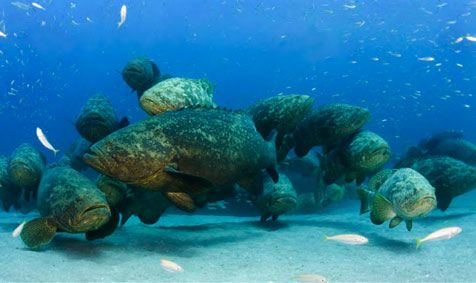
PLATE 1 Previously extinct Goliath grouper Epinephelus itajara prey population. The commercial extinction event of the
spawning aggregation re-forming off Jupiter, Florida, USA, after Goliath grouper in Florida provides a unique opportunity to
22 years of federal and state moratorium on harvest. Photograph test predatory effects on spiny lobster and grey snapper. In
by Walt Stearns. the food webs proposed by fishers, social perceptions follow
a simplification of the Lotka–Volterra predation model
In Florida a powerful lobby of recreational and (Fig. 1).
commercial fishers advocates the culling or ‘thinning out’ Here I examine the scientific evidence for and against
of the Goliath grouper population as a solution to recover culling the Goliath grouper based on the fishers’ assertion
fish and lobster stocks and to increase fishery yields. that fish and lobster stocks in Florida are negatively affected
Each encounter with an individual Goliath grouper at
sites previously vacant since the commercial extinction Food web 1: Perceptions held by lobster fishers
occurred is perceived as a population recovery. Hence,
fishers perceive the recovery of the Goliath grouper Goliath grouper
population as of greater magnitude than that shown by
scientific studies, and they view such recovery as the main
cause for declining catches of other fisheries targets Spiny lobster
because, due to its size, the species is considered a top Food web 2: Perceptions held by recreational
predator of Caribbean spiny lobster Panulirus argus, grey and commercial fishers
snapper Lutjanus griseus and several other snapper and
Goliath grouper
grouper species. This is an example of the ‘shifting baselines
syndrome’ (Pauly, 1995) whereby fishers accept reduced
abundance and size information from recent periods as Spiny lobster Fish:
baselines, resulting in inappropriate reference points for All groupers
evaluating overfishing and the disappearance of large fish. All snappers
Such perceptions, and requests for culling the Goliath Food web 3: Scientific evidence
grouper, based on the perception that it is the only species
Goliath grouper
responsible for lobster and snapper declines, are repeatedly
stated by anglers and spear-fishers (Fleshler, 2011; Kelly,
2011) and at stakeholder meetings of the Florida Fish and Invertebrates Slow, poisonous fish
Wildlife Conservation Commission (FWC, 2010, 2011). In a
Worms Catfish
study conducted in south Florida (Harrington et al., 2009) Octopus Stingrays
of 167 dive and fishing charters, 45% of the businesses Snails Pufferfish
considered the increasing Goliath grouper population had a Crabs Burrfish
negative impact on the habitats in which their charters Shrimps Porcupinefish
operate. Twenty four percent suggested a positive effect, Lobsters: Cowfish
and the remaining 30% either had no opinion or thought Spiny lobster Trunkfish
the groupers had no effect. When separated by sectors, 46% FIG. 1 Goliath grouper Epinephelus itajara food webs: (1) from
of fishers thought Goliath groupers were detrimental to common perceptions held by lobster fishers, (2) from common
perceptions held by recreational and commercial fishers, and (3)
the marine ecosystems, 37% of divers considered the
from scientific evidence based on isotope analysis, dentition and
groupers had a positive effect, and most spear-fishers studies of stomach content (see text for references) and the
had no opinion or thought the groupers had no effect. conclusions of this study. Predators of the Caribbean spiny
In 2010 Florida’s spiny lobster and grey snapper commercial lobster Panulirus argus, which are eaten by the Goliath grouper,
landings generated an estimated USD 35.5 million and USD are also indicated. Arrows flow from prey to predator.
© 2012 Fauna & Flora International, Oryx, 47(1), 88–95
Downloaded from https://www.cambridge.org/core. IP address: 46.4.80.155, on 14 Aug 2021 at 05:02:05, subject to the Cambridge Core terms of use, available at https://www.cambridge.org/core/terms
. https://doi.org/10.1017/S003060531200036190 S. Frias-Torres
by the grouper’s recovering population. Although a detailed Results
quantitative study of fishers’ perceptions is beyond the
scope of this article, their general assertions can be used For the Goliath grouper the curve of commercial landing
in hypothesis testing. If the fishers’ food webs in Fig. 1 are data over time can be used as a proxy for the species-
correct, the extinction event of the Goliath grouper should specific extinction curve because declining landings reflect
have increased the population and commercial catches a population shrinking towards commercial extinction.
of their target prey (lobsters, groupers and snappers), the During 1977–1990 correlations for Goliath grouper–
stomach contents of Goliath groupers should contain spiny lobster landings (r 5 0.006, P 5 0.98), and Goliath
predominantly their target prey, and in the case of food grouper–grey snapper landings (r 5 0.477, P 5 0.08; Fig. 2)
web 2, Goliath grouper dentition should include canine were not statistically significant.
teeth typical of a piscivorous fish. During 1950–2010 commercial catches for spiny lobster
and grey snapper peaked in 1972 and 1983, respectively.
After the peak, linear regressions of catches show a
Methods statistically significant decrease for both spiny lobster
To examine the relationship between Goliath grouper, spiny (β 5 0.63, r2 5 0.40, F1,37 5 24.42, P 5 0.000; Fig. 3a) and
lobster and grey snapper abundance I used NOAA’s grey snapper (β 5 0.92, r2 5 0.84, F1,26 5 134.92, P 5 0.000;
National Marine Fisheries Service (NMFS) database for Fig. 4a). Linear regressions of fishing effort, as total number
commercial landings (NMFS, 2012), and Florida Fish and of trips, for 1986–2010 show a statistically significant
Wildlife Conservation Commission’s data on fishing decrease for both spiny lobster (β 5 0.90, r2 5 0.81,
effort (FWC, 2012). Commercial landing data included the F1,23 5 94.9, P 5 0.000; Fig. 3b) and grey snapper
period 1950–1990 (the onset of the harvest moratorium) (β 5 0.96, r2 5 0.93, F1,23 5 309.6, P 5 0.000; Fig. 4b).
for the Goliath grouper and 1950–2010 (the most recent Linear regressions of CPUE beginning with the onset of
data available) for spiny lobster and grey snapper. Where the 1990 moratorium on fishing for Goliath groupers show a
necessary data were changed to metric units. The catch statistically significant increase for both spiny lobster
per unit effort (CPUE) was obtained by dividing the total (β 5 0.65, r2 5 0.42, F1,19 5 13.78, P 5 0.0015) and grey
annual catch (in kg) by the number of trips reported each snapper (β 5 0.93, r2 5 0.86, F1,19 5 118.45, P 5 0.000;
year. The number of trips was only available after 1986. Fig. 5).
However, I used the period 1990–2010 for CPUE analysis, as
it coincides with the onset (1990) and duration of the (a)
moratorium on harvest of the Goliath grouper.
To examine the relationship between Goliath grouper
and grey snapper abundance after the 1990 moratorium in
Florida I used 25,995 fisheries-independent diver-based
surveys carried out by REEF Environmental Education
Foundation trained volunteers (REEF, 2012) between 1993
and 2007 (the most recent data available). The REEF
database includes a density index and a percentage
sighting frequency. The density index is recorded as a
ranked variable with values of 1 (5 1 fish), 2 (5 2–10 fish),
3 (5 11–100 fish) or 4 (. 100 fish). The original fish counts (b)
for values 2, 3 and 4 are unknown. Density is considered
high at $ 3, and low at values , 3. The percentage sighting
frequency indicates the percentage of times out of all surveys
a species was recorded. At values of $ 50% a species is often
observed. At values , 50% a species is rarely observed.
A relative measure of species abundance is obtained by
multiplying the density index by the percentage sighting
frequency. The REEF database does not include invertebrate
counts. Parametric correlations, linear regression analysis
and non-parametric Spearman’s rank correlation coeffi-
cients were used as appropriate (Sokal & Rohlf, 1995). FIG. 2 Time series (1950–2010) of commercial landings in Florida
Statistical analyses were performed using Statistica v. 6.0 of (a) Caribbean spiny lobster P. argus, and (b) grey snapper
(StatSoft Inc., Tulsa, USA). Differences were considered L. griseus, compared to the extinction curve of Goliath grouper
statistically significant at P , 0.05. E. itajara. The moratorium on fishing E. itajara began in 1990.
© 2012 Fauna & Flora International, Oryx, 47(1), 88–95
Downloaded from https://www.cambridge.org/core. IP address: 46.4.80.155, on 14 Aug 2021 at 05:02:05, subject to the Cambridge Core terms of use, available at https://www.cambridge.org/core/terms
. https://doi.org/10.1017/S0030605312000361Critically Endangered Goliath grouper 91
(a) (a)
Total catch (tons)
Total catch (tons)
(b) (b)
Total no. of trips
Total no. of trips
Year Year
FIG. 3 Trends of commercial fishing effort for Caribbean spiny FIG. 4 Trends of commercial fishing effort for grey snapper in
lobster in Florida since the start of the Goliath grouper Florida since the start of the Goliath grouper extinction event in
extinction event in 1970: (a) total catch during 1972–2010, and 1970: (a) total catch during 1983–2010, and (b) total number of
(b) total number of trips during 1986–2010. All linear regressions trips during 1986–2010. All linear regressions are negative and
are negative and statistically significant (see text for details). statistically significant (see text for details). Dotted lines are 95%
Dotted lines are 95% confidence intervals. The dashed-line confidence intervals. The dashed-line rectangles indicate the
rectangles indicate the Goliath grouper extinction period. Goliath grouper extinction period.
For 1993–2007 REEF diver surveys indicate Goliath
L. griseus CPUE (kg trip-1)
grouper abundance in the reefs of Florida remained low:
P. argus CPUE (kg trip-1)
the density index increased from 0 in 1993 to 1.4 in 2007 and
the percentage sighting frequency remained , 8%. The
Goliath grouper is categorized as ‘low density–rarely
observed’ (Fig. 6a). For grey snapper the density index
varied between 2.4 and 2.7 and the percentage sighting
frequency fluctuated around 50%, from 68% in 1993 to 44.7%
in 2007. The grey snapper is categorized as ‘low density–
often observed’ (Fig. 6a). The correlation between Goliath
Year
grouper and grey snapper abundance (as density multiplied
FIG. 5 Time series (1990–2010) of commercial catch per unit
by percentage sighting frequency) is not statistically
effort (CPUE, kg trip−1) in Florida for Caribbean spiny lobster
significant (Spearman’s rank correlation, r 5 0.182, P. argus and grey snapper L. griseus. The increases are
P 5 0.515; Fig. 6b). statistically significant in both cases (see text for details).
Discussion
functionally or entirely extinct in most coastal ecosystems
Historical ecology research shows that marine megafauna (Jackson et al., 2001). The earliest European explorers of the
species such as the Goliath grouper, together with whales, Caribbean described the abundance of large-bodied grouper
manatees, the sea cow Trichechus manatus, dugong species and native fisheries (Jackson, 2001). In the Florida
Dugong dugon, Caribbean monk seal Monachus tropicalis, Keys historical photographs of Goliath groupers as trophy
marine turtles, crocodiles, Atlantic codfish Gadus morhua, fish and newspaper accounts of landings since 1923 show
swordfish Xiphias gladius, sharks and rays are now that inshore depletion of the largest Goliath grouper
© 2012 Fauna & Flora International, Oryx, 47(1), 88–95
Downloaded from https://www.cambridge.org/core. IP address: 46.4.80.155, on 14 Aug 2021 at 05:02:05, subject to the Cambridge Core terms of use, available at https://www.cambridge.org/core/terms
. https://doi.org/10.1017/S003060531200036192 S. Frias-Torres
positive. Although there are inherent limitations to each
(a) analysis they strongly suggest that the Goliath grouper is not
High density a top predator of lobster and snapper. Morphological, diet
2007 Low density and isotope studies provide additional support.
The poor development of the canine teeth of the Goliath
1993
grouper reflects a generalist (polyphage) diet (Smith, 1971).
2007 Studies on stomach contents (Bullock & Smith, 1991;
Sadovy & Eklund, 1999) reveal that the diet includes
invertebrates, mostly shrimp and crabs, but also octopus,
worms, gastropods, lobsters and slow-moving poisonous
1993
fish (catfish, Ariidae; stingrays, Dasyatidae; cowfish and
Rarely observed Often observed
trunkfish, Ostraciidae; burrfish and porcupinefish,
Diodontidae; pufferfish, Tetraodontidae). In addition to
feeding on spiny lobster as part of a diverse diet, the
Goliath grouper feeds on species identified as predators of
spiny lobster by Randall (1967) and Mintz et al. (1994):
(b) octopus, crabs, catfish, stingrays, pufferfish, burrfish and
porcupinefish (Fig. 1). Food web dynamics, based on carbon
and stable nitrogen isotope analyses of the Goliath grouper
confirm the diet preferences (invertebrates and poisonous
slow-moving fish) obtained through studies of dentition
and stomach content. The isotope analyses indicated a
broad prey base with a relatively high trophic status (Evers
et al., 2009) but not to the level of a top predatory fish. Thus,
all the scientific evidence indicates that the Goliath grouper
has a more diverse diet than that proposed by social
perceptions (Fig. 1).
Commercial fishing effort in Florida (as total catch and
number of trips) declined during and after the Goliath
FIG. 6 Trends of Goliath grouper E. itajara and grey snapper grouper extinction event. After commercial catches peaked
L. griseus abundance in Florida between 1993 and 2007 based on for spiny lobster (in 1972) and grey snapper (in 1983), the
the REEF database: (a) plot of density index versus percentage persistence and increase of CPUE values while catches and
sighting frequency, indicating the start and end of the time fishing effort decreased (Figs 3–5) suggest a condition
period for each species, and (b) time series of abundance known as hyperstability, where fish or fishers’ behaviour
(as density multiplied by percentage sighting frequency). results in stable or increasing CPUE even as fish abundance
declines, until the stock starts to collapse (Hilborn &
individuals was occurring by 1950 (McClenachan, 2009). Walters, 1992). Two major regulations, the 1990 ban on
The final decline occurred in the mid 1970s, when fishers gill-nets (Burton, 2001) and the 1992 Trap Reduction
began to target the spawning aggregations systematically Program, which reduced the use of sub-legal sized spiny
(DeMaria, 1996) until the fishery, and the population, lobster to bait traps in the commercial fishery (Muller et al.,
collapsed in the late 1980s. 2000), did not significantly affect the trends observed. The
The analyses shown here demonstrate that the Goliath pressure from recreational fisheries must be considered.
grouper commercial extinction event (1970–1990) did not Marine recreational fishing activity in Florida has
result in an increase of Caribbean spiny lobster or grey almost doubled over the past 2 decades, from 15–20 million
snapper commercial landings in Florida (Figs 2–4). When individual trips in the early 1980s to 25–30 million trips in
the analyses are extended beyond 1990 (Figs 3–5), the onset the early 2000s (Ault et al., 2003). Recreational landings
of the harvest moratorium for the Goliath grouper, estimated for the 2-day sport season lobster fishery in late
commercial landings of spiny lobster and grey snapper July and for the period between 6 August and Labor Day
reflect increasing fishing pressure, and REEF fisheries, (the first Monday in September), indicate that from 1987 to
independent diver-based surveys (Fig. 6) show there is 2000 mean recreational landings were 23.7 ± SE 0.95% of
no correlation between Goliath grouper and grey snapper commercial landings in the Florida Keys. This amount
abundance in Florida’s reefs. If food webs 1 and 2 proposed should be added to ascertain the total fishing pressure on
in Fig. 1 are correct the correlations in Fig. 2 would be the spiny lobster (Muller et al., 2000). In the Florida Keys,
negative and the regressions in Figs 3 and 4 would be where grey snapper stocks are overfished, the recreational
© 2012 Fauna & Flora International, Oryx, 47(1), 88–95
Downloaded from https://www.cambridge.org/core. IP address: 46.4.80.155, on 14 Aug 2021 at 05:02:05, subject to the Cambridge Core terms of use, available at https://www.cambridge.org/core/terms
. https://doi.org/10.1017/S0030605312000361Critically Endangered Goliath grouper 93
fishery is the principal fleet targeting grey snapper and other to 30% of annual GDP, which benefit from the long lifespan
reef-fish species. Here, reef fish populations have declined in of many shark species (Gallagher & Hammerschlag, 2011).
recent decades because of a combination of human-related In Belize dive ecotourism targeting spawning aggregations
stressors, such as overfishing, and habitat degradation of the snapper–grouper complex can generate 20 times
(Ault et al., 2005). Recreational landings in the continental the income produced from fishing the aggregations (Sala
USA, including catch-and-release, seriously affect many of et al., 2001). Small groups of properly trained divers seem to
the most valued overfished species, sometimes rivalling or have little impact on the normal behaviour of even the most
even replacing commercial fisheries (Coleman et al., 2004). timid aggregating fish (Heyman et al., 2010). The char-
Based on the evidence presented here the recovering ismatic long-lived Goliath grouper could benefit from dive
trends of the Goliath grouper are not directly responsible ecotourism as a sustainable alternative to overfishing and
for declining commercial landings of spiny lobster and dive ecotourism could become a key strategy to ensure the
grey snapper. The most likely cause is commercial and conservation of the species. Socio-economic valuations of
recreational overfishing. how such ecotourism could benefit local communities, and
studies to quantify what levels of diver ecotourism pressure
alter normal spawning aggregation behaviour in the Goliath
Should the Goliath grouper be culled in Florida? grouper require further investigation.
Thirdly, the Goliath grouper could provide biocontrol
A potential reopening of the Goliath grouper fishery of invasive Indo-Pacific red lionfish (Pterois volitans/Pterois
in Florida for culling purposes raises ecological, socio- miles, Scorpaenidae). The venom-spined piscivorous
economic and ethical concerns. For example, non-human lionfish, introduced to Florida waters in the early 1990s,
predators of spiny lobster are numerous and diverse, has invaded the USA eastern seaboard, Florida, the Gulf of
consisting of at least 26 different species, including Mexico and the Caribbean. A voracious predator of native
invertebrates, elasmobranchs, teleost fish, reptiles and marine juvenile reef fishes and invertebrates, the lionfish population
mammals (Mintz et al., 1994; DeLoach, 1999). If preying on has the potential to act synergistically with other existing
spiny lobster is a justification for culling Goliath groupers stressors, such as climate change, overfishing and pollution,
then we would also need to cull a diverse and significant making this invasion of particular concern for the future
group of Florida’s marine fauna. The rationale for culling the of Atlantic coral reefs (Albins & Hixon, 2008). The Goliath
recovering Goliath grouper population as the solution to grouper exploits a unique niche, feeding on invertebrates
depleted or decreasing fisheries is questionable because of and venomous fish. Venom is common in the fish
documented overfishing in Florida, the evidence presented fraction of the Goliath grouper’s diet: skin-secreted
here and the unpredictable consequences of culling a species toxins of Ostraciidae (cowfish, trunkfish), Diodontidae
that has proven extremely vulnerable to overfishing and is (porcupinefish, burrfish) and Tetraodontidae (pufferfish;
slow to recover. Malpezzi et al., 1997), and venom-charged spines of
A substantial recovery of the Goliath grouper population Dasyatidae (stingrays) and Ariidae (catfish; Haddad &
could result in three main socio-economic and ecological Martins, 2006; Sivan, 2009). Thus, the Goliath grouper’s
benefits that require further investigation. Firstly, the adaptation to feeding on poisonous and venom-spined fish
Goliath grouper feeds on a number of species identified could potentially serve as a natural biocontrol for invasive
as predators of the spiny lobster (Fig. 1; Mintz et al., 1994; lionfish. However, predation by the Goliath grouper on
Randall, 1967). Because of the complexity of trophic P. volitans/P. miles has not yet been documented, and
cascading effects (Pace et al., 1999) restoring the Goliath non-lethal studies of the stomach contents of the Goliath
grouper population in Florida could result in a top-down grouper in the current P. volitans/P. miles invasion are still
control of lobster predators, possibly making more lobsters underway. The potential of other large-bodied groupers
available to the fisheries. This requires further investigation. (Nassau Epinephelus striatus; tiger Mycteroperca tigris; black
Secondly, the Goliath grouper’s enormous size, site Mycteroperca bonaci; yellowfin Mycteroperca venenosa
attachment (resulting in reliable encounters), formation of and yellowmouth Mycteroperca intersticialis) as natural
spawning aggregations and curiosity towards divers (Sadovy biocontrol of invasive lionfish has been demonstrated: when
& Eklund, 1999) makes it a major attraction for SCUBA comparing lionfish abundance in marine reserves (where
diving ecotourism. Grouper–diver encounter operations large-bodied groupers eating lionfish are present) vs
have already been initiated in the Florida Keys and in parts unprotected sites (where large-bodied groupers are
of east Florida, where previously extinct spawning aggrega- overfished or extinct) in the Caribbean, lionfish biomass
tions are forming again (Plate 1). Diving ecotourism as an exhibited a 7-fold and non-linear reduction in relation to the
alternative to overfishing provides more value to local biomass of groupers (Mumby et al., 2011).
economies. For example, global shark-based ecotourism In conclusion, the recovering population of the Goliath
operations provide large economic values, in some cases up grouper in Florida is not the cause of declining lobster and
© 2012 Fauna & Flora International, Oryx, 47(1), 88–95
Downloaded from https://www.cambridge.org/core. IP address: 46.4.80.155, on 14 Aug 2021 at 05:02:05, subject to the Cambridge Core terms of use, available at https://www.cambridge.org/core/terms
. https://doi.org/10.1017/S003060531200036194 S. Frias-Torres
fish stocks in the region. Instead, overfishing is the main F L E S H L E R , D. (2011) Success story or pest? The Palm Beach Post, 11
cause. The Goliath grouper could provide ecological and June, 6B.
F R I A S -T O R R E S , S. (2006) Habitat use by juvenile Goliath grouper,
socio-economic benefits as top-down control on lobster
Epinephelus itajara, in the Florida Keys, USA. Endangered Species
predators, in ecotourism, and as a potential biocontrol Research, 2, 1–6.
agent for invasive lionfishes. Culling the Goliath grouper is FWC (F LO R I D A F I S H A N D W I L D L I F E C O N S E R VAT I O N C O M M I S S I O N )
not supported by the scientific evidence and continued (2010) Minutes Commission Meeting, December 1–2, 2010, Weston,
protection of the species is required. FL. Http://www.myfwc.com/media/1185876/2010_Dec_Minutes.pdf
[accessed 1 July 2011].
FWC (F LO R I D A F I S H A N D W I L D L I F E C O N S E R VAT I O N C O M M I S S I O N )
(2011) Minutes Commission Meeting, February 23–24, 2011,
Acknowledgements Apalachicola, FL. Http://www.myfwc.com/media/1381539/
2011_feb_minutes.pdf [accessed 1 July 2011].
I thank J. Serafy, E. Widder, D. DeMaria and two FWC (F LO R I D A F I S H A N D W I L D L I F E C O N S E R VAT I O N C O M M I S S I O N )
anonymous reviewers for comments, and W. Stearns (2012) Commercial Fisheries Landings in Florida. Http://myfwc.
for providing his copyrighted photograph in Plate 1. com/research/saltwater/fishstats/commercial-fisheries/landings-in-
Manuscript writing was funded by the Schmidt Ocean florida [accessed 10 February 2012].
Institute. Views expressed herein are those of the author G A L L A G H E R , A.J. & H A M M E R S C H L A G , N. (2011) Global shark
currency: the distribution, frequency, and economic value of shark
and do not necessarily reflect the views of any supporting ecotourism. Current Issues in Tourism, 14, 797–812.
agency. G E R B E R , L.R., M O R I S S E T T E , L., K A S C H N E R , K. & P A U LY , D. (2009)
Should whales be culled to increase fishery yield? Science, 323,
880–881.
References H A D D A D , V. & M A R T I N S , I.A. (2006) Frequency and gravity of human
envenomations caused by marine catfish (suborder Siluroidei): a
A L B I N S , M.A. & H I X O N , M.A. (2008) Invasive Indo-Pacific lionfish clinical and epidemiological study. Toxicon, 47, 838–843.
Pterois volitans reduce recruitment of Atlantic coral-reef fishes. H A R R I N G T O N , J., A WA D , B., K I N G O N , K. & H A S K I N S , A. (2009)
Marine Ecology Progress Series, 367, 233–238. Goliath Grouper Study: A Survey Analysis of Dive Shop and Charter
A U LT , J.S., B O H N S AC K , J.A., S M I T H , S.G. & L U O , J. (2005) Towards Boat Operators in Florida. Final Report. Florida Fish and Wildlife
sustainable multispecies fisheries in the Florida, USA, coral reef Conservation Commission. Http://www.cefa.fsu.edu/Projects/
ecosystem. Bulletin of Marine Science, 76, 595–622. Current-Projects [accessed 10 July 2011].
A U LT , J.S., S M I T H , S.G., D I A Z , G.A. & F R A N K L I N , E. (2003) Florida H E I T H A U S , M. R., F R I D , A., W I R S I N G , A.J. & W O R M , B. (2008)
Hogfish Fishery Stock Assessment. Final Report Contract No. Predicting ecological consequences of marine top predator declines.
FFWCC S 7701 617573. Florida Marine Research Institute, Florida Trends in Ecology & Evolution, 23, 202–210.
Fish and Wildlife Conservation Commission, USA. H E Y M A N , W.D., C A R R , L.M. & L O B E L , P.S. (2010). Diver ecotourism
B U L LO C K , L.H. & S M I T H , G.B. (1991) Seabasses (Pisces: Serranidae). and disturbance to reef fish spawning aggregations: it is better to
Memoirs of the Hourglass Cruises, 8, 1–243. be disturbed than to be dead. Marine Ecology Progress Series, 419,
B U R T O N , M.L. (2001) Age, growth, and mortality of gray snapper, 201–210.
Lutjanus griseus, from the east coast of Florida. Fishery Bulletin H I L B O R N , R. & W A LT E R S , C.J. (1992) Quantitative Fisheries Stock
NOAA, 99, 254–265. Assessment. Chapman & Hall, New York, USA.
C A R O , T. (1998) How do we refocus behavioral ecology to address J AC K S O N , J.B.C. (2001) What was natural in the coastal oceans?
conservation issues more directly? In Behavioral Ecology and Proceedings of the National Academy of Sciences of the United States
Conservation Biology (ed. T. Caro), pp. 557–565. Oxford University of America, 98, 5411–5418.
Press, New York, USA. J AC K S O N , J.B.C., K I R B Y , M.X., B E R G E R , W.H., B J O R N D A L , K.A.,
C O L E M A N , F.C., F I G U E I R A , W.F., U E L A N D , J.S. & C R OW D E R , L.B. B OT S FO R D , L.W., B O U R Q U E , B.J. et al. (2001) Historical
(2004) The impact of United States recreational fisheries on marine overfishing and the recent collapse of coastal ecosystems. Science,
fish populations. Science, 305, 1958–60. 293, 629–638.
C R A I G , M.T. (2011) Epinephelus itajara. In IUCN Red List of J O H N S , G.M., L E E W O R T H Y , V.R., B E L L , F.W. & B O N N , M.A. (2001)
Threatened Species v. 2012.1. Http://www.iucnredlist.org [accessed Socio-economic Study of Reefs in Southeast Florida: Final Report.
10 July 2012]. Hazen and Sawyer Environmental Engineers & Scientists,
D E L O A C H , N. (1999) Reef Fish Behavior: Florida, Caribbean, Bahamas. Hollywood, FL, USA.
New World Publications, Jacksonville, USA. K E L LY , D. (2011) Goliath grouper catches coming? Florida Sportsman,
D E M A R I A , K. (1996) Changes in the Florida Keys Marine Ecosystem May 2011, 50.
Based Upon Interviews with Experienced Residents. The Nature K O E N I G , C.C. & C O L E M A N ., F.C. (2010) Population Density,
Conservancy Special Report, Key West, USA. Demographics, and Predation Effects of Adult Goliath Grouper
D U D L E Y , S.F.J. & C L I F F , G. (2010) Shark control: methods, efficacy and (October 2006–September 2009). MARFIN Project Final Report.
ecological impacts. In Sharks and their Relatives II: Biodiversity, Project NA05NMF4540045. Florida State University Coastal and
Adaptive Physiology and Conservation (eds J.C. Carrier, J.A. Musick Marine Laboratory, St. Teresa, USA.
& M.R. Heithaus), pp. 567–592. CRC Press, Taylor & Francis Group, L A L A S , C. & B R A D S H AW , C.J.A. (2001) Folklore and chimerical
Boca Raton, USA. numbers: Review of a millennium of interaction between fur seals
E V E R S , D.C., G R A H A M , R. T., P E R K I N S , C.R., M I C H E N E R , R. & and humans in the New Zealand region. New Zealand Journal of
D I V O L L , T. (2009) Mercury concentrations in the Goliath grouper Marine and Freshwater Research, 35, 477–497.
of Belize: an anthropogenic stressor of concern. Endangered Species L O T K A , A.J. (1925) Elements of Physical Biology. Williams & Wilkins,
Research, 7, 249–256. Baltimore, USA.
© 2012 Fauna & Flora International, Oryx, 47(1), 88–95
Downloaded from https://www.cambridge.org/core. IP address: 46.4.80.155, on 14 Aug 2021 at 05:02:05, subject to the Cambridge Core terms of use, available at https://www.cambridge.org/core/terms
. https://doi.org/10.1017/S0030605312000361Critically Endangered Goliath grouper 95
M A L P E Z Z I , E.L.A., D E F R E I TA S , J.C. & R A N T I N , F.T. (1997) R A N D A L L , J.E. (1967) Food habits of reef fishes of the West Indies.
Occurrence of toxins, other than paralysing type, in the skin of Studies in Tropical Oceanography, 5, 665–847.
tetraodontiformes fish. Toxicon, 35, 57–65. REEF (REEF E N V I R O N M E N T A L E D U C AT I O N F O U N D A T I O N )
M C C L E N AC H A N , L. (2009) Historical declines of Goliath grouper (2012) Tropical Western Atlantic/North Western Atlantic
populations in South Florida, USA. Endangered Species Research, Database. Http://www.reef.org/data/twa/index.htm
7, 175–181. [accessed 1 January 2012].
M I N T Z , J.D., L I P C I U S , R.N., E G G L E S T O N , D.B. & S E E B O , M.S. (1994) S A D O V Y , Y., C O R N I S H , A., D O M E I E R , M., C O L I N , P.L., R U S S E L L , M. &
Survival of juvenile Caribbean spiny lobster: effects of shelter size, L I N D E M A N , K.C. (2008) A global baseline for spawning aggregations
geographic location and conspecific abundance. Marine Ecology of reef fishes. Conservation Biology, 22, 1233–1244.
Progress Series, 112, 255–266. S A D O V Y , Y. & E K L U N D , A.M. (1999) Synopsis of biological
M O R I S S E T T E , L., C H R I S T E N S O N , V. & P A U LY , D. (2012) Marine information on the Nassau grouper, Epinephelus striatus (Bloch
mammal impacts in exploited ecosystems: Would large scale culling 1792) and the jewfish, E. itajara (Lichtenstein 1822). NOAA Technical
benefit fisheries? PLoS ONE, 7(9), e43966. Report NMFS, 146, 1–65.
M U M B Y , P.J., H A R B O R N E I , A.R. & B R U M B A U G H , D.R. (2011) S A L A , E., B A L L E S T E R O S , E. and S T A R R , R.M. (2001) Rapid
Grouper as a natural biocontrol of invasive lionfish. PLoS ONE, 6(6), decline of Nassau grouper spawning aggregations in
e21510. Belize: fishery management and conservation needs. Fisheries,
M U L L E R , R.G., S H A R P , W.C., M AT T H E W S , T.R., B E R T E L S E N , R. & 26, 23–30.
H U N T , J.H. (2000) The 2000 update of the stock assessment for spiny S C H E F F E R , M., C A R P E N T E R , S., F O L E Y , J.A., F O L K E , C. & W A L K E R , B.
lobster, Panulirus argus, in the Florida Keys. Florida Fish and (2001) Catastrophic shifts in ecosystems. Nature, 413, 591–596.
Wildlife Conservation Commission. Http://www.sefsc.noaa.gov/ S I VA N , G. (2009) Fish venom: pharmacological features and biological
sedar/download/2000%20spiny_lobster%20stock%20assessment. significance. Fish and Fisheries, 10, 159–172.
pdf?id=DOCUMENT [accessed 10 July 2010]. S M I T H , C.L. (1971) A revision of the American groupers: Epinephelus
M Y E R S , R.A. & W O R M , B. (2003) Rapid worldwide depletion of and allied genera. Bulletin of the American Museum of Natural
predatory fish communities. Nature, 423, 280–283. History, 146, 69–241.
NMFS (N AT I O N A L M A R I N E F I S H E R I E S S E R V I C E ) (2012) Annual S O K A L , R.R. & R O H L F , F.J. (1995) Biometry. 3rd edition. W.H. Freeman
Commercial Landing Statistics. Http://www.st.nmfs.noaa.gov/st1/ and Company, New York, USA.
commercial/landings/annual_landings.html [accessed V O LT E R R A , V. (1926) Fluctuations in the abundance of a species
10 February 2012]. considered mathematically. Nature, 118, 558–560.
P AC E , M.L., C O L E , J.J., C A R P E N T E R , S.R. & K I T C H E L L , J.F. (1999) Y O D Z I S , P. (2001) Must top predators be culled for the sake of fisheries?
Trophic cascades revealed in diverse ecosystems. Trends in Ecology Trends in Ecology & Evolution, 16, 78–84.
& Evolution, 14, 483–488.
P A U LY , D. (1995) Anecdotes and the shifting baseline syndrome of
fisheries. Trends in Ecology & Evolution, 10, 430. Biographical sketch
P U N T , A. & B U T T E R WO R T H , D. (1995) The effects of future
consumption by the Cape fur seal on catches and catch SARAH FRIAS-TORRES is an oceanographer and marine ecologist. She has
rates of the Cape hakes. 4. Modelling the biological wide interests in marine conservation biology and the behavioural
interaction between Cape fur seals Arctocephalus pusillus ecology of marine megafauna. Another major theme of her research is
pusillus and the Cape hakes Merluccius capensis and the behaviour and conservation of reef fish spawning aggregations. She
M. paradoxis. South African Journal of Marine Science, is currently focusing her research on Goliath groupers, a species she
16, 255–285. has been working with since 2003.
© 2012 Fauna & Flora International, Oryx, 47(1), 88–95
Downloaded from https://www.cambridge.org/core. IP address: 46.4.80.155, on 14 Aug 2021 at 05:02:05, subject to the Cambridge Core terms of use, available at https://www.cambridge.org/core/terms
. https://doi.org/10.1017/S0030605312000361You can also read


