SIAM/ITSM Service Design & Transition - U.S. 2020 - Orange Business ...
←
→
Page content transcription
If your browser does not render page correctly, please read the page content below
SIAM/ITSM
                                 A research report
Service Design & Transition      comparing provider
                                 strengths, challenges
                                 and competitive
                                 differentiators
U.S. 2020
Quadrant
Report

Customized report courtesy of:

                                               March 2020
ISG Provider Lens™ Quadrant Report | March 2020                                                                                                                  Section Name

                    About this Report
Information Services Group, Inc. is solely responsible for the content of this report.        ISG Provider Lens™ delivers leading-edge and actionable research studies, reports
                                                                                              and consulting services focused on technology and service providers’ strengths and
Unless otherwise cited, all content, including illustrations, research, conclusions,          weaknesses and how they are positioned relative to their peers in the market. These
assertions and positions contained in this report were developed by and are the sole          reports provide influential insights accessed by our large pool of advisors who are
property of Information Services Group, Inc.                                                  actively advising outsourcing deals as well as large numbers of ISG enterprise clients
                                                                                              who are potential outsourcers.
The research and analysis presented in this report includes research from the ISG
Provider Lens™ program, ongoing ISG Research programs, interviews with ISG advisors,          For more information about our studies, please email ISGLens@isg-one.com,
briefings with services providers and analysis of publicly available market information       call +49 (0) 561-50697537, or visit ISG Provider Lens™ under ISG Provider Lens™.
from multiple sources. The data collected for this report represents information that
ISG believes to be current as of March 2020 for providers who actively participated as
well as for providers who did not. ISG recognizes that many mergers and acquisitions
have taken place since that time, but those changes are not reflected in this report.

The lead author for this report is Lutz Peichert. The editor is Jan Erik Aase. The research   ISG Research™ provides subscription research, advisory consulting and executive

analyst is Rahul Basu and the data analyst is Vijayakumar Goud. The Quality and               event services focused on market trends and disruptive technologies driving change

Consistency Advisor is Jan Erik Aase.                                                         in business computing. ISG Research™ delivers guidance that helps businesses
                                                                                              accelerate growth and create more value.

                                                                                              For more information about ISG Research™ subscriptions, please email
                                                                                              contact@isg-one.com, call +49 (0) 561-50697537 or visit research.isg-one.com.

                                                                                                                                                                                 2
© 2020 Information Services Group, Inc. All Rights Reserved.
© 2020 Information Services Group, Inc. All rights reserved.
                                   Reproduction of this publication in any form without prior
1    Executive Summary
                                   permission is strictly prohibited. Information contained in this
4    Introduction                  report is based on the best available and reliable resources.
                                   Opinions expressed in this report reflect ISG’s judgment at the
15   Service Design & Transition
                                   time of this report and are subject to change without notice.
20   Methodology                   ISG has no liability for omissions, errors or completeness of
                                   information in this report. ISG Research™ and ISG Provider Lens™
                                   are trademarks of Information Services Group, Inc.
ISG Provider Lens™ Quadrant Report | March 2020 Section Name
Executive Summary
EXECUTIVE SUMMARY
SIAM/ITSM 2020
Digitalization is omnipresent and all-pervasive in the service integration and management Secondly, the market for service integration (SI) and managed services for Extended
(SIAM)/IT service management (ITSM) market. A shift from information technology (IT) to Enterprise Management Systems (EESM) is growing rapidly. SI is important as the BT
business technology (BT) is occurring across markets and with this the predicted extension management systems are driven by three forces: they need to support business process,
of the IT value chain has become a reality. The customers of a company have direct access the need to combine emerging technologies with legacy systems and user satisfaction. In
to business warehouse (BW) information or enterprise resource planning tools (ERPs) or this scenario, managed service providers (MSPs) are more in demand as there is a paucity
even business applications for details about product design, availability or delivery dates. of skilled resources to operate the complex solutions.
Commercial ERP is connected with smart factory systems to offer build-to-order services to
The SIAM/ITSM market is undergoing a fundamental change ― moving from labor-
customers and a smart factory can reach out to suppliers to ensure “just-in-time” delivery.
intensive implementations to highly automated functions. Vendors are investing heavily
In the healthcare industry, information can be shared easily. For instance, clinical data
in automation capabilities and using available/emerging modern technologies to unlock
easily gathered through electronic health records can encourage R&D departments of
new value for their services. While the IT environment has been producing data since
pharmaceutical companies to undertake research to manage chronic conditions such as
technology was invented, analytical tools are now being used to transform correlated data
diabetes. Customers can use virtual reality (VR) and augmented reality (AR) to design a
into information. With this intelligent automation (IA), IT can deliver incremental value by
kitchen or select curtains for the living room using the smartphone camera. And extension
integrating the systems of record with the systems of engagement, even within IT itself.
at the other end of the IT value chain happens in B2B relations and in shop floor integration
This integration is being used to make decisions or to automatically trigger activities based
with the same pace.
on extensive solution catalogs. User experience is improved by using highly sophisticated
The ITSM/SIAM market has been impacted twofold by digitalization. At the outset, IT4IT™ is natural language processing (NLP) techniques across a large variety of input channels,
a reality. Emerging technologies are available and systems of engagement together with the resulting in a seamless and personalized human-machine experience. Early use cases are
systems of record act as platforms for enterprise management systems (EMS). We, at ISG, being built using machine learning (ML) capabilities to act faster and to prevent incidents.
are of the opinion that we need to talk about the extended enterprise system management
(xESM) market as the one responsible for operating BT, and the need to secure business
process operations beyond the boundaries of a company’s BT environment.
1
© 2020 Information Services Group, Inc. All Rights Reserved.ISG Provider Lens™ Quadrant Report | March
Juni 2018
2020 Executive Summary
As mentioned earlier, IT4IT™ is reality and emerging technologies are available and in Business units need to constantly improve customer experience to win and retain
use. In this respect, “in use” has to be understood as technologies being used by vendors customers, hence, the number of IT services underpinning business solutions is constantly
to offer enhancements in the automation of processes. In some cases, for example growing, raising the importance of structured SIAM rapidly. Most of the business-related
in sourcing information management, such technologies allow better integration by services need to come from a large group of outside vendors to meet the requirements
helping to format unstructured data or by automatically sending an alert during pattern of companies in the ever-increasing competitive business environment. More companies
recognition in mass event data. In use does not necessarily mean that SIAM customers understand that running and managing the IT environment today requires a two-pronged
are extensively using this already operational technology. We have observed that even approach. First, operational IT service management activities must evolve from people-
though such technologies are available only few, very experienced or mature clients, often driven actions to automated, self-managed and machine-performed executions, and
working in close relationship with the vendor or system integrator, are using the available second, professional orchestration of the IT supply is needed, through a large number
solutions. For the majority of IT organizations, the lack of internal readiness prevents them of suppliers, to build a robust service ecosystem that can deliver end-to-end business
from fully utilizing them. services. IT operations management is evolving into a complex environment of service
elements and providers and is changing rapidly.
However, compared with last year’s study, the functionalities in the product offerings
have increased dramatically. We, at ISG, had to take that into account while comparing the Traditionally, IT organizations kept core infrastructure and application management
different offers; to plot the results in the charts for this report, we had to adjust the scaling in-house. With the increasing demand for more agility, a growing number of companies are
heavily to ensure that the charts were not top heavy. Hence, it is necessary to understand realizing that they cannot keep pace with this evolution. Labor shortages, along with the
the position of a provider in comparison with the other providers and not in comparison need for deep knowledge about a variety of new and complex technologies, is compelling
with its last year’s position. In some cases, it may appear that a vendor has lost ground IT departments to re-think their management approaches. The demand for managed
but, in reality, it has gained ground with respect to the functionality but has lost ground services is growing, and vendors are developing high-tech solutions with focus on the zero-
relative to other offerings as they simply developed faster. touch operating model to guarantee a sustainable business IT environment.
2
© 2020 Information Services Group, Inc. All Rights Reserved.ISG Provider Lens™ Quadrant Report | March 2020 Executive
Section
Summary
Name
Vendors in this market can be separated into three groups. One group comprises the Given the high variances in client maturity regarding SIAM, the success of vendors in
classic vendors that focus on developing feature-rich tool sets that are easy to implement, the market depends on their ability to demonstrate extensive knowledge of ITSM, SIAM
easy to enrich and can be leveraged by IT department, MSPs or system integrators. Even and governance, risk and compliance (GRC) processes. This knowledge needs to feed an
though the IT market is moving toward anything-as-a-service (XaaS) delivery models, the internal reference model used to define a robust, agile and secure SIAM framework that
market is still favorable for on-premise installations. Local legal requirements and legacy combines people, processes and tools seamlessly. In some cases, the reference model
installations are the driving forces here. This market segment is mainly split between is being supplemented with some already established models in the market such as
ServiceNow, BMC Software, Cherwell, Microfocus, Broadcom/CA Technologies, Atlassian, IT4IT™, defined by The Open Group. Proprietary assessment and coaching methodologies,
and Ivanti. However, there are some smaller players that offer feature-rich products that together with high transformation skills and a flexible pricing model, are additional and
have gained a certain market share, such as 4me, Matrix42 or Mphasis. important success factors in this market.
The second group comprises consulting and IT service companies that use the platforms Even though this market is not large, it is one of the fundamental pillars of every digital
of the first group and enhance the base functionality with specific features based on transformation strategy. With IT operational budgets still tight, and margins somewhat
their industry-specific or other specialized knowledge. These vendors range from global skinny, this market is clearly a very attractive one for vendors; given their strategic position
IT services companies such as Accenture, Deloitte or EY to focused local players such inside client organizations, SIAM/ITSM vendors are playing a key role and are about to get
Plat4mation, Trianz, Fusion GBS, FlyCast Partners and RightStar. These companies offer a a seat at the internal IT and business-decision table. Achieving such a position requires
variety of services, including implementation consultancy and managed services. a great deal of trust. This is either being gained through long-term, trusted relationships
or through high delivery quality, resulting in better user experience or a high customer
The third group comprises IT service companies that have, over time, developed feature-
satisfaction (CSat) or net promoter score.
rich, proprietary tool sets normally used only in a managed service environment. Some
of the companies in this group are Capgemini, HCL, Infosys, LTI, Orange and TechM. This
study looks at all of these product solutions independent from the delivery model
and provisioning.
3
© 2020 Information Services Group, Inc. All Rights Reserved.ISG Provider Lens™ Quadrant Report | March 2020
Introduction
Introduction
Definition
Simplified illustration SIAM, as a part of enterprise service management (ESM), is a holistic
approach used to manage a dynamic, multivendor and multiservice
SIAM / ITSM (2020) ecosystem. It is the result of the evolution of ITSM, IT operations
management (ITOM) and the governance, risk and compliance (GRC)
discipline. While ITSM is historically focused on designing business-related
Business Value Service Sourcing Information
services based on existing IT services and on managing individual service
Management Management
System Integrators for System Integrators for performance, SIAM focuses on adding additional services through a full-scale
ServiceNow Products BMC Software Products service lifecycle; at the same time, it integrates such individual services into
Service Design Service Operation
an end-to-end, business process-oriented approach that includes vendor
& Transition & Delivery
performance and management issues. While the integration of the various
processes and management disciplines become important, enterprises are
Source: ISG 2020
looking for solutions that support such efforts. The solutions can be products
that support internal teams or external service providers. This study focuses
4
© 2020 Information Services Group, Inc. All Rights Reserved.ISG Provider Lens™ Quadrant Report | March 2020 Introduction
Definition (cont.)
on products/tools available in the market and on companies that enhance such
tools through extensions and add-ons. It encompasses solutions that are being built Business Operating Model
by service providers, but it only analyzes the functional capabilities of such tools and
Customers Internal
Needs Service
solutions and not the service delivery capabilities of the providers. Processes
Delivery
In addition, the study analyzes the companies in the U.S. that provide system Organization
Services
Demand
Services
Supply
integration services for the above-mentioned combined system of records and/
Value People
or systems of engagement ecosystems. For better comparison, this study focuses
on system integrators (SIs) that deliver consulting and services on the two platform
Technologies External
systems that have found high acceptance in the U.S. market: BMC software’s suite Service
of Helix® and Truesight® products, and ServiceNow’s current release, New York, Governance Delivery
and forthcoming release, Orlando. ISG recognizes that there are several other,
well-designed and functionally rich platforms, but for the sake of not over-burdening
the study we have decided to focus on the above-mentioned two systems. Some of
Process execution through Automation, Integration and Information Sharing
the SIs we have analyzed offer services for other platform systems such as Cherwell,
Micro Focus, Broadcom/CA and Atlassian, but do not have any impact on the
Source: ISG 2020
analysis in this study.
5
© 2020 Information Services Group, Inc. All Rights Reserved.ISG Provider Lens™ Quadrant Report | March 2020 Introduction
Definition (cont.)
Scope of the Report
ISG studies are intended to anticipate the investigation efforts and buying The scope of the report covers product functionalities and service portfolios offered by vendors
decisions of typical enterprise clients. These clients will benefit from a study that in the heterogenous SIAM environment. Due to the broad scope and non-standardized SIAM
examines the functional capabilities while contemplating a significant strategy definitions, this report is based on a sub-set of ISG’s own SIAM reference model, where a key
transformation, making infrastructure purchase-versus-rent decisions, supporting focus area are the automation capabilities delivered by vendors for the operational tasks inside
the implementation of agile practices or incorporating automation into their SIAM. The more sophisticated areas covering GRC issues are excluded from this report and may
environments. The study comprises multiple quadrants covering a spectrum be covered in another ISG Provider Lens™ study.
of process automation capabilities that an enterprise client would require. Our
The six quadrants of the report focus on the processes through a plan-design-manage approach
research investigates several of the tool capabilities (templatized data structures,
underlined with an information layer feeding the three operational process clusters. Two
automated process policies, integration capabilities and standardized outputs) and
quadrants focus on the SI companies specialize in either ServiceNow’s platform or BMC Software’s
the support capabilities that provide consulting and managed services in addition to
offerings around the Helix® or TrueSight® product sets.
the tool solutions.
6
© 2020 Information Services Group, Inc. All Rights Reserved.ISG Provider Lens™ Quadrant Report | March 2020 Introduction
Definition (cont.)
The six quadrants that are covered are: Service Integrators for BMC Software products (BMCSI): It includes companies that are
dedicated to help clients design an architecture, build, customize and/or operate SIAM/ITSM
Business Value and Service Management (BVSM): It covers the processes for
solutions primarily based on the Helix® and TrueSight® offerings, and also recognizes other
demand analysis, catalog management, chargeback and customer satisfaction.
products such as ControlM®.
IT Service Design (SD): It incorporates all service design (SD)-related processes,
Service Integrators for ServiceNow’s products (SNSI): It includes companies that are dedicated
ranging from capacity availability management to service validation and
to help clients design an architect, build, customize and/or operate SIAM/ITSM solutions based
deployment.
on the current release, New York, while it also recognizes the support of other recent releases.
IT Service Operation (SO): It covers all operational processes for event and
problem management, including all reporting and improvement activities.
Sourcing Information Management (SIM): It is the underlying process cluster
that gathers, stores and provides data to the management processes; it includes
data homogenization and golden record management within the configuration
management database (CMDB) to support asset, configuration and access
management.
7
© 2020 Information Services Group, Inc. All Rights Reserved.ISG Provider Lens™ Quadrant Report | March 2020 Introduction
Provider Classifications
The ISG Provider Lens™ quadrants were created using an evaluation matrix containing four segments, where the providers are positioned accordingly.
Leader Product Market Contender
Challenger Challenger
The “leaders” among the vendors/ The “product challengers” offer a “Market challengers” are also “Contenders” are still lacking mature
providers have a highly attractive product and service portfolio that very competitive, but there is still products and services or sufficient
product and service offering and a provides an above-average cover- significant portfolio potential and depth and breadth of their offering,
very strong market and competitive age of corporate requirements, but they clearly lag behind the “leaders.” while also showing some strengths
position; they fulfill all requirements are not able to provide the same Often, the market challengers and improvement potentials in their
for successful market cultivation. resources and strengths as the are established vendors that market cultivation efforts. These
They can be regarded as opinion leaders regarding the individual are somewhat slow to address vendors are often generalists or
leaders, providing strategic market cultivation categories. Often, new trends, due to their size and niche players.
impulses to the market. They also this is due to the respective vendor’s company structure, and have
ensure innovative strength size or their weak footprint within therefore still some potential to
and stability. the respective target segment. optimize their portfolio and increase
their attractiveness.
8
© 2020 Information Services Group, Inc. All Rights Reserved.ISG Provider Lens™ Quadrant Report | March 2020 Introduction
Provider Classifications (cont.)
Each ISG Provider Lens™ quadrant may include a service provider(s) who ISG believes has a strong potential to move into the leader’s quadrant.
Rising Star Not In
Rising stars are mostly product challengers with high future potential. This service provider or vendor was not included in this
When receiving the “rising stars” award, such companies have a promis- quadrant as ISG could not obtain enough information to
ing portfolio, including the required roadmap and an adequate focus on position them. This omission does not imply that the
key market trends and customer requirements. Also, the “rising stars” service provider or vendor does not provide this service.
has an excellent management and understanding of the local market.
This award is only given to vendors or service providers that have made
extreme progress towards their goals within the last 12 months and
are on a good way to reach the leader quadrant within the next 12-24
months, due to their above-average impact and innovative strength.
9
© 2020 Information Services Group, Inc. All Rights Reserved.ISG Provider Lens™ Quadrant Report | March 2020 Introduction
SIAM/ITSM - Quadrant Provider Listing 1 of 3
System Integrators for System Integrators for Business Value Service Operation Service Design Sourcing Information
ServiceNow Products BMC Software Products Service Management & Delivery & Transition Management
4me 4 Not In 4 Not In 4 Market Challenger 4 Contender 4 Contender 4 Contender
Accenture 4 Leader 4 Not In 4 Not In 4 Not In 4 Not In 4 Not In
Atos 4 Leader 4 Not In 4 Not In 4 Not In 4 Not In 4 Not In
BMC 4 Not In 4 Not In 4 Market Challenger 4 Leader 4 Market Challenger 4 Market Challenger
Capgemini 4 Rising Star 4 Product Challenger 4 Leader 4 Leader 4 Leader 4 Leader
Cherwell 4 Not In 4 Not In 4 Contender 4 Product Challenger 4 Contender 4 Contender
Cognizant 4 Leader 4 Not In 4 Product Challenger 4 Not In 4 Not In 4 Not In
Column Technologies 4 Not In 4 Leader 4 Not In 4 Not In 4 Not In 4 Not In
Deloitte 4 Leader 4 Not In 4 Not In 4 Not In 4 Not In 4 Not In
DXC 4 Not In 4 Not In 4 Market Challenger 4 Market Challenger 4 Leader 4 Leader
10
© 2020 Information Services Group, Inc. All Rights Reserved.ISG Provider Lens™ Quadrant Report | March 2020 Introduction
SIAM/ITSM - Quadrant Provider Listing 2 of 3
System Integrators for System Integrators for Business Value Service Operation Service Design Sourcing Information
ServiceNow Products BMC Software Products Service Management & Delivery & Transition Management
EY 4 Contender 4 Not In 4 Not In 4 Not In 4 Not In 4 Not In
Flycast Partners 4 Not In 4 Rising Star 4 Not In 4 Not In 4 Not In 4 Not In
Fusion GBS 4 Not In 4 Leader 4 Not In 4 Not In 4 Not In 4 Not In
HCL 4 Leader 4 Not In 4 Leader 4 Leader 4 Leader 4 Leader
Highmetric 4 Contender 4 Not In 4 Not In 4 Not In 4 Not In 4 Not In
IBM 4 Leader 4 Not In 4 Not In 4 Not In 4 Not In 4 Not In
Infosys 4 Leader 4 Product Challenger 4 Leader 4 Product Challenger 4 Product Challenger 4 Product Challenger
InSource 4 Contender 4 Not In 4 Not In 4 Not In 4 Not In 4 Not In
LTI 4 Leader 4 Leader 4 Rising Star 4 Rising Star 4 Rising Star 4 Rising Star
Matrix42 4 Not In 4 Not In 4 Not In 4 Not In 4 Contender 4 Not In
11
© 2020 Information Services Group, Inc. All Rights Reserved.ISG Provider Lens™ Quadrant Report | March 2020 Introduction
SIAM/ITSM - Quadrant Provider Listing 3 of 3
System Integrators for System Integrators for Business Value Service Operation Service Design Sourcing Information
ServiceNow Products BMC Software Products Service Management & Delivery & Transition Management
Mindtree 4 Market Challenger 4 Not In 4 Not In 4 Contender 4 Not In 4 Not In
Mphasis 4 Not In 4 Not In 4 Product Challenger 4 Product Challenger 4 Product Challenger 4 Product Challenger
Orange Business Services 4 Contender 4 Contender 4 Leader 4 Rising Star 4 Leader 4 Leader
Plat4mation 4 Rising Star 4 Not In 4 Not In 4 Not In 4 Not In 4 Not In
RightStar Systems 4 Not In 4 Rising Star 4 Not In 4 Not In 4 Not In 4 Not In
ServiceNow 4 Not In 4 Not In 4 Leader 4 Leader 4 Market Challenger 4 Leader
Stefanini 4 Contender 4 Not In 4 Not In 4 Not In 4 Not In 4 Not In
Tech Mahindra 4 Contender 4 Not In 4 Product Challenger 4 Product Challenger 4 Product Challenger 4 Product Challenger
Trianz 4 Rising Star 4 Not In 4 Not In 4 Not In 4 Not In 4 Not In
12
© 2020 Information Services Group, Inc. All Rights Reserved.SIAM/ITSM Quadrants
ISG Provider Lens™ Quadrant Report | March 2020

ENTERPRISE CONTEXT
Service Design Quadrant
This report is relevant to U.S. enterprises of all sizes and across all industries to evaluate the   ISG sees service design and transition processes as a major growth area in the U.S. Client
tools and approaches for automating the processes to design IT services based on client              interest is still somewhat low but is expected to grow rapidly due to the growing need to
demand and migrate them into production.                                                             combine service elements from various vendors with the integration of more cloud and
                                                                                                     XaaS offerings.
Service design and transition processes are closing the critical gap between IT client
demand and IT service delivery. As building services are a complex exercise in a multi-              The available tools are highly capable of supporting some of the cross-discipline
vendor environment, the U.S. market shows heavy variances in the adoption of these                   processes such as change management. Most offerings provide easy-to-use yet strong
processes. Many leading enterprises have realized the importance of this process setup and           workflow engines, rule-based knowledge management to support risk analysis in change
are seeking the relevant tools and support.                                                          management, and functional-rich project and portfolio management (PPM) tools that can
                                                                                                     be easily integrated.
While analyzing this market segment, ISG has observed that the available tools offer strong
integration capabilities across the process. There are large variances among traditional IT          This report is useful for:
service providers offering the broadest set of functionalities.
                                                                                                     CIOs and IT leaders for evaluating the capability of tools that allow for process
In some cases, vendors will face challenges in providing adequate support to their clients.          automation across organizational boundaries to build end-to-end business services.
This is particularly visible when we compare the number of clients against the availability of
                                                                                                     Project leaders who are required to automate a cross-discipline process architecture for
local resources. U.S. enterprise clients should ask the appropriate questions while seeking
                                                                                                     combined change, capacity and release and deployment management.
support in such a field that requires strong consulting capabilities.
                                                                                                     VP of sourcing and vendor management to gain information on integrating service
                                                                                                     elements from different vendors and understand how cross-vendor interaction should be
                                                                                                     organized for service continuity purposes.

                                                                                                                                                                                         14
© 2020 Information Services Group, Inc. All Rights Reserved.
ISG Provider Lens™ Quadrant Report | March 2020
Service Design & Transition
SERVICE DESIGN & TRANSITION
Definition
This quadrant addresses the areas of IT service design and service
transition into operations. This set of processes bridge the gap between
the IT consumer and the operations teams that ensure stable delivery.
In this section, the SIAM aspect comes into play heavily while designing
a demand-driven service. Designing, documenting and implementing
SLAs, on-boarding suppliers and orchestrating service elements are
some of the key functions.
While service design mainly addresses topics such as the required
service availability, capacity, service continuity and security, the
transition part focuses on three key areas:
Transition of a service from planning into operation, with change and
change evaluation management;
Validation of changes and services;
Necessary processes to deploy a change or service and the
management of various release levels.
15
© 2020 Information Services Group, Inc. All Rights Reserved.ISG Provider Lens™ Quadrant Report | March 2020 Service Design & Transition
SERVICE DESIGN & TRANSITION
Definition (cont.)
In this part of the IT SIAM framework, integration with business value IT organizations have to decide whether to deliver the service on their own or use an external
and service management (BVSM) is essential to design services aligned supplier.
with customer needs. BVSM, as the direct interface and product
In this market segment, companies have the following characteristics:
marketing by the IT service organization generates information about
customer satisfaction, current services and new demands. The use Build the tools and provide the solution either through a classic on-premise installation or in a
SaaS delivery model;
of historical and current information about service consumption is
essential for designing and building the services. Strong service level Build the tools and provide the solutions in a pure-play SaaS environment;
agreements (SLAs), consumption reporting and AI, along with big data
Use existing solutions and provide implementation services dedicated to this solution;
and analytics are required in the future. New technologies will support
clients while dealing with the go-live activities for new or updated Use existing solutions, develop specific extensions and provide implementation services for a
services. In the future, ML and AI will help clients to better understand variety of solutions.
the implications of changes in order to avoid any shortcomings in
existing services. APIs and interfaces with outside systems are required
to automatically connect and communicate with suppliers and allow for
data exchange to update existing service catalogs with newly designed
service elements.
16
© 2020 Information Services Group, Inc. All Rights Reserved.ISG Provider Lens™ Quadrant Report | March 2020 Service Design & Transition
SERVICE DESIGN & TRANSITION
Eligibility Criteria Observations
Functional breadth of product offering; In the past, service design processes were mainly project-oriented activities. With high business
agility due to competitive pressure and the need to align services to customer needs, this area has
Process integration with associated BVSM processes;
recently become more industrialized. Currently, we see a large variety in the solutions offered.
Current use of modern technologies to reduce human intervention; Unsurprisingly, the leaders in this quadrant are all IT service providers. Years ago, these companies
Product strategy of using emerging technologies such as AI, ML, began to develop software tools to automate the processes because of the eroding margins in the
cognitive computing, big data and analytics; IT service business, for ensuring efficiency and to simultaneously serve multiple clients.
APIs and/or interfaces to other leading products in this study to Apart from process automation, process integration is strong across solutions. Integration is
integrate vendors; the cornerstone for success and the gap between service demand and demand-oriented service
delivery cannot be bridged in its absence. When integration is not strong and automation cannot
Customer satisfaction;
be established, testing is done manually, which increases the risk of test failures.
Use of templates and pre-defined routines, reusable use cases and
A key differentiator among vendors in this quadrant is the ability to serve clients efficiently.
other assets while installing the solution;
Implementing, running and keeping these processes updated require considerable local resources,
Support capabilities in the U.S. which are not available in some cases.
17
© 2020 Information Services Group, Inc. All Rights Reserved.ISG Provider Lens™ Quadrant Report | March 2020 Service Design & Transition
SERVICE DESIGN & TRANSITION
Observations (cont.)
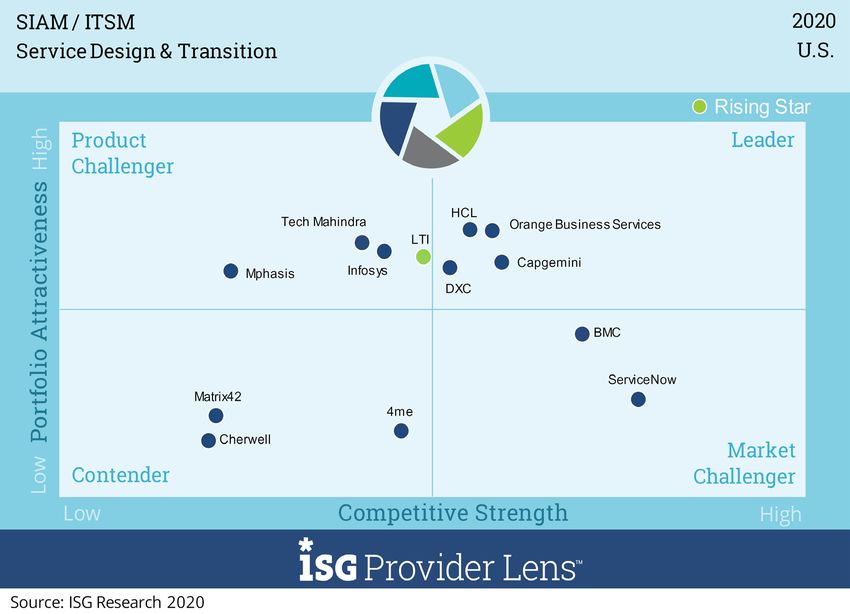
Our research indicates that this is a growth area for vendors as DXC Technology is a leader in this quadrant, as its SIAM transformation and on-boarding
customers are not able to harness the complete set of functionalities services help clients launch and make SIAM initiatives operational quickly. DXC uses its expertise
being offered. With rapid digital transformation reducing the time for to define a tiered product and solution offering that can be adapted to any client situation and
designing new IT services and transitioning them into production, new maturity level.
vendors require delivery resources locally, which includes trained sales
HCL Technologies stands out as a leader as its SIAM solution team enables NextGen SIAM with
and pre-sales who can understand customer issues and speak their
catalog aggregation, service orchestration and analytics. An AI-powered platform in its advanced
language.
marketplace connects Digital SIAM users with the underlying IT service delivery ecosystem to
We have identified the following vendors as leaders in this the quadrant: easily define new services.
Capgemini’s feature-rich Digital Ecosystem, SIAM 2.0, demonstrates Orange Business Services uses specific due diligence methodologies to ensure that services
the company’s ability in this area across multiple industry verticals, are designed to align with planned business outcomes. A single, unified and structured service
with this ecosystem focusing on service efficiency. To fill gaps where catalog ensures easy ordering across technologies, and service homogenization across provid-
no adequate solution is available, the self-developed functionality, ers enables fast delivery. This makes the company a leader in this quadrant.
ODIGO™, comes to play. Combined with strong technical alliances
LTI is the rising star in this quadrant. With extensive use of emerging technologies, LTI offers
these offerings make Capgemini a leader in this quadrant.
Digital ITSM4, an offering based on ITIL®4. This approach is being used to set up an environment
of ITIL®4 based service management practices for service design and transition; Digital ITSM4
delivers the architecture of the required tool set-up.
18
© 2020 Information Services Group, Inc. All Rights Reserved.ISG Provider Lens™ Quadrant Report | March 2020 Service Design & Transition
ORANGE BUSINESS SERVICES
Overview Caution
To stay competitive, Orange Business Services is making significant investments in innovation centers with its Orange Business Services solution is only available as a managed service, hence
extensive people resources. The company has built the expertise to serve its large number of clients and deliver clients that are looking for a solution that they can use on their own will be
professional services; it is becoming a major player in digital innovations and over the years has become an ideal discouraged from approaching the provider.
partner in digital transformation.
Orange Business Services does not offer its services to relatively small companies.
Orange defines SIAM (or MSI, as the company calls it) as a solution that allows an enterprise to achieve seamless
governance, unification, standardization and end-to-end management of their services. Within this environment,
service design is supported by specific “Due Diligence”-like methodologies to ensure that services are designed in
accordance with business outcomes. This approach helps to secure value, mitigate risks associated arising out of
misaligned services and accelerate service deployment.
Strengths
Strong experience in emerging technologies: Being a ServiceNow Premier Service Provider Partner, the
company integrates the ServiceNow functionality into its Service Management Suite.
2020 ISG Provider Lens™ Leader
Strong governance approach in service design: Transition and transformation support ensures that services
are designed to deliver business value.
Strong alliances: The company has numerous alliances with leading edge technology providers, which ensures
continuous innovations in its solution offerings.
Orange Business Services’ seven pillars
of MSI ensure structured service design
and guarantee business outcomes.
19
© 2020 Information Services Group, Inc. All Rights Reserved.Methodology Methodology
ISG Provider Lens™ Quadrant Report | March 2020

          METHODOLOGY
          The research study “ISG Provider Lens™ 2020 – SIAM/ITSM” analyzes the relevant
          software vendors/service providers in the US market, based on a multi-phased
          research and analysis process. It positions these providers based on the ISG
          Research methodology.

          The study was divided into the following steps:

         1.   Definition of SIAM/ITSM market                                               5.   Detailed analysis & evaluation of services & service documentation based
                                                                                                on the facts & figures received from providers & other sources.
         2.   Use of questionnaire-based surveys of service providers/vendor across all
              trend topics                                                                 6.   Use of the following key evaluation criteria:

         3.   Interactive discussions with service providers/vendors on capabilities
                                                                                                −   Strategy & vision

              & use cases
                                                                                                −   Innovation
                                                                                                −   Brand awareness and presence in the market
         4.   Leverage ISG’s internal databases & advisor knowledge & experience
                                                                                                −   Sales and partner landscape
              (wherever applicable)
                                                                                                −   Breadth and depth of portfolio of services offered
                                                                                                −   Technology advancements

                                                                                                                                                                           21
© 2020 Information Services Group, Inc. All Rights Reserved.
ISG Provider Lens™ Quadrant Report | March 2020
Authors and Editors
Lutz Peichert, Author
Executive Advisor, ISG Research
With more than 40 years of IT industry experience, Mr. Peichert has profound knowledge, in particular, in areas such as outsourcing, IT operations,
organizational design and IT/Business alignment. In his ISG role as an independent consultant, he supports customers to help them make strategic and
tactical decisions and set up and optimize organizations and processes to enable them to leverage IT and service solutions.
Lutz joined ISG in 2017 when ISG acquired Experton Group. From 2014 on Lutz served as a COO at Experton Group responsible for all research and
consulting activities. Until mid-2014 Lutz worked as Vice President and Principal Analyst for Forrester Research, where he was responsible for the "Sourcing
and Vendor Management" practice and also published Forrester's "SVM Practice Playbook". Prior to that he worked 10 years for META Group as a Principal
Director within the CIO Consulting Division.
Lutz is an experienced speaker on national and international conferences, such as the National Dutch Outsourcing Conference, the German
Computerwoche Forum, the Slovak CIO Conference and other events.
Lutz started his career in the late 1970ies as a system manager at the German Navy. He has a vocational diploma and has completed training as radio and
TV technician.
© 2020 Information Services Group, Inc. All Rights Reserved.ISG Provider Lens™ Quadrant Report | March 2020
Authors and Editors
Jan Erik Aase, Editor
Director
Jan Erik Aase is a director and principal analyst for ISG. He has more than 35 years of collective experience as an enterprise client, services provider, ISG advisor
and analyst. Jan Erik has overall accountability for the ISG Provider Lens™ reports, including both the buyer-centric Archetype reports and the Quadrant reports
focused on provider strengths and portfolio attractiveness. He sets the research agenda and ensures the quality and consistency of the Provider Lens™ team.
© 2020 Information Services Group, Inc. All Rights Reserved.ISG Provider Lens™ | Quadrant Report
March 2020
© 2020 Information Services Group, Inc. All Rights Reserved
ISG (Information Services Group) (Nasdaq: III) is a leading global technology research and advisory
firm. A trusted business partner to more than 700 clients, including more than 75 of world’s top 100
enterprises, ISG is committed to helping corporations, public sector organizations, and service and
technology providers achieve operational excellence and faster growth. The firm specializes in digital
transformation services, including automation, cloud and data analytics; sourcing advisory; managed
governance and risk services; network carrier services; strategy and operations design; change man-
agement; market intelligence and technology research and analysis. Founded in 2006, and based in
Stamford, Conn., ISG employs more than 1,300 digital-ready professionals operating in more than 20
countries—a global team known for its innovative thinking, market influence, deep industry and tech-
nology expertise, and world-class research and analytical capabilities based on the industry’s most
comprehensive marketplace data. For more information, visit www.isg-one.com.You can also read


