Service Framework for Mental Health and Wellbeing 2018-2021 - Promoting hope, opportunity and personal control
←
→
Page content transcription
If your browser does not render page correctly, please read the page content below
Service Framework
     for Mental Health and
           Wellbeing
          2018-2021
    Promoting hope, opportunity and personal control

l

                  Public Consultation
                     March 2018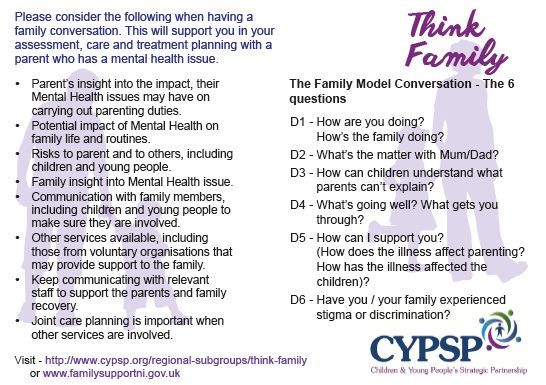
-2 -
CONTENTS
Foreword
Service Framework at a Glance
1. Introduction
1.1 Background
1.2 Aim of the Service Framework
1.3 Acknowledgements
1.4 Why do we need a Service Framework for Mental
Health and Well-being?
1.5 Methodology
1.6 Values and Principles of the Service Framework
1.7 Structure of the Service Framework
1.8 Service Framework Generic Standards
2. Implementing the Service Framework
2.1 Standard One: Access to Mental Health Services
2.2 Standard Two: Assessment, Formulation and
Diagnosis
2.3 Standard Three: Personal Well-Being Planning
2.4 Standard Four: Care and Treatment
2.5 Standard Five: Staying Engaged and Self-
Management
2.6 Research & Development Standard for Mental
Health
3. Monitoring the Service Framework
4. Supporting References
5. Bibliography
6. Appendices
-3 -Foreword
The overall aim of the Department of Health (DoH) is to improve the
health and social wellbeing of the people in Northern Ireland.
The revised Service Framework for Mental Health and Wellbeing 2018 is
one of a range of Service Frameworks developed by the Department in
support of this aim. Service Frameworks are a major strand of the
reform of health and social care services and help to ensure that care is
safe, effective and person-centred.
Recent focus by the NI Executive is to develop a Programme for
Government with clear outcomes to benefit the people and society of
Northern Ireland. Two of the outcomes in the draft PfG aim to:
(i) ensure that we care for others and help those in need, and
(ii) improve the length and quality of life for those living here.
To achieve these outcomes government will help to improve the general
mental health of people by supporting and promoting positive mental
health and wellbeing through prevention, early intervention and, where
necessary, providing appropriate treatment and care with a focus on the
principles of recovery.
This Framework builds on the 2010 version but offers a more
streamlined approach with fewer standards, and includes both service
and experience indicators. The Framework reflects the principles and
values of the ‘You In Mind’ Regional Mental Health Care Pathway 2014,
hereafter referred to as ‘You In Mind’, and recognises that all treatment
and care needs to be highly personalised and recovery orientated.
The purpose of the Framework is not only to provide guidance on the
steps of care to be delivered but it is designed also to enhance the
quality of service experience and promote consistency of service
delivery across Northern Ireland.
The scope of the Framework includes a focus on the required service
elements of access to mental health services, assessment, diagnosis,
-4 -treatment, self-management and the recovery of all adults who have a
mental health problem or condition.
The Framework represents the mechanism whereby ‘You In Mind’ will be
audited. It will be implemented alongside the ‘You In Mind’ regional care
pathway. In this respect, the Framework provides the standards and
outcomes measures that will help us verify that the standards and
services within ‘You In Mind’ are actually being delivered.
Dr Michael McBride
Chief Medical Officer
-5 -Service Framework At A Glance
DOMAIN
DOMAIN
Access to Personal Staying Engaged
Assessment, Care &
Mental Health Formulation & Well-being & Self-
Treatment
S
Services Planning Management
S
Diagnosis
SS4.1
S.S1.1 SS5.1
I receive I am involved in
I can access
Mental Health SS3.1 appropriate my own self
care and management and
S.S2.1 With my
STANDARDS
STANDARDS
Services any decision to
I have an consent, I treatment discharge me from
when I need
assessment jointly develop according to Mental Health
them
undertaken and receive a my assessed Services and I
including Personal needs know how to re-
SS1.2 personal safety enter services
Wellbeing when I need to
I receive assessment Plan (PWP), SS4.2
appropriate where
which I will review SS5.2
information appropriate, Mental Health
and I am given includes a with staff
about what Services ask me
my diagnosis, Personal progress
happens next and my
where relevant, Safety Plan against my family/carers for
when I am
in a timely where Personal feedback about
referred to my care
manner appropriate Wellbeing
Mental Health experience to
Plan on a
Services improve quality of
regular basis service
R1 – All HSC services promote, conduct and use research to improve the current and future health
and wellbeing of the population
Experience of Care1. Introduction
1.1 Background
Service frameworks have been identified as a major strand of the reform
of health and social care services and provide an opportunity to:
• Strengthen the integration of health and social care services;
• Enhance health and social wellbeing, to include identification of those
at risk, and prevent / protect individuals and local populations from
harm and / or disease;
• Promote evidence-informed practice;
• Focus on safe and effective care; and,
• Enhance multidisciplinary and intersectoral working.
The original Service Framework for Mental Health and Wellbeing was
launched in December 2010 with 58 standards and 164 associated
KPIs. However, given the introduction of the ‘You In Mind’, and its
importance across the HSC, it was apparent that the 2010 Service
Framework could not easily be aligned with the content and
requirements of the new regional care pathway. A copy of ‘You In Mind’
can be found at http://www.hscboard.hscni.net/our-work/social-care-and-
children/mental-health/
Upon review, it was clear that the existing Framework would require
substantial amendment and revision. It was therefore agreed, by
DHSSPS1 in July 2014 that a 'fundamental review' of the existing
Framework should be undertaken.
The HSCB and PHA were tasked with the review process to ensure that
the revised Service Framework for Mental Health and Wellbeing,
thereafter described as the Framework, reflected the requirements of
‘You In Mind’. This care pathway forms the central hub from which the
new Service Standards and Indicators are derived.
1
DHSSPS was renamed as the Department of Health (DoH) on 9 May 20161.2 Aim of the Service Framework
Service Frameworks set out the standards of care that individuals, their
carers and wider family can expect to receive from the HSC system. The
standards set out in a Service Framework reflect the agreed way of
providing care. They provide a common understanding about what HSC
providers and users of services can expect to provide and receive.
The revised Service Framework for Mental Health and Wellbeing 2018
reflects the principles and values of ‘You In Mind’ Regional Mental
Health Care Pathway, launched in 2014, which recognises that all
treatment and care needs to be highly personalised and recovery
orientated. It is based on valid, relevant published research, where
available.
The Framework provides the mechanism to audit the ‘You In Mind’ care
pathway. The domains, standards and indicators for this Framework are
all extrapolated from ‘You In Mind’ and this represents the key reference
point for all staff implementing the Framework.
The ‘You In Mind’ care pathway explains how people can access mental
health care and the steps involved from the point of referral to the point
that care is no longer required. It describes the standards of care
expected by mental health professionals who will work in partnership
with people towards their recovery. It outlines how care decisions are
made with people and for people. It places people, families, partners and
nominated friends (as appropriate) at the heart of all decision-making.
The content of ‘You In Mind’ was informed by expert advice and by
national standard setting bodies such as the National Institute for Health
and Clinical Excellence (NICE) and the Social Care Institute for
Excellence (SCIE), these are noted in the Supporting Resources of the
document.
-8 -‘You In Mind’ sets out generic standards of care expected for secondary
mental health services, using the stepped model of care, see Appendix
1 for further detail.
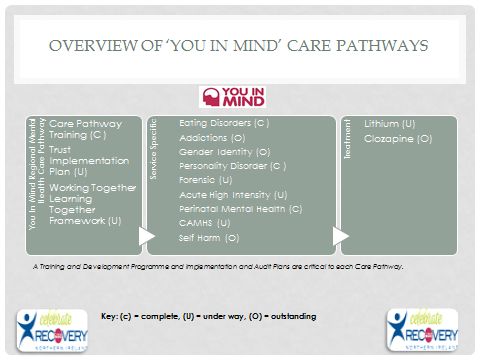
Service and condition specific care pathways have also been produced,
or are currently under production. These will set out the standards of
care for secondary mental health care specialist areas and mental health
conditions. Please see Appendix 2 for additional information. These will
also be informed by expert advice and by national standard setting
bodies, and will be subject to audit under the Framework.
Affordability
Many of the standards contained in the Framework do not require
additional resources as they are focussed on quality improvement and
should be capable of delivery by optimising the use of existing resources
and funding. Where there are additional costs associated with specific
standards (including non-recurrent costs associated with such areas as
informatics and data collection), these will be dependent upon, and
sought through existing financial planning, service development and
commissioning processes. The feasibility of implementing the framework
by reforming how services are delivered will be explored, in order to
determine the affordability of the investments required and performance
levels will be set in the light of the available resources in any one year.
This particularly relevant to data required for Phase II.
Equality Statement
In line with Section 75 of the Northern Ireland Act 1998, Mental Health
Services are provided and available to all irrespective of gender,
ethnicity, political opinion, religious belief, disability, age, sexual
orientation, dependant and marital status.
An equality screening exercise will be carried out as part of the public
consultation process for the Framework.
-9 -1.3 Acknowledgements
This Service Framework has been jointly developed by people with lived experience,
family members, partners, friends and/ or advocates for people with mental health
needs, and professionals involved in commissioning and providing care.
The development of the co-produced service standards included in the Framework
will enable Mental Health Services to deliver care in line with the best available
evidence, as set out in ‘You In Mind’ 2014.
At the heart of this process is the desire and commitment to ensure mental health
care in Northern Ireland provides the best of opportunity for personal recovery and to
create a new culture of partnership and co-working.
We wish to acknowledge the support of the following people and professional groups
in the development of the Service Framework.
Project Board Consultation Contributors Task & Finish Group
Aidan Murray (Chair) Health and Social Care Board / Stephen Bergin (Chair)
Stephen Bergin Public Health Agency Regional Eithne Darragh
Martin Daly Mental Health Commissioning Team Briege Quinn
Eileen Bell Department of Health, Social Paul McFall
Eileen Shevlin Services and Public Safety Fiona Dagg
Paul McFall Bronwen Robinson
Royal College of Psychiatrists (NI)
May McCann Martina McCafferty
Rodney Morton Division Clinical Psychology (NI)
Andrew Dawson Royal College of Nursing
Fiona Dagg
College of Occupational Therapy
Margaret Woods
Susan McDermott Belfast Health & Social Care Trust
Frances Dundee Southern Health & Social Care Trust
Barney McNeaney
Amanda McFadden South Eastern Health & Social Care
Don Bradley Trust
Bryce McMurray
Western Health & Social Care Trust
Phil Hughes
Diana Day-Cody Northern Health & Social Care Trust
Chris McCusker
Lesley McGrann
Molly Kane
Bronwen Robinson
Martina McCafferty
- 10 -1.4 Why do we need a Service Framework for Mental Health and
Well-being?
Northern Ireland has higher levels of mental ill health than any
other region in the UK. According to prescription trends, Northern
Ireland has significantly higher levels of depression than the rest
of the UK.
Mental illness is the single largest cause of disability, and leading
cause of sickness absence from work, in the UK. Mental health
problems are one of the main causes of the burden of disease
worldwide. In the UK, they are responsible for the largest burden
of disease– 28% of the total burden, compared to 16% each for
cancer and heart disease.
The Northern Ireland Census (2011) indicated that 5.8% of
Northern Ireland’s 1.8 million population has some form of mental
ill health. Women are more likely than men to have a common
mental health problem and are almost twice as likely to be
diagnosed with anxiety disorders.
In the 2016/17 Northern Ireland Health Survey, 17% of
respondents showed signs of mental ill health. Of these, 47% of
females and 37% of males were taking medication for stress,
anxiety or depression.
People with a mental illness die on average 15 to 20 years earlier
than those without, often from avoidable causes. We must
therefore strive to achieve parity between mental health and
physical health care, working more closely in partnership with
those who use our services and their carer’s.
In Northern Ireland the 2016/17 total planned spend on Mental
Health services was £263m, representing just over 7%2 of the
total spend on Health and Social Care in Northern Ireland.
2
Based on a Total Planned spend (POC) of £3.64bn
- 11 -With the introduction of ‘You In Mind’, in 2014, it was clear that the
existing Framework would require substantial amendment and revision.
Associated key drivers for the Review included:
Continued progress against the Bamford Review of Mental
Health and Learning Disability Action Plans 2009-2012 and
2012-2015.
Transforming Your Care, 2011 – a review of health and social
care in Northern Ireland published in December 2011 has many
parallels with the Bamford Vision in respect of mental health.
NICE CG136 – Service User Experience in Adult Mental Health
Services, 2011 and other Mental Health related NICE Guidelines
(please see ‘Supporting Resources’) – NICE recommended that
high quality care should be clinically effective, safe and be
provided in a way that ensures the service user has the best
possible experience of care.
A Regional Demand Analysis of Generic Adult Mental Health
Clinical Psychology & Psychological Therapy Services, 2013
undertaken by Dr Stephen Kelly, SEHSST.
GAIN ‘Your Story Can Change Lives’ Survey, 2012 – The audit
findings demonstrated a varied picture of how service users and
carers perceived their experience of mental health services and
care in Northern Ireland. The information from the audit helped
Trusts to identify what was working well and what things needed to
change. The audit was repeated in 2015/16 and is entitled ‘You in
Mind – Your Experience Matters’.
Implementing Recovery through Organisational Change
(ImROC) – the programme was introduced in each HSC Trust to
develop more recovery focused practice and therefore improve the
service user experience. Creating recovery-focused services
requires fundamental cultural change; the promotion of recovery
must underpin all treatment and support provided and guide the
- 12 -work of every mental health worker. Each HSC Trust now has its
own Recovery College and Peer Workers with lived experience
have been recruited across Northern Ireland.
The HSCB and PHA were tasked with the review process to ensure that
the new Framework reflected the requirements of ‘You In Mind’ and the
above referenced key drivers.
1.5 Methodology
Review Scope
The Review focused on redesigning the current Service Framework and,
in keeping with ‘You In Mind’, would incorporate the required service
elements including access to mental health services, assessment,
diagnosis, care and treatment, self-management, and the recovery of all
adults who have a mental health problem or condition.
Review Objectives
1. To scope out existing Mental Health Service Standards/Quality
Indicators best practice.
2. To carry out a baseline analysis of current data management
systems and data activity that currently informs Mental Health
Services commissioning and performance monitoring.
3. To develop a more streamlined Service Framework, based
provisionally upon 12 service standards (exact number to be
confirmed within the ‘review’ process), that will apply across a
number of key domain measures with associated key quality
indicators.
4. To establish a robust data management system that would report
against the agreed service standards and associated indicators. In
doing so, it is important to verify that existing data systems are able
to provide the required performance data.
- 13 -The mandate to develop the Framework was provided by the Service
Framework Programme Board, which is chaired by the Chief Medical
Officer of the Department of Health.
The revised Service Framework for Mental Health and Wellbeing was
developed by a Regional Project Board. This was chaired by Mr Aidan
Murray, Assistant Director of Mental Health and Learning Disability, HSC
Board, with representation from all aspects of the service including
people with lived experience, carers, advocates, voluntary organisations
and community groups, as well as professionals working in the field,
professional bodies, commissioners and DHSSPS, as described in the
Acknowledgements. The Project Board met on a quarterly basis; the
Terms of Reference are in Appendix 3.
A dedicated Task and Finish Group was also set up to provide project
management support to the Project Board to deliver on the key
objectives of the Review. The Team was responsible for developing the
Framework document itself and met on a bi-monthly basis.
The Framework itself was co-produced, in keeping with the values and
principles set out in ‘You In Mind’, through people with lived experience
themselves being represented at all levels of the consultation and
framework development process. This included representation on the
Project Board, the Task and Finish Group, and via the two Stakeholder
Engagement events held in January and April 2015. Workshop
discussions during the Stakeholder Engagement events were led by
people with a knowledge and expertise in mental health services, both
from a mental health professional background and from people with lived
experience of mental health. Participation in this process led to the
development of the final draft document. Copies of the Workshop reports
can be provided from the Health and Social Care Board.
A desk top scoping exercise of service frameworks both nationally and
internationally was also carried out to review good practice and support
the work of the Project Board. An overview of this exercise is set out
below:
- 14 -UK International
- Mental Health Outcomes
- No Health Without Mental Working Group, Mental Health
Health, NHS, 2011 Commission, Government of
Western Australia, 2012
- Code of Practice to Parts 2
+ 3 of Mental Health - Key Performance Indicators of
(Wales) Measure 2010, 2012 Australia Public Mental Health
Services, 2005
- Public Health Information
for Scotland, Scotland’s - Mental Health Outcomes,
Mental Health : Adults 2012 Ministry for Health New Zealand
- Establishing a Core Set of - Like Minds, Like Mine 2014-19,
National Sustainable Mental New Zealand
Health Indicators for Adults
in Scotland, 2007
A Data Scoping Workshop was also held in July 2015 to analyse current
HSC data management systems and data activity that currently informs
Mental Health Services commissioning and performance monitoring. It
also explored ways to report against the agreed Framework Service
Standards and associated Indicators. This will be discussed in more
detail in Section 2.
The Framework domains, standards, indicators and data sources are set
out in Section 2.
- 15 -1.6 Values and Principles of the Service Framework
The values and principles that were developed for the Bamford Review
were adopted for the development of the 2010 Service Framework for
Mental Health and Wellbeing and still apply to this revised Framework.
These include focusing on safe, effective care which involves patient
experience, recovery principles and with a family focus.
Please see Appendix 4 for a copy of the Values and Principles.
Experience of Care
The Framework will provide the mechanism to audit the experience of
people and their families of Mental Health Services, as described in ‘You
In Mind’. This includes:
Listened to
Being Listened to Valued and Understood
Given Meaningful information and Explanation
Encouraged and Given Time to Recover
Provided Advocacy and Peer Support
Given Choice
Provided Important Details
Support to Make My Own Decisions
Encouraged to give Feedback
Timely Access
Quality of care, as understood from a patient’s perspective was
highlighted in a report by Lord Darzi entitled ‘High Quality Care for All –
Our Journey So Far’ (2008). It defined three aspects that matter to
patients; their experience, the effectiveness of care interventions and the
safe delivery of care.
‘You In Mind’ is also modelled on NICE CG136 Improving Experience of
People Using Adult Mental Health Services Quality Standards, and outlines
how Mental Health Services will use recovery principles in providing care, as
set out overleaf.
- 16 -Feel reassured that the care I receive Feel I am being treated with Feel confident that what I have
will be safe, of a high standard empathy, dignity, sensitivity, to say will be listened to and
(effective) and promote recovery. compassion and respect by all used to direct decision about my
who supported me. care.
Be able to access help and Be actively involved in making Be supported by a team who
support easily when I need it. decisions and be supported to know me, and who commit to
maintain personal control and as partnering with me throughout
appropriate my family / partner and my care.
nominated friend are supported.
Receive appropriate explanations Receive information (and as Receive information on how I
(and as appropriate my family / appropriate my family / partner or and my family can access 24
partner or nominated friend) nominated friend) about treatment /
hour crisis support.
care options to assist me in the
regarding the outcomes of
development of my personal
assessments, investigations and
wellbeing plan (care plan).
any diagnosis I receive.
Be supported to receive care in Be given every opportunity as to Receive dedicated one to one care
the community and I will only be maintain my family and social and be confident that any
admitted to hospital if it is connections and have access to restrictions on my personal
advocacy and personalised activity movement and / or compulsory
required.
seven days per week. treatment will only be for the
shortest period required.
Recovery Principles
‘You In Mind’ states that recovery is a deeply personal and unique
process, a way of living a satisfying hopeful and contributing life. It is a
personal journey of discovery, which enables people to live well in the
presence or absence of symptoms.
As part of ‘You In Mind’ implementation Mental Health Services will
provide care that:
• Is personalised and addresses a person’s physical, emotional and
social needs;
• Recognises and builds on a person’s personal strengths;
• Promotes hope by enabling a person to better manage their own
mental health;
- 17 -• Creates opportunities for a person to contribute and participate in
meaningful tailored and purposeful activity;
• Supports family/partners/nominated friends, as appropriate, to assist
a person in their personal recovery.
Family Focus
The family approach should be taken into consideration when
implementing the Framework. This includes the consideration and
adherence to the Think Family Principles and Checklist as set out in
Appendix 5.
‘You In Mind’ also outlines the role of carer’s, family, friends, advocates;
what supports can be provided to carer’s, family, partners, nominated
friends, consent and confidentiality, and the process for agreeing who
will be involved in supporting a person’s recovery.
1.7 Structure of the Service Framework
The Service Framework for Mental Health and Wellbeing sets standards
in relation to access to mental health services, assessment, diagnosis,
care and treatment, self-management, and the recovery of all adults who
have a mental health problem or condition.
There are 5 Domains: each is presented in the same format, as set
out below:
1. Domain
2. Standards
3. Service Indicators
4. Experience Indicators
5. Phase I Data Source
6. Phase II Data Source
The ‘Service Indicators’ reflect the ‘You In Mind’ Care Pathway
components whilst the ‘Experience Indicators’ reflect the questions in the
GAIN ‘Your Story Can Change Lives’ survey (2012).
- 18 -Going forward, the Framework will have the capability to benchmark
against both the 2012 GAIN ‘Your Story Can Change Lives’ survey and
the 2015/16 survey re-run entitled ‘You in Mind – Your Experience
Matters’. It is proposed that annual Experience and Carer Audits will be
conducted.
Each standard is precluded by an introduction which is taken from NICE
CG136 and ‘You In Mind’. As stated in the introduction, the Framework
provides the mechanism to help verify that the requirements of ‘You In
Mind’ are being implemented.
This Service Framework encompasses, in the first instance, the
2018/19 to 2020/21 period; this will be reviewed by the Department of
Health’s Service Framework Programme Board.
1.8 Service Framework Generic Standards
All Service Frameworks incorporate a specific set of standards that are
identified as Generic. These apply to all HSC professionals and
service users, regardless of their health condition or social grouping,
and are therefore applicable to all Service Frameworks. They include:
communication;
involvement;
independent advocacy;
carers;
healthy eating;
physical activity;
smoking cessation;
alcohol;
safeguarding; and
palliative care.
- 19 -These Generic standards reinforce the holistic approach to health and
social care improvement and reflect the importance of health promotion
in preventing medical or social care issues occurring in the first place.
Their inclusion ensures:
equity of opportunity for all;
the communication of consistent messages to service users and
providers of HSC; and
a consistent approach on the design and delivery of services.
The responsibility for monitoring progress against the Generic
Standards rests with the Oversight Groups as set out below:
- 20 -1.9 Service Framework Generic Standards
The following generic standards GS1.1–1.10 are applicable across all Service Frameworks and will be
monitored through a range of Oversight Groups.
Standard Oversight Group
Communication with Individuals and Carers
GS 1.1 All patients, clients, carers and the public should be Regional PPI Forum
engaged through effective communications by all organisations Patient and Client Experience Working Group and Steering Group
delivering health and social care 10,000 Voices Implementation Group
GS 1.2 All patients, clients, carers and the public should have Regional PPI Forum
opportunities to be actively involved in the planning, delivery
and monitoring of health and social care at all levels.
GS 1.3 Users of Health and Social Care services and their carers Regional Carers Strategy Implementation Group
should have access to independent advocacy as required
GS 1.4 All Health and Social Care staff should identify carers Regional Carers Strategy Implementation Group
(whether they are parents, family members, siblings or friends) at
the earliest opportunity to work in partnership with them and to
ensure that they have effective support as neededService Framework Generic Standards
Standard Oversight Group
Prevention
GS 1.5 All Health and Social Care staff, as appropriate, should provide Obesity Strategy Implementation Group
people with healthy eating support and guidance according to their
needs
GS 1.6 All Health and Social Care staff, as appropriate, should Obesity Strategy Implementation Group
provide support and advice recommended levels of physical
activity
GS 1.7 All Health and Social Care staff, as appropriate, should Tobacco Strategy Implementation Group
advise people who smoke of the risks associated with smoking
and sign-post them to well-developed specialist smoking
cessation services
GS 1.8 All Health and Social Care staff, as appropriate, should New Strategic Direction for Alcohol and Drugs Group – chaired by CMO
provide support and advice on recommended levels of alcohol
consumption
- 22 -Service Framework Generic Standards
Standard Oversight Group
Prevention
GS 1.9 All Health and Social Care staff should ensure that people Northern Ireland Adult Safeguarding Partnership (NIASP)
of all ages are safeguarded from harm through abuse,
exploitation or neglect
GS 1.10 All people with advanced progressive incurable Transforming your Palliative and End of Life Care Implementation
conditions, in conjunction with their carers, should be supported Group, Living Matters, Dying Matters (LMDM) Steering Group
to have their end of life care needs expressed and to die in their
preferred place of care
- 23 -2. Implementing the Service Framework The Service Framework will be implemented in two phases. Phase I will include reporting on each standard using existing sources of performance and experience data, as described under the heading ‘Data Source’ across the five Domains. It is anticipated that these data returns, i.e. the baseline audit of the revised Framework, will be required in 2018/19. The Regional You in Mind Oversight Group represents the vehicle to deliver Phase II data for Mental Health Services. It was set up as significant challenges continue to exist in the Mental Health services in relation to the capability of IT systems around robust data collection. This represented one of the reasons for the Review of the Service Framework. These include evidencing how the system is doing in relation to improved outcomes for individuals. While multiple IT systems exist churning out considerable volumes of access data, a more integrated managed care data system is required to generate robust clinical outcomes and patient experience data. The latter outcomes/experience data, however, is generally not available. The current system does not allow for a seamless flow of information from referral, assessment, diagnosis, care and treatment and outcomes across the system. Clinicians are unable to provide standardised evidence of outcomes and benefits to individuals, leading to challenges for the system about understanding if we are making the most effective use of resources The Mental Health Informatics Project will develop an innovative managed care data framework and system. Based on the Institute for Healthcare Improvements’ Triple Aim Quality Indicators, it will deliver electronic solutions for the HSC system in NI regarding how we are doing at the heart of mental health care.
The aim of the project is to design and test patient-facing electronic
solutions for mental health care with the capability of gathering and
providing easily available data from an individual’s first point of contact.
The objectives include the design of an integrated model which will offer
technologies for mental health literacy i.e. apps for mental health care
pathways; a data system that will create standardised dashboards for
managing care and caseload management; an interactive electronic
healthcare record to support patient / carer interfaces; and in the future,
in line with the overall e-Health Strategy, the development of smart
technologies to support the development of interactive consultation
clinics.

A service specification and business case will be developed to design a
systematic outcomes model where monitoring clinical and experience
outcomes is routine, using validated and reliable change indices across
all professions. This will inform clinical practice and service design in a
more explicit and routine way. Patients will know how to navigate the
mental health service using a web-based system. They will co-produce
and have access to their personal care plan.

The model will, for the first time, provide data that will allow Mental
Health Services to generate standardised and robust practice-based
evidence about what we are doing, how we are doing it, and most
importantly, how we are doing. Please see Appendix 6 for illustration.

                                   - 25 -
2.1 Introducing Standard One – Access to Mental Health Services
NICE CG136 Quality Statement 6 states that people can access mental
health services when they need them.
NICE CG136 further adds that service providers, professionals and
commissioners should ensure that systems, support and commissioned
services are in place to support Quality Statement 6.
As set out in ‘You In Mind’ access to Mental Health Services includes:
Provide
Consultation with
Information
Mental Health
about how to
Services
access services
Reason for referral
Important contact
and consent
details provided
explained
- 26 -Domain
Domain
2.1 Standard One: SS1 – Access to Mental Health Services
Standard
Standard
SS1.2 - I receive appropriate information about what happens next
SS1.1 - I can access Mental Health Services when I need them
when I am referred to Mental Health Services
Service Indicator
S.S1.2(a) – All Mental Health Services (in-patient, community and specialist)
Service Indicator
S.S 1.1 (a) – My referral to secondary mental health services is categorised
according to IEAP standards. provide appropriate information about the service using an Appointment Letter
S.S1.1 (b) – Proportion of mental health services receiving electronic referrals which includes ‘Making the Most Of Your Appointment’.
via CCG SS1.2(b) All Mental Health Services will provide a copy of ‘Your Guide to Mental
S.S1.1 (c) - I was seen by Mental Health Services within the agreed timescales Health Services’ at first appointment.
EFF 2 - I was satisfied with the information I received about what happens
Experience
EFF1 – I found it easy to access Mental Health Services
Indicator
next
Experience
Indicator
CEFF – A number of carer experience indicators are currently CEFF – A number of carer experience indicators are currently being
being developed and will support the Experience Indicators set developed and will support the Experience Indicators set out above
out above
Data Source
• You in Mind Care Pathway Audit • Annual Targeted Experience/Carer Experience Feedback form
Data Source
Phase 1
• Annual Trust Statement • Annual Trust ‘You In Mind’ Care Pathway Audit
Phase 1
• Annual Targeted Experience Feedback Form (EFF) and Carer • Annual Trust Statement
Experience Feedback Form (CEFF)
Data Source
Target 4.13 – Commissioning Plan Direction 2017/18 Annual Trust Statement
Phase 2
Mental Health Minimum Data Set Annual Experience Feedback Form (EFF) and Carer Experience Feedback
Data Source
Annual Experience Feedback Form (EFF) and Carer Experience Form (CEFF)
Phase 2
Feedback Form (CEFF) Annual Trust ‘You In Mind’ Care Pathway Audit (if required)
Annual Trust ‘You In Mind’ Care Pathway Audit (if required)
2.2 Introducing Standard Two – Assessment, Formulation and
Diagnosis

NICE CG136 Quality Standard 7 states people using mental health
services understand the assessment process, their diagnosis and
treatment options, and receive emotional support for any sensitive
issues

NICE CG136 further adds that service providers, professionals and
commissioners should ensure that systems, support and commissioned
services are in place to support Quality Statement 7.

As set out in ‘You In Mind’, assessment includes consideration of the
following:

                                         My family and
                        My Current            social
                         concerns        circumstances

                      My physical and        My
                      medical needs
                                         expectations

’You In Mind’ also states that, in relation to formulation and diagnosis,
consideration will be given to:

                          Presenting       Underlying
                            needs           causes

                       Psychological       Explaining
                       and medical         Diagnosis &
                        assessment         symptoms
Domain
Domain
2.2 Standard Two: SS2 – Assessment, Formulation and Diagnosis
Standard
Standard
SS2.1 – I have an assessment undertaken including personal safety assessment where appropriate, and I am given my diagnosis, where relevant,
in a timely manner
Service Indicator
Service Indicator
S.S 2.1(a) – All individuals have a completed assessment that will include pharmacological, physical health, psychological, nursing, occupational &
social needs.
S.S2.1(b) – Staff are professionally competent to carry out assessment, formulation and diagnosis, where appropriate
Experience
Experience
Indicator
EFF 3(a) I was involved in planning my care and treatment
Indicator
EFF3(b) Other significant people who are important to me were involved in planning my care and treatment
CEFF – A number of carer experience indicators are currently being developed and will support the Experience Indicators set out above
Data Source
Data Source
Phase 1
Phase 1
• Annual Trust ‘You In Mind’ Care Pathway Audit
• Targeted Annual Experience/Carer Feedback Forms
HSC Trust Governance returns (monitored outside the Framework)
Data source
Data Source
Phase 2
Phase 2
• Regional Mental Health Care Pathway Documentation Core Mental Health Consultation or equivalent
• Annual Experience/Carer Feedback Forms – All Services
• HSC Trust Governance returns (monitored outside the Framework)
• Annual Trust ‘You In Mind’ Care Pathway Audit (if required)2.3 Introducing Standard Three – Personal Wellbeing Planning
NICE CG136 Quality Standard 8 states people using mental health
services jointly develop a care plan with mental health and social care
professionals, and are given a copy with an agreed date to review it.
NICE CG136 Quality Standard 9 states people using mental health
services who may be at risk of crisis are offered a crisis plan.
NICE CG136 further adds that service providers, professionals and
commissioners should ensure that systems, support and commissioned
services are in place to support Quality Statements 8 and 9.
As set out in ‘You In Mind’, Personal Wellbeing Planning includes:
Strengths Mental Health
Hope
Intervention
Goals
Resources Options
Personal Safety
Physical Health & Crisis
and Well-being Management
PlanDomain
Domain
2.3 Standard Three: SS3 – Personal Wellbeing Planning
Standard
Standard
SS3.1 – With my consent, I jointly develop and receive a Personal Wellbeing Plan (PWP), which includes a Personal Safety Plan where
appropriate
Service Indicator
Experience Indicator Service Indicator
S.S3.1(a) – Number of Personal Wellbeing Plans agreed and signed
S.S3.1 (b) - Proportion of individuals who have agreed and signed of those who were offered a Personal Wellbeing Plan
Experience Indicator
EFF 3(a) I was involved in planning my care and treatment
EFF3(b) Other significant people who are important to me were involved in planning my care and treatment
CEFF A number of carer experience indicators are currently being developed and will support the Experience Indicators set out above
Data Source
Data Source
Phase 1
Annual Trust Statement
Phase 1
• Annual Trust ‘You In Mind’ Care Pathway Audit
• Annual Targeted Experience Feedback Form (EFF) /Carer Experience Feedback Form (CEFF)
Data Source
Data Source
Annual Trust Statement
Phase 2
Phase 2
• Regional Mental Health Care Pathway Documentation - My Wellbeing Plan, or equivalent
• Annual Experience Feedback Form (EFF) /Carer Experience Feedback Form (CEFF)
• Annual Trust ‘You In Mind’ Care Pathway Audit (if required)2.4 Introducing Standard Four – Care and Treatment
NICE CG136 Quality Standard 1 states people using mental health
services, and their families or carers, feel optimistic that care will be
effective.
NICE CG136 further adds that service providers, professionals and
commissioners should ensure that systems, support and commissioned
services are in place to support Quality Statement 1.
Further relevant NICE guidance in relation to care and treatment is
referenced in the ‘Supporting Resources’ section.
As set out in ‘You In Mind’ care and treatment includes:
Talking Family and social
Therapies interventions
Occupational & Health and
creative Wellbeing drug
therapies therapyDOMAIN Standard
DOMAIN
2.4 Standard Four: SS4 – Care and Treatment
Standard
SS4.1 - I receive appropriate care and treatment SS4.2 - I will review with staff progress against my Personal
according to my assessed needs Wellbeing Plan on a regular basis
Service Indicator
Service Indicator
SS4.1(a) - All individuals receive care and treatment according to SS4.2 (a) - A Clinical /Recovery Outcomes tool is used to measure
assessed needs and may include the following – talking therapies, progress made against Personal Wellbeing Plans
family and social interventions, occupational and creative S.S4.2(b) – 7 day follow up post acute discharge visit
therapies and health and wellbeing drug therapy
CEFF – A number of carer experience indicators are currently EFF4 - The care and treatment I received made a positive difference
being developed and will support the Experience Indicators set out to me
Experience
Experience
CEFF – A number of carer experience indicators are currently being
Indicator
Indicator
above
developed and will support the Experience Indicators set out above
Annual Trust ‘You In Mind’ Care Pathway Audit Annual Trust ‘You In Mind’ Care Pathway Audit
Data Source
Data Source
• Annual Targeted Experience Feedback Form (EFF) /Carer
Phase 1
7 Day Post Discharge Return (under review)
Phase 1
Experience Feedback Form (CEFF) Annual Targeted Experience Feedback Form (EFF) /Carer
Experience Feedback Form (CEFF)
• Mental Health Minimum Data Set 7 Day Post Discharge Return (under review)
Data Source
• Annual Experience Feedback Form (EFF) /Carer Experience • Regional Mental Health Care Pathway Documentation - My
Data Source
Phase 2
Feedback Form (CEFF)– All Services Wellbeing Plan, or equivalent
Phase 2
• Regional Mental Health Care Pathway Documentation - My • Annual Experience Feedback Form (EFF) /Carer Experience
Wellbeing Plan, or equivalent Feedback Form (CEFF) – All Services
• Annual Trust ‘You In Mind’ Care Pathway Audit (if required) • Annual Trust ‘You In Mind’ Care Pathway Audit (if required)2.5 Introducing Standard Five – Staying Engaged and Self-
Management
NICE CG136 Quality Standard 3 states people using mental health
services are actively involved in shared decision-making and supported
in self-management.
As set out in ‘You In Mind’, staying engaged includes:
Keeping
Reviewing Risk
appointments
Making Contact Reaching
out
‘You In Mind’ states that self-management includes:
Recognising Preparing for
personal self-
improvement management
Agreeing
continuing Rapid access
supportNICE CG136 Quality Standard 5 also states people using mental
health services feel confident that the views of service users are used to
monitor and improve the performance of services.
NICE CG136 further adds that service providers, professionals and
commissioners should ensure that systems, support and commissioned
services are in place to support Quality Statements 3 and 5. We need to
add Carer Feedback form.
- 35 -DOMAIN
DOMAIN
2.5 Standard Five: SS5 – Staying Engaged & Self-Management
Standard
Standard
SS5.1 - I am involved in my own self-management and any decision to
discharge me from Mental Health Services and I know how to re-enter SS5.2 - Mental Health Services ask me and my family/carers for
services when I need to feedback about my care experience to improve quality of service
Service Indicator
Service Indicator
S.S5.1(a) – All Discharge Plans include arrangements for on-going
support to individuals and their carers, where required
S.S5.2(a) – Individuals in receipt of Mental Health Services and their
S.S5.1(b) – All GPs are advised when an individual is discharged from
families/carers are asked for feedback about Mental Health services
secondary Mental Health services
EFF5 - I felt valued, listened to and treated with respect during my
Experience
EFF6 - I know how to contact Mental Health Services if I need them
Indicator
Experience
care and treatment
Indicator
again in the future
CEFF – A number of carer experience indicators are currently being
CEFF – A number of carer experience indicators are currently being
developed and will support the Experience Indicators set out
developed and will support the Experience Indicators set out above
above
Data Source
Data Source
Phase 1
Annual Trust Statement
Phase 1
Annual Targeted Experience Feedback Form (EFF) /Carer
Annual Trust ‘You In Mind’ Care Pathway Audit
Experience Feedback Form (CEFF)
Annual Targeted Experience Feedback Form (EFF) /Carer Experience
Annual Trust ‘You In Mind’ Care Pathway Audit
Feedback Form (CEFF)
Data Source
Data Source
Phase 2
Phase 2
Annual Trust Statement
• Annual Targeted Experience Feedback Form (EFF) /Carer Experience Annual Targeted Experience Feedback Form (EFF) /Carer
Feedback Form (CEFF) – All Services Experience Feedback Form (CEFF) – All Services
Regional Mental Health Care Pathway Documentation – My Discharge Plan, RQIA Planned Audit Schedule (TBC)
or equivalent Annual Trust ‘You In Mind’ Care Pathway Audit (ir required)
Annual Trust ‘You In Mind’ Care Pathway Audit (if required)Domain
Domain
2.6
2.6 Researchand
Research andDevelopment
DevelopmentStandard
Standardfor
forMental
MentalHealth
Health
Standard
Standard
All
R1s–ervice frameworks
All HSC are required
services promote, conductto include
and a number
use research of research
to improve andand
the current development
future health standards.
and wellbeingThe research
of the population
and development standards for mental health are set out below:
Research Indicator
R1.1 – Number of research studies (active for all or part of the monitoring period) under the auspices of NICRN mental health.
Research Indicator
R1.2 – Percentage of commercial studies.
R1.3 – Number of patients screened for participation in research studies during the monitoring period under the auspices of NICRN mental
health.
R1.4 – Numbers of patients recruited into research studies during the monitoring period under the auspices of NICRN mental health.
R1.5 – Numbers of patients participating in research studies (active for all or part of the monitoring period) under the auspices of NICRN
mental health.
Data Source
Data Source
Northern Ireland Clinical Research Network (NICRN)
- 37 -3. Monitoring the Service Framework
A standardised Audit Template and Reporting Timeline will be
developed in 2018/19 to deliver the baseline data required within the
Phase I implementation period.
Trusts will use this to report annually against the Framework.
A Mental Health Minimum Data Set, developed as part of the Regional
Mental Health Informatics Project, thereafter managed by the Regional
You in Mind Oversight Group, will be designed to gather data across the
Domains and Standards for Phase II commencing 2019/20.
The Phase II Timeline will be reliant on the introduction of a new IT
system to electronically platform some of the reporting templates, as set
out in Phase II Data Sources for each standard.
- 38 -4. Supporting References
The ‘You In Mind’ Regional Mental Health Care Pathway (pages 54-60)
provides an extensive catalogue of supporting references across four key
areas:
1. Experienced Based References
2. Professional and Clinical Practise Guidelines
3. Risk and Personal Safety
4. Recovery and Wellbeing
Mental Health practitioners should be familiar with these resources and
actively use the referenced material in the implementation of ‘You In
Mind’. A copy of ‘You In Mind’ can be found at HSCB -
http://www.hscboard.hscni.net/mentalhealth/
Additional resource/reference materials are set out below:
PHA - www.mindingyourhead.info/
NICE - https://www.nice.org.uk/guidance/conditions-and-
diseases/mental-health-and-behavioural-conditions
Mental Health Foundation -
https://www.mentalhealth.org.uk/publications/mental-health-northern-
ireland-fundamental-facts
RCPsych - http://www.rcpsych.ac.uk/expertadvice.aspx
Faculty of Public Health - www.fph.org.uk/better_mental_health_for_all
Public Health England - http://fingertips.phe.org.uk/profile-group/mental-
health
- 39 -5. Bibliography
1. DHSSPS, Service Framework for Mental Health and Wellbeing,
2010
2. HSCB, ‘You In Mind’, Regional Mental Health Care Pathway, 2014
3. Mental Health Foundation, ‘Fundamental Facts about Mental
Health’, 2015
4. DHSSPS, Reform and Modernisation of Mental Health and Learning
Disability Services, Bamford Review, 2007
5. DHSSPS, ‘Transforming Your Care: A Review of Health and Social
Care in Northern Ireland, 2011
6. National Institute for Clinical Excellence (NICE) 136 – Service User
Experience in Adult Mental Health, 2011
7. Kelly S, A Regional Demand Analysis of Generic Adult Mental
Health Clinical Psychology & Psychological Therapy Services, 2013
8. Centre for Mental Health, ‘Recovery Public Mental Health and
Wellbeing, 2012, ImROC
9. Lord Darzi ‘High Quality Care for All – Our Story So Far’, 2008
10. Children and Young People’s Strategic Partnership, Think Family
Checklist
http://www.cypsp.org/wp-content/uploads/2015/02/Think_-
Family_Checklist_Leaflet.pdf
- 40 -6. Appendices
RE
1. Stepped Care Model – taken from ‘You In Mind’ Regional Mental
Health Care Pathway, HSCB, 2014
2. ‘You In Mind’ Service/Condition-specific Care Pathway Overview
3. Review of Service Framework for Mental Health and Wellbeing
Project Board Terms of Reference
4. Bamford Mental Health and Learning Disability Review Values and
Principles
5. Think Family Checklist, HSCB
6. Phase II Mental Health Informatics Project – Managed Care Data
Set Illustration
- 41 -Appendix 1
‘You In Mind’, Stepped Care Model for Mental Health Services in
Northern Ireland
Step 5:
Step 4: High Intensity Mental
Health Services
Step 3: Highly Specialised
Step 2: Condition Specific
Specialist Community Mental Health
Step 1:
Mental Health Services
Primary Care Services
Self directed help and Talking Therapies Support at this level is
health and wellbeing
services. usually provided in
Support at this level response to mental
usually involves health needs,
Support at this level including adopting
providing care in
Support at this level usually involves new problem solving
response to
Support at this level usually involves responding to mental coping strategies,
complex/specific
usually involves responding to mental health problems which involves the
mental health needs.
responding to health and emotional which are adversely delivery of intensive
Care at this step
stress and mild difficulties such as affecting the quality of recovery focused
involves the delivery
anxiety and personal/daily and/or support and
emotional of specialist
depression. Recovery family/occupational treatment provided at
difficulties which programmes of
focused support life. Recovery focused home or in hospital.
can be resolved recovery focused
involves a support and
support and
through making combination of talking treatment will involve
treatment delivered
recovery focused therapies and lifestyle a combination of
by a range of mental
lifestyle advice. psychological
health specialists.
adjustments and therapies and/or drug
adopting new therapies.
problem solving
and coping
strategies.
- 42 -Appendix 2
- 43 -Appendix 3
Review of
Service Framework for
Mental Health and Well-Being
Project Board
Terms of Reference
October 2014
- 44 -Aim of the Review
To carry out a fundamental review of the Service Framework for Mental
Health and Wellbeing (2010).
Objectives of the Review
1. To scope out existing Mental Health Service Standards/Quality
Indicators best practice.
2. To carry out a baseline analysis of current data management
systems and data activity that currently informs Mental Health
Services commissioning and performance monitoring.
3. To develop a more streamlined Service Framework, based
provisionally upon around 12 service standards (number to be
confirmed within the ‘review’ process), that will apply across a
number of key domain measures with associated key quality
indicators.
4. To establish a robust data management system capable of
reporting against the agreed service standards and associated
KQIs.
Project Structure
DHSSPS Service Framework
Programme Board
Senior Management Team, HSC
Board
Mental Health + Well Being Service
Framework Review Project Board
(Quarterly Meetings)
Service Framework Review
Task + Finish Group
(Monthly Meetings)
Service Framework Review
Task + Finish Group
(Monthly Meetings)
- 45 -Accountability and Reporting Arrangements
The Project Board is accountable to the Director of Social Care and
Children’s Services (HSCB), Ms Fionnuala McAndrew, and ultimately to
the Department of Social Services and Personal Safety (DHSSPS) for
implementation of the fundamental Review.
Duration of the Group
The Project Board will meet on a quarterly basis from November 2014 –
April 2016. Reports will be tabled at Project Board meetings and an
Annual Review Update will be sent to DHSSPS up to April 2016.
Project Board Membership
Name Organisation
Aidan Murray HSC Board (Chair)
Andrew Dawson DHSSPS
Fiona Houston South Eastern HSCT
Barney McNeany Belfast HSCT
Phil Hughes Northern HSCT
Bryce McMurray Southern SHCT
Dr Stephen Bergin PHA
Dr Gillian Clarke HSC Board, Integrated Care
Molly Kane PHA
Martina McCafferty HSC Board
Dr Diana Cody RCP
Dr Chris McCusker DCPNI
Dr Stephen Kelly South Eastern HSCT
Susan McDermott Western HSCT
Ffiona Dunbar HSC Board Information
Lesley McGrann HSC Board IT
Maire Gratton Cause
Paul McFall Expert By Experience
May McCann Carer
Task and Finish Group Membership
Martina McCafferty Eithne Darragh
Dr Stephen Bergin Paul McFall
Briege Quinn Ffiona Dunbar
- 46 -Appendix 4
Bamford Mental Health and Learning Disability Review Values and
Principles
Values
• Valuing those of us with mental health needs, including rights to
full citizenship, equality of opportunity and self determination
• Respect them as individuals – through openness in providing of
information, respect and courtesy in individual interactions with
service users, true partnership and empowerment in service
planning and provision – with government, providers and the
wider society each accepting their respective responsibilities
• Addressing the challenges facing people with mental health
needs
• Demonstrate justice and fairness – resources for services should
be allocated and managed according to criteria which are
transparent and demonstrate equity
• A process of reform, renewal and modernisation of services that
will make a real and meaningful difference to the lives of people
with mental health problems, to their carer’s and families
Principles
• Partnership with users and carers in the planning,
development, education and monitoring of services
• Partnership with users in the individual assessment process and
all therapeutic interventions of care and support
• Delivery of high quality effective therapeutic interventions,
care and support
• Equality of access and provision of services including the
needs of people from minority cultures, people with
disabilities, people subject to the criminal justice system
• Provision of services which are readily accessible
- 47 -You can also read


