SOMERVILLE HIGH SCHOOL - JUNIOR COLLEGE PLANNING NIGHT - Somerville ...
←
→
Page content transcription
If your browser does not render page correctly, please read the page content below
SOMERVILLE HIGH SCHOOL
 JUNIOR COLLEGE PLANNING NIGHT
               WEDNESDAY, JANUARY 27, 2021
                       6:30 PM

       PRESENTED BY THE SOMERVILLE HIGH SCHOOL
                GUIDANCE COUNSELORS
                    MS. KATHLEEN DELUCA
                   MRS. DEBORAH GROSSMITH
                    MRS. MARY HONRATH
                     MR. JEREMY HUDSON
                    MR. NICHOLAS MILICI
                   MRS. CHRISTINE THOMPSON

MRS. JENNIFER DEPACE, SUPERVISOR OF GUIDANCE & SPECIAL SERVICES
GUIDANCE OFFICE DIRECTORY
Mrs. Jennifer DePace, Supervisor of Guidance & Special Services
COUNSELOR GRADES STUDENTS
Mrs. Deborah Grossmith 9 A-C
908-243-1553 10 A-Cl
dgrossmith@somervilleschools.org 11-12 A-C
Mrs. Mary Honrath
9 D-I
908-243-1552
10 Co-J
mhonrath@somervilleschools.org
11-12 D-I
Mrs. Christine Thompson
9 J-K
908-243-1554
10 K-Mc
cthompson@somervilleschools.org
11 J-M
12 J-Md
9-12 ELL
Mr. Nicholas Milici
9 L-Q
908-243-1551
10 Me-Sc
nmilici@somervilleschools.org
11 N-Sc
12 Me-R
Ms. Kathleen DeLuca
9 R-Z
908-243-1555
10 Se-Z
kdeluca@somervilleschools.org
11 Sd-Z
12 S-Z
Mr. Jeremy Hudson
College/Career/SALA Counselor
908-243-1563
jhudson@somervilleschools.org
Mrs. Ashley Joshi Kerri Ireland Nancy Garvey
School Psychologist Secretary Secretary
908-243-1584 908-243-1550 908-243-1549
Doug Graiver
Student Assistance Counselor
908-243-5189
VISIT US ON OUR WEBSITE AT
www.somervillenjk12.org/domain/342
1SOMERVILLE HIGH SCHOOL
GUIDANCE SERVICES
JUNIOR COLLEGE PLANNING NIGHT
JANUARY 27, 2021
AGENDA
JENNIFER DePACE
▪ Introduction & Welcome
DEBORAH GROSSMITH
▪ Naviance Lessons
▪ College Trends
▪ Junior Year Checklist
JEREMY HUDSON
▪ Building Your College List
▪ Applications & Naviance
▪ Essay Writing
▪ Testing
▪ Admission Plans
▪ Resume
MARY HONRATH
▪ Presenting Yourself to Colleges
▪ College Fair
▪ Qualities Admissions Counselors are looking for in Prospective Students
▪ Questions to Ask College Representatives
NICHOLAS MILICI
▪ The College Visit
▪ NJ Stars I & II
▪ NCAA Clearinghouse
▪ Upcoming Events
2THE NAVIANCE WAREHOUSE
Documents stored in Naviance include:
● School Profile
● Student Transcript
● Counselor Recommendation
● Teacher Recommendations (2)
● Secondary School Report
These official documents will be electronically delivered to the applicant’s colleges
after a transcript is requested through Naviance.
3SHS JUNIOR YEAR CHECKLIST
January
o Students should develop a plan for taking and preparing for the SAT/ACT’s. Note upcoming registration
deadlines and exam dates and work on test preparation.
o Begin a more in-depth investigation of colleges. Create an initial list of colleges using the “Colleges I’m
Thinking About” tab in Naviance and visit the school websites.
o Mid-year evaluation of grades. Look for areas that need improvement.
o Consider job shadowing and volunteer work to learn more about potential careers.
o Look for opportunities to do virtual visits or on campus if it is deemed safe.
February
o Start selecting senior year courses, ensuring they are sufficiently but not overly challenging (check college
websites for minimum requirements – especially if you are interested in a specific program).
o Students and their counselors should discuss senior year courses and potential colleges.
March
o Research admission and financial aid information from colleges.
o Students should create a folder for each school they’re applying to.
o Begin virtual tours or on campus visits if it is deemed safe.
o Work on applications for summer jobs and internships.
April
o Continue researching schools. Attend virtual college fairs and talk with admission representatives.
o Think about teachers and mentors who could write letters of recommendation.
o Finalize course selection for senior year.
o Continue SAT/ACT and AP test preparation if applicable.
o Students should re-evaluate their list of colleges. The list should include “reach” schools, “target” schools
where they may be accepted, and “probable” schools where they’ll almost certainly be accepted.
o This is a good time to look into academic summer programs.
May
o Study hard and end the school year with strong grades. Look at final grades and GPA and determine where
improvements can be made.
o Continue exploring colleges, setting up virtual interviews, talking with admission and financial personnel,
and talking with current and former students.
Summer
o Begin college applications and essays
o Get a job and try to put away some money for college.
o Continue to visit and research colleges.
o Get leadership experience through volunteer activities.
o Stay sharp by doing things like participating in academic summer programs and reading challenging books.
4THE COLLEGE SEARCH
STRUCTURING YOUR LIST OF COLLEGES
● Three categories: Probable, Target, Reach
● Probable: Your GPA and test scores are above the average admitted student; likely acceptance
● Target: Your GPA and test scores are a close match to the average admitted student; 50/50 chance
● Reach: Your GPA and test scores are below the average admitted student
● 8-10 schools; 2-4 in each category
FINDING A GOOD FIT
● Academic and testing admission fit
o Determined by COLLEGE
o Do your scores and grades fit the school profile?
● Social & Academic Fit
o Determined by the STUDENT
o Does the school have your major, interests, social life?
● Financial fit
o Determined by FAMILY
o Can you afford the school? Consider hidden costs and aid
o Discuss with student before applying
ESSAY WRITING
● One of the only places on application where you have control
● Answer the question/prompt presented
● Edit and re-edit. Multiple drafts are normal
● Share with a peer, teacher, parent(s), counselor
● Draft these- save yourself the panic in 12th grade! Essay writing takes time and you want to present your best
work
● Supplemental essay(s)
ADMISSIONS PLANS
● Regular Decision - Non-binding
● Rolling Admission - Non-Binding
● Early Action - Non-binding
● Early Decision - Binding
BUILD YOUR RESUME
● Activities
● Community Service
● Employment
● Awards
● Hobbies
● Talents
● Unique experiences
● Summer experiences
● Home responsibilities (caring for animals, siblings, family members, helping with family business, etc.)
● Don’t undervalue anything you do. This is your place to shine!
5TESTING
SAT DATES
TEST DATE TEST REGISTRATION LATE REGISTRATION
DEADLINE MAIL/ONLINE/PHONE
MARCH 13, 2021 SAT FEBRUARY 12, 2021 FEBRUARY 23, 2021
MARCH 2, 2021
MAY 8, 2021 SAT APRIL 8, 2021 APRIL 20, 2021
APRIL 27, 2021
JUNE 5, 2021 SAT MAY 18, 2021
MAY 6, 2021
MAY 26, 2021
ACT DATES
TEST DATE REGISTRATION DEADLINE (LATE FEE REQUIRED)
APRIL 17, 2021 MARCH 12, 2021 MARCH 13-26, 2021
JUNE 12, 2021 MAY 7, 2021 MAY 8-21, 2021
JULY 17, 2021 JUNE 18, 2021 JUNE 19-25, 2021
See SAT.ORG and ACT.ORG for the latest updates on test dates and scoring
TEST DAY CHECK LIST
MUST BRING:
● Admission Ticket
● No. 2 pencils (2) and a soft eraser
● Photo Identification - You will be denied entrance to the test center if you can't present acceptable ID, if the validity of the
ID is in question, or if you fail to follow the Identification Requirements and Policies.
NICE TO HAVE:
● Acceptable calculator: graphing, scientific, or four-function (not recommended)
● NOT PERMITTED AS A CALCULATOR: laptop or portable computer; cell phone; electronic writing pad or pen-
input/stylus-driven device (e.g. Palm, P.D.A.s, Casio ClassPad 300) Note: The Sharp EL-9600 may be used without the
stylus; pocket organizer; calculator that has QWERTY (keyboard-like) keypad (e.g., TI-92 Plus, Voyage 200); calculator
that uses an electrical outlet, makes noise or has a paper tape
● A silent watch
● Extra batteries and backup equipment
● A bag or backpack
● A drink or snacks (for your break)
WHAT NOT TO BRING:
● Any electronic device, especially internet or bluetooth capable devices.
6WHAT INFORMATION IS CONTAINED ON A HIGH
SCHOOL TRANSCRIPT?
A. BASIC INFORMATION ABOUT THE SCHOOL:
1. Explanation of Course Levels
2. Definition of Special Programs
B. STUDENT INFORMATION
1. Biographical Data
2. State ID number
3. Subjects Listed by Grade
a. Level of courses
b. Final marks for grades 9-11
c. Credits received
4. Cumulative GPA- Weighted and Un-weighted
a. At End of Junior Year and Used for Entire Senior Year
b. At End of Senior Year – Used for Final Transcript sent to colleges or for
transfer students.
5. Total credits earned and awarded
6. Activities, Athletics, Academic Awards, etc., are not listed on the transcript.
The student includes these on his/her application. The student’s counselor will
also verify such participation through the recommendation sent to each college.
7Secondary School Transcript Record
Doe, Jane Somerville High School
123 Main Street 222 Davenport Street
Somerville, NJ 08876 Somerville, NJ 08876
(908) 218-4108
CEEB # 311365
Local ID: 682903 Gender: F DOB: 7/22/04
State ID: 91765906 Class of: 2022 Counselor: N. Milici
Course Grade Credits Course Grade Credits
Somerville High School Grade: 09 2018-19 Somerville High School Grade: 10 2019-20
Algebra 1CP 84 5.00 Chemistry CP 88 6.00
Biology CP 87 6.00 English 2H 94 5.00
English 1H 93 5.00 Geometry CP 86 5.00
Exploring Art 95 5.00 Health 10/Driver’s Ed 97 1.25
Health 9 93 1.25 Marketing 1 86 5.00
Phys Ed 9 100 3.75 Phys Ed 10 100 3.75
Spanish 1 89 5.00 Spanish 2 89 5.00
World Studies CP 85 5.00 US History 1CP 91 5.00
Credits Attempted: 36.00 Credits Earned: 36.00 Credits Attempted: 36.00 Credits Earned: 36.00
Course Grade Credits Course Grade Credits
Somerville High School Grade: 11 2020-21 Somerville High School Grade: 12 Grades In Progress
Algebra 2CP 86 5.00 AP English MP1: 93 0.00
Business Law and Ethics 95 5.00 Crime & Civil Law MP1: 87 0.00
English 3H 92 5.00 Economics MP1: 92 0.00
Health 11/CPR 94 1.25 Environmental Science MP1: 99 0.00
Physics CP 89 6.00 Phys Ed 12 100 0.00
Phys Ed 11 100 1.25 Statistics CP MP1: 99 0.00
Phys Ed 11 100 1.25 Women's Studies MP1: 98 0.00
Phys Ed 11 100 1.25 Credits Attempted: 31.25 Credits Earned: 1.25
Spanish 3 96 5.00
US History 2CP 89 5.00
Credits Attempted: 36.00 Credits Earned: 36.00
Total Credits Earned: 109.25 Unweighted GPA: 92.47
Total Credits Attempted: 109.25 Weighted GPA: 94.78
Explanation of Course Levels School Official's Signature:
Issue Date: 12/09/21 NOTE: Official Transcripts
have a raised seal.
H Honors (GPA Weight = 5 pts)
Definition of Special Programs
CE CEP Concurrent Enrollment Program with Raritan
AP Advanced Placement (GPA Weight = 5 Valley Community College (RVCC)
pts) SALA Somerville Academy of Liberal Arts (Associates
Degree Program through Raritan Valley
APEX Online Course (Graded P/F) Community College)
SMSA Somerville Medical Sciences Academy
82021 SPRING COLLEGE FAIRS
● 2/6, 2/23, 3/7, 3/11 – CollegeBoard Big
Future Days- cb.org/bigfuturedays
● National Association of College Admission
Counselors Virtual Fairs- 1/31, 2/28, 3/21,
5/2- nacacfairs.org
● Many schools represented & several from the
Northeast
● Excellent way to gather information quickly
● Ability to make an impression on admissions
reps
9Tips for a Successful Virtual College Fair Experience
Before the Fair
Consider all characteristics of colleges- location, size, admission statistics, student body, academic programs,
clubs/organizations, athletics, job placement rates, and more. Use the search and comparison features on Naviance
and College Board to narrow down your type of college. Review college websites before the fair to identify questions
you may have for colleges. Review the list of colleges attending so you can plan to visit with those colleges and have
an effective fair experience.
During the Fair
Make sure you pick up a map and a bag for handouts. Focus on the colleges you really want to know about, especially
those colleges you may not have a chance to physically visit in the near future. Show your “demonstration of interest”
by asking questions. Take a few minutes after each visit to jot down notes from your conversation. Plan to allow a
few minutes at the end to stop by booths you didn’t plan on visiting- you never know which unexpected colleges
could be a match for you.
After the Fair
Organize your thoughts, notes, and materials. Visit websites and take the “virtual tour” that may be offered on the
website. Begin to consider which colleges you would like to physically visit- possibly those schools that really
impressed you at the fair. If you had a very successful conversation with a representative, consider sending a note of
thanks and appreciation. Continue showing “demonstration of interest”.
Final Tip
Students- you should be speaking with the representatives. While it is understandable and common for parents to ask
questions, you should approach them first and start the conversation. Do not stand behind your parent(s) by letting
them do the talking. After all, this is YOUR college education!
10PRESENTING YOURSELF TO COLLEGES
● Clean up Facebook, Twitter, and all social media pages! Check your privacy settings
● Be professional in emails and all other correspondence
● Email address, screen name, password
● Google Search yourself! (Web and image search)
● Keep your communication formal; no text slang
● Dress appropriately for tours, and especially interviews
QUALITIES ADMISSIONS COUNSELORS ARE LOOKING
FOR IN PROSPECTIVE STUDENTS
● Challenging high school curriculum
● Grades that represent a strong upward trend
● Solid scores on standardized tests
● Passionate involvement in a few activities demonstrating leadership and initiative
● Letters of recommendation that give evidence of integrity, special skills, positive
character traits and an interest in learning.
● Special talents or experiences that will contribute to an interesting and well-
rounded student body.
● A well-written essay that provides insight into the student’s personality, values and
goals.
● Enthusiasm in attending the college. Demonstration of interest.
● Work and community service experiences that show dedication and responsibility.
● Demonstrated intellectual curiosity through reading, school, and leisure pursuits.
COLLEGES VISITING SHS
● This fall we had approximately 100 schools visit virtually
● Students sign up in Naviance to meet with the school
● Many colleges track student interest through these meetings (contact card)
● A great way to obtain an overview of colleges and programs
● Visits are generally small and participatory
● Good chance the meeting is run by your admissions counselor
CAMPUS VISITS
● Best way to learn about a school
● Tracked by admissions
● 3 excused visits per year
● Optional add-ons
11COLLEGE VISIT CHECKLIST
To help you find the right college, fill out one of these forms each time you visit a school.
College Name:
City: Tuition:
State: Room & Board:
Size: Financial Aid Options
TO DO LIST RATE IT
On a scale of 1-5, 5 being the best,
• Talk to professor • Talk to students rate the following:
• Visit the library • Visit student housing
• Tour Campus • Read bulletin boards People: _________
• Sit in on a class • Check out recreational facilities Social Life: _______
• Eat at a cafeteria • Check out student activities
• Talk to an admissions counselor • Tour the city around campus Classrooms: _______
• Read the college newspaper • Eat at an off-campus student Residential Halls: _______
• Check out the computer lab hang-out
Town: _______
• Picture yourself living here
Campus: ________
Food: _______
ASK A STUDENT THE BEST PART ABOUT MY VISIT
What is the best part about this college?
What is the worst part?
What is a typical day like?
THE WORST PART ABOUT MY VISIT
What do the students do on the weekends?
How are the classes structured?
Why did you choose this college?
Source: Cappex www.cappex.com/campusvisits
12NATIONAL ASSOCIATION OF COLLEGES AND EMPLOYERS
● Leadership – Consider taking on a leadership role in a club, activity, or sport.
● Written Communication – Our school offers a college writing course through
RVCC during the 12th grade year. Consider taking advantage of this opportunity.
● Teamwork – Many courses require students to collaborate on group projects. This
theme will continue after high school.
● Problem Solving – Increasingly, employers are looking for individuals who can
identify and solve problems.
● Verbal Communication – The ability to express complex information into every
day speech.
13QUESTIONS TO ASK YOURSELF ABOUT COLLEGE
Do you want to attend a large university or small college?
How far from home do you want to go to school?
Do you prefer a city campus, a suburban location, or a small town?
What program of study do you wish to pursue?
Are there activities such as sports or clubs in which you want to participate during college?
SUGGESTED QUESTIONS TO ASK COLLEGE REPRESENTATIVES
Admission:
What percent of last year’s applicant pool was admitted through early decision, early action or single choice
early action?
What factors do you consider when making an admission decision?
What is the GPA of the average entering freshman? Do you use the high school’s GPA or do you
recalculate? If so, how?
What kind of courses should I be taking in my senior year of high school?
Is the ACT/SAT required? Are SAT Subject Tests required?
What scores are in the middle 50% of entering freshmen?
Do you recommend an interview?
Financial Aid:
What are the basic costs for a year (tuition, room/board, fees, in-state/out-of-state)?
What is the total estimated student budget for a year?
What kind of financial aid programs are available? How do I start the process?
How many students receive financial aid?
What is the average award?
What kind of scholarship opportunities are there?
Programs of Study:
Do you have my major?
What are your top programs?
What unique programs does your institution offer?
What is your job placement rate for graduating students?
Do you have an honors program? What is the application process?
Campus Life:
What is the total enrollment?
What is the total undergraduate enrollment?
What is the male/female ration?
How many students live on campus?
Do you guarantee housing for 4 years?
What activities are available? Sports? Arts? Clubs? Fraternities? Sororities?
What safety measures do you have in place on your campus?
14RARITAN VALLEY COMMUNITY COLLEGE
▪Open Enrollment
➢ Not all students take college level courses
➢ Some must first take developmental courses
▪ Multiple programs are available at RVCC
➢ Concurrent Enrollment Program
➢ Associates Degree Program
➢ The Honors College
➢ Certificate Programs
➢ Workforce Development Program
▪ Placement Test/SAT Scores
➢ Accuplacer (Online Test)
➢ 550 Math, 540 Critical EBRW to test out
➢ Most students must take the foreign language placement test
➢ No calculators are permitted on the placement test
➢ There is a limited use of an online calculator
▪ Foreign Language Requirement
➢ Most majors require two semesters of a foreign language
➢ Spanish and French are available
▪ IEP/504 Students
➢ Limited accommodations are available
➢ There are no course modifications
➢ Contact RVCC Disabilities Services: (908) 526-1200 x8418
➢ E-MAIL: disabilityservices2@raritanval.edu
15DUAL ENROLLMENT
Our Dual Enrollment program is part of the 12th Grade Option Program that will increase their options to
begin preparation for a college education or a career following graduation. The programs offered provide
multiple and diverse paths leading to success for all students.
The Raritan Valley Community College Senior Year Option Enrollment Program is a partnership
program linking high schools and the College to provide qualified high school seniors the opportunity to
enroll in challenging courses normally taken by College freshman. Seniors may take day, evening,
weekend or online courses at any RVCC location.
The basic premise of the Senior Year Option Dual Enrollment Program is for students to increase their
educational options, to enhance their opportunities for challenging and beneficial work and to begin
preparation for their future college education or career.
This program will provide an opportunity for qualified seniors to receive college credit and college
experience prior to high school graduation. Students who successfully complete course work taken
through the Senior Year Option Dual Enrollment Program will have their earned college credits
documented on a regular RVCC transcript. These credits can either be applied to RVCC degree programs
or transferred to other colleges and universities across the nation. Equal high school credit will be
awarded for the college course. Credit will be noted as pass/fail and will not be included in the student’s
GPA. Interested students should see their guidance counselors for application forms.
THE HONORS COLLEGE
http://www.raritanval.edu/academic-programs/honors-college
The Honors College at RVCC is an excellent way for high-achieving students to enrich their academic
experience and to enhance their credentials for both college transfer and competitive employment
markets.
Honors College graduates fortify their transcripts and increase their chances of admission to highly
selective colleges. RVCC is developing Honors College transfer relationships with outstanding four-year
colleges that increase students’ chances of admission and transfer scholarships. Honors courses are
smaller, seminar-style, have an interdisciplinary focus and afford students a closer working relationship
with their professors.
To be eligible for the Honors College, students should:
● Be in Top 20% of their graduating class
● Have an unweighted cumulative GPA of 3.50
16NJ STARS
www.njstars.net
NJ STARS is a scholarship program exclusively for New Jersey residents that covers the cost of tuition at New
Jersey's 19 community colleges. Students who rank in the top 15 percent of their high school class at the end of either
junior or senior year may be eligible.
Students must complete a rigorous series of high school courses as a first step toward eligibility, as determined by the New
Jersey Commission on Higher Education in consultation with the New Jersey Commissioner of Education.
Students must take at least 12 college credits per semester and will be allowed to take up to 18 credits each semester if they
are able to handle the course load and wish to accelerate their graduation. Students will be permitted to use summer
sessions as part of their five semesters of eligibility, depending on state appropriation. Students will be permitted to take
fewer than 12 credits in their final semester if they need fewer than 12 credits to graduate (effective for Spring 2009 and up
NJ STARS enrollees). Students have five (5) semesters of eligibility for NJ STARS. Students majoring in areas that
require an additional 6th semester (nursing and engineering only) will be able to retain their eligibility for NJ STARS II.
However, those students will have to pay for the additional semester at the community college.
Students who score 450 or better on the Evidence-based Reading and Writing (ERW) and 500 or better on the Math
portions of the SAT are considered college- ready. Students who score a 4 or 5 on the Partnership for Assessment of
Readiness for College and Careers (PARCC) English Language Arts/Literacy Grade 11 exam and a 4 or 5 on the PARCC
Algebra II exam are considered college-ready. Students who do not take the SAT or achieve the required PARCC test
scores will have to take a college placement test selected by the New Jersey Council of County Colleges when they receive
their conditional NJ STARS eligibility letter from the New Jersey Higher Education Student Assistance Authority.
Community colleges will administer the test and may create partnerships with districts to have on-site testing as well.
Students who do not achieve the required placement test scores will be notified by the college that they are currently in
need of developmental courses prior to pursuing college course work through the NJ STARS program. Students will be
able to take appropriate courses while still in high school to improve their skills, or they can attend developmental courses
at the community college while enrolled in high school.
Students who graduate from high school and still need developmental course work will be given up to one year at their
own cost or using other non-STARS funds to gain the skills they need to be college ready. They will not be considered NJ
STARS scholars until they meet the requirement, but they will still have five semesters of eligibility upon meeting the
requirements during that year. Students must complete all developmental courses by September 1st of the year following
high school graduation.
Students who have earned college credits during high school will be able to submit those credits for consideration to the
community college, and upon meeting the established criteria should have those credits applied to their degree. Those
students who have earned an associate degree with a 3.25 grade point average or better while enrolled in high school will
be eligible to apply directly to a senior New Jersey public college or university for inclusion in NJ STARS II.
Dependent students of military families assigned to a military base and whose parents have established New Jersey as their
state of residence will be eligible for NJ STARS as long as all other conditions are met.
Students must earn a 3.25 cumulative grade point average upon graduation from community college to be eligible for NJ
STARS II.
Students who meet the top 15 percent requirement must first apply for all other federal and state financial aid available to
them by filing a Free Application for Federal Student Aid (FAFSA) annually within New Jersey's deadline. If a student
receives financial aid, NJ STARS will cover the remaining cost of tuition. If a student is not eligible for financial aid, NJ
STARS will cover the entire cost of tuition.
NJ STARS students must be enrolled in an associate degree program at a New Jersey community college.
NJ STARS students must maintain continuous full-time enrollment at a New Jersey community college, unless the student
is on approved medical leave or is on active military duty.
17NJ STARS students must have a 3.0 or better grade point average moving from freshmen to sophomore years to be eligible
for scholarship renewal for the second year.
For more information about NJ STARS and other state-sponsored scholarships and financial aid programs, visit the New
Jersey Higher Education Student Assistance Authority.
NJ STARS II
NJ STARS Students Can Earn a Significant Scholarship Towards Their Bachelor's Degrees with NJ STARS II
New Jersey community college NJ STARS students who earn their associate's degrees with a 3.25 grade point average or
better are eligible for up to a $2,500 per year NJ STARS II scholarship at any New Jersey public or independent NJ TAG-
participating four-year college or university.
The State funds 100% of the NJ STARS II award, while students will be responsible for any remaining balance.
NJ STARS II students have up to four semesters to complete their baccalaureate degrees.
NJ STARS II students must maintain a 3.25 grade point average in their junior year to receive the scholarship in their
senior year.
Students whose family income exceeds $250,000 will not be eligible for NJ STARS II.
Please note: all NJ STARS students applying to transfer to NJ public or independent NJ TAG-participating colleges and
universities must meet all transfer requirements. NJ STARS II eligibility does not guarantee admission to your NJ TAG-
participating college or university of choice.
For more information, please contact your local community college, the participating four-year public colleges and
universities, or visit the New Jersey Higher Education Student Assistance Authority.
18NCAA ELIGIBILITY for DIVISION I or DIVISION
II ATHLETICS
According to the NCAA, only 2 percent of high school athletes are awarded athletics scholarships to compete
in college. This small number means high school student-athletes and their parents need to have realistic
expectations about receiving an athletic scholarship to play sports in college. Academic, not athletic,
achievement is the most reliable path to success in life.
OVERVIEW
The National Collegiate Athletic Association operates under a series of policies that are used to determine if a high
school athlete is eligible to participate in Division I or Division II athletic programs. There is no flexibility or appeal
process for prospective athletes who do not meet these requirements. It is also important to note that being eligible to
play Division I or II athletics, does not guarantee the student athlete a spot on the team or scholarship money.
The chart below outlines the process that must be followed to ensure that student athletes meet all NCAA requirements
and included in the eligibility determination process. The subsequent pages of this document provide greater detail on
each step.
19THE KEY PLAYERS IN THE RECRUITMENT PROCESS
Not every student athlete is going to follow the exact same path through the recruitment process. In some instances,
college coaches will approach the student, other times the student will reach out to the college, and in a third scenario
high school coaches will contact colleges on behalf of the student. Some students will be recruited as early as Middle
School while others will not get attention until Senior Year. Regardless of how this process plays out, it is imperative
that all key people receive regular updates to ensure that all academic requirements and timelines are met.
Regular updates about recruitment between these three
groups are essential to help ensure that each
student-athlete maximizes his/her potential for eligibility.
➢ A prospective college athlete needs to start taking Core Courses during freshmen year of high school, but a
guidance counselor will not know to schedule these classes if he/she is not made aware of the student’s
aspirations to play Division I or Division II athletics. (see Core Courses below for more info)
➢ College coaches will primarily have contact with the student/parents and the high school coach. In the event
that a college coach contacts a Guidance Counselor, the counselor will only discuss the student’s academic
standing or release information if a signed Transcript Release Form is on file from the student.
20CORE COURSES – as part of the eligibility process, students are required to complete 16 NCAA-approved courses in
the following content areas:
Division I Division II
English 4 years 3 years
Math (Algebra 1 or higher) 3 years 2 years
Natural/Physical Science
2 years 2 years
(1 year of lab if offered by the high school)
Additional English, Math, Science 1 year 3 years
Social Science 2 years 2 years
Additional Courses from English, Math, Science,
4 years 4 years
Foreign Language, or Comparative Religion/Philosophy
➢ 10 of the 16 Core Course requirements must be satisfied once the student has completed six semesters of
high school
➢ 7 of those first 10 Core Courses must be from the English, Math and Science Content Area
➢ Grades earned in those 10 Core Courses are "Locked in" for the purpose of calculating the final Core Course
GPA. Any retakes of the first 10 Core Courses for grade improvement must be completed prior to Senior
Year
The list below indicates the Somerville High School courses that have been approved by the NCAA as Core Courses.
This list is updated annually based on any additions to the Somerville High School course catalog.
English Math Science Social Science World Language
AP English Advanced Algebra AP Biology AP European Hist AP French
Creative Writing Algebra 1CP AP Chemistry AP Gov and Pol French 1CP
English 1CP Algebra 2CP AP Physics 1 AP Human Geo French 2CP
English 1H Algebra 2H AP Physics 2 AP Psychology French 2H
English 2CP AP Calculus AB Biology CP AP US History French 3CP
English 2H AP Calculus BC Biology H Big History French 3H
English 3CP AP Statistics Chemistry CP Crime & Civil Law French 4CP
English 3H Calculus Chemistry H Economics French 4H
English 4CP Geometry CP Comp Anat & Phys Human Conscience French 5CP
English 4/Comp 1 Geometry H Environmental Science Psychology AP Spanish
Journalism Pre-Calculus CP Marine Biology US History 1CP Spanish 1CP
Shakespeare Pre-Calculus H Physics CP US History 1H Spanish 2CP
Women’s Studies Statistics CP Physics H US History 2CP Spanish 2H
World Studies CP Spanish 3CP
World Studies H Spanish 3H
Spanish 4CP
Spanish 4H
Spanish 5CP
21GPA CALCULATION
The NCAA recalculates a student’s GPA using only the Core Courses on his/her final high school transcript. The
NCAA uses a 4.0 scale and converts from Somerville’s 100-point scale using the following conversion.
NCAA Conversion
SHS Grade CP Level Honors or AP
100-90 4 5
89-80 3 4
79-70 2 3
69-65 1 2
The converted grade is then multiplied by 0.5 credits for a semester course or 1.00 credits for a full year course to
compute GPA quality points. The quality points from all core classes are then added together and the sum is divided
by the total number of credits to determine a final GPA. Important to note: an 80 and an 89 receive the same weight
according the NCAA and the difference between a 79 and an 80 is significant.
The following is a sample GPA conversion using only a small set of core courses:
Year-End NCAA NCAA Quality
Course Notes
SHS Grade Conversion Credits Points
English 4CP 79 2 1 2
AP Physics 1 87 4 1 4 Converts to a 4 because it's AP
US History 2CP 89 3 1 3
Intro to Sociology 95 4 0.5 2 One semester course
Music 100 n/a n/a n/a Is not an approved Core Course
SHS GPA = 90.617 NCAA GPA = 3.143
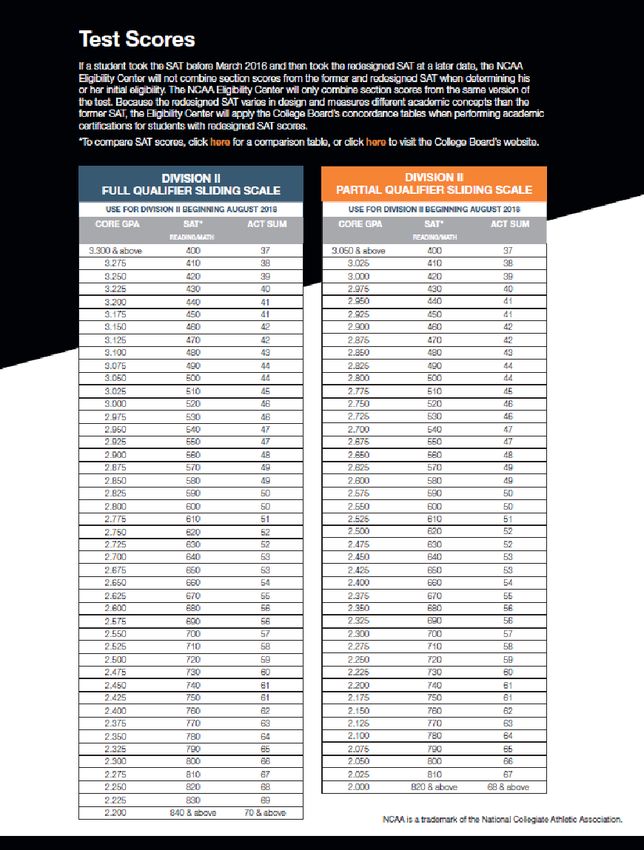
SAT/ACT SLIDING SCALE – once the student’s GPA is recalculated by the NCAA, it is compared to the student’s
SAT and/or ACT scores. Students with a higher GPA are able to use lower SAT/ACT scores, while students with a
lower GPA must earn higher scores on those tests in order to maintain eligibility. A complete listing of this sliding
scale is available in the Appendix A of this document. The student is responsible for reporting his/her scores directly
to the Eligibility Center using School Code 9999. Any test scores submitted by Somerville High School will not be
considered official.
A minimum GPA of 2.3 for Division I or 2.2 for Division II along with the
corresponding SAT/ACT scores are required to be eligible for athletic competition in
the student’s first year of college.
A minimum GPA of 2.0 along with the corresponding SAT/ACT scores are required to
be eligible for Red Shirt status in the student’s first year of college.
22NCAA ELIGIBILITY CENTER – this website serves as the central hub used to report and track all student data,
high school information, and college recruitment. Each group has its own roles and responsibilities within this site to
ensure that each prospective athlete is properly reviewed by the NCAA Eligibility Center to determine final eligibility
upon graduation from high school.
Student Responsibility –
1. Create a Certification Account and pay the $80 registration fee once a college coach has indicated that he/she
will be placed on the college’s Institutional Request List (IRL). A student can create this account without
consulting college coaches, but will end up wasting $80 if he/she is not officially recruited by a college program.
2. Ensure SAT/ACT scores are reported to the Eligibility Center using School Code 9999
3. After April 1 of his/her Senior Year, submit a request for Final Amateurism Certification Decision
4. If a student has not received a firm commitment from a college and does not wish to pay $80 prematurely, he/she
may create a free Profile Page and convert that Profile to a Certification Account at a later date.
Somerville High School Responsibility – update/modify the list of NCAA-approved courses as needed and upload a
student’s final high school transcript upon graduation.
College Coach Responsibility – add the prospective athlete’s name to the college’s Institutional Request List. Only
students listed on each college’s IRL will be receive a Final Amateurism Certification Decision. Any verbal or written
commitment from a coach is null and void if this formal review has not occurred.
NCAA Eligibility Center Website www.eligibilitycenter.org
Costumer Service Phone 877-262-1492 Fax 317-968-5100
Mailing Address NCAA Eligibility Center
Certification Processing
PO Box 7136
Indianapolis, IN 46207-7136
College Board CEEB Code 9999
23Appendix A
NCAA Division 1 Sliding Scale for SAT/ACT and GPA Requirements
New SAT Total Score Old SAT Total Score Minimum GPA
ACT
(March 2016 or later) (prior to March 2016) Required
400 400 37 3.55 or higher
410 410 38 3.525
420 410 38 3.525
430 420 39 3.5
440 430 40 3.475
450 430 40 3.475
460 440 41 3.45
470 450 41 3.425
480 450 41 3.425
490 460 42 3.4
500 470 42 3.375
510 470 42 3.375
520 480 43 3.35
530 490 44 3.325
540 490 44 3.325
550 500 44 3.3
560 510 45 3.275
570 510 45 3.275
580 520 46 3.25
590 530 46 3.225
600 540 47 3.2
610 540 47 3.2
620 550 47 3.175
630 560 48 3.15
640 560 48 3.15
650 570 49 3.125
660 580 49 3.1
670 580 49 3.1
680 590 50 3.075
690 600 50 3.05
700 600 50 3.05
710 610 51 3.025
720 620 52 3
730 630 52 2.975
740 640 53 2.95
750 660 54 2.9
760 670 55 2.875
770 680 56 2.85
780 690 56 2.825
790 700 57 2.8
800 710 58 2.775
24810 720 59 2.75
820 730 60 2.725
830 740 61 2.7
840 750 61 2.675
850 760 62 2.65
860 780 64 2.6
870 790 65 2.575
880 800 66 2.55
890 810 67 2.525
900 820 68 2.5
910 830 69 2.475
920 840 70 2.45
930 850 70 2.425
940 860 71 2.4
950 870 72 2.375
960 880 73 2.35
970 890 74 2.325
980 900 75 2.3
990 910 76 2.299
1000 920 77 2.25
1010 930 78 2.225
1020 940 79 2.2
1030 950 80 2.175
1040 960 81 2.15
1050 970 82 2.125
1060 980 83 2.1
1070 990 84 2.075
1080 1000 85 2.05
1090 1010 86 2.025
1100 1020 86 2
2526
Scholarships
Top Priority After Applications Are Submitted

So Much Information!
  ●   It is good to take some time and do some research of what is available now and in the coming months so that
      by this time during Senior year there is a plan on what to apply for.

  ●   Be aware of which scholarships could be a fit for you and which ones do not apply, not all will.

So Much Money!
  ●   There are millions of scholarships out there that amount to billions of dollars.

  ●   Some scholarships can provide you with significant aid in the thousands of dollars. Most will be smaller but
      they are all worth applying to. Every bit counts when paying for college.

  ●   Don’t worry about odds of winning a scholarship. Apply to as many as you can, it is not a calculated
      situation. There isn’t an easier way to get $500 than writing a couple hundred words.

Self-Directed Searching and Follow Through
  ●   Guidance will partially assist in the process but the ball is predominately in your court when searching for and
      completing scholarships.

  ●   Plenty of scholarships get handed out and not handed back. You may have been personally selected for a
      scholarship. Please do yourself the favor of seeing it through until the end.

  ●   Be mindful of deadlines and return instructions.

  ● High School Main Website
         o Guidance & Counseling Services Tab
              ▪ Scholarships

  ● Fastweb.com
         o 1.5 million scholarships
         o 3.4 billion dollars

  ● Senior Survey
       o Enters senior students in the running for local scholarships at the end of the year.
       o Last year over $100,000 in scholarships awarded to seniors.

                                                                                                                    27
SCHOLARSHIPS AND FINANCIAL AID
● FAFSA – Free Application for Federal Student Aid
o Administered by the U.S. Department of Education - determines student eligibility for federal
financial aid
o REQUIRED for all students applying to college
o Beginning in October, the federal government will allow families to file the FAFSA using PPY
(prior-prior year) tax data. This will allow families and students to apply for aid for the 2022-
2023 academic year using tax information from 2020 taxes.
o The FAFSA application can be submitted as early as October of the senior year
● CSS Profile – College Scholarship Service Profile – available October 1st of each year
o Distributed by the College Board for nonfederal financial aid
o Required by nearly 400 colleges, universities, professional schools, and scholarship programs
(mainly private and/or prestigious programs)
o Much more detailed than the FAFSA
o Fees: There is an initial application fee of $25, which includes one college. Each additional
report sent will cost $16
o Visit Collegeboard.org for a list of schools and institutions that use the PROFILE application
Financial Resources
College Net price calculator: http://collegecost.ed.gov/netpricecenter.aspx
Scholarship Search Sites: http://www.fastweb.com/
https://www.cappex.com/scholarships/
http://www.hesaa.org/Pages/NJGrantsHome.aspx
NJ College Loans: http://www.hesaa.org/Pages/NJCLASSHome.aspx
SHS Website: http://www.somervillenjk12.org
US Department of College Affordability and Transparency Center: http://www.collegecost.ed.gov/index.aspx
National Association of Financial Aid Administrators: www.nasfaa.org
28Speak the Language: Financial Aid
When it comes to money, you don’t need any misunderstandings. To help you navigate the
waters of paying for college, here is a list of commonly used terms and what they mean.
Award Letter: Official notification of the type and amount of financial aid a college is offering you.
Demonstrated Need: The difference between what your family can contribute toward college expenses and the actual
cost of attending college.
Expected Family Contribution (EFC): How much money you and your family are expected to contribute toward
college expenses. EFC is based on your FAFSA application and a calculation by the federal government.
Free Application for Federal Student Aid (FAFSA): The federal application every student must submit in order to be
eligible for federal financial aid. For more information and to complete the FAFSA visit www.fafsa.ed.gov
Grants: Money for college that does not have to be repaid. Most grants are need- based and are awarded by the state
or federal government.
Institutional Aid (or Campus- Based Aid): Financial assistance given by a college, typically either need-based or
merit-based aid.
Loans: Money given to a student that must be paid back. There are several types of loans, including low to zero
interest student loans given out by the federal government, like the Perkins and Stafford loans. These are the best
options, since you don’t have to pay back the money until you graduate. Private loans, offered through banks and
credit unions, typically have higher interest rates.
Merit Aid: Financial aid awarded to you from college based on your individual achievements and talents. For a full
listing of what’s available, visit www.meritaid.com
Need-Based Aid: Financial aid given based on the ability of you and your family to pay for college.
Scholarship: Money for college that does not have to be paid back. Usually awarded based on specific criteria, such as
your academic performance, extracurricular activities, college major, ethnic heritage or religious affiliation.
Scholarships may be awarded by colleges, private groups or states.
Student Aid Report (SAR): After you file the Free application for Federal Student Aid (FAFSA), you will receive a
SAR stating your EFC (expected family contribution) and eligibility for financial aid. This report is also sent to the
colleges you indicate on the FAFSA.
Student Loan: financial aid that must be repaid. Student loan programs are available through the federal government
and private lenders.
Work-Study: Financial aid given in exchange for work (typically at a job on campus). To qualify for the Federal
Work Study (FWS) program, you must complete the FAFSA.
29You can also read


