STRC - TMP-CH: Traffic Management Plans, a pilot study for western Switzerland André Robert-Grandpierre, RGR SA Jeff Konnen, INSER SA - Swiss ...
←
→
Page content transcription
If your browser does not render page correctly, please read the page content below
TMP-CH: Traffic Management Plans, a pilot
study for western Switzerland

André Robert-Grandpierre, RGR SA
Jeff Konnen, INSER SA

Conference paper STRC 2003
Session ITS

STRC
                Swiss Transport Research Conference
             3rd
             Monte Verità / Ascona, March 19-21, 2003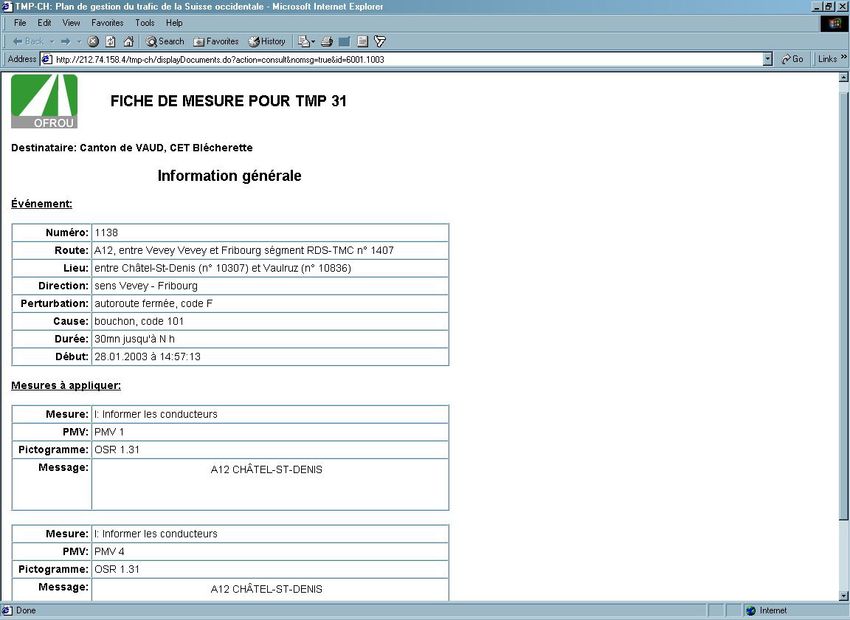
Swiss Transport Research Conference
_______________________________________________________________________________ March 19-21, 2003

TMP-CH: Traffic Management Plans, a pilot study for western Switzerland

André Robert-Grandpierre                            Jeff Konnen
RGR SA                                              INSER SA
Lausanne                                            Le Mont-sur-Lausanne

Phone:      021-616 10 78                           Phone:    021-643 77 11
Fax:        021-616 36 88                           Fax:      021-643 77 10
e-Mail:     andre@rgr-sa.ch                         e-Mail:   jk@inser.ch

Abstract

In Switzerland, traffic is regulated at the cantonal level. For special situations how-
ever decisions have to be made at an inter-cantonal level and bilateral agreements
are made between the different police corps.

TMP-CH aims at structuring these collaborations in order to permit rational event
management by defining several traffic management plans. Thus, traffic manage-
ment plans for the major highways in western Switzerland have been defined, includ-
ing traveller information. Coordination of radio broadcasted messages and VMS
(Variable Message Signs) Information was also part of the study.

These Plans were tested during the Swiss National Exposition 02 and will be the ba-
sics for the establishment of Swiss-wide Traffic Management Plans.

Keywords
Traffic Management Plan– Traveller Information – VMS – 3rd Swiss Transport Research Con-
ference – STRC 2003 – Monte Verità

                                                I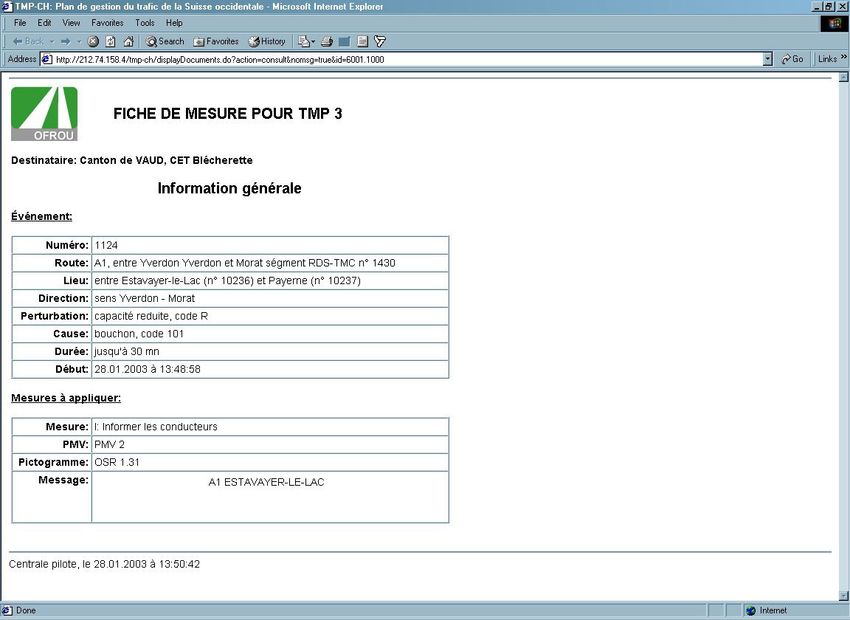
Swiss Transport Research Conference
_______________________________________________________________________________ March 19-21, 2003

1. Introduction

Nowadays, traffic is regulated at the cantonal level in Switzerland,. For special situations
however decisions have to be made at an intercantonal level and bilateral agreements are
made between the different police corps.

With the recent opening of the A1 between Yverdon and Payerne, on VD and FR territory,
and the oncoming A5 on VD and NE territory, the needs for an inter-cantonal decision plat-
form have increased.

The objective of the TMP-CH study is to introduce an experimental operating centre to man-
age inter-cantonal traffic events. Thus, the following functions had to be assured during the
test phase:

      • Knowledge of traffic conditions
      • Monitoring of highway events
      • Analysis of highway events (duration, traffic charge)
      • Introduction, management and suppression of a Traffic Management Plan (TMP)

The TMP-CH study is subdivided into several phases:

      • Analysis of the actual situation, establishment of TMPs and action plans. This phase
        is described in the present article
      • Definition of traffic prediction models (POLYDROM from C. deRham
        +DYNAMIT, realised by EPFL-scientists)
      • Implementation and management of the experimental operating centre
      • Evaluation of the results and recommendations for future steps

As this study was partly intended for traffic management at the Swiss national exposition, two
planning states have been considered:

      • Swiss national Exposition in 2002
      • Long-term planning for 2020, when the western highway network will be achieved.

                                               1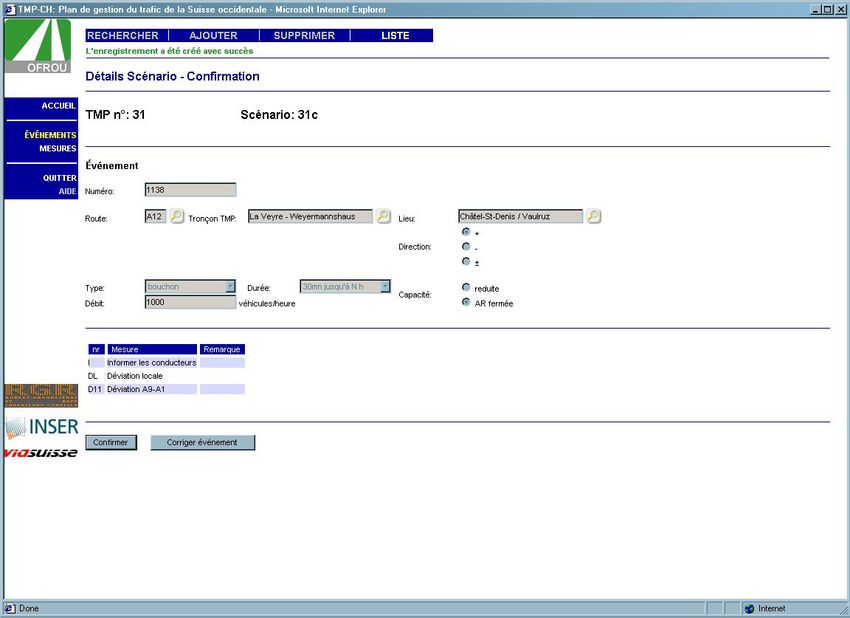
Swiss Transport Research Conference
_______________________________________________________________________________ March 19-21, 2003

2. Description of the TMPs

A traffic management plan is a set of rules for long distance traffic management. For each
TMP, several possible scenarios are defined, depending on the event's duration and the state
of the highway network. The choice of a scenario depends on the type of actions to be taken.
At a first stage, a set of possible deviations for the studied highway network has been defined
with travel time and distance as criteria. For each possible perturbation of the network, a traf-
fic management plan (TMP) is defined. According to the duration and the gravity of the inci-
dent, different scenarios relying on the deviation catalogue and traveller information strategies
are defined. This is done according to the following tables (Tables 1 and 2).

Table 1      Affection of scenarios according to the traffic situation
                                                         Predicted incident duration
                                    Up to 30 min                 30 min – N h1              More than N h

Capacity                    Reduced        Highway           Reduced        Highway   Reduced      Highway
                            capacity        closed           capacity        closed   capacity      closed
Scenario                        a              a               a/b              c          a/d          e

Table 2      Actions to be taken for a particular scenario type
                                                                 SCENARIOS
Actions                              a               b                  c              d             e

Information                      X                 X                    X             X             X
Major deviations                                   X                    X             X             X
Local deviations                                                        X                           X
Bi-directional traffic                                                                X
Complementary
                                                                                                    X
actions

1
      Segments with regulation for bi-directional traffic:                  N= 2h
      Segments without regulation for bi-directional traffic:               N=4h

                                                         2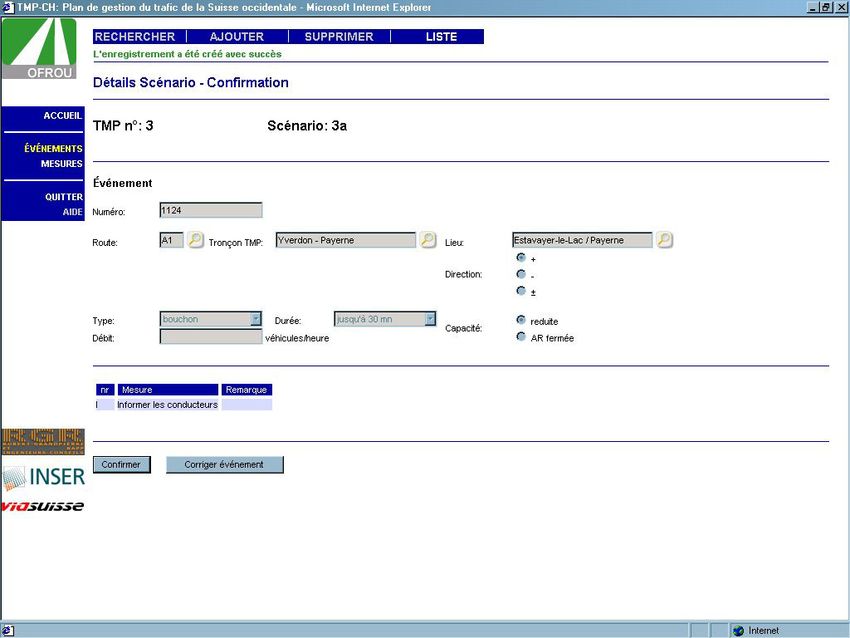
Swiss Transport Research Conference
_______________________________________________________________________________ March 19-21, 2003

3. Architecture of the Expo.02 TMP-Headquarter

During Expo.02, a temporary TMP-Headquarter was created in Colombier to manage the traf-
fic caused by the manifestation. It regrouped representatives of each canton and of ViaSuisse.
Decisions were coordinated among the different parties on site.

Input was, among others, given by the traffic counters of ASTRA, the Swiss federal roads au-
thority, and the ViaSuisse information system, TIC by GEWI. The computations were done
by the TMP-Information System (which was assured during office hours at RGR in
Lausanne) and the measures were communicated by telephone or fax to the cantonal authori-
ties and the Expo.02 central.

Figure 1    Infrastructure of the TMP-CH Headquarter

                        Centrale d'engagement et coordination EXPO.02
            ViaSuisse   (Colombier)                                        Centrale      RGR
            (Bienne)      Representant                   Opérateur         pilote        (Lausanne)
                          ViaSuisse                      centrale pilote

                          Interface à                     Interface à la                     Interface à la
               Server     ViaSuisse                      centrale pilote        Server      centrale pilote

                                                                                             Interface à
                          Centrales cantonales
                                                                                             ViaSuisse

                             VD           SO           BE             FR   NE

                                                                3
Swiss Transport Research Conference
_______________________________________________________________________________ March 19-21, 2003
Figure 2 Dataflow of the Expo02 TMP-Headquarter
events
ViaSuisse TMP-CH
m d
ea lie
su p
ap
information
re
s es
to
ap s ur ion
ply ea sit
m po
ro
ev e sp
e nt ur
s as
me
Traffic monitoring,
information and deviations
EXPO.02
simulations, ...
(RDS-TMC, ...)
ev
en
measure application
measures to apply
ts
confirmation of
information, deviations
(VMS) Cantonal
polices
Drivers
4Swiss Transport Research Conference
_______________________________________________________________________________ March 19-21, 2003
4. The Information System
The different rules defined by the traffic management plans have been implemented into a
state-of-the-art information system.
Its conception was based on an object-oriented UML modelling of the user needs. In the fol-
lowing chapter, some example screenshots illustrating the functioning of the IS are shown.
Figure 3 Physical architecture of the Information System
TMP-CH : Architecture de type INTRANET
Serveur Web +
Serveur Applicatif Serveur SGBD
Navigateur Web HTML JDBC
HTTP (applicatif)
Base
TMP-CH
Figure 4 UML Business Use Case Diagram of the Information System
Compteur
Outil de
simulation
gestion des événements gestion des outils de simulation gestion du trafic
gestion des mesures
Centrale Centrale EXPO.02 gestion des TMP
cantonale (CEC)
PMV ViaSuisse Opérateur centrale
pilote
Utilisateur routes
5Swiss Transport Research Conference
_______________________________________________________________________________ March 19-21, 2003
5. TMP Examples
To illustrate the functioning of the TMP concept, 2 example events will be shown.
1) A traffic congestion on A1 between Yverdon and Payerne
Let’s imagine, there is an accident on the A1 between Yverdon and Payerne. One highway
lane is closed temporarily, causing traffic congestion. The TMP operator enters the event into
his information system (see Figure 5). After a little rule-based reasoning, the system proposes
TMP n° 3, scenario 3a. This means that the drivers should be informed of the congestion,
without need for a deviation to be proposed. The system finally generates a standard fax (see
Figure 6), containing the text to be shown on a particular VMS. This fax can then be transmit-
ted to the police office in charge.
Figure 5 The proposition of the TMP-Information System for a traffic congestion on A1
6Swiss Transport Research Conference
_______________________________________________________________________________ March 19-21, 2003
Figure 6 Fax generated for scenario 3a
2) A highway closure due to an accident on A12 between Châtel-St Denis and Vaulruz
In our second example, we imagine a highway closure on A12, between Châtel-St Denis and
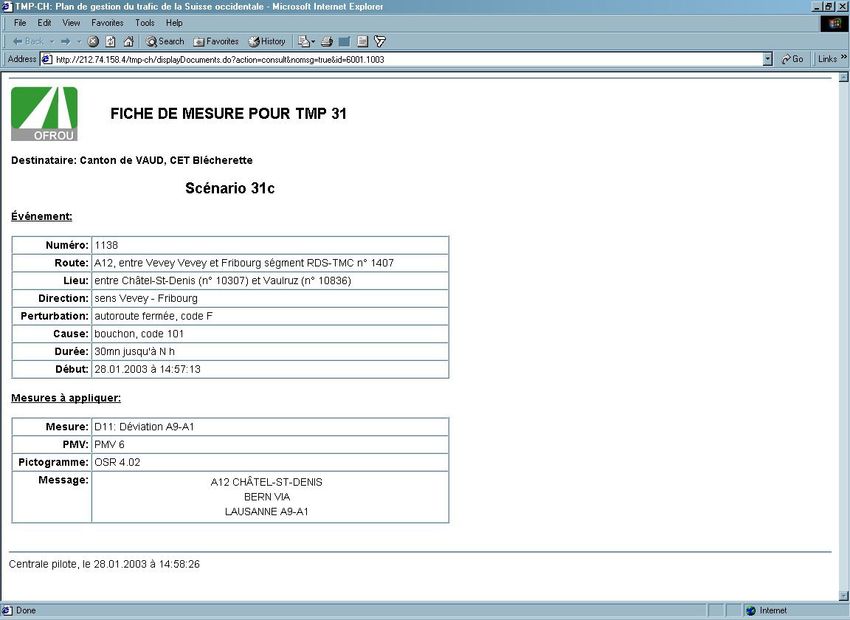
Vaulruz .The TMP information system proposes TMP n° 31, scenario 31c (see Figure 7). This
means driver information, implementation of a large-scale deviation (n°11) as well as a local
deviation. The system generates a fax for each action (see Figure 8), which can be transmitted
to the different authorities in charge. Finally, the implementation may be confirmed to the
system.
Figure 7 The proposition of the TMP-Information System for a highway closure on A12
7Swiss Transport Research Conference
_______________________________________________________________________________ March 19-21, 2003
Figure 8 Faxes generated for scenario 31c
8Swiss Transport Research Conference
_______________________________________________________________________________ March 19-21, 2003
6. Outlook
The TMPs which are currently defined are based on the Swiss highway network over the
planned test area in 2020 (see Figure 9). Nevertheless, it is planned to extend the TMP con-
cept to the entire Swiss highway network.
As a first step, the actual application is installed at the ViaSuisse traffic information central in
Bienne. If these tests turn out to be positive, the concept and the system may be extended over
the next years.
The first tests at Expo.02 have shown that TMP-CH can be a very useful application for man-
aging traffic at a large scale. It could help to coordinate the actions between the several part-
ners in traffic management and improve the decision making process.
Figure 9 Highway sectors managed by TMP in 2002
Tronçons autoroutiers gérés avec des TMP en 2002
Villars-Ste Croix - Yverdon : TMP 1/2
Yverdon - Payerne : TMP 3/4
Solothurn
Payerne - Kerzers : TMP 5/6 Grenchen
A1
A16
Kerzers - Weyermannshaus : TMP 7/8
Biel -
Weyermannshaus - Schönbühl :TMP 9/10 Bienne
Schönbhl - Luterbach : TMP 11/12 Lac Lyss
de Bienne
H20
Vevey - Weyermannshaus : TMP 31/32
RC22
A5 A6
H10
Neuchâtel
Kerzers
H10
Lac Bern
de Morat
Morat
Lac
de Neuchâtel A6
Avenches
Estavayer
Payerne Fribourg
Yverdon
A9b
Orbe H1
RC401 A12
Romont
Moudon
Echallens
RC636 Bulle
Cheseaux
RC744
Châtel-St-Denis
R5
Lausanne
A1 Morges
Vevey
Lac Léman Montreux
A9
Villeneuve
Légende
Aigle Zones à contrôler
avant la mise
en place des déviations
Monthey
9Swiss Transport Research Conference
_______________________________________________________________________________ March 19-21, 2003
7. References
INSER SA, (2002) TMP-CH, Analyse préliminaire
Robert-Grandpierre, André (2001) TMP-CH, Centrale pilote, Analyse de la situation actuelle
et établissement des TMP.
10Swiss Transport Research Conference
_______________________________________________________________________________ March 19-21, 2003
Appendix A: Deviations: 2 Examples
Solothurn
Grenchen
A1
A16
Biel -
Bienne
Lac Lyss
de Bienne
H20
A5 A6
H10
Neuchâtel
Kerzers
H10
Lac Bern
de Morat
Morat
Lac
de Neuchâtel A6
Avenches
Estavayer
Payerne Fribourg
Yverdon
A9b
Orbe H1 D2
RC401
Romont
A12
D1
Moudon
Echallens
RC636 Bulle
Cheseaux
RC744
Châtel-St-Denis
R5
Lausanne
A1 Morges
Vevey
Lac Léman Montreux Légende
A9
Villeneuve
Itinéraire normal
L= 96 km
Aigle
D1 Déviation 1
Lausanne-Bern
L= 105 km
D2
Monthey
Déviation 2
A9 Bern-Lausanne
L= 105 km
11Swiss Transport Research Conference
_______________________________________________________________________________ March 19-21, 2003
Solothurn
Grenchen
A1
A16
Biel -
Bienne
Lac Lyss
de Bienne
H20
A5 A6
H10
Neuchâtel
Kerzers
H10
Lac Bern
de Morat
Morat
Lac
de Neuchâtel A6
Avenches
Estavayer
Payerne Fribourg
Yverdon
A9b
D4
Orbe H1 D3 A12
RC401
Romont
Moudon
Echallens
RC636 Bulle
Cheseaux
RC744
Châtel-St-Denis
R5
Lausanne
A1 Morges
Vevey
Lac Léman Montreux Légende
A9
Villeneuve
Itinéraire normal
L= 51 km
D3
Aigle
Déviation 3
Lausanne-Payerne
L= 51 km
Monthey
D4 Déviation 4
A9 Payerne-Lausanne
L= 51 km
12Swiss Transport Research Conference
_______________________________________________________________________________ March 19-21, 2003
Appendix B: TMP, example:
TMP n° 1 - Etat 2002
Autoroute : A1 Direction : +
Tronçon : Villars - Ste-Croix / Yverdon
Segment :
Longueur : Caractéristiques :
Scénarios
Durée prévisible de l'incident
Jusqu'à 30mn 30mn jusqu'à Plus de N
N h (1) h (1)
Capacité Capacité AR Capacité AR Capacité AR
réduite fermée réduite fermée réduite fermée
Scénario 1a 1a 1a / 1b 1c 1a / 1d 1e
Mesures
Scénarios Mesures Page
1a I Informer les conducteurs
1b I Informer les conducteurs
D1 Déviation A9-A12 (véhicules légers)
D3 Déviation A9-H1 (poids lourds)
1c I Informer les conducteurs
DL Déviation locale
D1 Déviation A 9- A 12 (véhicules légers)
D3 Déviation A 9- H 1 (poids lourds)
13Swiss Transport Research Conference
_______________________________________________________________________________ March 19-21, 2003
S c é n a r io s M e s u re s Page
1d I In fo rm e r le s c o n d u c te u rs
D1 D é v ia tio n A 9 -A 1 2 (v é h ic u le s lé g e rs )
D3 D é v ia tio n A 9 -H 1 (p o id s lo u rd s )
M is e e n p la c e d u s c é n a rio 2 d e n c a s d e
TMP 2
tra fic b id ir e c tio n n e l
S c é n a r io 1 c a v e c m e s u re s c o m p lé -
m e n ta ire s e n fo n c tio n d e la s itu a tio n
1e
e ffe c tiv e , y c o m p ris a u x n iv e a u x in te rré -
g io n a l e t in te rn a tio n a l
R e m a rq u e s
M e s u re s A s p e c ts p a rtic u lie rs
I In fo rm a tio n v ia R a d io (In fo ro u te , R D S -T M C ), in te rn e t e t P M V
DL D é v ia tio n lo c a le m is e e n p la c e p a r la P o lic e
V é rific a tio n d e la fa is a b ilité d e la d é v ia tio n (d is p o n ib ilité ,
D1
c o m p a tib ilité d e s flu x d e tra fic )
V é rific a tio n d e la fa is a b ilité d e la d é v ia tio n (d is p o n ib ilité ,
D3
c o m p a tib ilité d e s flu x d e tra fic )
D u ré e p ré v is ib le d e l'in c id e n t :
(1 ) C e tte d u ré e e s t fo n c tio n d e la m is e e n p la c e d u tra fic b id ire c tio n n e l:
• S e g m e n ts a v e c ré g u la tio n : N = 2 h e u re s
• S e g m e n ts s a n s ré g u la tio n : N = 4 h e u re s
C a p a c ité :
C a p a c ité ré d u ite : F e rm e tu re p a rtie lle d e l'a u to ro u te
A R fe rm é e : F e rm e tu re c o m p lè te d e l'a u to ro u te
14You can also read


