Studying the squeezing effect and phase space distribution of single-photonadded coherent state using postselected von Neumann measurement
←
→
Page content transcription
If your browser does not render page correctly, please read the page content below

Studying the squeezing effect and phase space distribution of single- photon- added
                                                          coherent state using postselected von Neumann measurement
                                                                               Wen Jun Xu, Taximaiti Yusufu and Yusuf Turek∗
                                                     School of Physics and Electronic Engineering, Xinjiang Normal University, Urumqi, Xinjiang 830054, China
                                                                                            (Dated: September 15, 2021)
                                                             In this paper, ordinary and amplitude-squared squeezing as well as Wigner functions of single-
                                                          photon-added coherent state after postselected von Neumann measurements are investigated. The
                                                          analytical results show that the von Neumann type measurement which is characterized by post-
                                                          selection and weak value can significantly change the squeezing feature of single-photon-added co-
                                                          herent state. It is also found that the postselected measurement can increase the nonclassicality of
                                                          the original state in strong measurement regimes. It is anticipated that this work could may provide
                                                          an alternate and effective methods to solve state optimization problems based on the postselected
arXiv:2109.05423v2 [quant-ph] 14 Sep 2021

                                                          von Neumann measurement technique.

                                                          PACS numbers: 42.50.-p, 03.65.-w, 03.65.Ta

                                                              I.   INTRODUCTION                               quantum digital signature [51], the optimization for this
                                                                                                              state is worthy of study, in particular, it may provide new
                                               States which possess nonclassical features are an im-          methods to the implementations related processes. On
                                            portant resources for quantum information processing              the other hand, the weak signal amplification technique
                                            and the investigation of fundamental problems in quan-            proposed in 1988 [52] by Aharonov, Albert, and Vaidman
                                            tum theory. It has been shown that squeezed states of             is widely used in state optimization and precision mea-
                                            radiation fields has been can be considered truly quan-           surement problems [53–59]. Most recently, one of the
                                            tum [1]. In recent years studies concerning squeezing             authors of this paper investigated the effects of postse-
                                            especially quadrature squeezing of radiation fields has           lected von Neumann measurement on the properties of
                                            seen considerable attention as it may have applcaition            single-mode radiation fields [58, 59] and found that post-
                                            in optical communication and information theory [2–13],           selected von Neumann measurement changed the photon
                                            gravitatioanl wave detection [14], quantum teleportation          statistics and quadrature squeezing of radiation fields for
                                            [14–22], dense coding [23], resonance fluorscence [24],           different anomalous weak values and coupling strengths.
                                            and quantum cryptography [25]. Furthermore, with the              However, to the best of our knowledge, the effects of
                                            rapid development of the techniques for making higher-            postselected von Neumann measurement on higher-order
                                            order correlation measurements in quantum optics and              squeezing and phase-space distribution of SPACS have
                                            laser physics, the high-order squeezing effects of radiation      not been previously investigated.
                                            fields have also became a hot topic in state optimization            In this work, motivated by our prior work [56, 58, 59],
                                            researches. Higher-order squeezing of radiation fields was        we study the squeezing and Wigner function of SPACS
                                            first introduced by Hong and Manel [26] in 1985, and Hil-         after postselected von Neumann measurement. In this
                                            ley [27, 28] defined another type higher-order squeezing,         work, we take the spatial and polarization degrees of
                                            named amplitude- squared squeezing (ASS) of the elec-             freedom of SPACS as a measuring device (pointer) and
                                            tromagnetic field in 1987. Following this work the highe-         system, respectively, and consider all orders of the time
                                            squeezing of radiation fields has been investigated across        evolution operator. Following determination of the final
                                            many fields of research. [29–45].                                 state of the pointer, we check the criteria for existence
                                               Squeezing is an inherent feature of nonclassical states,       of squeezing of SPACS, and found that the postselected
                                            and its improvement requires optimization. Some states            measurement has positve effects on squeezing of SPACS
                                            do not initially possess squeezing, but after undergoing          in the weak measurement regime. Furthermore, we in-
                                            an optimization process, they may possess a pronounced            vestigate the state-distance and the Wigner function of
                                            squeezing effect, The single-photon-added coherent state          the SPACS after measurement. We found that with in-
                                            (SPACS) is a typical example. SPACAS are created by               creasing coupling strength, the original SPACS spoiled
                                            adding the creation operator a† to the coherent state, and        significantly, and the state exhibited more pronounced
                                            this optimization changes the coherent state from semi-           negative areas as well as interference structures in phase
                                            classical to a new quantum state which possess squeez-            space after postselected measurement. We observed that
                                            ing. Since this state has wide application across many            the postselected von Neumann measurement has posi-
                                            quantum information processes including quantum com-              tive effects on its nonclassicality including squeezing ef-
                                            munication [46], quantum key distribution [47–50], and            fects especially in the weak measurement regime. These
                                                                                                              results can be considered a result of weak value amplifi-
                                                                                                              cation of the weak measurement technique.
                                                                                                                 This paper is organized as follows. In Sec. II, we in-
                                            ∗   yusufu1984@hotmail.com                                        troduce the main concepts of our scheme and derive the
2
final pointer state after postselected measurement which and
will be used throughout the study. In Sec. III, we give ϕ ϕ
the details of ordinary squeezing and ASS effects of the |ψi i = cos |Hi + eiδ sin |V i, (4)
2 2
final pointer state. In Sec. IV, we investigate the state
distance and the Wigner function SPACS after measure- respectively. Here, α = reiθ and δ ∈ [0, 2π] and ϕ ∈
ment. A conclusion is given in Sec. V. [0, π). Here, we are reminded that in weak measurement
theory, the interaction strength between the system and
measurement is weak, and it is enough to only consider
II. MODEL AND THEORY the evolution of the unitary operator up to its first or-
der. However, if we want to connect the weak and strong
measurement and investigate the measurement feedback
In this section, we introduce the basic concepts of post-
of postselected weak measurement, and analyze experi-
selected von Neumann measurement and give the expres-
mental results obtained in non-ideal measurements, the
sion of the final pointer state which we use in this paper.
full-order evolution of the unitary operator is needed [61–
We know that every measurement problems consists of
63], We call this kind of measurement a postselected von
three main parts including a pointer(measuring device),
Neumann measurement. Thus, the evolution operator of
measuring system and the environment. In the current
this total system corresponding to the interaction Hamil-
work, we take the spatial and polarization degrees of free-
tonian, Eq. (1), is evaluated as
dom of SPACS as the pointer and system, respectively.
In general, in measurement problems we want to deter- 1 ˆ s 1 s
mine the system information of interest by comparing the e−ig0 σx ⊗P = I + σ̂x ⊗D + Iˆ − σ̂x ⊗D −
2 2 2 2
state-shifts of the pointer after measurement finishes, and (5)
we do not consider spoiling of the pointer in the entire sinceσ̂x2 = 1. Here,s = gσ0 is the ratio between the cou-
measurement process. Here, contrary to the standard pling strength and beam width, and it can characterize
goal of the measurement, we investigate the effects of pre- the measurement types i.e. the measurement is consid-
and post-selected measurement taken on a beam’s po- ered a weak measurement (strong measurement) if s < 1
larization(measured system) on the inherent properties (s > 1). D( 2s ) is the displacement operator defined as
of a beam’s spatial component (pointer). In the mea- † ∗
D(α) = eαâ −α â . The results of our current research
surement process, the system and pointer Hamiltonians are valid for weak and strong measurement regimes since
doesn’t effect the final read outs, so it is sufficient to only we take into account the all orders of the time evolution
consider their interaction Hamiltonian for our purposes. operator, Eq. (5). In the above calculation we use the
According to standard von Neumann measurement the- definition of the momentum operator represented in Fock
ory, the interaction Hamiltonian between the system and space in terms of an annihilation (creation) operator â
the pointer takes the form [60] (↠), i.g.,
i
a† − a
P̂ = (6)
Ĥ = g(t)Â ⊗ P̂ . (1) 2σ
where σ is the width of the beam. Thus, the total state
Here, Â is the system observable we want to measure, and
of the system, |ψi i⊗|φi, after the time evolution becomes
P̂ is the momentum operator h of the
i pointer conjugated
with the position operator, X̂, P̂ = i. g(t) is the cou- |Ψi = e−ig0 σx ⊗P |ψi i ⊗ |φi
pling strength function between the system and pointer
1 ˆ s
ˆ
−s
and it is assumed exponentially small except during a = I + σ̂x ⊗ D + I − σ̂x ⊗ D |ψi i ⊗ |φi
2 2 2
period of interaction time of order T , and is normalized (7)
R +∞ RT
according to −∞ g(t)dt = 0 g(t)dt = g0 . In this work,
we assume that the system observable A is Pauli x ma- After we take a strong projective measurement of the
trix, i.e., polarization degree of the beam with posts-elected state
|ψf i = |Hi, the above total system state gives us the
0 1 final state of the pointer, and its normalized expression
 = σ̂x = |HihV | + |V ihH| = (2) reads as
1 0
κ h s s i
Here, |Hi ≡ (1, 0)T and |V i ≡ (0, 1)T represent the hori- |Φi = √ (1 + hσx iw ) D + (1 − hσx iw ) D − |φi.
2 2 2
zontal and vertical polarization of the beam, respectively. (8)
We also assume that in our scheme the pointer and mea- Here,
surement system are initially prepared to
s2
κ−2 = 1 +|hσx i|2 + γ 2 e− 2 Re[(1 + hσx i∗w )(1 −hσx iw )×
† 1
|φi = γa |αi, γ=p (3) (γ −2 − s2 + αs − α∗ s)e2si=(α) ] (9)
1 + |α|2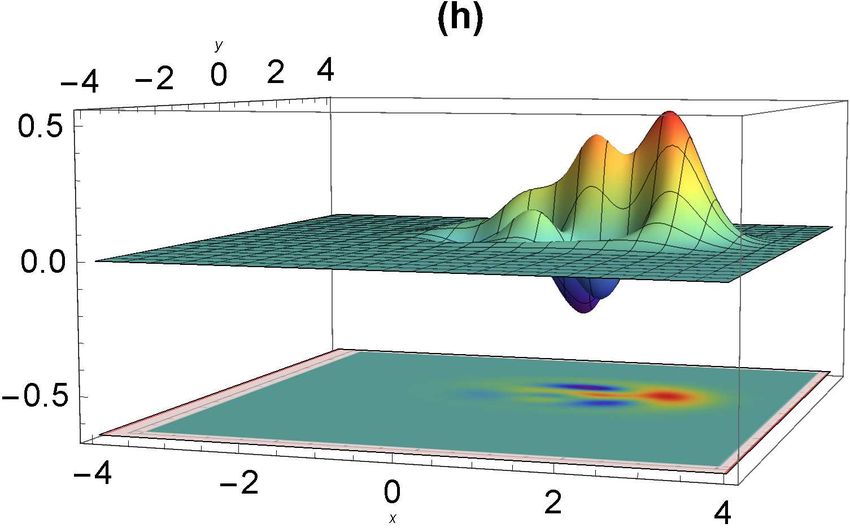
3

is the normalization coefficient, and the weak value of the         of the field mode amplitude can be defined by operators
system observable σ̂x is given by                                   Xθ and Yθ as [64]

                        hψf |σx |ψi i          ϕ                                                1
                                                                                                  ae−iθ + a† eiθ

             hσx iw =                 = eiδ tan .         (10)                          Xθ ≡                                     (11)
                         hψf |ψi i             2                                                2

In general, the expectation value of σx is bounded −1 ≤             and
hσx i ≤ 1 for any associated system state. However, as                                        1 2 −iθ
                                                                                                      + a†2 eiθ ,

we see in Eq. (10), the weak values of the observable σx                               Yθ ≡     a e                              (12)
                                                                                              2
can take arbitrary large numbers with small successful
post-selection probability Ps = |hψf |ψi i|2 = cos2 ϕ2 . This       respectively. For these operators, if 4Xθ ≡ Xθ − hXθ i,
weak value feature is used to amplify very weak but useful          4Yθ ≡ Yθ − hYθ i, the minimum variances are [65]
information on various of related physical systems.
   The state given in Eq. ( 8) is a spoiled version of                                   1 1 †
                                                                    h(4Xθ )2 imin =          ha ai − |hai|2 − |ha2 i − hai2 |

                                                                                          +
SPACS after postselected measurement. In the next sec-                                   4 2
tions, we study squeezing effects, and nonclassicality fea-                                                              (13)
tures characterized by the Wigner function.
                                                                                                1
                                                                       h(4Yθ )2 imin = ha† a + i                               (14)
                                                                                                2
 III.   ORDINARY AND AMPLITUDE SQUARE                                                   1  †2 2
                                                                                           ha a i − |ha2 i|2 − |ha4 i − ha2 i2 |

                SQUEEZING                                                            +
                                                                                        2
                                                                    where a and a† are annihilation and creation operators
   In this section, we check the ordinary (first-order) and         of the radiation field. If h(4Xθ )2 imin < 41 , Xθ is said to
ASS (second order) squeezing effects of SPACS after
                                                                    be ordinary squeezed and if h(4Yθ )2 imin < ha† a + 21 i, Yθ
postselected von Neumann measurement.The squeezing
                                                                    is said to be ASS. These conditions can be rewritten as
effect is one of the non-classical phenomena unique to
the quantum light field. The squeezing reflects the non-                       Sos = ha† ai − |hai|2 − |ha2 i − hai2 | < 0       (15)
classical statistical properties of the optical field by a
noise component lower than that of the coherent state.
In other words, the noise of an orthogonal component of
the squeezed light is lower than the noise of the corre-                  Sass = ha†2 a2 i − |ha2 i|2 − |ha4 i − ha2 i2 | < 0.   (16)
sponding component of the coherent state light field. In
practice, if this component is used to transmit informa-            Thus, the system characterized by any wave function may
tion, a higher signal-to-noise ratio can be obtained than           exhibit non-classical features if it satisfies Eqs. (15-16).
that of the coherent state. Consider a single mode of               To achieve our goal, we first have to calculate the above
electromagnetic field of frequency ω with creation and              related quantities and their explicit expressions under the
annihilation operator a† ,a. The quadrature and square              state |Φi.these are listed below.

  1.The expectation value ha† ai under the state |Ψi is given by

                                                                                                            ∗
              ha† ai = |κ|2 |1 + hσx iw |2 t1 (s) + |1 − hσx iw |2 t1 (−s) + 2Re[(1 − hσx iw ) (1 + hσx iw ) t3 (s)]

                                                                                                                                 (17)

where

                                                                                     s2
                                    t1 (s) = γ 2   2 + |α|4 + s|α|2 Re(α) + 3αα∗ + 1 +

                                                                                       4

and

                                 1 2 2isIm(α) − s2
                         t3 (s) =  γ e       e 2 (4|α|4 − 6sα|α|2 + 2(6αα∗ + sα∗2 (3α + s)
                                 4
                               + sRe(α)(8 − 9sα − 3s2 )) + 11α2 s2 + s4 + 6αs3 − 5s2 − 16αs + 4)

respectively.
  2.The expectation value hai under the state |Ψi is given by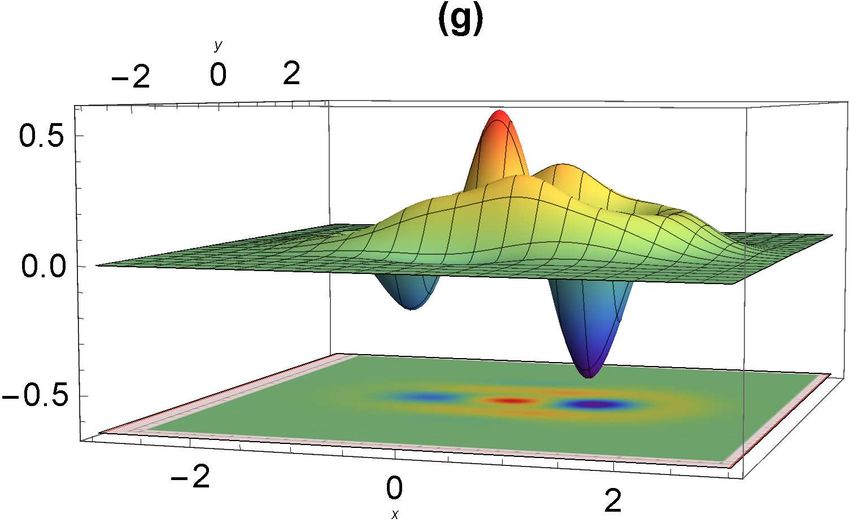
4


                                                                    s                                     s
                      hai = |κ|2 γ 2 {|1 + hσx iw |2 2α + α|α|2 + 2 + |1 − hσx iw |2 2α + α|α|2 − 2
                                                                  2γ                                     2γ
                                                       ∗                                      ∗
                          + (1 − hσx iw ) (1 + hσx iw ) w1 (s) + + (1 + hσx iw ) (1 − hσx iw ) w1 (−s)]}                      (18)
where

                              1 2isIm(α) − s2
                                        e 2 4α + α∗ (s − 2α)(s − α) + 2α2 s + s3 − 3αs2 − 3s

                          w1 (s) =
                                e
                              2
3.The expectation value ha2 i under the state |Ψi is given by

                                                                                                              ∗
                     ha2 i = |κ|2 {|1 + hσx iw |2 q1 (s) + |1 − hσx iw |2 q1 (−s) + (1 − hσx iw ) (1 + hσx iw ) q2 (s)
                                                         ∗
                          + (1 + hσx iw ) (1 − hσx iw ) q2 (−s)}                                                              (19)
where

                                                       1 2
                                            q1 (s) =     γ (2α + s)(6α + |α|2 (2α + s) + s)
                                                       4
and

                             1            s2
                   q2 (s) = − e2isIm(α) e− 2 γ 2 (s − 2α)(6α + α∗ (s − 2α)(s − α) + 2α2 s + s3 − 3αs2 − 5s)
                             4
respectively.
  4.The expectation value ha†2 a2 i under the state |Ψi is given by

                                                                                                                  ∗
                ha†2 a2 i = |κ|2 {|1 + hσx iw |2 f1 (s) + |1 − hσx iw |2 f2 (−s) + 2Re[(1 − hσx iw ) (1 + hσx iw ) f3 (s)]}   (20)
where
                                1 2
                       f1 (s) =   γ (2|α|6 + s|α|2 ((s2 + 16)Re(α) + sRe(α2 )) + 2|α|4 (2sRe(α) + s2 + 5)
                                2
                                                                                    s4
                              + 8α∗ α + 6s2 α∗ α + (2s3 + 8s)Re(α) + 3s2 Re(α2 )) +     + γ 2 s2
                                                                                    16
and

              1
f3 (s) = − γ 2 (s − 2α) (2α∗ + s)
            16
                2                                                                                           1
         2 (α∗ ) (s − 2α)(s − α) + 20|α|2 + 3sα∗ (s − 2α)(s − α) + 28isIm(α) + s2 2α2 + s2 − 3αs − 9 + 16e− 2 s(s−4iIm[α])


respectively.
  5.The expectation value ha4 i under the state |Ψi is given by

                     ha4 i = |κ|2 {|1 + hσx iw |2 h1 (s) + |1 − hσx iw |2 h1 (−s) + (1 + hσx iw )∗ (1 − hσx iw )h2 (s)        (21)
                                                         ∗
                          + (1 + hσx iw ) (1 − hσx iw ) h2 (−s)}                                                              (22)
where
                               1
                   h1 (s) =      (8αγ 2 |α|2 (α + s)(2α2 + s2 + 2αs) + s4 + 8αγ 2 (10α3 + 2s3 + 9αs2 + 16α2 s))
                              16
and
                              1 2 2isIm(α) − s2
                 h2 (s) = −      γ e      e 2 (s − 2α)3 (10α + α∗ (s − 2α)(s − α) + 2α2 s + s3 − 3αs2 − 9s)
                              16
respectively.

  Using the expression for Sos , the curves for this quan-             tity are plotted, and the analytical results are shown in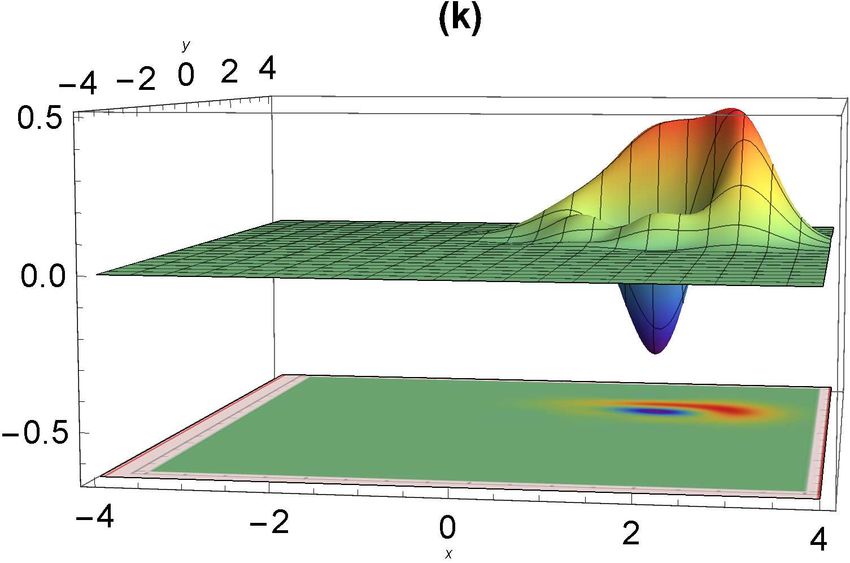
5
Ordinary squeezing
0.4
0.6 φ π
φ 5π
(a) 9 9
φ 3π
9
φ 7π
9
15 (a) 0
0.4 -0.4
-0.8
ASS
10 0 0.5 1
0.2
0.0 5
=π φ= 5 π
9 9
φ= 3 π φ= 7 π
-0.2 0 9 9
0 1 2 3 4 5
0 1 2 3 4 5
s
s
0.8 1
Ordinary squeezing
(b) φ π
9
(b)
0.6 φ 3π
0
9
0.4 φ 5π
9
φ 7π -1 φ π
9 9
0.2 φ 3π
-2 9
5π
0.0 φ
9
-3 φ 7π
9
-0.2
0.0 0.5 1.0 1.5 2.0 2.5 3.0 -4
0.0 0.5 1.0 1.5 2.0 2.5 3.0
r
r
Figure 1. (Color online) The effects of postselected von Neu-
mann measurement on ordinary squeezing of SPACS. Fig. Figure 2. (Color online) The effects of postselected von
1(a) shows the quantity Sos as a function of coupling strength Neumann measurement on ASS of SPACS. (a) the Sass as a
for different weak values with fixed coherent state parameter function of coupling strength s for different weak values with
(r = 1). Fig. 1(b) shows quantity Sos as a function of co- fixed coherent state parameter r (r = 1); (b) the Sass as
herent state parameter r for different weak values with fixed a function of coherent state parameter r for different weak
coupling strength (s = 0.5). Here, we take θ = π4 , δ = π6 . values with fixed weak coupling strength s (s = 0.5). Other
parameters are the same as those used in Fig. (1).
Fig. 1. In Fig. 1(a), we fixed the parameter r = 1
and plot the Sos as a function of coupling strength s action strength is too large, the system is strongly mea-
for different weak values quantified by ϕ. As we ob- sured and the size of the weak value has little impact on
served, when there is no interaction between system and the squeezing effect.This statement can also be observed
poiner (s = 0), there is no ordinary squeezing effect of in Fig. 1(a) and (b). In the weak measurement regime
initial SPACS at the r = 1 point. However, in moderate the SPACS showed a good ordinary squeezing effect after
coupling strength regions such as 0 < s 1) no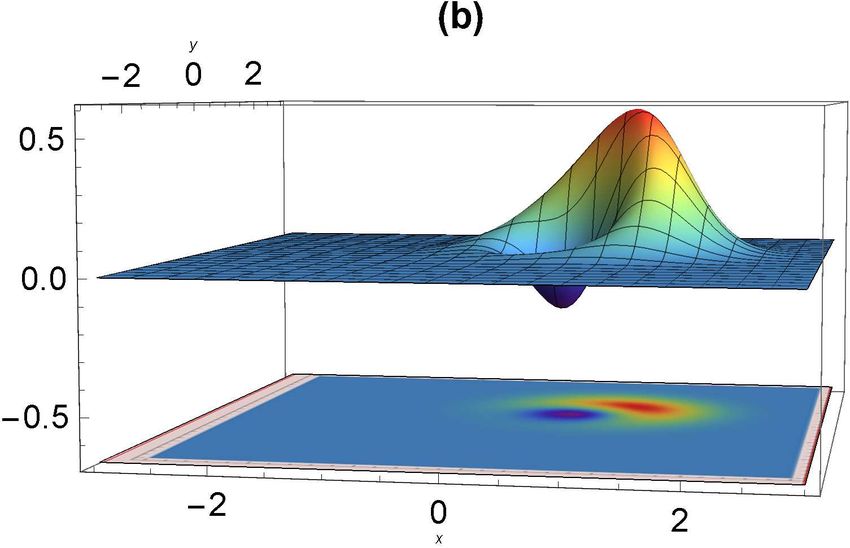
6

matter how large the value is taken. In order to further             1.0
investigate the ASS of the radiation field in the weak
                                                                                                                  s=0
measurement regime, we plot the Sass as a function of                0.8
                                                                                                                  s=0.5
the coherent state parameter r for different weak values
with s = 0.5. the analytical results are shown in Fig. 2b.           0.6                                          s=2

                                                                F
We can see that when r is relatively small, there is an
ASS effect no matter how large the weak value becomes.               0.4
By increasing the system parameter r, Sass takes nega-
tive values and its negativity is proportional to r. From
                                                                     0.2
Fig. 2a we can also observe that in the weak measure-                0.0
ment regime, the weak values have positive effects on the
ASS of SPACS, and it can also be considered a result of                    0         1     2          3       4           5
the weak signal amplification feature of the postselected                                         r
weak measurement technique.
                                                              Figure 3. (Color online) The state distance between |Φi and
                                                              initial SPACS |φi as a function of coherent state parameter
     IV.    STATE DISTANCE AND WIGNER                         r for various coupling strengths. Here, we set values θ = π4 ,
                   FUNCTION                                   δ = π6 , ϕ = 7π .
                                                                            9

   The postselected measurement taken on polarization
degree of freedom of the beam could spoil the inherent        where CN (λ) is the normal ordered characteristic func-
properties presented in its spatial part. Before we inves-    tion,and is defined as
tigate the phase-space distribution of SPACS after post-                                  h    †  ∗
                                                                                                    i
selected von Neumanm measurement, we check the sim-                           CW (λ) = T r ρeλa −λ a .           (25)
ilarity between the initial SPACS |φi and the state |Φi
after measurement. The state distance between those           Using the notation λ0 ,λ00 for the real and imaginary parts
two states can be evaluated by                                of λ and setting z = x + ip to emphasize the analogy be-
                                                              tween the radiation field quadratures and the normalized
                      F = |hφ|Φi|2 ,                  (23)
                                                              dimensionless position and momentum observables of the
and its value is bounded 0 ≤ F ≤ 1. If F = 1 (F = 0),         beam in phase space. We can rewrite the definition of the
then the two states are totally same (totally different).     Wigner function in terms of x, p and λ0 , λ00 as
The F in our case can be calculated after substituting                          Z +∞
equations Eq. (3)and Eq. (8) into the Eq. (23), and                          1                0   00
                                                                 W (x, p) = 2         e2i(pλ −xλ ) CW (λ)dλ0 dλ00 . (26)
the analytical results are shown in Fig. 3. In Fig. 3                        π −∞
we present the state distance F as a function of system
parameter r for different coupling strengths with a fixed     By substituting the final normalized pointer state |Φi
large weak value. As shown in Fig. 3, in the weak cou-        into Eq. (26), we can calculate the explicit expression of
pling regime (s = 0.5), the state after the postselected      its Wigner function and it reads as
measurement maintains similarity with the the coherent                     2|κ|2             2
state parameter r. However, with increasing the mea-          W (z) =                e−2|z−α| ×
surement strength, the initial state |φi is spoiled and the             π(1 + |α|2 )
similarity between the pointer states before and after the         {|1 + hσx iw |2 w(Γ) + |1 − hσx iw |2 w(−Γ)
measurement is decreases.                                       + 2 −1 + |2z − α|2 Re[(1 + hσx iw )∗ (1 − hσx iw )e2isIm[z] ]}.

   In order to further explain the squeezing effects of
                                                                                                                   (27)
SPACS after postselected von Neumann measurement,
in the rest of this section we study the Wigner function      with
of |Φi. The Wigner distribution function is the closest                        1 2
quantum analogue of the classical distribution function        w(Γ) = e− 2 s e−2(Re[α]−Re[z])s ×
in phase space. According to the value of the Wigner                                                    s
function we can intuitively determine the strength of its            −1 + |2z − α|2 + 2s(Re[α] − 2Re[z] + ) (28)
                                                                                                         2
quantum nature, and the negative value of the Wigner
function proves the nonclassicality of the quantum state.     This is a real Wigner function and its value is bounded
The Wigner function exists for any state, and it is defined   − π2 ≤ W (α) ≤ π2 in whole phase space.
as the two-dimensional Fourier transform of the symmet-          To depict the effects of the postselected von Neumann
ric order characteristic function. Thus, the Wigner func-     measurement on the non-classical feature of SPACS, in
tion for the state ρ = |ΦihΦ| is written as [64]              Fig. 4 we plot its curves for different parametric coherent
                 Z +∞                                         state parameters r and coupling strengths s. Each col-
              1                                               umn from left to right in-turn indicate the different coher-
     W (z) ≡ 2          exp(λ∗ z − λz ∗ )CW (λ)d2 λ,   (24)
              π −∞                                            ent state parameters r for 0, 1 and 2, and each row from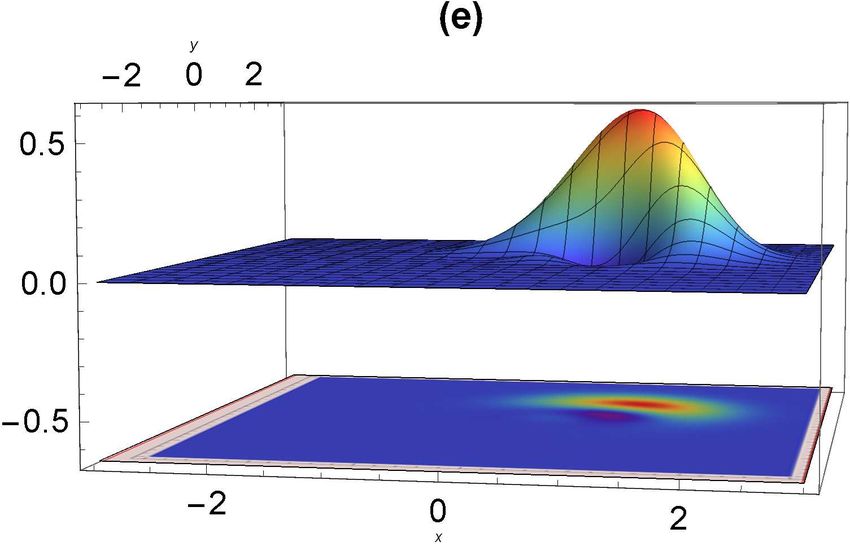
7

Figure 4. (Color online) Wigner function of SPACS with changing parameters. Each column is defined for the different coherent
state parameter α with r = 0, 1, 2, and are ordered accordingly from left to right. Figures (a) to (c) correspond to s = 0, (d)
to (f) correspond to s = 0.5, and (g) to (k) correspond to s = 2. Other parameters are the same as those used in Fig. (3).

up to down represent the different coupling strengths s          SPACS and this kind of squeezing is pronounced with
for 0, 0.5 and 2. It is observed that the positive peak of       increasing coupling strength (see Figs. 4g-k ). Further-
the Wigner function moves from the center to the edge            more, in Figs. 4(g-k) we can see that in the strong mea-
position in phase space and its shape gradually becomes          surement regime significant interference structures man-
irregular with changing coupling strength s. From the            ifest and the negative regions become larger than the
first row (see Figs. 4a-c ) we can see that the original         initial pointer state.
SPACS exhibit inherent features changing from single                As mentioned above, the existence of and progressively
photon state to coherent states with gradually increas-          stronger negative regions of the Wigner function in phase
ing coherent state parameter r. Figs. 4d-k indicate the          space indicates the degree of nonclassicality of the associ-
phase space density function W (z) after postselected von        ated state. From the above analysis we can conclude that
Neumann measurement. Fig. 4 d-f represent the Wigner             after the postselected von Neumann measurement, the
function for fixed weak interaction strength s = 0.5. It         phase space distribution of SPACS is not only squeezed
can be observed that the Wigner function distribution            but the nonclassicality is also pronounced in the strong
shows squeezing in phase space compared to the original          measurement regime.

                  V.    CONCLUSION                               determined the final state of the pointer state along with
                                                                 the standard measurement process. We examined the or-
 In this paper we have studied the squeezing and                 dinary (first-order) and ASS effects after measurement,
Wigner function of SPACS after postselected von Neu-             and found that in the weak measurement region, the or-
mann measurement. In order to achieve our goal, we first         dinary squeezing and ASS of the light field increased sig-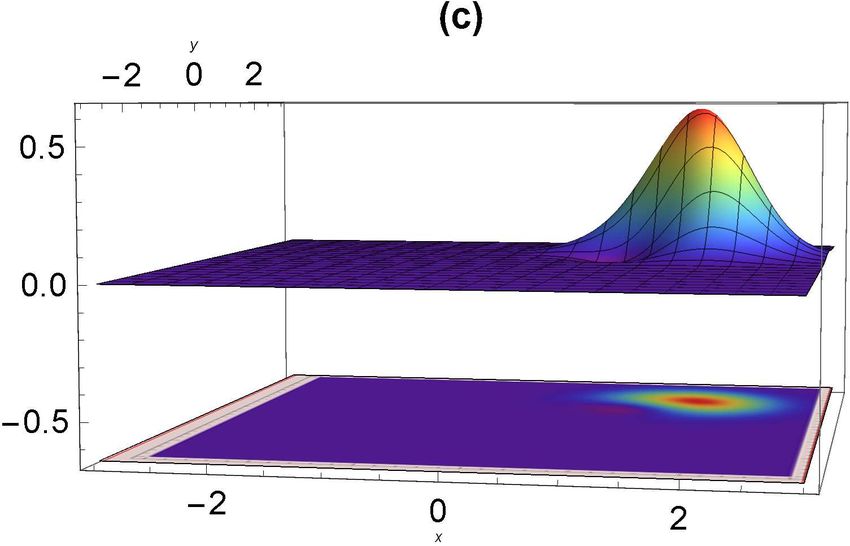
8

nificantly as the weak value increased.                           in phase space.
   To further explain our work, we examined the similar-             We anticipate that the theoretical scheme in this pa-
ity between the initial SPACS and the state after mea-            per may provide an effective method for solving practical
surement. We observed that under weak coupling, the               problems in quantum information processing associated
state after the postselected measurement maintains sim-           with SPACS.
ilarity with the initial state. However, as the intensity of
the measurement increases, the similarity between them
gradually decreased and indicated that the measurement
spoils the system state if the measurement is strong. We                         ACKNOWLEDGMENTS
also investigate the Wigner function of the system after
postselected measurement. It is observed that following              This work was supported by the Natural Science Foun-
the postselected von Neumann measurement, the phase               dation of Xinjiang Uyghur Autonomous Region (Grant
space distribution of SPACS is not only squeezed, but             No. 2020D01A72), the National Natural Science Foun-
also adevelops significant interference structures in the         dation of China (Grant No. 11865017) and the Introduc-
strongly measured regime. It also possess pronounced              tion Program of High Level Talents of Xinjiang Ministry
nonclassicality characterized with a large negative area          of Science.

 [1] A. Mari and J. Eisert, Phys. Rev. Lett. 103, 213603          [23] S. L. Braunstein and H. J. Kimble, Phys. Rev. A 61,
     (2009).                                                           042302 (2000).
 [2] Y. Yamamoto and H. A. Haus, Rev. Mod. Phys. 58, 1001         [24] V. Petersen, L. B. Madsen, and K. Mølmer, Phys. Rev.
     (1986).                                                           A 72, 053812 (2005).
 [3] H. Yuen and J. Shapiro, IEEE. T. Inform. Theory 26, 78       [25] J. Kempe, Phys. Rev. A 60, 910 (1999).
     (1980).                                                      [26] C. K. Hong and L. Mandel, Phys. Rev. A 32, 974 (1985).
 [4] S. L. Braunstein and H. J. Kimble, Phys. Rev. Lett. 80,      [27] M. Hillery, Opt. Commun 62, 135 (1987).
     869 (1998).                                                  [28] M. Hillery, Phys. Rev. A 36, 3796 (1987).
 [5] R. Lo Franco, G. Compagno, A. Messina, and A. Napoli,        [29] C. Gerry and S. Rodrigues, Phys. Rev. A 35, 4440 (1987).
     Phys. Rev. A 76, 011804 (2007).                              [30] Xiaoping Yang and Xiping Zheng, Phys. Lett. A 138, 409
 [6] R. L. Franco, G. Compagno, A. Messina, and A. Napoli,             (1989).
     Int. J. Quantum. Inf 07, 155 (2009).                         [31] E. K. Bashkirov and A. S. Shumovsky, Int. J. Mod. Phys.
 [7] R. L. Franco, G. Compagno, A. Messina, and A. Napoli,             B 4, 1579 (1990).
     Open. Syst. Inf. Dyn 13, 463 (2006).                         [32] M. H. Mahran, Phys. Rev. A 42, 4199 (1990).
 [8] R. Lo Franco, G. Compagno, A. Messina, and A. Napoli,        [33] P. Marian, Phys. Rev. A 44, 3325 (1991).
     Phys. Rev. A 74, 045803 (2006).                              [34] M. A. Mir, Int. Journ. Mod. Phys. B 7, 4439 (1993).
 [9] R. Lo Franco, G. Compagno, A. Messina, and A. Napoli,        [35] S.-d. Du and C.-d. Gong, Phys. Rev. A 48, 2198 (1993).
     Eur. Phys. J-Spec. Top 160, 247 (2008).                      [36] A. V. Chizhov, J. W. Haus, and K. C. Yeong, Phys. Rev.
[10] R. Lo Franco, G. Compagno, A. Messina, and A. Napoli,             A 52, 1698 (1995).
     Phys. Lett. A 374, 2235 (2010).                              [37] R. Lynch and H. A. Mavromatis, Phys. Rev. A 52, 55
[11] B. R. Mollow and R. J. Glauber, Phys. Rev. 160, 1076              (1995).
     (1967).                                                      [38] M. A. Mir, Int. J. Mod. Phys. B 12, 2743 (1998).
[12] R. Slusher and B. Yurke, J. Lightwave. Technol 8, 466        [39] R.-H. Xie and S. Yu, J. Opt. B-Quantum. S. O 4, 172
     (1990).                                                           (2002).
[13] H. Yuen and J. Shapiro, IEEE. T. Inform. Theory 24,          [40] R.-H. Xie and Q. Rao, Physica. A 312, 421 (2002).
     657 (1978).                                                  [41] Z. Wu, Z. Cheng, Y. Zhang, and Z. Cheng, Physica. B
[14] C. M. Caves, Phys. Rev. D 23, 1693 (1981).                        390, 250 (2007).
[15] G. J. Milburn and S. L. Braunstein, Phys. Rev. A 60,         [42] E. K. BASHKIROV, Int.J. Mod. Phys.B 21, 145 (2007).
     937 (1999).                                                  [43] D. K. Mishra, Opt. Commun 283, 3284 (2010).
[16] B. Schumacher, Phys. Rev. A 54, 2614 (1996).                 [44] D. K. Mishra and V. Singh, Opt. Quant. Electron 52, 68
[17] B. Schumacher and M. A. Nielsen, Phys. Rev. A 54, 2629            (2020).
     (1996).                                                      [45] S. Kumar and D. K. Giri, J. Optics-UK 49, 549 (2020).
[18] F.-l. Li, H.-r. Li, J.-x. Zhang, and S.-y. Zhu, Phys. Rev.   [46] P. V. P. Pinheiro and R. V. Ramos, Quant. Infor. Proc
     A 66, 024302 (2002).                                              12, 537 (2013).
[19] T. C. Zhang, K. W. Goh, C. W. Chou, P. Lodahl, and           [47] Y. Wang, W.-S. Bao, H.-Z. Bao, C. Zhou, M.-S. Jiang,
     H. J. Kimble, Phys. Rev. A 67, 033802 (2003).                     and H.-W. Li, Phys. Lett. A 381, 1393 (2017).
[20] B. Kraus, K. Hammerer, G. Giedke, and J. I. Cirac,           [48] M. Miranda and D. Mundarain, Quant. Infor. Proc 16,
     Phys. Rev. A 67, 042314 (2003).                                   298 (2017).
[21] A. Kitagawa and K. Yamamoto, Phys. Rev. A 68, 042324         [49] S. Srikara, K. Thapliyal, and A. Pathak, Quant. Infor.
     (2003).                                                           Proc 19, 371 (2020).
[22] A. Dolińska, B. C. Buchler, W. P. Bowen, T. C. Ralph,        [50] J.-R. Zhu, C.-Y. Wang, K. Liu, C.-M. Zhang, and
     and P. K. Lam, Phys. Rev. A 68, 052308 (2003).                    Q. Wang, Quant. Infor. Proc 17, 294 (2018).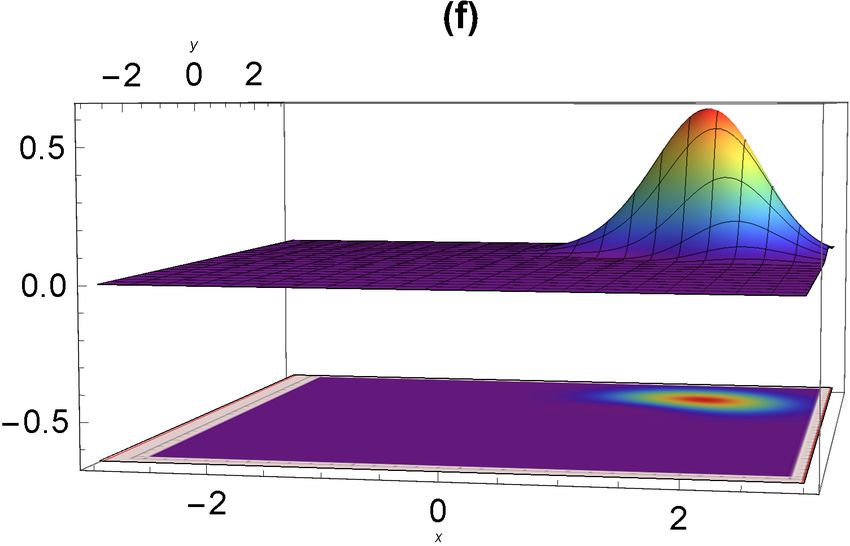
9

[51] J.-J. Chen, C.-H. Zhang, J.-M. Chen, C.-M. Zhang, and     [59] Y. Turek, Eur. Phys. J. Plus 136, 221 (2021).
     Q. Wang, Quant. Infor. Proc 19, 198 (2020).               [60] von Neumann J, Mathematical Foundations of Quantum
[52] Y. Aharonov, D. Z. Albert, and L. Vaidman, Phys. Rev.          Mechanics (Princeton University Press, Princeton, NJ,
     Lett. 60, 1351 (1988).                                         1955).
[53] K. Nakamura, A. Nishizawa, and M.-K. Fujimoto, Phys.      [61] Y. Aharonov and A. Botero, Phys. Rev. A 72, 052111
     Rev. A 85, 012113 (2012).                                      (2005).
[54] B. de Lima Bernardo, S. Azevedo, and A. Rosas, Opt.       [62] A. Di Lorenzo and J. C. Egues, Phys. Rev. A 77, 042108
     Commun 331, 194 (2014).                                        (2008).
[55] Y. Turek, H. Kobayashi, T. Akutsu, C.-P. Sun, and         [63] A. K. Pan and A. Matzkin, Phys. Rev. A 85, 022122
     Y. Shikano, New. J. Phys 17, 083029 (2015).                    (2012).
[56] Y. Turek, W. Maimaiti, Y. Shikano, C.-P. Sun, and         [64] G. Agarwal, Quantum Optics (Cambridge University
     M. Al-Amri, Phys. Rev. A 92, 022109 (2015).                    Press, Cambridge, England, 2013).
[57] Y. Turek and T. Yusufu, Eur. Phys. J. D 72, 202 (2018).   [65] P. Shukla and R. Prakash, Mod. Phys. Lett. B 27,
[58] Y. Turek, Chin. Phys. B 29, 090302 (2020).                     1350086 (2013).
You can also read


