Habit Owner's Manual Supplement - READ THIS SUPPLEMENT AND YOUR CANNONDALE BICYCLE OWNER'S MANUAL.
←
→
Page content transcription
If your browser does not render page correctly, please read the page content below

Habit
Owner’s Manual Supplement

READ THIS SUPPLEMENT AND YOUR
CANNONDALE BICYCLE OWNER’S MANUAL.
Both contain important safety information.
Keep both for future reference.
Safety Messages
                In this supplement, particularly important information
                           is presented in the following ways:

                       Indicates a hazardous situation which,
                       if not avoided, may result in death or
                       serious injury.

                       NOTICE
                       Indicates special precautions that
                       must be taken to avoid damage.

                   The following symbols are used in this manual:

Symbol                 Name                 Description
  NG
      LI
         -2    NGLI-2 synthetic grease      Apply NGLI-2 synthetic grease.

 CR
   B-
        GE
           L         Carbon gel             Apply carbon gel (friction paste) KF115/

                 Medium-strength
      2                                      Apply Loctite® 242 (blue) or equivalent.
               removable thread lock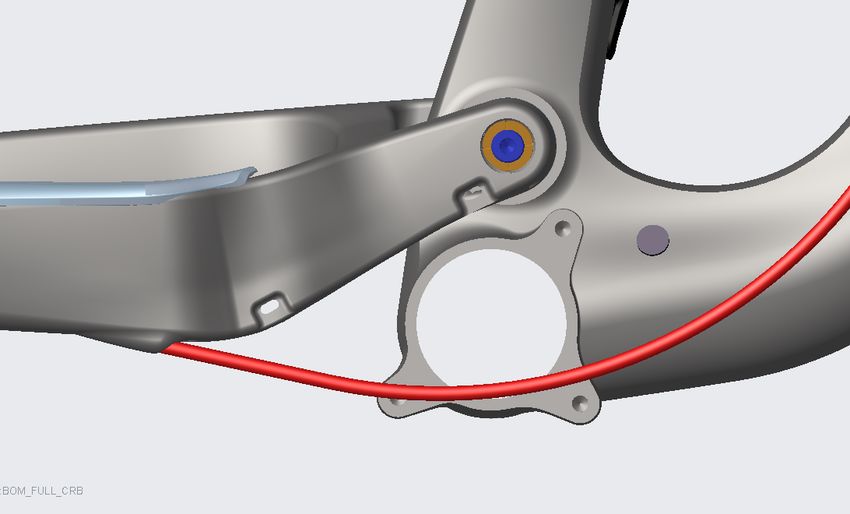
English

 Cannondale
 Supplements
                                                           CONTENTS
 This manual is a “supplement” to your         Safety Information............................. 2-6
 Cannondale Bicycle Owner’s Manual.
                                               Technical Information....................... 7-27
 This supplement provides additional
 and important model specific safety,          Replacement Parts......................... 28-29
 maintenance, and technical information.       Tightening Torques............................. 30
 It may be one of several important
 manuals/supplements for your bike;            Maintenance........................................ 31
 obtain and read all of them.
                                               Notes................................................... 32
 Please contact your Authorized
 Cannondale Dealer immediately if you
 need a manual or supplement, or have
 a question about your bike. You may
 also contact us using the appropriate
 country/region/location information.
 You can download Adobe Acrobat PDF
 versions of any manual/supplement from
 our website:                                  Your Cannondale Dealer
 http://www.cannondale.com.
                                               To make sure your bike is serviced and
                                               maintained correctly, and that you
 Contacting Cannondale                         protect applicable warranties, please
                                               coordinate all service and maintenance
 Cannondale USA
                                               through your Authorized Cannondale
 Cycling Sports Group, Inc.
                                               Dealer.
 1 Cannondale Way,
 Wilton CT, 06897, USA
 1-800-726-BIKE (2453)                          NOTICE

 Cycling Sports Group Europe B.V                Unauthorized service, maintenance,
 Mail: Postbus 5100                             or repair parts can result in serious
 Visits: Hanzepoort 27                          damage and void your warranty.
 7570 GC, OLDENZAAL, Netherlands
 Tel: +41 61 551 14 80
 Fax:+31 54 151 42 40

134938 Rev 1.                              1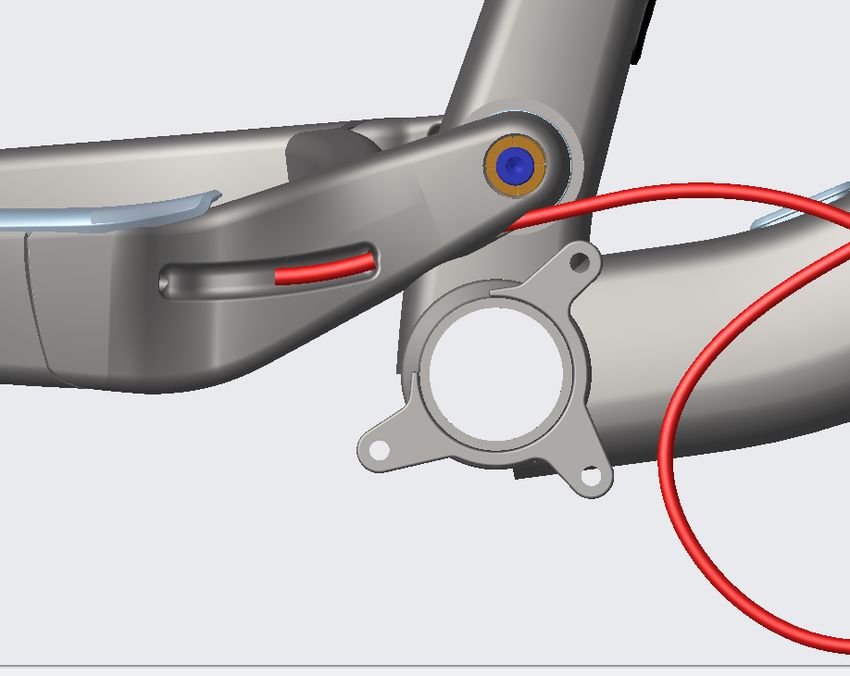
Habit - Owners Manual Supplement

                          SAFETY INFORMATION

 Important Composites                           Inspection & Crash
 Message                                        Damage Of Carbon
                                                Frames/Forks

  Your bike (frame and components) is
  made from composite materials also
  known as “carbon fiber.”                      After A Crash Or Impact:

  All riders must understand a                  Inspect frame carefully for damage
  fundamental reality of composites.            (See PART II, Section D. Inspect For
  Composite materials constructed of            Safety in your
  carbon fibers are strong and light, but       Cannondale Bicycle Owner’s Manual.
  when crashed or overloaded, carbon            Do not ride your bike if you see any
  fibers do not bend, they break.               sign of damage, such as broken,
  For your safety, as you own and use           splintered, or delaminated carbon
  the bike, you must follow proper              fiber.
  service, maintenance, and inspection          Any of the following may indicate a
  of all the composites (frame, stem,           delamination or damage:
  fork, handlebar, seat post, etc.) Ask
  your Cannondale Dealer for help.              ·   An unusual or strange feel to the
                                                    frame
  We urge you to read PART II, Section          ·   Carbon which has a soft feel or
  D. “Inspect For Safety” in your                   altered shape
  Cannondale Bicycle Owner’s Manual             ·   Creaking or other unexplained
  BEFORE you ride.                                  noises,
  You can be severely injured,                  ·   Visible cracks, a white or milky
  paralyzed or killed in an accident if             color present in carbon fiber
  you ignore this warning.                          section

                                                Continuing to ride a damaged
                                                frame increases the chances of
                                                frame failure, with the possibility of
                                                injury or death of the rider.

134938 Rev 1.                               2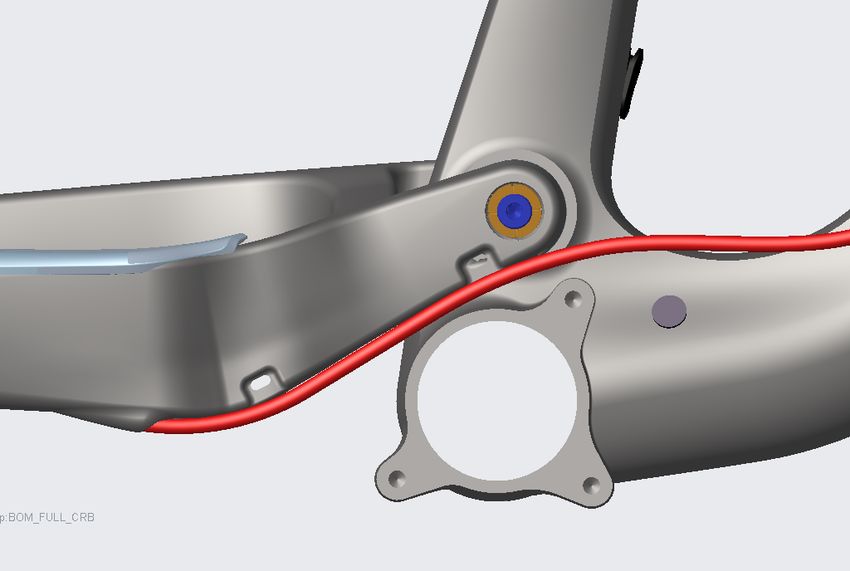
English

 Intended Use                               Servicing

                The intended use of
                all models is ASTM
                CONDITION 4,                 This supplement may include
                All-Mountain.                procedures beyond the scope of
                                             general mechanical aptitude.
                                             Special tools, skills, and knowledge
                                             may be required. Improper
                                             mechanical work increases the risk
                                             of an accident. Any bicycle accident
  Understand your bike and its               has risk of serious injury, paralysis or
  intended use. Using your bike the          death.
  wrong way is dangerous.                    To minimize risk we strongly
  Please read your Cannondale Bicycle        recommend that owners always
  Owner’s Manual for more information        have mechanical work done by an
  about Intended Use and Conditions          Authorized Cannondale Dealer.
  1-5.

134938 Rev 1.                           3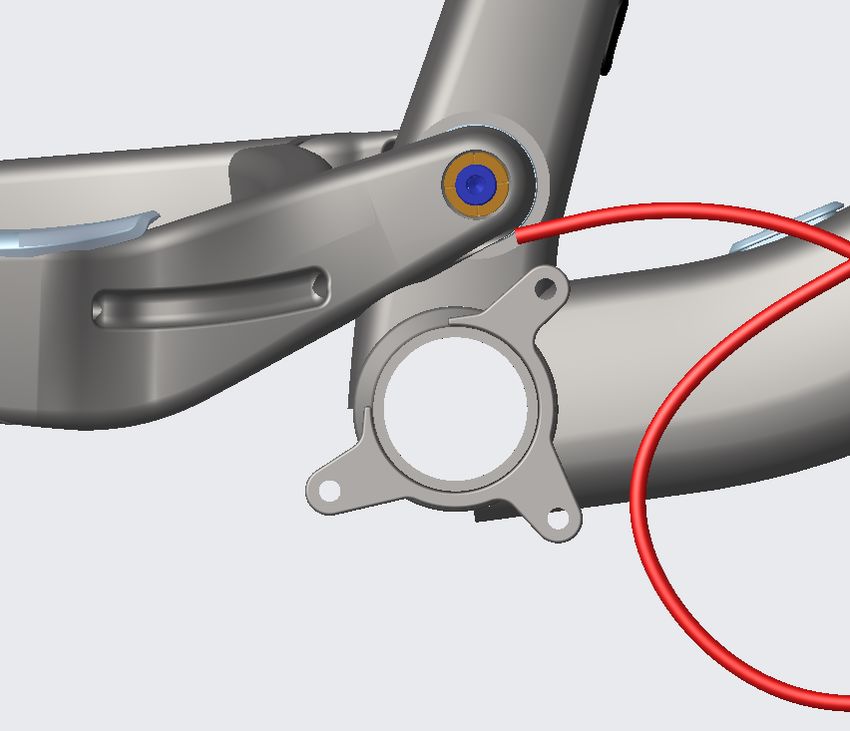
Habit - Owners Manual Supplement

Maximum Fork Length
Maximum Fork Length is an important frame safety testing specification for front
suspension mountain bikes. You must observe the measurement when installing headset
parts, headset adapters, installing and adjusting a fork, and selecting replacement forks.

                                          From
                                     Bottom Of Frame
                                        Head Tube

                                                 Maximum
                                                 Fork
                                                 Length

                                                       To Center Of
                                                       The Fork Axle

 You must select a replacement fork not only based on head tube diameter but the
 critical factor of frame maximum fork length.
 Do not exceed maximum fork length. Exceeding the MAXIMUM FORK LENGTH limit
 can overload the frame causing it to break while riding.
 Your retailer MUST follow and observe this specification for your bike. For Maximum
 Fork Length specifications for Cannondale bicycles, see www.cannondale.com.
 You can be severely injured, paralyzed or killed in an accident if you ignore this
 warning.

134938 Rev 1.                               4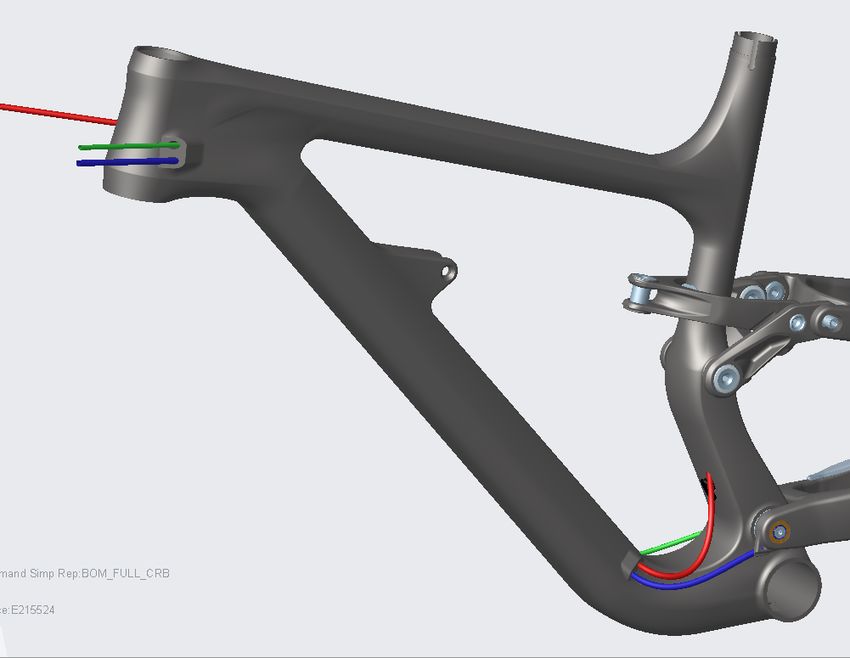
English

 Tire Size x Maximum Width

  Observe the Tire Size x Maximum Width for your bike found in the “Specifications”
  page of this manual.
  Mounting the wrong size tires can result in the tires hitting the fork or frame when
  riding. If this happens, you can lose control of your bike and you can be thrown off, a
  moving tire can be stopped because it touches the fork or frame.
  Do not mount oversized tires, ones that rub or hit the fork or frame, ones that result in
  too little clearance, or ones that can hit the fork or frame when the suspension is fully
  compressed or when riding.
  Take care that the tires you select are compatible with your bike’s fork or frame design.
  Also, be sure to follow the manufacturer’s recommendations of your front fork and rear
  shocks.
  When you are considering tires for your bike consider...
  The actual measured size of a tire may be different than its sidewall marking. Each
  time you mount a new tire, take the time to inspect the actual clearance between the
  rotating tire and all parts of the frame. The U.S. Consumer Product Safety Commission
  (CPSC) requires at least 1/16” (1.6 mm) tire clearance from any part of the bike.
  Allowing for lateral rim flex and a wheel or rim that is out-of-true will likely mean
  choosing a rear tire that provides even more clearance than the CPSC recommends.
  Ask your dealer for the right tires for your bike and its particular components!
  You can be severely injured, paralyzed or killed in an accident if you ignore this
  warning.

134938 Rev 1.                              5
Habit - Owners Manual Supplement

 Rear Shocks                                   Minimum Seat Post
                                               Insert

  Select only compatible shocks and
  forks for your bike. Do not modify
                                               Make sure at least 100 mm of the
  your bike in any way to mount one.
                                               seat post is inserted into the frame
  Have your shock or fork installed by a       at all times.
  professional bike mechanic
                                               Failure to insert the seat post at least
  Riding with the wrong rear shock can         100 mm can place a very high stress
  damage the frame. You could have a           on the seat tube top tube junction
  serious accident. Make sure the total        causing the frame to fail while riding.
  travel, eye-to-eye length, and stroke
                                               Remove the seat post. Measure 100
  length of the rear shock you select
                                               mm from the bottom of the seat post.
  meet the “Specifications” listed in
                                               Use a permanent marker to mark the
  this manual.
                                               post at 100 mm.
  When selecting different shocks
                                               When adjusting the seat post height
  or forks for your bike, make sure
                                               in the seat tube, never adjust the
  that the shock or fork you select is
                                               seat post so that the line you mark is
  compatible with your bike’s design
                                               above the top edge of the seat tube.
  and how you will use your bike.
                                               You must also be aware that bicycle
  You can be severely injured,
                                               seat posts are permanently marked
  paralyzed or killed in an accident if
                                               by the manufacturer with a “minimum
  you ignore this warning.
                                               insert” line on the seat post itself.
                                               You must not rely on this marking as
                                               an indication of the proper minimum
                                               seat post insertion depth.
                                               You can be severely injured,
                                               paralyzed or killed in an accident if
                                               you ignore this warning.

134938 Rev 1.                              6
English

                      TECHNICAL INFORMATION
Specifications

 Item                                                          Specification
 Model                                              Habit                      Bad Habit
                                                 XS: 27.5 in
 Wheel Size                                                                    27.5+ in
                                                 S-XL: 29 in
                                                XS: 120 mm,
 Rear Travel                                                                   130 mm
                                               S-XL: 130 mm
 Head Tube                                          UPR: 1 -1/8 in, LWR: 1-1/2 in
 Headset                                           Integrated, 1-1/8 in - 1-1/2 in
                                                        CRB: PF30 / 83 mm,
 Bottom Bracket: Type/ Width
                                                        ALLY: BSA / 83 mm
 Front Derailleur                                                   N/A
 Seat Post: Dia./Binder                                 31.6 mm / 34.9 mm
   Min. Seat Post Insert                                         100 mm
   Tire Size x Max. Width                    XS: 27.5 in x 2.5 in
                                                                           27.5 in x 2.8 in
 (measured)                                  S-XL: 29 in x 2.5 in
   Max. Fork Length                                              551 mm
 Rear Shock: Eye-To-Eye / Stroke / Bushing              XS: 190 mm / 45 mm
 Width                                                 S-XL: 210 mm / 50 mm
 Recommended Sag (measured at shock)                           25%, 11 mm
 Chain Guide                                                     ISCG 05
 Rear Brake: Mount Type /
                                                       Post Mount / 180 mm
 Min/Max Rotor Dia.
                                                     Maxle TA / 148 x 12 mm,
 Rear Axle: Type/Length
                                                        180 mm Length
                                                 Rear Wheel: 3mm Offset to NDS
 Ai Offset:                                      SRAM Chainring: +6 mm Offset
                                                 Hollowgram SpideRing: Ai Offset
   Intended Use                                ASTM CONDITION 4, All-Mountain
    Max. Weight Limit
                                                            305 lbs / 138 kg
 Total (rider+all equipment):

134938 Rev 1.                            7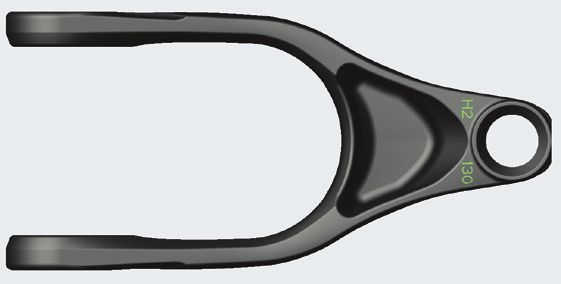
Habit - Owners Manual Supplement

                                                             B
                                                                   P
                                                                                      G

                                                               C

                                                                                                  O

                                           E   E’      A
                                                                                  D
                                                                                                          F

                            K                                          I                          M
                                L          J

                                                           H

                                                                                                      N
Dimensions = centimeter

 Geometry - Habit
 Frame Size                                             XS                  S              M               L      XL
   A       Seat Tube Length                             38                  40             44             48      52
   B       Top Tube Horizontal                         53.8                57.3           60.6            63.9   67.1
   C       Top Tube Actual                             47.6                 51            54.3            57.9   61.7
   D       Head Tube Angle                             66°                   *              *              *       *
   E       Seat Tube Angle                             66.3°                 *              *              *       *
   E1      Seat Tube Angle Effective                   74.5°                 *              *              *       *
   F       Stand Over                                   70                  72             75             77      78
   G       Head Tube Length                             9.5                10.5           11.5            12.5   13.5
   H       Wheel Base                                  110.3               114.4          117.6           121    124.4
    I      Front Center                                 67                  71            74.3            77.8   81.1
   J       Chain Stay Length                           43.5                  *              *              *       *
   K       Bottom Bracket Drop                          2.8                 3.8             *              *       *
   L       Bottom Bracket Height                       33.1                33.9             *              *       *
   M       Fork Rake                                    4.4                 5.1             *              *       *
   N       Trail                                       11.2                  *              *              *       *
   O       Stack                                        60                 60.7           61.6            62.5   63.4
   P       Reach                                       36.6                40.0           43.0            46.0   49.0

All Specifications subject to change without notice.

134938 Rev 1.                                              8
English
B
P
G
C
O
E E’ A
D
F
K I M
L J
H
N
Dimensions = centimeter
Geometry - Bad Habit
Frame Size S M L XL
A Seat Tube Length 40 44 48 52
B Top Tube Horizontal 57.3 60.6 63.9 67
C Top Tube Actual 74.5° * * *
D Head Tube Angle 66° * * *
E Seat Tube Angle 66.3° * * *
E1 Seat Tube Angle Effective 74.5° * * *
F Stand Over 71.7 74.7 76.7 77.7
G Head Tube Length 10.5 11.5 12.5 13.5
H Wheel Base 114.6 118 121.4 124.7
I Front Center 71.3 74.7 78.2 81.4
J Chain Stay Length 43.4 * * *
K Bottom Bracket Drop 2.8 * * *
L Bottom Bracket Height 33.6 * * *
M Fork Rake 5.1 * * *
N Trail 10.6 * * *
O Stack 60.7 61.6 62.5 63.4
P Reach 40 43 46 49
All Specifications subject to change without notice.
134938 Rev 1. 9Habit - Owners Manual Supplement
Cable Guide - K32109
To remove:
1. Un thread the guide bolt using a 2.5mm allen before pushing on the bolt head to
release the sliding part of the guide.
To install:
1. Route the housing or brake cable through the opening in the tube wall.
2. Slide the open cable guide over the exposed housing end.
3. Insert the cable guide into the frame. Use a 2.5mm allen key to push on the bolt head
to ease installation.
4. Pull the excess housing slack out of the frame.
5. Tightening the guide bolt until the cable no longer moves. Do not over-tighten.
Guide Guide Bolt
Housing / Cable
134938 Rev 1. 10English
To insert in frame opening, press NOTE: Pulling the slack from
both inward on the guide bolt the frame, before tightening
with the tool end and on the the guide bolt will reduce cable
housing side. rattle.
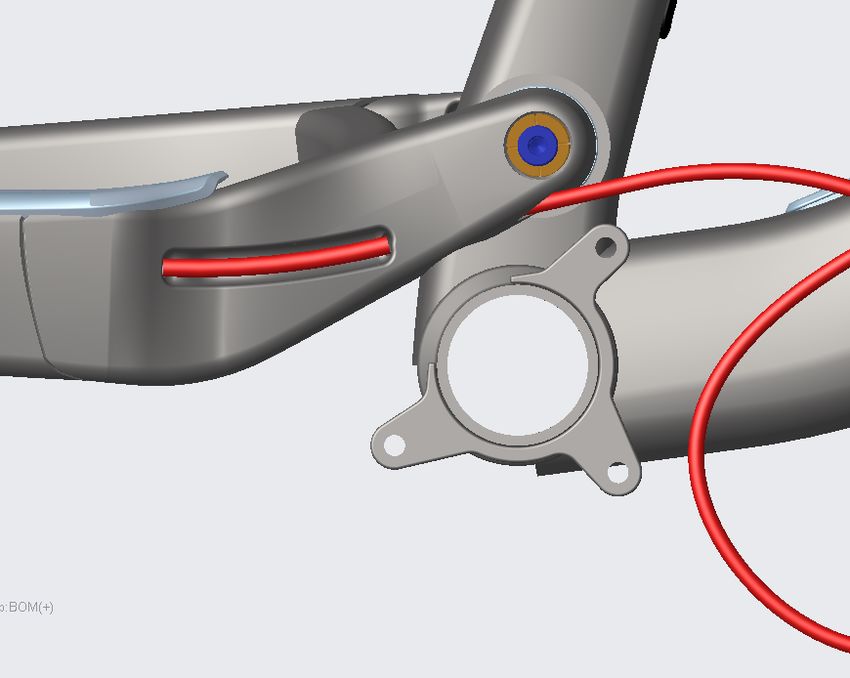
134938 Rev 1. 11Habit - Owners Manual Supplement Cable Routing: Alloy Chainstay To route shift housing through the alloy chainstay: 1. Form a loop of housing by the bottom bracket as shown A. This will help with pushing the housing into the chainstay. 2. Using pliers, add a slight bend to the end of the housing to ease installation. 3. Insert the housing into the chainstay opening. Push the loop of cable until the housing end exits the chainstay, shown B. 4. Continue pushing the housing until the housing enters the chainstay tube, shown C. 5. Remove the rear chainstay pivot hardware to access the rear opening of the chainstay. 6. While pushing the housing from the front of the chain stay, guide the housing up through the routing hole using a pick. To ease installation, use pliers to give the end of the housing a slight bend. 134938 Rev 1. 12
English

    A

   B

   C                 D

134938 Rev 1.   13
Habit - Owners Manual Supplement
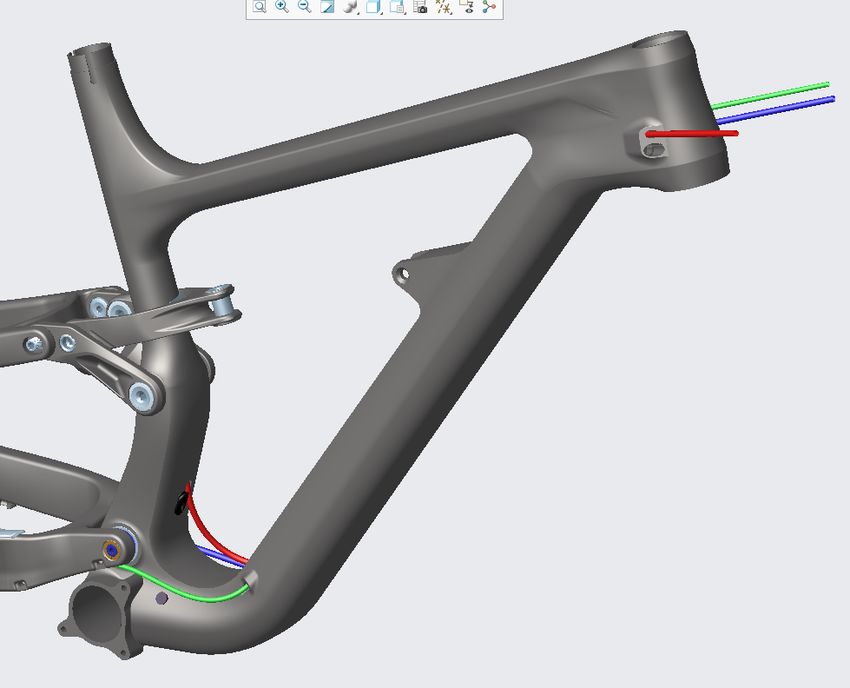
Cable Routing: Carbon Front Triangle
The carbon Habit Front triangle features internal tubing to ease cable routing. Please see
the below diagram to see entry/exit points and recommended uses. An internal tube is
not present in the lower head tube opening on the non-drive side, shown as SR below.
RD
RB
SR SP
RD - Rear Derailluer
RB - Rear Brake
SP - Seat Post Remote
SR - Shock Remote
RD
SP
RD
RB
RB
134938 Rev 1. 14English
Cable Routing: Carbon Chain Stay
To route the shift housing:
1. Insert the housing into the chainstay routing port shown, A.
2. Remove the rear chainstay pivot hardware to access the rear of the chainstay.
3. While pushing the housing from the front of the chain stay, guide the housing up
through the routing hole using a pick. To ease installation, use pliers to give the end of
the housing a slight bend, shown B.
4. Secure the forward end of the housing using two zip ties, shown C.
A
B
C
134938 Rev 1. 15Habit - Owners Manual Supplement
Size Specific Yokes
The Habit features size specific yoke lengths. Please see the table below to check the
proper yoke length for each frame size. Please check underneath the yoke for length
markings.
“130”
“120”
“100”
Frame Size Yoke Length
XS 100 mm
S 100 mm
M 100 mm
L 120 mm
XL 130 mm
134938 Rev 1. 16English
Yoke
Whenever a shock is installed in the yoke extension, ensure that darker shaded areas
shown below are clean and thoroughly greased with a high-quality bearing grease.
(Female)
NGLI-2
2
15 N·m
(male)
NOTE: When tightening, insert tool into and hold female bolt, turn bolt to
avoid scuffing the female bolt.
134938 Rev 1. 17Habit - Owners Manual Supplement Frame Assembly IMPORTANT: During assembly of the rear suspension pivots on all frame sizes, tighten the yoke to shock bolt last. Use the following method to assemble the shock yoke on the XS size habit: 1. Assemble all components of the frame, leaving the shock and yoke extension unatta- ched. Allow the suspension to rest under gravity. 2. Assemble the shock using the forward eyelet (frame side). 3. Assemble the shock yoke 90 from the side of the ST. 4. Rotate the yoke around the seat tube until it is inline with the rear shock eyelet and install the shock-yoke bolt loosely. 5. Assemble the yoke to link hardware before tightening the shock-yoke bolt to torque. 134938 Rev 1. 18
English

134938 Rev 1.   19
Habit - Owners Manual Supplement

Habit Flip Chip
The Habit and Bad Habit feature a flip chip enabling geometry adjustment.
•   Low - slacker head tube angle (-0.5°), lower bottom bracket hieght (-3 mm), and
    reach (-3 mm).
•   High - steeper head tube angle (+0.5°) , higher bottom bracket height (+3 mm), and
    reach (+ 3mm)

                         TIG

                                                                      HTEN
                           HTEN

                                                                         TIG

                               Low
                                                                             High

                Model                                 Habit                           Bad Habit
           Wheel Size                       27.5 in           29 in                   27.5+ in
      Standard* Flip Position                High             Low                       High
      Alternate Flip Position                Low              High                      Low

* In the Standard Flip Chip position, the geometry of the bike is shown on the Geometry
tables on pages 8 and 9.

                                  NOTE: Insert the hex
                                   tool completely into
                                                                             HTEN

                                                                                TIG

                                   the flip chip to turn.

134938 Rev 1.                                    20
English
Pivot Axle
Spacer
Flip Chip
2
5 N·m
2 shown
5 N·m in ‘High’
position
socket
IMPORTANT: Whenever a change is made to the Flip Chip position, make sure
the the hardware, flip chips, and seat stay sockets are wiped clean. Re-apply the
specified thread lock to the bolt threads and tighten to the specified torque.
134938 Rev 1. 21Habit - Owners Manual Supplement
Dropouts
Protector
2
5 N·m
2
5 N·m
Pivot Axle
Spacer
• When connecting the seat stays to the chain stay, make sure the small end of
spacers face the bearings . The flat side of the spacers should face out, as shown.
• When tightening the axles, insert the 5 mm hex key completely into the axle to
prevent damage when turning the bolt.
• Always clean and re-apply the specified thread lock to the bolt threads.
• Tighten with a torque wrench to the specified torque.
134938 Rev 1. 22English
Bearing
NGLI-2 grooves
Bearing
NGLI-2
Circlip
Circlip
• The condition of the bearings, pivot axles, and spacers should be inspected
periodically. These are normal wear parts so plan to have them replaced as they
wear-out.
• To inspect the bearings, remove the pivot to expose the bearings. There are two
bearings in each dropout. Rotate each bearing with your finger. The rotation
should feel smooth without binding. Each bearing should be fixed securely in the
opening. Check to make sure each circlip is seated in the groove.s
• Inspection frequency should be based upon how and where you ride. Evidence of
damage would be excessive play, visible wear, or corrosion of bearings.
• If you find any damage to the parts, discontinue riding until all the parts (bearings,
pivot axles, spacers) can be replaced. This will help prevent damage elsewhere.
• Do not re-use removed bearings; if removed replace all bearings with new ones.
134938 Rev 1. 23Habit - Owners Manual Supplement
LockR
Be sure to support the bike or swingarm to prevent personal injury or bike damage
when removing/disconnecting linkages of an axle.
To remove the LockR from the frame:
1. Loosen the screw 4-6 turns using a T25 Torx key.
2. Tap head of screw with a rubber mallet to un-seat the wedge bolt located on the
opposite side..
3. Remove the screw and wedge bolt from the still installed axle.
4. If it did not come out with the screw, insert a 5 mm hex key and turn to free and
remove it. If wedge still sticks insert a wooden or plastic dowel into the drive side
and drive it out.
5. To remove the axle itself, on non-drive side, insert a 6 mm hex key into the axle on
the non-drive side and and turn counter-clockwise until it can be removed.
To install the LockR from the frame:
1. Disassemble and clean all parts of the LockR axle. Do not install it assembled.
Inspect the parts for damage (burrs, scratches, deformity, wear). Replace the entire
LockR assembly if any damage is found.
2. Apply a light coating of a high-quality bicycle bearing grease to all parts.
3. Align the linkage and bearing and insert the threaded end of the pivot axle (1) into
the non-drive side.
4. Tighten the inserted pivot axle to 1 Nm using a 6 mm hex key fitted torque wrench
from the non-drive side.
NOTICE
Use a calibrated torque wrench. Exceeding 1 N·m will result in permanent
damage to the LockR pivot system.
5. Insert the wedge bolt (2) into the drive side of the axle and insert the small end of
the wedge (3) into the non-drive side axle head.
6. Thread the screw (4) into wedge bolt with a wrench and tighten to 5.0 Nm.
134938 Rev 1. 24English
DO NOT INSTALL ASSEMBLED
NGLI-2
1 N·m
NGLI-2
5 N·m
Unthread & dislodged & Insert 5mm & Unthread
tap mallet remove turn to free Remove Remove
3
1
m m
5m
3
6m
T25 4
134938 Rev 1. 25Habit - Owners Manual Supplement
Asymmetric Integration - Ai
NON-DRIVE DRIVE
3mm
148mm
The Ai rear hub is offset 3 mm to the drive side. This both aligns the cassette with the Ai frame’s 55mm
chainline, and aligns the rim/tire with frame’s centerline for correct tire clearance.
Ai wheels have equal spoke angles and tension on both sides (non-dished wheel) which improves wheel
stiffness, strength.
• The 3mm offset is for 148 X 12mm spacing only!
• Other Ai equipped bike with 142mm or 135mm rear spacing use a 6mm offset.
NOTICE
USE ONLY 3mm “Ai” OFFSET REAR WHEELS. Incorrect wheel offset can damage your frame.
Standard wheel assembled on this frame will result in insufficient tire clearance leading to rubbing
and serious frame damage. This kind of damage is not covered by the Cannondale Limited Warranty.
Building/Truing a Wheel
If you chose to build, or true the wheel, make sure the 3 mm offset is present. Consult with your
Cannondale Dealer if you have any questions.
134938 Rev 1. 26English
Hanger Replacement
2
2 N·m
Bolts
I-2
NGL
CK3257U00OS
• Before installing a new hanger, be sure to clean any dirt or debris on the dropout
with a nylon brush (old toothbrush).
• Inspect the area for any damage.
• Lightly grease the dropout surface.
• Always clean and re-apply the specified thread lock to the bolt threads.
• Tighten with a torque wrench to the specified torque.
134938 Rev 1. 27Habit - Owners Manual Supplement
REPLACEMENT PARTS
2 A
8 N·m F
A
C
2 B
2 N·m
A
A
B
D 2
5 N·m 2
G
B 15 N·m
A
E P
FT
ST-LNK
ER
UT
T-O
- LF
SST
R CS - LFT- OUTER
NE
T-IN
-RG
SST TER
OU
-R GT-
SST CS - RGT - OUTER
N O
ID Part Number Description CRB ALLY ID Part Number Description CRB ALLY
A K36169 Habit Pivot Hardware ✔ ✔ K36109 Habit Yoke XS-M BLK ✔ ✔
Habit Pivot CS SS LNK F K36099 Habit Yoke L BLK ✔ ✔
B K36179 ✔ ✔
Brgs K36089 Habit Yoke XL BLK ✔ ✔
Derailleur Hanger TA ST Habit Suspension Link
C CK3257U00OS ✔ ✔ G K91069 ✔ ✔
SS 015 BLK
CS and Horst Pivot
D K34129 ✔ ✔
Protectors
Habit CS SS ST Clear
E K34239 ✔ ✔
Protectors
134938 Rev 1. 28English
I
L
B
34.9 mm
E
NGLI-2
2
2 2
12 N·m
B 15 N·m 7 N·m
K
2
5 N·m H
P 2
7 N·m
I
A
A
R
N
G
LI
N O -2
J 5 N·m
1 N·m
M
ID Part Number Description CRB ALLY ID Part Number Description CRB ALLY
H K36079 Habit Shock Bolts ✔ ✔ PF30 Bottom Bracket
M KP197/SRM ✔
Habit CRB Rubber Cups And Bearings
I K32069 ✔
Frame Grommets BB30 Bearing Blue
N KB6180/ ✔
Habit DT Protector (QTY 2)
K34139 ✔ ✔
XS-S BB30 Bearing Blue
J 0 K22037 ✔
Habit DT Protector (QTY 24)
K34149 ✔ ✔
M-XL
P CK9017U00OS 17X30 Bearing Tool ✔ ✔
K K32109 Slide Guides (QTY 6) ✔
Seat Binder MTN Bolt
L KP388/ ✔ ✔
34.9
134938 Rev 1. 29Habit - Owners Manual Supplement
Tightening Torques
Correct tightening torque for the fasteners (bolts, screws, nuts) on your bicycle is very
important to your safety, durability, and performance of your bicycle.
We urge you to have your dealer correctly torque all fasteners using a torque wrench. If
you decide to tighten fasteners yourself always use a calibrated torque wrench!
N
G
LI
-2
2
15 N·m
2
12 N·m
See “Yoke” 2X
2
2X 7 N·m
2
5 N·m
2X
2 2
8 N·m 10 N·m
2X
See “LockR”
2
2 2X
5 N·m
2 N·m
134938 Rev 1. 30English
MAINTENANCE
The following table lists only supplemental maintenance items. Please consult your
Cannondale Bicycle Owner’s Manual for more information on basic bike maintenance.
Item Frequency
Cable Routing - Make sure control cables are in place,
undamaged and attached securely. Before first ride
Frame Protection - Check the various frame protectors
(downtube, headtube, chainstay, swingarm on your bike. Make
sure they are in place and in good condition.
Damage Inspection - Clean and visually inspect entire bike
Before and after each ride
frame/swing arm/linkage assembly for cracks or damage.
Check Tightening Torques - In addition to other component
specific tightening torques for your bike. tighten according to Every few rides
the “Tightening Torques” information listed in this supplement.
Disassemble, clean, inspect, re-grease, replace worn or In wet, muddy, sandy
damaged parts in the following assemblies: conditions every 25 hrs.
In dry, conditions
• Shock Link/Yoke • Pivot Axles • Frame Pivot Bearings
every 50 hrs.
Fork and Shock- Consult the manufacturer’s owner’s manual for maintenance requirements.
Any part of a poorly maintained bike can break or malfunction leading to an
accident where you can be killed, severely injured or paralyzed.
Frequent checks are necessary to identify the problems that can lead to an accident.
See “Inspect For Safety” in your Cannondale Bicycle Owners Manual.
134938 Rev 1. 31Habit - Owners Manual Supplement
NOTES
Use this page to write /record important information about your bike : (e.g. maintenance
history, dealer contact information, settings, etc.)
134938 Rev 1. 32WWW.CANNONDALE.COM © 2018 Cycling Sports Group Habit Owner’s Manual Supplement 134938 Rev. 1 CANNONDALE USA CANNONDALE EUROPE CANNONDALE UK Cycling Sports Group, Inc. Cycling Sports Group Europe, B.V. Cycling Sports Group 1 Cannondale Way, Hanzepoort 27, 7570 GC, Oldenzaal, Vantage Way, The Fulcrum, Wilton CT, 06897, USA Netherlands +41 61 4879380 Poole, Dorset, BH12 4NU 1-800-726-BIKE (2453) servicedeskeurope@cyclingsportsgroup.com +44 (0)1202732288 www.cannondale.com sales@cyclingsportsgroup.co.uk
You can also read


